Efficiency Improvement on Solar Cells
P.Ramesh Aravind 1, T.M.Sivaprakash 2 , S.Tamilselvan 3 , J.Udhayakumar 4 , Dr. N. Shivasankaran5
1
UG Scholar, Department of Mech. Engg., K.S.R. College of Engineering, Tiruchengode, India 2
UG Scholar, Department of Mech. Engg., K.S.R. College of Engineering, Tiruchengode, India 3
UG Scholar, Department of Mech. Engg., K.S.R. College of Engineering, Tiruchengode, India 4
UG Scholar, Department of Mech. Engg., K.S.R. College of Engineering, Tiruchengode, India 5
Associate Professor, Department of Mech. Engg., K.S.R College of Engineering, Tiruchengode, India
ABSTRACT: In times, researches square measure undergoing within the field of renewable energy. alternative energy is one in all them. several researchers had experimented with success over the development of soar cell potency and that they had fictional dye-synthesized cell (DSSC). during this project, we've got synthesized the ZnO nanoparticle and also the ready sample was characterised by Ultraviolet Spectra (UV) and Scanning microscope (SEM). Then the synthesized ZnO is coated over the cell because the second anti-reflective layer (ARL) to cut back the reflection of the incident daylight. The coating of second layer of ZnO reduces the bandgap of cell to a pair of.8.This will increase the potency of cell of concerning (2-5 %).
.
I. INTRODUCTION 1.1 Solar energy
In today's climate of growing energy wants and increasing environmental concern, alternatives to the employment of non-renewable and polluting fossil fuels got to be investigated. One such various is alternative energy. Alternative energy is sort of merely the energy created directly by the sun and picked up elsewhere, unremarkably the world. The sun creates its energy through a nuclear method that converts concerning 650,000,0001 loads of chemical element to He each second. The method creates heat and nonparticulate radiation. The warmth remains within the sun and is instrumental in maintaining the fusion. The nonparticulate radiation (including visible radiation, infra-red light-weight, and ultra-violet radiation) streams out into area all told directions.
Only a really little fraction of the overall radiation created reaches the world. The radiation that will reach the world is that the indirect supply of nearly each form of energy used these days. The exceptions square measure heat energy, and fission and fusion. Even fossil fuels owe their origins to the sun; they were once living plants and animals whose life was dependent upon the sun. a lot of of the world's needed energy are often equipped directly by alternative energy. Additional still are often provided indirectly. The utility of doing therefore are going to be examined, in addition because the advantages and disadvantages. Additionally, the uses alternative energy is presently applied to are going to be noted.
1.1 Anti Reflective coating
II. SELECTION OF MATERIAL 2.1 Zinc Oxide (ZnO) :
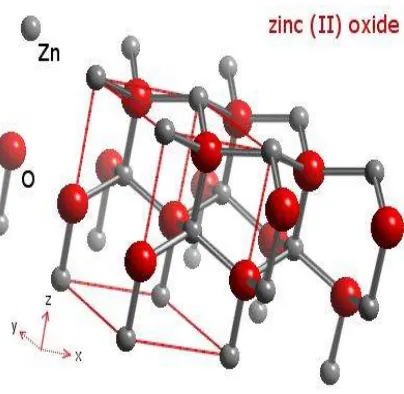
Fig 2.1 Structure of Zinc Oxide
Zinc oxide is Associate in Nursing chemical compound with the formula ZnO .ZnO could be a white powder that's insoluble in water, Associate in Nursingd it's wide used as an additive in various materials and product together with rubbers, plastics, ceramics, glass, cement, lubricants, paints, ointments, adhesives, sealants, pigments, foods , batteries, ferrites, hearth retardants, and first-aid tapes. It happens naturally because the mineral zincite , however most oxide is made synthetically. ZnO could be a wide-bandgap semiconductor of the II-VI semiconductor cluster. The native doping of the semiconductor owing to atomic number 8 vacancies or atomic number 30 interstitials is n-type. This semiconductor has many favorable properties, together with smart transparency, mobility , wide bandgap , and powerful room-temperature luminescence . Those properties area unit valuable in rising applications for: clear electrodes in liquid displays , energy-saving or heat-protecting windows, and physics as thin-film transistors.
2.1.1 Properties: Table 2.2 Properties of Zinc oxide:
PROPERTIES
Chemical formula ZnO
Molar mass 81.38 g/mol
Appearance White Solid
Meting point 1,975 °C (3,587 °F; 2,248 K)
(decomposes)
Boiling point 1,975 °C (3,587 °F; 2,248 K)
(decomposes) Solubility in water 0.0004 % (17.8 °C)
Band gap 3.3 eV
aq medium
Na
+OH
H
+OH
-2.3 CHARACTERIZATION 2.3.1 X-ray diffraction analysis:
The crystal structure of the as-prepared and mold samples was examined by powder X-ray diffractometer (X’Pert professional, PAN-alytical, the Netherlands). X-ray diffraction (XRD) patterns were obtained exploitation Cuk
α as a radiation (λ = one.5405˚A) supply by applying a continuing current and voltage, severally, thirty m A and forty
kV, within the scan vary 10–80° [16].
2.3.2 Microscope studies:
The morphology, microstructure, and composition of the pre-pared samples were measured victimization scanning negatron microscope(SEM) in addition to energy-dispersive X-ray analysis (EDX) (JSM5300; JEOL, Japan). The ready sample (1 µg) was soiled on the conducting adhesive carbon tape fastened on a brass stub of13 millimeter dimension. Then, the sample was subjected to gold coating (approximate thickness of 5–10 nm) for 30–60 s by applying a twenty m A current to the target by employing a tube sputter [17]
.2.3.3 UV spectrum:
Optical properties of the mixture nanoparticle resolution were analyzed employing a ultraviolet light photometer (Lambda 35; PerkinElmer).The samples were distributed in resolution with variable dilution and placed in an exceedingly 1-cm sq. quartz cuvette for analysis at temperature [16].
III. SYNTHESIS OF MATERIAL
Nanotechnology becomes much more popular nowadays. Scientists believe that by engineering material size into nanoscale, there will be an enhancement on properties of the material. In many literatures, it can also be learned that nano ZnO offers better performance compared to that of in bulk size. There have been many methods to synthesize nano ZnO. Some of the widely used methods are, for instance, Chemical vapor deposition (CVD), mechanical alloying. Those methods have their own advantages and disadvantages. For example, CVD and dip coating, they can produce nano ZnO with high purity, however high growth temperature is needed in their system. Also, the preparation scheme is quite complex and can be very method where it can synthesize nano ZnO in relatively simple manner . Nevertheless, to date, there has been no reports on mechanical alloying method that can yield pure nano ZnO. Another possible method is sol-gel method. The good thing about this method is that, it is relatively simple and cheap in process, and it does not need to be treated in high growth temperature. However, to date, there is still a little knowledge on the effect of pH variation on sol-gel working solution, also whether high purity of nano ZnO can be achieved by this method. In this research, nano ZnO was synthesized by sol-gel method, in an attempt to find the optimum condition to produce single crystal ZnO with relatively small size. The pH condition would be varied for this optimization process.
Zn(CH3COO)2.2H2O
Zn(OH)2
(Zn[OH]4)2- + Na+
(Zn[OH]4)2-
Zinc acetate dehydrate (Zn(CH2COO)2·2H2O) (ZAD),distilled water, Sodium hydroxide (NaOH),were used as starting material, solvent and stabilizer, respectively. The mixture was confected to 0.1mol for 100ml and stirred magnetically. After stirring for 30 minutes at 60˚C, Sodium hydroxide was added drop by drop under constant stirring. The resultant
Fig 3.4: Synthesis of Zinc Oxide IV. RESULT AND DISCUSSION 4.1 Material Morphology:
The synthesized ZnO nanoparticles ar characterised by radical violet spectra (UV) and Scanning microscope (SEM) with EDAX.
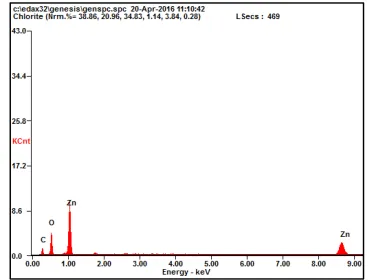
The surface morphology of sample examined through SEM image is shown in fig four.1. The SEM image of pure ZnO (fig4.1 a) illustrates that no surface gaps ar fashioned though it's composed of interconnected spheric nanoparticles with a mean grain size of ∼110 nm with slight activity. The discovered SEM results(Fig. 4.1a,4.1b) indicate that ZnO nanoparticles haven't any result on the morphology. Fig.4.2 shows the EDAX spectra of the ready samples whereas the fundamental microanalysis of the anion-doped materials is summarized within the inserted table. The discovered EDAX spectra make sure the purity of pure ZnO nanoparticles also because the absence of residuals shown in fig4.2. Further, the EDX spectra make sure the presence of components, namely Zn, O2 and little quantity of carbon as, shown in fig4.2.The actinic radiation absorption spectra discovered for Zno is shown in fig four.3. As mentioned in fig four.3 the absorption spectra of pure Zno nanoparticle show a peak precisely within the vary below four hundred, that is active solely beneath the actinic radiation region.
The discovered SEM result (fig four.1a, 4.1 b) shows that the synthesized ZnO nanoparticle has flower like structure and also the peaks (fig four.2) within the SEM result confirms the crystalline nature of the ZnO nanoparticle.
Fig 4.1(b) SEM image of ZnO at 200nm
Fig 4.2 SEM and EDAX image of ZnO nanoparticle
4.2 Bandgap calculation:
Fig 4.3 Ultraviolet spectra of ZnO
In the above figure 4.3, the peak ofZnO is below 400. The slope for the above peak graph cuts the X-axis at ~440 nm. The slope for the absorbance and wavelength of ZnO is 440nm. The band gap (Eg) is calculated by using the equation
Eg =hc/λ
h is planks constant c is velocity of light in air
λ is wavelength
h= 6.626×10⁻³⁴ Js c= 3×10⁸ m/s
λ= 440 nm
Eg = 6.626×10-34×3×108 / 440×10-9 Eg= 4.517×10⁻¹⁹ J
1 eV= 1.602×10⁻¹⁹J
Eg= 2.818 eV
The measured value of bandgap energy for pure ZnO is calculated above. This in turn enhances the performance of solar cells and photocatalysts as well as increases the absorbance of visible light .A decrease in the bandgap value is noticed (i.e., 2.8 eV) when the ZnO nanoparticle is synthesized. As a result, the absorption of light in the visible region takes place.
4.3 Efficiency graph: 4.3.1 Dip coating:
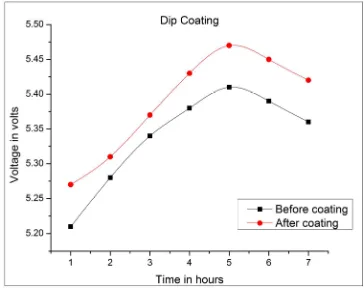
In dip coating method the solar cell has been nano coated with zinc oxide to increase the efficiency. This increases the ability of the nano coated solar cell to absorb the sunlight by reducing the reflection ofthesunlight. The fig 4.4 shows the variation of voltage with respect to time by the solar cell between coated and non coated cell.
We have plotted the graph between the voltage and time for the 5v commercial solar cell of about 7 hours in the sunlight. The observed graph shows that there is an increase in power output voltage of about 3.27%. There is the slight increase in the output voltage, this is due to the second layer of dip coated ZnO nanoparticles. As the bandgap of the synthesized ZnO (2.8) which is slightly lower than the bulk sized ZnO (3.3), this layer reduces the reflection of the incident sunlight to a considerable amount and also increases the absorbtion of sunlight.
Fig 4.4 dip coating
4.3.2 RF Sputtering:
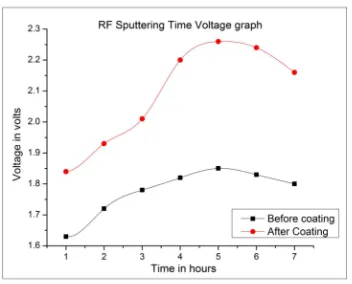
Fig 4.5 RF sputtering V. CONCLUSION
In this project we have synthesized the ZnO nanoparticles by sol-gel method. The structural and morphological characteristics of the material were investigated. The synthesized ZnO nanoparticle has coated over the solar cell by dip coating and RF sputtering methods. The coating over the solar cell increases the efficiency of the solar cell of about 3.7% and 22% respectively.
REFERENCES
[1] D. Gal, G. Hodes, D. Lincot, H.-W. Schock (2000), Electrochemical deposition of zinc oxide films from non-aqueous solution: a new buffer/window process for thin film solar cells, Thin Solid Films, 361-362 , 79-83.
[2] B. Rech, O. Kluth, T. Repmann, T. Roschek, J. Springer, J.M.uller, F.Finger, H.Stiebig, H.Wagner (2002), New materials and deposition techniques for highly efficient silicon thin film solar cells, Solar Energy Materials & Solar Cells, 74 ,439–447.
[3] J. Hüpkes, B. Rech, S. Calnan, O. Kluth, U. Zastrow, H. Siekmann, M. Wuttig (2004), Material Study on Reactively Sputtered Zinc Oxide for Thin Film Silicon Solar Cells, Proceedings of the 5th ICCG, 351, 164-169.
[4] Seok-Soon Kim, Jun-Ho Yum, Yung-Eun Sung (2005), Flexible dye-sensitized solar cells using ZnO coated TiO2 nanoparticles, Journal of Photochemistry and Photobiology A: Chemistry,171, 269–273.
[5] Seung-Jae Roh, Rajaram S. Mane, Sun-Ki Min, Won-Joo Lee, C. D. Lokhande (2006),Achievement of 4.51% conversion efficiency using ZnO recombination barrier layer in TiO2 based dye-sensitized solar cells, Applied physics letters, 89, 253512.
[6] J B Baxter, A.M.Walker, K.vanOmmering ,E S Aydil (2006),Synthesis and characterization of ZnO nanowires and their integration into dye-sensitized solar cells, Institute of physics publishing,17,S304–S312.
[7] Ana M. Peiro, Punniamoorthy Ravirajan, Kuveshni Govender, David S. Boyle, Paul O’Brien, Donal D. C. Bradley, Jenny Nelson, James R. Durrant (2006), Hybrid polymer/metal oxide solar cells based on ZnO columnar structures, Journal of Materials Chemistry, 16, 2088– 2096.
[8] Sujuan Wu, Hongwei Han, Qidong Tai, Jing Zhang, Bo Lei Chen, Sheng Xu, Conghua Zhou, Ying Yang, Hao Hu, and Xing-Zhong Zhao (2008), Improvement in dye-sensitized solar cells with a ZnO-coated TiO2 electrode by RF magnetron sputtering, Applied physics letters, 92, 122106.
[9] J. C. Bernède, Y. Berredjem, L. Cattin, M. Morsli (2008), Improvement of organic solar cell performances using a zinc oxide anode coated by an ultrathin metallic layer, Applied physics letters, 92, 083304.
[10] 1Alex B. F. Martinson, Jeffrey W. Elam, Joseph T. Hupp, Michael J. Pellin (2007), ZnO Nanotube Based Dye-Sensitized Solar Cells,78,2183-2187.
[11] Jan Gilot, Martijn M. Wienk, René A. J. Janssen (2007),Double and triple junction polymer solar cells processed from solution, Applied physics letters, 90, 143512.
[12] Steven K. Hau, Hin-Lap Yi, Nam Seob Baek, Jingyu Zou, Kevin O’Malley and Alex K.-Y. Jen (2008), Air-stable inverted flexible polymer solar cells using zinc oxide nanoparticles as an electron selective layer, Applied physics letters, 92, 253301.
[13] Frederik C. Krebs (2009), Polymer solar cell modules prepared using roll-to-roll methods: Knife-over-edge coating, slot-die coating and screen printing, Solar Energy Materials & Solar Cells ,93, 465–475.
[14] Nobuyuki Sekine , Cheng-Hsuan Chou , Wei Lek Kwan, Yang Yang (2009), ZnO nano-ridge structure and its application in inverted polymer solar cell, Organic Electronics, 10, 1473–1477.
[16] O.K. Simiya, M. Selvam, A. Karthik, V. Rajendran (2014), Dye-sensitized solar cells based on visible-light-active TiO2 heterojunction nanoparticles, Synthetic metals, 188, 124-129.
[17] Morteza Eslamian (2014),Spray-on Thin Film PV Solar Cells: Advances, Potentials and Challenges, Coatings, 4, 60-84.
[18] Hyun-Jun Hwang and Hak-Sung Kim (2014), TiO2 / Silver/ carbon nanotube Nano composite working electrodes for high performance dye-sensitized solar cells, Journal Of Composite Materials, 96, 531-539.
[19] Gerhard Auer, Peter Woditsch, Axel Westerhaus, Jürgen Kischkewitz, Wolf-Dieter Griebler and Marcel Liedekerke (2009),Pigments, Inorganic, White Pigments, Ullmann's Encyclopedia of Industrial Chemistry, Wiley-VCH, 63, 188–189.
[20] R. Coustal, F. Prevet (1929), Sur un nouveau procédé de préparation – du sulfure de zinc phosphorescent, 6, 449 – 450. [21] Egon Wiberg, Arnold Frederick Holleman (2001), Inorganic Chemistry, 12, 352651.
[22] Satya Prakash (2000),Advanced Inorganic Chemistry: V. 1, S. Chand, 81,219-0263.
[23] Wells A.F. (1984) Structural Inorganic Chemistry 5th edition Oxford Science Publications, 19, 855370.
[24] A.Walsh, G.W. Watson (2004), Electronic structures of rocksalt, litharge, and herzenbergite SnO , density functional theory, 70, 235114. [25] M.S. Moreno, A. Varela, L.C. Otero-Diaz (1997), Cation non stoichiometry in tin-mono oxide-phase Sn1- δO with tweed
microstructure, condensed matter, 56, 5186-5192.