ISSN(Online): 2319-8753 ISSN (Print): 2347-6710
I
nternational
J
ournal of
I
nnovative
R
esearch in
S
cience,
E
ngineering and
T
echnology
(An ISO 3297: 2007 Certified Organization)
Website: www.ijirset.com
Vol. 6, Issue 7, July 2017
A Review on Event Detection Techniques in
Wireless Sensor Network
Mehanas Shahul 1, Sanu Thomas 2, R Vijayakumar 3
M.Tech Student, School of Computer Sciences, Mahatma Gandhi University, Kottayam, Kerala, India1
Senior Lecturer, School of Technology and Applied Science, Mahatma Gandhi University, Kottayam, Kerala, India2
Professor, School of Computer Sciences, Mahatma Gandhi University, Kottayam, Kerala, India3
ABSTRACT: Different mechanisms for event detection schemes are implemented in an event region detection in a wireless sensor network. Threshold based event detection technique is the basic event detection approach with low computational overhead. Abnormal detection of events are also a major problem in event detection in wsn. Different methods are there to eliminate such faulty recognition of events. Node deployment can be done using grid based system. To detect and refine the event region, a grid-based deployment with threshold based detection scheme can be used effectively.
KEYWORDS: Wireless Sensor Network, Event Region, Event Detection, Deployment, Fault Tolerance.
I. INTRODUCTION
In wireless sensor networks (WSNs), sensor nodes are randomly distributed over a large location. The sensor nodes are equipped with a sensing, data communicating, and processing units, which enable them to monitor the physical world, communicate and exchange the collected sensory data with other nodes, locally process and make decisions about monitored phenomena. This will lead to the detection of events and unusual data behaviors in a monitored environment. This feature is referred as event detection. Event detection in WSNs has received much attention in variety of applications, such as military target tracking and surveillance, meteorological hazards, wildlife monitoring, natural disaster relief and health care.[1]
The capabilities of sensor nodes in a WSN can vary widely, the simple sensor nodes may monitor a single physical phenomenon, while more complex devices may combine many different sensing techniques. They can also differ in their communication capabilities with varying data rates and latencies. Simple sensors may collect and communicate information about the observed environment, but more powerful devices may perform extensive processing and aggregation functions. Node deployment is an important issue to be solved in WSNs. A proper node deployment scheme can reduce the complexity of problems in WSNs and can be extend the lifetime of WSNs by minimizing energy consumption. A large number of sensor nodes are densely deployed inside the phenomenon or very close to it. In random deployment, position of sensor nodes need not be predetermined. So they can be used in inaccessible regions or disaster relief operations [2].
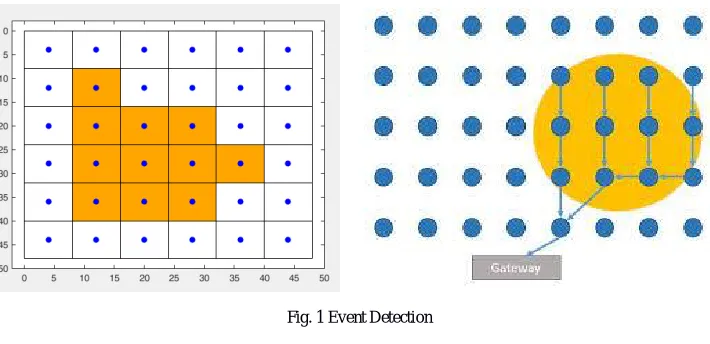
Fig. 1 Event Detection
II. RELATEDWORK
Sometimes an event may contain boolean or exact measurement. Detecting and recognizing these events can be very important, and removing the faults as well as errors are also important. Abnormal event detection is one of the vital tasks in wireless sensor networks. However, the faults of nodes and the poor deployment environment have brought great challenges to abnormal event detection.
Grid-based sensor deployment is an effective and efficient practice for provisioning wireless sensor networks. Usually grid-based deployment of sensors use the assumption that each device can be placed exactly at the grid vertices and which is difficult to be implemented or not sufficient due to a variety of errors. To overcome the negative impacts of errors, the grid resolution and the number of devices to be deployed should be re-evaluated. In this [6] paper, two deployment errors are identified as misalignment and random errors and their impacts on the coverage properties of the WSN. K.Xu et.al, proposed and analyzed the robust grid-based deployment design in which the minimum number of sensors required by a robust grid-based sensor deployment as a viable approach to overcome such errors for the guaranteed coverage in the worst case.
High-quality environmental monitoring for a wireless sensor networks required large-scale deployment. The information about identifiable events in such region follows Bayesian fault-recognition algorithms with spatially correlated environmental conditions and exploits uncorrelated measurement errors due to faulty equipment. The randomized decision scheme and the threshold decision scheme, are two Bayesian algorithms which derived analytical expressions for their performance. Optimal setting is derived for the average-correlation model of threshold decision scheme. Analysis showed that the threshold decision scheme has better performance in terms of the minimization of errors. For completely distributed and localized environment, faults can be reduced by 85 to 95 percent for fault rates as high as 10 percent for the optimal threshold decision scheme showed by the theoretical and simulation result. [3]
The implementation of the work [4] done by using Contiki, a WSN operating system and the evaluation is conducted by Cooja as the WSN emulator. The fuzzy inference system (FIS) is implemented on TelosB motes and evaluates the probability of fire detection, by considering power conservation. For network congestion reduction, distributed implementation of the FIS is considered to maximize network lifetime. Event based execution of the FIS showed significant advantages in packet loss, number of transmissions, mean service time of a generated alarm, and better utilization of the FIS algorithm. Performance metrics of FIS implementation are compared and analyzed with critical network conditions for the evaluation.
ISSN(Online): 2319-8753 ISSN (Print): 2347-6710
I
nternational
J
ournal of
I
nnovative
R
esearch in
S
cience,
E
ngineering and
T
echnology
(An ISO 3297: 2007 Certified Organization)
Website: www.ijirset.com
Vol. 6, Issue 7, July 2017
Abnormal event detection is one of the main problems in wireless sensor networks. In wireless sensor networks, abnormal events are usually complex, because an event usually involves multiple observed attributes, and it is difficult to describe an abnormal event pattern. Existing anomaly detection algorithms detect an abnormal event by comparing a single attribute threshold or by considering the spatio-temporal correlations of sensor readings. However, some important information may be hidden in the correlations among different attributes. In order to improve the accuracy of abnormal event detection in wireless sensor networks with multiple attributes and reduce the influence of environmental noises and sensor failures on the event detection results, M. Wang et.el proposed Abnormal Event Detection based on Multi Attribute Correlation (MACAED) [7]. Considering a Bayesian network that can effectively represent the dependencies among variables and is used to establish the dependency model of observed attributes. Structure learning is used to obtain the dependency structure of abnormal events. Each node learns the parameters to get a conditional probability table. Introducing the attribute correlation confidence to check whether the attribute correlation mode of the point is an abnormal mode. The degree of temporal correlation was calculated using the sliding window model and the spatial similarity was calculated by using the neighbor node information. Finally, the anomaly events were detected by three kinds of attribute correlation. Abnormal Event Detection based on Multi Attribute Correlation (MACAED) algorithm can reduce the impact of interference factors and the rate of the false alarm effectively; it can also improve the accuracy of event detection.
In [8], an adaptive distributed event detection method is proposed, which dynamically adjusts the decision threshold based on the trust value of the sensor nodes and uses the moving average filter to tolerate the transient faults of the sensor nodes. Although this method is fault-tolerant, it is still possible to misjudge the event nodes into faulty nodes. Particularly when the event range is large, the accuracy of detection will decrease significantly.
A Bayesian modeling approach is used to address the problem of online fault-tolerant dynamic event region detection in wireless sensor networks. In this model every network node is associated with a virtual community and a trust index [9], which quantitatively measures the trustworthiness of this node in its community. If a sensor node’s trust value is smaller than a threshold, it suggests that this node encounters a fault and thus its sensor reading can not be trusted at this moment. The practical issues, including spatiotemporal correlations of neighbour nodes’ sensor readings, the presence of sensor faults and the requirement of online processing are linked together by the concept trust and are all taken into account in the modeling stage. Experimental results demonstrate that the dynamic ERD solution can provide striking better performance than existent methods in terms of error rate in detecting the event region. The trust value of each node is updated online by a particle filter algorithm upon the arrival of new observations. The decision on whether a node is located in the event region is made based upon the current estimate of this node’s trust value.
Tsang-Yi Wang et.al incorporate both local detection performance and spatial information into the decentralized detection design such that the reliability of spatial information can be modeled. This is different from the works in [11] and [3] where local detection performance is not employed in their fusion approaches. The fusion rule [10] performs in a sequential manner. Communication constraints and possible sensor faults are considered in the design of the fusion rule. The algorithm is applicable to both event-region detection and boundary-region detection. The advantages of our strategy are demonstrated through performance comparison with two sequential detection schemes. By comparing with the sequential ICM scheme, which is modified from the ICM scheme in [3], the fusion rule approach achieves a better performance due to the use of the local detection performance in the fusion process. As compared to the sequential detection without the collaboration (SDWOC) scheme, the proposed approach has a larger decreasing rate of the error probability as a function of the time index due to the utilization of spatial information.
Fig 2. Block diagram of decision trees to detect event using voting
Table shows the comparison of event detection from different papers
Event Detection Disadvantages Advantages
Distributed Communication and system complexity are more
reliability, robustness
Threshold based Not so proficient in detecting abnormal event
Low computational overhead, simple monitoring is sufficient
Grid-based Node deployment within grid region Require minimum number of sensors, low overhead at small grid size
TABLE 1
III. CONCLUSION
We have discussed about different event detection schemes implemented in an event region detection in a wireless sensor network. Threshold based event detection technique is the basic event detection approach with low computational overhead . Abnormal detection of events are also a major problem in event detection in WSN. Different methods are proposed to eliminate such faulty recognition of events. For this problem, multi attribute correlation or a trusted model dynamic detection mechanisms can be used. To detect and refine the event region, a grid-based deployment with threshold based detection scheme can be used effectively.
REFERENCES
[1] A. Nasridinov, S. Ihm, Y. Jeong and Y. Park, “Event Detection in Wireless Sensor Networks: Survey and Challenges”, Mobile, Ubiquitous, and Intelligent Computing, pp 585-590, Part of the Lecture Notes in Electrical Engineering book series (LNEE, volume 274),
[2] Ian F. Akyildiz, Weilian Su, Yogesh Sankarasubramaniam, and Erdal Cayirci, “ A Survey on Sensor Networks”, IEEE Communications Magazine, Vo. 40, Issue: 8, August 2002
[3] B. Krishnamachari and S. Iyengar,, “Distributed Bayesian Algorithms for Fault-Tolerant Event Region Detection in Wireless Sensor Networks” , IEEE Transactions On Computers, Vol. 53, No. 3, March 2004.
[4] Sofia Maria Dima, Christos Antonopoulos, and Stavros Koubias, “On Event/Time Triggered and Distributed Analysis of a WSN System for Event Detection, Using Fuzzy Logic ”, Journal of Sensors, Volume 2016, Article ID 9350928, 28 pages.
[5] T. Wang and Q. Cheng, “Distributed Sequential Event-Region Detection in Sensor Networks”, IEEE 66th Vehicular Technology Conference, 2007
[6] K. Xu, G. Takahara and H. Hassanein, “On the Robustness of Grid-based Deployment in Wireless Sensor Networks”, International conference on Wireless Communications and Mobile Computing, 2006
ISSN(Online): 2319-8753 ISSN (Print): 2347-6710
I
nternational
J
ournal of
I
nnovative
R
esearch in
S
cience,
E
ngineering and
T
echnology
(An ISO 3297: 2007 Certified Organization)
Website: www.ijirset.com
Vol. 6, Issue 7, July 2017
[8] S.-J. Yim and Y.-H. Choi, “An adaptive fault-tolerant event detection scheme for wireless sensor networks,” Sensors, vol. 10, no. 3, pp. 2332– 2347, 2010.
[9] J. Wang and B. Liu , “Online Fault-Tolerant Dynamic Event Region Detection in Sensor Networks via Trust Model”, IEEE Wireless Communications and Networking Conference , 2017.
[10] Tsang-Yi Wang and Qi Cheng, “Collaborative Event-Region and Boundary-Region Detections in Wireless Sensor Networks”, IEEE Transactions On Signal Processing, Vol. 56, No. 6, June 2008.