Voltage Outputs of Air-Condition Cooled
Monocrystalline PV Module
Adikankwu Henry O.1, Ileberi Gbalimene R.2
Research Engineer, Department of Mechanical Engineering and Manufacturing, Centre for Satellite Technology
Development, Abuja, Nigeria1, 2
ABSTRACT: Photovoltaic module generates electricity (current and voltage). Ambient temperature affect solar cell
voltage performance and cooling of a photovoltaic module is critical to reduce the cell temperature and to improve the voltage generation. In this research, cooling of mono-crystalline silicon module using air-conditioning system was investigated at Kaduna, North-Central of Nigeria with the aim of comparing the voltage generation performance of cooled and uncooled photovoltaic module systems.The results show that the reduction in module cell temperature due to the cooling process improves the voltage generation.
KEYWORDS: Photovoltaic module, Monocrystalline silicon, Voltage output, Temperature, Air-condition technique.
I. INTRODUCTION
Photovoltaic (pv)modules are solar cells that covert solar radiation into electricity (current and voltage). Its development and improvement in efficiency, reliability, application and dependability in providing clean and sustainable energy for the society have attracted research work by engineers and scholars. The solar power is predictable in that the insolation is subject to variation with time during the day [1]. At noon, the intensity of insolation is high, which is responsible for high temperature, increase during the period while in the morning and evening when the intensity is low, the temperature is reduced. Characteristics such as manufacturing process, band-gap energy, etc., of the crystalline silicon used in a solar cell cause the silicon temperature to increase as the ambient temperature increases [2]. Solar radiation and operating temperature are the main environmental factors that affect the photovoltaic output performance [3]. The amount of photon energy (band-gap energy) required to free an electron in crystalline silicon is 1.1 electron-volt [4]. More than 50% fraction of the incident solar energy is converted into heating of the solar cell and this increases the operating temperature of the photovoltaic module [5]. Investigation on the electrical efficiency of a hybrid photovoltaic/thermal (pv/t) solar system with and without cooling shows that the efficiency rises from 8.6% to 12.5% by varying the air flow rate through the duct, and the operating temperature of the module decreases from 68°C to 28°C[6]. Increase in excess solar energy absorption leads to increase in cell temperature of the module and this causes reduction in output power of the module. Cooling the module keeps the operating temperature within the proportional limit at which more voltage will be generated because the effect of temperature is more prominent on the pv voltage production.
II. RELATEDWORK
voltage, short circuit current, maximum output power and fill factor. But the maximum influence of temperature is recorded in the open circuit voltage. This shows that open circuit voltage of a pv module is sensitive to cell temperature.The equation below gives the cell temperature dependent on open circuit voltage (Voc) [13]:
( )= − In
equals the bang gap energy, is the maximum reverses saturated current, K is Boltzmann’s constant, T is the temperature, n is the ideality factor, q is electron charge and is short circuit current.
Since module efficiency decreases with increasing temperature,the experimental investigation of the effect of temperature variation on photovoltaic cell and efficiency improvement using water sprinkle cooling system [9],while maintaining the temperature of the module improved the panel efficiency. The study shows that the open circuit voltage decreases with increasing temperature and this further show that the efficiency of crystalline silicon cell module depends on the temperature. Part of the reasons for solar efficiency dropsis open circuit voltage, and this explains the need for solar module cooling [10]. The efficiency and output power of pv module is inversely proportional to its temperature [11] and to control the performance of the solar cell, adequate knowledge and information of environmental parameters such as ambient temperature is required. Increase in ambient temperature causes an increase in cell temperature and this result to decrease in open circuit voltage, fill factor, maximum power and cell efficiency. These parameters play a vital role on the voltage performance characteristics of silicon solar cell.At maximum temperature, the voltage decreases and thus cooling is required to reduce the cell temperature and also to improve the voltage performance within the working period. In designing a cooling system that will keep the cell temperature low and improve the voltage performance, [12] suggested that air cooling of the pv panel decreases the operating temperature and increases the voltage and as well, the power output. If an appropriate cooling technique is applied to solar module, the increase cell temperature challenge will be tackled and the module will become more effective and efficient in voltage generation.One of the proposed ways to cool the pv is to useair conditioner(ac) system to remove the heat build-up on the top and bottom module. This paper examines the effects of ambient and cell temperatures on solarvoltage performance for ac cooled and uncooled module systems.
III.METHODOLOGY
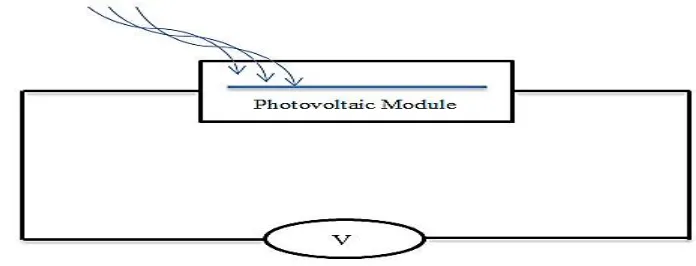
Two Mono-crystalline photovoltaic modules with area of 2863cm² each were tested. Temperature and voltage characteristics were determined and figure 1 shows the experimental circuit setup. The materials consisted of the following: thermocouple, voltmeter, thermometer and air conditioner. The experiment was carried out in Kaduna, Nigeria in May, 2014. The module cell temperature and the voltage were observed and measured using thermocouple and voltmeter respectively. The cooling temperature of the air conditioner was set at 27°C. The hourly temperature and voltage were recorded.
IV.EXPERIMENTAL RESULTS
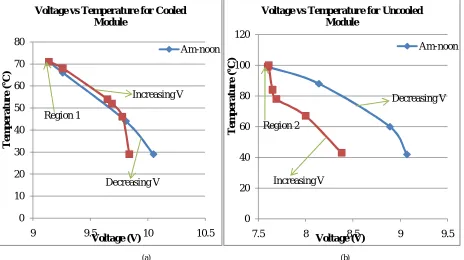
Typical daily variations of voltage for increasing temperature from morning (am) to noon (9am-12noon) and from noon to evening (pm) (12noon-5pm) are shown in figure 2a and figure 2b respectively. Region 1 and 2 represent the point of voltage (V) reversal for respective modules. The space between increasing and decreasing voltage (V) shows the voltage generation difference due to heat build-up on cell
Figure 2: Temperature and Voltage variation of mono-crystalline photovoltaic for (a) Cooled module system (b) Uncooled module system.
Table (1) illustrates the comparison of the module temperature and voltage values of ac cooled and uncooled mono-crystalline pv system under the same time and ambient temperature variation.
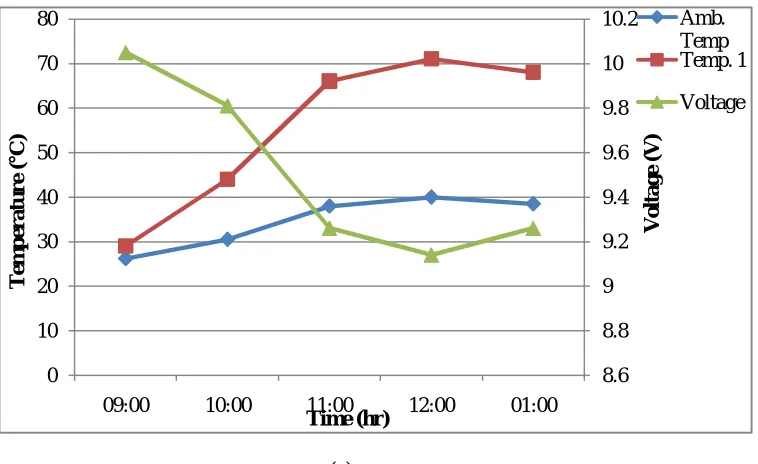
Figure 3 presents the graphs of daily voltage and temperature produced for the cooled and uncooled pv system for the period of study. Increase in temperature from 9am-1pm is observed with a decrease in voltage over the same period and this is due to temperature effect on the band gap. At noon, where the ambient temperature and module temperature were highest due to irradiance, both module voltages decreased to the lowest and after that, the voltage increases with decrease in temperature (figure 2). The ac cooling effecton the cooled module increased the total voltage generation by 18% when compared to the uncooled module. These results are similar and in conformity to research work done by [8-12] using different approach.
0 10 20 30 40 50 60 70 80
9 9.5 10 10.5
Te
m
p
e
r
atu
r
e
(°
C
)
Voltage (V) Voltage vs Temperature for Cooled
Module
Am-noon
Increasing V
Decreasing V Region 1
0 20 40 60 80 100 120
7.5 8 8.5 9 9.5
Te
m
p
e
r
atu
r
e
(°
C
)
Voltage (V) Voltage vs Temperature for Uncooled
Module
Am-noon
Increasing V
Decreasing V
Region 2
Table 1: Temperature and Voltage Variation for Cooled and Uncooled PV module
COOLED MODULE UNCOOLED MODULE
TIME (h) AmbientTemp erature (°C)
Temperature 1(°C) Voltage (V) Temperature 2 (°C) Voltage (V)
9:00 26.2 29 10.05 42 9.07
10:00 30.5 44 9.81 60 8.89
11:00 38.0 66 9.26 88 8.14
12:00 40.0 71 9.14 99 7.60
1:00 38.5 68 9.26 100 7.61
2:00 28.8 54 9.65 84 7.65
3:00 39.0 52 9.69 78 7.69
4:00 36.0 46 9.78 67 8.00
5:00 32.2 29 9.84 43 8.38
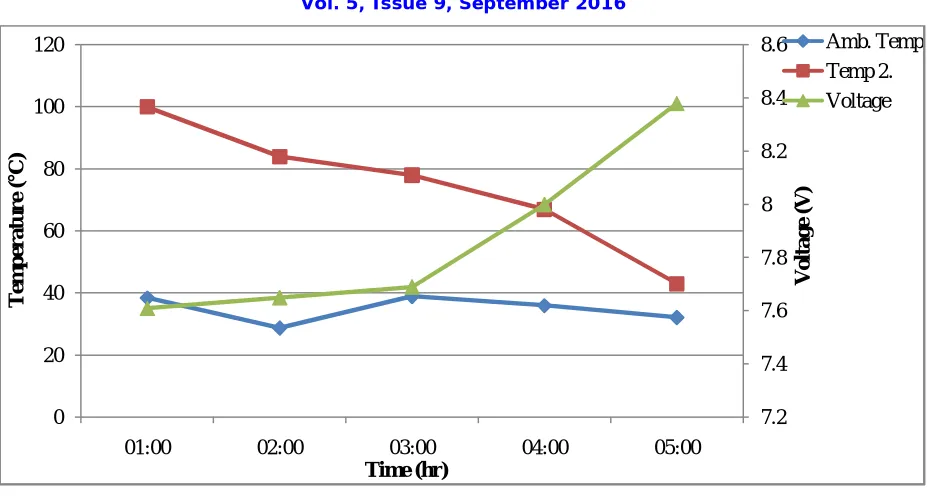
In table 1, variations in ambient temperature between the hours of 9am to 5pm results to solar module temperature and voltage characteristics under cooled and uncooled condition. At 9am when the ambient temperature is 26.2°C, the cooled module temperature and voltage are 29°C and 10.5 V respectively while the uncooled temperature and voltage are 42°C and 9.07 V respectively. The minimum voltage value obtained for both cooled and uncooled module system occurred at 12 noon when the ambient temperature is at highest (40 °C)
(a)
8.6 8.8 9 9.2 9.4 9.6 9.8 10 10.2
0 10 20 30 40 50 60 70 80
09:00 10:00 11:00 12:00 01:00
V
o
ltage
(V
)
Te
m
p
e
r
atu
r
e
(°
C
)
Time (hr)
Amb. Temp Temp. 1
(b)
Figure 3: Module temperature and voltage characteristics for Morning-Noon period (a) cooled system (b) uncooled system
Rapid increase in ambient temperature from the period of 9am to 12noon resulted in a corresponding sharp increase and decrease in both module temperature and voltage respectively as indicated in figure 3a and 3b. Thereafter, it is observed that a slight decrease in uncooled module temperature is as a result of slight decrease in ambient temperature which caused the output voltage to rise. However, the total uncooled module temperature value for morning-noon period is 16% higher than the total temperature generated by the cooled module. This is responsible for the low voltage output of uncooled module when compared with the cooled module system.
6.5 7 7.5 8 8.5 9 9.5 0 20 40 60 80 100 120
09:00 10:00 11:00 12:00 01:00
V o ltage (V ) Te m p e r atu r e (° C ) Time (s) Amb. Temp Temp 2. Voltage 8.9 9 9.1 9.2 9.3 9.4 9.5 9.6 9.7 9.8 9.9 0 10 20 30 40 50 60 70 80
01:00 02:00 03:00 04:00 05:00
(b)
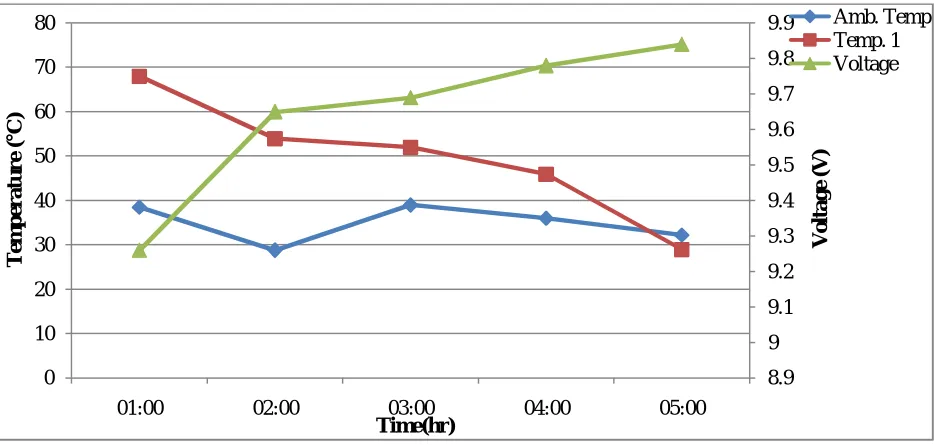
Figure 5: Uncooled system module temperature and voltage characteristics for Noon-Evening period
Figure 4 and 5 presents the graphs of daily voltage and temperature produced for the cooled and uncooled pv system between the hours of 1pm-5pm. Ambient temperature variation for noon-evening period is observed with an increase in voltage as the temperature decreases. The total voltage generated by the cooled module during this period is 10% higher than the uncooled voltage output. This is due to ac cooling effect on the module which reduces the module temperature and improves the output voltage performance
V. CONCLUSION
The voltage characteristics of a photovoltaic module cooled with air-conditioned cooling system was studied. Increase in cell temperature of the module causes a decrease in module open circuit voltage and a decrease in operating temperature causes a significant increase in open circuit voltage performance. The voltage performance of air-condition cooled mono-crystalline photovoltaic module is higher when compare with uncooled module. Our results obtained and presented in the literature using the air-conditioning technique are in consonant with the water sprinkling and silicon oil cooling methods used by different literatures.
REFERENCES
[1] Solar Power (Technology and Economics), http://www.mpoweruk.com/solar_power.htm
[2] Balamuralikrishnan, B., Deepika, B.,Nagajothis,K., Shree, S.S. and Subasini, P.T. “Efficiency Enhancement of Photovoltaic Cell”,
International Journal of Advanced Research in Electrical Electronics and Instrumentation Engineering, Vol. 3, Issue 4, pp. 305-313, 2014.
[3] Abdulkadir, M.,Samosir A.S. andYatim A.H.M. “Modeling and Simulation of a Solar Photovoltaic System, Its Dynamics and Transient
Characteristics in LABVIEW”, International Journal of Power Electronics and Drive System, Vol. 3, Issue 2, pp. 185-192, 2013.
[4] Wasfi,M. ‘‘Solar Energy and Photovoltaic Systems”, Journal of Selected Areas in Renewable and Sustainable Energy, 2011.
[5] Chandrasekar, M.,Suresh, S., Senthilkumar, T. and Ganesh M.K. "Passive cooling of standalone flat PV module with cotton wick structures",
Energy Conversion and Management, Vol.71, pp. 43–50, 2013.
[6] TeoH.,Lee P. and Hawlader, M."An active cooling system for photovoltaic Modules", Applied Energy, Vol.90, pp.309 – 315, 2012.
[7] Dinçer,F. andMeralM. E. “Critical Factors that Affecting Efficiency of Solar Cells”, Smart Grid and Renewable Energy, Vol.1, pp. 47-50,
2010.
[8] Chader,S.,Purohit A., Sharma, A., Arvind, A., NehraP. and Dhaka,M.S. “A study on photovoltaic parameters of mono-crystalline silicon
solar cell with cell temperature” Energy Reports,Vol. 1, pp. 104-109, 2015.
[9] Tiwari, P. K. and ChaurasiaP.B.L. “Experimental Investigation of the Effect of Temperature Variation on Photovoltaic Cell and Efficiency
7.2 7.4 7.6 7.8 8 8.2 8.4 8.6
0 20 40 60 80 100 120
01:00 02:00 03:00 04:00 05:00
V
o
ltage
(V
)
Te
m
p
e
r
atu
r
e
(°
C
)
Time (hr)
[10] Meneses-Rodriguez, D., Horley, P. P., Gonzalez-Hernandez, J.,Vorobiev, Y. V. and Gorley, P.N. ‘‘Photovoltaic solar cells performance at elevated temperatures”, Journal of Solar Energy, Vol.78, pp. 243-250, 2005.
[11] Abdulgafar, S. A.,Omar, O. S. and Yousif, K. M. “Improving The Efficiency Of Polycrystalline Solar Panel Via Water Immersion Method”,
International journal of Innovative Research in Science, Engineering and Technology, Vol. 3, Issue 1, 2014.
[12] Irwan,Y.M., Leow, W.Z., Irwanto,M., Fareq M, Amelia, A.R., Gomesh,N.andSafwati, I. “Analysis Air Cooling Mechanism for Photovoltaic
Panel by Solar Simulator”, International Journal of Electrical and Computer Engineering, Vol. 5, Issue 4, pp. 636-643, 2015.
[13] Cai, W., Chao, F., Long, T.J., Xiong, L.D., Fu, H.S. and Gang, X.Z.‘’The influence of environment temperatures on single crystalline and