PARAMETER SENSITIVITY STUDY USING FINITE ELEMENT ANALYSES TO MODEL POSTULATED TENDON CORROSION AND RESULTING PREDICTED EFFECTS ON
STRUCTURAL PERFORMANCE
Lili Akin1, Christopher Jones2, Robert Dameron3,Madhumita Sircar4, and Herman Graves5
1Principal Member of Technical Staff, Sandia National Laboratories, Albuquerque, NM ([email protected]) 2Senior Member of Technical Staff, Sandia National Laboratories, Albuquerque, NM
3Director of Structures, Moffatt & Nichol, San Diego, CA
4Technical Lead and Program Manager, US Nuclear Regulatory Commission (NRC), Rockville, MD 5Senior Structural Engineer, US Nuclear Regulatory Commission, Rockville, MD
ABSTRACT
A concern for the durability and performance of a prestressed concrete containment structures is corrosion of the prestressing tendons. Most prestressed containments in the USA were constructed with ungrouted tendons to simplify in-service inspection and testing. However, interest in increasing the understanding of the behavior of grouted tendons is on the rise. To study corrosion, and the differences in performance that corrosion may incur with grouted versus ungrouted tendons, a three dimensional (3D) Global Finite Element Analysis (FEA) model was created and analyzed for both grouted and ungrouted tendons. Two corrosion scenarios were postulated at locations that are potentially susceptible: 1) corroded vertical tendons at the wall to basemat juncture, and 2) corrosion to the hoop tendons adjacent to the equipment hatch. Results indicate that corroded vertical and hoop tendons result in a reduction in ultimate pressure capacity of about 10% and 25%, respectively. For both cases, grouted tendons reached a higher failure pressure than ungrouted tendons.
INTRODUCTION
The most serious threat to the durability of any prestressed concrete structure is corrosion of the prestressing and/or reinforcement. Rebar corrosion can cause spalling of cover concrete but, corrosion of the prestressing tendons is of even greater concern, because it can trigger structural failure, or in less severe corrosion conditions, loss of functionality for which the structure was designed. Of particular interest to the authors is the behavior of grouted and ungrouted tendon systems in prestressed concrete containment vessels (PCCVs) subject to localized corrosion. Both localized and full FEA models of the 1:4 Scale PCCV tested at Sandia National Laboratories were created to study and compare the response of grouted and ungrouted systems, with postulated corrosion introduced.
FINITE ELEMENT MODELS
The Sandia 1:4 Scale PCCV test model, built and tested in 1999-2000 has been a useful prototype for examining behavior of a PCCV by test and by extensive analysis by many groups [1]. It continues to be used, most recently in a round-robin exercise in which participants from the USA, India, and Europe have conducted additional post-test analysis to study postulated aspects of PCCV construction details and beyond-design-basis-loadings [2]. The prestressing tendons of the model structure are shown in Figure 1. Note that pressures in this paper are given in multiples of design pressure (Pd); Pd for the structure was 0.39 MPa (56.5 psi).
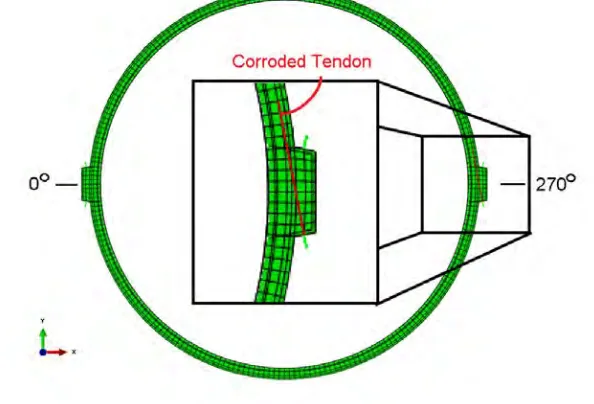
Localized FEA Model
have some susceptibility to corrosion. The analyses were performed for both grouted and ungrouted tendons, and the results were compared to see the corresponding structural responses.
Figure 1: Construction photos of prestressing tendons in the Sandia 1:4 Scale PCCV Model
Figure 2. FEM model developed with corrosion applied at anchorage
The definition of “failure” for these studies is dictated only by tendon straining. “Failure” occurs when a tendon reaches its material limit of 3.8% strain. In these studies, no consideration is given to liner strain driven liner tearing and leakage failure.
Global 3D FEA Model
For studying corrosion with the full 3D FEA Model, two potential corrosion cases were postulated. Certain areas of the vessel are assumed to suffer tendon corrosion over time. The authors suggest that a realistic way to simulate such field conditions is as follows:
1. Dead Load and Prestressing Loads are applied to the structure (when the structure is new); 2. Certain tendon groups/regions are down-sized to a smaller (corroded) tendon cross-sectional area;
this involves eliminating and replacing certain segments of tendon elements as an additional analysis step; structure equilibrium is allowed to be reached at the end of this step. Note that between Steps 1 and 2, the analyst could also introduce other “aging” conditions to the structure, such as creep of concrete, steel tendon relaxation, aging of concrete material properties (usually strength and stiffness increases), although these have not been introduced in the current study; 3. Severe accident pressure is applied up to structure system failure.
The research and findings of Smith [3] add to the basis and relevance of introducing corrosion in this way. Smith’s research noted that certain forms of corrosion influence the tendons in additional ways, other than section loss; i.e., reduction in ductility, reduction in effective ultimate strength. But the authors view loss in section as the most likely scenario, and in fact, from the view point of effect on the global PCCV structure, loss in section is roughly equivalent to reduction in ultimate strength. A distinction of the current work compared to previous studies is having the 3D global FEA. Previous studies have used either sector models or axisymmetric models so that conclusions about behavior and failure mode were made on an axisymmetric basis. 3D global FEA (enabled by current computational facility) can show non-axisymmetric behaviors and “early” failures associated with them.
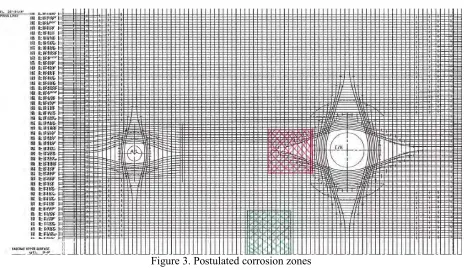
Two demonstration cases were performed, as illustrated in Figures 3 and 4. Unbonded (ungrouted) and bonded (grouted) tendons were analyzed and compared. The first case applied corrosion to the outer vertical tendons along the bottom of the vessel. This could simulate problems encountered either from
1) water penetrating the vertical tendon system through the anchorages or 2) water penetrating the concrete wall near the wall-basemat-juncture.
Both are locations potentially susceptible to such phenomena, and in fact Case 1 has been observed to have occurred in at least one U.S. plant [4,5].
Figure 3. Postulated corrosion zones
due to corrosion in the identified zones. The affected areas are centered on the 0° azimuth, extend circumferentially 20°, and extend vertically, to form approximately a square zone of affected tendons.
Figures 9 and 10 show stresses in vertical tendons for Corrosion Case 1 (unbonded and bonded). After Anchorage (Figure 5), no corrosion is present. After corrosion (Figure 6), the stresses increase substantially in the corroded portion (due to the small sectional area) and decrease elsewhere on those tendons, because the corrosion reduces the overall forces in the affected tendons. These Figures show that when the corrosion occurs on only one side (near one end of a hairpin tendon that is jacked from both ends), the effects of that corrosion dissipates over the dome, due to the frictional resistance between the tendon and the dome. The dome acts as a ‘friction anchor’ such that the corrosion on one side is not “felt” by the other end of the tendon.
Figure 5. Stress in vertical tendons after anchorage, before (left) and after (right) corrosion case 1 (unbonded)
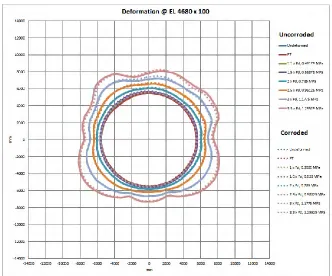
Corrosion Case 1 reached apparent ‘failure’ at just above 3.3Pd. This can be compared with 3.6Pd for the uncorroded case [6]. The liner strains do not show significant difference between this corroded case and the uncorroded case. Nor was there any significant difference in displacements or tendon strains between grouted and ungrouted. The failure mode for the structure is failure of the corroded tendons. Figure 6 shows comparisons of radial displacement profiles cut through the Elevation 4.68m (15.4 ft) of the 1:4 Scale PCCV vessel (the elevation of the E/H). These show slightly larger radial displacements occurring near the 0-degree azimuth, and slightly lower displacements occurring at other azimuths.
Figure 7 shows strains in hoop tendons for Corrosion Case 2. The figures show strains for the tendons anchored at 270-degrees. After anchorage, no corrosion is present. As corrosion is introduced, as is similar with the strain increase in Corrosion Case 1, the strains increase substantially in the corroded portion (due to the decreased sectional area) and decrease elsewhere on those tendons, because the corrosion reduces the overall forces in the affected tendons.
Between 2.5Pd and 2.8Pd, some hoop tendons begin failing, i.e., strains exceed 3.8%, and when this occurs, a progressive collapse mechanism ensues. Failure pressure was 2.8Pd.As with the vertical tendon corrosion case, the effects of localized hoop tendon corrosion do not affect the entire length of the locally corroded tendon owing to friction around the circumference of the containment vessel. The friction between the tendon and the cylinder is sufficient that even though the tendons are unbonded, one end of the 360° tendon loop is not affected by the corrosion on the opposite side of the PCCV.
The liner strains at the pressure milestones shown are significantly different between this
corroded case and the uncorroded case – the liner strains in the corroded case are higher, especially in the vicinity of the tendon corrosion. The “structural” failure mode, irrespective of the liner, is failure of the corroded tendons. The “functional” failure mode will be liner tearing, and as such, will occur at
Figure 6. Radial displacement comparisons between uncorroded and corrosion case 1
Figure 10 shows comparisons of radial displacement profiles cut through the Elevation 4.68m (15.4 ft) of the 1:4 Scale PCCV vessel (the elevation of the E/H) with and without corrosion. These show much larger radial displacements occurring near the 0-degree azimuth than at other azimuths. Figure 11 shows the same information for the grouted tendon case.
Figure 8. Strain in hoop tendons anchored at 270° at 2.8 x Pd, corrosion case 2, ungrouted vs. grouted
Figure 10. Radial displacement comparisons between uncorroded and corrosion case 2, ungrouted
RESULTS
A direct comparison between the maximum tendon strains for Corrosion Case 1 and 2, ungrouted and grouted, is displayed in Table 1.
Table 1. Max tendon strain for corrosion case 1 and 2, ungrouted and grouted at various pressure
milestones (Pd = 0.39MPa)
Corrosion Case 1 Corrosion Case 2
Unbonded Bonded Unbonded Bonded
xPd strain xPd strain xPd strain xPd strain
0 2.41% 0 2.41% 0.0 1.19% 0.0 1.19%
1 2.47% 0.9 2.41% 1.1 1.44% 1.1 1.21%
1.6 2.51% 1.5 2.42% 1.5 1.65% 1.5 1.22%
2 2.52% 2 2.41% 2.0 2.74% 2.0 1.33%
2.5 2.94% 2.5 2.44% 2.5 7.23% 2.5 1.71%
3 3.68% 3 2.49% 2.8 18.02% 3.0 2.52%
3.3 7.56% 3.3 2.56% 3.3 3.55%
3.4 2.54% 3.4 3.97%
3.6 2.57% 3.6 4.90%
General observations drawn from the tendon corrosion FEA are:
1. Reduction of tendon area provides a reasonable approach to analytically simulating corrosion, and solutions are obtainable;
2. Reduction of area of about 60% is the apparent limit (based on this short study) for obtaining solutions in this way – area reductions more than 60% failed to converge when only subjected to the prestressing forces, i.e., the structure has difficulty redistributing the prestress when 60% is lost along a substantial bank of tendons (note that this instability is for an unbonded tendon analysis);
3. The vertical tendon corrosion case resulted in a reduction in ultimate pressure capacity (tendon failure capacity, NOT capacity defined by liner tearing) of about 10% (3.3Pd versus 3.64Pd).
4. The hoop tendon corrosion case resulted in reduction in ultimate pressure capacity of approximately 25%, with tendons beginning to rupture between 2.5 and 2.8Pd, and pressure unsustainable beyond 2.8Pd. The reduction in capacity would be even greater if tendon embrittlement (reduction in ductility) were considered. This result is for the bonded (grouted) tendon case.
CONCLUSIONS
The overall conclusions of the 2012 parametric finite element analysis study [2] with corrosion studies are similar to those of Smith [3], but with some added observations about local behavior at the particular azimuth where corrosion is introduced. Reduced prestressing force (with associated degradation of prestressing tendons) in PCCVs showed that when the area of selected hoop tendons was reduced, there was a significant impact on the ultimate capacity of the PCCV. But when selected hoop prestressing tendons remained, but with loss of prestressing force (Smith’s work), the predicted ultimate capacity was not significantly affected. This shows that the tendons’ presence as structural elements is more important to ultimate capacity than the prestressing effects on the concrete (although the response at lower pressures is affected).
Concrete cracking and ultimate capacity occur at lower pressures for all corroded cases. For Case 1 where selected vertical tendons were analyzed with degradation of the tendons, there was only a small impact (~10%) on the ultimate capacity for the specific accident analyzed. But it should be noted that loss of vertical prestress may significantly affect containments’ resistance to strong seismic events, because these events stress the walls of the containment cylinder in tangential shear [2].
For the corrosion of hoop tendons, the effect on ultimate capacity was much greater: 25% for bonded tendons and 40% for unbonded. The difference in performance between bonded and unbonded tendons appears to be the former’s greater ability to redistribute stress to neighboring tendons, once corrosion occurs.
ACKNOWLEDGEMENTS
This report was prepared as an account of work sponsored by an agency of the U.S. Government.
Neither the U.S. Government nor any agency thereof, nor any of their employees, makes any
warranty, expressed or implied, or assumes any legal liability or responsibility for any third
party’s use, or the results of such use, of any information, apparatus, product, or process
disclosed in this report, or represents that its use by such third party would not infringe privately
owned rights. The views expressed in this paper are not necessarily those of the U.S. Nuclear
Regulatory Commission.
REFERENCES
1. Hessheimer, M.F., Klamerus, E.W., Lambert, L.D., Rightley, G.S., and Dameron, R.A. (2003). Overpressurization Test of a 1:4-Scale Prestressed Concrete Containment Vessel Model, NUREG/CR-6810, SAND2003-0840P, Sandia National Laboratories, Albuquerque, NM.
2. R. A. Dameron et al, “Assessment of durability and long term corrosion.” Task 3 Draft Report, NRC-SNL Ongoing Project, Expected Publication, February 2014.
3. J. A. Smith, “Capacity of Prestressed Concrete Containment Vessels with Prestressing Loss,” Sandia Report, SAND2001-1762, Sept. 2001.
4. D.J. Naus, “Aging Management of Nuclear Power Plant Concrete Structures – Overview and Suggested Research Topics,” Oak Ridge National Laboratory, presented at Nuclear Energy
Agency (NEA)/Committee on the Safety of Nuclear Installations (CSNI)/R(2008)7
workshop, Prague, Czech Republic, pp. 17–39, October 1-3, 2008.
5. H. Ashar and G. Bagchi, “Assessment of Inservice Conditions of Safety-Related Nuclear Plant Structures,” NUREG-1522, U.S. Nuclear Regulatory Commission, Washington, D.C., July 1995. 6. M. F. Hessheimer, R. A. Dameron, “Containment Integrity Research at Sandia National