ISSN(Online): 2319-8753 ISSN (Print) : 2347-6710
I
nternational
J
ournal of
I
nnovative
R
esearch in
S
cience,
E
ngineering and
T
echnology
(An ISO 3297: 2007 Certified Organization)
Vol. 5, Issue 3, March 2016
Analyze and Implementation of Cluster based
Routing Protocol in MANETs
Manpreet kaur1, Sarabjit kaur2
P.G. Student, Department of Computer Engineering, CTITR Engineering College, jalandhar, Punjab, India1
Assistant Professor, Department of Computer Engineering, CTITR Engineering College, jalandhar, Punjab, India2
ABSTRACT: MANET is self setting up adhoc network through which cellular nodes tend to be migrated as well as connect with each other. Because of flexibility, topology alterations at random so there is certainly insufficient transmission relating to the nodes, security are going to be lessened. In MANET, you can find various kinds of Routing protocols methods are used. Routing protocols methods are employed to send as well as obtain information from origin to vacation spot correctly. Clustering structured routing protocols methods are the methods through which course-plotting will certainly done by means of grouping. Clustering is often a practice where a big network is divided right small groups as well as communities. The leading purpose of clustering is usually to boost routing protocols in the network stratum through reducing the size of the particular routing protocols platforms as well as lessens improve over head through updating the particular routing protocols platforms soon after topological alterations take place. This kind of report is evaluate as well as apply the particular functionality associated with current cluster structured routing protocols method that the election associated with cluster go is dependent on the particular minimum Ids associated with node in cluster. We all evaluate the particular functionality associated with CBRP method as well as present each of our outcomes.
KEYWORDS: - MANET, Clustering, Routing Protocol, CBRP.
I. INTRODUCTION
Adhoc is usually a Latin keyword and key phrase significance with the objective or maybe short-lived. MANET is actually a kind of adhoc community that will adjust the site and in addition do it yourself starting community regarding convenient nodes affixed by means of wireless inbound links. The idea doesn’t involve starting up place. The idea utilizes a wireless website link with attach with a variety of methods. It is common peer to help you peer instead of customer server. These methods usually are produced dynamically by having a very good autonomous technique regarding convenient nodes which are affixed by using wireless inbound links. Nodes usually are widely to progress at random. Probably it's going to accomplish whilst stand alone trend or maybe is normally linked to the much larger web. Each node characteristics as being a router. A number of apps constructed into which can adhoc community are utilized. They're armed forces processes, catastrophe circumstances and so on. On your deployment regarding MANET, a variety of redirecting techniques help. The leading goal of almost any community is usually to supply the full transmission inside network.
1) Routing protocols for MANETs:
This is a group of procedures utilised by the particular router so that you can discuss between origin and in addition getaway. These people simply tend not to head out the data between origin and in addition getaway they up-date the particular course-plotting kitchen table. Routing protocols specifications keep your impact associated with bandwidth, postpone, price etc metrics with course-plotting kitchen table. Routing protocols methods is divided in subsequent different types. It depends when the particular network composition.
ISSN(Online): 2319-8753 ISSN (Print) : 2347-6710
I
nternational
J
ournal of
I
nnovative
R
esearch in
S
cience,
E
ngineering and
T
echnology
(An ISO 3297: 2007 Certified Organization)
Vol. 5, Issue 3, March 2016
path is made by having a course development plan of action. If your course could be formed towards the place, right onto your pathway development plan of action ends. The actual practices tend to be AODV, DSR, ABR and many others. It will help make some sort of course when it is when need. This kind of builds a reduced price due to the fact the path is made when need.
Proactive protocols (table driven): The specific positive methods continually keep and also updated this redirecting truth a multilevel to ensure that if your package should be moved this specific already appreciates this paths and also can be utilized immediately. They're suitable for much less amount of nodes inside web-sites, simply because they should revise node things suitable for just about every node in the redirecting table of each and every node. That positive aspects additional Routing over head problem. There exists use of additional bandwidth inside redirecting table. DSDV retains this course with regards to every web host sets continuously. It offers basic dispersed shortest-path methods.
Hybrid protocols: Most of these methods stands out as the mixture of both equally reactive and also functional methods. Regarding example– ZRP.
Variation between the reactive and also practical practices:
Average end-to-end wait or simply some time consumed on the data to reach for the distinct location inside useful resource is actually adjusting on the inside Reactive Methods nonetheless is always continual on the inside Realistic Methods for any offered Random local community. This distribution regarding package data may be a lot more efficient on the inside Reactive Methods when compared with on the inside Realistic Methods. Reactive Methods tend to be much faster on the inside success when compared with Realistic methods.
Reactive Methods are generally a lot more adaptive and also do the job significantly far better in a range of topographies when compared with Realistic Methods.
II. CLUSTERING in MANETs
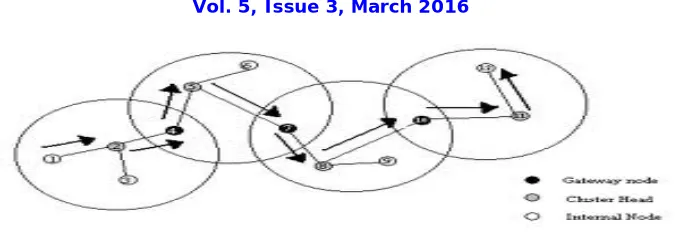
The procedure in which divides this community in to interconnected substructures, known as clusters. Every single cluster carries a distinct node elected since cluster head (CH) depending on a specific metric or maybe a variety of metrics for example identity, degree, mobility, weight, density and many others. The particular cluster go plays this part
associated with manager in their substructure. Every CH weight, density base section in their cluster along with conveys having various other CH. The cluster is actually for that reason made up of some sort of cluster go, gateways
along with members node. These kinds of several types of nodes have got unique functions:
Cluster Head(CH): It does not take manager on the cluster. The cluster go typically serves like a nearby manager to its cluster, executing intra-cluster transmission, arrangement, data forwarding and many others.
Gateway: It is a frequent node between a couple of clusters.
ISSN(Online): 2319-8753 ISSN (Print) : 2347-6710
I
nternational
J
ournal of
I
nnovative
R
esearch in
S
cience,
E
ngineering and
T
echnology
(An ISO 3297: 2007 Certified Organization)
Vol. 5, Issue 3, March 2016
Fig 2.1 States of nodes in clustering
The issues occurs in clustering : This highly active as well as unpredictable mother nature connected with MANET’s makes it challenging for that Cluster based routing protocol to be able to break down a new mobile network multilevel straight into groups as well as dedication connected with Cluster heads for every cluster. Clustering lowers conversation as well as command outgoings on account of pre determined paths connected with conversation by way of cluster heads. It is essential for scalability connected with press accessibility methodologies, redirecting methodologies plus the stability national infrastructure. Routing methodologies which often thinks merely bidirectional links may have link asymmetry due inefficient or abnormal routing. Low competition multilevel volume can be symbolized with the undiscovered unidirectional links, which often lowers the actual multilevel connectivity.
III. RELATED WORK 1) An efficient Cluster based routing protocol for MANETs:
In D.K Sharma et al. proposed as well as applied the new approach for inter as well as intra cluster routing. This specific formula usually takes the main benefit of proactive and reactive routing protocols. For inter as well as intra cluster routing, proactive as well as reactive concepts are used respectively that's given enhanced performance for large networks. We've got partioned the whole multilevel straight into a number of cluster having a cluster head for cluster creation and maintenance. A cluster can be given by one main factor, which is the ideal long distance helped in the cluster head. Every single cluster head retains a new a two routing tables. Proactive routing table for intra cluster as well as reactive redirecting for inter cluster. Key factor is used to be able to break down the whole multilevel in numerous overlapping sub networks. The main element factor would depend about final number connected with nodes from the multilevel. This specific worth can be none massive none small. If it's very small and then cluster size will certainly small. The quantity of groups from the multilevel boosts as well as reactive redirecting cost to do business will be increased. This technique doesn't take into account the technique of token dependent structure. Any time just about any cluster node wants to forwards files packets to be able to neighbor cluster head nodes, it post an RREQ to be able to it's cluster check out send out concept to be able to it's gateway nodes. These kinds of gateways nodes forward the actual cluster for their neighbor cluster head as well as respond immediately for the source’s cluster head node. Waiting occasion as well as cost to do business is usually lowered by this technique because RREQ concept isn't send out from the overall multilevel.
2) An Improved Cluster based Routing Protocol with Backup Cluster head for MANETs:
In R. Balasubramaniyan et.al proposed an improved CBRP protocol suggest a new copy cluster head for every cluster check out boost the balance connected with cluster in the event of n't anticipated failure connected with cluster head the previous endure cluster head failure trouble which often lowers the actual cluster stability. To raise the actual cluster stability it relies on a weight dependent clustering formula to be able to choose the actual cluster head.
3) A Distributed weighted cluster based routing protocol for MANETs:
ISSN(Online): 2319-8753 ISSN (Print) : 2347-6710
I
nternational
J
ournal of
I
nnovative
R
esearch in
S
cience,
E
ngineering and
T
echnology
(An ISO 3297: 2007 Certified Organization)
Vol. 5, Issue 3, March 2016
with regard to MANETs featuring its unique cluster scalp of cluster which includes accountable for routing schemes between clusters.
4) Cluster based routing protocol for mobile adhoc networks:
In M. Rezaee proposed a cluster based routing protocol method with regard to mobile adhoc system. In this routing is completed easily mainly because routing is actually counted in tackle of cluster head. Caused by weight group, cluster formation speed improves and also leads to system program being a lot more readily available. Re-creating of cluster is actually rarely executed when a couple groupings track down from the exact same range, at least one turns into gateway of various other node. By means of faltering any kind of node from the option, their cluster head may use a different node for you to forward packets. This particular leads to error tolerance. The ideas boost the PDR in various scenarios. And lessen the conclusion to end delay.
Each one of these methods, balance will certainly reduced until at this point as well as reduce your performance of method in system to prevent these types of difficulties, most of us will certainly first examine the outcome of method analyze by good quality of service parameters.
IV. CBRP (CLUSTER BASED ROUTING PROTOCOL)
It is just a reactive routing protocol method by which routing protocol is predicated on-demand procedure similar to option development, supply routing protocol and also option eradication. Recently there have been a few various approaches in cluster-based routing protocol. Your cluster-based routing protocol method (CBRP) had been released in 1999. Throughout CBRP your nodes of the wifi system usually are broken down in numerous disjoint or maybe overlapping groupings. Each and every cluster elects one node like a cluster scalp. Most of these particular nodes are responsible for routing protocol process. Neighbours of cluster minds can't be cluster minds too. Although cluster minds can connect collectively by using gateway nodes. Any gateway is often a node of which works like a advanced node concerning two or more cluster minds. Your routing protocol process is conducted since resource routing protocol by simply racing some sort of option obtain information from the system. Due to clustered structure it will have less traffic, mainly because option asks is only going to become passed concerning cluster heads.
Cluster formation
Within cluster formation identifier centered clustering is used. When you use identifier-based clustering any node elects by itself because the cluster head if it's this bare minimum ID in it's neighbourhood node just a cluster. So that you can assist this cluster sourcing course of action every single node runs on the neighbour table, wherever the item stores information about it's neighbour nodes, for instance their particular ID’s, their particular part in the cluster (cluster head as well as participant node) and also the status of the connection to that node (uni-/bi-directional). This neighbour table will be taken care of by simply frequently broadcasting HELLO communications. The HELLO information has information about just one node’s state, it's neighbour table as well as cluster adjacency table. Different expresses identify this clustering course of action with regards to the recent node state.
These states are:- Undecided
Therefore this node won't participate in any kind of cluster: this generally arises in case a new node presents itself in the multilevel. As a result, if the item is provided with any HELLO information coming from a cluster head and there exists a bi-directional url involving all of them the item modifications it's state to be member in this cluster pointed out through the cluster head. Or else the item seems upward in it's neighbour dining room table if it's any kind of bi-directional links. In that case, the item gets by itself this cluster head of a new cluster, otherwise, the item is always in the unsure state and will try yet again.
Clusterhead
ISSN(Online): 2319-8753 ISSN (Print) : 2347-6710
I
nternational
J
ournal of
I
nnovative
R
esearch in
S
cience,
E
ngineering and
T
echnology
(An ISO 3297: 2007 Certified Organization)
Vol. 5, Issue 3, March 2016
Member
In case a participant loses it's cluster head, the item actively seeks bi-directional links to be able to additional nodes. In the event that the item picks up any kind of, the item modifications it's state to be able to cluster head if it's the lowest ID, or else the item turns to the unsure state. Each participant node sits at least to a single cluster.
Routing
CBRP uses two data structures to support the routing process
1. Cluster adjacency table (CAT) and
2. two-hop topology database.
This CAT stores information about adjoining clusters. That is, if they usually are bi-directionally as well as uni-directionally associated. Actually, any cluster is known as bi-uni-directionally associated, when there is any bi-directional link involving a pair of nodes of the clusters, as well as if you will discover at least a pair of opposite uni-directional links involving a pair of nodes, uni-directionally associated, when there is one uni-directional link involving all of them.
This two-hop topology repository will be build through the info gotten by simply HELLO communications. It has almost all nodes which have been at most a pair of hops apart. This route performs in a two hops steps. Very first, the item detects any option coming from a supplier node S with a desired destination node D, soon after the item routes this packets.
Route discovery
Route discovery is done by using source routing. Inside the CBRP solely cluster heads usually are bombarded together with option demand deal (RREQ). Entry nodes receive the RREQs at the same time, although without broadcasting all of them. These people onward all of them to a higher cluster heads. This strategy lowers this multilevel targeted traffic. In the beginning, node S broadcasts any RREQ together with unique ID that contains this destination’s target, this adjoining cluster head(s)—including this entrance nodes to realize them—and this cluster target listing that consists of this details of the cluster heads developing this route.
When a node N receives a RREQ it does the following:
IF N is member IF D is in the neighbour table send RREQ to D, otherwise N is gateway to Cluster head C forward RREQ to C, otherwise discard RREQ. IF N is cluster head, and RREQ already seen discard RREQ ELSE record ID in cluster address list of RREQ. IF D is neighbour OR D is two hops away send RREQ to D ELSE FOR EACH neighbouring clusterhead C DO IF NOT C in address list of RREQ record C in cluster address list of RREQ ENDIF ENDFOR ENDIF broadcast RREQ. If the RREQ reaches the destination node D it contains the loose source route. D sends a route reply message (RREP) back to S using the reversed loose source route . Every time a cluster head receives this RREP it computes a strict source route, which then consists only of nodes that form the shortest path within each cluster.
Source Routes: The loose source route (non-dashed arrows) and the exacting source route (dashed arrows) from S to D.
Problems and limitations
Such as a lot of the different routing protocols, CBRP possesses some restrictions in addition to troubles that are disadvantages when compared to different practices.
If a community in addition to groupings turn into too large, the particular cost to do business for each supply boosts caused by origin routing. Just about every node on the route must be located inside the routed packet. Hence the supply dimension increases proportional on the path length of the route. In accordance with this, the particular indication time period boosts too. Also, if your cluster dimension expands the size of HELLO mail messages in addition to located data structures increases. In accordance with this go up regarding cost to do business along with the toned a couple of level chain of command the particular CBRP will be scalable a extent.
ISSN(Online): 2319-8753 ISSN (Print) : 2347-6710
I
nternational
J
ournal of
I
nnovative
R
esearch in
S
cience,
E
ngineering and
T
echnology
(An ISO 3297: 2007 Certified Organization)
Vol. 5, Issue 3, March 2016
V. EXPERIMENTAL RESULTS AND ANALYSIS PERFORMANCE OF CBRP PROTOCOL
Simulation can be defined as “Imitating or perhaps price how events might arise inside a real situation”. It could possibly require complex mathematical modelling, function actively playing with no the help of technologies, or perhaps combos. The worthiness is based on the particular positioning anyone underneath sensible conditions, in which adjust due to behaviour regarding other involved and that means you are unable to foresee the particular sequence regarding events or perhaps the ultimate consequence.
On this work, random waypoint freedom is known as. In random waypoint freedom model any mobility node will start the particular simulation by means of holding out any specific stop time period. Next time period it decides any random vacation spot in your neighbourhood and a random speed spread evenly concerning some ranges. Following hitting their spot position, the particular mobile node waits yet again stop time period mere seconds prior to picking a brand-new means position in addition to swiftness. Targeted traffic solutions are usually CBR (continuous bit rate). The origin spot frames are usually distributed arbitrarily over the community. Through transforming the total quantity of nodes in addition to freedom, we obtain examples. Every node starts off their quest from a random area to a random spot on such basis as picking a cluster go with a minimal Ids. After the vacation spot will be achieved, yet another random spot will be specific.
Parameter Value
Terrain Area 2000 m x 2000 m
Simulation Time 150 millisecond
MAC Type 802.11
Application Traffic CBR
Routing Protocol CBRP
Data Payload 512 Bytes/Packet
Pause Time 2.0 s
Number of Nodes random
Number of Sources 1
Performance Metrics
Three key performance metrics are evaluated in our experiments:
1) Throughput: The particular throughput is the ratio regarding complete number of data which often grows to the particular device in the sender on the time period it will take for the device to get one more supply. It really is symbolized inside portions for each second bit or perhaps packets for each mere seconds. In MANETs throughput will be troubled by a variety of alterations inside topology, limited bandwidth and limited power.
2) Average end-to-end delay of data packets: Delay indicates the time it got for just a supply going in the origin from the source to the destination. The Delay is an average time period so that you can traverse the particular supply inside community. For instance each of the delays induced throughout route buy, streaming in addition to running at more advanced nodes.
3) Packet delivery ratio: This is a ratio regarding complete supply received on the complete supply delivered to the particular community.
PDR= ∑ Number of packets receive / ∑ Number of packets send
In cluster based routing protocol there are various techniques to form clusters. In this current implementation we have chosen minimum node id in a particular set of clusters. By using this technique for cluster formations we have
evaluated various results w. r. t. delay in packets communication, packet delivery ration and overall system throughput. All parameters are calculated and graphed in various combinations.
ISSN(Online): 2319-8753 ISSN (Print) : 2347-6710
I
nternational
J
ournal of
I
nnovative
R
esearch in
S
cience,
E
ngineering and
T
echnology
(An ISO 3297: 2007 Certified Organization)
Vol. 5, Issue 3, March 2016
Fig 4.1 Effect of Throughput by increasing the speed of nodes
In figure 4.1 shows that as we increase the speed of nodes, the nodes move rapidly due to this the throughput of the nodes will decrease. It is totally random in nature as simulation shows the results as per current nature of the network.
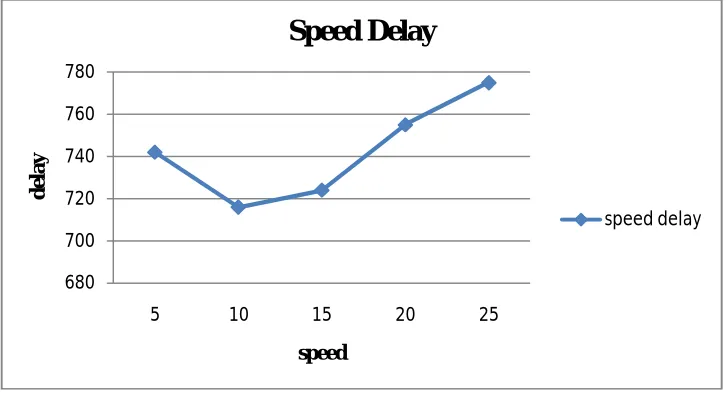
Figure 4.2 Effect of Delay with respect to increase of speed of nodes
Figure 4.2 shows that as we increase the speed of nodes the communication get faster between several nodes and overhead increases thus the delay goes increased.
0 1000000 2000000 3000000 4000000 5000000 6000000
5 10 15 20 25
th
r
o
u
gh
p
u
t
speed
speed throughput
mob throughput
680 700 720 740 760 780
5 10 15 20 25
d
e
lay
speed
Speed Delay
ISSN(Online): 2319-8753 ISSN (Print) : 2347-6710
I
nternational
J
ournal of
I
nnovative
R
esearch in
S
cience,
E
ngineering and
T
echnology
(An ISO 3297: 2007 Certified Organization)
Vol. 5, Issue 3, March 2016
Figure 4.3 Effect of packet delivery ratio with respect to speed
Figure 4.3 shows that the packet delivery ratio is constant for some time (average) and then decreased as the speed of nodes increases.
Scenario 2: When the number of nodes increases, the results and effects of calculated parameters as shown below:
Figure 4.4 Effect of packet delivery ratio with respect to speed 0
0.1 0.2 0.3 0.4 0.5 0.6 0.7
5 10 15 20 25
P
D
R
speed
speed pdr
speed pdr
0 500000 1000000 1500000 2000000 2500000 3000000 3500000 4000000 4500000
16 36 64 100 144
Th
ro
u
gh
p
u
t(
kb
p
s)
Nodes
Nodes Throughput
ISSN(Online): 2319-8753 ISSN (Print) : 2347-6710
I
nternational
J
ournal of
I
nnovative
R
esearch in
S
cience,
E
ngineering and
T
echnology
(An ISO 3297: 2007 Certified Organization)
Vol. 5, Issue 3, March 2016
Figure 4.4 show that throughput will decrease when we increase the number of nodes in the network. . It is totally random in nature as simulation shows the results as per current nature of the network.
Figure 4.5 Effect of packet delivery ratio with respect to speed
Figure 4.5 shows that when we increase the number of nodes in the network, the delay will be increase due to its high traffic in the network, communication between the nodes will be less.
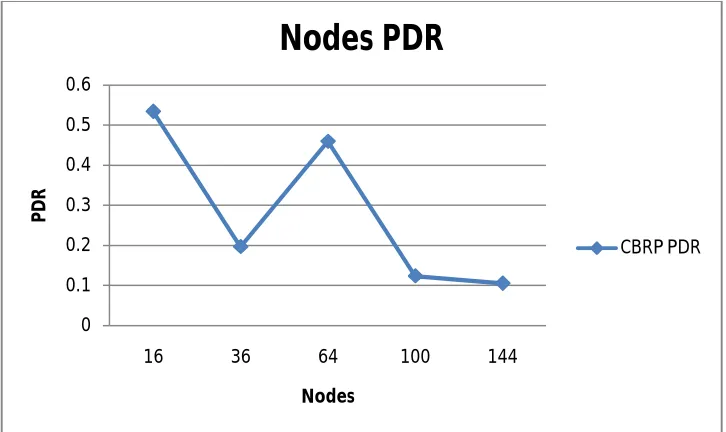
Figure 4.6 Effect of packet delivery ratio with respect to speed 0
100 200 300 400 500 600 700 800 900
16 36 64 100 144
d
e
lay
nodes
Node Delay
node delay
0 0.1 0.2 0.3 0.4 0.5 0.6
16 36 64 100 144
P
D
R
Nodes
Nodes PDR
ISSN(Online): 2319-8753 ISSN (Print) : 2347-6710
I
nternational
J
ournal of
I
nnovative
R
esearch in
S
cience,
E
ngineering and
T
echnology
(An ISO 3297: 2007 Certified Organization)
Vol. 5, Issue 3, March 2016
Figure 4.6 shows that when we increase the number of nodes in the network, the communication increases within nodes, the packet delivery ratio must increase but it decreases because of rapid change in topology in the network and increase the overhead through election of cluster head through minimum ID. So due to this efficiency and scalability issues occur. To improve the parameters of quality of service, changing a cluster head schemes in the existing cluster based routing protocol in network.
VI. CONCLUSION
This research work must be done applying MANET through which transmission build is performed against the protocol that CBRP (Cluster Structured Routing Protocol). On this project the particular groupings are usually formed prior to transmission come about. In cluster centered routing project there are various techniques to form clusters. On this present enactment we have now preferred minimal node identity inside a particular number of groupings. By using this technique for cluster formations we have evaluated various results w. r. t. delay in packets communication, packet delivery ratio and overall system throughput. Most details are usually measured in addition to graphed in various combos. Now we have examined rather than applying minimal node identity seeing that cluster go this is often swapped out by means of another technique through which weight of a node can easily measured through which total details may perhaps enhanced that's precisely what need to do inside the proposed work.
REFERENCES
[1] S. Srinivas et al. “A Robust cluster based routing protocol for MANET” “ICCC ACM, pp:26-30, 2011.
[2] M.Anupama et al. “Survey of cluster based routing protocol in MANETs”, “International journal of computer theory and engineering”, Vol. 3 pp: 806-815, 2011.
[3] R. Balasubramaniyan et al. “An improved cluster based routing protocol with backup cluster head for MANETs”, ARPN journal of engineering and applied sciences, Vol. 10 pp:4927-4930, 2015.
[4] C. Naveen et al. “A Distributed weighted cluster based routing protocol for MANETs”, Springer- Verlag Berlin Heidelberg, pp 147-151,2011. [5] Ha. Dang et al. “Clustering and cluster based routing protocol for Delay-Tolerant mobile networks”, IEEE Transactions on Wireless Communication, Vol. 9, NO. 6, pp: 1874-1881, 2010.
[6] S. Karunakaran et al. “An Adaptive weighted cluster based routing protocol for Mobile Adhoc Networks”; WEAS Transaction on Communications, Vol. 7, NO. 4, pp: 248-257, 2008.
[7] M.Rezaee etal. “Cluster based routing protocol for Mobile adhoc Networks”,
[8] S.K.Dhirendra et al. “An efficient cluster based routing protocol for MANET”, 3rd IEEE International Advance Computing Conference(IACC), pp: 224-229, 2012.
[9] S.Rajesh et al. “Survey on cluster based routing protocol in MANETs”, International journal of science and research”, Vol. 4, NO. 1, 2015. [10] M. Sheetal et al. “Survey on Various Cluster head Election Algorithms for MANET”, IEEE International conference on current trends in technology, Nuicone, pp: 1-6, 2011.