ISSN(Online): 2319-8753 ISSN (Print): 2347-6710
International Journal of Innovative Research in Science,
Engineering and Technology
(An ISO 3297: 2007 Certified Organization)
Website: www.ijirset.com
Vol. 6, Issue 9, September 2017
A Study of Wireless Distributed Computing
Challenges and Approaches
Dr. G. Geetharamani 1, J. Arun Pandian 2, K. Kanchanadevi 3
Head, Department of Mathematics, Anna University BIT Campus, Tiruchirappalli, Tami Nadu, India 1
Assistant Professor, Department of Computer Science and Engineering, M.A.M. College of Engineering and
Technology, Tiruchirappalli, Tamil Nadu, India 2
Junior Software Engineer, SEC Information India Pvt. Ltd., Pondicherry, India 3
ABSTRACT: Wireless distributed computing, in which cluster of wireless computing devices, connected through a wireless networking devices. Wireless distributed computing eradicates the need for a core computing system, which is critical in numerous significant applications, such as autonomous control and navigation systems for vehicles, in which access to the core computing system can be extremely limited. Our survey is different from existing surveys in that we focus on recent developments in Wireless distributed computing technologies. We review the leading research projects, standards and technologies, and platforms. This paper intends to help new researchers entering the domain of WDC by providing a comprehensive survey on recent developments.
KEYWORDS: Wireless distributed computing, Map Reduce and cognitive radio network.
I. INTRODUCTION
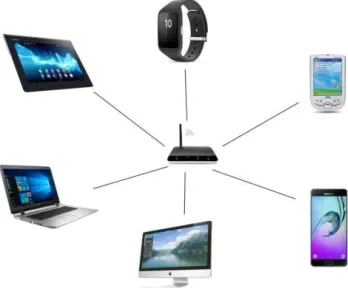
Wireless distributed computing (WDC) exploits wireless connectivity to distribute processing-intensive tasks between multiple wireless devices. Moreover, Wireless distributed computing (WDC) is an enabling technology that allows radio nodes to co-ordinate in processing complex computational tasks of an application in a distributed manner [1]. Wireless distributed computing research is being driven by the fact that mobile portable computing devices have limitations in executing complex mobile applications, mainly attributed to their limited resource and functionality. Figure 1 shows the model framework of Wireless distributed computing.
Fig.1: Wireless Distributed Computing Framework
ISSN(Online): 2319-8753 ISSN (Print): 2347-6710
International Journal of Innovative Research in Science,
Engineering and Technology
(An ISO 3297: 2007 Certified Organization)
Website: www.ijirset.com
Vol. 6, Issue 9, September 2017
several Challenges and Approaches related to Wireless distributed computing (WDC) by defining some open challenges. In addition, study on some applications of WDCs in High Performance computing and real world.
Rest of the paper is organized as follows: Section 2 gives an overview of WDCs. Challenges, approaches and applications of WDC in section 3. Section 4 concludes survey study with references at the end.
II. WIRELESS DISTRIBUTED COMPUTING OVERVIEW
WDC is achievable today due to the availability of key technologies such as distributed computing, fault tolerant computing, software defined network (SDN), and cognitive radio network (CRN). These technologies can present capabilities such as association among wirelessly connected computational devices, flexible link design, and adaptation and autonomous operation in dynamic WDC environments [3]. These capabilities facilitate flexible and optimized use of resources, consistent wireless communications, cooperative optimization of computation and communication processes, and customization for the QoS needs of WDC.
Several classes of applications can potentially advantage from WDC, some of which are listed as follows:
Composite Communication Waveforms - Strong communication signal processing approaches often
engage composite computations which can be executed in a distributed approach.
Robust Process Control - Control applications necessitate time-critical coordination between wireless
sensors and actuators in wireless sensor networking.
Information sharing - Sharing of video, images, and voice data may need composite information coding
and ad-hoc network system capabilities.
Real-time data capture, processing and dissemination - This division includes time-critical data collection
applications, such as portable mobile scientific computing, where the collected data is processed to offer information to a remote device.
The example applications of WDCs are Distributed data storage and database search, image processing and pattern recognition systems, Synthetic Aperture Radar processing and signal detection and classification systems
III. WIRELESS DISTRIBUTED COMPUTING CHALLENGES AND APPROACHES
Recent advancements in radio technology supply enormous flexibility and superior capabilities in executing wireless services [1]. One of these capabilities that can offer significant advantages over conventional approaches is the model of collaborative computing in wireless networks. Through collaborative radio nodes, numerous autonomous radio nodes operate together to form a wireless distributed computing (WDC) with extensively increased performance, operating efficiency, and abilities over a single node. Wireless distributed computing exploits wireless connectivity to distribute processing- intensive tasks among several devices. The purposes are to reduce per-node and network resource requirements, and enable complex applications not otherwise possible. For example image processing in a network of small form factor radio nodes.
Personal computing devices, such as smart-phones and Personal Digital Assistances, are commonplace, several wireless network interfaces, can support compute demanding tasks, and are equipped with powerful means to produce multimedia content. Thus, they provide the resources for what we envision as a human pervasive network: a network created by user devices, suitable to communicate to user’s rich multimedia content and services according to their benefit and requirements [2]. Similar to opportunistic networks, where the communication is built on connectivity opportunities, we envisage a network above these properties that joins together features of traditional pervasive networks and opportunistic networks fostering a new computing paradigm: opportunistic computing.
Currently, smart phones are becoming more powerful and have a performance alike earlier workstations. A mobile ad-hoc cluster is fundamentally a division of mobile nodes of the wireless network that satisfies a certain property. In this paper [4], author shows that setting up a smart phone cluster is not only achievable, but it is also a rational thing to do, considering the absolute number of mobile devices and the applications that could benefit from it.
ISSN(Online): 2319-8753 ISSN (Print): 2347-6710
International Journal of Innovative Research in Science,
Engineering and Technology
(An ISO 3297: 2007 Certified Organization)
Website: www.ijirset.com
Vol. 6, Issue 9, September 2017
devices into an IT infrastructure makes ecologic sense while saving costs at the same time. It shows how fluctuating energy spot market prices due to demand and varying supply could be fed into a CANDIS scheduler to further reduce costs of computation by shifting it to times of cheap energy prices. Thus, the presented approach can increase a business' sustainability, save money and - if applied on a larger scale - help to stabilize electricity grids when industrialized countries continue their move to renewable.
The authors [6] proposed that a computing infrastructure that leverages inactive Smart phones being charged during the night is energy and cost effective option to running tasks on conventional server infrastructure. While parallel execution and scheduling models be present for servers, Smart phones present a exclusive set of technical challenges due to the heterogeneity in CPU clock speed, inconsistency in network bandwidth, and lesser availability compared to servers.
Map Reduce is a distributed computing algorithm which splits up large problem into small pieces, such that a large cluster of computers can work on those small pieces in an efficient, appropriate manner. Map Reduce was created by Google, and is broadly used as a means of processing huge amounts of textual data for the reason of indexing it for search later on. Map Reduce is a programming model and an associated implementation for processing and create large data sets. Users denote a map function that processes a key/value pair to generate a set of intermediate key/value pairs, and a reduce function that merges all intermediate values associated with the same intermediate key.
This paper [7] observed the feasibility of using smart mobile devices in a Map Reduce distributed system by exploring numerous areas; including quantifying the contribution they build to computation throughput, power expenditure, end-user contribution, and security. The proposed Map Reduce System over heterogeneous mobile nodes consists of three key components: a server component that coordinates and aggregates results, a mobile node client for apple iPhone, and a traditional client for reference and to obtain baseline data. A prototypical research implementation demonstrates that it is certain possible to influence smart mobile devices in heterogeneous Map Reduce distributed systems, provided certain conditions are understood and accepted. Map Reduce distributed systems could see sizable gains of processing throughput by incorporating as many mobile devices as probable in such a heterogeneous computing environment. Taking into account the massive number of such devices available and in active use today, this is a reasonably achievable goal and represents an exciting area of study. This paper [7] introduced appropriate background materials, discussed related works, described the proposed system, explains obtained results, and finally, discussed some useful topics for further research in this area.
In this [8] Paper, implemented a Map Reduce distributed system for a large cluster of commodity machines and is highly scalable: a typical Map Reduce distributed computation processes many terabytes of data on thousands of machines. Programmers find the system effortless to utilize: hundreds of Map Reduce distributed programs have been implemented and upwards of one thousand Map Reduce distributed system jobs are executed on Google's clusters every day.
In this article [10], author discussed wireless distributed computing research aims to quantify the benefits of distributed processing over local processing, extend traditional distributed computing (DC) approaches to permit operation in dynamic radio environments, and convene design and implementation challenges exclusive to WDC with the assist of recently available enabling technologies, such as software and cognitive radios.
In this article [11], authors discusses the advancement from opportunistic networking to opportunistic computing; authors survey key current achievements in opportunistic networking, and describes the main ideas and challenges of opportunistic computing systems. Authors concluded to further possible scenarios and functionalities to make opportunistic computing a key player in the next-generation Internet.
ISSN(Online): 2319-8753 ISSN (Print): 2347-6710
International Journal of Innovative Research in Science,
Engineering and Technology
(An ISO 3297: 2007 Certified Organization)
Website: www.ijirset.com
Vol. 6, Issue 9, September 2017
Individual cognitive radio nodes in an ad-hoc cognitive radio network (CRN) have to perform composite data processing operations for numerous purposes, such as situational awareness and cognitive engine (CE) decision making. In an implementation point of view, every cognitive radio (CR) may not have the computational and power resources to perform these tasks by itself. In this paper [13], wireless distributed computing (WDC) is presented as a technology that enables multiple resource-constrained nodes to collaborate in computing complex tasks in a distributed manner. This approach has several benefits over the traditional approach of local computing, such as reduced energy and power consumption, reduced burden on the resources of individual nodes, and improved robustness. However, the benefits are negated by the communication overhead involved in wireless distributed computing.
This paper [13] demonstrates the application of wireless distributed computing to cognitive radio networks with the help of an example cognitive engine processing task. In addition, the paper analyzed the impact of the wireless environment on wireless distributed computing scalability in homogeneous and heterogeneous environments. The paper also proposed a workload allocation scheme that utilizes a combination of stochastic optimization and decision-tree search approaches. The results shows limitations in the scalability of wireless distributed computing networks, mainly due to the communication overhead involved in sharing raw data pertaining to delegated computational tasks.
Smart phones face a unique set of technical challenges in distributed computing due to the heterogeneity in CPU clock speed, variability in network bandwidth, and lower availability than servers. In this paper [1], author addressed many of these challenges to develop Computing while Charging (CWC) —a distributed computing infrastructure using smart phones and implemented using tested of eighteen number Android phones.
In wireless distributed computing system, users communicate with each other via the access point to exchange their locally computed intermediate computation results, which is known as data shuffling. In this paper [2], proposed a scalable framework for wireless distributed computing system, in which the required communication bandwidth for data shuffling does not increase with the number of users in the network. The key idea is to utilize a particular repetitive pattern of placing the data set (thus a particular repetitive pattern of intermediate computations), in order to provide the coding opportunities at both the users and the access point, which reduce the required uplink communication bandwidth from users to the access point and the downlink communication bandwidth from access point to users by factors that grow linearly with the number of users. Author experimented that the proposed data set placement and coded shuffling schemes are optimal for both a centralized setting and a decentralized setting, by developing tight information-theoretic lower bounds.
IV. CONCLUSION
The research in wireless distributed computing is very dynamic, and there are high expectations regarding applications and business potential of High Performance computing. This paper has presented a state of the art on recent developments in wireless distributed computing technology and its applications. We have identified the obstacles in the application of wireless distributed computing that should be addressed in order to push the technology further.
Finally, we have identified several open research issues that need to be investigated in future. We believe that, this article with rich bibliography content, can give valuable insight into recent developments in wireless distributed computing and encourage new research.
REFERENCES
[1] Mustafa Y. Arslan, Indrajeet Singh† and Shailendra Singh, CWC: A Distributed Computing Infrastructure Using Smartphones, IEEE Transactions on Mobile Computing, DOI 10.1109/TMC.2014.2362753.
[2] Songze Li, Qian Yu, Mohammad Ali Maddah-Ali, A. Salman Avestimehr, Senior Member, IEEE A Scalable Framework for Wireless Distributed Computing, IEEE/ACM TRANSACTIONS ON NETWORKING, 2017.
[3] Dinesh Datla, Xuetao Chen, Thomas Tsou, Sahana Raghunandan, S. M. Shajedul Hasan, Jeffrey H. Reed, Bruce Fette, Carl B. Dietrich, Jeong-Ho Kim, Tamal Bose, Wireless distributed computing: a survey of research challenges, Communications Magazine, IEEE January 2012 (Volume:50 , Issue: 1 )
[4] F. B¨usching, S. Schildt, and L. Wolf. DroidCluster: Towards Smartphone Cluster Computing - The Streets are Paved with Potential Computer Clusters -. In ICDCSW, June 2012.
[5] S. Schildt, F. B¨usching, E. J¨orns, and L. Wolf. CANDIS: Heterogeneous Mobile Cloud Framework and Energy Cost-Aware Scheduling. In IEEE GreenCom iThings/CPSCom, June 2013.
ISSN(Online): 2319-8753 ISSN (Print): 2347-6710
International Journal of Innovative Research in Science,
Engineering and Technology
(An ISO 3297: 2007 Certified Organization)
Website: www.ijirset.com
Vol. 6, Issue 9, September 2017
[7] P. R. Elespuru, S. Shakya, and S. Mishra. MapReduce System over Heterogeneous Mobile Devices. In SEUS, 2009. [8] J. Dean and S. Ghemawat. MapReduce: Simplified Data Processing on Large Clusters. In USENIX OSDI, 2004. [9] http://research.cs.wisc.edu/condor/.
[10] D. Datla, X. Chen, T. Tsou, S. Raghunandan, S. M. Hasan, J. H. Reed, B. Fette, C. B. Dietrich, J.-H Kim, and T. Bose. Wireless Distributed Computing: A Survey of Research Challenges. IEEE Communications Magazine, 50(1), Jan 2012.
[11] M. Conti, S. Giordano, M. May, and A. Passarella. From Opportunistic Networks to Opportunistic Computing. IEEE Communications Magazine, 48(9), Sept 2010.
[12] D. Datla, H. I. Volos, S. M. Hasan, J. H. Reed, and T. Bose. Task Allocation and Scheduling in Wireless Distributed Computing Networks. Analog Integrated Circuits and Signal Processing, 69(2-3):341–353, Dec 2011.
[13] D. Datla, H. I. Volos, S. M. Hasan, J. H. Reed, and T. Bose. Wireless Distributed Computing in Cognitive Radio Networks. Ad Hoc Networks Special Issue on Cognitive Radio Ad Hoc Networks, 10(5):845–857, July 2012.
[14] Z. Dong, L. Kong, P. Cheng, L. He, Y. Gu, L. Fang, T. Zhu, and C. Liu. REPC: Reliable and Efficient Participatory Computing for Mobile Devices. In IEEE SECON, 2014.