ISSN(Online): 2319-8753 ISSN (Print): 2347-6710
I
nternational
J
ournal of
I
nnovative
R
esearch in
S
cience,
E
ngineering and
T
echnology
(An ISO 3297: 2007 Certified Organization)
Vol. 5, Issue 5, May 2016
A Study on Minimization of Critical Defects
in Casting Process Considering Various
Parameters
Beeresh chatrad1, Nithin Kammar2, Prasanna P Kulkarni3, Srinivas patil4
[1, 2]
Students,Dept.of Mechanical Engineering. Sri Taralabalu Jagadguru Institute of Technology Ranebennur,
Karnataka, India
[3]
Assistant Professor, Dept. of Mechanical Engineering. Sri Taralabalu Jagadguru Institute of Technology
Ranebennur, Karnataka, India
[4]
Assistant professor, Dept. of Mechanical, Engineering, Sri Channabasaveswara Institute of Technology Gubbi
(Tumkur), Karnataka, India
ABSTRACT: The defects need to be diagnosed correctly for appropriate remedial measures; otherwise new defects may be introduced. Since in casting process involves complex interactions among various parameters and operations related to metal composition, methods design, moulding, melting, pouring, shake-out, fettling and machining. if shrinkage porosity is identified as gas porosity, and the pouring temperature is lowered to reduce the same, it may lead to another defect, namely cold shut. In this paper we considered some of the parameters causing the defects in one industry and rectify the problems and suggest the remedies for it.
An attempt has been made in this work to identify the causes and possible remedies for the occurrence of the casting defects in grey cast iron cylinder liners. The entire study will made by considering the various influencing parameters like melting of the metals, alloy agents, pouring temperature, pouring process and pouring time, impurities present in the ladle, etc. Finally conclude the optimized parameters with minimum casting defects with economic impact of the critical manufacturing operations related to some specific case studies and possible goals have been identified
KEYWORDS: Grey cast iron cylinder liner, Pouring time, Pouring temperature, Handling time, Casting defects
I. INTRODUCTION
ISSN(Online): 2319-8753 ISSN (Print): 2347-6710
I
nternational
J
ournal of
I
nnovative
R
esearch in
S
cience,
E
ngineering and
T
echnology
(An ISO 3297: 2007 Certified Organization)
Vol. 5, Issue 5, May 2016
component manufacturing, is decided to work out during his project[1].This will be beneficial in enhancing the yield of casting. Beside this, standardization (optimization) of process parameter for entire cycle of manufacturing of the critical part is intended in the proposed work. By enhancing the quality and reducing the cost of casting component which in turn will be profitable for both the industry as well as the customer was planned in his proposed study. This was used to study the types of defects in the casting. Have used two techniques are used for the analysis of the casting defects. Few researchers[2]used a design of experiment (Taguchi method) for analysis of sand and mould related defects like as sand drop, bad mould, blow holes, cuts and washes, etc. and another method is computer aided casting simulation technique stem, which is used for meth ding, filling and solidification related defects such as shrinkage porosity, hot tears, etc. Some authors [3]studied the occurrence of different types of casting defects and its scientific analysis by computerised simulation techniques supported by industrial case studies. The main two categories of defects viz. solidification related defects like hot tear, shrinkage and porosity defects etc. and flow-related defects like sand burn in and rough surface/ metal penetration, air entrapment, cold shut etc. were discussed along with simulation results and practical case studies. The author has concluded that the defect analysis done by simulation helps to practical foundry men to take decision and corrective actions can be taken to eliminate these defects with lesser efforts. Optimum riser design and its location will ensure removal of hot spot from the casting [4], Here, riser having higher value of the modulus has been designed so that it should have higher solidification time compared to casting. It is observed that the influences of using a pouring cup (a standard gating) and a pouring basin (an alternative gating) on formation of surface quality problems on steel casting due to entrained air [5]. His experiment constitutes two steel wedge-block castings poured from a bottom pouring ladle the first one utilizing a pouring cup and the second, a pouring basin with a dam, with or without a submerged ladle nozzle extension (shroud) into the pouring basin. Prior experiments showed that 30 – 60% air entrainment by volume in a typical ladle bottom pouring operations. Magnesium alloys, as a structural material with low density, high specific strength, good electromagnetic shielding characteristics and good machinability, have a wide application prospect in aerospace, automobile and electronic industries [6]. AZ31 is the most widely used commercial magnesium alloy. However, as low mechanical properties, the applications of AZ31 alloy were constrained. Simulation based trials do not involve wastage of material, energy and labor, and also do not hold up regular production. Defect Analysis is using defects as data for continuous quality improvement. Defect analysis generally seeks to classify defects into categories and identify possible causes in order to direct process improvement efforts. It is essential to examine the details of defects more minutely. Orthogonal Defect Classification (ODC) which enables to evaluate the effectiveness and completeness of the verification processes. In process-defects are analyzed at various stages of the project lifecycle on the basis of the defect types This in-process defect analysis has proved to be an effective way of reducing the number of defects in subsequent lifecycle phases and ensuring a zero defect[7]. With Taguchi optimization method the % rejection of castings due to sand related defects is reduced from 10 % to a maximum up to 3.59 % [8]. Design of experiments method such as Taguchi method can be efficiently applied for deciding the optimum settings of process parameters to have minimum rejection due to defects for a new casting as well as for analysis of defects in existing casting. Casting simulation technique can be efficiently used for analysis of casting defects related to methoding such as shrinkage porosities by the mould filling and solidification analysis [9].
ISSN(Online): 2319-8753 ISSN (Print): 2347-6710
I
nternational
J
ournal of
I
nnovative
R
esearch in
S
cience,
E
ngineering and
T
echnology
(An ISO 3297: 2007 Certified Organization)
Vol. 5, Issue 5, May 2016
II. MATERIAL AND PROCESS STUDY
The main focus of the research work is to analyze and minimize the casting defects. Present work is aimed at studying principle causes and remedies for defects formation.
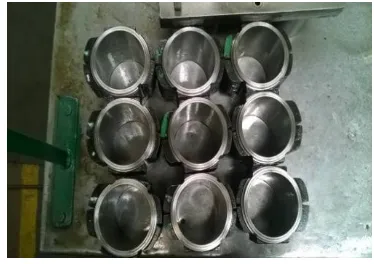
As casted cylinder liner prepared by gray cast iron shown in Figure 1 and 2. Chemical composition of the cylinder liner given in the table 1.
Figure. 1 Engine cylinder liners Figure.2 Engine cylinder liners top view
Table 1. Chemical Composition of cylinder liner
Element C Si Mn P Cr Su Cu Mo
%wt 3.35-3.45 1.70-1.80 0.60-0.70 0.05-0.07 0.40-0.45 0.05max 0.5-0.6 0.4-0.5
2.1 Historical data study
To understand this concept better data for occurrence of defects are collected from industries from last four months given in the table number 2 and 3. From this data a chart has been prepared which further helps to identify occurrence of major defects in castings. The data collection has been done by the team with the help and supervision by Quality Assurance Department. After performing studies and researches, the team found that defects are caused in shell moulding and foundry section were the biggest problem for the rejection and low productivity.
Table. 2. Defect survey on December-14 and january-15
Rejection type No of components rejected
December % of rejection January % of rejection
Total production 10227 9.6 12760 6.9
Foundry defects 413 4 540 4.2
Machine shop rejection 304 2.9 171 1.3
Rib cut 109 1 57 0.4
Due to power loss 38 0.3 30 0.2
Shell defects 147 1.4 104 0.8
ISSN(Online): 2319-8753 ISSN (Print): 2347-6710
I
nternational
J
ournal of
I
nnovative
R
esearch in
S
cience,
E
ngineering and
T
echnology
(An ISO 3297: 2007 Certified Organization)
Vol. 5, Issue 5, May 2016
Table. 3. Defect survey on February-15 and March-15
Rejection type No of components rejected
February % of rejection March % of rejection
Total production 8717 20.9 9205 14.5
Foundry defects 1392 15.9 948 10.2
Machine shop rejection 197 2.2 200 2.1
Rib cut 0.9 98 1
Due to power loss 21 0.2 41 0.4
Shell defects 120 1.3 74 0.8
From the history data analysis we observed that most of the defects occurred in the foundry section
Foundry defects are blow holes, cold shut, porosity, misrun etc.
Machine shop rejections occur due to tool cutting.
Rib cut occurs due to slow and fast pouring of molten metal and during removal of runner.
Shell defects occur due to low strength of mould which further leads to mould breaking. Figure 3 shows the graphical representation for percentage of rejection per month in industries.
0 20 40
Dec-14
Jan-15
Feb-15
Mar-15
P
er
ce
n
ta
g
e
o
f
o
f
re
je
ct
io
n
Month
% of rejection
Figure.3Percentage of rejection for various months 2.2 Cause and effect diagram
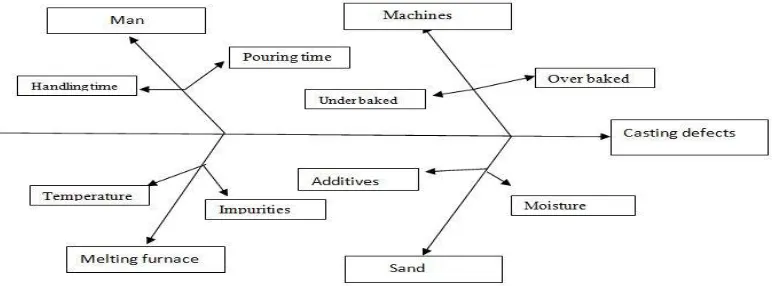
In order to analyze the particular case study properly, it is necessary to prepare some cause effect diagram for occurrence of particular type defect shown in Fig 4. Cause and effect diagrams were prepared for different types of defects like blowholes, porosity, misrun, and rib cut etc.
ISSN(Online): 2319-8753 ISSN (Print): 2347-6710
I
nternational
J
ournal of
I
nnovative
R
esearch in
S
cience,
E
ngineering and
T
echnology
(An ISO 3297: 2007 Certified Organization)
Vol. 5, Issue 5, May 2016
After observing the whole process in industry, various parameters like pouring time pouring temperature, handling time were selected which might be causes defects like blow hole,porocity,cold shut, misrun, inclusion, cracks and pinholes during casting process. In the present work by considering above mentioned parameters in order to study the various casting defects. Various pouring temperature, pouring time and Handling times selected during process are given inte table 4.
Table 4. Observation table Temperature
0 c
Avg. Handling time in sec
Avg. Pouring time in sec
1350-1380 10.56 5.20
1380-1410 10.21 4.48
1410-1430 12.66 5.71
1430-1470 11.26 5.29
1470-1500 9.56 3.94
3. Results and discussions
In present study by considering various parameters like Pouring temperature, Handling time and Pouring time, at different combinations at average of 30 components are following results are obtained as given in the table5.
Table 5. Experimentally observed casting defects Temperature
0 c
Avg. Handling time in sec
Avg. Pouring time in sec
No. of components
tested
No. of components
rejected
Type of rejection
1350-1380 9.0 4.20 30 9 Cold shut ,Blow hole
1380-1410 9.58 4.48 30 7 Blow hole
1410-1430 10.82 5.71 30 5 No
1430-1470 11.26 5.29 30 8 Porosity
1470-1500 11.59 4.94 30 12 Mould break
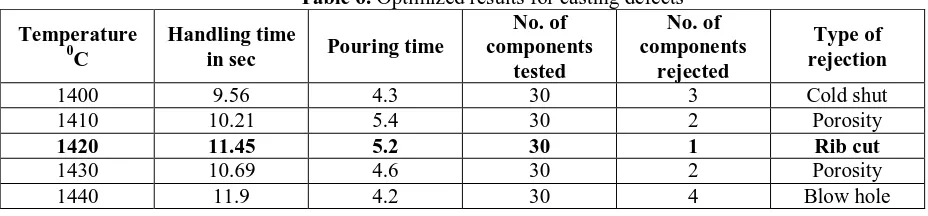
Experimental result obtained during casting process at various intervals of time and temperature are recorded in the table 5. By considering the temperature range of 14000c-1450 0c with various interval of time (handling time and pouring time)it was recorded various type of rejection given in the table 6.
Table 6. Optimized results for casting defects
Temperature 0
C
Handling time
in sec Pouring time
No. of components
tested
No. of components
rejected
Type of rejection
1400 9.56 4.3 30 3 Cold shut
1410 10.21 5.4 30 2 Porosity
1420 11.45 5.2 30 1 Rib cut
1430 10.69 4.6 30 2 Porosity
ISSN(Online): 2319-8753 ISSN (Print): 2347-6710
I
nternational
J
ournal of
I
nnovative
R
esearch in
S
cience,
E
ngineering and
T
echnology
(An ISO 3297: 2007 Certified Organization)
Vol. 5, Issue 5, May 2016
3.1 Effect of pouring time on rejection percentage
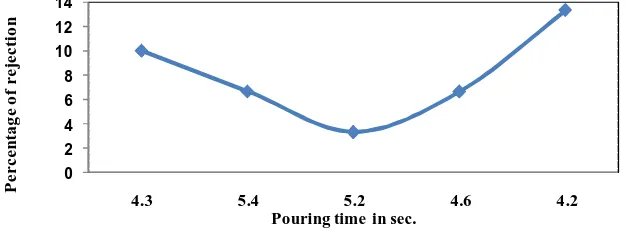
Figure 5 shows effect of pouring time on percentage of rejection. It was found that as the pouring time increases within the range of 3-6minute rejection rate is below 10%, where as time increases above 6 seconds it leads to increase the rejection percentage above 10%.
Figure.5 Pouring time vs percentage of rejection
It can be explained due to molten metal get solidified itself inside the mould as well as ladle before complete filling of the mould at the mean time the air entrapped in the metal during solidification it may lead to blow holes in casting shown in figure 9e and also pin holes. On other hand high pouring rate (least pouring time) increases pressurized fluid flow inside the mould and also there might be mean turbulent flow which may causes cavity harder and results to increases rough surface. It was evident that pouring time is the effective parameter in order to reduce the casting defects in present observation. According to the graph it was clear that rejection percentage is less at pouring time below 5 sec.
3.2 Effect of pouring temperature on rejection percentage
Figure 6 shows effect of pouring temperature on rejection percentage. According to figure where the temperature ranges below 14000c and above 14600c rejection percentage is within 10%. As temperature increases above 14500c and 15200c it leads to increase hot cracking mould, discontinuity as well as irregular casted component as shown in figure 9, due to high or excess temperature in casting process it is observed that breakage of the mould which produces defective component shown in figure 9a. Whereas at least temperature molten metal will get solidified inside the mould it may leads to cold shut, misrun or mismatch defects in the casting process at temperature range of 13500 c-14000c shown in figure 9b and 9d. It was clear by experimental study, pouring temperature
= 14300c -14500c rejection percentage is below 5% is the least rejection rate. There were 9 experiments conducted using Taguchi’s
0 5 10 15 20 25 30
1350 1380 1410 1430 1470 1500
Pe rc e n ta ge o f r e je ct io n
PouringTemperature in 0c
0 2 4 6 8 10 12 14
4.3 5.4 5.2 4.6 4.2
P e r c e n ta g e o f r e je c ti o n
ISSN(Online): 2319-8753 ISSN (Print): 2347-6710
I
nternational
J
ournal of
I
nnovative
R
esearch in
S
cience,
E
ngineering and
T
echnology
(An ISO 3297: 2007 Certified Organization)
Vol. 5, Issue 5, May 2016
DOE by changing the selected variables and different results were derived, from very bad to good, were shown up. Four process parameters were studied like sand – binder ratio, mould permeability, pouring temperature and de-oxidant amount in three levels. Factorial experiment was carried out. Finally it was concluded that the sand-binder ratio = 100:1, mould permeability = 250-300, pouring temperature = 1460-1490, and de-oxidant amount = 0.2 parameters are giving better and accurate castings [9]. Also handling time of molten metal from furnace to mould is essential parameter in order to avoid solidification of molten metal and gas entrapped from the atmosphere into molten metal which leads to increase blow holes and pin holes shown in figure e. Whereas pin hole and blow hole might be increases due to insufficient air vent provided in the mould as well as cavity. Due to increase in handling time it may causes the rib cut defect and mismatch or misrun in casted component shown in figure 9d.This can be explained due to the premature intrepton of pouring due to work man error.
Figure.6Temperature vs percentage of rejection
Fig 7. Melting Furnace Figure.8Pouring with ladle
a) Mould Break
ISSN(Online): 2319-8753 ISSN (Print): 2347-6710
I
nternational
J
ournal of
I
nnovative
R
esearch in
S
cience,
E
ngineering and
T
echnology
(An ISO 3297: 2007 Certified Organization)
Vol. 5, Issue 5, May 2016
b) Cold Shut
c) Rib Cut d) Misrun
Figure.9 Effect of temperature on different casting defects
3.3 Casting defect analyses
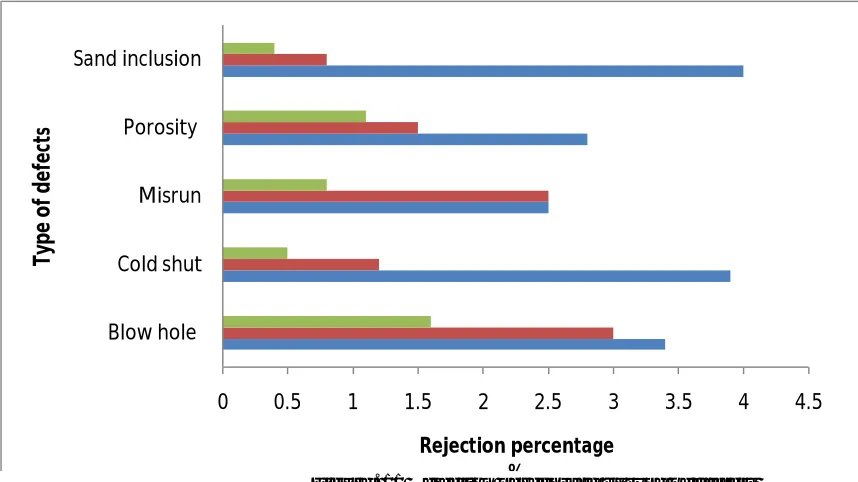
According to figure 10 various types of causes defects such as blow hole, porosity, sand inclusion, misrun, cold shut are observed in casting process at three different temperatures. It may due to improper handling time, pouring temperature, poring time which may causes various defects due to lack of knowledge and training imparted to workers which leads to rejection and rework of casting.
Figure. 11Rejection percentage vs type of defects
Apart from these parameters improper handling of ladle, mould cavity and mould box shown in figure 7 and 8, impurities or contamination which might be causes above mentioned defects. So it is very essential to proper cleaning of the mould cavity, mould box and ladle from contaminations as well as oil and moisture contents. In
0 0.5 1 1.5 2 2.5 3 3.5 4 4.5 Blow hole
Cold shut Misrun Porosity Sand inclusion
Rejection percentage %
Ty
p
e
o
f
d
ef
ec
ISSN(Online): 2319-8753 ISSN (Print): 2347-6710
I
nternational
J
ournal of
I
nnovative
R
esearch in
S
cience,
E
ngineering and
T
echnology
(An ISO 3297: 2007 Certified Organization)
Vol. 5, Issue 5, May 2016
order to identify the casting defect and problem related to casting. Especially industry based problem is decides to study in detail technical solution for minimizing various casting defects to improve the entire process of critical component manufacturing, is decided to work out during his project. This will be beneficial in enhancing the yield of casting. Beside this, standardization (optimization) of process parameter for entire cycle of manufacturing of the critical part is intended in the proposed work. By enhancing the quality and reducing the cost of casting component which in turn will be profitable for both the industry as well as the customer was planned in his proposed study. This was used to study the types of defects in the casting [10]. Some researchers have used statistical analysis method for optimizing process parameters of casting process.
IV. CONCLUSIONS
Based on the above experiment conducted the following conclusions are obtained
Percentage of rejections is less at 14200c-14800c.
Percentages of rejections are increasing at least temperature 14000c and maximum temperature14800 c.
As the pouring time increases the rate of rejection also increases.
As increased handling time which lead to increase in defective component.
Porosity and inclusions increased due to the impurity in the ladle and mould due to improper cleaning.
Least pouring time of molten metal leads to increase in the surface defects.
In this work, limited variables and relatively larger temperature ranges are taken. Finally experiments were conducted, it was clearly evident that the trail of experiment at the range of temperature of 14200 c-14500 c and handling time of 9-11 sec and pouring time of 4-5 sec are the better combination or optimized parameters in order to minimize the casting defects. This will help to quality control department of casting industries for analysis of casting defect. This study will definitely be helpful in improving the productivity and yield of the casting. Rejections of the casting on the basis of the casting defect should be as minimized and all the above research is heading in the same direction.
REFERENCES
[1] Review of Casting Defect Analysis to Initiate the Improvement Process “A.P.More, Dr.R.N.Baxi, Dr.S.B.Jaju Mechanical Engineering Department, G.H.Raisoni College of Engineering, Nagpur.440016 (India).
[2]Uday A. Dabade and Rahul C. Bhedasgaonkar “Casting Defect Analysis using Design of Experiments (DoE) and Computer Aided Casting Simulation Technique” Elsevier Forty Sixth CIRP Conference on Manufacturing Systems 2013
[3] Tapan Roy “Analysis of Casting Defects in Foundry by Computerised Simulations (CAE) - A New Approach along with Some Industrial Case Studies” Transaction of 61st Indian foundry congress 2013.
[4] C. M. Choudharia, B. E. Narkhedeb, S. K. Mahajanc “Methoding and Simulation of LM 6 Sand Casting for Defect Minimization with its Experimental Validation”, Procedia Engineering 97 ( 2014 ) 1145 – 1154
[5] S. Kuyucak, “Sponsored Research: Clean Steel Casting production – Evaluation of Laboratory Castings”, American Foundry Society, 2007 [6] Zhan MY, Li CM, Zhang WW, Zhan MY. Processing of AZ31 magnesium alloy by accumulative roll-bonding at gradient temperature. Acta Metall Sin 2012; 25(1):65e75.
[7] Neeti Churamani, “Using Orthogonal Defect Classification for Defect Analysis”, NIIT Technologies New Delhi, India
[8] Uday A. Dabade* and Rahul C. Bhedasgaonkar “Casting Defect Analysis using Design of Experiments (DoE) and Computer Aided Casting Simulation Technique” Procedia CIRP 7 (2013) 616 – 621
[9] Achamyeleh A. Kassie and Samuel B. Assfaw “Minimization of Casting Defects” IOSR Journal of Engineering (IOSRJEN) Vol. 3, Issue 5 (May. 2013)