ISSN(Online): 2319-8753 ISSN (Print): 2347-6710
International Journal of Innovative Research in Science,
Engineering and Technology
(A High Impact Factor, Monthly, Peer Reviewed Journal)
Visit: www.ijirset.com
Vol. 7, Issue 3, March 2018
Automatic Pet Feeder Using Arduino
Mritunjay Subhashchandra Tiwari 1, Sahil Manoj Hawal 1, Nikhil Navanath Mhatre 1, Akshay Ramesh Bhosale1,
Mainak Bhaumik2
UG student Mahatma Gandhi Mission’s College of Engineering and Technology, Kamothe New Mumbai, India1
Assistant professer Mahatma Gandhi Mission’s College of Engineering and Technology, Kamothe, New Mumbai,
India 2
ABSTRACT: The work is about pet feeding machine automatically for a daily minimum period of time of eight hours when all people of nuclear family members are busy at work for the survival in the metro cities and other cities. This set up is controlled by the Mobile app automatically. The pets of home can get food after an interval of half hours and the same can be monitored using mobile app and the owner of the pet always ensure about the feeding of the pet especially dogs and cats when they are busy at work. The food for pet has been kept inside a box while leaving home. The food would be served to the pets automatically up to a certain quantity only when the pet comes near to the box when they feel hungry. It is an excellent idea to protect the pets from starving whenever no one is at home and all are busy with their scheduled routine works and job at office or in business. The cost of a care taking of a pet has been reduced down due to the launching of such machine in the market. Such idea is being globally getting popular due to automatic system and mobile app involvement.
KEYWORDS: Continuous servo Motor, Arduino UNO, RTC.
I. INTRODUCTION
Nowadays most of us are fascinated to have pets at their home. But these pets have to be taken care properly. Their feeding on time is an important task as they become part of our family. But in our busy schedule we fail to pay attention on our pet thus it doesn’t get proper food on time. This paper addresses the above issue by introducing an Automatic Pet Feeding System to ensure feeding pet on frequent interval of time. Automatic Pet Feeding System consists food storage, servo motor, dispenser, feeding bowl, etc. It also features Arduino to automatically control the operations. It is also possible to make more hi-tech by adding cameras and audio box to check activities of pet and talk to it.
Automatic pet feeding system features a machine which can feed pets (e.g. dogs) automatically after frequent intervals in absence of his master. By using machine master don’t have to stay with his pet every time to feed it and he gets liberty to do his other works outside without caring about his pet. Dish for feeding pet could be filled in number of ways one is we can set the time and date using Arduino UNO which is displayed on LCD screen fitted on body of pet feeder.
ISSN(Online): 2319-8753 ISSN (Print): 2347-6710
International Journal of Innovative Research in Science,
Engineering and Technology
(A High Impact Factor, Monthly, Peer Reviewed Journal)
Visit: www.ijirset.com
Vol. 7, Issue 3, March 2018
Components
Automatic pet feeder includes these basic components mentioned: Continuous Servomotor MG995, Ky-40 Rotary Decoder Encoder Module, Real Time Clock (RTC), Arduino UNO, Acrylic sheets, PVC pipe T-Section, Wi-Fi module (ESP8266), LCD Display.
II. WORKING
Working of the Automatic Pet Feeder is given below according to the components used in the system:
1. Servo motor
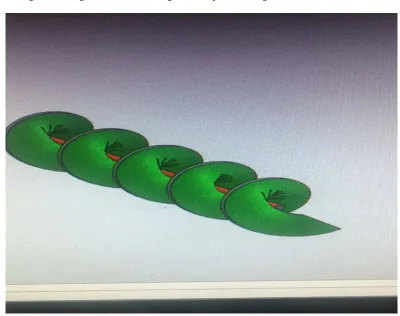
We are using Continuous Rotation 360 degrees gear Servo motor Arduino using MPN of MG-995 with digital modulation & having the torque (for 6.0V: 152.76 oz-in), Speed (for 6.0V: 0.16 sec/60 degree), weight(1.94 oz=55.0g), Gear type(Metal). The motor rotates the AUGER which delivers food from storage to dish. Motor gets the signals from Arduino UNO which is already programmed. When AUGER starts rotating due to servo motor the food from the upper body of the mechanism transmits to the dish. The shape of auger is like a drilling device, Auger which we are using is made by 3D Printing.
Fig. 1: Auger design
2. ARDUINO UNO:
ISSN(Online): 2319-8753 ISSN (Print): 2347-6710
International Journal of Innovative Research in Science,
Engineering and Technology
(A High Impact Factor, Monthly, Peer Reviewed Journal)
Visit: www.ijirset.com
Vol. 7, Issue 3, March 2018
header, and a reset button. It contains everything needed to control the microcontroller. Simply connecting with computer using USB cable to feed the program and get started. Arduino UNO is programmed by using Arduino IDE (an open source arduino software). Programming is done in a way that we can set the time and date for the system which is displayed on the LED screen. Real Time Clock (RTC) which is connected to arduino.the time is set by using Ky-040 rotary decoder encoder. When real time matches with the RTC it gives the signal to motor and motor starts rotating. Further motor gives the motion to the auger which transfers the food to the dish. Some features of Arduino UNO are as follows:
Microcontrollers: ATmega328. Operating Voltage: 5V.
Input Voltage (recommended): 7-12V. Input Voltage (limits): 6-20V.
Digital I/O Pins: 14(of which 6 provide PWM output). Analog Input Pins: 6.
DC Current per I/O Pin: 40mA. DC Current for 3.3V pm: 50mA.
Flash memory: 32 KB of which 0.5 KB used boot loader. SRAM: 2KB (ATmega328).
EE PROM: 1KB (ATmega328). Clock speed: 16 MHz.
ISSN(Online): 2319-8753 ISSN (Print): 2347-6710
International Journal of Innovative Research in Science,
Engineering and Technology
(A High Impact Factor, Monthly, Peer Reviewed Journal)
Visit: www.ijirset.com
Vol. 7, Issue 3, March 2018
3. Wi-Fi Module
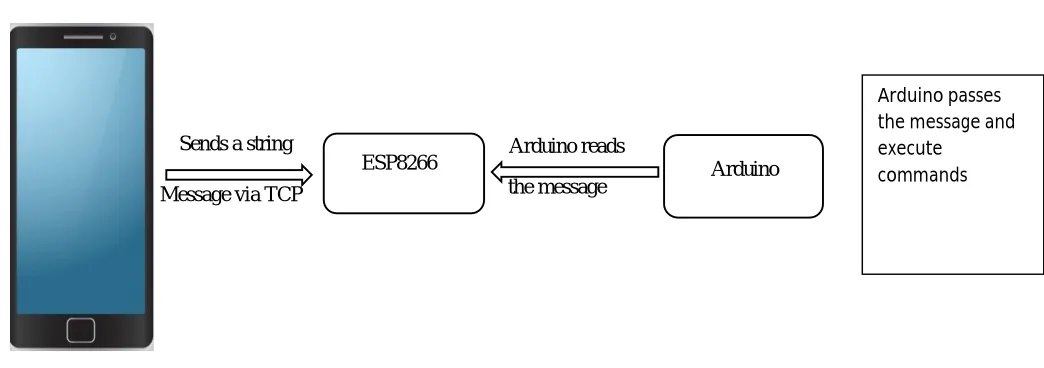
In Automatic pet feeder we are using ESP8266 Wi-Fi module which is a low cost Wi-Fi microchip with TCP/IP stack & microcontroller. ESP8266 module is used to receive the signal from mobile and transmits to Arduino which further gives signal to the servo motor. Some features of ESP8266 are mentioned below:
Processor: L106 32-bit RISC microprocessor or core based on the tensilica Xtensa diamond standard 106 micro running at 80MHz.
Memory: 32KiB instruction RAM. 32KiB instruction cache RAM. 80KiB user data RAM
16KiB ETS system data RAM. External QSPI flash: up to 16MiB is supported.
Fig. 3: Flowchart showing processing of wifi module
III. MECHANICAL DESIGN
We are using an acrylic fibre for making the outer body of pet feeder. Acrylic fibre is a synthetic fibre of polyacrylonitrile. Acrylate polymer is a group of polymers (plastics) noted for transparency and elasticity. Acrylic is safe for making food storage containers. Acrylic is non-toxic material for making the containers for storage of food. In this, we are using a 120 cm x 120 cm acrylic sheet. The thickness of sheet is 3 mm thick. The upper body of the pet feeder i.e. container is made by 25 cm x 25 cm x 25 cm box. And the lower body of the pet feeder is made by 35 cm x 35 cm x 15 cm box. The upper body consists the container for food storage having 1 kg capacity. The lower body consists the space for electronic operating components and display for the set time and set quantity. Lower body also consists the slot for dispensing the food from the container to the bowl according to the set time and in set quantity.
Dimensions 1. Upper Body a) Length – 25 cm b) Width – 25 cm c) Height – 25 cm 2. Lower Body a) Length – 35 cm
ESP8266 Arduino
Arduino passes the message and execute
commands
Sends a string
Message via TCP
Arduino reads
ISSN(Online): 2319-8753 ISSN (Print): 2347-6710
International Journal of Innovative Research in Science,
Engineering and Technology
(A High Impact Factor, Monthly, Peer Reviewed Journal)
Visit: www.ijirset.com
Vol. 7, Issue 3, March 2018
b) Width – 35 cm c) Height – 15 cm
IV. RESULTS & DISCUSSION
Automatic Pet Feeder works efficiently and fulfils the objective of feeding pet in absence of its master. It works for on house hold 230V AC supply. The servomotor rotates the Auger and food gets delivered into plate as programmed in the Arduino.
The design can be made more factory feasible and aesthetic. The auger can be made by 3D printing which can be created as the auger is the moving part. Different materials can be used unlike acrylic sheet which was used in it. The APF could be made more advanced by installing cameras and audio box as it would make possible to interact with pet through smart phones as well as keep observation on it.
APF is indeed a helper to the owner for proper care taking of pet and more advancements can be expected in future.
ISSN(Online): 2319-8753 ISSN (Print): 2347-6710
International Journal of Innovative Research in Science,
Engineering and Technology
(A High Impact Factor, Monthly, Peer Reviewed Journal)
Visit: www.ijirset.com
Vol. 7, Issue 3, March 2018
V. CONCLUSION
Automatic Pet Feeding System was planned to ensure the time to time feeding of pet in absence of its master so that master can do his other tasks without worrying about feeding. Automatic Pet Feeding System has attractive design and aesthetic model. Arduino and IoT adds Automation in the system. The report showcased the basic design of the system to be made. And also the Arduino circuit to control the functions of the system. The actual fabrication is expected in next academic semester. The success of Automatic Pet Feeding System would be great help to pet lovers in India.
ACKNOWLEDGEMENT
The authors are very much thankful for continuous support and inspiration received from all the faculty members, co-workers, colleagues of the MGM College of Engineering. We are grateful to our residential society neighbors to text the set up in their home with their pets to provide the food to the pets automatically using our machine. Last but not the least, we all the authors are very much thankful and grateful to our family members for moral support, inspiration with financial support to finish the project in time with positive results which achieved after a contribution of works of searching the materials from different location and assembling all that to get the results with a team works and during day night work at residential work the disturbance faced and the late night refreshment provided to us to complete the project successfully with continuous passionate trial and error method.
REFERENCES
[1]. S. Subaashri, M. Sowndarya, D.K.S. Sowmiyalaxmi, S.V. Sivassan, C. Rajasekaran (2017), ‘Automatic Pet Monitoring & Feeding System using IoT, Vol. No. 10, PP 253-258.
[2]. Lewis o Wing (1993), ‘Aytomatic Pet Feeder’.
[3]. Chung-Ming Own, Haw-Yunshin, Chen-Ya Teng (2013), ‘The Study & Application of the IoT in Pet Systems’ Vol.1, No.3, PP 1-8, http://dx.doi.org.
[4]. Rachel Hail, Kristine McCarthy, Filip Rege, Alexix Rodrigvez Carlson (2008), ‘The Smart Pet Feeder’.
BIOGRAPHY
1. Mritunjay Subhashchandra Tiwari BE Mechanical final year student in MGM College of Engineering and
Technology , Kamothe Navi Mumbai. Mb.+917303763867.
ISSN(Online): 2319-8753 ISSN (Print): 2347-6710
International Journal of Innovative Research in Science,
Engineering and Technology
(A High Impact Factor, Monthly, Peer Reviewed Journal)
Visit: www.ijirset.com
Vol. 7, Issue 3, March 2018
3. Nikhil Navnath Mhatre BE Mechanical final year student in MGM College of Engineering and Technology ,Kamothe Navi Mumbai. Mb:+919029839730.
4.Akshay Ramesh Bhosale BE Mechanical final year student in MGM College of Engineering and technology
,kamothe Navi Mumbai. Mb:+919029664513.
5. Mainak Bhaumik, B.E (Mechanical), M.E. (Thermal), is working as an Assistant Professor in MGM College of
Engineering and technology, Kamothe, Navi Mumbai, India. The author is having three years of experience in Deepak Fertilizers and Petrochemical Corporation Ltd., Navi Mumbai, India as an Assistant Manager, one year teaching experience in Sardar Patel College of Engineering, Andheri (W), Mumbai. India as a Lecturer in Mechanical Engg. Dept., one year teaching experience in Rizvi College of Engineering, Bandra (W), Mumbai, India as a Lecturer in Mechanical Engg. Dept. one year teaching experience in Saboo Siddik College of Engineering, Byculla (W), Mumbai, India as a Lecturer in Automobile Engg. Dept , New Panvel, Navi Mumbai – 410206, Maharastra, India. Mb. +919819568377.