DOI: 10.1534/genetics.106.068486
Male Development Time Influences the Strength of Wolbachia-Induced
Cytoplasmic Incompatibility Expression in
Drosophila melanogaster
Ryuichi Yamada,* Kevin D. Floate,
†Markus Riegler* and Scott L. O’Neill*
,1*School of Integrative Biology, The University of Queensland, Brisbane 4072 Australia and†Lethbridge Research Center, Agriculture and Agri-Food Canada, Lethbridge, Alberta T1J 4B1, Canada
Manuscript received November 17, 2006 Accepted for publication July 4, 2007
ABSTRACT
Cytoplasmic incompatibility (CI) is the most widespread reproductive modification induced in insects by the maternally inherited intracellular bacteria, Wolbachia. Expression of CI inDrosophila melanogasteris quite variable. Published papers typically show that CI expression is weak and often varies between different Drosophila lines and different labs reporting the results. The basis for this variability is not well understood but is often considered to be due to unspecified host genotype interactions with Wolbachia. Here, we show that male development time can greatly influence CI expression inD. melanogaster. In a given family, males that develop fastest express very strong CI. The ‘‘younger brothers’’ of these males (males that take longer to undergo larval development) quickly lose their ability to express the CI phenotype as a function of development time. This effect is independent of male age effects and is enhanced when flies are reared under crowded conditions. No correlation is seen between this effect and Wolbachia densities in testes, suggesting that a more subtle interaction between host and symbiont is responsible. The observed younger brother effect may explain much of the reported variability in CI expression in this species. When male development time is controlled, it is possible to obtain consistently high levels of CI expression, which will benefit future studies that wish to useD. melanogasteras a model host to unravel CI mechanisms.
W
OLBACHIA are intracellular, maternally inherited,a-Proteobacteria known to infect a broad range of invertebrates, including crustaceans, mites, filarial nema-todes, spiders, and at least 25% of all insect species (Werren 1997; Jeyaprakash and Hoy 2000; Floate
et al. 2006). In arthropods, Wolbachia commonly act as reproductive parasites and manipulate their host’s reproduction in a variety of ways, including male killing, feminization of genetic males, parthenogenesis induc-tion, or more commonly via cytoplasmic incompatibility (CI) (Werrenand O’Neill1997). It is considered that
all these phenotypes provide a reproductive advantage to infected females, thereby allowing Wolbachia to per-sist and spread into host populations (Hoffmannand
Turelli1997).
CI is the best-described reproductive modification caused by Wolbachia. CI results in failure to produce progeny in crosses between an infected male and a female that lacks the same strain of Wolbachia found in the male. The reciprocal cross between uninfected males and infected females is fertile, as are crosses between males and females harboring the same Wolba-chia strain. CI provides a reproductive advantage to infected females since they can mate successfully with either infected or uninfected males, while uninfected
females are incompatible with infected males (Werren
and O’Neill 1997). Therefore, as a consequence of
maternal inheritance of Wolbachia-infected individuals will increase in frequency in a host population. Though the molecular mechanisms of CI have not yet been identified, several lines of evidence suggest that the proper functioning of sperm is modified by Wolbachia infection (Werren1997; Poinsotet al. 2003).
Cytolog-ical studies demonstrate a delay in nuclear envelope breakdown and a disruption of paternal chromosome condensation in CI embryos during the first mitotic division, leading to their subsequent death (Callaini
et al. 1997; Tramand Sullivan2002; Tramet al. 2003).
Werren proposed a nomenclature for describing Wolbachia strains based on the modification status of male sperm and the ability of female embryos to rescue this modification. In this system, four phenotypic cate-gories can be expected: mod1/resc1, mod1/resc,
mod/resc1, and mod/resc- (Werren 1997). In wild
Drosophila simulans population, five distinct Wolbachia strains have been reported to date (Mercot and
Charlat 2004). wRi, wHa, and wNo have been
de-scribed as mod1/resc1 strains. These three Wolbachia strains induce distinctive CI phenotypes inD. simulans. The wRi strain induces high CI, while wHa and wNo show partial CI (Mercot and Charlat 2004). In
ad-dition, two modstrains have been described from D. simulans;wMa displays amod/resc1phenotype (Mercot
and Poinsot 1998a; Charlat et al. 2003) and wAu is
1Corresponding author:School of Integrative Biology, The University of Queensland, St. Lucia, QLD 4072, Brisbane, Australia.
E-mail: [email protected]
considered amod/rescstrain, which induces no CI and does not appear to rescue the modification of all
mod1 strains tested so far ( Jamesand Ballard2000;
Reynolds and Hoffmann2002; Charlatet al. 2003,
2004).
In D. melanogaster, Wolbachia infection also induces CI (Hoffmann1988), but its expression appears much
more variable. Early studies have shown CI expression ranging from 0 to 77% incompatible embryos (Holden
et al. 1993; Hoffmannet al. 1994; Solignacet al. 1994).
Genetic characterization of Wolbachia strains, based on gene sequences such as 16S rDNA (Holdenet al. 1993),
ftsZ(Werrenet al. 1995),dnaA(Bourtziset al. 1994),
and wsp (Zhou et al. 1998), have all concluded that
D. melanogaster is predominantly infected by a single
mod1/resc1strain of Wolbachia known aswMel. How-ever, expression of CI by this strain appears to be very variable, with different studies reporting results ranging from very strong to very weak CI (Bourtziset al. 1996;
Poinsotet al. 1998; McGrawet al. 2002; Reynoldsand
Hoffmann2002). The basis of this variability is not well
understood but is often considered to be due to host genetic background differences. Another possible ex-planation is that the wMel strain actually consists of different cryptic variants. A recent report has character-ized five different Wolbachia genetic variants within stocks ofD. melanogaster(Riegleret al. 2005), although
phenotypic variation associated with these strains is unclear.
Several environmental and physiological factors have been identified that influence the expression of CI in
D. simulans. For example, infected males exposed to nu-tritional stress have a decreased ability to induce CI (Sinkins et al. 1995; Clancy and Hoffmann 1998).
Similarly, males that have multiply mated also show reduced expression of CI (Karret al. 1998) as do old
males (Hoffmannet al. 1990; Turelliand Hoffmann
1995). The influence of these factors on expression of CI inD. melanogasteris unclear.
Only one study has shown very strong CI in w Mel-infected D. melanogaster (Reynolds and Hoffmann
2002). In this study, Reynolds and Hoffmann clearly showed the importance of a male age effect in D. melanogaster. They described that CI levels declined rapidly with increasing male age in both wMel- and
wMelCS-infected lines. Notably, 1-day-old males showed almost perfect CI, while 5-day-old males expressed no CI. Following the discovery of a male age effect, very young males have been used for CI tests in recent studies (Veneti et al. 2003; Fry et al. 2004). Unexpectedly,
Veneti et al. (2003) observed weak CI in 3 different
variants (25% withwMel, 0% withwMelCS andwMelPop) and Fryet al. (2004) observed no CI withwMel, despite
using young males. Taken together, the large fluc-tuations of CI levels reported within single host lines under the same experimental conditions (Solignac
et al. 1994; Poinsot et al. 1998) suggests that factors
other than male age are influencing CI levels in D. melanogaster.
In this study, we show for the first time, to our knowledge, an effect of male development time on CI expression. InD. melanogaster, consistently high levels of CI are expressed when the fastest developing males are used in crosses. The ‘‘younger brothers’’ of these males quickly lose their ability to express the CI phenotype as a function of development time. The observed younger brother effect may explain much of the reported vari-ability in CI expression inD. melanogaster.
MATERIALS AND METHODS
Fly lines: Fly lines were kept on a standard corn diet at a constant temperature of 25°. TheD. melanogaster strain de-signated BNE used in this work originated from field-caught flies collected in Brisbane, Queensland, Australia in 2004 (BNE) and 2006 (BNE2). BNE and BNE2 are both infected with thewMel Wolbachia strain (Riegleret al. 2005). Virgin
females from D. melanogaster yw67c23 infected with the wMel Wolbachia strain were mated to males of the BNE line. Female offspring were then backcrossed to males of the BNE line for a total of five generations. The resultingwMel(BNE) line was maintained for a further five generations before performing CI assays. Cured wMel(BNE) and BNE2 lines were subse-quently generated by tetracycline treatment following estab-lished protocols (Hoffmann1988) and designated BNE-T and
BNE2-T. The following Wolbachia-infectedD. melanogasterand D. simulanslines were used in this work:D. melanogaster Canton-S carrying thewMelCS Wolbachia strain, Harwich carrying the wMel (Riegleret al. 2005),D. simulansN7No carrying thewNo
(Mercotand Poinsot1998b), Coffs Harbour carryingwAu
(Hoffmannet al. 1996), and DSH carrying thewHa infection
(O’Neilland Karr1990). Wolbachia genotypes were
charac-terized using polymorphic markers (Riegler et al. 2005;
Millerand Riegler2006). Cured lines were generated and
designated CS-T, Hw-T, No-T, Ha-T, and Au-T.
Rearing conditions: To standardize rearing conditions for CI tests, flies (n¼100 aged3–5 day, male and female mixed population) were grown under controlled low density condi-tions. One hundred flies (3–5 days old, male and female mixed population) were collected from stock bottles and placed into plastic bottle egging chambers. They were allowed to oviposit for 5 hr, and then 200 eggs were counted and transferred to fresh bottles containing 40 ml of diet. This ensured that all flies used in subsequent crosses had been reared under standardized conditions of low density. All flies were incubated at 25°with a 12-hr-light/dark cycle.
CI tests:Unless noted, male flies were used in CI tests within 24 hr of eclosing to avoid any complications arising from diminishing incompatibility with increasing male age. Female flies ,5 days old were used in crosses. For D. melanogaster, single pairs of males and females were placed in empty vials and visually monitored for mating. Pairs that failed to mate were excluded. The Wolbachia infection status of mated males was confirmed by PCR of thewspgene using primers 81F and 691R (Braiget al. 1998). Females were transferred to plastic
using a Mann-WhitneyU-test. ForD. simulans, single pairs of virgin males and females were introduced to plastic bottles with molasses plate lids. They were given 24 hr to mate, then the males were removed and the females were allowed to lay eggs. The same procedure as above was followed to collect eggs.
Wolbachia density measurement: Virgin male flies were collected within 7 hr of eclosion and incubated overnight in standard food vials and then frozen at 80°. DNA of single flies was extracted using the Holmes-Bonner method (Holmes and Bonner 1973). DNA of testes was extracted
using the simplified STE method (O’Neillet al. 1992). In
brief, a single pair of testes was dissected into 20ml of STE (100 mm NaCl/10 mm Tris-HCl, pH 8.0/1 mm EDTA, pH 8.0)
containing 1 mg/ml proteinase K and incubated for 30 min at 37°followed by 5 min at 95°. Samples were vortexed and briefly centrifuged, and 1ml of the supernatant was used as the tem-plate in subsequent quantitative PCR (Q-PCR) using the LightCycler system (Roche) with SYBR Green (Invitrogen, Carlsbad, CA). Primers were designed to amplify 69-bp regions of the single copy Wolbachia WD1063/wsp gene (444F 59 -AGCGTATATTAGCACTCCTTTGGAA and 512R 59- TGACCA GCAAAACCAAATTTACTTT). A temperature profile of 95°
for 5 sec, 60°for 5 sec, and 72°for 10 sec was used for 50 cycles. Initial copy number was estimated by comparison to a stan-dard curve using Roche LightCycler data analysis software v3.1.02. Three replicates were run and averaged for each sample. For each eclosion-day point, we collected measure-ment on five samples. Statistical analysis was performed using Mann-WhitneyU-test.
Immunological studies: Testes were dissected in TBST (25 mmTris, 137 mmNaCl, 5 mmKCl, 0.1% Tween, pH 7.5) and
fixed with TBST containing 3.7% formaldehyde for 30 min. After washing with TBST, testes were incubated overnight at 4°
in a 1:500 dilution of anti-WSP polyclonal antibody (Dobson
et al. 1999) in TBST with 1% BSA. After removing the primary antibody with TBST, testes were incubated for 1 hr at room temperature in a 1:500 dilution of Alexa Fluor 488 goat anti-rabbit IgG (H1L) antibody (Molecular Probes, Eugene, OR; no. A11034) in TBST with 1% BSA. Testes were then washed in TBST and stained with 1 mg/ml 49 ,6-diamidino-2-phenylin-dole (DAPI) for 5 min, washed again, and mounted with 80% glycerol. Individual cysts were removed from the testes and stained on poly-l-lysine-coated slides according to Clarket al.
(2002).
RESULTS
The complete genome sequence of the Wolbachia
wMel strain was determined using Wolbachia isolated from the D. melanogaster yw67c23 line (Wu et al. 2004). However, yw67c23males failed to copulate within a 1-hr observation period in our lab, presumably due to muta-tions in theyellowandwhitegenes (Burnetet al. 1973;
Sciandraand Bennett1976; R. Yamada, unpublished
results), while wild-type D. melanogaster males typically copulate within 5 min. To facilitate standardized CI test conditions using visually monitored mating, we gener-ated a field-caught wild-typeD. melanogasterline carrying
wMel originating from yw67c23, designatedwMel(BNE). We tested if male development time influenced the strength of CI expression in D. melanogaster using
wMel(BNE) under controlled uncrowded conditions (200 eggs seeded per bottle). Adult fly emergence
under these conditions was very synchronous, occur-ring predominantly within a 2-day time interval (Figure 1A). In crosses between day 1-eclosing infected males and uninfected BNE-T females, the CI level (mean unhatched eggs) was 0.95 (n¼17) compared to 0.02 (n¼12) in crosses where both sexes were uninfected (Figure 2). The high CI induced by day 1 males declined with increasing larval development time. Day 2 males induced slightly weaker CI (0.85,n¼19) in comparison to that of the Day 1 males (Mann-Whitney, P ¼0.01), while day 3 males induced greatly reduced CI (0.529,
n¼15) when compared to day 1 males (Mann-Whitney,
P,0.0001).
Under crowded conditions (900 eggs seeded per bottle), flies eclosed over a longer time period with greater variability (Figure 1B). When males from these bottles were used in CI test crosses, it was found that initial CI strength from day 1 males was indistinguish-able from equivalent males from uncrowded bottles. However, males collected on subsequent days showed significantly reduced CI expression compared to equiv-alent males reared under uncrowded conditions (Fig-ure 2). Males eclosing on day 5 expressed no CI, hatch rates being indistinguishable from control crosses.
crowded day 1 males, but CI data showed that the smaller flies eclosing earlier expressed stronger CI than the late eclosing larger flies. Therefore, the younger brother ef-fect cannot be explained simply as a consequence of male size.
It is well known that CI strength is dependent on Wolbachia densities in insects (Breeuwerand Werren
1993; Bressacand Rousset1993; Bourtziset al. 1996;
Bordenstein et al. 2006) and it is possible that the
observed effect could be explained by a relationship between male development time and Wolbachia density. We examined Wolbachia densities in flies collected on different emergence days by quantitative PCR (Q-PCR) using the single copywspgene. Initiallywspgene copy number was quantified from whole flies and no re-duction was observed in absolute quantities of
Wolba-chia despite the smaller size of late eclosing males (Figure 4A). We then examined wspcopy number in dissected testes of males grown under both crowded and uncrowded conditions and again no correlation was found between Wolbachia density and male develop-ment time (Figure 4B), even under the more extreme crowded conditions. It is possible that Wolbachia dis-tribution within sperm cysts, rather than densityper se, might be a better predictor of CI levels (Clark et al.
2002, 2003; Veneti et al. 2003). Therefore, we
per-formed DAPI staining and immunostaining to visualize Wolbachia density and distribution in testes and cysts. Although day1-eclosed males induce almost perfect CI expression, we could not detect any difference in Wolbachia densities or distribution in cysts between day 1 and day 5 males (data not shown) consistent with the Figure 1.—Distribution of fly emergence in
uncrowded conditions with 200 eggs per bottle (A) and crowded conditions with 900 eggs per bottle (B). wMel(BNE) flies were kept on a 12-hr-light/dark cycle and emerging flies were counted every morning (9:00 am) and evening
(5:00pm). Bars, mean number of flies emerging
per bottle (n¼3). Error bars indicate SEM.
Figure 2.—Younger brother effect on the level of CI in
wMel-infectedD. melanogaster. Crosses were performed as fol-lows: open circles, BNE-T females3wMel(BNE) males grown under uncrowded conditions of 200 eggs per bottle; closed circles, BNE-T females 3 wMel(BNE) males grown under crowded conditions of 900 eggs per bottle; open square, BNE-T females 3 BNE-T males compatible cross control; closed square,wMel(BNE) females3wMel(BNE) males com-patible cross control. Values beside circles and squares repre-sent number of single-female replicates. Error bars indicate SEM.
Figure3.—Mean wing length of male flies. Open circles,
Q-PCR data. As such, the younger brother effect cannot be explained by an interaction between development time and Wolbachia densities in flies.
We examined the generality of the younger brother ef-fect by examining differentD. melanogasterlines. Canton-S and Harwich are long-established inbred laboratory strains naturally infected withwMelCS andwMel, respectively (Riegleret al. 2005). InwMelCS-infected Canton-S, we
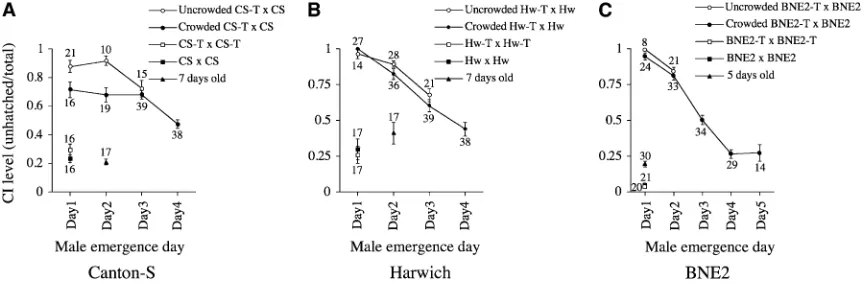
observed a weaker younger brother effect (Figure 5A). Under uncrowded conditions, day 2 males induced a similar level of CI (0.92, n ¼ 10) compared to day 1 males (0.88,n¼21), while day 3 males induced reduced CI (0.72,n¼15) when compared to day 1 males (Mann-Whitney,P¼0.03). Under crowded condition, the initial CI strength from day 1 males (0.71,n¼16) was distin-guishable from equivalent males from uncrowded bottles (Mann-Whitney,P¼0.02), whereas day 2 and day 3 males induced similar CI strength (0.68,n¼19; 0.679,n¼39, respectively) when compared to day 1 males. The CI strength declined in day 4 males (0.47,n ¼38) com-pared to day 3 males under crowded conditions (Mann-Whitney,P , 0.001). In wMel-infected Harwich, the younger brother effect was obvious in both uncrowded and crowded conditions (Figure 5B). In addition, the recently field-caught BNE2 line infected withwMel was also examined for the effect. In this line, a strong youn-ger brother effect was observed in both uncrowded and crowded conditions (Figure 5C). To examine the influ-ence of male age effects, day 1 males were aged for 5 days and then used for CI tests. Five-day-old males that had originally eclosed on day 1 showed a reduced ability to express CI (0.19,n ¼30) when compared to 1-day-old
males (Mann-Whitney,P,0.001) (Figure 5C). Seven-day-old males expressed no CI in the Canton-S and Harwich lines, although equivalent males induced high CI if they were only 1 day old (Figure 5, A and B).
We also examined Wolbachia strains inD. simulans. As observed forwMel inD. melanogaster, CI levels associated with thewNo strain inD. simulans have been reported as quite variable, making it a potential candidate for the younger brother effect (Mercot et al. 1995; Mercot
and Poinsot1998a; Jameset al. 2002; Venetiet al. 2003;
Mercotand Charlat2004). Under our experimental
conditions,wNo induced strong CI expression. In crosses between day 1 wNo-infected males and uninfected fe-males, mean egg hatch failure was 0.86 (n¼21) com-pared to 0.09 (n¼21) in crosses where both sexes were uninfected (Table 1). While there was some variability in CI levels between males with different development time, there was no clear younger brother effect. We also examinedwHa- andwAu-infectedD. simulans. ThewHa infection expressed strong CI regardless of male de-velopment time. The wAu line expressed no CI even when day 1 males where used in the test cross (Table 1). This is consistent with the previous report that thewAu strain does not induce CI (James and Ballard 2000;
Reynoldsand Hoffmann 2002; Charlat et al. 2003,
2004).
DISCUSSION
In studies of the Wolbachia symbiosis of insects during the last 20 years,D. simulanshas been used more heavily as a model host thanD. melanogaster, despite the wealth of genetic tools available in the latter. One of the reasons for this is the highly variable expression of the CI phenotype in D. melanogaster, making its study difficult. In different papers, a variety of CI levels have been reported, varying from 0 to almost 100%. Recent work from Reynoldsand Hoffmann(2002) indicated
that almost 100% CI could be obtained with w Mel-infected 1-day-old males but not with older males, indi-cating a strong male age effect in this species. However, even when this factor has been controlled in subsequent experiments, variability in CI expression has still been seen. For example, Fryet al. (2004) observed no CI
ex-pression inwMel-infected lines, even though they used
16- to 40-hr posteclosion males. In a study reported by Venetiet al. (2003), 1-day-old males were used in CI
crosses; however, wMel-infected lines showed low CI levels (25%), whilewMelCS andwMelPop showed no CI. Similarly, McGrawet al. (2002) detected weak CI
usingwMel-infected 1- to 2-day-old males.
One possible confounding factor in these different studies is the possibility of multiple matings by males. Reynoldsand Hoffmann(2002) separated males and
females after mating to avoid repeated copulation. In contrast, other studies have left males and females Figure 4.—Mean Wolbachia density as determined by
together during the egg collection period. Repeated copulation is a factor that is known to reduce CI inD. simulans (Karr et al. 1998). If males remained with
females for several days, CI expression could be di-minished by both repeated copulation and subsequent matings with older males. In contrast, isolated females produce constant CI levels for 5 days after copulation (R. Yamada, unpublished results). However, in the
report of Fry et al. (2004), eggs were collected from
females kept with males for one 24-hr period, limiting the possibility of either male age or multiple mating effects. CI levels would have been predicted under these conditions to be around 50%, but no CI was found.
Although some of these contradictions might have been due to repeated copulation and/or host line differences, much of it might be due to an undescribed factor influencing CI levels, independently of male age effects. In this study, we found that a rapid decline in CI levels is correlated with male development time. This
effect is independent of male age. For example, 1-day-old males expressed high CI levels if they had un-dergone fast development, whereas no CI was detected with 1-day-old males that had undergone slow develop-ment. However, males that develop fastest lose their ability to express CI as they age. These results suggest that male development time and male age influence CI expression independently. Male development time influenced CI expression in all D. melanogaster lines examined, including North American inbred lab lines (Canton-S, Harwich) and a recently caught Australian (BNE2) wild-type strain as well as across two Wolbachia genotypes (wMel andwMelCS), indicating that this is a general effect inD. melanogaster. We refer to this obser-vation as the younger brother effect, and it may explain much of the reported variability in CI expression in
D. melanogaster.
We examined three possibilities to explain the re-lationship between CI levels and observed development Figure5.—Younger brother effect on the level of CI in differentD. melanogasterlines. (A) Canton-S line. (B) Harwich line. (C)
BNE2 line. Crosses were performed as follows: open circles, uninfected females3infected males grown under uncrowded con-ditions of 200 eggs per bottle; closed circles, uninfected females3infected males grown under crowded conditions of 900 eggs per bottle; open square, uninfected females3uninfected males compatible cross control; closed square, infected females3infected males compatible crosses control; closed triangle, uninfected females37-day-old infected males (A and B) and uninfected fe-males35-day-old infected males (C). Values beside circles and squares represent number of single-female replicates. Error bars indicate SEM.
TABLE 1
Effect of male development time on CI in Wolbachia-infectedD. simulans
Female Male No. of crosses Total eggs counter Mean CI (unhatched/total) SE
No-T wNo-Day1 21 1387 0.862 0.022
No-T wNo-Day2 23 2262 0.779 0.025
No-T wNo-Day3 22 2361 0.798 0.042
No-T wNo-Day4 25 2770 0.835 0.031
No-T No-T 21 1530 0.089 0.011
Ha-T wHa-Day1 9 734 0.994 0.006
Ha-T wHa-Day2 10 726 0.987 0.007
Ha-T wHa-Day3 3 243 0.870 0.065
Ha-T Ha-T 10 920 0.096 0.009
Au-T wAu-Day1 19 2118 0.346 0.058
wAu wAu-Day 20 2028 0.363 0.045
time differences. First, slower developing males might lose the infection, resulting in the presence of un-infected males in CI crosses. This can be excluded by the observation that the Wolbachia infection in males was present in nearly 100% of individuals across all de-velopment times. The infection status of males was confirmed by PCR after copulation and data from PCR-negative males were excluded in our analysis. Second, fastest developing males might have originated from eggs laid earlier in the life of females, which in turn may have influenced CI. Larvae from these eggs may develop faster and contain higher levels of Wolbachia. If a female effect such as this existed, then males that develop from eggs laid by older females should ex-press lower CI than males that develop from eggs laid by younger females. No difference in CI levels of sons derived from either young or old females was observed. Third, a relationship might exist between Wolbachia density and development time such that highly infected larvae develop faster than larvae infected at low levels. There are a number of reports suggesting a positive correlation between Wolbachia density and strength of CI in many insect species, including Drosophila. In an earlier study, Bressac and Rousset (1993) found a
decrease in the frequency of infected sperm cysts with age, which might correlate with the reduction of CI levels in older males. Following this discovery, Clark
et al. (2002) found that fewer cysts are infected inw Mel-infected D. melanogaster thanwRi-infected D. simulans. Recently, Veneti et al. (2003) showed a relationship
between the percentage of infected cysts and CI levels in a variety of Wolbachia strains. In their report,mod1
strains, includingwRi,wHa, wNo, andwMel showed a positive correlation between infected cysts and CI levels. On the basis of this hypothesis, testes of fast developing males should carry higher infection densities than slower developing males. However, we failed to detect any differ-ence in either Wolbachia density in testes or frequency of infected cysts between fast and slow developing males. In our data, allwMel-infected males showed a low infection frequency of cysts (,10%). This observation is consis-tent with previous studies (Veneti et al. 2003). It is
possible that Wolbachia are lost after eclosion, although sperm chromosomes are fully modified in the early stages of development. The loss of Wolbachia-infected cysts happens around day 3 posteclosion in D. simulans
(Clarket al. 2002). It is possible that slower developing
males lose their Wolbachia, whereas fast developing males maintain a Wolbachia density necessary for high CI induction. To test this, we examined the infection status of newly eclosed males prior to the standard time allowed for maturation before being used in crossing studies. Again, we saw no difference between fast and slow developing males by both Q-PCR of testes and DAPI staining of sperm cysts (data not shown).
The effect of crowding on expression of the younger brother effect was quite pronounced, suggesting that
nutritional stress may play a role in its expression. How-ever, neither nutritional condition nor body sizeper seis known to directly influence CI strength (Clancy and
Hoffmann1998; our data). While the younger brother
effect appears to be quite strong inD. melanogaster, the mechanism by which it acts seems independent of bacterial density. It also seems to be largely absent in
D. simulans. Understanding this effect and controlling for it in experiments allows consistently high levels of CI to be expressed, which will greatly facilitate the use of
D. melanogaster as a model organism to determine the molecular mechanisms by which Wolbachia is so suc-cessfully able to manipulate the reproduction of its host.
We thank Manpreet Sidhu and Jenny Gough for technical support and assistance and Peter Cook, David Merritt, and Jason Rice for help with experiments. We also thank Michael Clark, Elizabeth McGraw, and Wolfgang Miller for helpful discussion and In˜ aki Iturbe-Ormaetxe and Jeremy Brownlie for providing constructive comments on the manuscript. This work was supported by grants from the Australian Research Council.
LITERATURE CITED
Bordenstein, S. R., M. L. Marshall, A. J. Fry, U. Kimand J. J. Wernegreen, 2006 The tripartite associations between bacte-riophage, Wolbachia, and arthropods. PLoS Pathog.2:e43. Bourtzis, K., A. Nirgianaki, P. Onyangoand C. Savakis, 1994 A
prokaryotic dnaA sequence inDrosophila melanogaster: Wolbachia infection and cytoplasmic incompatibility among laboratory strains. Insect Mol. Biol.3:131–142.
Bourtzis, K., A. Nirgianaki, G. Markakisand C. Savakis, 1996 Wolba-chia infection and cytoplasmic incompatibility in Drosophila species. Genetics144:1063–1073.
Braig, H. R., W. Zhou, S. L. Dobsonand S. L. O’Neill, 1998 Clon-ing and characterization of a gene encodClon-ing the major surface protein of the bacterial endosymbiont Wolbachia pipientis. J. Bacteriol.180:2373–2378.
Breeuwer, J. A., and J. H. Werren, 1993 Cytoplasmic incompatibil-ity and bacterial densincompatibil-ity inNasonia vitripennis. Genetics135:565– 574.
Bressac, C., and F. Rousset, 1993 The reproductive incompatibility system in Drosophila simulans: DAPI-staining analysis of the Wol-bachia symbionts in sperm cysts. J. Invertebr. Pathol.61:226–230. Burnet, B., K. Connollyand B. Harrison, 1973 Phenocopies of pigmentary and behavioral effects of the yellow mutant in Dro-sophila induced by alpha-dimethyltyrosine. Science181:1059– 1060.
Callaini, G., R. Dallai and M. G. Riparbelli, 1997 Wolbachia-induced delay of paternal chromatin condensation does not prevent maternal chromosomes from entering anaphase in incompatible crosses of Drosophila simulans. J. Cell Sci.110(Pt. 2): 271–280. Charlat, S., L. LeChatand H. Mercot, 2003 Characterization of non-cytoplasmic incompatibility inducing Wolbachia in two con-tinental African populations of Drosophila simulans. Heredity
90:49–55.
Charlat, S., M. Riegler, I. Baures, D. Poinsot, C. Staufferet al., 2004 Incipient evolution of Wolbachia compatibility types. Evo-lution Int. J. Org. EvoEvo-lution58:1901–1908.
Clancy, D. J., and A. A. Hoffmann, 1998 Environmental effects on cytoplasmic incompatibility and bacterial load in Wolbachia-infected Drosophila simulans. Entomol. Exp. Appl.86:13–24. Clark, M. E., Z. Veneti, K. Bourtzisand T. L. Karr, 2002 The
dis-tribution and proliferation of the intracellular bacteria Wolbachia during spermatogenesis in Drosophila. Mech. Dev.111:3–15. Clark, M. E., Z. Veneti, K. Bourtzis and T. L. Karr,
Dobson, S. L., K. Bourtzis, H. R. Braig, B. F. Jones, W. Zhouet al., 1999 Wolbachia infections are distributed throughout insect somatic and germ line tissues. Insect Biochem. Mol. Biol.29:
153–160.
Floate, K. D., G. K. Kyei-Pokuand P. C. Coghlin, 2006 Overview and relevance of Wolbachia bacteria in biocontrol research. Bio-control Sci. Tech.16:767–788.
Fry, A. J., M. R. Palmerand D. M. Rand, 2004 Variable fitness ef-fects of Wolbachia infection inDrosophila melanogaster. Heredity
93:379–389.
Hoffmann, A. A., 1988 Partial cytoplasmic incompatibility between two Australian populations ofDrosophila melanogaster. Entomol. Exp. Appl.48:61–67.
Hoffmann, A. A., and M. Turelli, 1997 Cytoplasmic incompatibil-ity in insects, pp. 42–80 inInfluential Passengers: Inherited Microor-ganisms and Arthropod Reproduction, edited by S. L. O’Neill, A. A. Hoffmannand J. H. Werren. Oxford University Press, Oxford. Hoffmann, A. A., M. Turelliand L. G. Harshman, 1990 Factors affecting the distribution of cytoplasmic incompatibility in Dro-sophila simulans. Genetics126:933–948.
Hoffmann, A. A., D. J. Clancyand E. Merton, 1994 Cytoplasmic incompatibility in Australian populations ofDrosophila melanogaster. Genetics136:993–999.
Hoffmann, A. A., D. Clancy and J. Duncan, 1996 Naturally-occurring Wolbachia infection inDrosophila simulansthat does not cause cytoplasmic incompatibility. Heredity76(Pt. 1): 1–8. Holden, P. R., P. Jonesand J. F. Brookfield, 1993 Evidence for
a Wolbachia symbiont inDrosophila melanogaster. Genet. Res.62:
23–29.
Holmes, D. S., and J. Bonner, 1973 Preparation, molecular weight, base composition, and secondary structure of giant nuclear ribo-nucleic acid. Biochemistry12:2330–2338.
James, A. C., and J. W. Ballard, 2000 Expression of cytoplasmic in-compatibility inDrosophila simulansand its impact on infection frequencies and distribution ofWolbachia pipientis. Evolution Int. J. Org. Evolution54:1661–1672.
James, A. C., M. D. Dean, M. E. McMahon and J. W. Ballard, 2002 Dynamics of double and single Wolbachia infections in Drosophila simulansfrom New Caledonia. Heredity88:182–189. Jeyaprakash, A., and M. A. Hoy, 2000 Long PCR improves
Wolba-chia DNA amplification: wsp sequences found in 76% of sixty-three arthropod species. Insect Mol. Biol.9:393–405.
Karr, T. L., W. Yangand M. E. Feder, 1998 Overcoming cytoplas-mic incompatibility in Drosophila. Proc. Biol. Sci.265:391–395. McGraw, E. A., D. J. Merritt, J. N. Drollerand S. L. O’Neill, 2002 Wolbachia density and virulence attenuation after trans-fer into a novel host. Proc. Natl. Acad. Sci. USA99:2918–2923. Mercot, H., and S. Charlat, 2004 Wolbachia infections inDrosophila melanogasterandD. simulans: polymorphism and levels of cytoplas-mic incompatibility. Genetica120:51–59.
Mercot, H., and D. Poinsot, 1998a . . .and discovered on Mount Kilimanjaro. Nature391:853.
Mercot, H., and D. Poinsot, 1998b Wolbachia transmission in a naturally bi-infectedDrosophila simulansstrain from New-Caledonia. Entomol. Exp. Appl.86:97–103.
Mercot, H., B. Llorente, M. Jacques, A. Atlan and C. Montchamp-Moreau, 1995 Variability within the Seychelles cytoplasmic incompatibility system inDrosophila simulans. Genet-ics141:1015–1023.
Miller, W. J., and M. Riegler, 2006 Evolutionary dynamics of wAu-like Wolbachia variants in neotropical Drosophila spp. Appl. Environ. Microbiol.72:826–835.
O’Neill, S. L., and T. L. Karr, 1990 Bidirectional incompatibility between conspecific populations ofDrosophila simulans. Nature
348:178–180.
O’Neill, S. L., R. Giordano, A. M. Colbert, T. L. Karrand H. M. Robertson, 1992 16S rRNA phylogenetic analysis of the bacte-rial endosymbionts associated with cytoplasmic incompatibility in insects. Proc. Natl. Acad. Sci. USA89:2699–2702.
Poinsot, D., K. Bourtzis, G. Markakis, C. Savakisand H. Mercot, 1998 Wolbachia transfer from Drosophila melanogaster intoD. simulans: host effect and cytoplasmic incompatibility relation-ships. Genetics150:227–237.
Poinsot, D., S. Charlatand H. Mercot, 2003 On the mechanism of Wolbachia-induced cytoplasmic incompatibility: confronting the models with the facts. BioEssays25:259–265.
Reynolds, K. T., and A. A. Hoffmann, 2002 Male age, host effects and the weak expression or non-expression of cytoplasmic in-compatibility in Drosophila strains infected by maternally trans-mitted Wolbachia. Genet. Res.80:79–87.
Riegler, M., M. Sidhu, W. J. Millerand S. L. O’Neill, 2005 Evi-dence for a global Wolbachia replacement inDrosophila mela-nogaster. Curr. Biol.15:1428–1433.
Sciandra, Jr., R. J., and J. Bennett, 1976 Behavior and single gene substitution inDrosophila melanogaster. I. Mating and courtship dif-ferences with w, cn, and bw loci. Behav. Genet.6:205–218. Sinkins, S. P., H. R. Braigand S. L. O’Neill, 1995 Wolbachia
super-infections and the expression of cytoplasmic incompatibility. Proc. Biol. Sci.261:325–330.
Solignac, M., D. Vautrinand F. Rousset, 1994 Widespread occur-rence of the proteobacteria Wolbachia and partial cytoplasmic in-compatibility inDrosophila melanogaster. C. R. Acad. Sci. III, Sci. Vie317:461–470.
Tram, U., and W. Sullivan, 2002 Role of delayed nuclear envelope breakdown and mitosis in Wolbachia-induced cytoplasmic in-compatibility. Science296:1124–1126.
Tram, U., P. M. Ferreeand W. Sullivan, 2003 Identification of Wolbachia host interacting factors through cytological analysis. Microbes Infect.5:999–1011.
Turelli, M., and A. A. Hoffmann, 1995 Cytoplasmic incompatibil-ity inDrosophila simulans: dynamics and parameter estimates from natural populations. Genetics140:1319–1338.
Veneti, Z., M. E. Clark, S. Zabalou, T. L. Karr, C. Savakiset al., 2003 Cytoplasmic incompatibility and sperm cyst infection in different Drosophila-Wolbachia associations. Genetics164:545– 552.
Werren, J. H., 1997 Biology of Wolbachia. Annu. Rev. Entomol.42: 587–609.
Werren, J. H., and S. L. O’Neill, 1997 The evolution of heritable symbionts, pp. 1–41 inInfluential Passengers: Inherited Microorgan-isms and Arthropod Reproduction, edited by S. L. O’Neill, A. A. Hoffmannand J. H. Werren. Oxford University Press, Oxford. Werren, J. H., W. Zhangand L. R. Guo, 1995 Evolution and phy-logeny of Wolbachia: reproductive parasites of arthropods. Proc. Biol. Sci.261:55–63.
Wu, M., L. V. Sun, J. Vamathevan, M. Riegler, R. Deboyet al., 2004 Phylogenomics of the reproductive parasiteWolbachia pi-pientiswMel: a streamlined genome overrun by mobile genetic elements. PLoS Biol.2:E69.
Zhou, W., F. Roussetand S. O’Neil, 1998 Phylogeny and PCR-based classification of Wolbachia strains using wsp gene sequences. Proc. Biol. Sci.265:509–515.