EPJ Web of Conferences 192, 00005 (2018) https://doi.org/10.1051/epjconf/201819200005 QCD@Work 2018
Experimental results from CMS
JohnStrologas1(for the CMS collaboration)
1Department of Physics, University of Ioannina, Ioannina 45110, Greece
Abstract.We present some of the latest results of the CMS experiment, cover-ing analyses in QCD multijet, top, bottom, Higgs, forward/small-xQCD, heavy-ion, exotic, and supersymmetry physics utilizing LHC integrated luminosity up to∼80 fb−1.
1 Introduction
CMS, as a major general-purpose detector at the LHC, provides an abundance of high-quality data that enable the performance of analyses on a plethora of physics topics. We present some of the legacy and most recent results with some emphasis on Quantum Chromodynamics (QCD) relevance.
2 QCD multijet physics
Double-differential inclusive jet production cross sections have been measured with 8 TeV [1] and 13-TeV [2] data, corresponding to luminosity of 19.7 fb−1and 71 pb−1 respectively.
Particle-flow [3] jets are reconstructed with the anti-ktalgorithm [4] withRdistance
parame-ter of 0.4 and 0.7. Results demonstrate excellent understanding of QCD next-to-leading order (NLO) fixed-order calculations corrected for non-perturbative (NP) effects from parton show-ering, hadronization and multiparton interactions. As shown in Figs. 1 and 2, the Standard Model (SM) agrees with the observed distributions for a cross-section range of 18 orders of magnitude, up to 2 TeV in jet-transverse momentumpT and in seven absolute rapidityybins
up to 4.7, for jets reconstructed with bothR=0.4 andR=0.7.
Studies of azimuthal correlations between the leading two jets or any pair of jets [5] compare 35.9-fb−1, 13-TeV data to event generators at LO (Pythia8, Herwig++, Mad -graph+Pythia8) and NLO (Powheg, Herwig7). Levels of agreement depend on jet
multi-plicity.
The triple-differential dijet cross section, measured as a function of pT, the difference,
and sum of jet rapidities with 19.7-fb−1, 8-TeV data [6], is not described sufficiently by NLO
QCD calculations with NP and electroweak corrections. This fact is used for constraining the proton parton-distribution functions (PDF). The inclusion of these CMS results in the PDF fits changes the gluon PDF shape at lower xvalues and reduces the systematic uncertainty effect at higherx, compared to deep-inelastic-scattering-only fits, as shown in Fig. 3.
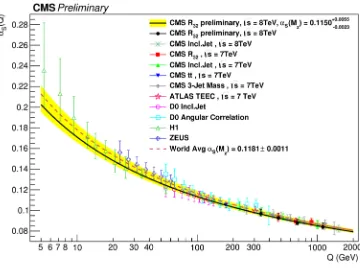
A measurement of the ratio of inclusive 3-jet to 2-jet cross section withR=0.7 jets with 19.7-fb−1 data from 8-TeV collisions provides an accurate measurement of the strong
EPJ Web of Conferences 192, 00005 (2018) https://doi.org/10.1051/epjconf/201819200005 QCD@Work 2018
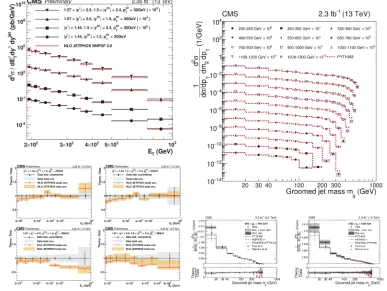
Figure 1. Upper plot: Double-differential inclu-sive jet cross section forR=0.4 jets at 13 TeV. Lower plot: comparison with NLO-in-QCD the-oretical prediction, with NP and electroweak cor-rections, for|y|<0.5.
Figure 2. Upper plot: Double-differential inclu-sive jet cross section for R=0.7 jets at 13 TeV. Lower plot: comparison with NLO-in-QCD the-oretical prediction, with NP and electroweak cor-rections, for|y|<0.5.
Figure 3. Extraction of the gluon PDF with in-clusion of input from the CMS triple-differential inclusive jet cross section atQ2 =104GeV2 (in-sert:Q2=1.9 GeV2).
EPJ Web of Conferences 192, 00005 (2018) https://doi.org/10.1051/epjconf/201819200005 QCD@Work 2018
Figure 5. Upper plot: Triple-differential cross section of the production of photon in associa-tion with jets in four combinaassocia-tions of rapidities of photon and the highest-pT jet, as a function of
photon ET. Lower plot: Theory/Data plots for
these rapidity bins.
Figure 6. Upper plot: Normalized double-differential inclusive dijet cross section as a func-tion of groomed jet mass for 11pT bins. Lower
plot: Comparison of groomed jet mass with gen-erators and theoretical calculation in twopTbins.
and denominator quantities. The analysis is done in four average leading-two-jet pT bins,
resulting in measurement ofaS for four values of energy scaleQ, as shown in Fig. 4.
The production of a photon in association with jets is an excellent test of QCD.
Inclusive-photon double-differential and photon+jet triple-differential measurements (shown in Fig. 5)
with 2.26-fb−1, 13-TeV data agree well with the NLO-in-QCD JetPhoxgenerator [8].
The same luminosity was used for the measurement of the inclusive dijet cross section as
a function of groomed and ungroomed jet mass, for 11pT bins ofR=0.8 jets, as a test of soft
QCD effects [9]. Good agreement with Pythia8 is observed, especially for groomed masses
below 200 GeV, and comparisons with theoretical calculations are made, as shown in Fig. 6. The measurement of the jet charge, defined as the sum of jet-constituent charge with
three different variations of momentum weights, has been measured in 8 TeV dijet data that
EPJ Web of Conferences 192, 00005 (2018) https://doi.org/10.1051/epjconf/201819200005 QCD@Work 2018
Figure 7.Jet multiplicity in top pair events in lepton+jets final states.
Figure 8.Jet multiplicity in top pair events in dilepton final states.
presence of extra jets is studied as a QCD test and for the determination of backgrounds
in new-physics searches. Main background comes from QCD multijet events, bosons+jets
and othertt¯channels. Powheg, with Pythia8 showering and hadronization, describes the jet
multiplicity, as shown in Fig. 7, but some kinematics are only consistent with prediction after the inclusion of theoretical uncertainties in the unfolding.
The corresponding decays of the top pair to dileptons were also recently analyzed with the
same luminosity [12] by requiring two leptons and at least two jets, one of whichb-tagged.
The analysis was performed in separate lepton-flavor channels which were eventually
com-bined. Main backgrounds come from top+W,W/Z+jet, diboson andtt¯+W. Good agreement
in jet-multiplicities compared to Powheg+Pythia8 were observed, as shown in Fig. 8, and the
top chromomagnetic dipole moment and its y-charge asymmetry were determined.
A recently released analysis measures the single-top production cross section in
associa-tion with a photon, for muonic top decays [13], in 13-TeV, 35.9-fb−1data. A muon, photon,
missing transverse momentum and at least two jets are required. Main background istt¯+γ.
The result isσ(tγ+jets)× B(t → µνb) = 115±17(stat)±30(syst) fb, whereas the SM
prediction is 81±4 fb, which translates to a 4.4-σevidence.
4 Higgs physics
The current CMS combined RunII measured Higgs boson cross section divided by the SM
prediction (signal strengthµ) is 1.17±0.1 [14]. Improvements in the precision of theggH
production rate of around 50%, compared with RunI, has been achieved due to higher lumi-nosity and collider energy. Fig. 9 shows the good agreement of measured cross section with SM prediction for all Higgs production and decay channels.
The combination of 13-TeV data with the 7- and 8-TeV data allowed for the first
observa-tion of the Higgs boson producobserva-tion in associaobserva-tion with a top-quark pair [15]. This is a 5.2-σ
discovery (expected 4.2-σ). All Higgs-decay channels signal strength agree with expectation,
as shown in Fig. 10.
Latest results include the decay H → ZZ → [16]. The analysis was performed
separately in the 4e, 4µ,eeµµchannels and then combined. The data collected in 2017 were
analyzed separately and combined with 2016 data for a total integrated luminosity of 77.4
fb−1. The resulted signal strength isµ=1.10+0.19
EPJ Web of Conferences 192, 00005 (2018) https://doi.org/10.1051/epjconf/201819200005 QCD@Work 2018
Figure 9.The current status of signal strength
µfor all Higgs production and decay combina-tions at 13 TeV.
Figure 10. Signal strength for the different Higgs decay channels used in theHtt¯ discov-ery.
The production of Higgs in association with a vector boson and the subsequent Higgs
decay to two tau leptons was recently completed, at 13 TeV with 35.9 fb−1[17]. At least one
of the tau hadrons is required to decay hadronically. A 2.3-sigma excess in the signal strength
was observed (µ=2.54+1.35
−1.26). The results are combined with earlierH→ττanalyses.
5 Heavy-ion physics
The CMS maintains a very active and productive heavy-ion collisions program. One of the latest released results measures the center-of-mass pseudorapidity distribution of the muon
fromW± boson decays in 8.16-TeV pPb collisions [18]. This analysis probes the nuclear
PDFs of u andd quarks. A shown in Fig. 11, modified PDFs are needed to describe the
pseudorapidity distributions.
A recent study of anisotropic flow in XeXe collisions at 5.44 TeV and comparison with the respective PbPb results probes the system-size dependence and the role of initial state
effects [19].
6 Forward and small-
x
QCD physics
Forward and small-xanalyses offer valuable insight into a different range of parton dynamics.
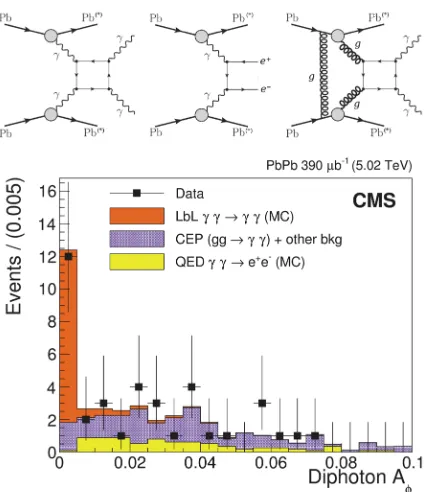
A 5-TeV PbPb search for “light-by-light” scatter [20] led to a 4.1-σevidence withσ(γγ→
γγ)=120±46(stat)±28(syst)±4(theory) nb. The powerfulγγacoplanarity variable was
used for the separation ofγγ→ γγsignal fromγγ→ eeandgg→ γγevents, as shown in
Fig. 12.
EPJ Web of Conferences 192, 00005 (2018) https://doi.org/10.1051/epjconf/201819200005 QCD@Work 2018
Figure 11. The forward-backward pseudora-pidity ratios of the muons from the production ofW−(upper) andW+(lower) bosons inpPb collisions can be explained only with nuclear modifications in the PDFs.
Figure 12.The diphoton system acoplanarity
Aφis a valuable quantity for separating
light-by-light scatter fromγγ → eeandgg →γγ
background processes shown in the Feynman diagrams.
considered. The separation was achieved after a photon-energy scale calibration that utilizes
χb(nP) decays toY(nS)γleading to a measuredY(3S)γinvariant mass resolution of 2.2 MeV,
as shown in Fig. 13(a). The invariant mass is shown in Fig. 13(b).
The first observation of the rare decayZ → J/ψ++−was performed with 35.9 fb−1
of 13-TeV data [22]. Both direct production of J/ψand through ψ(2S) → J/ψ+X were
considered. The signal is extracted from an unbinned log-likelihood fit, resulting to 13±
3.9(stat)µ+µ−µ+µ−events and 11.2±3.4(stat)e+e−µ+µ−events leading to the measured ratio
of branching fractionsB(Z→J/ψ+−)/B(Z→µ+µ−µ+µ−)=0.67±0.18(stat)±0.05(syst).
8 Standard Model overview
EPJ Web of Conferences 192, 00005 (2018) https://doi.org/10.1051/epjconf/201819200005 QCD@Work 2018
Figure 13. (a) The inset shows theχb1(1P) andχb1(1P) masses fitted before and after the photon energy calibration. (b) The resolved
χb1(3P) andχb2(3P) resonances.
Figure 14.(a) The limits on the pair-produced scalar top decaying to diquark resonances. (b) The limit on dark quarks assuming dark pion mass of 1 GeV. (c) Them1/2vsm0limits of the same-sign dimuon analysis.
9 Exotic and supersymmetry physics
CMS runs a diverse program of analyses dedicated to direct discovery of new physics, either model-independent or described by existing supersymmetric (SUSY) or exotic models.
A 13-TeV, 35.9-fb−1 analysis looks for pair-produced resonances decaying to diquark
pairs [24]. The four jets are either reconstructed as boosted dijets, with use of appropriate grooming, for resonances below 400 GeV or they are fully resolved above 400 GeV. A
ver-sion of the analysis also requires two of the jets to beb-tagged. The results are consistent
with expectation and limits are set on R-parity violating SUSY production pair of scalar top
quarks. Fig. 14(a) shows the limit for the sub-analysis that does not requireb-tagged jets.
Using multijet events in 13-TeV, 38.5-fb−1data , an analysis searched for potential
EPJ Web of Conferences 192, 00005 (2018) https://doi.org/10.1051/epjconf/201819200005 QCD@Work 2018
withR=0.8 are used with soft-drop grooming and dedicatedb-tagging. The results agree with the SM and confidence limits are set.
A 13-TeV, 16.1-fb−1 analysis [27] looks for dark quarks, which are the decay products
of heavy mediators in the BSSW dark-QCD model. The signature consists of 4 high-pT jets
two from ordinary quarks and two from dark quarks, which result in emerging jets with many displaced vertices from the decay of dark hadrons to the SM charged particles. Mediator particles with masses between 400 and 1250 GeV are excluded for dark hadron decay lengths between 5 and 225 mm. Fig. 14(b) shows exclusion limits for models with a 1-GeV dark pion. A 13-TeV, 35.9-fb−1 analysis looks for same-sign dimuons with at least two jets [28].
Results are consistent with SM expectation and limits are set in R-parity-violating single chargino or neutralino production in association with a muon, as shown in Fig. 14(c).
10 Conclusions
An overview of some of the latest and legacy CMS physics results were presented. A complete collection of CMS publications and preliminary public results can be found in https://cms-results.web.cern.ch/cms-results/public-results/publications/.
References
[1] CMS Collaboration, J. High Energy Phys. 03 (2017) 156. [2] CMS Collaboration, Eur. Phys. J. C76(2016) 451. [3] CMS Collaboration, 2017 JINST12P10003.
[4] M. Cacciari, G. P. Salam, and G. Soyez, J. High Energy Phys. 04(2008) 063. [5] CMS Collaboration, Eur. Phys. J. C78(2018) 566.
[6] CMS Collaboration, Eur. Phys. J. C77(2017) 746. [7] CMS Collaboration, CMS-PAS-SMP-16-008 (2017).
[8] CMS Collaboration, arXiv:1807.00782, submitted to Eur. Phys. J. C (2018). [9] CMS Collaboration, arXiv:1807.05974, submitted to J. High Energy Phys. (2018). [10] CMS Collaboration, J. High Energy Phys.10(2017) 131.
[11] CMS Collaboration, J. High Energy Phys.06(2018) 002. [12] CMS Collaboration, CMS-PAS-TOP-17-014 (2018).
[13] CMS Collaboration, arXiv:1808.02913, submitted to Phys. Rev. Lett. (2018). [14] CMS Collaboration, arXiv:1809.10733, submitted to Eur. Phys. J. C (2018). [15] CMS Collaboration, Phys. Rev. Lett.120(2018) 231801.
[16] CMS Collaboration, CMS-PAS-HIG-18-001 (2018).
[17] CMS Collaboration, arXiv:1809.03590, submitted to J. High Energy Phys. (2018). [18] CMS Collaboration, CMS-PAS-HIN-17-007 (2018).
[19] CMS Collaboration, CMS-PAS-HIN-18-001 (2018).
[20] CMS Collaboration, arXiv:1810.04602, submitted to Phys. Lett. B (2018). [21] CMS Collaboration, Phys. Rev. Lett.121, 092002 (2018).
[22] CMS Collaboration, Phys. Rev. Lett.121, 141801 (2018).
[23] CMS Collaboration, https://twiki.cern.ch/twiki/bin/view/CMSPublic/PhysicsResultsCombined/. [24] CMS Collaboration, arXiv:1808.03124, submitted to Phys. Rev. D (2018).
[25] CMS Collaboration, arXiv:1808.03078, accepted by Phys. Rev. D (2018). [26] CMS Collaboration, CMS-EXO-17-019 (2018).