JOURNIU OF
IMNGE MNMGEMENT
Published bimonthly-January, March, May,July, September, November-by the Society for Range Management 2120 South Birch Street Denver, Colorado 80222 Copyright @ 1974 by the Society for Range Management
TABLE OF CONTENTS: Vol. 27, No. 4, July 1974
ARTICLES 253
255
258
Managing Editor
FRANCIS T. COLBERT 263
2120 South Birch Street
Denver, Colo. 80222 267
Editor
ELBERT H. REID
624 South Shields Street Fort Collins, Colo. 80521
272
Book Review Editor 276
DONALD N. HYDER
Agricultural Research Service Colorado State University Fort Collins, Colo. 80521
279
Copy Editor 283
PATRICIA G. SMITH 2120 South Birch Street
Denver, Colo. 80222 285
Editorial Board
288 1972.74
LOWELL K. HALLS, Nacogdoches, Tex. ROBERT L. ROSS, Bozeman, Mont. GERALD W. TOMANEK, Hays, Kan. HENRY A. WRIGHT, Lubbock, Tex.
293
1973-75
DWIGHT R. CABLE, Tucson, Ariz. JOHN P. WORKMAN, Logan, Utah RUSSELL J. LORENZ, Mandan, N.D. LEWIS L. YARLETT, Gainesville, Fla.
297
302
305 1974-76
PHILLIP L. SIMS, Fort Collins, Colo. REX D. PIEPER, Las Cruces, N. Mex. MINORU HIRONAKA, Moscow, Ida. MARK R. KILCHER, Swift Current, Sask.
308
310
INDIVIDUAL SUBSCRIPTION is by membership in the Society for Range Management.
LIBRARY or other INSTITUTIONAL SUBSCRIP- TIONS, on a calendar year basis, are $15.00 postpaid to all countries. Payments from outside the United States should be remitted in US dollars by international money order or draft on a New York bank.
313
318
TECHNICAL NOTES
CHANGE OF ADDRESS notices should be sent to the Managing Editor, 2120 S. Birch St., Denver, CO 80222, no later than the first day of the month of issue. Copies lost due to a change of address cannot be replaced unless adequate notice is given. To assure uninterrupted ser- vice, provide your local postmaster with a Change of Address Order (POD Form 3575). indicating thereon to guarantee forwarding postage for second-class mail.
322
323
325
BUSINESS CORRESPONDENCE, concerning subscrip- tions, advertising, reprints, back issues, and related matters, should be addressed to the Managing Editor, 2120 S. Birch St., Denver, CO 80222.
EDITORIAL CORRESPONDENCE, concerning manu- scripts or other editorial matters, should be addressed to the Editor, 624 S. Shields St., Fort Collins, CO 80521. INSTRUCTIONS FOR AUTHORS appear each year rn the March issue; copies of these instructions are available from the editor.
VIEWPOINT
326 Grazing Management Terminology by M. M. Kothmann
BOOK REVIEWS
328 Pest Control Strategies for the Future (National Academy of Sciences); Wildlife Ecology, An Analytical Approach (Aaron N. Moen).
SECOND CLASS POSTAGE paid at Denver, Colorado.
COVER: Fistulated sheep used in diet and selection studies on the U.S. Sheep Experiment Station’s summer range, Centennial Mountains, southwestern Montana (see article by William C. Krueger, William A. Laycock, and Donald A. Price, page 258).
Future of Rangelands in the United States by Robert W. Long
Future of Rangelands in Canada by Eugene F. Whelan
Relationships of Taste, Smell, Sight, and Touch to Forage Selection by William C. Krueger, William A. Laycock, and Donald A. Price
Aspen Invasion in a Portion of the Alberta Parklands by Arthur W. Bailey and Robert A. Wroe
Salt and Oxalic Acid Content of Leaves of the Saltbush A triplex halimus in the Northern Negev by Sigmund J. Ellern, Yochai B. Samish, and David Lachover
Relationship between Precipitation and Annual Rangeland Herbage Production in Southeastern Kansas by Thomas N. Shiflet and Harland E. Dietz
Carbohydrate and Organic Nitrogen Concentrations within Range Grass Parts at Maturity by L. J. Perry, Jr. and Lowell E. Moser
Influence of Nitrogen and Irrigation on Carbohydrate Reserves of Buffalograss by R. D. Pettit and Richard E. Fagan
Variation in Pinehill Bluestem, a Southern Ecotype of the Andropogon scoparius Complex by Harold E. Grelen
Evaluation of Methods for Screening Grasses for Resistance to Grasshopper Feeding by G. B. Hewitt and C. C. Blickenstaff
Evaluation of the Atrazine-Fallow Technique for Weed Control and Seedling Establishment by Richard E. Eckert, Jr., Jerry E. Asher, M. Dale Christensen, and Raymond A. Evans
Tolerance of Bermudagrass to Herbicides by R. W. Bovey, R. E. Meyer, and E. C. Holt
Control of Gambel Oak with Three Herbicides by Gordon A. Van EPPS
Seedling Emergence and Survival from Different Seasons and Rates of Seeding Mountain Rangelands by A. C. Hull, Jr.
Effect of Planting Depth on Seedling Growth of Russian Wildrye (Elymus junceus Fisch.) by William J. McGinnies
Clipping Height and Frequency Influence Growth Response of Nitrogen- Fertilized Blue Grama by Ermias Bekele, Rex D. Pieper, and Don D. Dwyer
Comparison of Vegetation Structure and Composition in Modified and Natural Chaparral by John A. Rosario and Earl W. Lathrop
Canopy Structure of a Tall-grass Prairie by Sheila Conant and Paul G. Risser
Infiltration for Three Rangeland Soil-Vegetation Complexes by J. M. Tromble, K. G. Renard, and A. P. Thatcher
A Mobile Infiltrometer for Use on Rangelands by W. H. Blackburn, R. 0. Meeuwig, and C. M. Skau
A Double Sampling Technique for Estimating Dietary Composition by Donald G. Peden, Richard M. Hansen, Richard W. Rice, and George M. Van Dyne
Future
of Rangelands
in the United
States
t
t .., . . _ .
” _“x”.
..a,,.:,-
.” .,. .c
^..._ -1.. _ _ c
.- -.-
_ ,
1
II ,‘_. ”
ROBERT W. LONG
Throughout our recent history the United States has had a tendency to group its national moods into segments of 10 years OI so. Each decade is identified significantly.
For example, the twenties are remembered largely as a time of phenomenal growth, gaiety, and an initial baptism in world power politics.
Mention of the thirties brings memories of hardship, frustration, and a reassessment of domestic economic policy. This decade also spawned an array of farm programs that lingered far beyond their need.
The forties brought another world conflict with its after- shocks, and development of a policy of containment as an international strategy.
Then came the quieter fifties, which accelerated toward the end with our preparations for space exploration and a national nzawwment of educational values.
The soaring, volatile sixties captured home of the emo- tional, environmental and economic moods of earlier times, yet the period suffered the spoilage of a futile mission in southeast Asia and its own shock waves of reaction.
Now we are in the middle of the seventies. We are more mature now about conflicts in the name of Democracy. We talk more urgently about the preservation of our environ- mental qualities. Some people have already become blase over the spectacular accomplishments of manned space travel.
And yet when this decade should be in a period of comfortable growth in all areas, we have run head-long into new domestic and international issues of considerable magni- tude :
a Our world mechanical machine is running away from its propellant.
a We are rediscovering the full meaning of energy and inflation.
a We are taking a new look at the farmer and the rancher and learning anew the value of the marketplace and the meaning of a price mechanism as a governor for buyers and sellers.
a The nation is also concerned for the first time with basic supply problems - not just in energy, but in timber and even food.
These are not merely national issues. Some of them have become ccmmon denominators for our personal problems and are having a domino effect on our very life styles.
Yet despite our troubles, we have enjoyed some significant high notes. Detente is working. Also, two years ago the United States was running a serious deficit in our balance of trade. This year, however, we are in the black again and the primary reason is agriculture.
The 1973 agricultural trade surplus of $9.3 billion wiped out a deficit of $7.6 billion in nonagricultural trade. This left us with an overall 1973 trade surplus of $1.7 billion. There’s no doubt that the trade surplus in agriculture is stabilizing the dollar, strengthening our posture in international trade, and helping pay for much-needed oil and consumer goods that add so much to our level of affluence.
That surplus, incidentally, was built by the sale of $17.7 billion of American agricultural products abroad during 1973, against food imports of $8.4 billion.
1973 also brought the highest rate of employment in nearly 20 years. And it brought record levels of farm production and farm income. The latter, for instance, included net farm income of $26.1 billion - nearly 78% more than the level of 5 years ago.
For all of us, the needs of the time dictate our priorities, and a major thrust of our efforts on the farm scene in the United States is found in our national agricultural policy. Five elements of that policy are particularly relevant:
As one of America’s most productive indutries, agriculture finds itself under heavy pressure because of a dramatic fact - rapidly rising demand.
The prime element of this demand is the world’s ballooning population. The global population reached the 1 billion mark about 1830. In 1930, only a century later, we reached the 2 billion mark. Thirty years later we added the third billion, and by 1975 this compounding rate of growth will take us to 4 billion.
Even the smallest child knows that somewhere, somehow, we must produce farm goods to feed all these consumers.
The second element of demand (even more striking than population statistics) is the fact that these 4 billion people are demanding a higher quality of life than any of their ancestors. This rising standard of living is not concentrated just in our hemisphere. It is occurring all around the globe.
In agricultural circles, one of the most celebrated facts of the decade is that all this population growth and relative economic abundance have merged into an incredible demand for more and better food - particularly animal protein.
This circumstance is a two-edged sword. While it is a great boon to agricultural producers, it nevertheless presents to all of us the proverbial horns of a dilemma.
(1) Through our Statistical Reporting System and other *Ivlv--rvvvvvvvy-rTv services, we are establishing a reliable supply monitoring
network to inform buyers and sellers of reserve levels of all basic crops.
(2) We are resisting the growth of trade barriers at home and abroad. Recent examples are the opening up of import quotas on wheat, beef, and dairy products. Record levels of our own farm products going into export markets give new emphasis to reciprocal trade agreements.
(3) We are maintaining a high level of agricultural research in state and federal systems. Of particular importance today is the need to maintain an efficient germ plasm bank to avoid a genetic vulnerability in seed varieties. Also of interest in your discussions at this meeting is that our Agricultural Research Service is conducting fertilization studies to increase the nutrient level in a wide spectrum of grasses. Other research at state stations and private research and development is delving into increased pest resistance of grasses and working to increase the protein control in many types of forage.
(4) We are more closely regulating trading in commodities which could be subject to abuse through excessive manipula- tion. The responsible agency is the Commodity Exchange Authority (CEA) which oversees activities in futures trading. It’s timely that the CEA itself is undergoing an overhaul to increase its effectiveness.
(5) Finally, and most importantly, we are working to reduce the burden of government influence in the market- place. A major part of this effort has been our turn-around from stifling control policies that have lingered in our country since the 1930’s. With a few minor exceptions, the over-hang of Commodity Credit Corporation grain stocks is gone. We are getting out of the business of periodically depressing the market for these commodities. The price support payments that for a generation cost billions of tax dollars annually will this year be reduced to near zero. To repeat a phrase coined by Treasury Secretary George Schultz, “We are going to keep our cotton-pickin’ hands out of the marketplace.”
In the midst of all this activity, the reservoir of feed in our rangelands is demanding renewed attention. Here’s why:
‘We may need to decide between cultivation of crops for intensive feeding or investing in better yields from our grasslands to increase carrying capacity-it’s currently the major factor in increas- ing the world’s red meat supply.”
On the one hand, much of our cultivated acreage is being used to produce supplemental feed for livestock, or we could say, “animal calories.” We may need to explore alternative sources of nutrition for direct human consumption because we can’t meet the short term demand.
On the other hand, this demand for more and better food is cutting into our available grassland. A recent study in land use conversion shows that more than 4 million acres of our grasslands are being converted to cropland this year.
The dilemma - and the irony - is this: In addition to being a viable alternative to cultivated feed, our rangeland represents the only way we know to corral the vast resource of the plains and mountain meadows for man’s use. So far, it’s the only way we know to convert the ranges into high-protein food. Yet a given rangeland area cannot serve both purposes. We may need to decide between cultivation of crops for intensive feeding or investing in better yields from our grasslands to increase carrying capacity - it’s currently the major limiting factor in increasing the world’s red meat supply.
For the United States, this would have several interesting implications: Increased range utilization for livestock produc- tion can reduce the drainage on future national energy requirements for meat animals. Further, it can release more feed grains for overseas sale and, in effect, exchange for fuel or whatever is most critically in short supply. In this way, range production can contribute, however indirectly, to a more favorable economic balance for the nation’s needs.
Here are some interesting notes on increased use of better managed rangelands as a source of livestock feed energy. Several independent studies have concluded that it takes about 22 gallons of gasoline per acre to produce corn. On the other hand, range livestock production has a much lower fossil fuel requirement - perhaps one twentieth - for the gross energy production that results.
Theoretically, for every acre of corn saved by tradeoff to range grazing (that is, about 87 bushels of corn), about 21 gallons of gasoline are also saved.
Consideration should also be given to the favorable charac- teristics of livestock grazing in the context of the environment. Livestock grazing of forest-range lands provides an opportun- ity to tap the energy of the sun without major alteration of natural ecosystems. It also yields few by-products alien to the ecosystems. It contributes significantly to a favorable nature
“This is our dilemma on land use. It is going to require that we ultimately have a national land use program to satisfy the multiple interests of our people.”
picture in terms of weed control, reduction of fire hazards, and other factors.
We have made many improvements in the management of our ranges, but we have a long way to go. One point of special interest is the accelerated rangeland program that is in the development stages at the U.S. Department of Agriculture. Grazing covers more of our public land today than any other single use, including reforestation. In 1970, about 850 million acres of forest and nonforest ranges were used for livestock production.
Based on our demand for more animal protein, during the next 10 years our nation will need nearly 1 million more beef cows per year. Couple this with the burgeoning foreign and domestic demand for our grain products, and it’s clear that we
must up-grade the carrying capacity of our ranges.
The Forest Service’s Range Study, released last summer, estimates that by the year 2000 America’s annual per capita consumption of beef will reach what may prove to be a conservative level of 135 pounds - 16% higher than it is today, even after the incredible 86% increase since 1950.
The study also predicts that by 1980 the demand for range grazing to fulfill meat and wool needs will increase by 20% over the 1970 level, and by 50% at the end of the century.
Dovetail these factors with other projections - such as wood growth, water yield, wildlife habitat, scenery and recreational demands - and it’s easy to see what a mamoth task we have ahead.
This is our dilemma on land use. It is going to require that we ultimately have a national land use program to satisfy the multiple interests of our people.
To maintain our claim for livestock use we must improve the varieties of grasses and forage crops, increase use of fertilizers and water, and integrate forage, range, and livestock management into more efficient systems. If we can do these things - coupled with a maximization of roughage sources like newspaper, wood pulp, peanut hulls, and corn stalks - we may make significant strides toward meeting the demand for red meat.
The U.S. Department of Agriculture is fundamentally a service agency designed to underwrite and provide support for these efforts. In that perspective: We administer grazing on 105 million acres of federal lands in the National Forest System. With this sizeable commitment it is understandable why we should be deeply involved in forest-range grazing and forest-range research. Additionally, with technical assistance through the Soil Conservation Service and educational pro- grams from our Extension Service, we are aiding the private sector in range management and developing plant materials used in improving ranges. Through the Agricultural Research Service we are restudying the long-term implications of needed forage and range technology. And our Agricultural Stabiliza- tion and Conservation Service administers programs for range- land resource protection and stabilization. Also, of course, other federal agencies - like the Bureau of Land Management, the Bureau of Indian Affairs, the National Park Service - also play significant roles in our nation’s efforts to get maximum use from our rangelands.
The upshot of it all is that Mexico, Canada, and the United States comprise a mammoth complex of rangeland. And that very rangeland just might hold the answer to our supply problem in red meat. But like most problems, this one won’t be solved by isolation of effort. We must respond in concert. We must communicate freely, exchanging views and sharing research findings.
The problem transcends national borders, and so must the solution.
Future
of Rangelands
in Canada
EUGENE F. WHELAN
An outsider looking at agriculture in North America would probably notice that pasture, forage and rangelands have not been in the limelight. The glamour crops have been the cereals and the oilseeds. But I think we are about to witness a major change. I think forages, and especially the grasses and clovers, are going to come to front and center stage over the next 20 years here in North America.
What leads me to make this prediction? Basically, the increased demand for food, and in particular, the growing demand for beef. The beef industry in Canada predicts that demand will increase by 38% between now and 1980. That’s only 6 years from now. And that increase will come on top of the absolutely huge increase in beef production that has taken place over the past 10 years.
There are basically two ways to produce beef in Canada. We can either produce it completely on grasses and forage, or finish heifers and steers in feedlots using grain. During the past 10 years, the Canadian beef industry has emphasized grain-fed beef. I think a good deal of the expansion for the future will come from grass-fed beef. In any case, we are going to have more cattle on pasture and grass.
First of all, it is obvious that all of our beef starts on grass or rangeland. There is an expression in our beef industry that says every steak starts out as a cow and a calf on pasture. Whether or not our future beef production comes from grain-feeding feedlots, we will still increase the number of feeder cattle produced on range or grassland.
Secondly, more of our beef is going to come from beef animals, as opposed to culls from dairy herds. Our national dairy herd has been shrinking for many years, and so has the dairy herd in the United States. The slack in beef production has had to be taken up by beef animals, and those animals start out on rangeland and pasture.
Many people in our beef industry seem to think that most of our beef will continue to be fed out on grain and in feedlots. I’m not so sure about that forecast. Anyone who operates a feedlot in North America will tell you that the price of feed grains has moved so high that grain-fed beef is becoming very expensive to produce. But the demand for beef is continuing to increase. I think we are at the price level today where grass-fed beef can compete, right here in North America, with grain-fed beef.
Our studies in Canada show that we can produce top- quality beef on grass. The industry seems to think that only grain-fed beef will qualify for the top grades. But research shows otherwise. We have found that a cow, coming off grass, can grade right in our top-quality bracket. We have also found that we can breed a heifer, have her drop a calf, then feed that cow up to beef standards and get an A-quality carcass.
The author is Minister of Agriculture, Ottawa, Canada.
Paper was presented at the 27th Annual Meeting, Society for Range Management, February 8, 1974, Tucson, Arizona.
And we can do that on grasses and forages, not grain.
The growing demand for beef, and the rising prices and demand for feed grains, are putting grasses and forages back into the picture. And that, in terms of Canadian potential, is good news. We have more marginal crop land than almost any other nation in the world. It’s marginal land if you are talking about cash crops, but much of it is top-notch grass, forage, and pasture land. There is a tremendous belt of this type of land in eastern Canada, stretching from the clay belt in northern Ontario, past the Ottawa Valley, and right through to Nova Scotia. There is another huge tract of this top-notch forage and pasture land in our Peace River district, and it stretches north in the Slave River lowlands.
You are the experts in grasses, forages, and pasture. In the past, you have shown Canadian farmers how to manage rangeland to increase the production of beef per acre by six times. You have developed the new varieties and the feed rations for beef cattle. I predict that, over the next 10 years and beyond, the results of your work are going to be applied to beef production as never before, and that you will be challenged to develop beef production systems based entirely on grass, hay, and forage. Corn silage is really only the beginning of this trend. I think it will broaden and grow to include many more types of forages, silages, and haylages.
The scientists at our federal research stations at Lethbridge, Swift Current, Manyberries, and Melfort in western Canada have done a great deal of work which is contributing to increased beef production on forages.
The most recent work at Lethbridge indicates that we can increase beef production by six times, simply by seeding our native rangeland to Russian wildrye and managing it properly. There are about 40 million acres of native rangeland in western Canada, and about a third of it could be seeded to Russian wildrye. The two varieties they recommend are Mayak and Sawki.
An economist looked into the research and figured that it pays a rancher to seed native range to Russian wildrye whenever the price of calves goes over 30 cents a pound. That work was done a few years ago so you might want to add a
few cents - perhaps bring it up to 35 cents a pound. But today’s calf prices are up around 60 cents a pound, so it certainly pays a rancher to seed native rangeland down to Russian wildrye, or even the Parkway or Summit varieties of crested wheatgrass. If calf prices go any higher, our ranchers could increase production even further by using fertilizer, but our research shows that we have to use a lot - about 200 pounds of nitrogen per acre. At today’s prices for feeder calves, and at today’s fertilizer prices, it’s not a paying proposition. But the point is that we know we can increase our beef production by a hefty amount on the land we are already grazing in western Canada.
Shifting over to eastern Canada, our research scientists see a very definite potential to increase beef production. We could double the number of beef cattle in eastern Canada, and that would only bring us back to the level we were at 50 years ago in terms of total forage-eating animals. Add to that the fact that we now know how to double forage production per acre, and you can double that beef production figure again.
We have enough potato waste and cull potatoes to feed out 50,000 cattle in feedlots. None of that is being used for beef today. We have another 10,000 beef cattle that could be fed out on pea vines that are left in the field after the crop is harvested for processing.
The Maritimes has ideal weather for cow-calf opeators, with plenty of rainfall, and right through the entire season. Summer droughts are almost unheard of in the Maritimes, so pasture is lush right through the entire grazing season. Add to that the fact that we only need about 2 or 3 acres per cow unit, compared to 25 and 30 acres per cow unit required in the west, and the fact that there is plenty of land available at $100 an acre or less - roughly the same price as in western Canada - and you begin to glimpse the potential that hasn’t been scratched in the east.
We can’t over-winter cattle on rangeland in the east, but we do know that we can put up plenty of grass silage on a 30 to 35% dry matter basis. The best grass is timothy, and a lot of work has already been done with the crop for the dairy industry that can be applied directly to grass silage for beef herds. Our scientists have developed three outstanding varieties - Bounty, Champ, and Climax. We have another source of winter feed in straw, which can make up 50% of a cow’s winter ration.
In Ontario, farmers are seeding down marginal or rough land with birdsfoot trefoil, and find that it is an excellent forage once it is established because it can keep on producing for years and years without having to be ripped up again and reseeded.
I don’t think we should be ruling out the future for grain-fed beef, eben though I happen to believe that we have been overemphasizing feed grains when it comes to producing more beef. The feedlot industry, especially the one that has developed in western Canada, is probably here to stay. And the Federal government is developing a new national feed grains policy to help make sure that Canadian agriculture can take full advantage of the growing market for grainfed meats.
The Federal government has taken a number of other positive steps to encourage beef production in Canada. I have already mentioned the research into pasture and range management, and the development of new grasses and forage varities. For the past 3 years, the Federal government has encouraged an increase in forage production across the Prairies by offering a $lO-an-acre subsidy to farmers who divert land
JOURNAL OF RANGE MANAGEMENT 27(4), July 1974
“The feedlot industry, especially the one that has developed in western Canada, is probably here to stay. And the Federal government is developing a new national feed grains policy to help make sure that Canadian agriculture can take full advan- tage of the growing market for grainfed meats.”
from grain or special crops into grasses and forages. We have spent more than $41,800,000 on the program, and about 4,400,OOO acres have been diverted into grass or forage production.
A growing percentage of our calves are the product of artificial insemination, and have at least some blood from exotic breeds in their veins. Both trends are the result of Federal government research and services to the industry. Much of the pioneering work on freezing semen was done by Federal government scientists. The Federal government set up, and operates, the maximum quarantine stations which enable our breeders to introduce exotic cattle. Since the program started in 1966, we have imported 3,873 head of cattle. The import program is so popular that we have more than 3,000 applications to bring in more than 9,000 head of cattle this year. The quarantine stations can only handle 960 head.
A great deal of research is underway across Canada to determine exactly what merits and demerits each of the exotic breeds has to offer, and we are also testing some of the more popular crossbreeds. The Federal government also operates joint Federal-provincial Record of Performance testing pro-
grams, has brought in a new beef grading system, which we think is the best in the world, and has introduced a beef carcass appraisal program so producers can get results on their animals right through to the cutting floor of the packinghouse.
Looking to the future, we have plans for new policies and programs that are all aimed at further expansion of the beef industry. We fully intend to maintain our high health standards, we are working on a Federal-provincial livestock insurance program, we are developing price and income stabilization programs, we will be introducing legislation to improve the transportation of live cattle and to cut our losses in transit, and we are increasing our research and promotion work in market development.
In summary, we in Canada see a bright future ahead for an expanding beef industry. We have taken steps to support the industry in its efforts to step up production to serve that growing market, and we will continue to develop and refine our policies and programs so we can do an even better job in the future. As Minister of Agriculture, I believe we have a very vigorous, aggressive and sound beef industry in Canada, and I have a lot of faith in our ability to increase production and win markets with our top-quality beef. I think we produce the best beef in the world, and so far I haven’t tasted beef from any other corner of the world that would make me change my mind.
That, in turn, is going to increase the importance of our forage, pasture and rangeland. As members of this society, you are going to find that your services will be very much in demand in the years immediately ahead.
Smell,
Sight,
and Touch
to Forage
Selection
WILLIAM C. KRUEGER, WILLIAM A. LAYCOCK, AND DONALD A. PRICE
Highlight: Chemical impairment of taste, smell, and touch and physical obstruction of sight were studied in relation to forage preferences of sheep in a tall-forb plant community. Taste was the special sense most influential in direc- ting forage preference; the other senses appeared to supplement taste. Sheep preferred sour and sweet plants and generally rejected bitter plants, although some were palatable. Smell was of minor importance in selection. Touch and sight related to such specific plant conditions as succulence and growth form. Simultaneous impairment of all four senses did not result in completely random selection, but did increase preference for unpalatable plants and decrease prefer- ence for palatable ones.
Little is known of the effect of herbivores’ special senses in selection of their diet; however, it is commonly accepted that different plants within a plant community have varying palata- bilities for grazing sheep. Palatability of a plant species varies somewhat depending upon its association with different plant species, but many fac- tors interact to produce a selective response. This selective response has been termed “preference.” An excel- lent review of important factors involved in forage selection by rumi- nants has been presented by Marten (1970). The study reported here was undertaken to gain insight into the basis of forage preference.
Study Area and Methods
Field sampling was conducted dur- ing the summer of 1968 on the U.S.
Sheep Experiment Station summer
range in the Centennial Mountains of
technician and La
y!$Zgeirs
l%Zt ZZ%gist , International Forest and Range Experiment Station, For- est Service, U.S. Department of Agriculture, Ogden, Utah; both stationed in Logan, Utah, at the Forestry Sciences Laboratory, main- tained in cooperation with Utah State Uni- versity. Presently, Krueger is assistant profes- sor, Rangeland Resources Program, Oregon State University, Corvallis. Price is research leader, U.S. Sheep Experiment Station, Ag- riculture Research Service, U.S. Dep. Agr., Dubois, Idaho.The report is part of a dissertation sub- mitted by the senior author in partial fulfill- ment of the PhD degree in range science at Utah State University.
The authors acknowledge Dr. R. L. Hurst, head, Department of Applied Statistics and Computer Science, Utah State University, for assistance with statistical procedures.
Manuscript received October 20, 1973.
southwestern Montana. The study area was 7,800 ft in elevation and domi- nated by tall forbs. Eight l/2-acre study pastures were located on a 20% slope that had a north aspect in a sticky geranium/northwest cinquefoil
(Geranium viscosissim urn/P0 ten tilla
gracilis) community. Two pastures
were used in each of four grazing trials.
Forage production of each pasture was sampled immediately prior to each grazing treatment. Except in one instance, 30 plots, each 4.8 ft2, were located by a stratified random method in each pasture; prior to Trial 4, only
15 plots were sampled. Major plant species were clipped at ground level and weighed, and green weight of minor species was estimated. Samples of each plant species were collected and ovendried at 50°C to allow con- version of green weight to dry weight. Twenty-five esophageally fistulated sheep, that had similar breeding and experiences, were used in the study. Twenty were yearlings; the rest were 2-5 years old. Only 20 sheep were used during a sampling period. However, because of problems resulting from the fistulation, occasionally an unthrifty yearling was replaced by one of the older sheep. Sampling was begun at dawn and fistulated sheep collected samples for approximately 1 hour. Prior to sampling, sheep were fasted from dark until daybreak. During the sampling period, salt and water were removed from the pastures so that chemical analyses could be performed on the samples. Results of chemical analyses will be reported in another paper. Between trials, sheep were
placed in adjacent holding pastures with vegetation similar to that of the
sampled pastures. Animals were
allowed to graze untreated in holding pastures for 10 days prior to sensory impairment so they would become familiar with the vegetation.
Two pastures were each grazed five successive days in four different trials. Twenty sheep representing five treat- ments were sampled in each trial. The first trial compared forage preferences of untreated fistulated sheep with those of sheep that had a single sense impairment (Table 1). Trials 2-4 ex- amined forage preferences of sheep that had varying combinations of sen- sory impairment and compared prefer- ences with those of untreated sheep in each trial. Consequently, all possible
combinations of treatments were
included in the study.
Treatments to impair the senses of smell, taste, and sight were performed at least 4 days before sampling to allow sheep time to adjust to treat- ments. Suppression of the senses of taste and smell (ageusia and anosmia) was induced by topical application of a 2% solution of osmic acid (0~04). This chemical alters nerve endings, making them insensitive to stimuli for 6 months or longer (0~01 and Farrar, 1955). Control of smell and taste was tested after treatments were applied for several days and for several weeks. Untreated sheep reacted vigorously to
fumes from household ammonia;
anosmic sheep reacted to ammonia as they did to water. Salt consumption
was measured for untreated and
ageusic sheep. When salt was juxta- posed with pelleted alfalfa, ageusic sheep consumed 8.7 times as much salt as untreated sheep. When salt was physically displaced and sheep had to make a deliberate selection for salt, ageusic sheep consumed only half as much as untreated sheep. Sight was controlled (anopsia) by means of a blindfold (Fig. 1). Sheep in the initial anopsic group had blindfolds in combi- nation with other treatments through- out subsequent trials. Blindfold treat- ments varied for sheep that initially had other treatments (Table 1). The sense of touch in the lips was con- trolled (atactilia) by topical applica- tion of 5% xylocaine ointment. This treatment was applied daily immedi- ately prior to grazing. Xylocaine is a topical anesthetic commonly used in medical practice.
Plant species present in the diet were determined by a modification of Heady and Torell’s (1959) technique. Each sample was thawed, spread on a tray, and 100 points were examined through a stereoscopic microscope that had a crosshair mounted in one ocular. The plant fragment directly under the crosshair was identified from epidermal characteristics. Plant fragments that could not be identified at 15X were removed, mounted on a slide, and examined at 125X (Ward,
1970).
A relative preference index (RPI) was used to evaluate forage prefer- erences and to minimize confounding differences in preference that might result from varying availability of plant species (Krueger, 1972). The following formula was used to deter- mine relative preference for each plant species in each diet. Values were based on surface area of green “lants: _ .
fd X D Relative Preference Index = __
Where: fd = frequency in diet fr X R D = percent diet
fr = frequency on rangeland R = percent range composition
Frequency in diet was the percent- age of samples for each treatment in which a species occurred. Percent diet was the percentage of a plant species in each diet on a surface-area basis determined from microscopic point sampling. Frequency on rangeland was the percentage of plots in which a plant species occurred for each pasture grazed during each trial. Percent range
composition was determined from values for green weight converted to surface area by using a small stage photoelectric planimeter (Caldwell and Moore, 1971). Interception of trans- mitted light for known green weights of samples of each plant species was compared to a standard curve (r’ = 0.99) and surface area in relation to weight was determined. All green weight production figures were then converted to percent surface area for use in the preference index.
A subjective evaluation of coarse- ness, smell, and taste was based on human sensory perception. Coarseness was evaluated by chewing the different plants and assigning them to one of three categories (“high,” “moderate,” or “low” coarseness). It was difficult to assign a specific smell to each plant species, although there were many distinct odors among the various plants. Smell was classified as “strong,” “moderate,” or “faint.” Taste was classified as “bitter,” “sweet,” or “sour.” The categorization of these plant attributes may or may not be equivalent to the evaluation of
Treatment groups
Trial Date (19681 1 2 3 4 5
I July 22-26 f-4’ AS’
w
Ag’ Ati2 July 30.Aug. 3 N AP, AS AP> Ag As, Ag AP, At 3 Aug. 7-11 N As, At AP, Ag, As As, At, Ag Ag, At 4 Aug. 17-21 N As, Ap, At As,Ap,Ag,At - - - AP, At, Ag IN = control.
a plant by a sheep, but it did prove useful in interpreting the grazing pre- ference of the animals.
Statistical comparisons were made by “sing least-squares techniques (Draper and Smith, 1966) and planned contrasts (Ostle, 1963). Each treat- ment was compared to the control for the same sampling period; no statis- tical comparisons were made across periods or among other treatments. Differences were accepted as signifi- cant at P < 0.20. At P < 0.20 results of statistical testing were consistent and biologically explainable. At lower levels inconsistencies not biologically explainable began to appear in data analysis.
Results
All pastures sampled during the study were similar in amount of each plant species available to the grazing sheep. To help develop a perspective of the plant community structure. average composition on a green surface area basis for important plant species
is presented in Table 2. Sticky gera- nium made up about 50% of green production on a surface area basis and had a frequency “ear 100%. Northwest cinquefoil, second in availability, made up about 10% of the composition and had a frequency greater than 90%. Mountain brome (Bromus merginatus) made up about 8% of the composition and had a frequency about 90%. The most palatable plants in this commun- ity, mountain sorrel (Rumex
paucifolius) and thickleaf grounds4
(Senecio cr~ssulus), made up about 1%
of the composition and were lower in frequency than the more abundant species.
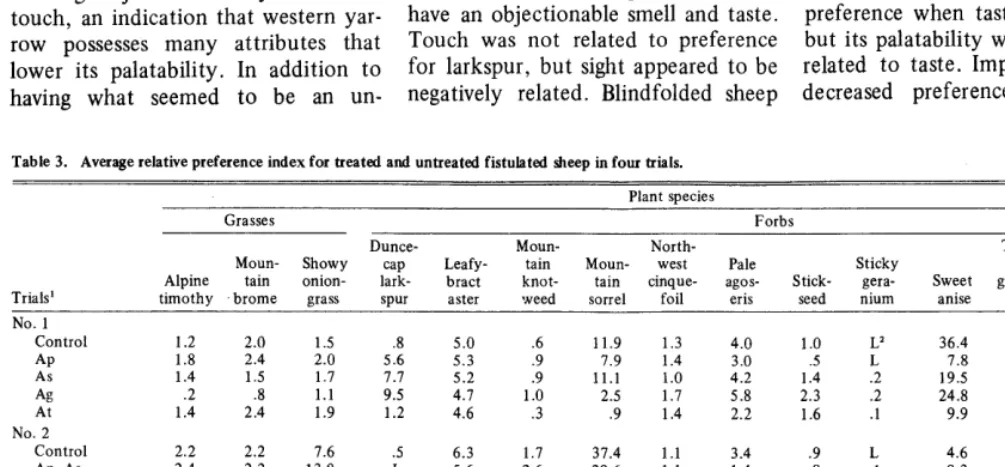
species studied in these pastures (Table 3). Buchanan et al. (1972) have pre- sented preference rankings for these plants from fistulated, but otherwise untreated, animals grazing the same range. Similar palatability relationships were found in their study when these were compared to forage preferences of control sheep in this study.
Although all senses were related to preference for some plant species, taste appeared to be the most impor- tant. Sticky geranium, classified as “bitter ,” was unpalatable. Compared to untreated sheep, ageusic sheep sig- nificantly preferred sticky geranium (Table 4). When all senses were im- paired except taste, preference did not deviate significantly from that of con- trol animals. When either smell, sight, or touch was controlled, preference of sheep for geranium was not sig- nificantly different from that of untreated animals. However, when taste was impaired in combination with one, two, or three other senses, the sheep showed a significant increase in their acceptance of sticky geranium.
Palatability of western yarrow
(Achilles lanulosa) was also related to taste, but not as exclusively as that of sticky geranium. The only sense not eliciting rejection for yarrow was touch, an indication that western yar- row possesses many attributes that lower its palatability. In addition to having what seemed to be an un-
Table 2. Range composition (%) of major plant species based on green surface area, and total production (lb/acre, ovendry) by trials.
Measurement and
plant species Trial 1 Trial 2 Trial 3 Trial 4
Composition Grasses
Alpine timothy Mountain brome Showy onion grass Forbs
Duncecap larkspur Leafybract aster Mountain knotweed Mountain sorrel Northwest cinquefoil Pale agoseris Stickseed Sticky geranium Sweetanise Thickleaf groundsel Western valarian Western yarrow
3.8 2.4 1.2 1.2
8.1 7.9 9.9 8.5
2.4 .7 1.4 1.8
3.3 2.9 1.9 2.8
5.5 5.4 3.6 4.6
1.2 .8 .4 2.4
.8 .4 .2 .2
10.6 11.7 9.2 8.0
1.5 1.0 .4 .2
2.5 1.4 1.4 1.0
39.8 48.8 57.4 49.0
.6 .9 1.9 1.0
.6 1.4 1.2 1.0
3.7 .8 .7 .7
1.5 .9 .6 1.2
Total production 1,827 1,748 1,516 1,570
pleasant taste and smell, bitter-tasting western yarrow was also recognized by sight as being unpalatable.
Both duncecap larkspur (Delphinium
occidentale) and northwest cinquefoil,
both bitter-tasting plants, were more palatable when sheep had their sense of taste controlled. Because of the low availability of larkspur, valid statistical comparisons could not be made for all trials. Duncecap larkspur seemed to have an objectionable smell and taste. Touch was not related to preference for larkspur, but sight appeared to be negatively related. Blindfolded sheep
showed a preference for larkspur of 5.6 compared to 0.8 for control sheep in the same trial. When sheep could see, smell, or taste, regardless of com- bination of treatments, preference for larkspur appeared to be lower than when these senses were controlled. Frequently, however, no statistical dif- ference was found.
Northwest cinquefoil was another plant that significantly increased in preference when taste was controlled, but its palatability was not exclusively related to taste. Impairment of smell decreased preference for northwest
Table 3. Average relative preference index for treated and untreated fistulated sheep in four trials.
Grasses Forbs
Dunce- Moun- North- Thick-
Moun- Showy cap Leafy- tain Moun- west Pale Sticky leaf
Alvine tain onion- lark-
timbthy brome
bract knot- tain cinque- agos- Stick- gera- Sweet ground- Western Western
grass svur aster weed sorrel foil eris seed nium anise se1 valarian varrow
- Trials’
No. 1
Control 1.2 2.0
AP 1.8 2.4
As 1.4 1.5
Ag .2 .8
At 1.4 2.4
No. 2
Control 2.2 2.2
AP, As 2.4 2.2
AP, Ag 2.5 2.2
As, Ag 1.2 1.4
AP, At 2.3 2.1 No. 3
Control 18.5 2.1
As, At 1.2 1.8
As, AP, Ag 7.0 2.2
As, Ag, At 5.8 1.2
Ag, At 4.7 1.8
No. 4
Control 2.0 2.6
As, Ap, At 1.2 2.9
AP, At, Ag 2.4 2.6 As, Ap, Ag, At 2.4 2.8
1.5 .8 5.0 .6 11.9 1.3 4.0 1.0 LZ 36.4 55.7 1.7 L
2.0 5.6 5.3 .9 7.9 1.4 3.0 .5 L 7.8 45.8 1.6 .3
1.7 7.7 5.2 .9 11.1 1.0 4.2 1.4 .2 19.5 73.1 3.9 .3
1.1 9.5 4.7 1.0 2.5 1.7 5.8 2.3 .2 24.8 31.5 1.4 .2
1.9 1.2 4.6 .3 .9 1.4 2.2 1.6 .l 9.9 31.9 1.1 .l
7.6 13.8 9.2 7.8 9.6 3.7 3.0 4.9 3.8 4.4 2.2 2.8 3.4 3.1 .5 L .4 L L L L 35.1 1.9 L .3 .4 .l .3
6.3 1.7 37.4 1.1 3.4 .9 L 4.6 14.2 1.3 .2
5.6 2.6 29.6 1.1 1.4 .8 .l 8.3 10.0 3.5 .4
5.4 1.4 .2 1.5 1.8 .5 .l 5.5 6.6 1.0 .8
5.0 1.0 2.2 2.0 2.8 2.5 .l 5.9 5.6 3.7 .5
4.5 .3 11.4 1.1 .9 1.0 .l 17.8 2.9 .5 .2
9.6 3.7 69.6 2.0
7.8 8.2 61.4 1.4
7.5 4.8 2.4 1.8
9.4 2.4 9.1 2.1
9.6 4.3 5.3 1.4
25.6 .7 L
3.2 4.5 .l
13.2 .5 .2
3.5 3.5 .2
6.8 1.9 .l
14.6 12.2 2.0
8.2 13.9 .l
4.1 20.2 2.1
3.3 10.6 1.8
2.7 27.8 8.0
12.8 .8 2.4
11.9 1.3 1.8
5.7 .4 .5
2.1 1.2 1.7 1.0
2.4 1.9 L
1.9 .4 .l
.l .4
2.7 :: .3
2.5 2.4 .l 2.7 7.2 13.2 4.0 3.2 :: .l 1.4 .l .5 1.4 1.0 .3 .4 .2 2.1 2.1
8.0 1.6 .l
’ Symbols used are as follows: As = anosmia, sense of smell impaired; Ap = anopsia, sense of sight impaired; Ag = ageusia, sense of taste impaired; and At = atactilia, sense of touch impaired.
‘L = less than .l.
Table 4. Statistical relationships of relative preference indices for selected treatments of sheep when compared to control sheep. Values indicate the level of significance of difference when compared to control.
Plant species
Grasses
Alpine timothy Mountain brome Showy oniongrass
Forbs
Duncecap larkspur Leafybract aster Mountain knotweed Mountain sorrel Northwest cinquefoil Pale agoseris Stickseed Sticky geranium Sweetanise Thickleaf groundsel Western valarian Western yarrow
I $2 .02 .Ol NS .05 NS NS .Ol .lO NS NS .Ol NS NS NS .02
As, Ap, At As
(4) (1)
NS3 NS
.Ol NS
NS NS
NS .lO
NS NS
NS NS
NS NS
.05 .15
NS NS
.05 NS
NS NS
NS NS
NS NS
NS .lO
.15 .Ol
AP, At, Ag (4) NS .Ol NS NS .02 .20 .20 .20 .15 .05 .Ol NS .15 NS .20 AP (1) .20 NS .20 NS NS NS NS NS NS NS NS .20 NS NS .Ol
As, Ag, At (3) .15 NS NS NA4 NS NS .lO NS .lO NS .Ol .02 NS NS .15 NS NS NS NS NS .20 .Ol NS .lO NS NS .20 .20 NS NS
As, AP, Ag (3) .20 NS NS NA NS NS .lO NS NS NS .Ol .05 NS NS .02
As, AP, Ag, At
(4) NS .02 NS NS NS .05 .lO .lO NS .05 .Ol NS .20 NS .15
’ Symbols used are as follows: As = anosmia. sense of smell impaired; Ap = anopsia, sense of sight impaired; Ag = ageusia, sense of taste impaired; and Ai = atactilia, sense of touch impaired.
2 Trial number.
‘Not significant at P < .20. 4Not statistically tested.
’
cinquefoil; anosmic sheep had a prefer- ence value of 1 .O compared to 1.3 for control animals. However, the interac- tion of smell and taste suggested that taste was more influential in selection of this plant. When both smell and taste were controlled, the relative pre- ference index increased, which is the same response observed with impair- ment of taste alone, but opposite of the response observed when smell alone was impaired (Table 3). Although this difference was not significant, it did show a tendency for the effects of taste impairment to override the effects of smell impairment. Further evidence to suggest a more important influence of taste was found when all other senses were impaired. When this occurred, preference decreased signifi- cantly; animals that could only taste took less northwest cinquefoil than control animals. When senses except smell were controlled, sheep prefer- ence remained depressed, which indi- cated that selection on the basis of smell was dependent upon other sen- sory stimuli.
Preference for grasses was primarily related to taste and sight. Preference for alpine timothy (Phleum alpinum) and for mountain brome was signifi- cantly decreased when taste was impaired. Preference for showy onion- grass (Melica spectabilis) was not sig- nificantly altered by taste treatment. Preference for showy oniongrass and alpine timothy increased when sight
was impaired. This change was prob- ably related primarily to the change in feeding behavior of the sheep when blindfolded. Anopsic sheep tended to feed longer in a specific spot and lower in the vegetation. Grasses that tended to grow lower than most other vegeta-
tion were more frequently en-
countered by anopsic sheep than by untreated animals. Since these low- growing grasses did not have other o b j e c tionable characteristics, they were consumed more frequently by anopsic sheep than by sheep that had better access to higher growing vegeta- tion because of normal behavior. Changes in feeding behavior were only apparent for anopsic sheep.
Mountain sorrel was a forb strongly preferred because of its sour taste. When taste was impaired singly or in combination with other senses, prefer- ence for sorrel decreased. Mountain sorrel a tender, succulent plant, was also preferred on the basis of touch. However, taste seemed to be more influential, as indicated by results when all senses except touch were controlled. In this case, the preference index for treated sheep was 2.4 com- pared to 69.6 for untreated sheep. Preference remained depressed when all senses except touch were impaired. When all senses except taste were controlled, no significant differences were noted between treated and con- trol sheep.
Preference for other succulent
JOURNAL OF RANGE MANAGEMENT 27(d), July 1974
plants, such as thickleaf groundsel, swee tanise (Osmorhiza occiden talis), and pale agoseris (Agoseris glauca), was also positively related to the sense of touch. Mountain knotweed (Poly-
gonum montanum), not succulent but
rated low in degree of coarseness, decreased in preference when touch was controlled. No plants had charac- teristics producing sufficiently adverse tactile stimuli to cause significant decreases in preference. The role of touch in selection was not as influen- tial as that of other senses. Preference for thickleaf groundsel was more re- lated to interactions of smell and taste. Sheep with smell and taste controlled showed a significantly lower prefer- ence (5.6) than untreated sheep (14.2) with P < 0.01. Most bitter plants in this study were unpalatable; however, the bitter-tasting thickleaf groundsel was preferred when smell and taste functioned together. Since preference for groundsel decreased when only smell remained intact, it is probable that the bitter taste of this plant and its tenderness provide highly preferred stimuli for acceptance by sheep.
Sweetanise was a highly preferred plant. Acceptance of this plant decreased from RPI = 36.4 to RPI = 24.8 when taste was controlled. While the difference was not significant, it did suggest sheep preferred the sweet taste of this plant. Sweetanise, also highly succulent, was preferred on the basis of touch. Sight was also related
to palatability of sweetanise, which is a tall-growing plant. Sheep could see sweetanise plants from any area of the pasture and would actively seek them out unless blindfolded. Other plants of exceptionally high palatability were not as obvious to sheep at long dis- tances, and the animals did not signifi- cantly relate to sight of them.
Leafybract aster (Aster foliaceus)
was both abundant and high in palata- bility. This aster has a faint bitter taste, but is still highly preferred by sheep on this range. Changes in prefer- ence for aster as a result of sensory impairment generally were not signifi- cant. Smell apparently was not of importance in selection of aster. Pre- ference decreased significantly when smell was the only sense intact, indi- cating that other senses related to preference but smell was neutral. It was suspected from results of treat- ment combinations that touch was influential in determining preference for leafybract aster, but no clearcut significant relationship could be estab- lished.
Stickseed (Hackelia j7oribunda) was selected nearly at random by the grazing sheep. No relationship to spe- cific senses could be established, although there were indications that sense alteration would change prefer- ence values.
Discussion
Results of this study indicated rela- tionships of the senses to forage selec- tion are complex. Taste appeared to be the primary sense used for selection of many species in the animals’ diet, although taste frequently interacted with other senses. However, taste of some plants had no apparent influence on their palatability. Arnold (1966b) found that sheep surgically treated to control the sense of taste were unable to differentiate between species and strains of plants as successfully as intact sheep. This work was done on improved pastures in Australia, but the basic relationships of taste seem to be the same as on rangeland in this study. Longhurst and Kepner (1968) studied the effect of impairment of smell and taste in selection of feed treated with extracts from plant leaves high in volatile oils. They found taste to be of less importance in preference than smell. However, when smell and taste were both controlled, the degree of selectivity was less than if smell alone
was controlled.
On the range studied, sticky gera- nium made up about half of dry weight production. Since selectivity of this plant was almost exclusively a function of taste, some change in the taste of this plant to improve palata- bility could almost double the carrying capacity. Perhaps a chemical substance could be applied to improve the taste of geranium or a fertilizer program might change palatability of this plant.
The other senses appear to supple- ment the sense of taste. Smell was only of specific importance in selec- tion of northwest cinquefoil; in con- junction with taste, smell was influen- tial in selection of certain other plant species. Tribe (1949) suggested smell was only supplementary to other senses in influencing forage selection of sheep. Arnold (1966b) found smell to be of importance and closely related to selection of plant parts or specific phenological stages of plants. Longhurst and Kepner (1968) deter- mined that olfaction was the first sense used in making a selection and so had its greatest effect in initial forage selection.
Sight was related to selection of certain palatable plants, such as sweetanise. Other plants of high pala- tability, but low-growth form, could not be seen from distances greater than 10 or more feet. Consequently, no relationship to sight was shown. Arnold (1966a) found sight was not important for selection of plant species in grass-clover-alfalfa pastures, but did report changes in grazing behavior similar to those described in this paper. Arnold did not blindfold the sheep; he restricted their vision with “blinkers” that did not totally obstruct sight except at the point of forage selection.
Plants selected, at least in part, on the basis of touch were all categorized as “low” in coarseness; generally they
were succulent. Overall, touch
appeared primarily to supplement the sense of taste in selection of plant species.
When all four senses were impaired, sheep showed some interesting altera- tions in forage preference. Changes in preference did not result in completely random forage selection; however, plants of low palatability, such as geranium and western yarrow, in- creased in preference after impairment of all four senses. Plants of high
palatability, such as mountain sorrel and thickleaf groundsel, decreased in preference. Although sensory impair- ment was severe, some factors influ- encing forage selection, such as touch in the tongue and the common chemi- cal sense, were not controlled. Arnold (1966b) reported the control of smell, taste, and touch in combination did not completely alter animal forage preference in an area where sight was of minor importance. Longhurst and Kepner (1968) in feeding trials of sheep also found impairment of smell, taste, and touch in combination did not completely alter sheep forage pre- ferences.
Literature Cited
&mold, G. W. 1966a. The special senses in grazing animals. I. Sight and dietary habits in sheep. Aust. J. Agr. Res.
17:521-529.
Arnold, G. W. 1966b. The special senses in grazing animals. II. Smell, taste, and touch and dietary habits in sheep. Aust. J. Agr. Res. 17:531-542.
Buchanan, H., W. A. Laycock, and D. A. Price. 1972. Botanical and nutritive con- tent of the summer diet of sheep on a tall forb range in southwestern Montana. J. Anim. Sci. 35:423-430.
Caldwell, M. M., and R. T. Moore. 1971. A
portable smallstage photoelectric planimeter for leaf area measurements. J, Range Manage. 24:394-395.
Draper, N. R., and H. Smith. 1966. Applied regression analysis. John Wiley and Sons, Inc., New York. 407 p.
Heady, H. F., and D. T. Torell. 1959.
Forage preferences exhibited by sheep with esophageal fistulas. J. Range Manage. 12:28-33.
Krueger, W. C. 1972. Evaluating animal forage preference. J. Range Manage. 25:471475.
Longhurst, W. M., and R. E. Kepner. 1968. Strontium-90 and Cesium-137 food chain relationships to deer and sheep. V. Fac- tors influencing radionuclide accumula- tion. Progress Report. AEC Project No. UCD 34, p. 104-112. (68 p. mimeo.) Marten, G. C. 1970. Measurement and sig-
nificance of palatability. In: Proc. of National Conference on Forage Quality Evaluation and Utilization. Dl-D55. Nebraska Center for Continuing Educa- tion, Lincoln.
0~01, A., and G. E. Farrar, Jr. 1955. The dispensatory of the United States of America. J. B. Lippincott Co., Philadel- phia, Pa. 2139 p.
Ostle, B. 1963. Statistics in research, 2nd ed. Iowa State Univ. Press, Ames. 585 p.
Tribe, D. E. 1949. The importance of the sense of smell to the grazing sheep. J. Agr. Sci. 39:309-312.
Ward, A. L. 1970. Stomach content and fecal analysis: Methods of forage identifi- cation. In: Range and wildlife habitat evaluation-a research symposium, p. 146-158. U.S. Dep. Agr. Misc. Publ. 1147.220 p.