_____________________________________________________________________________________________________
*Corresponding author: E-mail: [email protected];
www.sciencedomain.org
An Introduction to Proprioception Concept in Pilates
and Yoga
Alicia Garcia-Falgueras
1*1
Official College of Psychologist in Madrid, Spain.
Author’s contribution
The author designed, analyzed, interpreted and prepared the manuscript, posed and took the pictures in fig. 1.
Article Information
DOI: 10.9734/BJMMR/2016/25540
Editor(s):
(1) Ashish Anand, Department of Orthopaedic Surgery, GV Montgomery Veteran Affairs Medical Center, Jackson, MS, USA.
Reviewers:
(1) Maria Justine, Universiti Teknologi MARA, Malaysia. (2)Ayhan Goktepe, Selcuk University, Turkey. Complete Peer review History:http://sciencedomain.org/review-history/14259
Received 8th March 2016 Accepted 13th April 2016 Published 20th April 2016
ABSTRACT
Our brains are continuously and unconsciously integrating proprioceptive information together with the visual and vestibular systems through synapses in neurons, interneurons and motoneurons connections to the brain motor cortex and cerebellum to inform about our overall sense of body position, movements and acceleration in balance. Those natural complex integrations and calculations to have a posture are improvable through knowledge and physical exercises or activities. Professional athletes have been training and working out on their specific proprioceptions during many years, till reaching excellence in some of their complex movements. We explained in this text some basic ideas about proprioception, balance and homeostasis and suggest briefly some Pilates and yoga exercises as examples that are aimed to upgrade them.
Keywords: Balance; body symmetry; pilates; yoga; proprioception; contrology; equilibrium.
1. INTRODUCTION
1.1 Proprioception
Voluntary movement, based on one own individual sense of relative position of
neighboring parts of the body and strength or effort being employed for muscles in each movements, is known as
proprioception. It is an essential sort of sense to inform about the direction and range of motion, as well as the balance, equipoise and
coordination of body symmetry. It is very relevant for normal development of the body schema and every sport is requiring
a specific sort of propriocetive abilities or skills to perform it properly. For instance, proprioception
is essential for sports such as skating, skiing, skate board, snow board, surfing and all
the activities where a challenge against gravity or
nature is part of the competition. For contact sports, i.e. boxing, kickboxing,
taekwondo, karate, judo, etc., a full developed own proprioception and capacity of
knowledge about each own movements and reactions are also required, because in these contact sports, confusing the opponent about his/her own proprioceptivity is a key to success and win.
Superior locomotive abilities are essential for human survival and a fundamental
reason of our phylogenetic prosperity. Ontogenetic biological evolution on movement begins early in individual lives, with a motor system that allows us to drive and flow through the basic and common monitorization of the psychomotor functions. According to Evolutionary Psychology of Development, this ontogenetic motor development begins to happen around 0-2 years, during the sensoriomotor period. This learning remains active throughout life and can be practiced to improve. Laterality and symmetry can be both improved in a varied and diverse specific movements during lifespan (i. e. sole of the foot proprioception might be facilitated by walking on the bare feet).
At the beginning of the past century, Sherrington made a precise study about muscle responses, in dogs and its nervous
system, while terms related with proprioception were already mentioned [1].
Proprioception was declared as the system which regulates the total posture
(postural equilibrium) and segmental posture (joint stability) as well as initiates several conscious peripheral sensations (“muscle senses”). The spinocerebellar tracts are thought to be responsible for “nonconscious proprioception” (e.g. muscle tension and length) [2]. Recent studies from neurophysiological perspective have pointed out control posture might be mediated by spinal mechanisms with modulation of proprioceptive information in feedback with the spinal neuronal circuitry (i.e. spinal cord, synaptic connectivities, motor units, etc.) [3].
1.2 Homeostasis
Related to this, we also find the homeostasis concept, that is defined as the dynamic process by which an organism maintains and controls its internal environment despite perturbations from external forces. The action patterns that are used to restore homeostasis are known as mechanisms [2]. Homeostasis is happening to maintain our balance in physiological functions, which fluctuate during the sleep-wake cycle [4], for instance. Concerning to energy and muscle activity, in animal studies serotonin is considered as an energy-saving monoamine neurotransmitter and it has been suggested to be used for anti-obesity treatment, since inhibition of its synthesis in adipose tissue is a potentially beneficial strategy to increase insulin sensitivity and decrease lipogenesis [5]. On the other hand, glucocortidoids are also involved in homeostatic mechanisms, because they elicit the atrophy of muscles by increasing the rate of protein degradation inducing the catabolism of skeletal muscle, a major body store of aminoacids [6]. But man and woman bodies are not having the same homeostatic mechanisms, processes, or substrate metabolism, since muscle fiber type distribution and skeletal muscle are different [7].
That is one reason why physical exercises over muscles have to be different between
genders. Estradiol receptors, very abundant in metabolism of woman, have been found in muscle biopsies, in myofiber muclei, and its implications for muscle metabolism has been discussed [7]. Physical exercise represents a major challenge to whole-body homeostasis: for instance, during prolonged exercise at a fixed level of moderate intensity, rates of carbohydrate oxidation decline while lipolysis and fat oxidation increases [8].
1.3 Balance
Jeter et al. [9] conducted a revision research article in which they exposed the
differences between static and dynamic balance. The further is the ability to keep the center of gravity within a support base
in vertical position, standing or sitting. On the other hand, the dynamic balance that
balance are carried out. Synapses with the interneurons and motorneurons are continuously shifting and firing for the movement and postural control to happen.
Practice is able to provide a close to excellence in performance of these calculations, getting greater control over movements. These calculation are made by three systems who works in harmony: The visual system, the somatosensory (proprioception) and the vestibular system [9]. System is defined as an organized grouping of related structures that perform certain common actions [10]. There are, moreover, many intra individual differences, and it has been described the vestibular system may mature earlier at early ages (7-10 years old) in girls than in boys [11]. With enough practice of movements and exercises, according to proper duration and frequency, a maximum optimization of this harmony might be achieved.
There is a test that measures balance, giving a scored about the ability of the individual over its own static and dynamic balance, with marks of 0 (unable) to 4 (independent) per each exercise. It consists in 14 simple motor tests to perform in about a quarter of an hour (Table 1). This test is known as Berg Balance Scale, named like that after Katherine Berg work [12]. Total scores are classifies in three groups: Values from 0-20 indicates that the person would need a wheelchair. From 21-40 the person would need help for walking. From 41-56, the person is completely independent in its movements. Although this test is mainly applied to clinical cases for severe defects in position, or for longitudinal follow-up studies on the same person about posturography studies, this test might also be of help for sport trainers who would need to improve balance aspects in their trainees or students. The test is compounded by 14 simple exercises shown in Table 1.
Another test to check static balance is known as the Balance Error Scoring System (B.E.S.S.) useful to use in adults over 18 [11,13]. It consists in three exercises: 1) Double Leg Stance-feet together; 2) Single Leg Stance- non-dominant foot and 3) Tandem Stance-non dominant foot in back, to perform over a firm or foam surface and with closed eyes with no shoes. The test Items of the Balance Error Scoring System (BESS) are mean to measure static balance. Errors in this test are considered for instance, opening eyes, not staying more than 5 seconds in one exercise, step, stumble or fall.
1.4 Posture
Posture control is also a very relevant variable related to balance. Improvements in postural control throughout childhood likely contribute to an adult adjusted and controlled attitude or pose, while performing seemingly routine activities during infancy [14]. The ability of control posture based on demands of different tasks is present early in infancy, but it is defined into the second decade of life [14]. Current evidence is indicating specific sensorimotor mechanism (e.g. neurocognitive capabilities, neuromuscular control and coordination or postural control) are not overall developed by the averages ages of pubertal onset for girls and boys (8-14 years old) being the younger ones more dependent than adults on visual stimuli [11].
Table 1. Test items scale balance of Berg. Exercises suggested to measure posturography and to improved balance checking variables related to proprioception,
visual input and vestibular systems [12]
Exercise Score
(0-4) 1. Sitting unsupported.
2. Change of position: sitting to standing.
3. Change of position: standing to sitting.
4. Transfers
5. Standing unsupported. 6. Standing with eyes closed. 7. Standing with feet together. 8. Tandem standing.
9. Standing on one leg. 10. Turning trunk (feet fixed). 11. Retrieving objects from floor. 12. Turning 360 degrees. 13. Stool stepping.
14. Reaching forward while standing. Total
1.5 Pilates and Yoga
knowledge, the concept of proprioception has not been included as essential in yoga or Pilates exercise Tables. For instance, mirrors are not a mandatory element for some Pilates classes and this lack of visual feedback during physical exercises performance, might be a cause of falling easily into misconceptions about the own body and it could originate errors about wrongly imitations of the Pilates trainer.
Joseph Pilates explained his set of exercises from the concept of Contrology, which might be a synonymous of proprioception. The difference, perhaps, might lie in the fact the control in Contrology might initially shaft the focus of movement control outside the individual, whereas in proprioception this control is inside the individual himself, who masters and knows the state of his own muscles and movements. Pilates mentioned the graceful and controlled movements of cats as an example of this mastery in movements [15].
At every age, a person can perform some Pilates and yoga exercises that are aimed to work on these variables, through some poses that do not
cause any damage to the population. They are a reliable ways to exercise and improve balance in
people of any age for their physical and mental health. It is suggested a physical
exercise class of 45 minutes based on Pilates method, 3 times a week and during 3 years,
might bring evident and proven benefits for the health person. Some of the exercises that
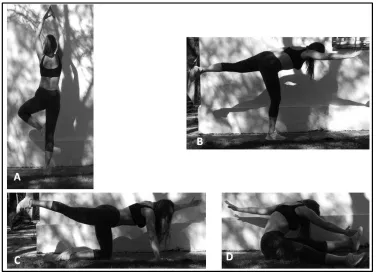
work balance are visually explained in Fig. 1 and they might be classified in two categories: 1) one leg stability and 2) activities for balance confidence.
1) Exercise balance on one leg (One Leg Stability: OLS)
A) Balance on one leg during several seconds. While that, arms are up toward sky, while the other leg is leaning on the fixed one, in harmony and control breathing (diaphragm). Whole exercise is first performed with one leg, second with the opposite leg, equally in time. It is important to visualize a straight line from the fingertips to the heel on floor that symbolizes the internal axis.
Fig. 1. Pilates exercises aimed to work on proprioception. A) and B) consist on exercises to improve balance on one leg, to enhance one leg stability (OLS). Exercises C) and D) are activities also pursuing the goal of gaining Balance confidence (ABC), through the core
This exercise is named Vrksasana (tree posture) and it involves several muscles: leg (Rectus Femoris, Vastus lateralis and medialis, Gracilis, Sartorius, Gastrocnemius or calves, Cuadriceps, Gluteus, Psoas major, Illiacus), belly (Rectus abdominis), shoulder (Deltoid).
B) Balance on one leg during several seconds, while ipsilateral arm is extended front and the other leg is extended back, forming two right angles in harmony and control breathing (diaphragm). Whole exercise is first performed with one leg, second with the opposite leg, equally in time. It is important to visualize a straight line from the extended arm fingertips to the heel of the extended leg, that symbolizes the internal axis.
This exercise is named Virabhadrasana (the warrior) and muscles involved are: leg (Semimembranosus, Semitendinosus, Gracilis, Sartorius, Gluteus, Biceps femoris), belly (Rectus abdominis, External Abdominal oblique), shoulder (Deltoid, Trapecius, Infraspinatus).
2) Exercises to improve balance (Activities for Balance Confidence: ABC).
C) Balance on one arm and contralateral leg resting on knee during several minutes, in harmony and control breathing (diaphragm), while the opposite arm and leg are extended. Whole exercise is first performed with one leg, second with the opposite leg, equally in time. It is important to visualize a straight line, from the fingertips of the extended arm to the heel of the extended leg, that symbolizes the internal axis.
This exercise is named Superman and muscles involved are: leg (Cuadriceps, Gluteus, Psoas major, Illiacus), belly (Rectus abdominis, multifidus, erector spinae), shoulder (Deltoid, Triceps).
D) Balance on core (abdomen) while stretching leg muscles and improving psoas major muscle length, touching feet with contralateral hand fingers. Performed during several minutes first performed with one leg, second with the opposite leg, with control breathing (diaphragm). It is important to visualize a straight line between both hands fingertips.
This exercise is named the Saw and muscles involved are: Leg (Sartorius, Gracilis, Semimembranosus, Semitendinosus, Gastrocnemius or calves, Gluteus), belly (Rectus abdominis, multifidus, Erector spinae), shoulder (Deltoids).
2. CONCLUSION
To our knowledge, no study to date has described differences in homeostasis mechanism related to specific physical exercises to perform in order to improve and enhance the balance and proprioception related to posture. Since homeostasis does exist differently in man and woman, with differences and specific developmental paths and metabolisms, subsequently different physical exercises for man and woman might be prescribed to be done. Here we described as examples four exercises that, performed properly and routinely, could be of good use for improving body balance in both man and woman, in an adjusted manner to capabilities and previous developed proprioception.
ACKNOWLEDGEMENTS
I thank Prof. Dr. D. F. Swaab for his teaching and orientation in the method of studying and researching. I am grateful to Ruma Bag and Rahul Roy from Editorial Science Domain International, for their professional work in publication procedure. The manuscript was improved thanks to comments of two anonymous reviewers.
CONSENT
It is not applicable.
ETHICAL APPROVAL
It is not applicable.
COMPETING INTERESTS
Author has declared that no competing interests exist.
REFERENCES
2. Riemann BL, Lephart SM. The sensorimotor system, part I: The physiologic basis of functional joint stability. J Athl Train. 2002;37:71-9. 3. Elias LA, Watanabe RN, Kohn AF. Spinal
mechanisms may provide a combination of intermittent and continuous control of human posture: Predictions from a biologically based neuromusculoskeletal model. PLoS Comput Biol. 2014;10:e1003944.
4. Buijs RM, Escobar C, Swaab DF. The circadian system and the balance of the autonomic nervous system. Handb Clin Neurol. 2013;117:173-91.
5. Namkung J, Kim H, Park S. Peripheral serotonin: A new player in systemic energy homeostasis. Mol Cells. 2015;38:1023-8. 6. Braun TP, Marks DL. The regulation of
muscle mass by endogenous glucocorticoids. Front Physiol. 2015;6:12. 7. Lundsgaard AM, Kiens B. Gender
differences in skeletal muscle substrate metabolism-molecular mechanisms and insulin sensitivity. Front Endocrinol (Lausanne). 2014;13;5:195.
8. Hawley JA, Hargreaves M, Joyner MJ, Zierath JR. Integrative biology of exercise. Cell. 2014;159:738-49.
9. Jeter PE, Nkodo AF, Moonaz SH, Dagnelie G. A systematic review of yoga for balance
in a healthy population. J Altern Complement Med. 2014;20:221-32. 10. Riemann BL, Lephart SM. The
sensorimotor system, Part II: The role of proprioception in motor control and functional joint stability. J Athl Train. 2002;37:80-4.
11. Quatman-Yates CC, Quatman CE, Meszaros AJ, Paterno MV, Hewett TE. A
systematic review of sensorimotor function during adolescence: A
developmental stage of increased motor awkwardness? Br J Sports Med. 2012;46:649-55.
12. Berg KO, Wood-Dauphinee SL, Williams JI, Maki B. Measuring balance in the elderly: Validation of an instrument. Can J Public Health. 1992;83:S7-11.
13. Quatman-Yates C, Hugentobler J, Ammon R, Mwase N, Kurowski B, Myer GD. The utility of the balance error scoring system for mild brain injury assessments in children and adolescents. Phys Sportsmed. 2014;42:32-8.
14. Haddad JM, Rietdyk S, Claxton LJ, Huber JE. Task-dependent postural control throughout the lifespan. Exerc Sport Sci Rev. 2013;41:123-32.
15. Pilates J. Pilates´s return to life through contrology. Presentation Dynamics (NY) Editorial;1945.
_________________________________________________________________________________
© 2016 Garcia-Falgueras; This is an Open Access article distributed under the terms of the Creative Commons Attribution License (http://creativecommons.org/licenses/by/4.0), which permits unrestricted use, distribution, and reproduction in any medium, provided the original work is properly cited.
Peer-review history: