Security and Efficiency Analysis of
The Hamming Distance Computation Protocol
Based On Oblivious Transfer
Mehmet Sabır Kiraz, Ziya Alper Genc¸, S¨uleyman Kardas¸
Abstract—In Financial Cryptography 2013, Bringer, Chabanne and Patey proposed two cryptographic protocols for the com-putation of Hamming distance in the two-party setting. Their first scheme uses Oblivious Transfer and provides security in the semi-honest model. The other scheme uses Committed Oblivious Transfer (COT) and is claimed to provide full security in the malicious case. The proposed protocols have direct implications to biometric authentication schemes between a prover and a verifier where the verifier has biometric data of the users in plain form. In this paper, we show that their protocol against malicious adversaries is not actually secure. Namely, we show a generic attack such that a malicious user can compute a Hamming distance which is different from the actual value. For biometric authentication systems, this attack allows a malicious adversary to pass the authentication without knowledge of the honest user’s input with at most O(n) complexity instead ofO(2n), wheren
is the input length. We propose an enhanced version of their protocol where this attack is eliminated. The security of our mod-ified protocol is proved using simulation-based paradigm. Also as for efficiency concerns, the modified protocol utilizes Verifiable Oblivious Transfer (VOT) which excludes the commitments to outputs (as they exist in COT). We show that the use of VOT does not reduce the security of the protocol but improves the efficiency significantly.
Index Terms—Biometric Identification, Authentication, Ham-ming distance, Privacy, Committed Oblivious Transfer.
1. INTRODUCTION
Recently, several commercial organizations have invested in secure electronic authentication systems to reliably verify identity of individuals. Biometric authentication mechanisms is one of the wide-spread popular technology because of the cost-effective improvements in sensor technologies and in the efficiency of matching algorithms [1]. The biometric data (i.e. templates) of a user is inherently unique. This uniqueness provides the reliability of the individual to be securely authen-ticated for accessing to an environment when the biometric data is kept as secret. The biometric data cannot be directly used with conventional encryption techniques because these data are inherently noisy [2]. Namely, whenever two sample of data extracted from the same fingerprint, these data would not be exactly same. In this context, in order to eliminate noisy
Mehmet Sabır Kiraz (corresponding author), Ziya Alper Genc¸ and S¨uleyman Kardas¸ and is with the Department of Cryptology, TUBITAK BILGEM UEKAE, Kocaeli, Turkey (e-mail: {mehmet.kiraz, ziya.genc, su-leyman.kardas}@tubitak.gov.tr
Ziya Alper Genc¸ is also with the ˙Istanbul S¸ehir University and S¨uleyman Kardas¸ is also with Sabancı University, Istanbul, Turkey.
nature of the biometric templates, several error correction techniques have been proposed in the literature [3], [4], [5].
Biometric authentication over insecure network raises more security and privacy issues. The primary security issue is the protection of the plain biometric templates against malicious adversary because they cannot be replaced with a new one, once they are compromised. The common biometric authen-tication system is as follows. For each user, the biometric template is stored in a database during theenrollment phase. In the verification phase, a new fresh acquisition of a user is compared to the template of the same individual stored in the database. The verification phase can either be pro-cessed within the smart card (i.e, on-card matching), or in a system outside the card (i.e, off-card matching) [6]. Since the biometric template is not necessarily transferred to the outside environment, the on-card matching technique protects the template. In both techniques, the authentication protocol should not expose the biometric template without the user’s agreement. In order to ensure privacy of the user, the biometric template should be stored in an encrypted form in the database and no one including the server side can learn any information on link between the user and her biometric data. But still, it should be possible to verify whether a user is authentic [7].
In order to thwart, the security and privacy issue described above for the biometric authentication, several matching algo-rithms are proposed in the literature. Many of them utilize the computation of the Hamming distance of two binary biometric templates. Note that the Hamming distance does not reveal any significant information to any polynomially bounded adversary. In this context, in Financial Cryptography 2013, Bringer et al.[8] have proposed two secure Hamming distance computation schemes based on Oblivious Transfer. In their proposals, the authors integrate the advantages of both biometrics and cryptography in order to improve the overall security and privacy of an authentication system. The first scheme is solely based on 1-out-of-2 Oblivious Transfer (OT) and it achieves full security in the semi-honest setting, and one-sided security in the malicious setting. The second scheme uses Committed Oblivious Transfer (COT) and is claimed to provide full security against malicious adversaries.
A. Contributions
The main contributions of this paper are summarized as follows:
that SHADE is insecure in the malicious model. Namely, the full scheme has a severe weakness on computation of Hamming distance. We show that this weakness allows any malicious adversary to violate the completeness of the protocol, i.e., a different value of Hamming distance from the actual one.
The protocol flaw resides in the method used for val-idation of the inputs of a user. Using zero-knowledge proofs, the protocol forces the user to submit valid inputs, i.e. pairs of integers (x, y) that differ by 1. The method succeeds at checking the difference, however, it fails at validation of the pairs, i.e. a malicious party can submit invalid pairs (x−2−1, x+ 2−1). Since SHADE
computes the Hamming distance by summing each side and evaluating the difference, a verifier would compute an incorrect value. As a practical example for biometric authentication, we show that a malicious adversary can pass the authentication by running the algorithm at most O(n) times (instead of running O(2n) times, where
n is the input length.). Last but least, an adversary with knowledge of distribution of inputs can mount a more powerful attack. Note that we believe this attack is of independent interest and may be applied to other schemes.
• In order to eliminate this severe weakness, we propose a new method for input validation. This way, we remove the fault in the protocol and enhance the security of it. We also show that the computational complexity of the fixed protocol is comparable with the insecure protocol. Moreover, we optimize the new input validation method for biometric authentication systems. We prove the secu-rity of our protocol using ideal/real simulation paradigm in the standard model [9], [10], [11] and [12].
• Lastly, we consider the efficiency of the protocol and
show that running a COT is not necessary in the second option of the protocol. We show that VOT is sufficient instead of using complete COT protocol which contains additional commitments and zero-knowledge proofs [13]. This leads a considerable improvement in the computa-tional complexity of the protocol.
B. Organization
Section 2 gives the related work on the computation of Hamming distance and biometric authentication systems. Sec-tion 3 provides the security and privacy model for biometric authentication protocol. Section 4 reviews the two schemes in the protocol, basic scheme which uses OTs and full scheme based on COT of bit-strings. In Section 5, we present an attack to the full scheme of Bringeret al.and show that their protocol is insecure. In Section 6, we propose a security fix and discuss the efficiency of their protocol in the malicious model. Here, we show that VOT is sufficient instead of COT. In Section 7 we prove our fixed protocol using simulation-based paradigm. The complexity analysis of the proposed protocol is shown in Section 8. Finally, Section 9 concludes the paper.
2. RELATEDWORK
There has been a large amount of research done on the security and efficiency of biometric authentication systems. In this section, we review the most recent works for biometric authentication.
Hamming distance together with Oblivious Transfers is one of the most elegant tools used in biometric authentication systems. For example, Jarrous and Pinkas propose binHDOT protocol [14] to compute Hamming distance based on 1-out-of-2 Committed Oblivious Transfer with Constant Difference (COTCD) of Jarecki and Shmatikov [15] and Oblivious Poly-nomial Evaluation (OPE) of Hazay and Lindell [16]. The protocol also uses commitments and zero-knowledge proofs to guarantee that each party follows the protocol. The protocol provides full security in the malicious model. One OPE protocol andnCOTCDs are invoked to compute the Hamming distance between two strings ofn bits.
The SCiFI (Secure Computation of Face Recognition) of Osadchy et al. is the first secure face identification sys-tem which is well suited for real-life applications [17]. The SCiFI system consist of two parts: a client and a server. The server prepares face recognition database that contains representations of face images. This computation is done offline. In the verification phase, the client prepares her face representation and then a cryptographic protocol which uses Paillier encryption and Oblivious Transfer running between the server and the client. The authors implemented a complete SCiFI system in which a face is represented with a string of 900 bits. The authors designed the system by aiming the minimal online overhead: the most significant requirement for computing Hamming distance between this length of bit strings is 8 invocations of 1-out-of-2 OTs.
Bringer et al. [18] used biometric authentica-tion/identification for access control. Note that it is important to securely store the biometric template to the server. Using conventional encryption schemes for securing the biometric template can provide a strong protection. Note that conventional cryptography requires exact match while biometrics always have a threshold value, therefore biometric authentication over the encrypted domain is a challenging task. In this paper, a cryptographic scheme is given for biometric identification over an encrypted domain which uses Bloom Filters with Storage and Locality-Sensitive Hashing. This paper is interesting since it proposes the first biometric authentication/identification scheme over encrypted binary templates which is stored in the server’s database.
Erkin et al. [21] propose a privacy preserving face recog-nition system on encrypted messages which is based on the standard Eigenface recognition system [22]. In their protocol design, they utilized semantically secure Paillier homomorphic public-key encryption schemes and Damg˚ard, Geisler and Krøigaard (DGK) cryptosystem [23], [24]. Later, Sadeghiet al.
make an improvement over the efficiency of this system [25]. In this study, they merge the eigenface recognition algorithm using homomorphic encryption and Yao’s garbled circuits. Their protocol improves the scheme proposed by Erkin et al.
significantly, i.e. it has only a constant number ofO(1)rounds and most of the computation and communication performed during the pre-computation phase.
Tuyls et al.[26] propose a template protection scheme for fingerprint based authentication in order to protect biometric data. During the enrollment phase, Alice’s biometric features
X is extracted, the Helper Data [27] W is computed (that is required by error-correction mechanism), a one-way hash function H is applied to S and the data (Alice, W, H(S)) is stored to the server. Here,Sis a randomly chosen secret value such that G(X,W)=S for a shielding functionG[28]. During the verification phase, after Alice’s noisy biometric data X is extracted, the server sends W back to the sensor. The sensor computes S =G(X,W) andH(S). Then, the server compares
H(S) withH(S), and grants access if the results are equal. The Helper Data is sent over the public channel, i.e. an adversary may obtainW. Tuylset al.however design the system in such a way that the adversary obtains minimal information aboutX
by capturingW.
Kulkarni et al. [29] propose a biometric authentication scheme based on Iris Matching. Their scheme uses the some-what homomorphic encryption scheme of Boneh et al. [30] which allows an arbitrary number of addition of ciphertexts but supports only one multiplication operation between the ciphertexts. The scheme is based on Paillier encryption and bi-linear pairing. This scheme consists of two phases: Enrollment phase and Verification phase. During the Enrollment phase, first the necessary keys are generated by the server and sent to the client securely. Secondly, the client’s biometric data is XORed with the key, and a mask value is XORed with a mask key. Both XORed values are sent to the server. During the Verification (authentication) phase, the client sends an encryption of an authenticated biometric data to compute the distance. The protocol is proven to be secure in the semi-honest model.
Kerschbaum et al. [31] propose an authentication scheme in a different setting. Particularly, they assume that there are two parties where each of them has a fingerprint template. They would like to learn whether the templates match, i.e. generated from the same fingerprint. However, they do not want to reveal the templates if there is no match. Their protocol uses secure multi-party computation which is secure only in the semi-honest model.
Barni et al. propose a privacy preserving authentication scheme for finger-code templates by using homomorphic en-cryption which is secure only in the semi-honest model [32], [33]. Their protocol allows the use of the Euclidean distances to compare fingerprints in such a way that the biometric data
is reduced for computing a smaller encrypted value that is sent to the server.
3. SECURITY ANDPRIVACYMODEL
We adopt the standard simulation-based definition of ideal/real security paradigm in the standard model which is already highlighted in [9], [10], [11] and [12]. In simulation-based security, the view of a protocol execution in a real set-ting is compared (a statistical/computational indisset-tinguishable manner) as if the computation is executed in an ideal setting where the parties send inputs to a trusted third party F that performs the computation and returns its result.
In an ideal setting, the parties send their inputs x and y to a trusted third party F who computes f(x, y) (which is the output of the Hamming distance in our setting) and sends f1(x, y) to the first party and f2(x, y) to the second party
(f1(x, y)andf2(x, y)can be⊥if only one party is required
to learn the output). Note that the adversary, who controls one of the parties, can choose to send any input it wishes to the trusted third party F, while the honest party always sends its specified input. In a real execution of a protocol, one of the parties is assumed to be corrupted under the complete control of an adversaryA. Note that we always assume that the adversaryAcorrupts one of the two parties at the beginning of the protocol execution and is fixed throughout the computation (it is known as static adversary model).
Informally, a protocol is secure if for every real-model adversary A interacting with an honest party running the protocol, there exists an ideal-model adversaryS interacting with the trusted party computing f, such that the output of the adversary and the honest party in the real model is computationally indistinguishable from the output of simulator and the honest party in the ideal model. More formally,
Definition 3.1. (Simulation-based security) Let f and the protocolΠbe as above. We say that the protocolΠf securely computes the ideal functionality F if for any probabilistic polynomial-time real-world adversary A, there exists a prob-abilistic polynomial-time an ideal-model adversaryS (called the simulator) such that
REALΠF,A(x, y)x,ys.t.|x|=|y|≈IDEALF,S(x, y)x,ys.t.|x|=|y|
Note that the above definition implies that the parties already know the input lengths (by the requirement that |x|
= |y|).
4. THEBASIC AND THEFULLSCHEME OFBRINGERet al.
In this section, we briefly describe the basic and the full scheme of [8] used for computation of Hamming distance between two bit strings. The basic scheme uses oblivious transfer (OT) and provides full security when the parties are semi-honest and one-sided security in the malicious model. The full scheme uses committed oblivious transfer (COT) [36] and zero-knowledge proofs of knowledge [13] to compute the Hamming distance in malicious model. Each scheme has two options to select the party which computes and outputs the result meaning that each party may act as a server and the other as a client.
A. The Basic Scheme
The basic scheme is designed to provide secure and efficient method for computing the Hamming distance between two bit strings in semi-honest model. The intuition behind this proto-col is that if both parties are semi-honest, the OT protoproto-cols are sufficient to preserve privacy.
The basic scheme in [8] is roughly as follows:
Using the local notation, let P1 and P2 have the inputs
X = {x1, . . . , xn} and Y = {y1, . . . , yn} respectively. At
the first step, P1 randomly picks r1, . . . , rn ∈R Zn+1 and
computes R = n P
i=1
ri. For each 1 ≤ i ≤ n, the parties run
oblivious transfer in whichP1 acts as the sender andP2 acts
as the receiver. More precisely, P1 inputs (ri+xi, ri+xi)
where xi = 1−xi and P2 inputs yi. At the end of OT, P2
receives ti= (ri+xi)ifyi= 0and(ti=ri+xi)otherwise.
Next,P2 computesT =
n P
i=1
ti. In the last step,
• 1st Option: P2 sendsT toP1.
P1 computes and outputs T−R.
• 2nd Option:P1sends R toP2.
P2 computes and outputs T−R.
In the case of one party is malicious, the privacy of the honest party is still provided because of the flexibility at the end of the protocol.
Compared to the related protocols for secure computation of Hamming distance in the semi honest model, the basic scheme of Bringer et al. [8] is the most efficient protocol as they proved in Section 6 of [8].
The authors also mention that the basic scheme can be optimized by using the state of the art techniques, i.e. extended oblivious transfer, as first proposed by Ishaiet al.in [37] and later improved in [38]. This technique leads to an efficient construction which extends k OTs to n OTs (k < n) in the random oracle model that is secure against only semi-honest adversaries (note that hash functions can be replaced with RO model in the real case).
B. The Full Scheme
The full scheme of Bringeret al. considers the case where the parties are assumed to be malicious. Note that running OT protocol does not prevent a party from modifying her input. Secondly, the receiver may send a different value than the actual OT output that she computes. In order to prevent such
scenarios, the authors propose to use the 1-out-of-2 Committed Oblivious Transfer (COT) protocol of Kiraz et al. presented in [36]. Though, in Section 5, we show that the idea of input validation for P1 is not sufficient and can be exploited with
success.
Before we proceed, let’s continue with the description of the full scheme.
At the first step of the protocol,P2 commits to her inputs
yi’s and proves that each yi is either 0 or 1. At the same
time, P1 generates random ri’s from the plaintext space of
the commitments scheme and computes R = n P
i=1
ri but
this time she commits to (ai, bi) = (ri + xi, ri +xi).
Let’s denoteCommit(M) for a commitment functionality of a message M (note that Commit includes randomness and we hide it for the sake of simplicity). P1 publishes the
commitments Ai = Commit(ai) and Bi = Commit(bi).
Note that Commitfunctionality is basically a (2,2)-threshold homomorphic encryption which is used as a commitment scheme (e.g., ElGamal [39], Paillier [40]). Furthermore, using these commitments she proves that her inputs ai’s and bi’s
differ by 1. Next, the COT protocol is run for each i. At the end of each COT, P2 receives ti =ri+ (xi⊕yi) and both
parties receiveCi=Commit(ti). When all the COTs are run,
P2computes the sum T =
n P
i=1
ti.
At this point, there are again two options:
• 1st Option:P2 computes C =Commit(T) =C1·. . .·
Cnbecause of the underlying homomorphic property [8].
P2 sends T to P1 and proves that C commits to T. P1
computes C=C1·. . .·Cn and checks the proof. If all
verifications are successful,P1 outputs T−R.
• 2nd Option: P1 computes K = Commit(2R +n) =
A1·. . .·An·B1·. . .·Bn.P1sendsR toP2 and proves
that K commits to2R+n.P2 computesK=A1·. . .·
An·B1·. . .·Bn and checks thatK=Commit(2R+n).
If all verifications are successful,P2 outputsT−R.
The authors in [8] claims that the above scheme is fully secure against malicious parties. However, in the next section we show that a maliciousP1can easily break the completeness
property of the scheme.
5. SECURITY ANDEFFICIENCYANALYSIS OF THE
BRINGER’SPROTOCOLet al.
We are now ready to describe the protocol flaw of the full scheme in detail. The security flaw is due to the proof for validation of P1’s input bits. The flaw allows a maliciousP1
to change the Hamming distance between her input andP2’s
input. In the next section, we will propose a solution to fix the flaw by designing a new proof for validation. We show that the complexity of the new proof for the validation of P1’s
input bits for biometric authentication systems is significantly reduced.
committed output of COT is expected to be used in further parts of the system. However, the committed outputs of COT are not used in the case that P1 computes the Hamming
distance. Hence, we will point out that verifiable OT will be sufficient in the case thatP1computes the Hamming distance.
This will eliminate to computen commitments together with the zero-knowledge proofs (for each run of COT protocol). In this way, we will improve the efficiency of the protocol by using VOT instead of COT when P1 is the server.
A. Attack to the Full Scheme
The protocol is insecure in the case whereP1is malicious.
This is becauseP1is free in the sense that she can commit to
any pair such that the absolute value of the difference of the encrypted values pairs is 1, i.e.P1 proves that |bi−ai| = 1
where the pair (ai, bi) is supposed to be (ri+xi, ri+xi).
However, a maliciousP1may choose invalid pairs in a special
way together with the proofs that difference between each pair is equal to 1. Our attack uses the fact that at the end of each COT, P2 receives either ti = ri +g or ti = ri +h and
computes the sum T = n P
i=1
ti, whereg, hare within the finite
cyclic group. Note that gis expected to be equal to xi andh
toxi. However, with a careful choosing ofg’s andh’s, some
g’s can be neutralized by some h’s in this sum. Hence, the completeness property of the protocol can be violated.
Before we describe the attack we need to highlight that the underlying COT scheme uses threshold ElGamal encryption as a commitment mechanism, i.e.Commit(xi) =Enc(xi)where
xi ∈ G where G is a large finite cyclic group (of a prime
order) [36]. This guarantees the existence of the inverse ofn.
Without loss of generality assume that#0’s inP2’s inputY
is`(i.e.,#1’s inY isn−`). We would like to highlight that the Hamming distance can be scalable with the knowledge of
#0’s (similarly #1’s) in P2 as follows: a malicious P1 may
use (ai, bi) = (ri+g, ri+h)for a predetermined Hamming
distance valueHD=`g +(n−`)hsuch thatg−h= 1. Then,
HD=`g+ (n−`)(g−1) =ng−n+`.
For an example, if a maliciousP1desires Hamming distance
HD to be 0 then she choose g = 1−`n−1. Next, h= g-1= -`n−1. Hence,P
1may use(ai, bi)=(ri+(1−`n−1), ri−`n−1)
as input. To be more concrete, the attack is given as follows:
• P2 commits to her inputsyi’s and proves that each yi is
either0or1.P1then generates randomri’s and computes
R=
n P
i=1
ri.
• Next, instead of following the protocol, P1 computes
(ai, bi)=(ri+ (1−`n−1), ri−`n−1)and publishesAi=
Commit(ai)andBi=Commit(bi). Note that for eachi, |bi−ai|= 1and hence, the proofs will pass successfully. • At the end of each COT, P2 receives either ti = ri+ (1−`n−1) or ti =ri−`n−1. After COTs are run, P2
computes the sum
T =
n X
i=1
ti
= X
i|yi=0
ri+ (1−`n−1)
+ X
i|yi=1
ri−`n−1
= `(1−`n−1) + (n−`)(−`n−1) + n X
i=1
ri
= n X
i=1
ri
= R.
Therefore, the Hamming distance dH(X, Y)=T −R will
be equal to 0. We stress that the weakness in the scheme is destructive as we prove that a relatively insignificant informa-tion leakage causes computainforma-tion of a completely inaccurate result. Namely, without knowledge of the realX,P1 foolsP2
into outputting an incorrect Hamming distance value without being detected. Furthermore, a malicious P1 with the prior
knowledge of`is capable of manipulatingHDas it is easy to findgandhusing above equation. This is interesting because of the following result: The authors in [41] propose a privacy-preserving protocol for iris-based authentication using Yao’s garbled circuits. They show that Hamming distance between two iris codes owning by the same person is rarely close to 0 or tonbetween different people. Therefore, the scalability feature of our attack can be easily adopted to various settings. In this part, we propose the most general case and in the next section we give a practical attack for biometric authentication schemes reducing the computational complexity of an attacker fromO(2n)toO(n), wherenis the input length. Namely, an
attacker without any prior knowledge can authenticate herself using onlyn trials instead of2n.
B. A Special Case: Apply the Generic Attack to Biometric Authentication Systems
In this section, we apply the proposed attack for biomet-ric authentication systems with full success. Note that the matching procedure for fingerprint, palm print or iris actually measures the Hamming distance between the two bit-strings X andY that encode the biometric sample and template (e.g., [7], [42], [29]).
The attack basically usesn(instead of 2n) protocol runs to
successfully authenticate to the system, wheren is the input length. In general, for an n-bit string Y = (y1, . . . , yn), an
attacker must roughly try2nsearch forX of lengthnto pass
the threshold value which is infeasible for largen. However, using the proposed attack a corruptedP1 can authenticate the
system after at mostntrials (because the number of 0s or 1s in Y is between 0 ≤ ` ≤ n). More precisely, for ` = 1 to na corruptedP1 runs the method proposed previous section.
Because0≤`≤n, the authentication will be successful with at mostntrials without any knowledge of the real inputX.
C. Apply the Generic for Uniformly Distributed Inputs
bit-strings of P2 (which is generated from a biometric template)
is expected to be independent and identically distributed. That is, there are nearly equal number of zeros and ones in an input bit string. Below, we show that this fact easily allows an adversary to minimize the Hamming distance and successfully deceive a verifier:
1) P2 commits to her inputsyi’s and proves that each yi is
either 0 or 1.
2) P1 picks random ri’s and computes R= n P
i=1
ri.
3) Instead of computing (ai, bi) = (ri + xi, ri + ¯xi),
P1 computes (ai, bi) = (ri −2−1, ri + 2−1) in order
to make the commitments Ai = CommitP1,i(ai) and Bi = CommitP1,i(bi). The authors in [8] uses homo-morphic encryption as the commitment mechanism. Since those cryptosystems work in a group of prime order, the multiplicative inverse of 2 always exists, i.e.P1 can
commit to(ai, bi) = (ri−2−1, ri+ 2−1). NextP1proves
that |bi−ai|= 1which always holds. Note thatP1 does
not prove the validity of her input, i.e, she does not prove that thexi’s are equal to either 0 or 1.
4) COTs are run and, in one half of the COTs (because of the uniform distributed inputs), P2 receives ti=ri−2−1
andti=ri+ 2−1 in the other half.
5) P2 computes T ←
n P
i=1
ti. Since yi’s are equally
dis-tributed, i.e. the numbers of 0s and 1s in {y1, . . . , yn}
are equal, P2 computes T =
P
i
ri+ 2−1
+
P
i
ri−2−1
= n P
i=1
ri=R.
6) Using the 2nd option,K=Commit
P2,i(2R+n) =A1· . . .·An·B1·. . .·Bn.
7) P1 sendsR and the proof thatK commits to2R+nto
P2.
8) P2 computes dH(X, Y)= T −R = 0 and authenticates
P1.
D. Our solution for the attack
The weakness of the full scheme is due to the wrong method used for validation of the input pairs{(ai, bi),∀i= 1, . . . , n}.
A malicious P1 can exploit this weakness as described in the
previous section. Therefore, designing cryptographic protocols should be carefully checked against these kinds of tricks.
As a security fix, we modify the step in which P1
gen-erates random ri values. Namely, after generating each ri,
P1 will compute and publish Ai = Commit(ri+xi), Bi =
Commit(ri+x)andCommit(ri). Moreover,P1 will send the
proof of:
((ai−ri) = 0∨(bi−ri) = 0)∧ |bi−ai|= 1
that is equivalent to
(ai+bi−2ri= 1)∧ |bi−ai|= 1
This statement contains one more relation than the original proof in [8]. Although the computation cost of the protocol is slightly increased, the validation process is now secure. To see this, assume that (ai+bi−2ri = 1)∧ |bi−ai| = 1 is
true. This implies|bi−ai|= 1and(ai+bi−2ri= 1). Here,
there are two cases:
ai=bi+ 1⇒2bi+ 1−2ri= 1⇒bi=ri, ai=ri+ 1
bi=ai+ 1⇒2ai+ 1−2ri= 1⇒ai=ri, bi=ri+ 1
In Section 7 we provide the security analysis of the im-proved scheme.
1) More Efficient Solution for Biometric Authentication:
Biometric authentication systems are designed to tolerate a small level of errors. In general, the measure process is not perfect in most environments and thus, instead of exact match, a biometric system authenticates a party that matches with a small error to prevent false negatives.
The authentication process must also have a small com-plexity to compute the result in the fastest way. Therefore each party must prove nothing more than the necessary and sufficient data for validation of her input.
These motivations lead us to design a more efficient proof that can be used in the biometric authentication systems. Namely, after generating and publishing the commitments to ai, bi, ri as in the previous section, P1 sends the proof of:
ai+bi−2ri = 1.
The above relation has a smaller complexity than|bi−ai|= 1
while it still provides higher security. This input validation method is an efficient solution for our attack in the case of biometric authentication. Note that an adversary may input
(ai, bi) = (ri−2−1, ri+ 2−1)and pass the validation but its
Hamming distance will be n2 which is the expected value of Hamming distance between two random inputs with lengthn.
E. Efficiency Enhancements
In this section, we present some improvements for the efficiency of the protocol. First, we reduce the computational complexity of the protocol using VOT instead of COT without sacrificing the security. Namely, COT will not be necessary in the case whereP2computes the final Hamming distance. Next
we will reduce the complexity of the proof for the validity of P1’s inputs in the case of biometric authentication.
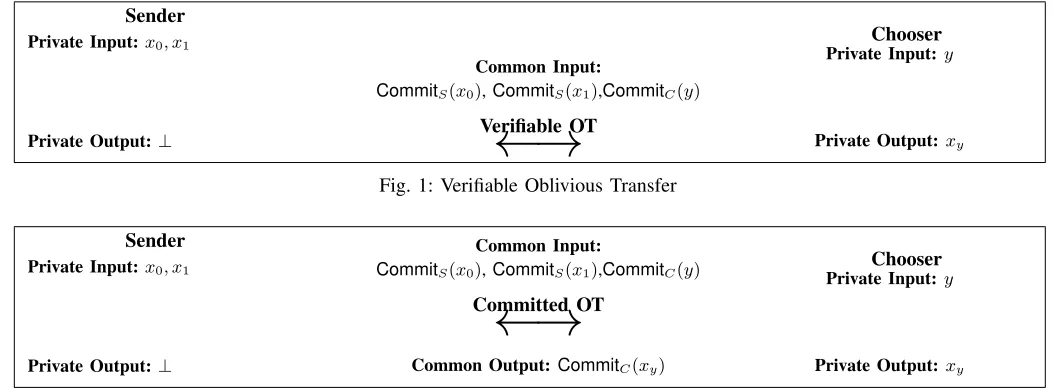
1) COT versus VOT: Verifiable OT and Committed OT are natural combination of 21
-OT and commitments. Let CommitS and CommitC be commitments by Sender and
Chooser respectively. The functionality of committed OT is illustrated in Figure 2.
Verifiable OT is defined if theCommitC(xy)is not required as output. We show that the basic protocol in [8] does not have to use COT in the case that the server computes the result.
We note two aspects:
What to transfer
bits x0, x1∈ {0,1}
strings x0, x1∈ {0,1}k
Committed Output
yes→Committed OT no →Verifiable OT
Sender
Private Input:x0, x1
Private Output:⊥
Common Input:
CommitS(x0),CommitS(x1),CommitC(y)
Verifiable OT
←→
Chooser
Private Input:y
Private Output:xy
Fig. 1: Verifiable Oblivious Transfer
Sender
Private Input:x0, x1
Private Output:⊥
Common Input:
CommitS(x0),CommitS(x1),CommitC(y)
Committed OT
←→
Common Output:CommitC(xy)
Chooser
Private Input:y
Private Output:xy
Fig. 2: Committed Oblivious Transfer
receiver to obtain the output together with its commitment to this value. In the beginning of the protocol, the input of P1
is an n-bit string X = (x1, . . . , xn) and the input of P2 is
an n-bit string Y = (y1, . . . , yn). After running the protocol
there are two options:
• P1 obtains the Hamming distance dH(X, Y) and P2
obtains nothing
• P2 obtains the Hamming distance dH(X, Y) and P1
obtains nothing
In caseP2 computes the Hamming distance, the committed
values from the output of COT will not be used. In such case, these commitments are not necessary to be computed and, therefore VOT will be sufficient to use. We realized this observation after writing the COT protocol explicitly with the overall protocol instead of using as a black box. If P1
computes the Hamming distance COT will still be necessary to use.
6. OURFIXED ANDIMPROVEDSCHEME
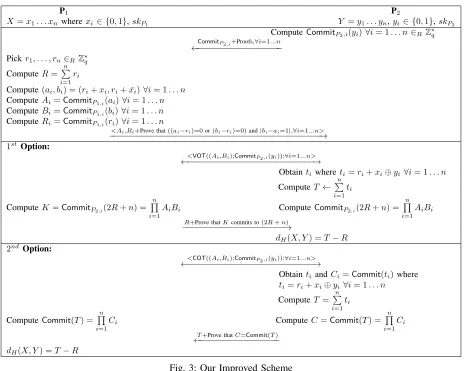
We have made modifications to the full scheme in [8]: we fix the security weakness described in Section 5 and improve the efficiency of the protocol as mentioned in Section 5. Now, we give the corrected scheme with all details:
Inputs:
• P1 inputs ann-bit stringX = (x1, . . . , xn) • P2 inputs ann-bit stringY = (y1, . . . , yn)
Outputs:
• 1stOption:P
1obtainsdH(X, Y)andP2obtains nothing
• 2ndOption:P
2obtainsdH(X, Y)andP1obtains nothing
Protocol:
1) P2 commits to her inputsyi’s and proves that each ofyi
is either 0or 1.
2) P1 generates random ri’s from the plaintext space of
Commitand computes R= n P
i=1
ri.
3) P1 commits to (ai, bi, ri) = (ri+xi, ri +xi, ri). P1
publishes Ai = Commit(ai), Bi = Commit(bi) and
Commit(ri).
4) P1proves that(|ai−ri|= 0∨|bi−ri|= 0)∧|bi−ai|= 1.
5) For eachi= 1, . . . , n, a COT is run where
• P1 acts as the sender andP2 as the receiver.
• P2’s selection bit isyi. • P1’s input bit is (ai, bi).
• The output obtained byP2is ti=ri+ (xi⊕yi). • Both parties obtainCi=Commit(ti).
6) P2 computes T =
n P
i=1
ti
7) 1nd Option: Run VOT
a) P1 computesK=Commit(2R+n) =A1·. . .·An·
B1·. . .·Bn.
b) P1sendsRtoP2and proves thatKcommits to2R+n.
c) P2 computesK=A1·. . . An·B1·. . .·Bn and checks
thatK=Commit(2R+n).
d) If all verifications are successful,P2 outputs T−R.
2st Option: Run COT
a) P2 computes C=Commit(T) =C1·. . .·Cn.
b) P2 sends T toP1 and proves thatC commits to T.
c) P1 computes C=C1·. . .·Cn and checks the proof.
d) If all verifications are successful,P1 outputs T−R.
7. SECURITYANALYSIS OFOURSCHEME
A cryptographic protocol is secure if the view of an adver-sary in a real protocol execution can be generated from the information the adversary has (i.e., its input and output). In this section, we proved the security of the proposed protocol by constructing a simulator, which is given only the input and output of the “corrupted” party, and generating a view that is indistinguishable from the view of the adversary in a real protocol execution [9], [10], [11], [12]. This implies that the adversary learns no information from the real protocol because it could generate anything from what it sees in such an execution by itself.
P1 P2
X=x1. . . xnwherexi∈ {0,1},skP1 Y =y1. . . yn,yi∈ {0,1},skP2
ComputeCommitP2,i(yi)∀i= 1. . . n ∈R Z
∗
q
CommitP2,i+Proofs,∀i=1...n
←−−−−−−−−−−−−−−−−−−
Pickr1, . . . , rn∈RZ∗q
ComputeR= n
P
i=1 ri
Compute(ai, bi) = (ri+xi, ri+ ¯xi)∀i= 1. . . n
ComputeAi=CommitP1,i(ai)∀i= 1. . . n ComputeBi=CommitP1,i(bi)∀i= 1. . . n ComputeRi=CommitP1,i(ri)∀i= 1. . . n
<Ai,Bi+Prove that((ai−ri)=0or(bi−ri)=0)and|bi−ai=1|,∀i=1...n>
−−−−−−−−−−−−−−−−−−−−−−−−−−−−−−−−−−−−−−−−−−−−→
1stOption:
<VOT((Ai,Bi);CommitP2,i(yi)):∀i=1...n>
←−−−−−−−−−−−−−−−−−−−−−−−−−−→
Obtaintiwhereti=ri+xi⊕yi∀i= 1. . . n
ComputeT←
n
P
i=1 ti
ComputeK=CommitP2,i(2R+n) =
n
Q
i=1
AiBi ComputeCommitP2,i(2R+n) =
n
Q
i=1 AiBi
R+Prove thatKcommits to(2R+n) −−−−−−−−−−−−−−−−−−−−−→
dH(X, Y) =T−R 2nd
Option:
<COT((Ai,Bi);CommitP2,i(yi)):∀i=1...n>
←−−−−−−−−−−−−−−−−−−−−−−−−−−→
ObtaintiandCi=Commit(ti)where ti=ri+xi⊕yi∀i= 1. . . n
ComputeT= n
P
i=1 ti
ComputeCommit(T) = n
Q
i=1
Ci ComputeC=Commit(T) =
n
Q
i=1 Ci
T+Prove thatC=Commit(T)
←−−−−−−−−−−−−−−−−−
dH(X, Y) =T−R
Fig. 3: Our Improved Scheme
Proof. We show that given a party is corrupted, there exists a simulator that can produce a view to the adversary that is statistically indistinguishable from the view in the real protocol execution based on its private decryption share as well as public information.
Case-1-P1is corrupted.LetAP1be an adversary corrupting P1. We construct a simulator SP1 and show that the view of the adversary AP1 in the simulation with SP1 is statistically close to its view in a hybrid execution of the protocol with a trusted party running the VOT (resp. COT) protocol. Since we assume that the VOT (resp. COT) protocol is secure, we analyze the security of the protocol in the hybrid model with a trusted party computing the VOT (resp. COT) functionality. Note that the simulator SP1 knows X, skP1 and dH(X, Y). The simulator proceeds as follows:
1) SP1 picks arbitrary Y˜ = y˜1. . .y˜n and computes
˜
CommitP2,i.SP1 can simulate the proofs since it knows the committed input values y˜i’s andskP1.
2) In case of VOT is run:
a) SP1 first extracts the input ofRP1 from VOT function-ality in the hybrid model, then sends the input to the trusted party and learns the output value t˜i.
b) SP1 computes T˜ = n P
i=1
˜
ti and computes
CommitP2,i(2R + n) =
n Q
i=1
AiBi as in the real
protocol.
In case of COT is run:
a) SP1 first extracts the input of RP1 from COT func-tionality in the hybrid model, then sends the input to the trusted party and learns the output value t˜i and
˜
Ci =Commit( ˜ti)∀i= 1, . . . , n.
b) SP1 computesT˜=
n P
i=1
˜
ti andCommit( ˜T) = n Q
i=1
˜
Ci as
in the real protocol.
c) SP1 can simulate the proof since it knows the commit-ted input valueT˜’s andskP1.
Consequently, each step of the proposed authentication protocol for the simulator is simulated and this completes the simulation for the malicious verifier. The transcript is consistent and statistically indistinguishable from the verifier’s view when interacting with honest P2.
1) SP2 picks arbitraryX˜ = ˜x1. . .x˜n. 2) SP2 picks r˜i ∈R Z
∗
q and computesR˜P2 =
n P
i=1
˜
ri. Next,
SP2 computes (˜ai,˜bi) = (˜ri+ ˜xi,r˜i+ ¯˜ix)∀i = 1. . . n. SP2 computes A˜i, B˜i and R˜i as in the real protocol. SP2 can again simulate the proofs since he knows the committed input values andskP2.
3) In case VOT is run:
a) SP2 first extracts the input of RP1 from VOT func-tionality in the hybrid model and then sends the input to the trusted party. SP2 next computes K˜ = CommitP2,i(2 ˜R+n).SP2 can simulate the proof since it knows the committed input values andskP2. In case COT is run:
a) SP2 first extracts the input of RP1 from COT func-tionality in the hybrid model and then sends the input to the trusted party and learn Ci ∀i = 1, . . . , n. SP2
computes Commit( ˜T) = n Q
i=1
˜
Ci.
Consequently, each step of the proposed authentication protocol for the simulator is simulated and this completes the simulation for the malicious verifier. The transcript is consistent and statistically indistinguishable from the verifier’s view when interacting with honest P1.
8. COMPLEXITYANALYSISOFOURFIXEDPROTOCOL
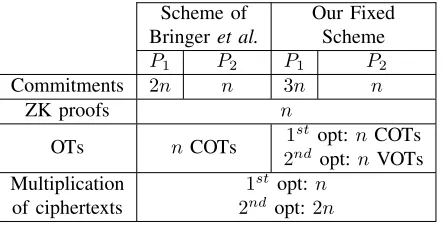
In this section, we analyze the computational complexity of our fixed protocol and compare it with the full scheme of Bringeret al.[8]. In our protocol, the number of invoked zero-knowledge proofs and multiplication of ciphertexts remain the same. However, we have improved the efficiency of the protocol significantly by replacing n COTs with n VOTs in the second option of the protocol where P2 computes the
final Hamming distance. In this way, we show thatnnumber commitments,2nnumber of partial decryption and2nnumber of ZK proofs can be removed. The number of commitments of P1 is increased from 2n to 3n in order to guarantee the
validity of P1’s inputs. This is the price that should be paid
to make the protocol secure. The complexity comparison of the full scheme of Bringeret al. [8] and our fixed protocol is illustrated in Figure 4.
Scheme of Bringeret al.
Our Fixed Scheme
P1 P2 P1 P2
Commitments 2n n 3n n
ZK proofs n
OTs n COTs 1
st opt: nCOTs 2nd opt:nVOTs
Multiplication of ciphertexts
1st opt:n 2nd opt:2n
Fig. 4: Complexity Comparison
Our analysis shows that the additional cost of the security fix is onlynnumber of commitments made byP1, independent
of the party which computes the final Hamming distance. However, in the case that P2 computes the final Hamming
distance, the computational savings that can be achieved by replacing the n COTs with n VOTs are far more larger. In general, a COT protocol requires one more flow than a VOT protocol in which the chooser recommits to its received value and proves that the new commitment equals to her previous committed input. In particular, the full scheme in [8] uses the COT scheme of [36] where each run of a COT protocol re-quires one commitment, two partial decryption of a ciphertext and two zero-knowledge proofs in addition to a VOT protocol. As a result, we avoid unnecessary use of two zero-knowledge proofs and two partial decryptions. Consequently, we improve the efficiency of the protocol significantly while we establish the security of the protocol.
9. CONCLUSION
Bringeret al.[8] proposed two Hamming distance computa-tion schemes which can be applied to biometric authenticacomputa-tion systems. In semi-honest setting, the basic scheme in [8] is the most efficient up to date. However, their full scheme is insecure in the malicious case.
In this paper, we show that the full scheme of Bringeret al.
[8] has a critical security issue. In our attack, we show that an adversary without having any prior knowledge can make the verifier compute an incorrect Hamming distance. In the case of biometric authentication systems, a malicious user can easily authenticate without any information about the honest party. Namely, the complexity of the security of the system is reduced fromO(2n)toO(n), wheren is the input length.
Moreover, we fix the protocol by placing a robust method for input validation without adding a significant cost. We also enhance the efficiency of their protocol significantly by showing that Verifiable Oblivious Transfer (VOT) is sufficient to use instead of Committed Oblivious Transfer (COT) in the second option of the full scheme. VOT reduction avoids the unnecessary computation of one commitment, two zero-knowledge proofs and two partial decryption of the ciphertext for each bit of the input.
REFERENCES
[1] Anil K. Jain, Arun Ross, and Salil Prabhakar. An introduction to biometric recognition.Circuits and Systems for Video Technology, IEEE Transactions on, 14(1):4–20, Jan 2004.
[2] Tom A. M. Kevenaar, Geert Jan Schrijen, Michiel van der Veen, Anton H. M. Akkermans, and Fei Zuo. Face recognition with renewable and privacy preserving binary templates. In Automatic Identification Advanced Technologies, 2005. Fourth IEEE Workshop on, pages 21–26, Oct 2005.
[3] Feng Hao, Ross Anderson, and John Daugman. Combining crypto with biometrics effectively. IEEE Trans. Comput., 55(9):1081–1088, September 2006.
[4] Sanjay Kanade, Dijana Petrovska-Delacretaz, and Bernadette Dorizzi. Cancelable iris biometrics and using error correcting codes to reduce variability in biometric data. InComputer Vision and Pattern Recog-nition, 2009. CVPR 2009. IEEE Conference on, pages 120–127, June 2009.
[5] Ari Juels and Martin Wattenberg. A fuzzy commitment scheme. In Pro-ceedings of the 6th ACM Conference on Computer and Communications Security, CCS ’99, pages 28–36, New York, NY, USA, 1999. ACM. [6] Anongporn Salaiwarakul and Mark D. Ryan. Analysis of a biometric
[7] Julien Bringer and Herv´e Chabanne. An authentication protocol with encrypted biometric data. In Serge Vaudenay, editor, Progress in Cryptology – AFRICACRYPT 2008, volume 5023 ofLecture Notes in Computer Science, pages 109–124. Springer Berlin Heidelberg, 2008. [8] Julien Bringer, Herv´e Chabanne, and Alain Patey. Shade: Secure
ham-ming distance computation from oblivious transfer. In AndrewA. Adams, Michael Brenner, and Matthew Smith, editors,Financial Cryptography and Data Security, volume 7862 ofLecture Notes in Computer Science, pages 164–176. Springer Berlin Heidelberg, 2013.
[9] Ran Canetti. Security and composition of multiparty cryptographic protocols. Journal of Cryptology, 13(1):143–202, 2000.
[10] Oded Goldreich. Foundations of Cryptography: Volume 2, Basic Applications. Cambridge University Press, New York, NY, USA, 2004. [11] Yehuda Lindell and Benny Pinkas. An efficient protocol for secure two-party computation in the presence of malicious adversaries. In Moni Naor, editor,Advances in Cryptology - EUROCRYPT 2007, volume 4515 ofLecture Notes in Computer Science, pages 52–78. Springer Berlin Heidelberg, 2007.
[12] Abhi Shelat and Chih-Hao Shen. Two-output secure computation with malicious adversaries. InProceedings of the 30th Annual International Conference on Theory and Applications of Cryptographic Techniques: Advances in Cryptology, EUROCRYPT’11, pages 386–405, Berlin, Heidelberg, 2011. Springer-Verlag.
[13] Ronald Cramer, Ivan Damg˚ard, and Berry Schoenmakers. Proofs of partial knowledge and simplified design of witness hiding protocols. In Yvo G. Desmedt, editor,Advances in Cryptology – CRYPTO ’94, volume 839 of Lecture Notes in Computer Science, pages 174–187. Springer Berlin Heidelberg, 1994.
[14] Ayman Jarrous and Benny Pinkas. Secure hamming distance based computation and its applications. In Michel Abdalla, David Pointcheval, Pierre-Alain Fouque, and Damien Vergnaud, editors,Applied Cryptog-raphy and Network Security, volume 5536 ofLecture Notes in Computer Science, pages 107–124. Springer Berlin Heidelberg, 2009.
[15] Stanislaw Jarecki and Vitaly Shmatikov. Efficient two-party secure computation on committed inputs. In Moni Naor, editor, Advances in Cryptology - EUROCRYPT 2007, volume 4515 ofLecture Notes in Computer Science, pages 97–114. Springer Berlin Heidelberg, 2007. [16] Carmit Hazay and Yehuda Lindell. Efficient oblivious polynomial
evaluation with simulation-based security. Cryptology ePrint Archive, Report 2009/459, 2009. http://eprint.iacr.org/.
[17] Margarita Osadchy, Benny Pinkas, Ayman Jarrous, and Boaz Moskovich. Scifi - a system for secure face identification. InSecurity and Privacy (SP), 2010 IEEE Symposium on, pages 239–254, May 2010.
[18] Julien Bringer, Herv´e Chabanne, and Bruno Kindarji. Identification with encrypted biometric data.Security and Communication Networks, 4(5):548–562, 2011.
[19] Julien Bringer, Herv´e Chabanne, Malika Izabach´ene, David Pointcheval, Qiang Tang, and S´ebastien Zimmer. An application of the goldwasser-micali cryptosystem to biometric authentication. In Josef Pieprzyk, Hossein Ghodosi, and Ed Dawson, editors, Information Security and Privacy, volume 4586 of Lecture Notes in Computer Science, pages 96–106. Springer Berlin Heidelberg, 2007.
[20] Shafi Goldwasser and Silvio Micali. Probabilistic encryption & how to play mental poker keeping secret all partial information. InProceedings of the Fourteenth Annual ACM Symposium on Theory of Computing, STOC ’82, pages 365–377, New York, NY, USA, 1982. ACM. [21] Zekeriya Erkin, Martin Franz, Jorge Guajardo, Stefan Katzenbeisser,
Inald Lagendijk, and Tomas Toft. Privacy-preserving face recognition. In Ian Goldberg and Mikhail J. Atallah, editors, Privacy Enhancing Technologies, volume 5672 ofLecture Notes in Computer Science, pages 235–253. Springer Berlin Heidelberg, 2009.
[22] Matthew Turk and Alex Pentland. Eigenfaces for recognition. J. Cognitive Neuroscience, 3(1):71–86, January 1991.
[23] Ivan Damg˚ard, Martin Geisler, and Mikkel Krøigaard. Efficient and secure comparison for on-line auctions. In Josef Pieprzyk, Hossein Ghodosi, and Ed Dawson, editors,Information Security and Privacy, volume 4586 ofLecture Notes in Computer Science, pages 416–430. Springer Berlin Heidelberg, 2007.
[24] Ivan Damg˚ard, Martin Geisler, and Mikkel Kroigard. A correction to efficient and secure comparison for on line auctions. Int. J. Appl. Cryptol., 1(4):323–324, August 2009.
[25] Ahmad-Reza Sadeghi, Thomas Schneider, and Immo Wehrenberg. Ef-ficient privacy-preserving face recognition. In Proceedings of the 12th International Conference on Information Security and Cryptology, ICISC’09, pages 229–244, Berlin, Heidelberg, 2010. Springer-Verlag. [26] Pim Tuyls, Anton H. M. Akkermans, Tom A. M. Kevenaar,
Geert-Jan Schrijen, Asker M. Bazen, and Raimond N. J. Veldhuis. Practical
biometric authentication with template protection. In Takeo Kanade, Anil Jain, and Nalini K. Ratha, editors,Audio- and Video-Based Biomet-ric Person Authentication, volume 3546 ofLecture Notes in Computer Science, pages 436–446. Springer Berlin Heidelberg, 2005.
[27] Pim Tuyls and Jasper Goseling. Capacity and examples of template-protecting biometric authentication systems. In Davide Maltoni and Anil K. Jain, editors,Biometric Authentication, volume 3087 ofLecture Notes in Computer Science, pages 158–170. Springer Berlin Heidelberg, 2004.
[28] Jean-Paul Linnartz and Pim Tuyls. New shielding functions to enhance privacy and prevent misuse of biometric templates. In Josef Kittler and Mark S. Nixon, editors,Audio- and Video-Based Biometric Person Authentication, volume 2688 ofLecture Notes in Computer Science, pages 393–402. Springer Berlin Heidelberg, 2003.
[29] Rohan Kulkarni and Anoop Namboodiri. Secure hamming distance based biometric authentication. InBiometrics (ICB), 2013 International Conference on, pages 1–6, June 2013.
[30] Dan Boneh, Eu-Jin Goh, and Kobbi Nissim. Evaluating 2-dnf formulas on ciphertexts. In Joe Kilian, editor,Theory of Cryptography, volume 3378 ofLecture Notes in Computer Science, pages 325–341. Springer Berlin Heidelberg, 2005.
[31] Florian Kerschbaum, Mikhail J. Atallah, David M’Ra¨ıhi, and JohnR. Rice. Private fingerprint verification without local storage. In David Zhang and Anil K. Jain, editors,Biometric Authentication, volume 3072 ofLecture Notes in Computer Science, pages 387–394. Springer Berlin Heidelberg, 2004.
[32] Mauro Barni, Tiziano Bianchi, Dario Catalano, Mario Di Rai-mondo, Ruggero Donida Labati, Pierluigi Failla, Dario Fiore, Riccardo Lazzeretti, Vincenzo Piuri, Alessandro Piva, and Fabio Scotti. A privacy-compliant fingerprint recognition system based on homomorphic encryption and fingercode templates. InBiometrics: Theory Applications and Systems (BTAS), 2010 Fourth IEEE International Conference on, pages 1–7, Sept 2010.
[33] Mauro Barni, Tiziano Bianchi, Dario Catalano, Mario Di Rai-mondo, Ruggero Donida Labati, Pierluigi Failla, Dario Fiore, Riccardo Lazzeretti, Vincenzo Piuri, Fabio Scotti, and Alessandro Piva. Privacy-preserving fingercode authentication. InProceedings of the 12th ACM Workshop on Multimedia and Security, MM&Sec ’10, pages 231–240, New York, NY, USA, 2010. ACM.
[34] Ran Canetti. Universally composable security: a new paradigm for cryptographic protocols. In Foundations of Computer Science, 2001. Proceedings. 42nd IEEE Symposium on, pages 136–145, Oct 2001. [35] Yonatan Aumann and Yehuda Lindell. Security against covert
adver-saries: Efficient protocols for realistic adversaries. In Salil P. Vadhan, editor, Theory of Cryptography, volume 4392 of Lecture Notes in Computer Science, pages 137–156. Springer Berlin Heidelberg, 2007. [36] Mehmet S. Kiraz, Berry Schoenmakers, and Jos´e Villegas. Efficient
committed oblivious transfer of bit strings. In JuanA. Garay, ArjenK. Lenstra, Masahiro Mambo, and Ren´e Peralta, editors,Information Secu-rity, volume 4779 ofLecture Notes in Computer Science, pages 130–144. Springer Berlin Heidelberg, 2007.
[37] Yuval Ishai, Joe Kilian, Kobbi Nissim, and Erez Petrank. Extending oblivious transfers efficiently. In Dan Boneh, editor, Advances in Cryptology - CRYPTO 2003, volume 2729 ofLecture Notes in Computer Science, pages 145–161. Springer Berlin Heidelberg, 2003.
[38] Vladimir Kolesnikov and Ranjit Kumaresan. Improved ot extension for transferring short secrets. In Ran Canetti and Juan A. Garay, editors,
Advances in Cryptology – CRYPTO 2013, volume 8043 ofLecture Notes in Computer Science, pages 54–70. Springer Berlin Heidelberg, 2013. [39] T. Elgamal. A public key cryptosystem and a signature scheme based
on discrete logarithms. Information Theory, IEEE Transactions on, 31(4):469–472, Jul 1985.
[40] Pascal Paillier. Public-key cryptosystems based on composite degree residuosity classes. In Jacques Stern, editor,Advances in Cryptology EUROCRYPT 99, volume 1592 ofLecture Notes in Computer Science, pages 223–238. Springer Berlin Heidelberg, 1999.
[41] Ying Luo, Sen-ching Samson Cheung, Tommaso Pignata, Riccardo Lazzeretti, and Mauro Barni. An efficient protocol for private iris-code matching by means of garbled circuits. 19th IEEE International Conference on Image Processing (ICIP’12), pages 2653–2656, 2012. http://dx.doi.org/10.1109/ICIP.2012.6467444.