ISSN 2348 – 7968
The Analysis of Population Registry System From an Operations
Systems Perspective
Oygur Yamak1 and Melis Kaytaz Yiğit2
1
Faculty of Management/Marmara University, İstanbul, Turkey
2
Faculty of Economics and Administrative Sciences/Canik Başarı University, Samsun, Turkey
Abstract
The address-based population registry system is a vital part of public administration system in Turkey and its services are carried out mainly by a special organization founded with this purpose under the direction of ministry of interior. Its mission is mainly to register residents of Turkey from birth to death and update their data whenever a change occurs. The person identification information is needed by other public systems such as judicial system, electoral system, tax system, and the military service. It also interacts with other social systems such as education system and health care system. The stakeholders of the system differ within a wide range from local administrations to government institutions and private organizations. This paper presents this system and its elements and sheds light to its probable improvement areas.
Keywords: System Thinking, Social Systems, Population Registry, Civil Registration System.
1. Introduction
There has been a growing concern on systems theory and its applications in the recent years. A considerable number of the systems literature concentrates on social sciences in general (or organizations in particular). Systems theory has a wide range of solutions or answers for complex social or socio-technical systems thanks to the initial efforts of von Bertalanffy (1968), Churchman (1968) and others who followed their path including Ackoff (1960), Emery (1969), and Checkland (1998) among many others.
Aim of this paper is to attempt looking at a social system from a different perspective, in terms of operations systems, which is not an orthodox way of analyzing a social system. This document is set in 10-point Times New Roman. If absolutely necessary, we suggest the use of condensed line spacing rather than smaller point sizes. Some technical formatting software print mathematical formulas in italic type, with subscripts and superscripts in a slightly smaller font size. This is acceptable.
1.1 Systems Concept
A system has been defined as the totality of elements in interaction with each other (Bertalanffy 1956), the totality of objects together with their mutual interactions (Hall and Fagen 1956), unity consisting in mutually interacting parts (Ackoff 1960) and a recognizably delimited aggregate of dynamic elements that are in some way interconnected and interdependent and that continue to operate together according to certain laws and in such a way as to produce some characteristic total effect (Boguslaw 1965). These definitions in essence agree that a system is a set of units or elements that are actively interrelated and that operate in some sense as a bounded unit.
Bertalanffy also points out that living systems differ from nonliving systems in being open to their environments as opposed to the relatively closed nature of nonliving systems. Open systems are those through which there is a continuing flow of component materials from the environment, and a continuous output of product of the system’s action back to the environment.
Open systems take in input, i.e., they import some form of energy from the external environment, and then transform or reorganize it through the application of throughput processes. The body converts starch and sugar into heat and action. The personality converts chemical and electrical forms of stimulation into sensory qualities. The organization creates a new product, processes materials, trains people, or provides a service. Open systems export some products into the environment, i.e. they produce outputs. The outputs of one system become available for use as inputs for another system. This basic conception of an open system as a cycle of input-conversion-output facilitates the analysis of living systems at a variety of levels.
ISSN 2348 – 7968 interdependence rather than with the constant attributes of
objects. (Baker 1970)
Miller (1965) views living system as a self-regulating because in it input not only affects output, but output often adjusts input. Negative feedback is a situation in which information comes back to the system as input in such a way to decrease the deviation of output from a steady state. The critical nature of negative feedback is that when it discontinues, system’s steady state vanishes, and at the same time its boundaries disappear and the system ceases to survive.
Systems approach tries to understand the problem by examining all the relevant elements. It is necessary to examine each element within the system; its role, its interactions with other elements instead of separating and examining it alone. However one should bear in mind that systems approach is not a panacea for solving all the problems of an organization. It is rather a methodology or a philosophy which makes it possible to better understand and analyze complex situations and increase the chance of making right decisions (Kast and Rosenzweig, 1972). 3. Tables, Figures and Equations
1.2. Operations Systems
Peter Drucker defines operations systems as businesses producing or distributing physical goods (1954). Operations management is commonly understood as the manufacturing management whereas number of service businesses today exceeds physical goods producers overwhelmingly.
The most important characteristic of the operations systems is the presence of a transformation process. This process which is a series of sub-processes primarily converts inputs supplied from environment or an upstream process to an output as desired by the downstream processes or environment.
Any effective operations system has certain distinctive attributes, i.e. it
• has a clear, well-defined objectives
• accepts manpower, equipment, materials, data, energy as inputs
• produces product/services as output
• has subsystems which have interrelationships
• interacts with other systems in exchange for inputs/outputs
Population and Address Registration System appear to possess at least these characteristics of operations systems. The only difference from a conventional operations system is in being that output is generally in the form of processed data instead of physical products. In fact in a conventional operations system information plays a vital role in almost every operation thus an operations system can be said to be an information system as well.
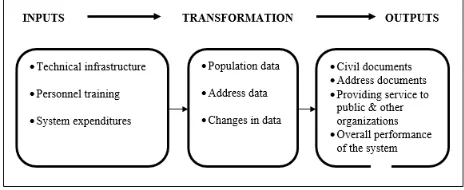
The inputs and outputs of this system are shown in Fig 1.
Fig. 1: Population and Address Registration System (PARS) Source: Yamak, Kaytaz: (2010)
Our aim is to examine social systems that are open to, and acutely dependent upon, an external environment. In this sense, an information system of any kind is a perfect example of an operations system. Population and Address Registration System is basically an information system; processed data is stored in data bases and then converted to any form of ad-hoc information as output and presented to the requester at the required time and required place.
2. Civil Registration System
Civil registration is defined as the continuous, permanent, compulsory and universal recording of the occurrence and characteristics of vital events pertaining to the population as provided through decree or regulation in accordance with the legal requirements of a country. Civil registration is carried out primarily for the purpose of establishing the legal documents provided by the law. These records are also a main source of vital statistics. Complete coverage, accuracy and timeliness of civil registration are essential for quality vital statistics.
ISSN 2348 – 7968 legal requirement to notify the relevant authority of any life
event which affects the registry.
Turkey has its social, legal, political, educational, health care, judicial systems designed and tailored to its specific needs. These systems have their own subsystems within their structures but on the other hand they also interact with each other. In this paper the Population and Address Registration System which exists under Public Administration System will be analyzed with systems approach.
2.1 Population and Address Registration System
Civil Registration System (or Population and Address Registration System as it is known in Turkey) is basically an open social system which exchanges information with its environment. Population and Address Registration System (or shortly PARS) is an address-based system and its main objective is to monitor the population register data stored in a central system, to standardize the address data and also to provide better and more effective usage of public resources with substantial savings of manpower and time.
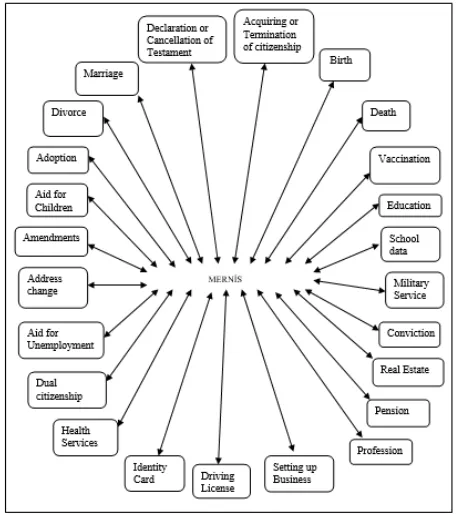
Every open system has its environment; everything that falls outside the boundaries of the system constitutes its environment. Every system interacts with and survives within its environment. They altogether make a bigger system on an upper level (Hicks & Gullett, 1979). Fig.2 shows the systems in interaction with Population and Address Registration System. The principal systems interacting with PARS are judicial, health, education, defense, and security systems.
2.2 Population Data
Population-related data covers all vital events of citizens. Vital events that are typically recorded include birth, death, marriage, divorce, child adoption, immigration, and any change of residence. Among the legal documents that are derived from civil registration are birth certificates, death certificates, and marriage certificates.
Data collected in this process is processed to obtain information and the change in data is continuously recorded into the system by the corresponding organization. System output consists of a range from functional and overall performance to the documents given to the individuals upon request such as the population and address related documents as well as the online services which are easily reached by public or other institutions.
Figure-2: Systems interacting with Population & Address Registration System
Source: Yamak, Kaytaz: (2010)
2.3 Sub-Systems
Turkey embarked on creating a central data base for information on Turkish population; both citizens and foreigners residents in the country. The database known as the Central Population Registry System (or MERNIS) contains civil information of the population registered by local government agencies and uploaded to the register for purposes of information sharing.
ISSN 2348 – 7968
Fig. 3: Population Address Registration System and its subsystems Source: Civil Affairs Bureau, 2007.
Fig. 4: Internal Processes interacting with Central Population Registry System (MERNİS)
Adapted from Source: Civil Affairs Bureau, 2007.
3. Process
3.1. An outlook on the processes
There are three databases, one for each subsystem, operating within the Population and Address Registration System (see Fig 4).
First one, known as National Address Database (or NAD), is the central database which collects and stores all the address information within Turkish Republic,
Second database, is the Central Population Registry System (or known briefly as MERNİS) which stores and maintains electronically the civil registry information of all the residents in Turkey. Fig.4 shows the type of events that are continuously kept track of by MERNİS.
Identity Sharing System which is managed by Citizens Affairs Bureau is a system that stores electronically family records with limited information and separately from central database with restricted usage, and shares with other public or corporate bodies in a secure medium.
There are some processes in each of the subsystems and some more in the interactions with external systems. The general process relating to the address registry is given in Fig.5.
3.2. Some Problems
Address Registry System has had some pitfalls in the implementation process. There have been some mistakes and incomplete data in the national numbering plan. These problems are as follows:
• the addition of non-existing addresses into the system
• the absence of street-signs
These problems could be tackled successfully in the present or near future. But the biggest obstacle in solving these problems appears to be the lack of training and scarcity of qualified personnel. This affects the efficiency and effectiveness of the system directly.
ISSN 2348 – 7968 system for the provinces get public allowances according
to their share in the overall population.
However general trend is that governments’ approach to civil registration system has been somewhat slow in the past; only recently the efforts are concentrated on building an encompassing system rather than applying independent efforts.
Figure-5: General flow chart of operations in the Address Registry System
Source: Civil Affairs Bureau, National Address Database Booklet, 2008.
4. Conclusions and Future Study
A civil registration system refers to all institutional, legal, technical settings needed to perform the civil registration functions in a technical, sound, coordinated, and standardized manner throughout the country, taking into account cultural and social circumstances particular to the country. Therefore it is necessary that the system’s objectives should be in accordance with those of all the stakeholders to increase the effectiveness of civil registry services if one wants to get most out of this system.
The most critical problem in Turkish civil registration system is within the Address System. The scarcity of qualified personnel on many occasions has been a serious bottleneck in the system. Improvement in this direction is necessary.
Furthermore since a civil registration system can be thought as an operations system in structure it would be wise to analyze some critical processes from a different angle, that of operations system, and thus making it as lean as possible; focusing more on value adding operations in the processes and eliminating non value adding elements, i.e. disclosing the waste in the system. This should be our aim for extending our study.
References
Ackoff, R.L. (1960), “Systems, Organizations and Interdisciplinary Research”, General Systems Yearbook, Vol. 5, 1-8.
Baker, F. (1970), “General Systems Theory, Research and Medical Care”, in A. Sheldon, F. Baker & C.P. McLaughlin (eds.) Systems and Medical Care, Massachusetts: MIT Press. Bertalanffy, L. von (1968), General System Theory, New York:
George Braziller.
Bertalanffy, L. von (1956), “General System Theory”, General Systems Yearbook,Vol.1,1-10.
Boguslaw, W. (1965), The New Utopians, Englewood Cliffs: Prentice-Hall.
Checkland, Peter (1998), Systems Thinking Systems Practice, John Wiley & Sons.
Churchman, C. West (1968), The Systems Approach, New York: Delta Publishing Co.
Drucker, P. (1954), The Practice of Management, New York: Harper & Row.
Emery, F.E. (ed.) (1969), Systems Thinking, Great Britain: Penguin Books.
Guest, R.M. (1962), Organizational Change: The Study of Effective Leadership, Homewood-Ill., Irwin-Dorsey.
Hall, A.D. & R.E. Fagen (1956), “Definition of System”, General Systems Yearbook, Vol.1, 18-28.
Hicks, G.H. & C.R. Gullett (1979), Organizations: Theory and Behavior, Mc Graw Hill.
Kast, F.E. and J.E. Rosenzweig (1972), “General Systems Theory: Applications for Organization and Management”, Academy of Management Journal, December, 447-465.
Miller, J.G. (1965), “Living Systems: Basic Concepts”. Behavioral Science, 10, 3, 193-237.
http://www.nvi.gov.tr/