Western University Western University
Scholarship@Western
Scholarship@Western
Electronic Thesis and Dissertation Repository
9-8-2014 12:00 AM
Advances in Dynamic Virtualized Cloud Management
Advances in Dynamic Virtualized Cloud Management
Michael Tighe
The University of Western Ontario
Supervisor Dr. Michael Bauer
The University of Western Ontario Graduate Program in Computer Science
A thesis submitted in partial fulfillment of the requirements for the degree in Doctor of Philosophy
© Michael Tighe 2014
Follow this and additional works at: https://ir.lib.uwo.ca/etd
Part of the OS and Networks Commons, and the Systems Architecture Commons
Recommended Citation Recommended Citation
Tighe, Michael, "Advances in Dynamic Virtualized Cloud Management" (2014). Electronic Thesis and Dissertation Repository. 2475.
https://ir.lib.uwo.ca/etd/2475
This Dissertation/Thesis is brought to you for free and open access by Scholarship@Western. It has been accepted for inclusion in Electronic Thesis and Dissertation Repository by an authorized administrator of
ADVANCES IN DYNAMIC VIRTUALIZED CLOUD MANAGEMENT
(Thesis format: Integrated Article)
by
Michael Tighe
Graduate Program in Computer Science
A thesis submitted in partial fulfillment
of the requirements for the degree of
Doctor of Philosophy
The School of Graduate and Postdoctoral Studies
The University of Western Ontario
London, Ontario, Canada
c
Abstract
Cloud computing continues to gain in popularity, with more and more applications being
deployed into public and private clouds. Deploying an application in the cloud allows
applica-tion owners to provision computing resources on-demand, and scale quickly to meet demand.
An Infrastructure as a Service (IaaS) cloud provides low-level resources, in the form of virtual
machines (VMs), to clients on a pay-per-use basis. The cloud provider (owner) can reduce
costs by lowering power consumption. As a typical server can consume 50% or more of its peak power consumption when idle, this can be accomplished by consolidating client VMs
onto as few hosts (servers) as possible. This, however, can lead to resource contention, and
degraded VM performance. As such, VM placements must be dynamically adapted to meet
changing workload demands. We refer to this process asdynamic management. Clients should also take advantage of the cloud environment by scaling their applications up and down (adding
and removing VMs) to match current workload demands.
This thesis proposes a number of contributions to the field of dynamic cloud management.
First, we propose a method of dynamically switching between management strategies at
run-time in order to achieve more than one management goal. In order to increase the scalability
of dynamic management algorithms, we introduce a distributed version of our management algorithm. We then consider deploying applications which consist of multiple VMs, and
au-tomatically scale their deployment to match their workload. We present an integrated
man-agement algorithm which handles both dynamic manman-agement and application scaling. When
dealing with multi-VM applications, the placement of communicating VMs within the data
centre topology should be taken into account. To address this consideration, we propose a
topology-aware version of our dynamic management algorithm. Finally, we describe a
simula-tion tool, DCSim, which we have developed to help evaluate dynamic management algorithms
and techniques.
Keywords: data centre management, virtualization, cloud management, energy
manage-ment, SLA managemanage-ment, application scaling.
Co-Authorship Statement
This thesis is composed of several published papers, which were co-authored with other
authors. This section describes the contributions of the authors of each paper. Dr. Michael
Bauer is a co-author on all papers, and served the role of supervisor, offering advice and guid-ance on both the research and writing of each paper. In some papers, Dr. Hanan Lutfiyya also
appears as a co-author, in a similar supervisory role.
Dynamic Virtual Machine Management
This chapter is presented as necessary background work for the subsequent chapters, and is
based on a paper primarily authored by Gaston Keller, a PhD Candidate at the University of
Western Ontario. The thesis author was a co-author on this publication, providing some
feed-back and input on the work. The version presented in this chapter has been heavily modified
to match the style of the thesis. Furthermore, additional content has been added to define the
problem and general approach taken by the work, including some material from a journal paper
currently under submission by the thesis author.
Switching Data Centre Management Strategies at Run-time
This chapter represents the work of three primary authors, including the thesis author, Gaston
Keller, and Graham Foster, a former Masters student at the University of Western Ontario.
An equal contribution to the work was made by all three primary authors. More specifically,
the main contribution of the thesis author were the SP-DSSalgorithm and its evaluation, the
Optimal Power Efficiency metric, and the method of scoring and comparing the performance of strategies. A portion of the work was used as the subject of the Masters Thesis of Graham
Foster. Writing of the paper was also completed by all three primary authors. Some text in the
paper has been adapted for this thesis.
A Distributed Approach to Dynamic VM Management
This chapter contains a full length version of a published short paper, with some adaptation for
this thesis. The thesis author is primarily responsible for the work and writing, with co-author
Gaston Keller providing thePeriodicandReactivecentralized management algorithms against which the novel distributed algorithm is compared.
Integrated Cloud Application Autoscaling with Dynamic VM Management
This chapter presents work from a conference publication, adapted for this thesis. It also
includes some content from an extended version, currently under submission to a journal. The
thesis author is the primary author of this work.
Topology-aware Dynamic VM Management
This chapter presents a portion of work from a journal paper, currently under submission. The
paper is an extension of a conference paper, and this chapter presents the additional content.
The thesis author is the primary author of this work.
DCSim
This chapter details a simulation tool used to evaluate algorithms and techniques throughout
the thesis work. The tool was primarily developed by the thesis author, with contributions from Gaston Keller, a PhD Candidate at the University of Western Ontario. The content of this
chap-ter is based on two workshop publications, as well as additional content added to reflect the
latest additions to the tool. Gaston Keller served as co-author on both publications, providing
contributions and design input for the tool itself, as well as feedback and the writing of some
sections of the publications. More specifically, Gaston Keller is responsible for the
implemen-tation of Rack & Clusterfeatures of DCSim, the initial management policy implementations and contributed bug fixes. The thesis author developed the core functionality of the tool. Jamil
Shamy, a former student at the University of Western Ontario, was a co-author on the second
publication. He contributed a visualization tool for DCSim, which was described in the paper.
Contents
Abstract ii
Co-Authorship Statement iii
List of Figures x
List of Tables xi
1 Introduction 1
1.1 Contributions . . . 4
1.2 Organization . . . 5
2 Dynamic Virtual Machine Management 9 2.1 Introduction . . . 9
2.2 Related Work . . . 10
2.3 Problem Definition . . . 11
2.4 Management Operations . . . 13
2.5 Algorithms . . . 14
2.5.1 VM Relocation . . . 15
2.5.2 VM Consolidation . . . 15
2.5.3 VM Placement . . . 16
2.5.4 Sort Ordering . . . 17
2.6 Evaluation . . . 18
2.6.1 Metrics . . . 19
2.6.2 Results . . . 19
2.7 Conclusions . . . 21
3 Switching Data Centre Management Strategies at Run-time 24 3.1 Introduction . . . 24
3.2 Related Work . . . 25
3.3 Management Strategies . . . 26
3.3.1 Terminology . . . 26
3.3.2 Power and SLA Strategies . . . 27
Host Classification . . . 28
VM Placement . . . 28
VM Relocation . . . 29
VM Consolidation . . . 29
3.3.3 Hybrid Strategy . . . 29
3.4 Dynamic Strategy Switching . . . 30
3.4.1 SP-DSS . . . 30
3.4.2 Goal-DSS . . . 30
3.4.3 Util-DSS . . . 31
3.5 Experiments . . . 32
3.5.1 Strategy Evaluation and Comparison . . . 32
3.5.2 Experimental Setup . . . 33
3.5.3 Workload . . . 34
3.5.4 Strategy Switching Tuning Parameters . . . 35
3.5.5 Results . . . 35
3.5.6 Discussion . . . 36
3.6 Conclusions and Future Work . . . 38
4 A Distributed Approach to Dynamic VM Management 41 4.1 Introduction . . . 41
4.2 Related Work . . . 42
4.3 Dynamic VM Management . . . 44
4.3.1 A Centralized Approach . . . 44
Host Monitoring . . . 45
4.3.2 Periodic versus Reactive . . . 45
4.4 Distributed VM Management . . . 45
4.4.1 Architecture . . . 46
4.4.2 Management Operations . . . 46
Monitoring . . . 46
VM Relocation . . . 46
VM Consolidation . . . 47
VM Placement . . . 49
Host Power State Knowledge . . . 49
4.4.3 Management Bandwidth . . . 49
4.5 Experiments . . . 50
4.5.1 Metrics . . . 50
4.5.2 Experimental Setup . . . 51
4.5.3 Workload . . . 51
4.5.4 Tuning Parameters . . . 52
4.5.5 Distributed versus Centralized . . . 53
4.6 Conclusions and Future Work . . . 54
5 Integrating Cloud Application Autoscaling with Dynamic VM Management 58 5.1 Introduction . . . 58
5.2 Related Work . . . 60
5.3 Problem Definition . . . 61
5.3.1 Applications . . . 61
5.3.2 VM Live Migration . . . 63
5.4 Application Autoscaling . . . 64
5.4.1 Application Model . . . 64
5.4.2 Algorithm . . . 66
5.5 Integrated Application-aware Algorithm . . . 67
5.6 Evaluation . . . 70
5.6.1 Metrics . . . 71
5.6.2 Experimental Setup . . . 71
5.6.3 Autoscaling . . . 73
5.6.4 Autoscaling with Dynamic VM Management . . . 74
5.6.5 Integrated Algorithm . . . 75
5.6.6 Discussion . . . 76
5.7 Conclusions and Future Work . . . 77
6 Topology-aware Dynamic VM Management 81 6.1 Introduction . . . 81
6.2 Related Work . . . 82
6.3 Problem Definition . . . 82
6.3.1 Application Placement . . . 82
6.3.2 VM Live Migration . . . 83
6.4 Topology-aware Algorithm . . . 83
6.4.1 VM Placement . . . 84
6.4.2 Dynamic Management . . . 84
6.5 Evaluation . . . 86
6.5.1 Metrics . . . 86
6.5.2 Experimental Setup . . . 86
6.5.3 Topology-aware Algorithm . . . 87
6.6 Conclusions and Future Work . . . 88
7 DCSim 92 7.1 Introduction . . . 92
7.2 Related Work . . . 93
7.3 DCSim Architecture & Components . . . 94
7.3.1 VMs, Hosts, Racks & Clusters . . . 95
VM . . . 95
Host . . . 96
Rack . . . 96
Cluster . . . 97
7.3.2 Data Centre Network . . . 97
7.3.3 Simulation Engine . . . 97
7.3.4 Events . . . 98
7.3.5 Application Model . . . 99
7.3.6 Resource Managers & Scheduling . . . 105
7.3.7 Autonomic Managers & Policies . . . 105
7.3.8 Management Actions . . . 106
7.3.9 Metrics . . . 106
7.4 Configuring and Using DCSim . . . 107
7.4.1 Workloads . . . 107
7.4.2 Default Metrics . . . 107
7.4.3 Performing Experiments with DCSim . . . 109
7.4.4 Output & Logging . . . 109
7.4.5 Visualization Tool . . . 110
7.5 Evaluation . . . 110
7.5.1 Data Centre Infrastructure . . . 110
7.5.2 Management Systems - Common Elements . . . 111
7.5.3 Static Management System . . . 111
7.5.4 Dynamic Periodic Management System . . . 112
7.5.5 Dynamic Reactive Management System . . . 113
7.5.6 Experimental Setup . . . 113
7.5.7 Results . . . 114
7.6 Conclusions and Future Work . . . 115
8 Conclusions and Future Work 118
8.1 Conclusions . . . 118
8.2 Threats to Validity . . . 121
8.3 Future Work . . . 122
Curriculum Vitae 123
List of Figures
3.1 Strategy Scores . . . 37
5.1 Data Centre Model . . . 62
5.2 Application Example . . . 65
5.3 Algorithm Comparison . . . 77
6.1 Rack Utilization Target . . . 87
6.2 Algorithm Comparison . . . 88
7.1 DCSim Overview . . . 95
7.2 Application Model . . . 100
List of Tables
2.1 Dynamic Management Policies . . . 18
2.2 First-fit Algorithm Comparison . . . 20
3.1 DSS Tuning Parameters . . . 36
3.2 Strategy Results . . . 36
4.1 Distributed Tuning Parameters . . . 53
4.2 Distributed vs Centralized Results . . . 54
5.1 Autoscaling Algorithm (AS) . . . 72
5.2 Applications . . . 72
5.3 Detailed SLA for AS-6 . . . 74
5.4 Separate Autoscaling and Allocation (AS+DVM) . . . 75
5.5 Integrated Algorithm (INT) . . . 76
6.1 Topology-aware (INT+TOPO) Rack Target (Υh) . . . 87
6.2 Topology-aware vs Topology-unaware . . . 88
7.1 Notation . . . 104
7.2 Management Systems Comparison . . . 114
Chapter 1
Introduction
The rise of cloud computing has been swift, since it first started appearing almost a decade
ago. While some of its fame can be attributed to pure marketing, it represents a clear shift in
computing paradigm. An increasing number of applications are being deployed in the cloud,
whether they are migrated to it or developed for it explicitly. Cloud-based applications are a
diverse group, ranging from personal web sites, to e-commerce sites, to major online applica-tions, such as Netflix and Dropbox. The promise of cloud computing is simple: computing
resources, on-demand, billed as a utility. Driven by economies of scale and the maturation of
virtualization technologies, the cloud is delivering on this promise.
As cloud computing is an overly broad term, it can be further sub-divided into a number
of more specific categories. The first classification is whether the cloud is publicor private. A private cloud is owned and utilized by the same organization, while a public cloud offers
its services to all. A public cloud is always multi-tenant, although a private cloud may be as
well (different company divisions, locations, etc.). In this work, we focus on a public cloud
offering, although the algorithms are applicable to any multi-tenant cloud, public or private.
Clouds can be again classified into three additional categories: Software as a Service(SaaS),
Platform as a Service(PaaS), andInfrastructure as a Service(IaaS). The SaaS model provides software online and on-demand, either free or by subscription. Examples include Gmail [4]
and SalesForce [12]. A PaaS cloud provides a specific development platform, or stack, for
developing cloud-based applications. The PaaS cloud handles all deployment details, allowing the developer to simply build the application and let the PaaS provider (such as Google App
Engine [5]) handle the rest. Finally, an IaaS cloud provides resources with low-level access,
allowing the client to provision complete servers and to control everything from the operating
system level above. The pioneer IaaS cloud was Amazon Web Services [1], released in 2006.
Since then, a multitude of IaaS offerings have been deployed, from Microsoft Azure [9], to
Google Compute Engine [6], to Rackspace Public Cloud [11]. In this work, we focus on
2 Chapter1. Introduction
managing an IaaS cloud.
Clouds consist of physical machines combined with a layer of software which provides
access to these resources to users, or clients. The physical machines, or servers, are deployed
within a data centre, which is a facility housing a very large number of servers. In addition to
servers, the data centre must also provide power, cooling, networking, and other infrastructure
requirements. An IaaS cloud is typically virtualized, providing clients with virtual machines (VMs) rather than full, “bare metal” servers. Virtualization is a technology that allows multiple
virtual machines to run on a single server (called ahost), providing the illusion that each has control over a physical machine. The VMs on a host are managed by the hypervisor, and each VM contains its own complete operating system. As such, clients can configure and
deploy VMs exactly to their requirements, regardless of the underlying cloud environment.
Furthermore, multiple VMs can be co-located on a single host, with each VM using a portion
of the total physical resources. This helps enable higher server resource utilization within the
data centre.
There are three primary actors in this environment: the provider, theclient, and the user. The cloud provider is the owner of the cloud infrastructure, which is rented to clients. Clients
provision VMs from the provider in order to deploy applications in the cloud, which are ac-cessed by their users. The provider offers services to the clients, and the clients provide services
to their users.
One of the primary goals of the cloud provider is to minimize costs while continuing to
pro-vide clients with the expected level of service. Towards this goal, cloud propro-viders should take
measures to ensure that their resources are highly utilized. A typical server (host) can consume
50% (or more) of its peak power consumption when idle [2]. As such, an underutilized server
represents a significant expense in terms of wasted power. Furthermore, by achieving high host
utilization, fewer hosts are required to handle a given workload, and more clients can be served
on the same infrastructure. Therefore, proper placement of VMs and allocation of resources is
extremely important in minimizing the costs and maximizing the revenue of an IaaS cloud.
The simplest approach to VM placement is to statically place each VM and allocate it
enough resources to meet the peak demand of the application(s) it is running. The workload
of an application can be highly variable [3], however, and can on average be as low as 30% of peak load. This leads to a significant underutilization of resources, even with multiple VMs
co-located on a single host. Host utilization could be increased by allocating VMs only enough
resource to meet average demand, but this comes at the cost of application performance
degra-dation should demand rise above average, due to competition between VMs. If the demands
of each VM are well known, or do not vary, then a static placement could be effective. The
opti-3
mal placement is NP-Hard [7]. Some work uses a linear programming approach to computing
a static VM placement [13]. In this case, however, any change in VM resource demand or
the set of VMs present in the data centre would require the placement to be recomputed from
scratch. Clearly, this is not feasible. Given the high variability of many application workloads [8], a dynamic approach to VM management is required. For dynamic placement of VMs,
linear programming techniques are too slow to provide the necessary responsiveness and suffer
from limited scalability [10]. For large dynamic systems, first-fit heuristics for the bin packing
problem can be a more effective choice [14].
In order to contend with constantly changing VM resource demands, the VM placement
must be managed and adapted dynamically. By continuously adapting the VM placement
to meet current demands, the cloud provider can achieve high resource utilization without
sacrificing VM performance. The CPU of each cost can beoversubscribed, meaning that the VMs co-located on a host are promised more CPU than is actually available. In the event
that VM demands begin to stress the host resources, a VM can be moved to another host with
spare capacity. This is accomplished using a VM live migration operation. Live migration allows a running VM to be moved from one host to another (from asourceto atarget) without incurring significant downtime or performance degradation. However, live migrations are not
entirely without cost (e.g. bandwidth and CPU overhead), and should be minimized as much
as possible. Dynamic VM management is a difficult challenge, as it must compute and adapt
VM placement under highly dynamic resource demands. Conflicting goals, such as power
conservation versus performance, further complicate the situation.
The cloud client has similar goals: minimize infrastructure costs while providing expected
service to their clients. This is accomplished by leveraging the on-demand nature of the cloud,
which provides a seemingly infinite pool of resources which can be provisioned at a moments
notice. Clients can use only the resources they require, when they require them. That is,
appli-cations can scale up and down to meet current demands by dynamically adding and removing
resources, in order to pay only for the resources they require to achieve their performance goals. This can be done automatically, by monitoring the performance of the deployed application and
scaling the number of VMs performing tasks within it. We refer to this process asautoscaling. As this ability is a key advantage to deploying applications in the cloud, cloud providers should
offer autoscaling as a service, or provide the necessary infrastructure to support it. Ideally,
au-toscaling could be integrated into dynamic VM management, in order to ensure that the goals
of both the cloud provider and client are met.
Evaluating new algorithms for dynamic management can be a challenge, due to the scale
and complexity of the infrastructure on which they are intended to run. Even if a reasonably
feasi-4 Chapter1. Introduction
ble), the implementation and execution of experiments would be difficult and time consuming.
In order to facilitate both rapid development and evaluation of new algorithms for dynamic
management in the cloud, simulation is typically employed.
There remain a number of open challenges in dynamic management in the cloud. While
basic concepts and algorithms have been explored, significant complexity remains in removing
assumptions and adding in the pieces required to build a truly complete and viable solution.
In this thesis, we tackle several of these challenges, advancing the state-of-the-art in dynamic virtualized cloud management and constructing an ever more thorough solution.
1.1
Contributions
This thesis consists of a set of contributions to several different aspects of dynamic virtualized
cloud (data centre) management. Each chapter deals with a particular sub-problem in the area,
all of which contribute towards the advancement of dynamic virtualized cloud management.
Below is a brief description of the contributions of each chapter.
Chapter 3 - Switching Data Centre Management Strategies at Run-time
A cloud provider (data centre operator/owner) may have several goals they which to achieve,
such as minimizing their power consumption and minimizing the Service Level Agreement (SLA) violations they incur. An SLA violation occurs when a client VM does not receive the resources it has requested. Most work focuses on achieving a single primary goal, with other goals being either ignored or considered secondary. In addition, goals often may be in
conflict with one another. In this chapter, we present a method of pursuing multiple goals
simultaneously.
Chapter 4 - A Distributed Approach to Dynamic VM Management
Most work on dynamic management makes use of a centralized architecture. In this approach,
a single manager must maintain global knowledge of the data centre state, and perform all
management computations. Due to the scale and highly dynamic nature of the problem, a
centralized solution is unlikely to scale well enough. As such, a distributed solution may be
more appropriate. In this chapter, we present a distributed version of a dynamic management
1.2. Organization 5
Chapter 5 - Integrating Cloud Application Autoscaling with Dynamic VM Management
The cloud client (application/VM owner), has its own set of goals, similar to those of the cloud
provider. The client should attempt to minimize their infrastructure costs, while providing good service to their users. Since a cloud client pays for resource on a per-use basis, this can
be accomplished by automatically scaling an application up and down (by adding and removing
VMs) to match the current workload demand. In this chapter, we examine how running both
au-toscaling and dynamic VM management together affects performance, and propose integrating
the two into a single algorithm. The integrated algorithm is capable of leveraging some control
over autoscaling in order to assist dynamic VM management, resulting in a significant
reduc-tion in required migrareduc-tions. Reducing the number of migrareduc-tions performed during dynamic
management is important, as migrations incur both bandwidth and performance overheads.
Chapter 6 - Topology-aware Dynamic VM Management
When an application consisting of multiple VMs is deployed in the cloud, their location within
the network topology can have an effect on application performance. Most work treats the data
centre as a flat, structureless collection of servers. In this chapter, we introduce a
topology-aware dynamic management approach, which attempts to place application VMs near each
other (in terms of network links) to reduce both communication latency, and utilization of
higher level network elements.
Chapter 7 - DCSim: A Data Centre Simulation Tool
Algorithms for dynamic VM management in the cloud are targeted at a very large scale
de-ployment. This poses a challenge to researchers, as experimentation on a representative scale is simply not feasible. As such, most work turns to simulation in order to evaluate new
algo-rithms and techniques. There is a lack of open-source simulation tools targeted at simulating a
multi-tenant, infrastructure as a service cloud. In this chapter, we present DCSim (Data Centre
Simulator), an extensible simulation tool designed specifically to address these requirements.
1.2
Organization
This thesis is presented in an integrated articleformat, meaning that each chapter presents a single piece of work in publication format. Each source paper has been modified for
consis-tency, readability, and to avoid repetition between chapters, where appropriate. Furthermore,
6 Chapter1. Introduction
literature which was not presented in Chapter 1 or Chapter 2. Each chapter lists references
cited within it in its own bibliography section.
The remainder of the thesis is organized as follows: Chapter 2 presents background work
Bibliography
[1] Amazon. Amazon web services. http://aws.amazon.com/, July 2014.
[2] L.A. Barroso and U. Holzle. The case for energy-proportional computing. Computer, 40(12):33–37, Dec 2007.
[3] Norman Bobroff, Andrzej Kochut, and Kirk Beaty. Dynamic placement of virtual
ma-chines for managing sla violations. In IM Proceedings, 2007 IEEE/IFIP Int. Symp. on, pages 119–128, 2007.
[4] Google. Gmail. http://mail.google.com, July 2014.
[5] Google. Google app engine. http://appengine.google.com/, July 2014.
[6] Google. Google compute engine. http://cloud.google.com/, July 2014.
[7] Chris Hyser, Bret Mckee, Rob Gardner, and Brian J. Watson. Autonomic virtual
ma-chine placement in the data center. Technical Report HPL-2007-189, HP Laboratories,
December 2007.
[8] A. Kochut and K. Beaty. On Strategies for Dynamic Resource Management in Virtualized
Server Environments. InMASCOTS Proceedings, 2007 15th Int. Symp. on, pages 193– 200, 2007.
[9] Microsoft. Microsoft azure. http://azure.microsoft.com/, July 2014.
[10] Rina Panigrahy, Kunal Talwar, Lincoln Uyeda, and Udi Wieder. Heuristics for vector bin
packing. Technical report, Microsoft Research, 2011.
[11] Inc. RackSpace. Rackspace. http://www.rackspace.com/, July 2014.
[12] Inc. salesforce.com. salesforce. http://www.salesforce.com/, July 2014.
[13] B. Speitkamp and M. Bichler. A mathematical programming approach for server
consol-idation problems in virtualized data centers. IEEE TSC, 3(4):266 –278, 2010.
8 BIBLIOGRAPHY
[14] Mark Stillwell, David Schanzenbach, Fr´ed´eric Vivien, and Henri Casanova. Resource
Chapter 2
Dynamic Virtual Machine Management
2.1
Introduction
Dynamic Virtual Machine (VM) Management is the process of placing a set of VMs into a set
of hosts, and dynamically adapting this placement as VM workloads and resource demands
change over time. These hosts are located in a data centre, which is a large collection of interconnected physical servers (hosts), contained within a single building (e.g. a warehouse).
The data centre also provides all of the necessary additional infrastructure, such as cooling,
power and networking. As described in Chapter 1, the data centre is owned and operated by
theCloud Provider, whose goals are to minimize costs while providing the expected service to its clients. As idle hosts still consume a large portion of their peak power usage, it is necessary
to ensure that hosts are either highly utilized or powered off(or suspended) in order to reduce
power costs. On the other hand, VMs must be given enough resources to meet their demand.
VM performance is encapsulated in aService Level Agreement(SLA), which in a basic form defines some thresholds on performance metrics, such as response time. Specifically, we define two primary objectives:
• Minimize SLA violation
• Minimize power consumption
In order to accomplish both goals, VMs must be placed into as few hosts as possible, and their placement must be dynamically adapted as their resource demands change.
The problem of dynamic virtual machine management is similar to the bin-packing
prob-lem, with the set of VMs considered as items and hosts as bins. The goal is then to pack VMs
into hosts such that we use the fewest number of hosts possible. Greedy heuristics for the
bin-packing problem can be effective, such asfirst-fit decreasing[6, 14]. The first-fit decreas-ing algorithm first sorts items in decreasdecreas-ing order by size, and then places them sequentially
10 Chapter2. DynamicVirtualMachineManagement
in the first available bin with enough spare capacity. There are other factors, however, which
further complicate the situation. As VM resource demands are highly variable and change over
time, the initial placement must be constantly adapted. The entire placement cannot simply
be recalculated from scratch, as VMs are now placed and running in hosts, and cannot all be removed to perform a complete new placement. Rather, a few individual VMs must be moved
via VM live migration in order to ensure that all VMs have enough resources to meet their
demand. Live migration, however, incurs some performance and networking costs, and as such
the number of migrations performed should be minimized. We include secondary objectives
related to minimizing the impact of dynamic management:
• Minimize the number of migrations
• Minimize management bandwidth usage
• Ensure management is responsive and scalable
The goals of minimizing SLA violations and reducing power consumption are often in
conflict. Power consumption is best minimized with a tight packing of VMs into hosts, but
this comes at the cost of an increased risk of resource contention and SLA violations. On the
other hand, if additional host resources are left unused to accommodate increased demand from
VMs, more hosts are required and power consumption is increased. The order in which VMs
and hosts are considered in a bin-packing heuristic can have an effect on which migrations
are performed, and whether the heuristic algorithm favours the achievement of one goal or another. In this chapter, we define the general problem of dynamic VM management, present a
division of the problem into three distinct operations, and examine a set of variations on a
first-fit algorithm presented by Keller et al. [9], which provide a base for the algorithms presented
in subsequent chapters.
The remainder of this section is organized as follows: Section 2.2 presents some related
work, and Section 2.3 formally introduces the problem. Section 2.4 introduces a set of
man-agement operations for dynamic VM manman-agement, Section 2.5 proposes algorithms to perform
these operations, and Section 2.6 evaluates the algorithms. Finally, we conclude in Section 2.7.
2.2
Related Work
Initial work in the literature examined computing static VM placements, often based on
re-source demand predictions, which may be periodically recomputed to adjust for changing
de-mands. Bobroffet al. [4] propose a first-fit descreasing heuristic based on the forecasted
2.3. ProblemDefinition 11
Best-fit approaches have also been investigated [5]. Speitkamp and Bichler [11] compute a
VM placement using a linear programming based heuristic. Finally, vector bin-packing has
also proven effective, as demonstrated by Stillwell et al. [12]. Since these approaches calculate
a VM placement from scratch, they are not suitable for managing VMs with highly dynamic demands.
Best-fit and first-fit heuristics have also been adapted to perform dynamic management.
Wood et al. [13] propose Sandpiper, which uses a first-fit heuristic to dynamically adapt VM
placement. Beloglazov and Buyya [3] propose a set of best-fit heuristic algorithms for dynamic
VM management. Khanna et al. [10] propose an optimization model to solve the problem,
as well as a heuristic solution. Their solution sorts VMs by CPU utilization and memory
consumption, and hosts by available capacity, in an attempt to minimize migration costs and
maximize host resource utilization. Such heuristics offer the benefit of quick execution and scalability while still calculating a good placement. Other techniques have been employed as
well, such as fuzzy logic-based controllers [7].
2.3
Problem Definition
In this section, we present various aspects of the dynamic VM management problem. In its simplest form, the problem of dynamic VM management is to place a set of VMs, V, into a set of hosts, H, and to dynamically adapt this placement as the resource demand of each VM changes. Hosts are located withinracks, which are sets of hosts directly connected via a single switch. Racks are connected to each other through additional layers of networking, the details
of which are not considered for the purpose of this work. We denote a rack asr ∈R, and the set of hosts inrasHr ⊆ H.
We consider two characteristics of a VM (v∈V):
• ItsCPU usage: denotedωv(s). It also has a fixed upper limit on CPU usage,ωmaxv . The
CPU utilization of a VM is therefore ωv(s)/ωmaxv . CPU usage is quantified in terms of
CPU units, in which a single unit is equivalent to 1MHz clock speed. For example, a 2.5GHz processor core would have 2500 CPU units.
• Itsmemory: denotedµv. Memory size is static.
Theplacement(also calledallocation) of a VM, is defined by the following function:
αh,v(s)=
1 ifvis placed onh
12 Chapter2. DynamicVirtualMachineManagement
A VM can only be placed on a single host at a time. Therefore, if there exists a hosth1 such thatαh1,v(s)=1, then∀h∈H\h1, αh,v(s)= 0.
Each host,h ∈ H, has a total memory capacity Mh. The placement must be such that the
sum of the memory allocations for each VM on a host does not exceed the memory capacity of
the host.
X
v∈V
µv∗αh,v(s)6 Mh, ∀h∈H ∀s∈R+
Each host, h, has a total CPU capacity Ωh. The CPU usage of a host, Ω0h(s), is equal to
the sum of the CPU usage of all VMs placed on that host, and cannot exceed the total CPU capacity of the host. Consequently, for s∈R+, we have:
Ω0
h(s)=
X
v∈V
ωV(s)∗αh,v(s)6 Ωh
Note that this is not a rule that must be enforced, but rather is a physical property of the host.
For simplification, we denote the set of VMs on a host h as Vh, Consequently, we have:
v∈Vh ⇐⇒ αh,v =1.
It is important to avoid overloading the CPU of a host, in order to avoid compromising the
performance of VMs placed on it. To this end, we define an upper threshold on CPU utilization, τ(e.g. 0.9, or 90%). We calculate the amount by which each host, h, exceeds τ. We denote this asτh(s), and calculate is as follows:
τh(s)=
Ω0
h(s)
Ωh
−τ if Ω
0
h(s)
Ωh
−τ >0
0 otherwise
Then, our goal is to minimize this value for all hosts, which gives use the following
objec-tive:
∀s∈R+, min X
h∈H
τh(s)
A second goal is to reduce power consumption, which, in this work, is accomplished by
minimizing the number ofactivehosts. An active host contains at least one VM. The number of VMs on a host is denoted |h|. Formally, a host is active at time s ∈ R+ if the following function is equal to 1:
active(h,s)=
2.4. ManagementOperations 13
By minimizing the number of active hosts, we can ensure that hosts are not underutilized.
Since an idle server can still use 50% of its maximum power consumption [2], higher host
utilization results in better power efficiency in terms of CPU processing per watt. Therefore,
the total number of active hosts should be minimized, giving us the following objective:
∀s∈R+, min X
h∈H
active(h,s)
2.4
Management Operations
We define three primary operations that are involved in dynamic VM management, as well
as four distinct host states used to classify a host. Hosts are classified based on their CPU
utilization as follows:
• stressedhosts (denotedH!) have a high CPU utilization, and are therefore considered to be at risk of overloading. In this case, the performance of VMs running on the host would
degrade, violating SLA. It is therefore undesirable for a host to be in the stressed state.
Stressed hosts have a CPU utilization higher than a specified upper threshold, denoted Ωτ;
• partially utilized hosts (denoted H+) have anormal CPU utilization level, representing a healthy host. This is the ideal state for a host, as it is highly utilized (and therefore
energy efficient), but not stressed. Partially utilized hosts have a CPU utilization below Ωτand above a lower threshold, denotedΩτ;
• underutilizedhosts (denotedH−), have a low CPU utilization. Since servers are at their least power efficient under light loads, hosts in this state represent a waste of power
consumption and should be consolidated onto fewer, partially utilized hosts or shut down entirely. Hosts in the underutilized state have a CPU utilization belowΩτ;
• emptyhosts (denoted H∅) are not hosting any VMs, and may be in a lower power state such assuspendedoroff to conserve power.
Our approach to dynamic VM management consists of three operations, described in the remainder of this section.
VM Placement
The VM Placement operation is responsible for the initial placement of a new VM in the data
centre. When a client requests the instantiation of a new VM, the VM Placement operation is
14 Chapter2. DynamicVirtualMachineManagement
VM Relocation
The VM Relocation operation is responsible for relievingstress situations. A stress situation refers to one or more hosts being in thestressedstate. The VM Relocation operation is respon-sible for alleviating the stressed hosts by selecting one or more VMs on the stressed host to
migrate away, as well as selecting target hosts on which to place the migrating VMs. The
tar-get host must have enough spare capacity to host the incoming VMs without becoming stressed
itself. Once migrations have been found to eliminate the stress situation, they are executed. The
VM Relocation operation can either be triggered on a periodic interval, or can be triggered in
response to a host becoming stressed.
VM Consolidation
The VM Consolidation operation is responsible for minimizing the number of hosts required to
contain the current set of VMs. It does so by identifying underutilized hosts, and migrating all
VMs on the host away in order to be able to shut down the underutilized host. Similar to the VM
Relocation operation, it searches for migration target hosts for each VM on an underutilized
host, and if successful, performs the migrations and shuts down (or suspends) the underutilized host. Note that the operation may be unable to migrate all VMs on an underutilized host. In
this case, it may migrate only a subset of the VMs, in the hope that placements can be found
for the remaining VMs in subsequent invocations of the operation. The VM Consolidation
operation is usually triggered on a periodic interval, less frequently than VM Relocation.
2.5
Algorithms
We now present algorithms to perform each of the three management operations. We
some-times refer to a specific implemention of a management operation as a policy (e.g. a VM Reloction policy). Each of the algorithms is similar, based on a first-fit heuristic. This heuristic
algorithm first sorts the VMs present on a host, then sorts the possible target hosts for
migra-tion, and finally iterates through each VM, choosing the first available target host from the list
with enough capacity to host the VM. Once this process is complete, the migrations are
per-formed. The order in which VMs and target hosts are sorted has an impact on the performance
2.5. Algorithms 15
2.5.1
VM Relocation
As mentioned above, a host is considered stressed when its CPU utilization exceeds the upper
threshold, Ωτ. The VM Relocation operation is then tasked with relieving the stress situation
through VM migration. The VM Relocation operation is triggered on a regular interval (e.g.
every 10 minutes). Algorithm 1 describes the VM Relocation algorithm. It takes as input the
set of hosts in the data centre (H), and first classifies them intostressed(H!),partially utilized
(H+), underutilized(H−), and empty(H∅) sets (line 1). We use the set of stressed hosts (H!) as the sources for migration, as we want to move VMs off of these hosts to solve the stress
situations. This set is sorted in line 2. The remaining categories are sorted and then combined into a single list in line 3. As mentioned previously, the sorting order has an impact on the
algorithm, and will be discussed further in Section 2.5.4. The VMs of each source host (Vh) are
sorted (line 6) and iterated through, searching for a target host (ht) for eachv∈Vh(lines 7-13).
Once a suitable VM and target has been found, the algorithm performs the migration (line 10)
and moves on to the next source host.
Algorithm 1: VM Relocation Data: H
H!,H+,H−,H∅ ←classify(H)
1
sources←sort(H!)
2
targets←combine(sort(H+), sort(H−), sort(H∅))
3
forh∈ sourcesdo
4
success←FALSE
5
vmCandidates←sort(Vh)
6
forv∈vmCandidatesdo
7
forht ∈targetsdo
8
if hasCapacity(ht, v)then
9
migrate(h,v,ht)
10
success←TRUE
11
break
12
if successthen break
13
2.5.2
VM Consolidation
The VM Consolidation operation is similar in operation to VM Relocation. It is responsible for
migrating VMs offof underutilized hosts, with CPU utilization below the lower threshold,Ωτ.
Algorithm 2 describes the VM Consolidation algorithm. Again, it takes as input the set of hosts
16 Chapter2. DynamicVirtualMachineManagement
as the source set (line 2). The target hosts for migration come from thepartially utilized (H+) andunderutilized(H−) hosts (line 3). We initialize theusedT argetsandusedS ourcessets to keep track of hosts that have been used as a target or source for migration, in order to avoid
using the same host as both a source and a target for migration (lines 4-5). This is necessary asunderutilizedhosts are in both the soure and target sets. Each host in the source set is then iterated through (line 6), skipping any host that has been used as a target (line 7). All VMs in
the source host are then iterated through (line 8), searching for target hosts to which to migrate
them. If a host is found that has enough spare capacity, is not the same host as the source, and
has not been used previously as a source, then we proceed with a migration (line 10). First, we
update theusedT argetsandusedS ourcessets (lines 11-12), and finally perform the migration (line 13).
Algorithm 2: VM Consolidation Data: H
H!,H+,H−,H∅ ←classify(H)
1
sources←sort(H−)
2
targets←combine(sort(H+), sort(H−))
3
usedT argets← ∅
4
usedS ources← ∅
5
forh∈ sourcesdo
6
if h∈usedT argetsthen continue
7
forv∈Vhdo
8
forht ∈targetsdo
9
if hasCapacity(ht, v)∧ht ,h∧ ht <usedS ourcesthen
10
usedT argets←usedT argets∪ht
11
usedS ources← usedS ources∪h
12
migrate(h,v,ht)
13
break
14
2.5.3
VM Placement
The VM Placement operation is, again, similar to VM Relocation. When a client requests the creation of a new VM in the data centre, the VM Placement operation is executed to place the
VM on a host. Algorithm 3 describes the VM Placement algorithm. It takes the set of hosts
2.5. Algorithms 17
the algorithm terminates. Note that it is possible that no suitable target host is found, in which
case the placement fails.
Algorithm 3: VM Placement Data: H,v
H!,H+,H−,H∅ ←classify(H)
1
targets←combine(sort(H+), sort(H−), sort(H∅))
2
forht ∈targetsdo
3
if hasCapacity(ht, v)then
4
place(v,ht)
5
break
6
2.5.4
Sort Ordering
The algorithms for each of the three management operations include steps to sort both the list
of target hosts, and the list of potential VMs to migrate. For example, in the VM Relocation
algorithm (Algorithm 1), potential target host sets are sorted and then combined in line 3, and
candidate VMs are sorted in line 6. Keller et al. [9] propose varying the order of both target
hosts and candidate VMs to affect the performance and characteristics of the algorithms. Three
options for target host sorting are proposed:
• Increasing: sortpartially utilized (H+) andunderutilized(H−) hosts in increasing order by CPU utilization, and combine the sets asH−·H+·H∅.
• Decreasing: sortpartially utilized(H+) andunderutilized(H−) hosts in decreasing order by CPU utilization, and combine the sets asH+·H−·H∅.
• Mixed: sortpartially utilized (H+) in increasing order andunderutilized (H−) hosts in decreasing order by CPU utilization, and combine the sets asH+·H−·H∅.
These three sorting orders represent three different approaches to host target selection. The
increasingorder attempts to place the VM on the most lightly loaded host available which is not empty (i.e. off orsuspended). This approach gives the VM the best chance of having enough resources to fulfil its current and future needs, but may result in load being spread across more
hosts than necessary. Thedecreasing sorting order attempts to place VMs on the target host with the highest utilization which has enough spare capacity to fit the VM. This keeps VMs
tightly packed on fewer hosts, but comes at the risk of causing a new stress situation on the
18 Chapter2. DynamicVirtualMachineManagement
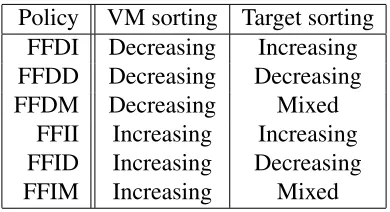
Policy VM sorting Target sorting FFDI Decreasing Increasing FFDD Decreasing Decreasing
FFDM Decreasing Mixed
FFII Increasing Increasing FFID Increasing Decreasing
FFIM Increasing Mixed
Table 2.1: Dynamic Management Policies
the two by starting its search at the boundary betweenpartially utilizedandunderutilized, and preferingpartially utilized.
Next, the candidate VMs for migration must be sorted, in one of two ways:
• Increasing: sort VMs in increasing order by CPU utilization (prefer smaller VMs).
• Decreasing: sort VMs in decreasing order by CPU utilization (prefer largers VMs).
By combining the three sorting orders for target hosts with both sorting orders for candidate
VMs, we can construct six differentpoliciesfor dynamic VM management. Table 2.1 lists all six policies (sort orders).
2.6
Evaluation
Evaluation of the algorithms for VM Placement, VM Relocation and VM Consolidation was
conducted by Keller et al. [9] through simulation, using the DCSim open-source simulation
tool (see Chapter 7). Each of the policies defined in Section 2.5.4 were evaluated, as well as
a random policy which selected candidate VMs and target hosts at random. Individual VM Relocation,VM ConsolidationandVM Placementpolicies were created for each overarching policy (i.e. FFDI, FFDD, etc.). Each policy and configuration was simulated five times, each
with a different randomized workload, and the average results were taken. The simulated data centre contained 100 hosts, and 400 VMs. Each VM is driven by one of 5 traces: theClarkNet,
EPA, andSDSCtraces [1], and two different job types from theGoogle Cluster Datatrace [8]. The normalized rate of incoming requests, in 100 second intervals, is calculated for each trace.
The request rates are used to define the current workload of each VM, with the CPU resource
requirements of the VM calculated as a linear function of the current rate. Each VM starts its
2.6. Evaluation 19
2.6.1
Metrics
The simulations were evaluated based on the following reported metrics:
Migrations
The total number of migrations performed during the experiment. Since migrations incur both
performance and networking overhead, fewer migrations are preferred.
Active Hosts
The average number of activehosts. An activehost is defined as a host in the onstate, con-taining at least one VM. Feweractivehosts typically implies reduced power consumption, and demonstrates the ability to host a set of VMs with a smaller infrastructure.
Host Utilization
The average CPU utilization of active hosts. Higher host utilization values implies that the management system is making better use of available resources, which should result in
de-creased power consumption. It may also, however, come at the cost of VM performance.
Power Consumption
The total power consumed during the simulation, in kWh. Lower values are preferred, as this
translates directly into energy cost savings.
SLA Violation
Generally speaking, we consider that an SLA violation occurs when a VM is not given the
resources it requires to perform its task. In this evaluation, SLA violations are recorded as
the percentage of CPU which the VM requires but does not receive due to contention with
other VMs. Note that it is impossible to obtain this value in a real-world environment. It is
assumed that a VM which does not receive the CPU time it requires suffers a degradation in performance, and therefore is in violation of its SLA. This metric is further explained asCPU Underprovisionedin Chapter 7.
2.6.2
Results
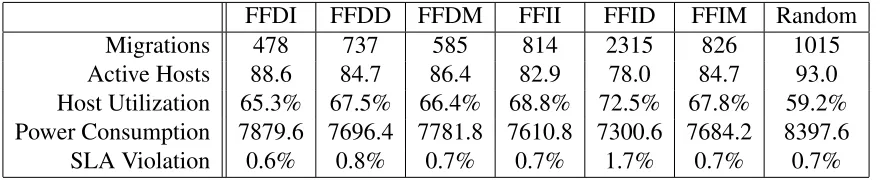
Table 2.2 shows the results of the experiment. We summarize the important insights gained
20 Chapter2. DynamicVirtualMachineManagement
FFDI FFDD FFDM FFII FFID FFIM Random
Migrations 478 737 585 814 2315 826 1015
Active Hosts 88.6 84.7 86.4 82.9 78.0 84.7 93.0
Host Utilization 65.3% 67.5% 66.4% 68.8% 72.5% 67.8% 59.2% Power Consumption 7879.6 7696.4 7781.8 7610.8 7300.6 7684.2 8397.6
SLA Violation 0.6% 0.8% 0.7% 0.7% 1.7% 0.7% 0.7%
Table 2.2: First-fit Algorithm Comparison
FFDI
The FFDI (decreasingVM sorting,increasingtarget host sorting) achieved the best SLA per-formance, while consuming the most power and using the fewest migrations. This policy
attempts to take the largest VM from a stressed host and place it on the least loaded non-empty
host available. Thus, it creates a situation in which the stressed host utilization is significantly
reduced, and the migrated VM is on a machine with a large spare capacity. This reduces the risk of subsequent stress situations, and therefore improves SLA performance and decreases
the probability that an additional migration will be required. By the same token, VMs become
spread across a larger number ofpartially utilizedorunderutilizedhosts, thus increasing power consumption.
FFID
The FFID (increasingVM sorting,decreasingtarget host sorting) achieved the opposite effect, providing the best power consumption at the expense of the worst SLA performance and most
triggered migrations. This policy attempts to remove the smallest possible VM to relieve the
stress situation, and place it on the highest utilized host that still has enough spare capacity to
contain it. Thus, while it keeps hosts highly utilized and thus maintains low power
consump-tion, it increases the risk that a new stress situation will be triggered at the target host, and
may even leave the source host in danger of again becoming stressed. This inevitably triggers
additional migrations to deal with the subsequent stress situations, and incurs SLA violation.
Remaining Policies
The remaining variations all fall somewhere in between the two extremes presented by FFDI
2.7. Conclusions 21
2.7
Conclusions
We have introduced the problem ofDynamic VM Management, and taken a look at some of the challenges that it brings. Furthermore, we have presented the general approach taken to
address dynamic management throughout the remainder of the work. That is, dynamic VM
management is divided into three primary operations: VM Placement,VM Relocation, andVM Consolidation. Variations on a first-fit heuristic, proposed by Keller et al. [9], are employed to carry out these operations. The behaviour of these algorithms can be influenced through the use
of different sorting and concatenation orders for target hosts and candidate VMs for migration,
allowing the algorithms to be tuned towards one goal over another (i.e. SLA versus power consumption, or vise versa). In fact, there is no single approach that satisfies both primary
goals, but rather there is a spectrum of options to select from in order to match algorithm
behaviour with business goals and priorities.
This basic structure and set of algorithms is used and built upon throughout the remaining
Bibliography
[1] The Internet Traffic Archive. The internet traffic archive. http://ita.ee.lbl.gov/, July 2014.
[2] L.A. Barroso and U. Holzle. The case for energy-proportional computing. Computer, 40(12):33–37, Dec 2007.
[3] Anton Beloglazov and Rajkumar Buyya. Optimal online deterministic algorithms and
adaptive heuristics for energy and performance efficient dynamic consolidation of virtual
machines in cloud data centers. Concurrency Computat.: Pract. Exper., pages 1–24, 2011.
[4] Norman Bobroff, Andrzej Kochut, and Kirk Beaty. Dynamic placement of virtual
ma-chines for managing sla violations. In IM Proceedings, 2007 IEEE/IFIP Int. Symp. on, pages 119–128, 2007.
[5] Michael Cardosa, Madhukar R. Korupolu, and Aameek Singh. Shares and utilities
based power consolidation in virtualized server environments. InIM Proceedings, 2009 IEEE/IFIP Int. Symp. on, 2009.
[6] Gyrgy Dsa. The tight bound of first fit decreasing bin-packing algorithm is FFD (I)≤11/9
OPT (I)+6/9. In Bo Chen, Mike Paterson, and Guochuan Zhang, editors, Combi-natorics, Algorithms, Probabilistic and Experimental Methodologies, volume 4614 of
Lecture Notes in Computer Science, pages 1–11. Springer Berlin / Heidelberg, 2007. 10.1007/978-3-540-74450-4 1.
[7] D. Gmach, J. Rolia, L. Cherkasova, G. Belrose, T. Turicchi, and A. Kemper. An integrated approach to resource pool management: Policies, efficiency and quality metrics. In38th Annual IEEE/IFIP Int. Conf. on Dependable Systems and Networks (DSN), June 2008.
[8] Google Inc. Google cluster data. http://code.google.com/p/
googleclusterdata/, July 2014.
BIBLIOGRAPHY 23
[9] Gast´on Keller, Michael Tighe, Hanan Lutfiyya, and Michael Bauer. An analysis of first
fit heuristics for the virtual machine relocation problem. In SVM Proceedings, 6th Int. DMTF Academic Alliance Workshop on, October 2012.
[10] Gunjan Khanna, Kirk Beaty, Gautam Kar, and Andrzej Kochut. Application performance
management in virtualized server environments. InNOMS Proceedings, 2006 IEEE/IFIP, 2006.
[11] B. Speitkamp and M. Bichler. A mathematical programming approach for server
consol-idation problems in virtualized data centers. IEEE TSC, 3(4):266 –278, 2010.
[12] Mark Stillwell, David Schanzenbach, Fr´ed´eric Vivien, and Henri Casanova. Resource
al-location algorithms for virtualized service hosting platforms.J. Parallel Distrib. Comput., 70(9):962–974, September 2010.
[13] Timothy Wood, Prashant Shenoy, Arun Venkataramani, and Mazin Yousif. Black-box
and gray-box strategies for virtual machine migration. InNSDI Proceedings, 4th Symp. on, pages 229–242, Cambridge, MA, USA, April 2007.
[14] Minyi Yue. A simple proof of the inequality FFD (L) ≤ 11/9 OPT (L) + 1, ∀ L for
Chapter 3
Switching Data Centre Management
Strategies at Run-time
3.1
Introduction
In Chapter 2, we introduced two primary goals for dynamic VM management:
• Minimize SLA violation
• Minimize power consumption
The operator of the data centre (the cloud provider), may want to conserve power to reduce costs. This is accomplished by consolidating load onto as few hosts (physical servers) as
possible, and switching remaining hosts into a power saving state (off or suspended). At the same time, they must provide the level of service that clients expect, in terms of resources
available to VMs. As such, either additional capacity needs to be left in reserve for VMs
when required, or VM placement needs to be dynamically adapted to meet changing resource
demands, or both. If VMs are tightly packed onto hosts to conserve power, they are likely to
contend for resources with co-located VMs and violate their SLA. On the other hand, if VMs
are less tightly packed, they will have fewer SLA violations but consume more power. As such, the two primary goals are in conflict with one another.
We define adynamic management strategyto consist of a set of policies, such that there is a policy that governs each of the defined management operations (i.e. a VM Placement pol-icy, aVM Relocationpolicy, and aVM Consolidationpolicy). The set of policies which form a management strategy are designed in such a way as they work together as a cohesive unit,
following a common approach to dynamic management. The design of management strategies
This chapter is based on work published in [6]
3.2. RelatedWork 25
often focuses on achieving a single goal, or on prioritizing goals such that a single goal is
con-sidered the primary goal and others are concon-sidered secondary, e.g., [4, 11, 13, 14]. Designing a
management strategy to achieve multiple goals is difficult, as improving performance towards
one goal frequently results in degradation of performance towards another. Such is the case with our primary goals ofminimize SLA violationandminimize power consumption.
In order to address the problem of achieving multiple goals simultaneously, we propose
dynamic strategy switching. Dynamic strategy switching involves changing between a set of strategies at run-time, each of which focuses on a single goal. In this case, one strategy is designed to minimize SLA violations, and another to minimize power consumption. We
hy-pothesize that depending on the current state of the data centre, one strategy will be more
effective/necessary than the other. By recognizing these situations and switching to the
appro-priate strategy for the given situation, we aim to achieve better performance in attaining both
goals. The main contributions of this work are three novel methods of dynamically switching
between single-goal management strategies, and a method of comparing the performance of
strategies that aim to achieve more than one goal.
The remainder of this chapter is organized as follows: Section 3.2 reviews related work
in this area, Sections 3.3 and 3.4 describe the management strategies and strategy switching
approaches we explored, respectively. Section 3.5 presents experiments and evaluation, and
finally, Section 3.6 concludes and discusses future work.
3.2
Related Work
Research in dynamic management of virtualized data centres focuses on one or more of the
three primary management operations (i.e. VM Placement, VM Relocation or VM Consol-idation). Most solutions focus on pursuing a single goal, or in the case of multiple goals, prioritizing one over all others. Wood et al. [14] addressed the VM Relocation problem using
a first-fit decreasing heuristic, with the goal of reducing SLA violations. In the process of
at-taining this goal, it spreads VMs out across hosts, and thus sacrifices power consumption. As
described in Chapter 2, Keller et al. [10] studied variants of a first-fit heuristic to address the
VM Relocation problem, showing that the order in which VMs and hosts are considered for
migration impacts the behaviour of the algorithms. In particular, the algorithm can be tuned to
favour SLA or power related goals, but always at the expense of the other goal.
Some work addresses VM Relocation and VM Consolidation together, in most cases,
fo-cusing primarily on minimizing power consumption. Minimizing SLA violations becomes a
secondary goal. Khanna et al. [11] implemented a first-fit heuristic that migrated the least
26 Chapter3. SwitchingDataCentreManagementStrategies atRun-time
al. [13] relied on a first-fit decreasing heuristic which placed VMs in the most power effi
-cient servers first. Beloglazov and Buyya [3] proposed a best-fit decreasing heuristic which
selected for migration the VMs with the smallest memory footprint and placed them in the
host that provided the least increase in power consumption. Much of the existing work on dy-namic management uses some form of first-fit heuristics, though occasionally alternatives are
proposed, such as fuzzy logic-based controllers [7].
Unlike the existing work, we focus on achieving multiple goals simultaneously. Neither
goal is considered secondary, and although they may be opposing goals (e.g. minimizing SLA
violations and minimizing power consumption), we attempt to achieve both without prioritizing
one goal over another.
3.3
Management Strategies
As mentioned in Section 3.1, minimizing SLA violations and minimizing power consumption
are commonly studied goals in data centre management. In this section, we will discuss the
design of management strategies to pursue these goals, which are representative of those found in the literature. We design two single-goalmanagement strategies,Power andSLA, to work towards achieving a single goal each. Then, we present one Hybrid strategy, which makes a best effort to achieve both goals simultaneously, still within a single strategy. The strategies
presented assume frequent monitoring. Calculations are performed on monitored values over
a sliding window of time, referred to as themonitoring window.
3.3.1
Terminology
This section presents the terms and metrics used in the description of management strategies.
SLA Violation
An SLA violation, denoted Sv, occurs when resources required by a VM are not available to
it, as this situation leads to a degradation in performance. The percentage of required CPU not
available is the SLA violation, as described in Chapter 2.6.
Data Centre Utilization
The overall utilization of the data centre is calculated as the percentage of total CPU capacity
3.3. ManagementStrategies 27
Power Efficiency
For a host,h, the power efficiency,ψh, is the amount of processing being performed per watt
of power. This is measured in CPU-shares-per-watt (cpu/watt). LetΩ0h be the CPU utilization
of host h, and Ψh be its power consumption. Power efficiency (ψh) of a single host is then
calculated as follows:
ψh =
Ω0
h
Ψh
As an active host machine consumes a significant amount of power even when under little
or no CPU load (i.e. very low power efficiency) increased host utilization corresponds with increased power efficiency for that host. This metric is used to calculate the power efficiency
for the entire data centre,ψdc, calculated as
ψdc=
X
h∈H
Ω0
h
X
h∈H
Ψh
Maximum Power Efficiency
This metric represents the best power efficiency a host can achieve, calculated as the power
efficiency of the host at maximum CPU utilization, and is denotedψmaxh .
Optimal Power Efficiency
Optimal Power Efficiency,ψoptdc, represents the best possible power efficiency achievable at the
data centre level, given the current workload and set of host machines available. The best
power efficiency would be achieved by placing VMs in such a way that each host is 100%
utilized, with the most power efficient hosts being filled first. We first calculate the total
CPU-in-use across the data centre. We order the available hosts by maximum power efficiency, and
allocate the CPU-in-use to hosts such that each host is allocated 100% of its CPU capacity. We calculateψoptdc to be the power efficiency of the data centre given this allocation.
3.3.2
Power and SLA Strategies
ThePowerandSLAstrategies aresingle-goalstrategies, which means that all management de-cisions are geared towards achieving a single, primary goal. Single-goal strategies may pursue
secondary goals, but always give them lower priority than the primary goal. The presented
28 Chapter3. SwitchingDataCentreManagementStrategies atRun-time
These strategies have several opportunities to differentiate themselves in order to pursue their
individual goals, and the choices are reflected in the individual policies of each strategy.
Strate-gies can be tailored to a specific goal through the following methods:
• Setting appropriate threshold values for classifying hosts asstressed(the upper threshold, Ωτ) andunderutilized(the lower threshold,Ωτ).
• Modifying the sorting order of target hosts in the three management operations.
• Setting the execution frequency ofVM RelocationandVM Consolidationoperations.
See Chapter 2.4 for details on host classification and management operations.
In the following sections, we describe the specific settings for the policies of each strategy,
and how they work to achieve the goal of the strategy.
Host Classification
Each strategy uses a different value for the upper threshold, Ωτ, which controls the point at
which a host is classified asstressed. Thepowerstrategy setsΩτ = 95%, allowing hosts to be very highly utilized before triggering a stress situation and subsequent VM migration. TheSLA
strategy setΩτ= 85%, which provides an extra safety margin to handle increases in VM CPU
demand. Both strategies use a lower threshold value ofΩτ = 60%, which defines the point at
which a host is classified asunderutilizedand is a candidate forVM Consolidation.
VM Placement
TheVM Placementoperation runs each time a new VM creation request is received, and selects a host in which to place the new VM. See Algorithm 3 for the general placement algorithm. We
modify the construction of the target host list (line 2) for each strategy. ThePowerstrategy sorts the partially utilized (H+) andunderutilized (H−) sets in decreasing order first by maximum power efficiency (ψmaxh ), and then by CPU utilization (Ω0h). Theempty(H∅) host set is sorted in decreasing order by power efficiency. Finally, the target list is built asH+·H−·H∅. This sorting method ensures that the placement focuses on power efficiency over any other considerations.
The SLAstrategy constructs its target host list differently. The partially utilized hosts are sorted in increasing order first by CPU utilization and then by maximum power efficiency, and
theunderutilizedhosts are sorted in decreasing order first by CPU utilization, and then by max-imum power efficiency. The sorting order of theemptyhosts, as well as the final construction of the target list, remains the same as in thePower strategy. This sorting method ensures that the placement focuses on spreading load across the set of hosts, leaving spare resources to handle