10 | P a g e
Semantic Web and its Analysis Paradigm
Dr.Amit Asthana
1, Himanshu Shekhar
21
Associate Professor,
2Research Scholar
Subharti University Meerut
ABSTRACT
The World Wide Web has a important terminology Semantic Web which is a most important research topic now a days. The reason for developing is to create a metadata rich web of resource that can explain by the explaining of metadata not only by the how they displayed or syntactically. It is an extended version of current web. In current web, well defined information is given, good enabling computers and co-operative work of people. The semantic web is to build a network of content stored on the web which make possible for machines to understand meaning of data and people’s request and use of web content by machines. Semantic is basically study of communication’s meaning. It is a collection of methods and technologies which give permission to machines to understand the meaning or semantic of information on World Wide Web. In this paper my focus is to explain the architecture, agent, different agent based model and schemas .The main idea is to explore it in detail keeping in view the performance for the semantic web.
Keywords: Semantic Web, Ontology, Unicode, RDF, Agents and Pragmatics.
INTRODUCTION
The Semantic is nothing else but the extension of the WWW which enable the person to share the contents
beyond the applications and websites. It allows different researcher to create their method for the analysis of the
web content. Its execution need addition of semantic process the data based on information of semantic due to
which computer can make inference, understand explanation of resources and relations.
1.1Approaches used in Semantic Web:
The main goal of the new approach is that on each work of the text under consideration, a software agent is
assigned. Agents have access to a knowledge store about possible meanings of words of the text and engage into
transaction with each other until an accord is reached on meanings of each word and each sentence. The method
which is agent based is for defining semantics which enables computers to understand contents of documents
which is written in a natural language such as English. Available applications of semantic analysis are countable
and include:
Written communication between people and computers.
Written communication among computers.
Software translators.
Text referencing engines.
Semantic search engines.
11 | P a g e
II. SEMANTIC WEB ARCHITECTURE
Semantic Web allows machine supported date interpretation and ontology as data model. Semantic Web
Technology allows automated discovery, selection, composition and web based execution of the services.
Semantic Web Services as integrated solution for realizing the vision of the next generation of the Web .
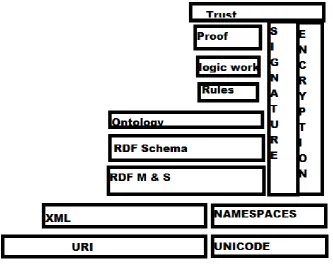
Fig 1 Architecture of Semantic Web
The layers of semantic web are setup in such a way that the bottom layer show lesser complexity and upper
layer show higher complexity. This designing of semantic web helps in scalability and excites using the similar
tools for the purpose at hand.
Layers description are there:
2.1
URI and UNICODE
These are the two technologies that give security that this layer are directly taken from WWW. URI give us
global indentifiers and UNICODE is charcter encoding standard that support international characters.
2.2
XML and Namespaces
Semantic web should smoothly integrated with the web.It must be knitted with web documented. HTML itself is
not sufficent to acquire all that which can be expressible by semantic web alone. We can say that, HTML is a
12 | P a g e
only for initial purpose but now many possiblities have been devloped. XML added namespace so that it canincrease modularisation and reuse of XML. Sematic web also use this for the same purpose. XML has brick the
road by adding some metadata which is in human redable tages that explains data.XML documents can involve
information regarding the producer of a web page, suitable keywords for search engine devlopment & the
software tools used to devlope the XML file. When XML is not devloped, data was stored in flat file and
database formats where much data was fix to an application. XML get on & made data interoperable in a single
domain. When both parties know & understand the elements names used then only XML provides syntactic
interoperability.Semantic web help address this problem by making understandable tags for both humans and
machines.To understand data for machine, first step is to get data into a uniform format, where a field labeled
“street” always has same format & same information and so on. This type of service can be available at today’s
website that has forms in which users allow to enter informations and runs a query such as airline websites that
give permission to visitors foe book flights etc. Next step requires that data from multiple domains is clasified
on the basis of its properties & relationships with each other.
2.3 RDF Model and Syntax
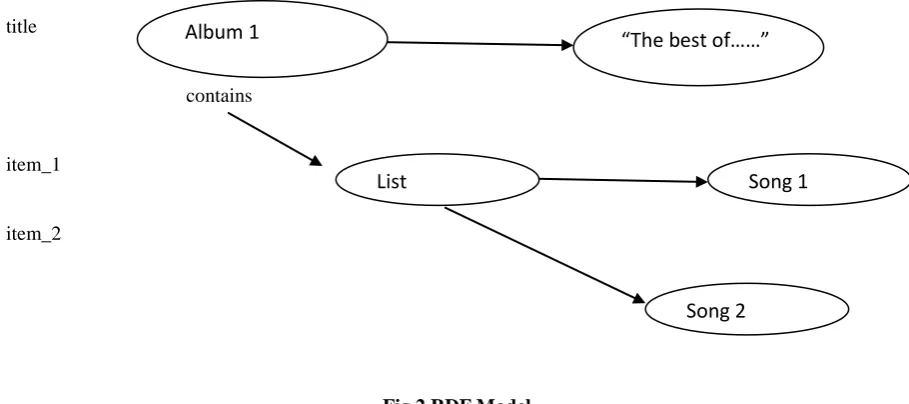
This model give a view of building blocks so that we can realise the semantic web. This layer first time
devloped for IT. This layer defines the RDF graph model & the RDF abstract syntax. Rdf graph is a collection
of nodes and directed edges between nodes. It creats directed graph that model the network of terms & relations
between terms of the semantic web. These nodes & relations are known as source which are identified by URI’s
because each node has different URI and different relations. URI’s are also called properties.
title
contains
item_1
item_2
Fig 2 RDF Model
Any particular edge are identified by the traide composed by the origin node i.e. the property and the final node.
Traids is triples ore RDF statements & they are abstract syntax of RDF. Graphs can be in serial in such a way
that as a set of triples. One triple is for each edge in the graph. Both representations are same so graph model
can be reconstructed from the set triples which can also be assigned an explicit identifier. This phenomenon is
known as reification.
Album 1
“The best of……”
List
Song 1
13 | P a g e
2.4 RDF Schema (Resource Description Framework)
Simple RDF gives the tools to provide the semantic networks. This is a knowledge representation. Technology
presented in the semantic network section. Still, there is still a defect of many semantic network is that no
facilities is available with RDF. Systematic relations are not defined here but defined in the RDF schema
specifications. Taxonomical relations supplement RDF to a knowledge representation language with ability
similar to semantic networks. This enables systematically reasoning regarding of resources & specifications that
relate them.
For defining metadata vocabularies, RDF schema specification give some primitives from semantic networks.
RDF schema design metadata vocabularies in a modular way. Schema primitives are just like to object
orientation constucts. They also evolved from the semantic network tradition.
Some relevent are:
Type: By this propert we relate a resource to a class to which it belongs. It is catogrised on the basis of member
of this class and class charcaterstics.
Class: A class has common conceptual abstraction with a collection of things that share some charactestics.
Subclass of: This propert holds the systematically relations between class.
e.g. If class B is a subclass of class A then class B has some good properties of class A in addition of some other
properties, on the basis of which class B differentiate with class A.
2.5 Ontology
Ontologies are necessary when the expressiveness achieved with semantic network-like tools is not enough.
Metadata vocabularies defined by RDF Schemas can be considered simplified ontologies. The tools included in
this layer rise the developed vocabularies to the category of ontologies. Ontologies, which were defined in the
Knowledge Representation Ontology section, are specially suited to formalize domain specific knowledge. Once
it is formalized, it can be easily interconnected with other formalizations. This facilitates the interoperability
among independent communities and thus ontologies are one of the fundamental building blocks of the
Semantic Web. Description Logics are particularly suited for ontology creation. They were introduced in the
corresponding Knowledge Representation subsection. The World Wide Web Consortium is currently
developing a language for web ontologies, OWL. It is based on Description Logics and expressible in RDF so it
integrates smoothly in the current Semantic Web initiative.Description Logic makes possible to develop
ontologies that are more expressible than RDF Schemas. Moreover, the particular computational properties of
description logics reasoners make possible efficient classification and subsumption inferences.
2.6 Rules
The rules layer allows proof without full logic machinery. Similar rules are those used by the production
systems presented in the corresponding Knowledge Representation subsection. They capture dynamic
knowledge as a set of conditions that must be fulfilled in order to achieve the set of consequences of the rule.
14 | P a g e
based on a previous initiative called Rule Modelling Language (RuleML) [Boley01]. As RuleML, SWRLcovers the entire rule spectrum, from derivation and transformation rules to reaction rules. It can thus specify
queries and inferences in Web ontologies, mappings between Web ontologies, and dynamic Web behaviours of
workflows, services, and agents.
2.7 Logic
The purpose of this layer is to provide the features of FOL. First Order Logic was described as the most
significant type of logic in the Logic types section. With FOL support, the Semantic Web has all the capabilities
of logic available at a reasonable computation cost as shown in the Deduction section. There are some
initiatives in this layer. One of the first alternatives was RDFLogic [Berners-Lee03]. It provides some
extensions to basic RDF to represent important FOL constructs, for instance the universal (∀) and existential (∃)
quantifiers. These extensions are supported by the CWM [Berners-Lee05] inference engine. Another more
recent initiative is SWRL FOL [Patel-Schneider04], an extension of the rule language SWRL in order to cope
with FOL features.
2.8 Proof
The use of inference engines in the Semantic Web makes it open, contrary to computer programs that apply the
black-box principle. An inference engine can be asked why it has arrived to a conclusion, i.e. it gives proofs of
their conclusions. There is also another important motivation for proofs. Inference engines problems are open
questions that may require great or even infinite answer time. This is worse as the reasoning medium moves
from simple taxonomical knowledge to full FOL. When possible, this problem can be reduced by providing
reasoning engines pre-build demonstrations, proofs that can be easily checked. Therefore, the idea is to write
down the proofs when the problem is faced and it is easier to solve as the reasoning context is more constrained.
Further, proofs are used whenever the problem is newly faced as a clue that facilitates reasoning on a wider
content. Many inference engines specialized in particular subsets of logic have been presented so far. For
instance:
Prolog for logic programming.
The production system Jess .
The Fact implementation of Description Logics reasoners.
The CWM inference engine presented in the previous section.
2.9 AGENT BASED METHOD FOR SEMANTIC ANALYSIS
The method consists of the following four steps: Morphological analysis Syntactic analysis ,Semantic analysis
15 | P a g e
2.9.1 Morphological Analysis1. It refers to the analysis of morphology.
2. Main emphasis is on the word in a sentence. How it deals & for it an agent is assigned to word.
2.9.2Syntactical Analysis
In semantic analysis, the main emphasis is on the structure of a sentence.Semantic analysis is executed at that
place where the word agent has to identify S.A. structure of a sentence. There is proper agreement between
subject and predicate.
2.9.3Semantic Analysis
Main focus on the meanings derived from the structure.Much emphasis is on the possible & appropriate
meaning of the word to derive the real meaning of a sentence. This analysis is essential to realize the
compatibility of the concerned words in each grammatically correct sentence.
2.9.4 Pragmatics
Ontology and acquirement of sufficient knowledge is accessed by word agents. Now the main work
consideration of the agents is on the additional requirement for execution.
III. METHOD FEATURE
Ontology which understands text understandable knowledge, rules for language development and problem
domain knowledge, needs to specify some discussion to making rules.
Every word has its own autonomous consideration & thus it searches its own meaning on the basis of the
knowledge available in ontology.
Through a process of discussion and arguments, ultimately tentative decisions are formed.
To derive the meaning Hit and Trial method is kept in mind.
Meaning derivation process should be in regular by changing ontology.
IV. CONCLUSION
In this paper our focus is on the architecure and the integration of agent technology and ontologies has made
significant impact on the use of web services .This gives the ability to extend programs to more efficiently
perform tasks for users with less human intervention. Unifying these research areas and bringing to fruition a
web teeming with complex, "intelligent" agents is both possible and practical. Although a number of research
challenges still remain. The pieces are coming together, and thus, the semantic web of agents is no longer a
science fiction future. It is a practical application on which to focus current efforts.