How rotation affects masses and ages of classical Cepheids
Richard I.Anderson1,,SylviaEkström2,CyrilGeorgy2,GeorgesMeynet2, andHideyukiSaio3
1Department of Physics and Astronomy, The Johns Hopkins University, Baltimore, MD 21218, USA 2Départment d’Astronomie, Université de Genève, 1290 Sauverny, Switzerland
3Astronomical Institute, Graduate School of Science, Tohoku University, Sendai, 980-8578 Miyagi, Japan
Abstract.Classical Cepheid variable stars are both sensitive astrophysical laboratories and accurate cosmic distance tracers. We have recently investigated how the evolutionary effects of rotation impact the properties of these important stars and here provide an ac-cessible overview of some key elements as well as two important consequences. Firstly, rotation resolves the long-standing Cepheid mass discrepancy problem. Second, rotation increases main sequence lifetimes, i.e, Cepheids are approximately twice as old as previ-ously thought. Finally, we highlight the importance of the short-period ends of Cepheid period distributions as indicators for model adequacy.
1 Introduction
Classical Cepheid variable stars (henceforth: Cepheids) are yellow (super-)giant stars of intermediate mass (3−10M) well-suited for investigating how rotation affects stellar evolution in general. The evolutionary status of Cepheids can be accurately inferred, since these stars occupy a well-defined region in the Hertzsprung-Russell diagram, the classical instability strip (IS). Additionally, Cepheid variability is very noticeable and straightforward to identify. Due to the timescales involved, nearly all Cepheids are observed during the blue loop evolutionary phase, i.e., during second or third IS crossings, which are inferred using observed rates of period change ([1]). Since blue loop evolution is highly sensitive to model assumptions and input physics ([2]), the same holds for Cepheid properties. The impact of rotation on stellar evolution increases with mass ([3]), and Cepheids occupy some-what of a “sweet spot” in this regard. They are massive enough for rotational mixing to be relevant, but not as dominated by binary interactions and radiatively-driven winds as more massive stars ([4, 5]). That said, many Cepheids are part of binary systems ([6–8]) and interactions may occur during various stages of a star’s evolution ([9, 10]).
Geneva stellar evolution models provide insights into the effects of rotation for a wide range of masses and metallicities ([11, 12]). Capitalizing on their sensitivity to stellar physics, we have car-ried out the first detailed investigations of how rotation impacts the evolution and pulsation properties of Cepheids ([13, 14]). In this contribution, we provide an accessible overview of some key no-tions regarding rotation and argue that rotation is required to correctly predict Cepheid properties. Specifically, we focus on the Cepheid mass discrepancy (§2) and period-age relations (§3). We close by highlighting the importance of correctly reproducing the short-period end of the Cepheid period distribution as well as the need to test predictions that are unmistakably linked to rotation (§4).
3.6 3.7 3.8 3.9 4.0 4.1 4.2 4.3 4.4
Teff [K]
2.0 2.5 3.0 3.5 4.0
log ( L/L ) 3M 4M 7M
Figure 1.Evolutionary tracks for 3, 4, and 7M models with LMC metallicity (Z=0.006). Cyan and black lines: Geneva models without and with average initial (ZAMS) rotation (ω= Ω/Ωcrit=0.5). Yellow
lines: MESA models ([15]) withv/vcrit=0.4, i.e.,
ω=0.586. 5Mmodels not shown for clarity. Blue and red IS boundaries from [14]. Cepheids are highly sensitive to model assumptions and input physics, being observed almost exclusively during blue loop evolution, i.e., 2ndand 3rdIS crossings. Rotation
modifies the mass-luminosity relation and resolves the long-standing Cepheid mass discrepancy (§2).
2 How rotation resolves the Cepheid mass discrepancy problem
Much work has been done to resolve the long-standing Cepheid mass discrepancy problem (cf. [16, 17], and references therein), which manifests in a 10−20% overestimate of Cepheid masses inferred from stellar evolution models compared to other (pulsational, or model-independent) mass estimates. Conceptually, there are two possibilities of resolving the mass discrepancy: a) lowering the mass of a given model at fixed luminosity, e.g. via enhanced mass-loss ([18]), and b) increasing luminosity at fixed mass, e.g. by increasing effective stellar core sizes via enhanced convective core overshooting (e.g., [19]) or rotational mixing ([13]). Despite growing observational evidence for circumstellar material in the vicinity of Cepheids ([20–22]), pulsationally-enhanced mass-loss rates ([18], ˙M ∼ 10−10−10−8M
yr−1) do not appear sufficient to resolve the mass discrepancy given that the Cepheid evolutionary phase is relatively short-lived (104−106yr). Rotation, however, provides a sufficient
increase in luminosity to resolve the mass discrepancy, cf. Figures 1 and 2.
Geneva stellar evolution models include convective core overshooting (dover/HP =0.1) to match
the observed width of the main sequence over the mass range 1.35−9M([11]) and have not been ad-justed to reproduce properties of evolved stars. Notably, Geneva models include a consistent treatment of (radially) differential rotation that induces mixing throughout a star at all times during its evolution. Rotational mixing occurs even in radiative layers, notably replenishing the core’s hydrogen supply while bringing processed materials to the surface during main sequence evolution. Thus, rotational mixing increases the core’s effective mass, although hydrostatic effects (centrifugal forces) counter-act this increase for very fast rotation ([13]). Due to this competition, luminosity does not increase
0.5 1.0 1.5
logP[d]
3 4 5 6 7 8 9 M/ M MW
0.5 1.0 1.5
logP[d]
MW incl. rot.
0.5 1.0 1.5
logP[d]
LMC
0.5 1.0 1.5
logP[d]
LMC incl. rot.
monotonously with increasing rotation. Rather, luminosity reaches a maximum near typical initial angular rotation rates, varies relatively slowly over the range of most probableω = Ω/Ωcrit ∼ 0.5,
and falls offtowards both extremes. However, even the models with the fastest rotation feature higher luminosities than models with no rotation.
Rotation thus modifies the mass-luminosity relation (MLR). Since initial angular velocities (ω) differ from star to star, it follows that MLRs have intrinsic scatter. Of course, MLRs also change during the evolution of a star, e.g. between 2ndand 3rdIS crossings (Fig. 1). Hence, to resolve the mass
discrepancy, both effects (rotation and crossing) must be considered simultaneously ([13]). Mass-period relations provide more direct observational tests, since pulsation Mass-periods are easily measured and since luminosity differences between 2ndand 3rdcrossings imply changes in stellar structure that
affect the pulsation equation (P = Q/√ρ¯), where ¯ρdenotes average density and Qis the pulsation “constant” ([23]). Figure 2 shows that observed and predicted mass-period relations in the Milky Way (MW) and Large Magellanic Cloud (LMC) agree for models that include average levels of rotation.
The intrinsic scatter of MLRs implied by rotation is further relevant for predicting the period-luminosity-color (PLC) relation, which follows from inserting anassumed MLR into the pulsation equation combined with the Stefan-Boltzmann law. Given that the MLR itself is not unique, the PLC-relation cannot be unique, either. It would be interesting to test the impact of any associated effects (e.g., changes in He abundance) on Cepheid light and radial velocity variations ([24]).
3 Rotational rejuvenation: Cepheids older than previously thought
Period-age relations ([25]) provide useful age estimates of stellar populations based on readily-observed pulsation periods. The age of a star in the Cepheid stage is dominated by its main sequence lifetime, followed by the duration of core He burning before the onset of blue loop evolution and the evolution along it. Rotation significantly prolongs the duration over which a star can produce energy via fusion in its core by effectively increasing core size, leading to increased lifetimes for increas-ing levels of rotation. Note that period-age relations for models with average and fast rotation are comparable, in contrast to the effects of rotation on MLRs (§2, [13]). Using Geneva models ([14]), we have quantified this effect and find that typical levels of rotation imply Cepheids to be older by approximately 60−100% than if rotation is not taken into account (cf. Fig. 3).
This change in Cepheid age scale is particularly important if Cepheid ages are compared with other age indicators. To illustrate the impact, ages for three∼ 20 d Cepheids located in the nuclear bulge of the Galaxy ([26]) have been estimated to be 25±5 Myr using solar-metallicity period-age relations that do not account for rotation ([27]). Yet, period-age relations that take into account typical
0.0 0.5 1.0 1.5 2.0
log(P [d])
7.0
7.5
8.0
8.5
log(t
[yr])
Z= 0.014
Z= 0.006
Z= 0.002
ω= 0.0
ω= 0.5
ω= 0.9
Fundamental mode
Figure 3.Period-age relations for fundamental mode Cepheids [14]. Line styles differentiate Solar, LMC, and SMC metallicity and colors indicate ZAMS rotation rate (ω) as indicated. Cyan lines are literature period-age relations that do not take into account rotation and are on a slightly different metallicity scale (Z=0.02,ZLMC=0.008,ZSMC=0.004, [27]).
initial rotation rates imply typical ages of 50−52 Myr, depending on the IS crossing. In the future, it will be important to cross-check the Cepheid age scale with other (hopefully independent) age in-dicators, such as asteroseismic studies of lower-mass stars in which rotational mixing is less efficient. In particular, Cepheids located in open clusters ([28]) are important test-beds for models, providing a means to compare period-age relations to cluster isochrone ages or potentially asteroseismic ages of cluster members. Further tests of the rotational mixing efficiency, especially via CNO surface abundances, will provide important cross-checks to evaluate the accuracy of the predictions.
4 Conclusions
Rotation has significant implications for Cepheids, resolving the mass discrepancy problem and im-plying significantly older ages than previously thought. Rotation leads to additional testable pre-dictions, since rotation impacts stellar structure, evolution, mass-loss, and surface abundances ([3]). To this end, we have carried out extensive comparisons with different kinds of observational data ([13, 14]) in the past and will continue to confront model predictions to observations.
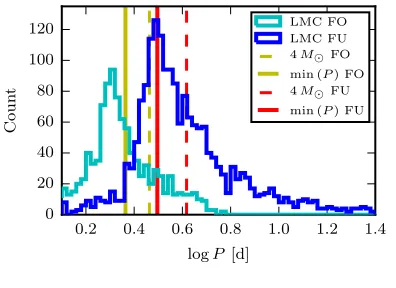
A related key observable isthe distribution of Cepheid pulsation periods, which is sensitive to the blueward extent of blue loops: the lower the minimum mass of a model entering the IS, the lower the predicted minimum period. Short-period Cepheids are by far the most numerous in a population due to long IS crossing timescales and the shape of the initial mass function. Given that blue loop evolution is suppressed in models with high values of convective core overshooting, the short-period peak sets a stringent constraint on this important parameter. Figure 4 shows that Geneva models correctly predict the peak in period for fundamental mode (FU) Cepheids1. Intriguingly, the predicted minimum period
for first overtone (FO) Cepheids is longer than observed. These points will be investigated further using synthetic populations ([29]).
CNO surface abundances probe the efficiency of main sequence rotational mixing, which is di-rectly related to the Cepheid age scale. In a preliminary comparison using literature abundances, it appeared that CNO surface abundance enhancement is over-predicted by Geneva models ([30]). How-ever, rotation does appear to be required to correctly reproduce the extended main sequence turnoffs of intermediate-age open clusters ([31]). Further observational tests of these effects are required to improve the models and ensure the accuracy and consistency of stellar age scales.
The ESA space missionGaiawill provide crucial information in this regard, allowing to firmly establish the often uncertain cluster membership of Cepheids ([28]) and thus significantly improving
1Minimum mass of models entering IS during blue loop evolution determined by interpolation 0.2 0.4 0.6 0.8 1.0 1.2 1.4
logP [d] 0
20 40 60 80 100 120
Coun
t
LMC FO LMC FU 4MFO
min (P) FO 4MFU
min (P) FU
the ability to use cluster populations as test-benches for different assumptions, input physics, and numerical implementations required to model stellar evolution.
References
[1] Turner, D. G., Abdel-Sabour Abdel-Latif, M., & Berdnikov, L. N., PASP,118, 410 (2006) [2] Kippenhahn, R. & Weigert, A., Stellar Structure and Evolution (Springer-Verlag, Berlin–
Heidelberg–New York; also Astronomy and Astrophysics Library XVI, 1994) [3] Maeder, A., & Meynet, G., ARA&A,38, 143 (2000)
[4] Puls, J., Vink, J. S., & Najarro, F., A&ARv,16, 209 (2008)
[5] Sana, H., de Mink, S. E., de Koter, A., et al., Science,337, 444 (2012) [6] Szabados, L., IBVS,5394, 1 (2003)
[7] Evans, N. R., Berdnikov, L., Lauer, J., et al., AJ,150, 13 (2015) [8] Anderson, R. I., Casertano, S., Riess, A. G., et al., ApJS,226, 18 (2016)
[9] Anderson, R. I., Sahlmann, J., Holl, B., Eyer, L., Palaversa, L., Mowlavi, N., Süveges, M., & Roelens, M., ApJ,804, 144 (2015)
[10] Neilson, H. R., Schneider, F. R. N., Izzard, R. G., Evans, N. R., & Langer, N., A&A,574, A2 (2015)
[11] Ekström, S., Georgy, C., Eggenberger, P., et al., A&A,537, A146 (2012)
[12] Georgy, C., Ekström, S., Granada, A., Meynet, G., Mowlavi, N., Eggenberger, P., & Maeder, A., A&A,553, A24 (2013)
[13] Anderson, R. I., Ekström, S., Georgy, C., Meynet, G., Mowlavi, N., & Eyer, L., A&A,564, A100 (2014)
[14] Anderson, R. I., Saio, H., Ekström, S., Georgy, C., & Meynet, G., A&A,591, A8 (2016) [15] Paxton, B., Cantiello, M., Arras, P., et al., ApJS,208, 4 (2013)
[16] Bono, G., Caputo, F., & Castellani, V., MmSAI,77, 207 (2006) [17] Keller, S. C., ApJ,677, 483 (2008)
[18] Neilson, H. R., & Lester, J. B., ApJ,684, 569 (2008)
[19] Prada Moroni, P. G., Gennaro, M., Bono, G., Pietrzy´nski, G., Gieren, W., Pilecki, B., Graczyk, D., & Thompson, I. B., ApJ,749, 108 (2012)
[20] Kervella, P., Mérand, A., & Gallenne, A., A&A,498, 425 (2009) [21] Marengo, M., Evans, N. R., Barmby, P., et al., ApJ,725, 2392 (2010) [22] Nardetto, N., Poretti, E., Rainer, M., et al., A&A,597, A73 (2017) [23] Saio, H., & Gautschy, A., ApJ,498, 360 (1998)
[24] Marconi, M., Molinaro, R., Bono, G., et al., ApJ,768, L6 (2013) [25] Kippenhahn, R., & Smith, L., A&A,1, 142 (1969)
[26] Matsunaga, N., Kawadu, T., Nishiyama, S., et al., Nature,477, 188 (2011)
[27] Bono, G., Marconi, M., Cassisi, S., Caputo, F., Gieren, W., & Pietrzynski, G., ApJ,621, 966 (2005)
[28] Anderson, R. I., Eyer, L., & Mowlavi, N., MNRAS,434, 2238 (2013)
[29] Georgy, C., Granada, A., Ekström, S., Meynet, G., Anderson, R. I., Wyttenbach, A., Eggen-berger, P., & Maeder, A., A&A,566, A21 (2014)
[30] Anderson, R. I., PhD thesis, Université de Genève (2013) [31] Brandt, T. D., & Huang, C. X., ApJ,807, 25 (2015)

![Figure 3. Period-age relations for fundamental modeRotation extends main sequence lifetimes by mixingunprocessed material into the core during H-burning,resulting in significantly (Cepheids [14]](https://thumb-us.123doks.com/thumbv2/123dok_us/8133607.1355565/3.482.44.236.515.651/relations-fundamental-moderotation-lifetimes-mixingunprocessed-resulting-signicantly-cepheids.webp)