Jefferson Lab Report
EugeneChudakov1,?,??
1Jefferson Lab, 12000 Jefferson Ave, Newport News,VA 23606, USA
Abstract. Jefferson Laboratory is finishing a major upgrade and has already started operations with the 12 GeV continuous electron beam. The main research direction is the study of the structure of hadrons, including a search for gluon excitations in the spectra of light mesons and baryons, and studies of multidimensional images of the nucleon. Studied of certain properties of atomic nuclei are also ongoing. There is also an active program of searching for effects beyond the Standard Model in parity-violating electron scattering, as well as a search for new particles.
1 Introduction
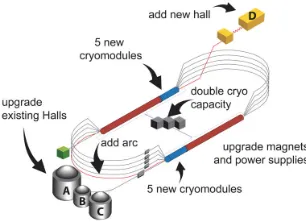
For more than a decade Thomas Jefferson National Accelerator Facility has operated a continuous electron accelerator CEBAF providing polarized electron beams up to 6 GeV energy and 180 µA current to 3 experimental halls A, B, and C. The scientific directions and results from this period have been outlined in a review [1]. Now, the facility is finishing a major upgrade, which doubles the energy of the accelerator to 12 GeV and installs new experimental equipment. The experimental program at 12 GeV has already started.
2 12 GeV Upgrade
The upgrade project is practically finished and will be formally finished by the end of September 2017. The upgraded facility is shown in fig. 1. The linacs operate at≈1500 MHz frequency. The injector produces 3 (4 in the near future) independent polarized electron beams at 500 or 250 MHz, with proper phase shifts. The beams can be extracted using RF separators after 1 – 5 passes to halls A – C. One of the beams can be extracted magnetically to Hall D after 5.5 passes. The extraction scheme has been upgraded in order to serve 4 experimental halls at the same time. With the energy per pass of 2.2 GeV, the maximum beam energy in Hall D is about 12 GeV, and 11 GeV in the other halls. The layout of the experimental halls is shown in fig. 2. Halls A and C are designed for high luminosity of<1039cm−2
and can receive a high beam current (<90µA at 11 GeV). They are equipped with small-acceptance, high-resolution spectrometers. CLAS12 in Hall B has a large acceptance, a good resolution, and is designed for a luminosity<1035cm−2(<100 nA). The Hall D tagger hall receives an electron beam < 5 µA that passes through a thin diamond radiator producing a coherent Bremsstrahlung photon
?e-mail: [email protected]
Figure 1.Jefferson Lab 12 GeV upgrade concept
beam peaking at about 9 GeV. The photon beam is collimated, providing a∼40% linear polarization at the top of the coherent peak. The nearly hermetic, medium-resolution spectrometer in Hall D is designed for a photon beam with the intensity in the coherent peak of<100 MHz.
The first beam was delivered to halls A and D in 2014. In Spring 2016 the 12 GeV operations started. Hall A ran physics experiments while Hall D finished commissioning and started the physics program. Hall B ran an the HPS (Heavy Photon Search) experiment, which does not use the CLAS12 spectrometer. In Spring 2017 halls A and D ran experiments, while CLAS12 and Hall C started commissioning. Hall B also ran experiment PRAD, which was not using CLAS12.
3 Physics Program
The physics program for the 12 GeV operation has been outlined briefly [2] and discussed in detail [3]. The major science questions to be addressed include [2]:
• What is the role of gluonic excitation in the spectroscopy of light mesons?
• Where is the missing spin in the nucleon? Is there a significant contribution from orbital angular momentum of valence quarks?
• Can we reveal a novel landscape of nucleon substructure through measurements of new multidi-mensional distribution functions?
• What is the relation between short-range N-N correlations, the partonic structure of nuclei, and the nature of the nuclear force?
• Can we discover evidence for physics beyond the standard model of particle physics?
A detailed program has been developed in collaboration with the user community and with the guidance of the Program Advisory Committee (PAC). By June 2017 76 experiments have been ap-proved by the PAC, while 4 have completed the data taking.
4 Early Experiments and Expected Results
4.1 Meson SpectroscopyHall A
Hall C
Hall B
Hall D
barrel calorimeter
time-of -flight
forward calorimeter
photon beam
electron beam electron
beam
superconducting magnet target
tagger magnet
tagger to detector distance is not to scale
diamond wafer
G
lueX
central drift chamber
forward drift chambers
Figure 2. Experimental halls. The beamlines to halls A – C have been upgraded to 11 GeV. Hall A basic equipment was not upgraded. The CLAS spectrometer in Hall B was removed and a new CLAS12 spectrometer installed. In Hall C a new SHMS high-resolution spectrometer was installed. Hall D is a completely new experimental hall. Hall A: 2 HRS spectrometers and smaller installable spectrometers BigBite and Super BigBite. Hall B: CLAS12 is a large acceptance spectrometer which uses superconducting solenoidal and toroidal magnets. Hall C: 2 high-resolution spectrometers. Hall D: a new hall for a polarized photon beam, equipped with a spectrometer based on a large superconducting solenoidal magnet.
provides a good experimental signature. The GlueX experiment will search for the exotic mesons in a mass range 1.2 – 2.5 GeV, produced by linearly polarized photons on a liquid hydrogen target. The commissioning of the experiment was complete in Spring 2016; this also provided some amount of physics-quality data. The first physics run took place in Spring 2017, taking about 20% of the data volume planned for the first stage the GlueX experiment. The search for exotic mesons requires a good understanding of the detector acceptance, the efficiency, the photoproduction mechanisms etc. The 2016 data allowed to start the appropriate studies. The linearly polarized beam allows to measure the beam asymmetries in photoproduction. The first GlueX physics publication [4] is dedicated to the measurement of the beam asymmetry ofπ0andηphotoproduction at∼9 GeV (see fig. 3).
The data were taken with two orientations of the diamond radiator, leading to two perpendicular planes of the photon polarization. Theπ0 production yield depends of the angle between the
pro-duction and polarization planesϕ. The apparatus function cancels out for the calculated asymmetry between the measured yields taken at two beam polarizations. The asymmetry is expected to have the formA(ϕ) = PΣcos 2ϕ, wherePis the beam polarization andΣis the production asymmetry. The results (see fig. 3) show thatΣ≈1, as expected for a vector (ωetc) exchange particle in the reaction
γp → π0p. These new results improve considerably the older results forπ0, and are the first such
measurements forη.
(GeV)
PS
E
7.5 8 8.5 9 9.5 10 10.5 11 11.5
Photon Flux (Arb. Units)
1000 2000 3000 4000 5000 6000 7000 (a) Diamond: PARA Diamond: PERP Aluminum
Photon Beam Energy (GeV)
7.5 8 8.5 9 9.5 10 10.5 11 11.5
Polarization 0 0.1 0.2 0.3 0.4 0.5
1.5% Syst. Uncert.
PARA PERP (b) ) 2 c
Invariant Mass (GeV/
γ γ
0 0.2 0.4 0.6 0.8 1
2
c
Counts / 10 MeV/
1 10 2 10 3 10 4 10 γ γ p → p γ GlueX Data background (MC) ω proton φ
-3 -2 -1 0 1 2 3
Counts 0 100 200 300 400 500 600 Polarization (a) proton φ
-3 -2 -1 0 1 2 3
Counts 0 100 200 300 400 500
|| Polarization (b)
proton
φ
-3 -2 -1 0 1 2 3
Yield Asymmetry -0.4 -0.2 0 0.2 0.4 0.6 || Y R + F Y || Y R - F Y (c) 2 ) c (GeV/ -t
0 0.2 0.4 0.6 0.8 1 1.2 1.4 1.6 1.8 2
Σ 0 0.2 0.4 0.6 0.8 1 1.2 1.4 <9.0 GeV γ GlueX 8.4<E =10 GeV γ E SLAC 0 π p → p γ (a) 2.1% Norm. Uncert. 2 ) c (GeV/ -t
0 0.2 0.4 0.6 0.8 1 1.2 1.4 1.6 1.8 2
Σ -0.4 -0.2 0 0.2 0.4 0.6 0.8 1 1.2 1.4 Laget [5,6] JPAC [7,8] Donnachie [9] Goldstein [4] η p → p γ (b)
Figure 3.First GlueX results [4]. Left (a) - photon beam spectrum; (b) - the measured photon linear polarization, for two crystal orientations. Center top - the mass spectra of two photons; bottom - theπ0asymmetry measured
with two orientations of the crystal radiator. Right (a) - measured asymmetry forπ0; (b) - measured asymmetry
forη.
(a) (b) (c)
invariant mass, GeV
-e
+
e
1 1.5 2 2.5 3 3.5
events/10 MeV 0 20 40 60 80 100 120 140 160 0 >2 e θ <200, 2 χ x-sec. kin.fit φ MC normalized to
data
MC φ Bethe-Heitler +
Figure 4.GlueX: signals observed in the 2016 data: (a) -fresonances inπ0π0final state; (b) -b
1(1235) resonance
inωπ0final state; (c) -e+e−final state in reactionγp→e+e−pshows a signal fromφand a signal fromJ/ψ.
J/ψproduction study is a “by-product” of the GlueX program, and it is of particular interest for two reasons. First, the photoproduction cross section close to threshold is sensitive to the gluon distribution at high x [5]. There are no data yet forE <11 GeV. Second, there is an opportunity to look for the recently found pentaquark in thes-channelγp→P(4450)→J/ψp[6], at the photon energies around 10 GeV. Such a measurement would probe the value of the branching ratio ofP→J/ψp. The GlueX collaboration is planning to produce more publishable results after combining the data from 2016 and 2017.
4.2 Testing the Standard Model
4.2.1 Parity Violation (PV) experiments
the protonQWp. The Standard Model predictsQpW=1−4 sin2θ
W. The electroweak mixing sin2θW de-pends on theQ2of the process. The QWeak experiment measured the value ofQp
WatQ2∼0.01 GeV2 using a 180µA longitudinally polarized electron beam interacting with a liquid hydrogen target. The final result reported at a seminar at Jefferson Lab in September 2017 is consistent with the Standard Model.
The next scheduled PV experiments PREX and CREX [8] in Hall A will measure the neutron skin of heavy nuclei. The next generation of PV experiments planned - MOLLER [9] and SoLID [10] - will allow to test the Standard Model electroweak predictions with a much improved accuracy, as well as to study QCD. The time scale for these experiments depends on the funding profile, not yet decided.
4.2.2 Proton Radius
The inconsistency of the proton radius measured in the electron scattering and in the spectroscopy of muonic atoms has attracted substantial attention as a potential violation of lepton universality. The PRAD experiment [11] is planning to improve the accuracy of the measurements. The experiment ran in Hall B in 2017, measuring the small-angle electron scattering using a hydrogen jet target and an electromagnetic calorimeter for the detector. The experiment also detected the Møller scattering in order to verify/normalize the cross section measured.
4.2.3 Search for Heavy Photons
A “heavy photon”A0- the gauge boson of an additional (beyond the SM) U(1) symmetry, has been
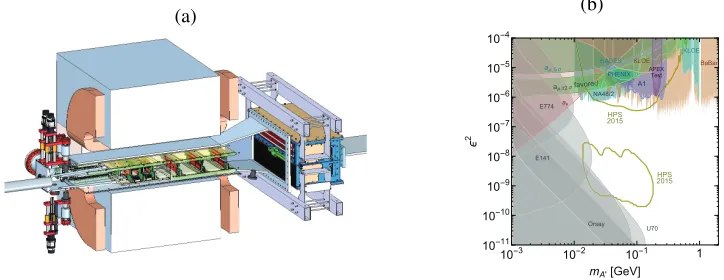
introduced in order to explain certain phenomena associated with dark matter. It may also contribute to the anomalous magnetic moments of leptons. It can be characterized by two parameters: the coupling to electrons·eand the massmA0. A part of the,mA0 space at higher values ofhas been already excluded by various experimental results. The HPS experiment [12, 13] is looking for the process
e−+Z →A0+e−+Z,A0→e++e−, and is aiming to extend the search to a region of much smaller
values of. In this region theA0would leave long enough that their decay paths can be detected with
a vertex detector (see fig. 5).
(a)
Figure 2.HPS detector setup. From left to right: the first dipole magnet, the target system, the SVT inside the analyzing magnet, the ECal and the third dipole magnet.
experiments and the constraint from the electromagnetic momentumae(red band). The reach was computed by as-suming a one-week run at 1.1 GeV, a one-week run at 2.2 GeV, and a two-week run at 4.4 GeV. The two regions in the reach plot correspond to the two analysis techniques used in HPS: the resonance search at higher2 and the detached vertex search at lower2. The latter region is particularly difficult to reach and can be uniquely explored by HPS. Indeed, on one side, it corresponds to low2and thus small cross sections, out of reach from collider exper-iments. On the other side, the relatively short decay length (<1 m) ofAin this region, makes it out of reach also from beam-dump experiments, where thick absorbers are used.
References
[1] Feldman D., Kors B. and Nath P., Phys. Rev. D75, 023503 (2007)
[2] Andreas S., Goodsell M. and Ringwald A., Phys. Rev. D87, 025007 (2013)
[3] Galison P. and Manohar A., Phys. Lett. B136, 279 (1984)
[4] Holdom B., Phys. Lett. B166, 196 (1984)
[5] Essig R., Schuster P. and Toro N., Phys. Rev. D80, 015003 (2009)
[6] Arkani-Hamed N., Finkbeiner D.P., Statyer T.R., Weiner N., Phys. Rev. D79, 015014 (2009)
[7] Pospelov M. and Ritz A., Phys. Lett. B671, 391-7 (2009)
[8] Adriani O. et al., Nature458, 607 (2009)
10-3 10-2 10-1 1
10-11 10-10 10-9 10-8 10-7 10-6 10-5 10-4
mA'[GeV]
2 APEX Test A1 PHENIX U70 E141 E774 a, 5
a,±2favored
ae BaBar KLOE KLOE HADES Orsay HPS 2015 HPS 2015
NA48/2
Figure 3.The HPS projected reach corresponding to the 2σlimit (yellow line). The green bandaμ±2σ(aμ±2σ) corresponds to the region where theAcan explain the discrepancy between the
ex-perimental value of the muon anomalous magnetic moment, con-sidering a 2σ(5σ) error, and the corresponding Standard Model calculation.
[9] Ackermann M. et al. (Fermi LAT Collaboration), Phys. Rev. Lett.108, 011103 (2012)
[10] Aguilar M. et al. (AMS Collaboration), Phys. Rev. Lett.110, 141102 (2013)
Dark Matter, Hadron Physics and Fusion Physics
(b)
Figure 2.HPS detector setup. From left to right: the first dipole magnet, the target system, the SVT inside the analyzing magnet, the ECal and the third dipole magnet.
experiments and the constraint from the electromagnetic
momentumae(red band). The reach was computed by
as-suming a one-week run at 1.1 GeV, a one-week run at 2.2 GeV, and a two-week run at 4.4 GeV. The two regions in the reach plot correspond to the two analysis techniques
used in HPS: the resonance search at higher2and the
detached vertex search at lower2. The latter region is
particularly difficult to reach and can be uniquely explored by HPS. Indeed, on one side, it corresponds to low2and
thus small cross sections, out of reach from collider exper-iments. On the other side, the relatively short decay length (<1 m) ofAin this region, makes it out of reach also from
beam-dump experiments, where thick absorbers are used.
References
[1] Feldman D., Kors B. and Nath P., Phys. Rev. D75,
023503 (2007)
[2] Andreas S., Goodsell M. and Ringwald A., Phys. Rev. D87, 025007 (2013)
[3] Galison P. and Manohar A., Phys. Lett. B136, 279
(1984)
[4] Holdom B., Phys. Lett. B166, 196 (1984) [5] Essig R., Schuster P. and Toro N., Phys. Rev. D80,
015003 (2009)
[6] Arkani-Hamed N., Finkbeiner D.P., Statyer T.R., Weiner N., Phys. Rev. D79, 015014 (2009)
[7] Pospelov M. and Ritz A., Phys. Lett. B671, 391-7
(2009)
[8] Adriani O. et al., Nature458, 607 (2009)
10-3 10-2 10-1 1
10-11 10-10 10-9
10-8
10-7
10-6
10-5 10-4
mA'[GeV]
2 APEX Test A1 PHENIX U70 E141 E774
a, 5
a,±2favored
ae BaBar KLOE KLOE HADES Orsay HPS 2015 HPS 2015
NA48/2
Figure 3.The HPS projected reach corresponding to the 2σlimit (yellow line). The green bandaμ±2σ(aμ±2σ) corresponds to the region where theAcan explain the discrepancy between the
ex-perimental value of the muon anomalous magnetic moment, con-sidering a 2σ(5σ) error, and the corresponding Standard Model calculation.
[9] Ackermann M. et al. (Fermi LAT Collaboration), Phys. Rev. Lett.108, 011103 (2012)
[10] Aguilar M. et al. (AMS Collaboration), Phys. Rev. Lett.110, 141102 (2013)
Dark Matter, Hadron Physics and Fusion Physics
01010-p.3
Figure 5. (a) Layout of the HPS experiment [12]. A thin target is located close to a dipole magnet. The trajectories are detected with a silicon vertex detector located very close to the electron beam. The electrons are identified with a EM calorimeter. (b) - the projected zone of sensitivity of the HPS experiment.
The HPS experiment has run in Hall B in the transition periods of 2015 and 2016, and will continue data taking. Another experiment APEX [14] searching forA0in a similar reaction in Hall A is ready
to be put on schedule.
4.3 Nucleon Structure
Two experiments have been completed in Hall A in 2014-2017: a measurement of the spectral function of 40 (E12-14-012 [15]), and a measurement of the proton magnetic formfactor at high Q2
(E12-07-108 [16]). An experiment to measure the DVCS cross section (E12-06-114 [17]) is about 50% complete. Many more experiments in this field are scheduled for running in halls A, B, and C.
5 Summary
The 12 GeV upgrade project at Jefferson Lab is complete and the 12 GeV operations have begun. The Jefferson Lab scientific community is looking forward to the implementation of the rich program developed for the post-upgrade era.
References
[1] D. Higinbotham, W. Melnitchouk, A. Thomas, eds.,New Insights into the Structure of Matter:
The First Decade of Science at Jefferson Lab, Vol. 299 ofJournal of Physics: Conference Series
(IOP Publishing, 2011),http://iopscience.iop.org/issue/1742-6596/299/1
[2] R.D. McKeown, Int. J. Mod. Phys. Conf. Ser.37, 1560019 (2015)
[3] J. Dudek, R. Ent, R. Essig, K.S. Kumar, C. Meyer, R.D. McKeown, Z.E. Meziani, G.A. Miller, M. Pennington, D. Richards et al., The European Physical Journal A48, 187 (2012)
[4] H. Al Ghoul et al. (GlueX), Phys. Rev.C95, 042201 (2017),1701.08123
[5] S.J. Brodsky, E. Chudakov, P. Hoyer, J.M. Laget, Phys. Lett.B498, 23 (2001),hep-ph/0010343
[6] V. Kubarovsky, M.B. Voloshin, Phys. Rev.D92, 031502 (2015),1508.00888
[7] D. Androic et al. (Qweak), Phys. Rev. Lett.111, 141803 (2013),1307.5275
[8] C.J. Horowitz, K.S. Kumar, R. Michaels, Eur. Phys. J.A50, 48 (2014),1307.3572
[9] J. Benesch et al. (MOLLER) (2014),1411.4088
[10] J.P. Chen, H. Gao, T.K. Hemmick, Z.E. Meziani, P.A. Souder (SoLID) (2014),1409.7741
[11] A.H. Gasparian (PRad), JPS Conf. Proc.13, 020052 (2017) [12] M. De Napoli (HPS), EPJ Web Conf.96, 01010 (2015) [13] M. De Napoli (HPS), EPJ Web Conf.142, 01011 (2017) [14] G.B. Franklin (APEX), EPJ Web Conf.142, 01015 (2017)
[15] O. Benhar et al., Measurement of the Spectral Function of 40Ar through the (e,e2p) reac-tion(2014), JLab proposal E12-14-012,http://www.jlab.org/exp_prog/proposals/14/ PR12-14-012.pdf
[16] S. Abrahamyan et al., Precision Measurement of the Proton Elastic Cross Section at High Q2(2007), JLab proposal E12-07-108,http://www.jlab.org/exp_prog/PACpage/PAC38/
proposals/Previously_Approved/E12-06-114_Update.pdf
[17] M. Amaryan et al., Measurements of Electron-Helicity Dependent Cross Sections of
Deeply Virtual Compton Scattering with CEBAF at 12 GeV (2006), JLab proposal
E12-06-114, http://www.jlab.org/exp_prog/PACpage/PAC38/proposals/Previously_

![Figure 3. First GlueX results [4]. Left (a) - photon beam spectrum; (b) - the measured photon linear polarization,for two crystal orientations](https://thumb-us.123doks.com/thumbv2/123dok_us/7993635.1327003/4.482.47.426.323.432/figure-gluex-results-spectrum-measured-polarization-crystal-orientations.webp)