35 | P a g e
Comparative Analysis of Smartphone Operating system
Android Apple iOS and Windows
Ankit Tiwari
Computer Science, Sachdeva Institute of Technology Mathura (India)
ABSTRACT
A smart phone is a mobile phone with highly advanced features. A smart phone has a High resolution touch screen display, Wi-Fi connectivity, web browsing capabilities and the ability to accept the sophisticated applications. The majority of these devices run on any of these popular mobile operating systems such as Android, iOS, Blackberry operating system and Windows operating system. Today the smart phone world is categorized into three aspects depends upon the mobile operating system which is used in a particular smart phone. These three major mobile operating systems are Android from Samsung, iOS from Apple and Windows from Microsoft. Technology and features may vary from one type of mobile operating system to another type of mobile operating system. This paper produces a comparative study on smart phone operating systems android, iOS, Windows. Big differences are highlighted when iOS is developed but Android are not developed. The present time we can see that iOS providing so much security for the user but we can see that Android (Google) given as security features “security patch system” which is coming at inbuilt in new mobile at present time. “SERCURTIY PATCH” system is a new tech for the Android user by this we can secure over mobile in case told
over mobile than no one kind access. It is works as the iOS security.
I.
INTRODUCTION
The term smart phone was first described by the company Ericsson in 1997. The term was given to the handsets
which has difference from other feature handsets. The most significant difference was that the advanced
“Application Programming Interfaces (APIs)”. The first phone to feature cellular + Personal Digital Assistance
(PDA) was developed by IBM in 1992 naming „simon personal communicator‟ which could be referred
as „smart phone‟. Later in 1996, Nokia released „Nokia 9000‟ which has also PDA device with a QWERTY
keypad with it. Later then mobile phone operating systems were introduced. Depends upon the operating
systems the mobile phones (now a day‟s Smart phones) are classified. More than 80% of the world mobile
market consists of smart phones as they‟re more reliable and easier to use. Today in world about 43% there
are Android users, 40% there are iOS users and are other users. They have easier User Interface (UI)
which makes every task easier. The user interface is everything designed into an information device with which
36 | P a g e
II.
TECHNOLOGY
The technology and features of the smart phones are varies to one operating system to another. Depends upon
the operating system used in the smart phones the smart phones are classified. This classification mainly focuses
on three major operating systems such as Android, iOS and Windows OS.
A part from these three major smart phone operating systems the Symbian operating system and blackberry
operating systems are used worldwide.Totally there are five steps involved in smart phones application
development.
1. Strategy
2. Design
3. Development
4. Marketing
5. Maintenance
At present various smart phone applications available. There are n number of smart phone applications are
available today. Some of the basic applications are in-build with the operating systems. Mobile app (smart
phone app) is nothing but a computer program run on mobile devices such as smart phones and tablet PCs. Most
such devices are sold with several apps included as pre-installed software such as Web browser, e-mail
client, and calendar, mapping program and an app for buying music or other media or more apps.
III.
PLATFORM PRESENTATION
Our research focuses on four of the main mobile platforms: Android, Windows Phone, iOS and Firefox OS. The next
sections will give a short introduction to each of these.
1.
Android Google:-
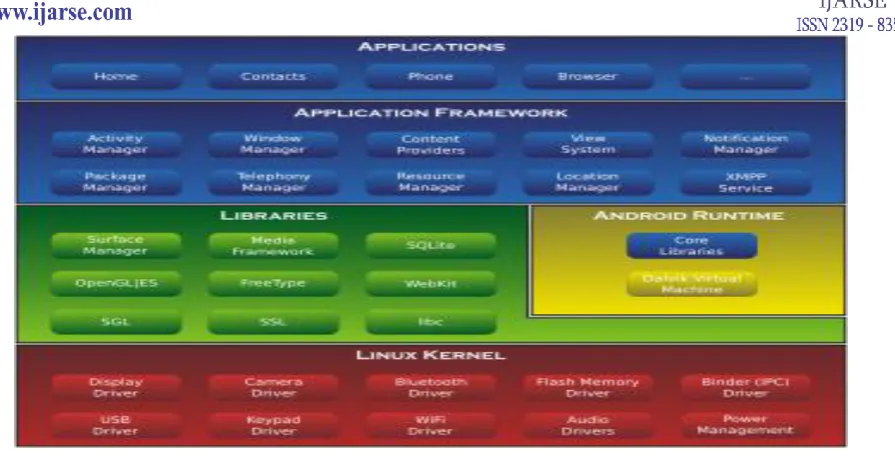
released Android in November 2007, under the framework of the Open Handset Alliance, with the goal of being an open source arena for software development on mobile platform. Android is an open sourcemobile operating system based on the Linux kernel and facilitates developers to write managed code in Java using
Google developed Java libraries. The Android platform does not only provide the mobile operating system itself
including the development environment, but also provides a custom built virtual machine (Dalvik Virtual Machine)
for the applications to run on as well as acting as the middleware between code and operating system. For
application development, Android facilitates the use of 2D and 3D graphic libraries, a customized, onboard SQL
engine for persistent storage and advanced network capabilities such as3G, 4G and WLAN. The API is constantly
evolving and the current release (7.1NOUGHT) is a huge increment compared with number of available features from
release 1.0. Since Android is an open source mobile operating system, the community is welcomed to collaborate in
the evolvement of the programming environment, the operating system and the API. Development tools for Android
37 | P a g e
Fig. 1 Android Architecture2.
Windows Phone:-
Previously, the mobile operating system created by Microsoft was called Windows Mobile. After the changes introduced by Apple (iOS) and Google (Android) in 2007, Microsoft decided to takea new direction and created Windows Phone. Similar to other alternatives, such as iOS and Android, Windows
Phone is an operating system for smartphones. It is usually used on touch screen devices, and offers
functionality such as networking, sensors and camera integration. Programs for Windows Phone 7 are written in
.NET managed code. Managed code is code written in languages that are available for use with the Microsoft
.NET Framework, for example C#. One of the benefits is that many of the error-prone and often complex tasks,
such as type safety checking, memory management and destruction of unneeded objects, are taken care of
Windows Phone 7 supports two popular programming platforms, namely Silverlight and XNA. Silverlight is
an evolution of the Windows Presentation Foundation (WPF). It provides developers with the ability to
create sophisticated user interfaces. The second platform, XNA, is Microsoft‟s game platform. It supports both
2D and 3D graphics .Development for Windows Phone is done in Visual Studio. There is a range of various
editions of Visual Studio, ranging from the free Visual Studio Express to the Ultimate edition. Although the
Express edition if enough to get started, the limitations quickly get in the way of productivity. For example, no
support for plugins is one of the main limitations. There are two languages that can be used to write programs
for Windows Phone, 1) Visual Basic .NET and 2) C#. We will focus on the C# language in this paper. We chose
to use this language because we were more familiar with it and also we found more resources, in books and on
the Internet, for Windows Phone development with C#. Programs created for Windows Phone are packaged
into XAP files, which is the Silverlight application package .According to Gartner, Microsoft currently
occupies the 3rd place in regards to market share (second quarter of 2013). For the first time Microsoft has a
larger market share compared to Blackberry. Even with the recent increase in popularity, the Windows Phone
platform is still a relatively small player with a 3.3% market share. The step up of the iOS (14.2%) and Android
(79.0%) is considerable. However, it will be interesting to see how the acquiring of Nokia will affect the further
38 | P a g e
Fig. 2 Windows Phone Architecture3.
Apple iOS:
iOS is one of the best operating system from Apple. This strong but expensive operating system is developed by Apple whose native language is C. Recently released its one of the major update in iOShistory that is iOS 7. iOS 7 allows us to function between various apps, a similar UI (User Interface)than
previous versions. Paying electricity bills, bank accounts maintenance are a tap away. It has improved Siri,
Airdrop (programming concepts) to transfer files. Control center which allows us to toggle different functions
just at a tap. Up to that level it is easier than other tasks. Apple i phone 5S also contains world‟s first and fastest
A7 chip with 64 bit architecture and M7 motion co-processor chip. Apple i phone 5S also includes a finger print
sensor which is the first ever technology launched by Apple. Some of the best iOS smart phones are: i Phone
5(discontinued now), i Phone 5C, i Phone 5S, i Pad 4, i Pad Mini, Sony Xperia Z3+ etc. Apple is now
preparing to launch the update of its new software iOS 7. iOS 7 has some bugs need to be fixed, iOS 7.0.2 has
been launched yet the software is not fully bus free. Apple is preparing its next gen device fourth quarter of
2014 work on finger print sensor‟s efficiency is being done.
39 | P a g e
IV.
PLATFORM COMPARISON
In this section we described the actual comparison of the four mobile application development platforms and
show how they relate through a common example implemented across all environments. We start off by
detailing the implemented scenario, before we present our findings and finally ending this section with a
discussion.
1.
ANDROID v/s IOS
Today mobile market provides us with so many options that it makes difficult for us to choose the best but as the saying goes “that what is wanted more is the best” and the same goes with ourfavorite Android. This Google‟s OS came into market in the year 2008 and before completing two years it has
shown a remarkable growth in the market. This is all because of some reasons that I will try to elaborate in the
following discussion. These are the points that are the most important that creates such a difference in my
opinion. It is changing the scenario in the worldwide market as it is being adopted by major players in
smartphone market like HTC, Samsung, Motorola, and Samsung and not to forget Google's Nexus One.
Android, because of its highlighting features is competing against mobile platforms from Apple, Microsoft,
Nokia, Palm, Research in Motion and Symbian. The android is growing faster than the iPhone. Its platform is
showing a rapid growth from the last two years and the openness of the platform can account for this rapid
growth. The comparison of android and iPhone can be done from different perspective but the final result is
supposed to be same foe each viewpoint. Here we discuss some of the main features that make the difference
between android and iPhone.
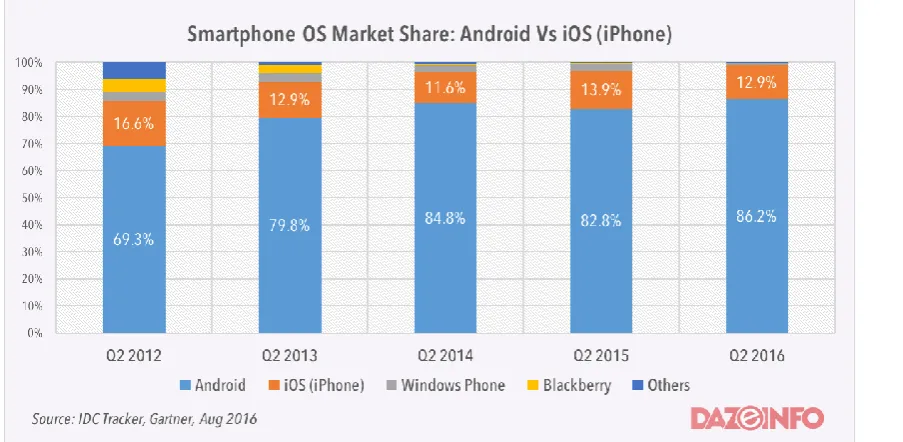
Fig. 4 Android v/s iOS iPhone
The above Bar-Chat shows the marketing share of smart phone operating systems. In overall market share
Android posses 86.2% in Dec2016. Apple posses 12.9% in Dec2016. Microsoft, Blackberry and other operating
40 | P a g e
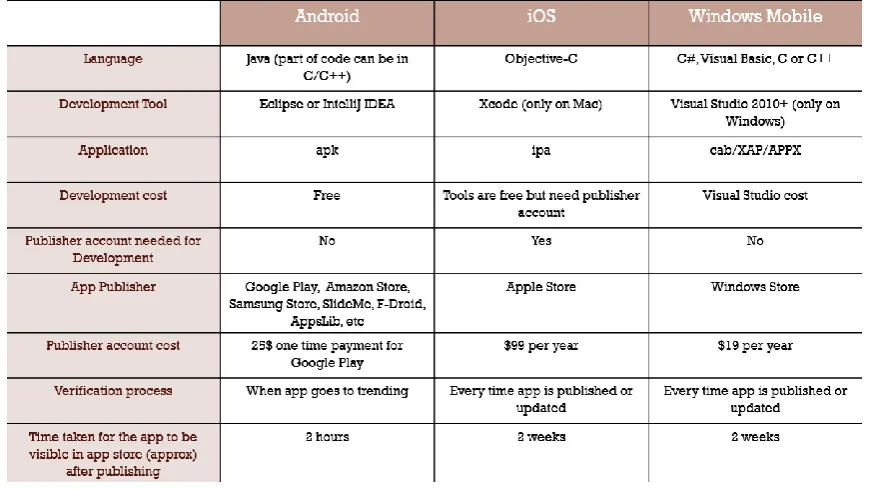
Comparison of Android, Apple iOS and Windows OS:
Fig. 5 Comparison btw Android, iOS and Windows Mobile
V.
CONCLUSION
Smart phones like personal computer provide various functionalities like use of application, usability, web
browsing, running GPS, expendable memory, multitasking, multi-processing, playing games, social networking
etc. In this paper we have presented a detail review and comparative analysis of smart phone operating systems
Android, and iOS. We have made comparison between Android. From this comparative analysis we have found
that Android and Windows operating systems are superior to other operating systems. Android gets 80.7% and
is the best smart phone operating system in world today. We can also use it as an Educational tool. Due to
Android an open source operating system the user can easily install third-party applications from the market and
ever from unreliable sources. Due to this it has some limitations which lead to malware attacks like viruses,
warms, spywares, adware and Trojan horse.
This paper provides a comparative analysis on smart phone operating systems and through this analysis we can
say that at present Android is the Best operating system for the smart phone used globally. Among Smart
phone‟s operating systems, android, iOS, Windows many differences are highlighted when iOS is developed but
Android is not developed. But in present time we can see that iOS providing so much security for the user but
we can see that Android (Google) given as security features “security patch system” which is coming at inbuilt
in new mobile at present time. “SERCURTIY PATCH” system is a new tech for the Android user by this we
41 | P a g e
VI.
ACKNOWLEDGEMENTS
Ankit Tiwari is scholar in Sachdeva Institute of Technology, Mathura, India. He has conference papers in his
credit. His interest is Networking.
Poonam Kumari is a Lecturer in Sachdeva Institute of Technology, Mathura, India. She has received her master
of Technology degree from Banasthali Vidyapeeth, Jaipur. Rajasthan, India. She has many international Papers
to her credit. His research interests are Biomedical Image and Signal Processing, biometrics, etc.
REFERENCES
[1] Wei, M., Chandran, A., Chang, H.-P., Chang, J.-H. and Nichols, C. (2009) Comprehensive Analysis of
Smartphone OS Capabilities and Performance.
[2] Sharma, T.N., Beniwal, M.Kr. and Sharma, A. (2013) Comparative Study of Different Mobile Operating
Systems. International Journal of Advancements in Research & Technology, 2, 1-2.
[3] Maker, F., Chan, Y., “A Survey on Android vs. Linux”, University of California, 2009
[4] Mr. Sumedh P. Ingale1, Prof. Sunil R. Gupta. Security In Android Based Smartphone. International Journal
of Application or Innovation in Engineering & Management.
[5] Thomas Renner SNET Project Technische Universit¨at Berlin. Mobile OS - Features, Concepts and
Challenges for Enterprise Environments.
[6] May, H. and G. Hearn, The mobile phone as media.
[7] Damianos Gavalas & Daphne Economou (2011), “Development Platforms for Mobile Applications: Status