157 | P a g e
A STUDY ON GREEN COMPUTING -IT
BUILDING BLOCKS
Mrs.S.Geethamani
1, Ms.S.Tharani
2, Mrs.V.Uthra
3 1,2,3Assistant Professor
Department of Computer Science
Sri Ramakrishna College of Arts and Science for Women
Coimbatore-44(India)
ABSTRACT
“Green Computing or green IT refers to idea where the IT organizations should implement and practice environment friendly network”. It is also defined as the study of designing, manufacturing,
disposing computer efficiently with minimal impact on environment. The goal of it is to reduce the
hazardous effect to environment by bio-degradability and maximize energy efficiency. The three
building blocks to green IT include EPP, Trends in Green ICT, IT innovations and achieving efficiency.
It is using the real life energy to make a computer system work which will not harm the environment.
The advantage of green IT reduced carbon emission increased cooling efficiency, reduced energy
costs, cost savings, financial performance, and positive publicity. Some of the steps followed in Green
IT so far were measure of the server power, share power cost in internal allocating owners, server and
storage virtualization, cloud computing.Research continues into key areas such as making the use of
computers as energy-efficient as possible and systems for efficiency-related computer technologies
Keywords:
Green IT, green computing, EPP, energy efficient, cost saving, Eco-kernel,
OpenMp, Meter
I.INTRODUCTION
Green computing refers to environmentally sustainable computing. It is also defined as “the study of
manufacturing and designing the computers with minimal or no impact to the environment. In 1992,
the energy save logo launched by the U.S Environmental protection Agency that is designed to
promote and recognize energy efficiency later Swedish introduced TCO for the CRT based monitors
but then it was a failure due to the usage of hazardous material while construction. Later government
organizations took an initiative to follow regulations which reduces the hazardous effect due to the
construction.
A. Approaches
Green computing can also develop solutions that offer benefits by aligning IT processes and practices
with core principles of sustainability, which are to reduce, reuse and recycle and finding innovative
ways to use IT in business processes to deliver sustainability benefits across the enterprise and beyond.
Energy efficient data center design should help to better utilize a data center’s space and increase
158 | P a g e
II. GREEN BUILDING BLOCKS(GBB)
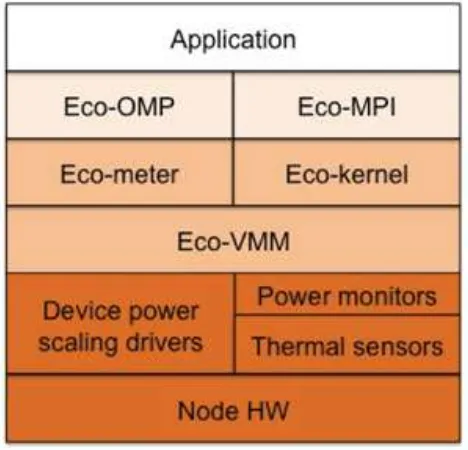
Green Building blocks is the joint effort of the computer architecture and the VLSI laboratory. It
provides the software backbone for fully instrumental and energy friendly clusters. GBB architecture
consists Eco-Kernel, Eco- OMP, Eco-Meter, Eco-MPI. Figure (1) describes the GBB Architecture.
A. Eco-Kernel
Eco-Kernel provides an API for scaling device capacities and power modes on demand. The purpose of
eco-kernel is to replace application-oblivious power management policies in the operating system, with
application-specific, phase-aware policies controlled explicitly by the run time.
B. Eco-Meter
Eco-meter is a hardware monitor that collects periodic samples of device-specific event counters, from
which it builds a performance, power and thermal signature of a running application. Application
Signatures are partitioned into phases of computation separated by communication or synchronization
events. The signatures derived by eco-meter are formulated as polynomial models, which co-relate
samples of events rates and configurations of hardware resources – specifically, the allocated capacity
and power mode of each resource-with performance and power consumption. Eco-Meter is used by
user level runtime systems in their policy modules to predict the performance and power consumption
of each phase in an application, in response to the probes that change temporarily the underlying
configuration and capacity of hardware resources.
C. Eco-Open Mp
Eco-OpenMp is an energy efficient implementation of Open Mp. The Eco-OpenMp runtime uses
interfaces to Eco-Meter and Eco-Kernel to implement optimization policies that improve energy
efficiency while maintaining a hard lower performance bound Eco-Open Mp operates simultaneously
two software knobs for controlling power efficiency, dynamic concurrency and dynamic voltage
frequency scaling. By alleviating contention between threads for shared resources, such as memory
bandwidth and cache space it helps in reducing the dynamic power consumption while sustaining and
occasionally improving performance. Dynamic Voltage also controls power consumption both are most
effective during memory-intensive phase of computation .The dynamic concurrency and voltage
policies in Eco-OpenMp are based on multi linear regression models correlating performance with
samples of event counters, thread count and core layout on systems with multi-core processors. The
combines phase-aware dynamic concurrency and dynamic voltage optimization scheme used in
Eco-Open Mp reduces execution time by 13.7%, total system power consumption by 5.9%, overall energy
consumption by 18.8% and energy-delay product by 39.5% in the NAS OpenMP benchmark suite.
Figure (1) describes the Eco-OpenMp percentage of energy consumption.
D. Eco- MPI
Eco-MPI is an energy-efficient implementation of the Message Passing Interface (MPI) communication
and tasking runtime substrates. The power-efficiency optimization policy of Eco-MPI is based on a
159 | P a g e
Figure (1) – Eco-OpenMp Energy consuming percentage
Eco-MPI is built on top of Eco-meter and Eco-kernel and follows the phase-sensitive optimization
strategy used also on Eco-OpenMP. Applications are decomposed into phases separated by
communication events. Eco-MPI estimates slack time due to communication and computation load
imbalance, using a novel model which calculates the rippling effects of slack on interacting tasks, both
within a node and across nodes. Eco-MPI is the first software prototype to achieve real-time power
reduction on clusters of up to 256 nodes, yielding up to 14% total energy savings in the Lawrence
Livermore National Laboratory (LLNL) Sequoia Benchmark suite. MPI is integrated with
Eco-OpenMP to implement power-aware execution of hybrid MPI-Eco-OpenMP programs.
Figure(2) GBB Architecture
III. 3 BUILDING BLOCKS
There are 3 steps necessary to develop green plan includes:
1). Creating a baseline of the environmental footprints.
2).Developing reasonable green Objectives
Eco-OpenMp Percentage
Energy Consumption 13.7 %
System Power
Consumption
5.9 %
Over all Energy
Consumption
18.8 %
160 | P a g e
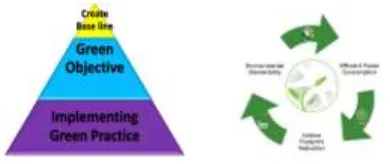
3) Implementing green practices with potential for significant impact.Figure (3) shows the building blocks of green IT. With high profile figures such AI gore calling
attention to the planetary crisis and global warming becoming a part of everyday conversation. the
result is the raised consciousness that every behavior imapacts the world in one way or the other. The
IT department is no different, and if yours is like, most others in corporate America, you’re starting to
field inquiries about how green your operation is .Everyone from the board of directors down to the
desktop users and in some cases outside customers are starting to ask more questions about the impact
their organizations has on the environment.
While concern for the most IT departments in the corporate green IT needn’t be a crisis. A thoughtful
big picture strategy built upon the incremental steps towards a cleaner, more energy efficient and
environment friendly IT department is the key to the success.
Before one can begin to create the process of Green IT strategy it is important to have a basic
understanding of how IT can impact on environment .The primary environment impact of IT is
comprised of the resource and the energy required to manufacture, run and dispose of IT hardware.
A. Creating a Baseline
The first step towards creating a green IT strategy is to create a baseline of your organization’s current
environment from an IT perspective. For the sake of reduction and cataloging improvements and
planning for future needs, a solid understanding of the current carbon footprints made by your IT
house.
Figure (3) – Building Blocks of Green IT and uses
The need for creating a comprehensive baseline of the environmental impact of IT can’t be understated.
Understanding the current state of affairs will help in examining the elements of green IT that are
within the control of the organization and those that are not. In addition, understanding the current
practices will help to guide any discussion about the trade-offs and when a green objective will take
priority over a cost or performance objective. Furthermore, a baseline will help in evaluation of
payback on any green initiatives that are slated. Armed with this baseline of information you will be
able to inform and educate others on reasonable green objectives and highlight the successes from
initiatives designed to green-up IT.
161 | P a g e
To start with the baseline, you will need to create an energy consumption analysis based on the currentIT hardware : desktop, PC’s, and associated monitors, laptops, servers and equipments, and networked
peripherals such as scanners and printers. This inventory will be useful for the creating an estimate of
the annual energy use.
One method of creating this energy consumption is to take the current IT asset inventory and create a
mathematical estimate of your energy consumption using averages from organizations.
A simpler approach is to use software that manages the PC energy strategy settings at network level. In
addition to the energy consumed when operating the PC, take into account the heating, cooling and
ventilation requirements necessary to operate your net work, this can account for a major source of
green impact.
Step-2 catalog disposal practices
The next step in creating baseline is to catalog your current hardware disposal practices. does your
organization utilize a certified Pc recycler that ensures toxic and hazardous materials inside the PC
monitors are disposed properly? Does your organization participate in the server manufacture disposal
program where parts are reused whenever possible?
Step-3 Examine acquisition and hardware lifecycle
The final step in creating baseline is to catalog your acquisition and PC lifecycle practices.
Understanding the average lifespan of your PC in your organization will help in determining how to
consider the environment impact of manufacturing PC. Average lifecycle includes the refresh cycle of
the organization desktop and the current life span of the servers.
B. Green Objectives
Second step in GBB is to focus on the green objective of your organization. Objective will be the result
of cost-reduction, regulatory/legislative requirements and social responsibility promises made by the
organization. The objective of going green is fraught with many trade-offs along the way meaning
sometimes what seem like the green solution may not really be green at all. The best way to minimize
the impact on the environment from a personal computer therefore is to extend its useful life as much
as possible. Understanding the business driver behind an objective will help to ensure the decisions
made to meet objective are as green as possible.
The following IT practices are greenand will supportyour overall green IT Strategy:
162 | P a g e
The single greatest opportunity for reducing energy consumption in the most organization is toimplement network level PC power Management solution. Historically most of the organizations have
kept the desktop PC’s on 24/7 and set operating systems power management to monitor off/standby
both of which consumes almost as much as power as fully powered idle machine. Desktop managers
needed access to networked PC’s for general maintenance and urgent security updates. Inconsistence
between the operating systems and the software applications or network security issues made waking
machines from a lower point setting such as sleep/hibernate. Conservative estimates put wasted energy
consumption of unused computers at the third of overall consumption. The simplest way to increase
energy efficiency is to use a network based solution to implement power setting policies that reflect
user behavior and turn the machine to sleep or hibernate when not in use.
Extend the useful life of IT hardware
Another opportunity to reduce the impact of their IT hardware over environment is to extend the life of
their IT hardware. That is presenting the present IT hardware is to replace them with an equipment
more energy efficient. The making of a PC hardware is equal in making the mid-sized car. The lifespan
of a car is about 10years whereas the lifespan of PC used in IT organization is 3years. By extending the
lifespan of PC in organization can significantly reduce the environmental footprint of the PC
Another way to reduce the impact is to delay the refresh cycle of the PC. So that it will have less
impact on the environment.
To that end when PC’s are at the end of the lifecycle, participating in the PC recycling program that
focus on the reselling of the machines extend useful of PC over 6000 users. These programs require a
little more than that of the IT department than by shipping them to manufacturers.
Truly green recycling programs
Ensuring proper disposal of the IT hardware is another green tactic. More than 1000 chemicals are used
in production which are toxic and hazardous to health. Reviewing the current recyclable and disposal
program to ensure that all recyclable parts are returned to the manufacturer and that equipment bound
for disposal is not sent to countries with less stringent regulation is another strategy that has significant
impact and is easy to implement.
Considering green in acquisition
Beginning to understand the energy efficiency of new acquisition is another green strategy that is easy
for IT to implement. The IT companies should change their hardware with new energy efficient PC
regularly but it is not been done due to cost and hence leading to environmental impact. Catrina
163 | P a g e
Figure (4) shows the green IT life cycle which will be continued while designing a hardware or anygreen IT products. Every phase in the green life cycle has to be given importance. Maintenance phase
needs more effort.
Figure (4) – Green IT cycle
IV. EPP
Environmentally Preferable Products is the abbreviation of EPP. It is said that Buying computers,
peripherals, copiers, and related electronics that are energy efficient as it often costs more to power a
computer over its useful life-cycle than it costs to buy it free of hazardous materials because, even
today, too many pieces of electronic equipment that contain hazardous materials end up in landfills and
taint local water supplies repairable and made of modular components that can easily be swapped out
when they fail so you don't have to replace whole systems until they reach the end of their useful life
highly recyclable and designed to be easily disassembled and recycled returnable to the manufacturer
under an end-of-life program who will then see that the component is refurbished or recycled.
V. CURRENT AND FUTURE WORK
GBB is extended in four directions. The first is virtualization of the power, thermal and performance
instrumentation infrastructure, followed by the derivation of appropriate metrics that would apportion
resources to applications in order to improve energy efficiency under performance constraints. The
second direction is the implementation of cluster-level static and dynamic task aggregation. Static task
aggregation amounts to clustering application tasks in fewer nodes than the number of nodes
apportioned to applications at submission time. Dynamic task aggregation amounts to dynamic
clustering of tasks after application submission and is enabled through virtual machine migration
mechanisms. The third direction is the integration of multi-device scaling capabilities in GBB, in
particular DRAM and disk scaling, in a unified modeling and policy framework. This research will
enable GBB to target data-intensive workloads dominated by I/O and memory traffic. The fourth
direction is the development of a GBB runtime for the Map Reduce programming model, targeting
164 | P a g e
VI. CONCLUSION
Recognizing going green is a process and often involves in trade-offs is important in creating a green
strategy .The creating of IT environmental baseline will assist in examining where your organization is
at as well as where it is going. Creating an objective that reflects in the both green desire and business
will ensure the strategies put in place are truly green. By implementing all of the strategies presented
here will make your organization grow in an environment friendly way.
REFERENCES
[1] Prof. Riyaz A. Sheikh, Dr. U.A. Lanjewar , Green Computing- Embrace a Secure Future,
International Journal of Computer Applications (0975 – 8887), volume 10-N.4, November 2010,
http://www.ijcaonline.org/volume10/number4/pxc3871984.pdf
[2] Robert R. Harmon, Haluk Demirkan, The Corporate Sustainability Dimensions of Service-Oriented
Information Technology, Annual SRII Global Conference, March 29 2011 – April 2 2011,
DOI:10.1109/SRII.2011.116,http://ieeexplore.ieee.org/xpl/freeabs_all.jsp?arnumber=5958139
[3] Andreas Berl, Erol Gelenbe, Marco Di Girolamo, Giovanni Giuliani, The Computer Journal, 2009,
Volume 53, Issue 7, pp. 1045-1051, DOI:
10.1093/comjnl/bxp080,http://comjnl.oxfordjournals.org/content/53/7/1045.short?rss=1
[4]www.it energy.co.uk/pdf/3buildingblocks_to_a_
greenitstrategy.pdf
[5] http://planetgreen.discovery.com/feature/green-material-guide/introduction-buildings-blocks.html
[6] E-Book – Green IT Managing your carbon footprint
[7] Image source :
Google Images
Charts using MS PowerPoint and Word