Western University Western University
Scholarship@Western
Scholarship@Western
Electronic Thesis and Dissertation Repository
9-18-2018 1:30 PM
1981: One or Several Aesthetics?
1981: One or Several Aesthetics?
Jacob Norris
The University of Western Ontario
Supervisor
John Vanderheide
The University of Western Ontario
Graduate Program in Theory and Criticism
A thesis submitted in partial fulfillment of the requirements for the degree in Master of Arts © Jacob Norris 2018
Follow this and additional works at: https://ir.lib.uwo.ca/etd
Part of the Comparative Literature Commons, Contemporary Art Commons, Fine Arts Commons, Musicology Commons, and the Theory and Criticism Commons
Recommended Citation Recommended Citation
Norris, Jacob, "1981: One or Several Aesthetics?" (2018). Electronic Thesis and Dissertation Repository. 5723.
https://ir.lib.uwo.ca/etd/5723
This Dissertation/Thesis is brought to you for free and open access by Scholarship@Western. It has been accepted for inclusion in Electronic Thesis and Dissertation Repository by an authorized administrator of
A B S T R A C T
Gilles Deleuze’s monograph on Francis Bacon, The Logic of Sensation (1981), proposes
a theory of aesthetic experience that prioritizes the material depths of sensation over stable,
identifiable forms. Deleuze’s key references in The Logic of Sensation to playwright Antonin
Artaud arouse the suspicion that Artaud’s schizophrenic experience of language, wherein
words are reduced to phonetic ramblings, illuminates how Deleuze interprets this chaos of
sensation in Bacon’s art. My work therefore calls back to The Logic of Sense (1969)and the
first section of his book on Masochism (1967)to explore the waves of consistency between
Deleuze’s understanding of language and the body, which is also to say between literature
and painting. Yet while The Logic of Sensation may read like an exhaustive theory of art,
Deleuze subtly indicates in this text that his system has its limits. Along with the molecular,
material depths of sensation, Deleuze alludes to a cosmological, immaterial function of art.
He observes this to exist almost exclusively in music and its force of floating time. Rather
than turning solely to Plateau 11: Of the Refrain, I also adopt his earlier writings on Proust
to explore a Deleuzian musicology. This Proust-music aesthetic schema (which I coin the
musical pole) contrasts sharply with that of Bacon-Artaud (the painterly pole). Through an
examination of the painterly and musical poles and to what extent the two can be
synthesized, my work examines the enthralling disjunction in Deleuze’s aesthetics.
K E Y W O R D S
A C K N O W L E D G E M E N T S
To John Vanderheide, for our actual and virtual correspondences. Your patience, wit, and trust have guided my project’s many twists and turns. I was the diamond miner and you the polisher.
To Shell, Deleuze says “to love is to try to explicate, to develop these unknown worlds that remain enveloped within the beloved.” Thank you for letting me into your world. Your smile keeps me going and your yawns teach me to be a clearer writer.
To my dad, John, you got me into philosophy and tell me I’m not allowed to leave it. Thank you for showing me, through your success and virtues, the value of education.
To my mom, Sue, I’m not sure if you’re aware but philosophers are sickly people. Montaigne had kidney stones, Nietzsche had god knows what, and all of us seem to smoke. You taught me the importance of health: in the kitchen, in exercise, in relationships.
To my brother, Micah, the real art historian. Thank you for your knowledge, taste, and wanderlust. We have checked off many cities and galleries together.
To my aunt, Anita, your work ethic and curiosity are second to none. Staring at the clouds together in my youth I credit as my first instance of “critical thinking.”
To my dog, Jessie, with whom I took far too many breaks, and without whom I would not have gained as many ideas from our walks.
And finally, to the Centre for the Study of Theory and Criticism, especially Kayleigh, Jeremy, Chris, Curtis, and Jan, for your support and contributions to my work, and of course,
T A B L E O F C O N T E N T S
Abstract . . . ii
Acknowledgements . . . iii
Table of Contents . . . iv
Introduction . . . 1
Chapter I . . . 7
Antonin Artaud, A Panoramic . . . 7
Bodily Signs . . . 10
The Artist at Work . . . . . . 19
Art-Historical Predecessors . . . 24
The Language of the Schizophrenic . . . 31
Organ-ized Sensation . . . . 38
Painting Hysteria . . . 43
Haptic Sensation . . . 50
From Painting to Music . . . 59
Chapter II . . . 61
On the Senses . . . 61
Remembrance of Things Proust . . . 63
Proust the Revenant . . . 65
Overcoded Faces . . . 69
The Face of the Lover . . . 74
Plumbing the Depths . . . 76
Guattari’s Portrait . . . 79
Egypt Rises Up . . . 81
The Remainder . . . 87
Chapter III . . . 89
When the Arts Overlap . . . 89
Chaosmos . . . 91
Folding Sides . . . 94
Synthesizers: Analog and Digital . . . 96
Boulez Teaches Us to Count . . . 104
Aesthetic Conjugations . . . 119
Conclusion . . . 124
The Two Poles . . . 124
Art as Immaterial . . . 125
Pure Thought . . . 127
Bibliography . . . 130
“Only the signs of art are immaterial.”1
I N T R O D U C T I O N
A friend of a friend once claimed that Gilles Deleuze’s The Logic of Sense is a treatise
on photography. His explanation must have been convincing, for my friend had inscribed
these words—in pen—on the flyleaf of his copy. I have not asked for the supporting
arguments, mainly because I one day hope to find it out for myself all Socratic-like. Really
though, it is a principle of self-discovery I model off 90s hip-hop production. Like a magic
trick, a musician need not reveal the samples they use, but can leave it up to the audience to
find them out on their own. There are certain legal issues in not declaring your sources,
though there is no doubt also beauty in not being told where a vocal chop or drum loop
comes from, and having to seek it out for yourself as if on a treasure hunt. It makes sense
then that we refer to shopping for old records as “digging.”
My work does not focus on Gilles Deleuze and photography, though I remain deeply
inspired by this friend’s formula of The Logic of Sense when I claim that Proust and Signs is a
treatise on music. As with photography, Deleuze never wrote a book on music. We are
forced to read between the lines, always in the “middle [milieu]” of his thought on this topic.2
He certainly had plans for a book, and as his biographer François Dosse describes, Deleuze’s
late encounter with Pascale Criton spurred an interest in chromatics (microtones and tuning
that exceeds twelve intervals an octave), something Deleuze hoped would evolve into an
extended study had it not been for his declining health.3 Like his unfinished book “on the
greatness of Marx,” in my mind his musical writings would always remain on the horizon.
And where we must resort to Anti-Oedipus to find the clues of Deleuze’s Marxism, when it
1 Gilles Deleuze, Proust and Signs, trans. Richard Howard (Minneapolis: University of Minnesota Press, 2000),
39.
2 Gilles Deleuze and Félix Guattari, A Thousand Plateaus: Capitalism and Schizophrenia, trans. Brian Massumi
(Minneapolis: University of Minnesota Press, 2005), 21.
3 François Dosse, Gilles Deleuze & Félix Guattari: Intersecting Lives, trans. Deborah Glassman (New York:
comes to music we continually seem to turn to Plateau 11: Of the Refrain from A Thousand
Plateaus.
But any glance at Félix Guattari’s independent work betrays that the main ideas in
Plateau 11 were not really Deleuze’s contributions. We need to look elsewhere for a
Deleuzian musicology, and in the absence of any substantial work written directly on the
matter, I resort to adopting his ideas on Proust. It is an aberrant Proust of course, “a child
that would be his own offspring, yet monstrous,” and hopefully still worthy of adoption.4
For Deleuze, Proust gets at “a bit of pure time,” time freed from measure, and this is
precisely what also attracts Deleuze to modernist composers like Olivier Messiaen and Pierre
Boulez.5 There is an intimate connection between how Proust handles speed and slowness—
the effect of the world’s rhythms on consciousness—and Deleuze’s interest in modern
music. I thus use Proust and Signs as a map to get to a fuller understanding of Deleuze’s
thought on music. A map, that is, and not a tracing, for “[w]hat distinguishes the map from
the tracing is that it is entirely oriented toward an experimentation in contact with the real.”6
Yet this is just one side of my project, and as it unfolded what became apparent is
that the Proust-music chimera is one beast among many others, a wolf among several
perhaps.7 Deleuze ceaselessly uses the arts to explain one another, and Proust mapping
Boulez only grazes the surface of these junctions. Time and again he employs analogies
across media—literature explains music, painting explains cinema. It is an important trope
running through Deleuze’s writing, though not often discussed. Perhaps because it is
counterintuitive that Deleuze of all thinkers would draw on analogies, given his metaphysical
animosity for them. In Difference and Repetition, Deleuze opposes an analogical conception of
4 Gilles Deleuze, Negotiations, trans. Martin Joughin (New York: Columbia University Press, 1995), 6. 5 Gilles Deleuze, “Making Inaudible Forces Audible,” in Two Regimes of Madness, ed. David Lapoujade,trans.
Ames Hodges and Mike Taormina (South Pasadena: Semiotext(e), 2007), 157.
being. To paint this picture, I call to mind one of the greatest emissaries for this analogical
(equivocal) metaphysics, Saint Thomas Aquinas.
Grounded upon an irreducible difference between finite beings and God, Aquinas
inquired into the nature of certain concepts (goodness, justice, knowledge, etc.) that we
nevertheless use to describe both entities. The Thomistic model finds its roots in the
Aristotelian categorization of identity—any difference (such as species) must refer back to a
shared point (genus)—making identity always the priority. In Aquinas’ case, what finite
creatures share with God is a resemblance based on cause and effect. God’s goodness, for
example, causes ours, despite the fact that when we compare the two we equivocate. Think
how sacrilegious it would be to reduce God’s qualities to those of His human analogues—
you see Aquinas’ point. Yet this is in a sense what Deleuze wants to do—and not so much
to profane the divine, but to elevate difference to a positive position (difference in itself, not
subordinate to identity). Following Duns Scotus, Spinoza, and Nietzsche, Deleuze outlines
the univocity of being: that being is said “in a single and same sense.”8 Distinct entities are
thus distinguished not by some ontological chasm (Aristotle, Aquinas), but rather now by
degree (Duns Scotus) and modality (Spinoza).
While Deleuze’s employment of analogies in describing the arts then comes as a
surprise, I argue it is in fact incredibly useful: it helps to uncover a key function of the Body
without Organs. As Deleuze articulates the ways in which music renders inaudible forces
audible and painting makes visible the invisible, as music puts “an ear in the stomach” and
painting gives us the sense of touch in our eyes, we feel ourselves moving beyond and below
the organized body.9
8 Gilles Deleuze, Difference and Repetition, trans. Paul Patton (New York: Columbia University Press, 1994), 36. 9 Gilles Deleuze, Francis Bacon: The Logic of Sensation, trans. Daniel W. Smith (Minneapolis: University of
As Deleuze develops connections across sense experience and likewise across the
works of distinct artists (such as Proust and Boulez), what we come to appreciate is that the
networks created are not neutral—some succeed and others come up against (and are
pedagogically meant to show) a limit. The rhizome’s powers of connection, infinite nodes
that can link up at any stage, are not always actualized.
My work therefore explores two sets of connections—the first between
surrealist-impressionist painter Francis Bacon and playwright Antonin Artaud, the second between
Proust, Boulez, and Messiaen. However, between these constellations there is also an
impasse. The model of aesthetics illustrated by Deleuze’s work on Francis Bacon is
incompatible with that of Proust and music. Unforgettably, Deleuze interrupts his
monograph on Bacon, The Logic of Sensation, to declare that “music begins where painting
ends, and this is what is meant when one speaks of the superiority of music. It is lodged on
lines of flight that pass through bodies, but which find their consistency elsewhere, whereas
painting is lodged farther up, where the body escapes from itself.”10 My first chapter
addresses this rift, while more generally exploring what I have coined the painterly pole of
Deleuze’s aesthetics. Centred around Deleuze’s claim that in Bacon’s paintings “hysteria
becomes art . . . [and] color is a direct action on the nervous system,” I explore the depths of
sensation, the molecular forces, at work in this art form.11 Throughout my study, I also
explain a critical distinction Deleuze makes between the hysteria of painting and what he
calls the “galloping schizophrenia” of music.12
Moreover, to chart the depths of sensation, I continually turn, as Deleuze himself
does, to his earlier explorations into the philosophy of language. Primarily, I build off of his
work on Masoch and Sade, where we find a striking similarity to his description of Bacon. In
Masochism: Coldness and Cruelty, Deleuze writes that “it seems that, for Masoch as for Sade,
language assumes its full value in acting directly on the senses [sur la sensualité].”13 Note how
closely this aligns to Bacon’s “color [a]s a direct action on the nervous system.”14 Similarly in
The Logic of Sense, for Artaud language is reduced to purely phonetic elements: “clappings,
crackings, gnashings, cracklings, explosions, the shattered sounds of internal objects, and
also the inarticulate howls-breaths [cris-souffles] of the body without organs.”15 Artaud is the
key conceptual persona informing the painterly pole, and in Chapter I we explore both
Bacon and Artaud, exemplars of the intersection of painting and literature.
In Chapter II, I ask whether it is possible to include Proust within this model of
aesthetics, which often tempts us with a grand narrative for understanding all experiences
and functions of art. The pre-conceptual realm of sensation, how art produces the new, and
what it says about human and animal creation, all seems sufficiently addressed in The Logic of
Sensation. First supposing that there is an alternative aesthetic schema for Proust and music,
we examine how Deleuze’s thought on painting and music communicate with one another.
Do they in fact speak in one and the same sense, or must Deleuze resort to analogies given
their radical difference? Ultimately, I conclude that the immaterial (spiritual) forces in
Proust—time, rhythm, and perception—are incompatible with the material depths in Bacon.
There then arises the need to explain the musical pole of Deleuze’s aesthetics, and this is my
task primarily in Chapter III. Making use of ideas found in Proust and Signs and A Thousand
Plateaus, I outline the intimate connection between Proust and music and its repulsion from
the painterly pole. Following Ronald Bogue’s theory that “[i]n music, Deleuze finds the key
13 Gilles Deleuze, Masochism: Coldness and Cruelty, trans. Jean McNeil and Aude Willam(New York: Zone Books,
2006), 17.
14 Deleuze, The Logic of Sensation, 53.
15 Gilles Deleuze, The Logic of Sense, ed. Constantin V. Boundas, trans. Mark Lester with Charles Stivale (New
to an understanding of art’s relation to the natural world . . . [and] regards painting as the
paradigmatic art of sensation, and hence as the medium that most fully discloses the inner
dimension of aesthetic experience,” I distinguish the molecular from the cosmological as two
divergent aesthetic movements, irreducible yet indispensible.16
As part of this project, I situate these two aesthetic poles within the greater
art-historical tradition. It is important to appreciate Deleuze’s indebtedness to elements of
phenomenology and impressionism, including the theory and practice of Erwin Straus,
Henri Maldiney, and Paul Cézanne. These figures arise in Chapter I. As for his sources on
the musical pole, save for Messiaen and Boulez who are at once case studies of and sources
for Deleuze’s theory, one must also include Friedrich Nietzsche’s The Birth of Tragedy,
specifically the distinction between the Apollonian and the Dionysian. Chapter III explores
these influences for the musical pole. The systems Deleuze inherits and reprises illuminate
the fundamental properties and distinctions between the painterly and musical pole.
It is not enough, however, simply to describe their differences. As already
mentioned, Deleuze insists on the “superiority of music.”17 My conclusion therefore weighs
the implications of this hierarchy and, following Peter Hallward’s idea that insofar as the
immateriality of music resembles a kind of “pure thought,” namely the virtual potential in
thinking, it achieves an aesthetic production unmatched by the other arts. Revisiting Proust
and Signs, I examine the concept of the immaterial (spiritual) in Deleuze’s aesthetics and its
ties to a philosophy of the virtual. In sum, I examine the two poles of Deleuze’s aesthetics,
the possibility of integrating one into the other (with Proust as a limit case of the Baconian
model), and the diverse ways in which aesthetic media analogically explain and are explained
by other art forms.
“And who suffered more from judgment in its harshest form, the terror of psychiatric expertise, than Artaud-Van Gogh?”1
C H A P T E R I
~A N T O N I N A R T A U D, A P A N O R A M I C~
Between The Logic of Sense (1969) and The Logic of Sensation (1981) one finds the
conceptual trajectory of the Body without Organs, and, more generally, the bulk of
Deleuze’s critical-clinical engagement with French dramatist Antonin Artaud. First
referenced in the Thirteenth Series of “the Schizophrenic and the Little Girl,” Artaud’s Body
without Organs is employed by Deleuze to chart what he calls the depths of the body. Of
particular interest to Deleuze during these younger years is the status of language, signs, and
signification. At large, The Logic of Sense is the closest Deleuze comes to a philosophy of
language, and though its genesis is of interest to him, so too is the possibility of its
disintegration, which is to say the withdrawal of sense back into the chaotic ramblings of a
body devoid of any language.
In alignment with Freudian psychoanalysis, Deleuze builds on Melanie Klein’s claim
that the child’s original experience of undifferentiated noise eventually becomes the voice—
something not yet a language, but which sets the stage for things other than just bodies and
corporeal clamours.2 But as one moves down from the Ideational heights to the purely
phonetic depths, a fall of language occurs wherein words are no longer separated from
objects of reference. The voice of the heights becomes a barrage of noise that, following
Artaud, Deleuze describes as emitting a force that acts directly on the body. Upon
introducing this schizophrenic, intensely physical, mode of language, Deleuze echoes a claim
inaugurated in Masochism: Coldness and Cruelty (1967) about the effect any language can have
1 Gilles Deleuze, “To Have Done with Judgment,” in Essays Critical and Clinical, trans. Daniel W. Smith and
Michael A. Greco (Minneapolis: University of Minnesota Press, 1997), 126.
2 Gilles Deleuze, The Logic of Sense, ed. Constantin V. Boundas, trans. Mark Lester with Charles Stivale (New
on the body. There he writes, “it seems that, for Masoch as for Sade, language assumes its
full value in acting directly on the senses [sur la sensualité].”3 This conception of language
foreshadows Deleuze’s aesthetic turn in the 1980s. In fact, a language that attacks the body is
reborn in Francis Bacon: The Logic of Sensation under the umbrella of a transformed aesthetic
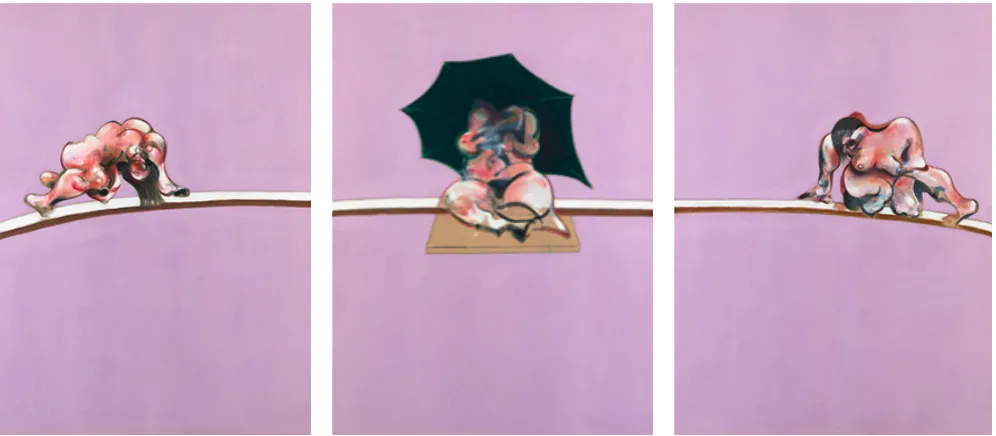
implication (fig. 1, fig. 2).4 Francis Bacon’s paintings have a force that acts on the nervous
system, and the weight Deleuze gives to this statement marks a move his philosophy
undergoes from a study of language and the body (Masoch, Carroll) to a language of the body
(Artaud, Bacon), which in many ways is to say a path from sense to sensation.
3 Gilles Deleuze, Masochism: Coldness and Cruelty, trans. Jean McNeil and Aude Willam(New York: Zone Books,
2006), 17.
4 An umbrella, that is, in light of the recurrence of this prop in Bacon’s work.
There are a number of elements in need of explication to develop how The Logic of
Sensation establishes a form of nondiscursive language that Deleuze was already outlining in
The Logic of Sense, and which paves the way for his aesthetics of painting. By way of Artaud’s
schizophrenic writing and the role he plays as a conceptual persona in Deleuze’s corpus, I
argue, one can trace the cohesion and evolution of Deleuze’s ideas on representation and the
way the two series of bodies and language interact. This corporeal conception of language
also prefigures an important role it will have after his collaboration with Félix Guattari. By
first treating The Logic of Sensation with broad strokes and explaining, naturally by way of
Bacon’s paintings, Deleuze’s key concepts in this work, we shall begin to see the role Artaud
plays in this text. Following this, The Logic of Sense will be reintroduced so as to notice how
Artaud’s persona unfolds from this early work, onward until its painterly form in Sensation.
How the Body without Organs is replaced by the concept of the Figure in the latter
text will also be addressed. I shall defend Deleuze’s rationale for substituting Artaud’s term, Figure Two. Oil on canvas, Triptych—Studies of the Human Body, Francis Bacon, 1970,
or at the least committing a kind of “buggery” to it,5 by pointing to the need for Deleuze to
diverge from Artaud’s notions of the self and ego that still remain in his original conception
of the Body without Organs.
The depths, in Artaud’s case, are still too personal for Deleuze. The way the self
inheres in Artaud’s depths is central to Deleuze’s interpretation in The Logic of Sense.
However, following his collaboration with Guattari and as the concept of the Body without
Organs will arise in relation to aesthetics and sensation, Deleuze, as it were, deforms or
remoulds Artaud in hopes of reaching a logic below the individual, a logic of presubjective
forces, the likes of which Deleuze defines as the very goal of aesthetics. Painting, for
Deleuze, battles with impersonal molecular forces—corpuscles of the nonhuman and
inorganic.
~B O D I L Y S I G N S~
As we shall encounter in the next two chapters, when it comes to the role of the
bodily sign in Deleuze’s writing between Proust and Signs (1964)and A Thousand Plateaus
(1980) what diverges by the time he writes The Logic of Sensation is a certain recreation of the
sign’s status of affection. The sign, as we find in Bacon and Deleuze’s aesthetics in general, is
something that can be felt through the material vibrations it creates upon the body.
Language is not something that removes us from the world; its ideas and concepts are still
strings that pull on our body. Bearing in mind a distinction Deleuze makes in TheLogic of
Sense between, on the one hand, eating, and, on the other, speaking, Deleuze is clearly
entertaining the zone of indiscernibility between the two.6 What would it mean to feel
concepts? For now, I’ll let my reader chew on this thought. There is one thing, however, I
5 Gilles Deleuze, “Letter to a Harsh Critic,” in Negotiations, 1972-1990 (New York: Columbia University Press,
1995), 6.
shall lay bear before you: this indiscernibility between eating and speaking adds an interesting
layer to Deleuze’s fascination with how Bacon paints the mouth, which, after all, is the site
(erogenous zone we might say) at which eating becomes speaking (fig. 3, fig. 4).
Figure Three. Oil on canvas, Three Studies for Figures at the Base of a Crucifixion, Francis Bacon, 1944, © The Estate of Francis Bacon. All rights reserved. DACS / SOCAN (2018).
.
Figure Four. Oil and sand on canvas, Study for a Head, Francis Bacon, 1952, © The Estate of Francis Bacon. All rights reserved. DACS / SOCAN (2018).
In this renewed conception of the sign and of language, Deleuze is building on a
specific lineage of art history that emerges from Erwin Straus’s The Primary World of the Senses
(1963), as well as the theory and practice of Henri Maldiney, Paul Cézanne, Vincent van
Gogh, and Paul Klee. Each of these figures will arise throughout this chapter, and what
connects all of them is the Deleuzian task of establishing the genetic principles of sensation
and how aesthetics plays a key role in revealing this process. In the words of Klee, the task
of aesthetics is “not to render the visible, but to render visible.”7 As I examine in my
conclusion, art equally so reveals much about the production of the new and the act of
creation. What we must also grapple with, though, is how some art forms (in Deleuze’s
mind, music) can move closer to the potential of pure thought. Philosophical thought, for
Deleuze, immerses itself far more in the virtual than the actual (the material world that art
subsists in), and it remains the case that certain works of art can launch us more into the
virtual while others fall short.8
Paul Klee’s statement repeats itself in many forms throughout the family of thinkers
above. Just as Cézanne sought to “paint the sensation,” Bacon intended to “record the fact.”9 Van
Gogh has his own form of bringing to the surface imperceptible forces of the sunflower, and
so do Straus and Maldiney from a more theoretical perspective. Deleuze, rightly so, brings
each of these declarations into a single aesthetic manifesto, and in so doing gestures to his
greater intention of directing the artist and spectator (although Deleuze prefers the word
“attendant” or “witness”10) to a plane below the level of the individual, thus opening up a
nonorganic state where self and world amalgamate. There, one experiences the sign, a pure
7 Paul Klee, quoted in Gilles Deleuze, Francis Bacon: The Logic of Sensation, trans. Daniel W. Smith (Minneapolis:
University of Minnesota Press, 2002), 48.
8 Thinking of it as a “fall” will prove important, for Deleuze frequently refers to the depths of sensation in
Bacon’s work as such.
sign, beyond the dogmatic image of thought, which in art exists as representation, as
narrative, and above all else as cliché. They are the three aesthetic powers of negation rather
than affirmation.
Deleuze’s Logic of Sensation focuses on the imperceptible forces that congregate on
Francis Bacon’s canvas, and these include powers such as gravity (fig. 5), time passed by (fig.
6), cramps (fig. 7) and inner contortions of the body (fig. 8).
Figure Six. Oil on canvas, Two Seated Figures, Francis Bacon, 1979, © The Estate of Francis Bacon. All rights reserved. DACS / SOCAN (2018).
Recalling Proust and Signs, one thinks of how Marcel Proust captured several imperceptibles:
“time wasted, time lost, time rediscovered, and time regained.”11 In Bacon’s case, these
invisible forces go hand-in-hand with the erasure or disintegration of the organic (organized)
body, and in these instances Deleuze emphasizes the way in which we encounter an image of
the Body without Organs. Bacon, however, is not alone in this feat. As Deleuze and Guattari
argue in What is Philosophy? (1991) the role of any work of art is to capture and preserve “a
bloc of sensation . . . a compound of percepts and affects,” a kind of slice of chaos or lightning in a
bottle.12 What the artist captures is something unique to her form, some invisible affect that
works on the body but that our eyes and common language gloss over.
11 Gilles Deleuze, Proust and Signs, trans. Richard Howard (Minneapolis: University of Minnesota Press, 2000,
87.
12 Gilles Deleuze and Félix Guattari, What is Philosophy?, trans. Hugh Tomlinson and Graham Burchell (New
York: Columbia, 1994), 164.
Deleuze cites Cézanne, whose paintings present the great rhythm of deep time
expressed by mountains as they fold, grow, and experience shifting climates (fig. 9), and
apples as they germinate and receive their particular redness and texture (fig. 10).
Figure Nine. Oil on canvas, Mont Sainte-Victoire, Paul Cézanne, 1904.
In such rhythms, one can hazard a guess why Deleuze showed such interest in molecular
biology and epigenetics. Biology for its attention to minute forces, epigenetics for how it
tracks the speeds and slowness of gene development and how an organism evolves given its
environment. Think of the way locusts are predominantly solitary creatures quite similar to
grasshoppers, but when plants and water become available and they congregate, they turn
into gregarious creatures and are spurred into a rapid change of gene expression, for
example, growing wings. Deleuze likens painting to charting these changes in speed and the
ability to pick up on imperceptible forces.13 But it is not always about finding such forces.
For example, what is remarkable about van Gogh is that he can be accredited with creating
forces of the sunflower (fig. 11).
13 As Chapter III shows, painting comes nowhere near how music can track such speeds.
Van Gogh, says Deleuze, “invented unknown forces, the unheard-of-force of a sunflower
seed,” although each “recomposition” of the sunflower necessarily entails a kind of
“decomposition” or erasure of its prior form.14 Art overwrites the actualized world, and the
painter’s inventions are much like the philosopher tasked with creating new concepts. 15 The
painter and the philosopher perform a dual kind of creation meant to spark a new image of
thought. As my conclusion meditates on, in Deleuze’s thinking it seems to be the case that
some art (and, more provocatively, art forms) move closer to this philosopher-creator, who
enters into the virtual realm by way of pure thought. As the end of this chapter develops,
and as I continue to revisit throughout my work, it is music that Deleuze considers capable
of leaving the material body and reaching out to the raw potential of pure thought in ways
painting cannot. At this stage, however, I ask my reader simply to prepare to see the
dichotomy between how Deleuze describes painting and music.
While still focused on painting, however, note how Deleuze’s Logic of Sensation
achieves the pairing of philosophical concepts with those affects and bodily languages an
artist invents or captures on the canvas.16 As we shall see, it is not the case that music
monopolizes the virtual, though for Deleuze the processes of music (time, rhythm, interval)
match strongly with the immateriality of thinking. Deleuze is infamous for these kinds of
“pairings.” We might call A Thousand Plateaus, for example, the pairing of philosophical
concepts with modern science, providing the metaphysics adequate for ideas of non-linear
mathematics, complexity theory, the irreversibility of time, and so on (though this summary
14 Deleuze, The Logic of Sensation, 49.
15 Deleuze and Guattari, What is Philosophy?, 15-34.
16 While there may be a hierarchy in Deleuze’s aesthetics at reaching the virtual, this is not to say painting is
does not even glaze the surface of that rhizomatic work).17 But with any pairing, of course,
not every force is neutral; there are always stronger or weaker connections. For this reason,
at the end of Chapter III we examine the particular resonances Deleuze sees between
literature and painting as aesthetic media, and the lack thereof between painting and music.
Moreover, as I shall focus on in this chapter and Chapter III, time and again Deleuze
effectively uses the arts to explain one another, especially in The Logic of Sensation. Painting
and literature are effectively drawn on to explain the other. Yet prior to focusing on this
trope in Deleuze’s aesthetics, let us reflect on the role of the artist and creation. That is,
before explaining how art disciplines interact, we must see how they act in solitude.
~T H E A R T I S T A T W O R K~
One of the central aims of The Logic of Sensation is to explain the process an artist
must go through in capturing the nonorganic forces of the world, and thus finding a way of
creating images that act, in a hysteric sense, directly on the body. For reasons we shall get
into, Deleuze opts to call this process hysteria (rather than schizophrenia)in The Logic of
Sensation, and this proves to be an indispensible distinction in understanding the function of
painting versus music (the latter which according to Deleuze takes on a “galloping
schizophrenia” not as tethered to the body like painting).18 Nonetheless, the creator as
painter is not wholly tied to the actualized material world. Deleuze claims that artists like
Bacon come upon a reservoir of clichés, concepts, representations, and figurations that must
be battled against and bypassed at a subterranean level of sensation (depth). Rather than
through the virtual power of thought—the Ideational heights—the painter goes deeper into
17 While they in turn characterize Bergson with the “profound desire” to catch philosophy up to science
(Cinema 1, 60), and credit him with major discoveries in consciousness and time, Deleuze and Guattari, especially in A Thousand Plateaus, are also attempting to synthesize philosophy and modern science.
matter. In encountering the pre-givens of the world that must be combatted, Deleuze writes
the following of the artist:
It is a mistake to think that the painter works on a white surface. The figurative belief follows from this mistake. If the painter were before a white surface, he could
reproduce on it an external object functioning as a model, but such is not the case. The painter has many things in his head, or around him, or in his studio. Now everything he has in his head or around him is already in the canvas, more or less virtually, more or less actually, before he begins his work.19
While this quote has become somewhat of a cliché in Deleuze scholarship, it is truly an
undeniable fact of artistic process.20 There are many signs that cut off the artist’s ability to
capture a pure sensation. Of all these pre-existing signs that must be dismantled, the face is
one of the main antagonists. (fig. 12, fig. 13).
19Ibid., 71.
20 What many do not know, however, is that the line really comes from painter, Gérard Fromanger, a close
friend of Deleuze. Fromanger recalls telling Deleuze, “I told him, ‘you see it as blank, but in fact it’s black.’ And his reaction was, ‘Ah, fantastic! It’s black, black with what?’ and I answered, ‘It’s black with everything every painter has painted before me,’ and he said, ‘So it’s not about blackening the canvas but about whitening it.’” (Gérard Fromanger, quoted in Dosse, Intersecting Lives, 441).
Figure Twelve. Oil on canvas, Self Portrait,
Francis Bacon, 1971, © The Estate of Francis Bacon. All rights reserved.
DACS / SOCAN (2018).
Figure Thirteen. Oil on canvas, Portrait of Michel Leiris, Francis Bacon, 1976, © The Estate of Francis Bacon. All rights
As we shall see in Chapter II, how applicable the breadth of Deleuze’s Logic of Sensation is—
how well it can account for the function of all art and not just painting—will have to
confront how artists construct and deconstruct faces. By exploring Deleuze’s commentary
on Marcel Proust, who according to Deleuze constructs faces everywhere, we begin to
realize that Deleuze’s aesthetics has two irreconcilable poles. Francis Bacon and Marcel
Proust stand sentinel at the two sides.
When I refer to faces and faciality, this does not necessarily mean a simple human
visage. Recalling Deleuze and Guattari’s critique of the face from an ethico-political
perspective (and contra-Levinas) in A Thousand Plateaus, the face signifies any form of
overcoded identity and alterity.21 The face is a surface effect, not a universal sign that
commands anything from us, and the face of the other in Levinas’s work tempts us to forget
this.22 For Deleuze and Guattari, whatever the ethical call of the other we are responsible for
may be, reaching it involves dismantling our imperialisms of the face—commonly
hierarchized around the white, male face of Christ. It helps to remember that, historically,
Jesus almost certainly was not white, and this is one element of Nietzschean genealogy and
political resistance Deleuze and Guattari exhibit. Yet in The Logic of Sensation the influence is
just as much Artaud who was antithetical to a topology of the body where everything
assembled around and was subordinated by one organ or part (say, the face).
Bacon’s paintings embark on a deterritorialization of the face, and the role this has in
Deleuze’s overall concern with regimes of signs is that he emphatically states that the history
of art is a history of the process of facialization. He is clear that the face is not a matter that
concerns only figurative or representative works of art like portraiture; rather, all painting
21 Gilles Deleuze and Félix Guattari, A Thousand Plateaus: Capitalism and Schizophrenia, trans. Brian Massumi
(Minneapolis: University of Minnesota Press, 2005), 167-91.
22 Emmanuel Levinas, Totality and Infinity, trans. Alphonso Lingis (Boston:Kluwer Academic Publishers, 1991),
implies the face and depicts it amid a system centralized by this organ. Deleuze and Guattari
unmask the majoritarian presuppositions of faciality, which is to say how recognition (and
here let us interpret it in the sense of a Levinasian politics of the gaze) is always already
wrapped up in a process of selection: what counts as a face, whether the subject of our gaze
abides by the norm, and so on. Aesthetics disrupts and indeed has the power to expose the
genesis of representation, calling forth signs that cannot be mitigated by our pre-existing
formulae of recognition. One could argue that for this reason Bacon’s paintings often appear
as gross or cruel; they stutter and deform, getting their energy from a chthonic realm below
organization—and for this reason does Bacon paint the head and not the face. Unlike the
face, the head is without structure; the distinction here is schematically the same as the
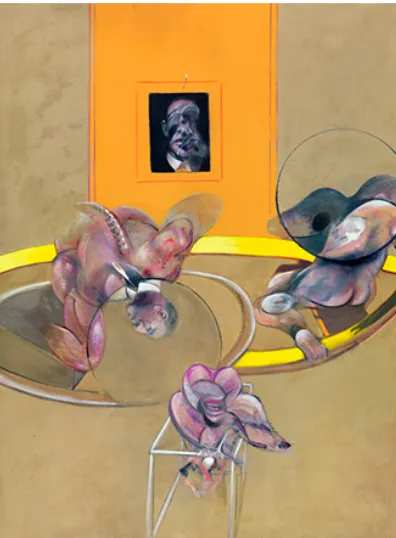
opposition between bone and flesh also in The Logic of Sensation. Referring to Bacon’s Three
Figures and a Portrait (fig. 14), and Bacon’s inspiration for this in how Edgar Degas paints the
woman’s spine in After the Bath (fig. 15), Deleuze writes, “what achieves this tension
[between flesh and bone] in the painting is, precisely, meat, through the splendor of its colors.
Meat is the state of the body in which flesh and bone confront each other locally rather than
being composed structurally.”23 All these arguments relate to a move away from a body as
something structured, also known as the “organism” as opposed to the Body without
Organs.24 This organism, as organized, has ties to the parasitism of representation and the
concepts that impinge on how one is affected by the work of art.
What Bacon accomplishes is a series of undecidable signs, each which opens up a
space for sensations to hit the viewer directly and unfiltered by concepts. These signs
23 Deleuze, The Logic of Sensation, 20-1.
24 “The organs distribute them- selves on the BwO, but they distribute themselves independently of the form
Deleuze calls the zone of indiscernibility and in Bacon the primary undecidable is between
the human and the animal. The mutations that Bacon’s figures undergo do not depict a
movement from the human to the animal, but rather seek to enter into the common traits
that demonstrate the very instability of our concepts and linguistic barriers, especially the
primacy of becoming over being, difference over identity.
Figure Fourteen. Oil, pastel, alkyd paint, and sand on canvas, Three Figures and a Portrait, Francis Bacon, 1975, © The Estate of Francis Bacon. All rights reserved. DACS / SOCAN (2018).
In the words of Lyotard, whose Discourse, Figure (1971) influences one of Deleuze’s terms in
The Logic of Sensation, painting seeks to capture the Figure without figuration. As summarized
by Ronald Bogue, in Discourse, Figure Lyotard’s primary opponent is structuralism’s
“textualization of the world and [Lyotard wants] to insist [instead] that the visual constitutes
a domain unassailable within codes and regulated oppositions.”25 He hopes to replace it with
a kind of sign that cannot be codified in the structures of, for instance, binary linguistic
categories. In The Logic of Sense, for example, Deleuze explores a more positive (rather than
differential) idea of the sign. There, signifier and signified are complementary but
nevertheless distinct series: the signifier as “empty place” and the signified as “occupant without a
place.”26 As Bogue continues: “To the extent that the visual is recognized, comprehended,
and assimilated within a rational order . . . its truth is lost, for it is thereby coded, made
‘readable’ and textualized. Its truth is only revealed in ‘the event,’ which ‘presents itself as a
fall, as a sliding and an error.”27 This concept of the fall will also inform Deleuze’s definition
of sensation in his work on Francis Bacon. Along with Lyotard, let us return to Straus,
Maldiney, and the quasi-phenomenological tradition that Deleuze is equally drawing on in
his aesthetics.
~A R T-H I S T O R I C A L P R E D E C E S S O R S~
Erwin Straus’s work can be captured in a distinction he makes between geography
and landscape as two distinct modes of perception. Perception as geographical can be
understood as viewing the world from a fixed and removed vantage point. In contrast, the
view from a landscape is one that shifts with the spectator. What is also valuable is that the
landscape grants us the capacity to get lost in it—something that cannot be attained from the
25 Ronald Bogue, Deleuze on Music, Painting, and the Arts (New York: Routledge, 2003), 113. 26 Deleuze, The Logic of Sense, 41.
sober outside offered by the geographic mode. As “Cézanne’s enigma” goes, one must
create a being of sensation where “Man is absent from but entirely within the landscape.”28
What will resonate above all else with Deleuze’s aesthetics is how the landscape, with its
constant movement and lack of an ideal vantage point, pivots perspective away from a
representation of fixed objects and beyond the classic distinction between subject and
object. There are three rhythms at work in the genesis of representation and it should be
noted that Deleuze attaches each of these to one of three elements at work in Bacon’s
triptychs. These three rhythms are (i) the attendant-witness; (ii) a diastolic enclosure of
sensation into a discernible object; and (iii) a systolic event that captures the dissolution of
these shapes.29 Like blood being pumped to the heart, forms are filled and emptied on
Bacon’s canvas, and the fine balance he strikes between the two is what Deleuze finds so
compelling. It is vital for the work of art to express the cohabitation of these forces, and the
shortcomings of certain forms of modern art that lean toward abstraction or expressionism
lie in how they overemphasize one of these rhythms—usually (ii) or (iii).
Given that the following chapters of my work take up the musical pole of Deleuze’s
aesthetics and how it differs radically from painting, it is interesting to reflect on how similar
the rhythmic triunes in Bacon’s triptychs are to how Deleuze and Guattari explain (the
musical concepts of) territories, the cosmos, and the refrain in A Thousand Plateaus. As
Chapter II unpacks, there are numerous moments like this where the irreconcilability of
painting and music seems to begin resolving itself. The ultimate realization in Chapter II,
however, is that there always remains an asymptote between the function of painting and
music no matter how close they may come at times. More often than not, Bacon stands as
28 Paul Cézanne, quoted in Gilles Deleuze and Félix Guattari, What is Philosophy? trans. Hugh Tomlinson and
Graham Burchell (New York: Columbia University Press, 1994), 169.
the antithesis of music, sometimes even framed as pitiable compared to “the superiority of
music.”30 It gives a whole new meaning to Bacon’s injunction to “pity the meat!”31 While it
would take much to forget the merits of painting—how it taps into molecular forces and
erases the world’s worn-out forms—Deleuze does not hesitate to note when painting takes
on a musical quality, and thus reaches beyond its material limitations. This is how Deleuze
explains Bacon’s exceptional32 musical instant, this time referring to his Triptych, August 1972
(fig 16):
If the attendant in the center is furnished with elongations and a well-defined mauve oval, we find a diminished torso in the Figure on the left, since a whole portion of it is missing, while the torso on the right is in the process of being built up, half of it having already been added . . . Correlatively, the mauve oval in the center changes status, turning into a pink pool lying next to the chair, in the left panel, and a red discharge from the leg, in the right panel. In this way, Bacon uses mutilations and prostheses in a game of added and subtracted values. It is like a collection of
hysterical “sleepings” and “awakenings” affecting the diverse parts of a body. But it is above allone of Bacon’s most profoundly musical paintings [my emphasis].33
30Ibid., 47. 31Ibid., 21.
32 In both senses of the word: unusual and unusually good. 33 Deleuze, The Logic of Sensation, 66.
The combination of hysteric sensations produces a rhythm that points beyond the actualized
world and this is what is so musical about it in Deleuze’s mind. But we must not forget how
attached these hysterical bodies are to the material plane in ways music is not. Sensation,
after all, is a fall where “the flesh descends from the bones, the body descends from the arms
and the raised thighs.”34 Music, in contrast, is an ascent. How it moves away from the
molecular upward to the rhythms of territories and the cosmos will be the focus of Chapter
III.
Moving beyond Straus and the descriptions of sensation offered above, Henri
Maldiney explains what this realm of sensation below the organized subject must feel like. At
this level, Being is but a Mitwelt with no boundaries between the world and us. In a Strausian
sense, this means that our engagement with the world disassembles our sense of subjectivity;
it is a moment of radical connection where the ‘I’ is suspended. From this disintegration, we
begin to see why Bacon describes his paintings as “matter[s] of fact” or the recording of
facts.35 His mission is to get beyond the subject and this involves a radical focus on the
objectivity (the object- and not subject-focused aspect of sensation). What Deleuze therefore
reads Bacon as inheriting is a deep recognition for how art should be about the immediacy
of sensation and that, to gain this state, that is to capture this force, art needs to fight against
forms that are narrative or representational. The figurative must become the figural. Art
must be made into pure images.
Several dangers come with art that seeks to be representational, though the ones
Deleuze focuses on are the cliché and the subordination of the eye to a model of recognition
which does not allow the possibility for an immediate, pure sensation. There then arises in
The Logic of Sensation the following question: Bacon says, “It is a very, very close and difficult
thing to know why some paint comes across directly onto the nervous system and other
paint tells the story in a long diatribe through the brain.”36 There are two major attempts by
modern painting to move beyond representation and these, as mentioned earlier, are
figural/expressionist and abstract art. For expressionist art, Jackson Pollock stands as the
poster boy. His work, along with abstract expressionists en masse, signifies a rejection of
material forms. In their place, emerge what Deleuze calls the “manual” aspect of painting—
that is, the return of an autonomous matter on the canvas that he names manual chaos.37
Deleuze is sympathetic to their project insofar as it seeks to move beyond the duality
of matter and form, substituting it for the intensities and forces at work in the world that our
minds selectively recognize, turn into stale identities, and deny the vital possibilities inherent
in becoming. Deleuze’s hesitance in committing himself to the mode of expression
characterized by expressionist art is that it plunges too deeply into chaos. Likewise, on the
other end of the spectrum of modern art we find abstractionists such as Piet Mondrian (fig.
17) and Wassily Kandinsky (fig. 18). Unlike the manual traits of Pollock, abstractionists
reintroduce form (lines and shape) and do so under the authority of an optical code.
Ultimately, Deleuze’s claim is that this art manages to be too organized; there is still a
subordination of the body to the eye based on figures, no matter how minimalist, on the
canvas. What Deleuze searches for is a haptic perception that will restore sensation and
becoming (in other words, the becoming-hand of the eye), which we shall get into later. In
an Aristotelian fashion, Deleuze seeks a golden mean between expression and abstraction
and finds it in Bacon.
36 Francis Bacon, quoted in David Sylvester, The Brutality of Fact: Interviews with Francis Bacon, 1962-1979 (New
York: Thames and Hudson, 1987), 18.
Figure Seventeen. Oil on canvas, Composition with Large Red Plane, Yellow, Black, Gray, and Blue, Piet Mondrian, 1921.
This is one of the central problems that Bacon’s art addresses: how can we “[s]ave the
contour,” that which gives determinacy to a figure, all the while presenting an image without
the dominance of narration, representation, and individuated bodies.38 With expressionism
and abstraction, the scale tips too heavily resulting in an unliveable chaos. It is the kind of art
that cannot give intensity. Bacon’s third approach to the problematic of modern art (getting
beyond representation) expresses a passage, a becoming, that demonstrates the processes,
many imperceptible, that a body undergoes as it moves beyond and below what can be
conceptualized, and in fact what counts as a discernible individual or form of
subjectification. Bacon thus treats the human form much as Nietzsche does, a kind of bridge
or tightrope that is always on the way to the overman (which is to be read as nonhuman).
There is, however, always a return of the human figure on the canvas—what Cézanne refers
to as that “stubborn geometry” or “geologic lines” of representation—but there are valuable
ways of demonstrating it undergoing a process or movement.39 This is one of Bacon’s
fundamental accomplishments.
Deleuze defines this process of movement and erasure as the intervening of the
Diagram on the Figure. The construction of form and its disintegration is a process that
takes several forms throughout Deleuze’s work, including the “distinctness and obscurity” of
Difference and Repetition, itself a Dionysian reprisal of the Apollonian “distinct and clear” that
Deleuze addresses in Nietzsche and Philosophy.40I return to Nietzsche and Philosophy, which in
certain respects is the foundation of Deleuze’s aesthetics, in Chapter III.
There is another distinction that complements the Figure and Diagram, which also
comes out of The Logic of Sensation: the digital and the analogue. A digital code homogenizes
38 Deleuze, The Logic of Sensation, 89.
and codifies data by sorting it primarily into a binary set. In contrast, there exists the
analogical mode, which organizes elements based on the immediate sensations created. For
example, take synthesizers—“[a]nalogical synthesizers are ‘modular’: they establish an
immediate connection between heterogeneous elements.”41 What is of interest to the overall
goal of this chapter—the development of the sign, language, and body that define the
painterly pole of Deleuze’s aesthetics—is that Deleuze actually discusses an analogical form
of language: “analogical language would be a language of relations, which consists of
expressive movements, paralinguistic signs, breaths and screams . . .”42 As I shall get into in
the next section of this chapter, this is exactly what Deleuze describes in The Logic of Sense as
the language of the schizophrenic. One can therefore demonstrate one of the major
consistencies in Deleuze’s thought based on the life of this idea. There is a kinship in his
philosophy of language and his aesthetics, most notably in the case of painting, which he
calls “the analogical art par excellence.”43
~T H E L A N G U A G E O F T H E S C H I Z O P H R E N I C~
From the outset of Difference and Repetition and The Logic of Sense, it is clear that
Antonin Artaud is one of the key conceptual personae in Deleuze’s oeuvre. Artaud’s concept
the Body without Organs gains significant traction from The Logic of Sense onward. While its
role and description sways both with and without the influence of Guattari (and this
movement is no aberration for many of the concepts Deleuze employs) the Body without
Organs and its creator, Artaud, can be observed throughout Deleuze’s work and thus
surveyed to draw out the waves of consistency in his thought—a gesture fundamental to a
systematic thinker like Deleuze, whose philosophy must be taken as a whole, though open,
41 Deleuze, The Logic of Sensation, 95. 42Ibid., 93
structure. While on the topic of the Body without Organs, though, I should mention that
Deleuze once remarked to Claire Parnet that he and Guattari did not share a common
understanding of this term.
Now, the introduction of Artaud is, as many of Deleuze’s figureheads, in response to
a particular problem. For Deleuze, Artaud “pursues . . . the terrible revelation of a thought
without image, and the conquest of a new principle which does not allow itself to be
represented.”44 The Body without Organs is what Artaud calls this.45 Furthermore, Artaud’s
theatre of cruelty expresses this “terrible revelation” with fervent precision. As Catherine
Dale states in “Cruel: Antonin Artaud and Gilles Deleuze,”
Artaud’s theatre is not designed to represent or reproduce (describe) man but to create a being which moves. The language of Artaud is a symbiosis of
technologies—asignifying semiotics, affective gestures, violent sounds and painful noises—challenging the organization of the organism in its collectivity (audience, participant, body) and in its singularity (event), occurring at the chasm between language and the body.46
At the heart of this process is what Artaud deems “cruelty.” This is not the cruelty of war,
but something far more eternal. For Artaud, “everything that acts is cruelty,” and in
announcing this he carves out his position in a philosophy of affect that deals with the
pervasiveness of cruelty.47 Deleuze will reprise how he takes up Artaud’s cruelty with regard
to Bacon’s artwork. Everyday forces of sitting (fig. 19) standing over a washbasin (fig. 7),
falling asleep (fig. 20), and so on come to bear a weight that exhausts the body, disturbing its
rhythmic speeds and slowness.
44 Gilles Deleuze, Difference and Repetition, trans. Paul Patton (New York: Columbia University Press, 1994), 147. 45 I deal with the source of the term, the Body without Organs, in the following section.
46 Catherine Dale, “Cruel: Antonin Artaud and Gilles Deleuze, in A Shock to Thought: Expression After Deleuze and
Guattari, ed. Brian Massumi (New York: Routledge, 2002), 88.
Figure Nineteen. Oil on canvas, Portrait of George Dyer Talking, Francis Bacon, 1966, © The Estate of Francis Bacon. All rights reserved. DACS / SOCAN (2018).
This weight is cruelty; and if Saint Augustine once spoke of his weight being his love,
we now find in Artaud a weight of cruelty. What Deleuze inherits from Artaud is an
understanding of this force as affecting the body in all circumstances. In The Logic of Sense,
Deleuze examines the affection even language (something that seems to be an Idea not an
affect of the body) has on us at the level of immediate forces. He defines this as the
schizophrenic depth of language.
Two versions of linguistic depth arise in The Logic of Sense, the first being the
schizophrenic’s and the second being what Deleuze calls the “crack”—a kind of return of
depth to the surface.48 The second version is equally as fascinating as the first and elucidates
the communication of the distinct planes of depth and surface, shedding light on the
divergent series of ascending away from or descending to the depths—each does not exist
on the same straight line that can be traced from depth upward finally to the heights; the
communication of series is not that straightforward. For our purpose, however, it is the first
version of depth that concerns us. It is the realm of the pre-Socratics, Nietzsche to a certain
extent (though he floats to the surface at times), and finally Artaud. Think of the way they all
philosophize; qu’est-ce que s’orienter dans la pensée? [what is orientation in thinking?]. Thales,
Anaximander, Heraclitus, Empedocles—each a natural philosopher or physicist—who
sought out the nature of things in the material world as such.49 The orientation of their
thinking was down into the caverns and into the deep. As legend has it, Thales once fell in a
well for gazing upward at the stars, so perhaps the orientation of his thinking was up to the
heights, though that fall forced him back to the ground with the other pre-Socratics. And in
those caves we will eventually find Nietzsche toiling away with his hammer, a tool we must
remember is that of the geologist or speleologist, and not necessarily a statue-crushing
mallet.
What we find in Artaud is a language reduced to its purely phonetic elements:
“clappings, crackings, gnashings, cracklings, explosions, the shattered sounds of internal
objects, and also the inarticulate howls-breaths [cris-souffles] of the body without organs.”50
For Deleuze, this is not to be understood as the primary or proto-linguistic state before
order descends onto nonsense—literally descends, that is, given that the voice of the father
is necessarily positioned above the child. Instead this state should be recognized as a
schizophrenic mode of language. What the schizophrenic mode reveals is the condition of
language that does not abide by any separation between words and bodies. A system of
schizophrenic language reinvents the connection between bodies and language.
While in The Logic of Sense Artaud is burdened by a kind of impotence, an inability to
rise to the surface of sense, by the time of Anti-Oedipus (1972)he signifies the “fulfillment of
literature.”51 Artaud’s writing achieves immediate contact with the reader, just as on the stage
the audience receives words in ways that resemble how the schizophrenic does—pure
consonants, indigestible sentences, and screams that vibrate the body. Let us begin with an
example. Artaud’s translation of Lewis Carroll’s famous ‘nonsense’ poem, Jabberwocky, creates
a certain fusion of words into unpronounceable or what Deleuze calls non-decomposable
blocks. In essence, this illustrates a linguistic form of the Body without Organs, much as in
The Logic of Sensation painting will as well. While Sense and Sensation are obviously working
with different languages (the verbal and pictorial respectively), one must acknowledge that
“the expression of intensities and bodily sensations, however, is common to both works and
50Ibid., 193.
51 Deleuze and Guattari, Anti-Oedipus: Capitalism and Schizophrenia, trans. Robert Hurley, Seem Mark, and Helen
Artaud is a key figure for Deleuze in that discussion.”52 Where this is leading us is a complete
understanding of one aesthetic pole, that of painting, which we shall see Deleuze contrasts
with the functions of music. Put simply, painting and music stand for the two sides of what
art can accomplish. Furthermore, since Deleuze’s writing on certain literature (primarily
Sade, Masoch, and Artaud) bears such a striking resemblance to what he says about painting,
and literature is frequently employed in The Logic of Sensation to explicate the function of
painting, a study of Artaud begets an understanding of painting.
Turning to Artaud’s translation from Carroll’s Jabberwocky, what jumps out to us is
that heabandons what Deleuze calls the playful and clean aspect of the original. Carroll is a
thinker of the surfaces; he glides across them without entering the dirty depths that Artaud
famously refers to as a place where “[a]ll writing is PIG SHIT (that is to say, every fixed or
written word is decomposed into noisy, alimentary, and excremental bits).”53 As Deleuze
describes it, there is a body-sieve filled with holes in the language of the schizophrenic, and
therefore no proper distinction can be made between language and bodies. Recall Freud’s
definition of the ego in Beyond the Pleasure Principle, where he calls it a barrier that applies the
classic Kantian categories (time, space, contiguity) only as checks that filter out immediate
experience, the presence of which, when it manages to bypass the ego, becomes unconscious
trauma.54 The ego, like the surface of sense, orders the world in such a way that it negates
pure affection. A border is necessary in this process of rejection, no matter how incorporeal
the margin may be, and its absence opens up the floodgates to piercing words and wounding
tonic elements. In a chapter on orality in The Logic of Sense, Deleuze constructs two series that
commonly demarcate the distinctions between words and bodies. On the one hand, there is
52 Robert Mark Causey, “Between Two Logics: Deleuze and Artaud on the Logics of Sense and Sensation
(PhD Thesis, Emory University, 2010), 10.
53 Deleuze, The Logic of Sense, 88.
54 Sigmund Freud, Beyond the Pleasure Principle, trans. James Strachey (London: W. W. Norton and Company,