Security of Reduced-Round Camellia against Impossible
Differential Attack
⋆Leibo Li1,2, Jiazhe Chen1,2 and Xiaoyun Wang1,2,3⋆⋆
1 Key Laboratory of Cryptologic Technology and Information Security, Ministry of Education, Shandong University, Jinan 250100, China 2 School of Mathematics, Shandong University, Jinan 250100, China
{lileibo, jiazhechen}@mail.sdu.edu.cn
3
Institute for Advanced Study, Tsinghua University, Beijing 100084, China
Abstract. Camellia is one of the widely used block ciphers, which has been selected as an inter-national standard by ISO/IEC. By using some interesting properties of F L/F L−1 functions, we introduce new 7-round impossible differentials of Camellia for weak keys, which can be used to attack reduced-round Camellia under weak-key setting. The weak keys that work for the impossi-ble differential take 3/4 of the whole key space, therefore, we can further get rid of the weak-key assumption and leverage the attacks to all keys by utilizing a method that is calledthe multiplied method. As a result, for the whole key space, 10-round Camellia-128, 11-round Camellia-192 and 12-round Camellia-256 can be attacked with about 2120, 2184 and 2240 encryptions, respectively. In addition, we are able to extend the attacks to 12-round Camellia-192 and 14-round Camellia-256 which include twoF L/F L−1 layers, provided that the attacks do not have to be started from the first round.
Keywords:Camellia, Block Cipher, Impossible Differential, Cryptanalysis.
1 Introduction
The block cipher Camellia is a 128-bit block cipher with variable key length of 128, 192, 256, which are denoted as Camellia-128, Camellia-192 and Camellia-256, respectively. Camellia was proposed by NTT and Mitsubishi in 2000 [1], and was selected as an e-government recommended cipher by CRYPTREC in 2002 [6], NESSIE block cipher portfolio in 2003 [19] and international standard by ISO/IEC 18033-3 in 2005 [9].
Many methods of cryptanalysis were applied to attack reduced-round Camellia in recent years, such as higher order differential attack [8], linear and differential attacks [20], truncated differential attack [10,13,21], collision attack [22], square attack [14,7] and impossible differential attack [16,18,23]. An important property of the Camellia’s structure is that F L/F L−1 layers
are inserted every 6 rounds. The F L/F L−1 layers are constructed by logical operations AND, OR, XOR and one bit rotation. This design could provide non-regularity across rounds [1] and destroy the differential property. So many previous papers proposed attacks on simplified ver-sions of Camellia, which did not take theF L/F L−1 layers and the whitening layers into account [7,13,16,18,20,22,23]. In this paper, we will mainly focus on the original Camellia, so the results we are interested in are the cryptanalysis with F L/F L−1 layers. Duo et al. proposed a square attack of 9-round Camellia-128 without whitening in [14], and an higher order differential attack was given by Hatano et al. for the last 11 rounds of Camellia-256 [8]. Recently, impossible differ-ential attacks of 10-round Camellia-192 and 11-round Camellia-256 were presented by proposing a 6-round impossible differential with F L/F L−1 layer [5]. By using the same impossible dif-ferential, attacks on 10-round (rounds 8 to 17) Camellia-128 and 11-round (rounds 13 to 23) Camellia-192 were given by Lu et al., which did not include the whitening layers [17]. With a
⋆
Supported by the National Natural Science Foundation of China (Grant No. 60931160442), and the Tsinghua University Initiative Scientific Research Program (2009THZ01002).
⋆⋆
7-round impossible including the F L/F L−1 layer, impossible differential attacks on 10-round Camellia-128 (without whitening keys), 10-round Camellia-192 and 11-round Camellia-256 are also proposed [15].
Impossible differential cryptanalysis was independently introduced by Biham [4] and Knud-sen [11], which is one of the most powerful toolkits to attack block ciphers. By starting the attack, the adversary tries to seek for an input difference that can never result in a output dif-ference. The differential which connects the input and output difference is impossible and called an impossible differential. When the adversary wants to launch an impossible differential attack on a block cipher, she adds rounds before and/or after the impossible differential, and collect enough pairs with required plaintext and ciphertext differences. Then she concludes that the subkey bits in added rounds must be wrong, if there is a pair meets the input and output of the impossible differential under these subkey bits. In this way, she discards as many wrong keys as possible and exhaustively searches the rest of the keys.
This paper introduces new 7-round impossible differentials of Camellia withF L/F L−1layers, which works for 75% of the keys. Although the impossible differential only holds under the weak-key assumption, the percentage of weak keys is so high that we can propose a “multiplied” method to recover the key for the whole key space. The idea is based on the fact that if the correct key belongs to the set of weak keys, then it will never satisfy the impossible differential. While if the correct key is not a weak key, the impossible differential will no longer hold, then if we leverage the impossible differential attack on the cipher under the assumption that the impossible differential holds, the correct will be eliminated randomly. Accordingly, in our attack, we first mount impossible differential attack on Camellia as in the weak-key setting. Then after the whole procedure, if there is a remaining key, we conclude that it is the correct key. However, if there is no key kept, we know that the correct key is not in the set of weak keys, but in the other 25% of the key space. In other words, we get 2-bit conditions about the key.
Furthermore, there are several independent impossible differentials under different weak-key assumptions, these impossible differentials are called “multiplied” impossible differentials. For each impossible differential, we can perform the procedure of impossible differential attack to either recover the right key or obtain 2-bit conditions of the key. The worst case is that the correct key does not belong to any of the weak-key sets. If we have a impossible differentials, then we get 2a-bit conditions of the key and have to search for the rest 2n−2a keys to get the correct key, wheren is the bit-length of the key. Consequently, the time complexity in this case is 2n−2a+a×2b, where 2b is the complexity for performing one impossible differential attack
procedure.
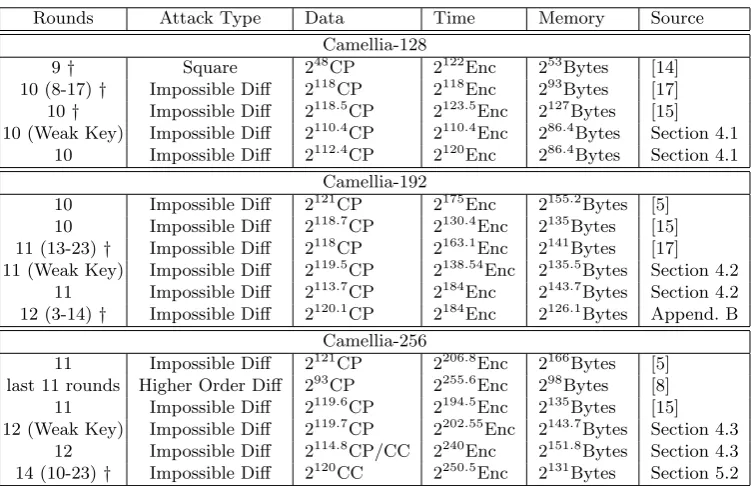
Based on this method, we present impossible differential attacks on 10-round Camellia-128, 11-round Camellia-192 and 12-round Camellia-256 with the time complexities of 2120, 2184 and 2240 encryptions, respectively. Note that all these attacks start from the first round and include the whitening layers. Additionally, we give attacks of 12-round Camellia-192 and 14-round Camellia-256 which do not start from the first 14-round but include two F L/F L−1 layers. Table 1 summarizes our results along with the best previously known results of reduced-round Camellia, where CP and CC refer to the number of chosen plaintexts and chosen ciphertexts, respectively, and Enc refers to the number of encryptions. “Weak Key” represents the weak key space which contains 3/4 of keys.
Table 1.Summary of the Attacks on Reduced-Round Camellia
Rounds Attack Type Data Time Memory Source Camellia-128
9† Square 248CP 2122Enc 253Bytes [14] 10 (8-17)† Impossible Diff 2118CP 2118Enc 293Bytes [17] 10† Impossible Diff 2118.5CP 2123.5Enc 2127Bytes [15] 10 (Weak Key) Impossible Diff 2110.4CP 2110.4Enc 286.4Bytes Section 4.1
10 Impossible Diff 2112.4CP 2120Enc 286.4Bytes Section 4.1 Camellia-192
10 Impossible Diff 2121CP 2175Enc 2155.2Bytes [5] 10 Impossible Diff 2118.7CP 2130.4Enc 2135Bytes [15] 11 (13-23)† Impossible Diff 2118CP 2163.1Enc 2141Bytes [17] 11 (Weak Key) Impossible Diff 2119.5CP 2138.54Enc 2135.5Bytes Section 4.2
11 Impossible Diff 2113.7CP 2184Enc 2143.7Bytes Section 4.2 12 (3-14)† Impossible Diff 2120.1CP 2184Enc 2126.1Bytes Append. B
Camellia-256
11 Impossible Diff 2121CP 2206.8Enc 2166Bytes [5] last 11 rounds Higher Order Diff 293CP 2255.6Enc 298Bytes [8] 11 Impossible Diff 2119.6CP 2194.5Enc 2135Bytes [15] 12 (Weak Key) Impossible Diff 2119.7CP 2202.55Enc 2143.7Bytes Section 4.3
12 Impossible Diff 2114.8CP/CC 2240Enc 2151.8Bytes Section 4.3 14 (10-23)† Impossible Diff 2120CC 2250.5Enc 2131Bytes Section 5.2 CP/CC: Partial phases of the attack are performed under the chosen ciphertext scenario.
†: The attack doesn’t include the whitening layers.
2 The Camellia Block Cipher
2.1 Notations
The following notations are used in this paper:
Lr−1, L′r−1 : the left 64-bit half of ther-th round input,
Rr−1, R′r−1 : the right 64-bit half of ther-th round input,
∆Lr−1 : the difference ofLr−1 and L′r−1,
∆Rr−1 : the difference ofRr−1 and R′r−1,
Sr, Sr′ : the output value of the S-box layer of ther-th round,
∆Sr : the difference ofSr andS′r,
Kr : the subkey used in ther-th round,
X(l) : thel-th byte of a 64-bit valueX (l= 1,∼,8),
X{i} : the i-th most significant bit of a bit string X(1≤i≤128), where the left most
bit is the most significant bit,
X{i∼j} : thei-th to the j-th most significant bit of X (1≤i, j ≤128),
x|y : bit string concatenation ofx and y, ⊕, ∩, ∪ : bitwise exclusive OR (XOR), AND, OR.
2.2 A Brief Description of Camellia
Camellia [1] is a Feistel structure block cipher, and the number of rounds are 18/24/24 for Camellia-128/192/-256, respectively. For Camellia-128, the encryption procedure is as follows.
Firstly, a 128-bit plaintext M is XORed with KW1|KW2 and get two 64-bit data L0 and
R0. Then, forr = 1 to 18, expect forr= 6 and 12, the following is carried out:
For r= 6 and 12, do the following:
L′r=Rr−1⊕F(Lr−1, Kr), R′r =Lr−1,
Lr=F L(L′r, KLr/3−1), Rr=F L(R′r, KLr/3),
Lastly, the 128-bit ciphertext C is computed as: C= (R18|L18)⊕(KW3|KW4).
Following the notations in [1] and [2], we denote the main key of Camellia byK, andKL,KR
are simply generated fromK. For Camellia-128,KLis the 128-bitK, andKRis 0. For
Camellia-192, KLis the left 128-bit ofK, the concatenation of the right 64-bit of K and its complement
used as KR. For Camellia-256, KL is the left 128-bit of K, and KR is the right 128-bit of K.
Two 128-bit keys KA and KB are derived from KL and KR by a non-linear transformation,
whereKB is only used in Camellia-192/256. Then the whitening keysKWi (i= 1, ...,4), round
subkeysKr (r = 1, ...,18) andKLj (j= 1, ...,4) are generated by rotatingKL, KR, KAorKB.
The round function F is composed of a key-addition layer, a substitution transformation S and a diffusion layer P. There are four types of 8×8 S-boxes s1, s2, s3 and s4 in the S
transformation layer, and a 64-bit data is substituted as follows:
S(x1|x2|x3|x4|x5|x6|x7|x8) =s1(x1)|s2(x2)|s3(x3)|s4(x4)|s2(x5)|s3(x6)|s4(x7)|s1(x8).
The linear transformation P : ({0,1}8)8 → ({0,1}8)8 maps (y1,· · ·, y8) → (z1,· · ·, z8), this
transformation and its inverse P−1 are defined as follows:
z1=y1⊕y3⊕y4⊕y6⊕y7⊕y8 y1 =z2⊕z3⊕z4⊕z6⊕z7⊕z8
z2=y1⊕y2⊕y4⊕y5⊕y7⊕y8 y2 =z1⊕z3⊕z4⊕z5⊕z7⊕z8
z3=y1⊕y2⊕y3⊕y5⊕y6⊕y8 y3 =z1⊕z2⊕z4⊕z5⊕z6⊕z8
z4=y2⊕y3⊕y4⊕y5⊕y6⊕y7 y4 =z1⊕z2⊕z3⊕z5⊕z6⊕z7
z5=y1⊕y2⊕y6⊕y7⊕y8 y5=z1⊕z2⊕z5⊕z7⊕z8
z6=y2⊕y3⊕y5⊕y7⊕y8 y6=z2⊕z3⊕z5⊕z6⊕z8
z7=y3⊕y4⊕y5⊕y6⊕y8 y7=z3⊕z4⊕z5⊕z6⊕z7
z8=y1⊕y4⊕y5⊕y6⊕y7 y8=z1⊕z4⊕z6⊕z7⊕z8
The F Lfunction is defined as (XL|XR, KLL|KLR)7→YL|YR, where
YR= ((XL∩KLL)≪1)⊕XR, YL= (YR∪KLR)⊕XL.
Similar to Camellia-128, Camellia-192/256 have a 24-round Feistel structure, and theF L/F L−1 function layer are inserted in the 6-th, 12-th and 18-th rounds. Before the first round and after the last round, there are pre- and post- whitening layers as well. For details of Camellia, we refer to [1,2].
3 7-Round Impossible Differentials of Camellia for Weak Keys
This section introduces 7-round impossible differentials of Camellia in weak-key setting, which is based on the following observations.
Observation 1 (from [12]) Let X, X′, K be l-bit values, and ∆X =X⊕X′, then the differ-ential properties of AND and OR operations are:
(X∩K)⊕(X′∩K) = (X⊕X′)∩K=∆X∩K,
(X∪K)⊕(X′∪K) = (X⊕K⊕(X∩K))⊕(X′⊕K⊕(X′∩K)) =∆X⊕(∆X∩K).
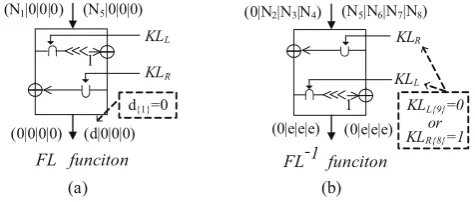
Observation 2 If the output difference of F L function is ∆Y = (0|0|0|0|d|0|0|0), where d̸= 0 andd{1}= 0, then the input difference ofF Lfunction should satisfy∆X(2,3,4,6,7,8) = 0 (see Fig.
∩
∩ 1
KLL
KLR
FL-1 funciton
(b)
(0|e|e|e) (0|N2|N3|N4)
(0|e|e|e) (N5|N6|N7|N8)
KLL{9}=0
or KLR{8}=1
∩
∩ 1
KLL
KLR
FL funciton (N1|0|0|0) (N5|0|0|0)
(0|0|0|0) (d|0|0|0)
(a)
d{1}=0
Fig. 1. Properties ofF L/F L−1 Function
Proof. From Observation 1 we know that
∆XL=∆YL⊕∆YR⊕(∆YR∩KLR),
and ∆YR(2,3,4) = 0, hence ∆XL(2,3,4) = 0. According to the condition ∆YR{1} = d{1} = 0, we conclude ∆XL{1} = 0, as we know
∆XR=∆YR⊕((∆XL∩KLL)≪1),
which implies ∆XR(6,7,8)= 0. ⊓⊔
Observation 3 If the output difference of F L−1 function is ∆X = (0|e|e|e|0|e|e|e), and the subkeys of F L−1 function satisfy that KLL{9} is 0 or KLR{8} is 1, then the first byte of input difference ∆Y should be zero, wheree is a non-zero byte (see Fig. 1. b).
Proof. On the one hand, ifKLL{9}= 0, we conclude that ((XL∩KLL)⊕(XL′ ∩KLL)){9} must
be 0. According to
∆YR=∆XR⊕(((XL∩KLL)⊕(XL′ ∩KLL))≪1)
we obtain∆YR(1) = 0 or∆YR= (0|N6|N7|N8). Then
∆YL=∆XL⊕(YR∪KLR)⊕(YR′ ∪KLR) = (0|N2|N3|N4),
where Ni are unknown bytes.
On the other hand, ifKLR{8} = 0, we obtain that ((YR∪KLR)⊕(YR′ ∪KLR)){8} must be
0. Since ((YR∪KLR)⊕(YR′ ∪KLR)){1∼7} is always 0, the left half input difference satisfy
∆YL=∆XL⊕(YR∪KLR)⊕(YR′ ∪KLR) = (0|N2|N3|N4). ⊓⊔
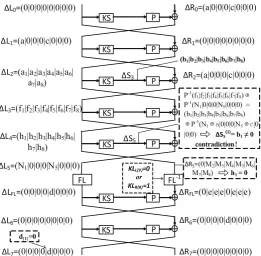
Observation 4 Given a 7-round Camellia encryption and a F L/F L−1 layer inserted between the fifth and sixth round. If the input difference of the first round is(0|0|0|0|0|0|0|0, a|0|0|0|c|0|0|0), and the subkeys ofF L−1 function satisfyKLL{9}= 0 orKLR{8} = 1, then the output difference
(0|0|0|0|d|0|0|0,0|0|0|0|0|0|0|0)with d{1} = 0 is impossible, where a and d are non-zero bytes, c
is an arbitrary value. (see Fig. 2).
Proof. Firstly, we analyze the forward direction. It is trivial that (∆L1, ∆R1) = (a|0|0|0|c|0|0|0,
0|0|0|0|0|0|0|0), then it propagates to (∆L2, ∆R2) = (a1|a2|a3|a4|a5|a6|a7|a8, a|0|0|0|c|0|0|0) after
the second round, where a1 and a5 are non-zero values, ai (i = 2,3,4,6,7,8) are unknown
∆L0=(0|0|0|0|0|0|0|0) ∆R0=(a|0|0|0|c|0|0|0)
∆L1=(a|0|0|0|c|0|0|0) ∆R1=(0|0|0|0|0|0|0|0)
∆L2=(a1|a2|a3|a4|a5|a6|
a7|a8)
∆L7=(0|0|0|0|d|0|0|0) ∆R7=(0|0|0|0|0|0|0|0) ∆RFL=(0|e|e|e|0|e|e|e) ∆LFL=(0|0|0|0|d|0|0|0)
∆L5=(N1|0|0|0|N5|0|0|0) ∆R5=(0|M2|M3|M4|M5|M6|
M7|M8) h1 = 0
∆L3=(f1|f2|f3|f4|f5|f6|f7|f8)
(b1|b2|b3|b4|b5|b6|b7|b8)
P-1
(f1|f2|f3|f4|f5|f6|f7|f8)Ͱ
P-1(N
1|0|0|0|N5|0|0|0) =
(b1|b2|b3|b4|b5|b6|b7|b8)
ͰP-1(N1ͰD|0|0|0|N5ͰF|0
|0|0) ∆S5(1)= b1≠ 0 contradiction!
∆L6=(0|0|0|0|0|0|0|0) ∆R6=(0|0|0|0|d|0|0|0) KLL{9}=0
or
KLR{8}=1
∆R2=(a|0|0|0|c|0|0|0)
∆L4=(h1|h2|h3|h4|h5|h6|
h7|h8)
d{1}=0
FL FL-1
KS P
KS P
KS KS KS
KS P
P
P P
∆S5 ∆S3
KS P
Fig. 2. A 7-Round Impossible Differential for Weak Keys
non-zero values. Then we have (∆L3, ∆R3) = (f1|f2|f3|f4|f5|f6|f7|f8, a1|a2|a3|a4|a5|a6|a7|a8),
and (∆L4, ∆R4) = (h1|h2|h3|h4|h5|h6|h7|h8, f1|f2|f3|f4 |f5|f6|f7|f8), where fi, hi are unknown
values.
Secondly, we consider the backward direction. The output difference of the seventh round is (∆L7, ∆R7) = (0|0|0|0|d|0|0|0,0|0|0|0|0|0|0|0), then the output difference of the sixth round
is (∆L6, ∆R6) = (0|0|0|0|0|0|0|0,0|0|0|0|d|0|0|0), and the output difference ofF L/F L−1 layer is
(0|0|0|0|d|0|0|0,0|e|e|e|0|e|e|e). According to the conditiond{1} = 0 and Observation 2, we obtain
that the input difference ofF Lfunction is (N1|0|0|0|N5|0|0|0). SinceKLL{9} = 0 orKLR{8} = 1,
in the light of Observation 3, the input difference ofF L−1 function is (0|M
2|M3|M4|M5|M6|M7|
M8),which means ∆L(1)4 =h1= 0.WhereN1, N5 and Mi (i= 2, ...,8) are unknown bytes.
Finally, we focus on the fifth round. The output difference ofS-layer in the fifth round is
∆S5=P−1(f1|f2|f3|f4|f5|f6|f7|f8)⊕P−1(N1|0|0|0|N5|0|0|0)
= (b1|b2|b3|b4|b5|b6|b7|b8)⊕P−1(N1⊕a|0|0|0|N5⊕c|0|0|0).
Then ∆S5(1)=b1 ̸= 0,which contradicts∆L(1)4 = 0. ⊓⊔
We also obtain three other impossible differentials under different weak-key assumptions:
– (0|0|0|0|0|0|0|0,0|a|0|0|0|c|0|0)9 (0|0|0|0|0|d|0|0,0|0|0|0|0|0|0|0) with conditions KLL{17}= 0 or KLR{16} = 1, andd{1} = 0,
– (0|0|0|0|0|0|0|0,0|0|a|0|0|0|c|0)9 (0|0|0|0|0|0|d|0,0|0|0|0|0|0|0|0) with conditions KLL{25}= 0 or KLR{24} = 1, andd{1} = 0,
– (0|0|0|0|0|0|0|0,0|0|0|a|0|0|0|c)9 (0|0|0|0|0|0|0|d,0|0|0|0|0|0|0|0) with conditions KLL{1} = 0 or KLR{32}= 1, and d{1} = 0.
– (0|0|0|0|0|0|0|0,0|0|0|0|d|0|0|0)9 (a|0|0|0|c|0|0|0,0|0|0|0|0|0|0|0) with conditions KL′L{9}= 0 or KL′R{8} = 1, andd{1} = 0,
– (0|0|0|0|0|0|0|0,0|0|0|0|0|d|0|0)9 (0|a|0|0|0|c|0|0,0|0|0|0|0|0|0|0) with conditions KL′L{17} = 0 orKL′R{16}= 1, and d{1}= 0,
– (0|0|0|0|0|0|0|0,0|0|0|0|0|0|d|0)9 (0|0|a|0|0|0|c|0,0|0|0|0|0|0|0|0) with conditions KL′L{25} = 0 orKL′R{24}= 1, and d{1}= 0,
– (0|0|0|0|0|0|0|0,0|0|0|0|0|0|0|d)9 (0|0|0|a|0|0|0|c,0|0|0|0|0|0|0|0) with conditions KL′L{1}= 0 or KL′R{32} = 1, andd{1} = 0,
where KL′ represents the subkey used in F L-function.
4 New Impossible Differential Attacks on Reduced-Round Camellia
In this section, we introduce impossible differential attacks on 10-round Camellia-128, 11-round Camellia-192 and 12-round Camellia-256 which start from the first round. As mentioned above, each attack will start with a weak-key attack that is based on the WKID, then it will be extended to an attack for the whole key space.
4.1 Impossible Differential Attack on 10-Round Camellia-128
KS P
KS P
5+2 WKID
∆L1=(0|0|0|0|0|0|0|0) ∆R1=(a|0|0|0|c|0|0|0)
∆L8=(0|0|0|0|d|0|0|0) ∆R8=(0|0|0|0|0|0|0|0)
∆L9=(0|f|f|f|0|f|f|f) ∆R9=(0|0|0|0|d|0|0|0)
∆L10=(g1|g2|g3|g4|g5
|g6|g7|g8)
∆R10=(0|f|f|f|0|f|f|f)
∆S9
∆S10
KS P
∆L0=(a|0|0|0|c|0|0|0) ∆R0=P(b1|0|0|0|b2|0|
0|0) ∆S1
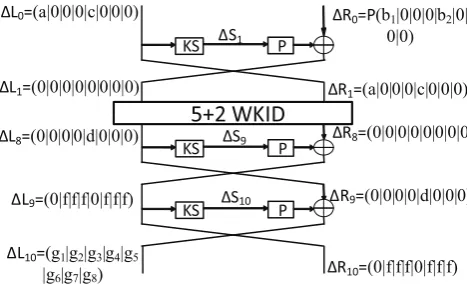
Fig. 3. Impossible Differential Attack on 10-Round Camellia-128 for Weak Keys
We first propose an attack that works for 3×2126 keys, which is mounted by adding one round on the top and two rounds on the bottom of the 5+2 WKID(Fig. 2). The attack pro-cedure is as follows.
Data Collection.
1. Choose 2n structures of plaintexts, and each structure contains 232 plaintexts
(L0, R0) = (α1|x1|x2|x3|α2|x4|x5|x6, P(β1|y1|y2|y3|β2|y4|y5|y6)),
wherexi and yi (i= 1, ...,6) are fixed values in each structure, while αj, βj (j= 1,2) takes
all the possible values, andP is the linear transformation.
R(4)10, theXORofR10(2)andR(6)10, theXORofR10(2)andR(7)10, theXORofR10(2)andR(8)10. Then by birthday paradox, we get 2n+63×2−56= 2n+7 pairs of ciphertexts with the differences
(∆L10, ∆R10) = (g1|g2|g3|g4|g5|g6|g7|g8,0|f|f|f|0|f|f|f),
and the differences of corresponding plaintext pairs satisfy
(∆L0, ∆R0) = (a|0|0|0|c|0|0|0, P(b1|0|0|0|b2|0|0|0)).
Wherea,c,f and bi (i= 1,2) are non-zero bytes, and gi are unknown bytes.
For every pair, compute the value
P−1(∆L10) =P−1(g1|g2|g3|g4|g5|g6|g7|g8) = (g1′|g′2|g3′|g′4|g5′|g6′|g′7|g8′).
Keep only the pairs whose ciphertexts satisfy g1′ = 0 4. The probability of this event is 2−8,
thus the expected number of remaining pairs is 2n+7×2−8 = 2n−1.
Key Recovery.
1. For each pair obtained in the data collection phase, guess the 16-bit value K1(1,5), partially encrypt its plaintext (L(1,5)0 , L′(1,5)0 ) to get the intermediate value (S1(1,5), S′(1,5)1 ) and the difference∆S1(1,5). Then discard the pairs whose intermediate values do not satisfy∆S1(1)=b1
and ∆S1(5) = b2. The probability of a pair being kept is 2−16, so the expected number of
remaining pairs is 2n−1×2−16= 2n−17.
2. In this step, the ciphertext of every remaining pair are considered.
(a) Guess the 8-bit value K10(8) for every remaining pair, partially decrypt the ciphertext (R(8)10, R′(8)10) to get the intermediate value (S10(8), S′(8)10) and the difference∆S10(8), and dis-card the pairs whose intermediate values do not satisfy∆S10(8)=g8′. The expected number of remaining pairs is 2n−17×2−8 = 2n−25.
(b) Forl= 2,3,4,6,7, guess the 8-bit valueK10(l). For every remaining pair, partially decrypt the ciphertext (R(l)10, R′(l)10) to get the intermediate value (S(l)10, S′(l)10) and the difference ∆S10(l), and keep only the pairs whose intermediate values satisfy∆S10(l) =gl′⊕g′5. Since for eachl, each pair will remain with probability 2−8, the expected number of remaining pairs is 2n−25×25×(−8) = 2n−65.
(c) Guess the 8-bit value K10(1), partially decrypt the ciphertextR10(1) of every remaining pair to get the intermediate value S10(1), which is also the value ofS′(1)10.
(d) Partially decrypt (S10, S10′ ) to get the intermediate values (R (5) 9 , R′
(5)
9 ), and discard the
pairs whose intermediate values do not satisfy ∆R(5)9{1} = 0.As the probability of a pair being discarded is 0.5, the expected number of remaining pairs is 2n−65×2−1= 2n−66.
3. For every remaining pair, guess the 8-bit value K9(5), partially decrypt the output value (R(5)9 , R′(5)9 ) to get the intermediate value (S9(5), S′(5)9 ) and the difference∆S9(5). If there is a pair satisfies ∆S9(5) = ∆R(2)10, we discard the key guess and try another one. Otherwise we exhaustively search for the rest 48 bits of the key under this key guess, if the correct key is obtained, we halt the attack; otherwise, another key guess should be tried.
4
Complexity.Since the probability of the event∆S9(5) =∆R(2)10 happens in step 3 of key recov-ery phase is 2−8, the expected number of remaining guesses for 72-bit target subkeys is about ϵ= 280×(1−2−8)2n−66. If we choose ϵ= 250, then nis 78.4, and the proposed attack requires
2n+32 = 2110.4 chosen plaintexts. The time and memory complexities are dominated by step 2 of data collection phase, which are about 2110.4 10-round encryptions and 2n−1×4×27 = 286.4 bytes.
Remark. The application of whitening layers does not effect the complexity of this attack, because the master key can be recovered by guessing equivalent keys [5].
Extending the Attack to the Whole Key Space. On the basis of the above impossible differential attack for weak keys, we construct a multiplied attack on 10-Round Camellia-128 as follows.
– Phase 1. Perform an impossible differential attack by using the5+2 WKID
(0|0|0|0|0|0|0|0, a|0|0|0|c|0|0|0)9(0|0|0|0|d|0|0|0,0|0|0|0|0|0|0|0).
This phase is extremely similar to the weak-key attack that is described above. However, it is slightly different when the attack is finished. That is, if there is a key kept, then the key is the correct key, and we halt the procedure of the attack. Otherwise, we conclude that the correct key does not belong to this set of weak keys, which means thatKL1{9}= 1 and KL2{8} = 0. In this case, we get 2-bit information of the key and perform the next phase.
– Phase 2. Perform an impossible differential attack by using the5+2 WKID
(0|0|0|0|0|0|0|0,0|a|0|0|0|c|0|0)9(0|0|0|0|0|d|0|0,0|0|0|0|0|0|0|0).
The procedure is similar to Phase 1, and either output the correct key or get another 2-bit information about the key and execute the next phase.
· · · ·
– Phase 4. Perform an impossible differential attack by using the5+2 WKID
(0|0|0|0|0|0|0|0,0|0|0|a|0|0|0|c)9(0|0|0|0|0|0|0|d,0|0|0|0|0|0|0|0).
Similarly, if success, then output the actual key, otherwise perform the next phase. – Phase 5. Announce the intermediate key
KA{95,103,111,119}= 0 and KA{6,14,22,30} = 1,
then exhaustively search for the remaining 120 bit value of KA and recover the master key
KL.
The upper bound of the time complexity is 2110.4+ 2110.4 + 2110.4 + 2110.4+ 2120 ≈ 2120. The data complexity is about 2112.4. The memory could be reused in different phase, so the memory requirement is about 286.4 bytes.
4.2 Attack on 11-Round Camellia-192
Data Collection. Choose 279.7 structures of plaintexts, and each structure contains 232 plain-texts:
(L0, R0) = (α1|x1|x2|x3|α2|x4|x5|x6, P(β1|y1|y2|y3|β2|y4|y5|y6)),
where xi and yi (i = 1, ...,6) are fixed values in each structure, while αj and βj (j = 1,2)
take all the possible values, and P is the linear transformation. Ask for the encryption of the corresponding ciphertext for each plaintext, compute P−1(R11) and store the
plaintext-ciphertext pairs (L0, R0, L11, R11) in a hash table indexed by 8-bit value (P−1(R11))(1).By
birth-day paradox, we get 2142.7×2−8= 2134.7 pairs whose ciphertext differences satisfyP−1(∆L11) =
(h′1|h′2|h′3|h′4|h5′|h′6|h′7|h′8) and P−1(∆R11) = (0|g′2|g3′|g′4|g5′|g6′|g7′|g8′), where h′i and gi′ are
un-known values.
Key Recovery.
1. Forl= 1,5, guess the 8-bit value ofK1(l), partially encrypt their plaintext (L(l)0 , L′(l)0 ) and dis-card the pairs whose intermediate value do not satisfy∆S1(l) = (P−1(∆R0))(l). The expected
number of remaining pairs is 2134.7×2−16= 2118.7.
2. In this step, we consider the ciphertext of each remaining pair.
(a) For l = 1,2,3,4,6,7,8, guess the 8-bit value of K11(l). Partially decrypt the ciphertext (R(l)11, R′(l)11) and keep only the pairs which satisfy ∆S11(l) = h′l. The expected number of remaining pairs is 2118.7×27×(−8) = 262.7.
(b) Guess the 8-bit value K11(5). Partially decrypt the ciphertext (R(5)11, R′(5)11), then compute the intermediate value (R10, R′10),where∆R10= (0|f|f|f|0|f|f|f) andf =∆S11(5)⊕h′5.
3. Application of the 10-round attack.
(a) Guess the 8-bit value K10(8), partially decrypt (R10(8), R′(8)10) and discard the pairs whose intermediate values do not satisfy ∆S10(8) =g8′. The expected number of remaining pairs is 262.7×2−8 = 254.7.
(b) For l = 2,3,4,6,7, guess the 8-bit value K10(l). Partially decrypt the intermediate value (R(l)10, R′(l)10) and keep only the pairs whose intermediate values satisfy ∆S10(l) = gl′⊕g5′. The expected number of remaining pairs is 254.7×25×(−8) = 214.7.
(c) Guess the 8-bit value K10(1), partially decrypt the intermediate value R(1)10 and calculate the intermediate values (R(5)9 , R′(5)9 ). Discard the pairs whose intermediate values do not satisfy∆R9(5){1}= 0.Then the expected number of remaining pairs is 214.7×2−1= 213.7.
(d) Guess the 8-bit value K9(5), partially decrypt the intermediate value (R9(5), R′(5)9 ) to get the difference ∆S9(5). If there is a pair satisfies∆S9(5) =∆R(2)10, we discard the key guess and try another one. Otherwise we exhaustively search for the rest 48 bits of KL and
KR under this key guess, if the correct key is obtained, we halt the attack; otherwise,
another key guess should be tried.
Complexity.The data complexity of the attack is 2111.7 chosen plaintexts. The time complex-ity is dominated by step 3 (d) which requires about 2144×(1 + (1−2−8) + (1−2−8)2+...+ (1−2−8)213.7−1)×2× 1
11× 1
8 ≈2146.54 11-round encryptions. The memory complexity is about
2134.7×4×27= 2143.7 bytes.
Reduce the Time Complexity to2138.54.Assume 16-bit valueα2andβ2are fixed in data
time complexity reduces to 2128×28×(1+(1−2−8)+(1−2−8)2+...+(1−2−8)2n−90−1)×2×111×18 ≈ 2138.54, the memory requirement reduces to 2n+23×4×27= 2135.5 bytes.
Extending the Attack to the Whole Key Space.Similar to 10-round attack on Camellia-128, we mount a multiplied attack on Camellia-192 for the whole key space. The expected time of the attack is about 4×2146.54+ 2192×(1−34)4 = 2184. The expected data of the attack is 2113.7. The memory requirement is about 2143.7 bytes.
4.3 The Attack on 12-Round Camellia-256
We add one round on the bottom of 11-round attack, and present a 12-round attack on Camellia-256. The attack procedure is similar to the 11-round attack. First choose 279.8 structures and
collect 2142.8plaintext-ciphertext pairs in data collection phase. After guessing the subkeyK1(1,5), we guess the 64-bit value K12 and compute the intermediate value (R11, R′11), then apply the
11-round attack to perform the remaining steps. In summary, the proposed attack requires 278.8+32 = 2111.8 chosen plaintexts. The time complexity is about 2210.55 12-round encryptions, and the memory requirement is about 2151.8 bytes. Similar to the above subsection, the time complexity and memory requirement can also reduce to 2202.55and 2143.7, respectively, but data complexity increases to 2119.7 in this case.
We also construct another type of impossible differential attack of Camellia-256, which adds four rounds on the top and one round on the bottom of the 2+5 WKID(see section 3). The attack is performed under the chosen ciphertext attack scenario. Similar to the attack based on the5+2 WKID, the data and time complexity are about 2111.8 and 2216.3, respectively.
Extending the Attack to the Whole Key Space. On the basis of two types of impos-sible differential attacks for weak keys, we mount a multiplied attack on 12-round Camellia-256 for the whole key space as below.
– Phase 1. Preform an impossible differential attack by using of5+2 WKID
(0|0|0|0|0|0|0|0, a|0|0|0|c|0|0|0)9(0|0|0|0|d|0|0|0,0|0|0|0|0|0|0|0).
If success, output the actual key, else perform the next phase.
· · · ·
– Phase 5. Preform an impossible differential attack by using of2+5 WKID
(0|0|0|0|0|0|0|0,0|0|0|0|d|0|0|0)9(a|0|0|0|c|0|0|0,0|0|0|0|0|0|0|0).
If success, output the actual key, else perform the next phase.
· · · ·
– Phase 9. Announce 16-bit value of the master key
KR{31,39,47,55,95,103,111,119}= 0 and KR{6,14,22,30,70,78,86,94} = 1,
then exhaustively search for the remaining 240 bit value ofKR, KL and recover the actual
key.
5 The Attacks Including Two F L/F L−1 Layers
If we do not start from the first round, we can take the attacks that include two F L/F L−1
layers into account. We first illustrate some new observations of F L and F L−1 functions, then present attacks on variants of 14-round Camellia-256 and 12-round Camellia-192 (Appendix B).
5.1 Observations of F L/F L−1 Layer
Our attacks are based on the following observations.
b7{8}=0 ∩
∩ 1
KLL
KLR
FL funciton
(b1|0|0|0) (b5|0|0|b8)
(a|0|0|0) (0|0|0|0)
(a)
b5{8}=0 b8{1...7}=0
∩
∩ 1
KLL KLR
FL-1 funciton (b)
(a|a|a|0) (a|0|0|a) (b1|b2|b3|b4) (b5|b6|b7|b8)
b3{8}=a{8} b8{1...7}=a{1...7} b1= a
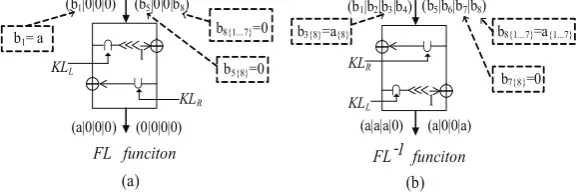
Fig. 4. Observations of F L/F L−1 Function
Observation 5 If the output difference ofF Lfunction is∆Y = (a|0|0|0|0|0|0|0), then the input difference should satisfy ∆X = (b1|0|0|0|b5|0|0|b8) withb1 =a, b5{8}= 0 andb8{1∼7} = 0, where
a is a non-zero byte (see Fig. 4. (a)).
Observation 6 If the output difference of F L−1 function is ∆X = (a|a|a|0|a|0|0|a), and the input difference∆Y = (b1|b2|b3|b4|b5|b6|b7|b8), thenb7{8} = 0,b3{8} =a{8} andb8{1∼7} =a{1∼7},
where ais a non-zero byte, bi are unknown bytes (see Fig. 4. (b)).
Observation 7 Suppose the input difference of thei-round of Camellia satisfies(∆Li−1, ∆Ri−1)
= (b1|b2|b3|b4|b5|b6|b7|b8, P(c′1|c′2|c′3|c′4|c′5|c′6|c′7|c′8)), and the output difference is (∆Li, ∆Ri) =
(a1|0|0|0|a5|0|0|a8, b1|b2|b3|b4|b5|b6|b7|b8) with a5{8} = 0 and a8{1∼7} = 0, where b′i, c′i are
arbi-trary bytes, and a1 is a nonzero byte, then the following results hold.
1. The intermediate value ∆Si =P−1(∆Li⊕∆Ri−1) = (c′1⊕a8|c′2⊕a1⊕a5⊕a8|c′3⊕a1⊕a5⊕
a8|c′4⊕a1⊕a5|c′5⊕a1⊕a5⊕a8|c′6⊕a5⊕a8|c′7⊕a5|c′8⊕a1⊕a8).
2. ∆Si(1){1∼7}=c′1{1∼7}, anda8{8} =∆S (1)
i{8}⊕c′1{8}.
3. ∆Si(7){8}=c7′{8}, anda5{1∼7} =∆Si(5){1∼7}⊕c′7{1∼7}.
4. a1 =∆Si(8)⊕c′8⊕a8.
5.2 Attack on 14-Round Camellia-256
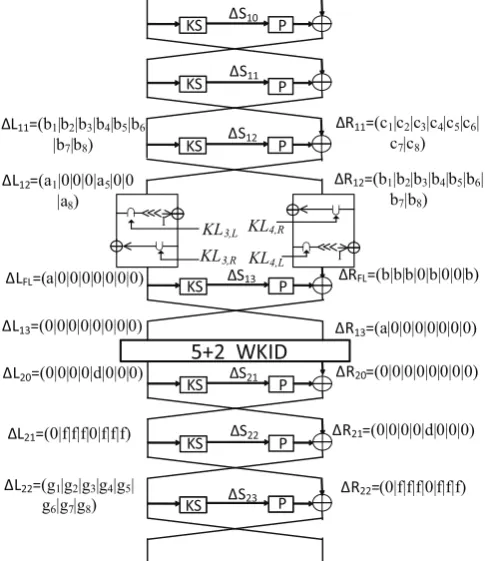
Our 14-round attack of Camellia-256, which is shown in Fig. 5 (Appendix A), works from round 10 to round 23, where the5+2 WKID is applied from round 14 to round 20.
Relation of Subkeys. First of all, we demonstrate the relation of subkeys used in the round 10, 11, 12, 13, 21, 22, 23 and the second F L/F L−1 layer (KL3, KL4) as follows.
K10 = KL{110∼128,1∼45}, K11 = KA{46∼109}, K12 = KA{110∼128,1∼45}, K13{1∼8} = KR{61∼68},
KL{29∼60},K21{33∼40}=KA{127,128,1∼6},K22=KA{31∼94}, K23=KL{112∼128,1∼47}.
With the key relation, we can first launch the impossible differential attack in weak-key set-ting, then extend it to an attack for all keys, which is similar to above attacks.
Data Collection. We choose the chosen ciphertext scenario to perform the attack and be-gin with choosing one structure of ciphertexts which contains 2120 ciphertexts:
(L23, R23) = (α1|α2|α3|α4|α5|α6|α7|α8, P(y1|β2|β3|β4|β5|β6|β7|β8)).
Where y1 is fixed, while αi (i = 1, ...,8) and βj (j = 2, ...8) take all possible values. Ask for
the decryption to get the corresponding plaintext for each ciphertext, which results in 2239 pairs which satisfy the difference:
(∆L23, ∆R23) = (f1|f2|f3|f4|f5|f6|f7|f8, P(0|g′2|g3′|g′4|g5′|g′6|g7′|g8′)).
Key Recovery.
1. Guess 130-bit value (KL{1∼47,110∼128}|KA{46∼109}),for every plaintext-ciphertext pair (P, C),
perform the following substeps.
(a) Partially encrypt the plaintext P to get the intermediate value (L11, R11). Since 38
bits of the subkey used in F L−1 function, which are KL4,R{1∼19} = KL{29∼47} and
KL4,L{1∼19} = KL{125∼128,1∼15}, have been guessed, 38-bit intermediate value R(1)F L|R(2)F L| R(3)F L{1∼3}|R(5)F L|R(6)F L|RF L(7){1,2}|R(8)F L{8} can be computed, whereRF L represents the value after
the F L−1 function.
(b) Partially decrypt the ciphertextCto get the intermediate values (L22, R22) andP−1(L22).
Note that now we can compute S22(3∼8) as the 48-bit value K22(3∼8) =KL{47∼94} is known. (c) Store the values (L11, R11) and (L22, R22) into a hash table Γ indexed by the following
143-bit values.
– R(1,5)22 ,R(2)22 ⊕R22(3),R(2)22 ⊕R(4)22,R(2)22 ⊕R(6)22,R(2)22 ⊕R(7)22,R(2)22 ⊕R(8)22. – S22(3)⊕P−1(L22)
(3)
⊕P−1(L22) (5)
,S22(4)⊕P−1(L22) (4)
⊕P−1(L22) (5)
,S22(6)⊕P−1(L22) (6)
⊕ P−1(L22)
(5)
,S22(7)⊕P−1(L22) (7)
⊕P−1(L22) (5)
,S22(8)⊕P−1(L22) (8)
.
– R(7)12{8},R(1)F L⊕(R(8)12{1∼7}|R(3)12{8}), R(2)F L⊕(R(8)12{1∼7}|R(3)12{8}), R(3)F L{1∼3}⊕R(8)12{1∼3},
R(5)F L⊕(R(8)12{1∼7}|R(3)12{8}), RF L(6),R(7)F L{1,2},RF L(8){8}⊕R(3)12{8}.
Then each two values lie in the same row of Γ form a pair that satisfies the following conditions.
– The difference ∆R22= (0|f|f|f|0|f|f|f),where f is a nonzero value.
– The differenceP−1(∆L22) = (0|g2′|g′3|g4′|g5′|g6′|g7′|g8′) satisfiesg3′⊕g5′ =∆S (3)
22,g4′⊕g5′ =
∆S22(4),g6′ ⊕g5′ =∆S22(6),g7′ ⊕g5′ =∆S22(7),g′8=∆S22(8).
– Assume the difference∆R12(equals to∆L11) is represented as (b1|b2|b3|b4|b5|b6|b7|b8),
then it satisfies b7{8} = 0, and the output difference of F L−1 function satisfies
∆R(1)F L = (b8{1∼7}|b3{8}), ∆R (2)
F L = (b8{1∼7}|b3{8}), ∆R (3)
F L{1∼3} = b8{1∼3}, ∆R (5) F L =
(b8{1∼7}|b3{8}), ∆R (6)
F L= 0, ∆R (7)
F L{1,2} = 0 and∆R (8)
F L{8} =b3{8}.
This step performs a 135-bit filtration from 2239 pairs, so the expected number of re-maining pairs is 2104.
2. Guess 12-bit valueKL4,R{20∼23,25∼32}, compute the output differences∆R(3)F L{4∼7},∆R(7)F L{3∼7}
and R(4)F L (fromb7{8} = 0 we conclude ∆R(3)F L{8} =b3{8}). Discard the pairs that do not
remaining pairs is 287.Moveover, from ∆R(4)F L = 0 and b7{8} = 0, we get ∆R (7)
F L{8} = 0 and
∆R(8)F L{1∼7} =b8{1∼7}. Therefore, at the end of this substep, all remaining pairs satisfy the
condition ∆RF L= (b|b|b|0|b|0|0|b), whereb= (b8{1∼7}|b3{8}).
3. Guess 7-bit value K22{9∼15}, compute the intermediate value ∆S (2)
22 (K22{16} (KA{46}) has
already been guessed in the step 1), and discard the pairs which do not satisfy∆S22(2) =g′2⊕g5′. Each pair will be kept with probability 2−8, so the expected number of remaining pairs is 279.
4. Compute the intermediate value P−1(∆R11) = (c1′|c′2|c′3|c′4|c′5|c6′|c′7|c′8), then perform the
following substeps.
(a) Guess 17-bit subkeys K12(1), K12(7) and K12(8){1}, calculate the value ∆S12(1,7,8) (7-bit value
K12(8){1∼7} (KA{39∼45}) has been guessed in step 3), and discard the pairs which do not
satisfy ∆S(1)12{1∼7} = c′1{1∼7} and ∆S12(7){8} = c′7{8} according to Observation 7. The
ex-pected number of remaining pairs is 271. Then we compute the value a8 =∆S12(1)⊕c′1,
a5{1∼7} =∆S12(7){1∼7}⊕c′7{1∼7} anda1 =∆S(8)12 ⊕c′8⊕a8.
(b) For i = 2 to 6, guess 8-bit subkey K12(i), compute the difference ∆S12(i) and discard the pairs which do not satisfy ∆S12(j) =c′j⊕a1⊕a5⊕a8 (j = 2,3,4), ∆S12(5) =c′5⊕a1⊕a8
and ∆S12(6)=c′6⊕a5⊕a8. Then we expect about 231 pairs remain.
5. Since all of the 128-bit value of KA have been guessed in step 1, 3 and 4, we compute the
values R21 and R′21 for every remaining pair and keep only the pairs whose ∆R (5)
21{1} = 0.
Then we partially decrypt R(5)21 and R′(5)21 to get the value ∆S21(5), keep only the pairs whose ∆S21(5) =f, which results in 222 remaining pairs.
6. Guess 17-bit valueKL3,L{1∼9} and KL (1)
3,R, compute∆L (5) F L,∆L
(8)
F L{8} and ∆L (1)
F L. Then
dis-card the pairs whose (∆L(5)F L{1∼7}|∆L(8)F L{8})̸= 0. The expected number of remaining pairs is about 214.
7. Guess 8-bit value K13(1), partially encrypt L(1)F L and L′(1)F L to get the value ∆S13(1) of every
remaining pair. If ∆S13(1) equals to ∆R(1,2,3,5,8)F L , delete this value from the list of all the 28 possible valuesK13(1).
8. After analyzing of all remaining pairs, if the list is not empty, announce that the value in the list along with above 223-bit guessed values are the candidates of 231-bit target value of subkey KA|KR{61∼68}|KL{1∼51,53∼69,93∼100,110∼128}, then recover the whole master key KL
and KRby key searching. Otherwise, try the other 223-bit guess.
Complexity. The time complexity is dominated by step 1, which requires about 5 rounds’ encryptions to compute the intermediate values for every plaintext and ciphertext pair. Then the time complexity is 2120×2130×5/14≈2248.514-round encryptions. The memory requirement is dominated by data collection, which needs 2131 bytes to store the known plaintexts and the corresponding ciphertexts. Similarly, the expected time of the attack for the whole key space is about 2250.5 14-round encryptions.
6 Conclusion
rounds of Camellia-192 and Camellia-256 that do not start from the first round, but include two
F L/F L−1 layers. Note that if the operation of one bit rotation was discarded in the F L and
F L−1 functions, the 7-round impossible differential would hold for all the keys. Therefore, we conclude that one bit rotation is greatly contributed to the security of Camellia with respect to the impossible differential attack.
References
1. Aoki, K., Ichikawa, T., Kanda, M., Matsui, M., Moriai, S., Nakajima, J., Tokita, T.: Camellia: a 128-bit Block Cipher Suitable for Multiple Platforms-Design and Analysis. In: Stinson, D.R., Tavares, S. (eds.) SAC 2000. LNCS, vol. 2012, pp. 39-56. Springer, Heidelberg (2001)
2. Aoki, K., Ichikawa, T., Kanda, M., Matsui, M., Moriai, S., Nakajima, J., Tokita, T.: Specification of Camellia-a 128-bit Block Cipher. version 2.0 (2001),
http://info.isl.ntt.co.jp/crypt/eng/camellia/specifications.html
3. Ben-Aroya, I., Biham, E.: Differential Cryptanalysis of Lucifer. J. Cryptology 9(1), 21-34 (1996)
4. Biham, E., Biryukov, A., Shamir, A.: Cryptanalysis of Skipjack Reduced to 31 Rounds Using Impossible Differentials. In: Stern, J. (ed.) EUROCRYPT 1999. LNCS, vol. 1592, pp. 12-23. Springer, Heidelberg (1999) 5. Chen, J., Jia, K., Yu, H., Wang, X.,: New Impossible Differential Attacks of Reduced-Round Camellia-192
and Camellia-256. In: ACISP 2011, LNCS 6812, pp. 16-33. Springer, Heidelberg (2011) 6. CRYPTREC-Cryptography Research and Evaluation Committees, report, Archive (2002),
http://www.ipa.go.jp/security/enc/CRYPTREC/index-e.html
7. Duo, L., Li, C., Feng, K.: Square Like Attack on Camellia. In: Qing, S., Imai, H., Wang, G. (eds.) ICICS 2007. LNCS, vol. 4861, pp. 269-283. Springer, Heidelberg (2007)
8. Hatano, Y., Sekine, H., Kaneko, T.: Higher Order Differential Attack of Camellia (II). In: Nyberg, K., Heys, H.M. (eds.) SAC 2002. LNCS, vol. 2595, pp. 129-146. Springer, Heidelberg (2003)
9. International Standardization of Organization (ISO), International Standard - ISO/IEC 18033-3, Information technology - Security techniques - Encryption algorithms - Part 3: Block ciphers (2005)
10. Kanda, M., Matsumoto, T.: Security of Camellia against Truncated Differential Cryptanalysis. In: Matsui, M. (ed.) FSE 2001. LNCS, vol. 2355, pp. 119-137. Springer, Heidelberg (2002)
11. Knudsen, L.R.: DEAL C a 128-bit Block Cipher. Technical report, Department of Informatics, University of Bergen, Norway (1998)
12. K¨uhn, U.: Improved cryptanalysis of MISTY1. In: Daemen, J., Rijmen, V. (eds.) FSE 2002. LNCS, vol. 2365, pp. 61-75. Springer, Heidelberg (2002)
13. Lee, S., Hong, S., Lee, S., Lim, J., Yoon, S.: Truncated Differential Cryptanalysis of Camellia. In: Kim, K.-c. (ed.) ICISC 2001. LNCS, vol. 2288, pp. 32-38. Springer, Heidelberg (2002)
14. Lei, D., Li, C., Feng, K.: New Observation on Camellia. In: Preneel, B., Tavares, S. (eds.) SAC 2005. LNCS, vol. 3897, pp. 51-64. Springer, Heidelberg (2006)
15. Li, L., Chen, J., Jia, K.: New Impossible Differential Cryptanalysis of Reduced-Round Camellia. To appear in: CANS 2011. (2011)
16. Lu, J., Kim, J., Keller, N., Dunkelman, O.: Improving the Efficiency of Impossible Differential Cryptanalysis of Reduced Camellia and MISTY1. In: Malkin, T.G. (ed.) CT-RSA 2008. LNCS, vol. 4964, pp. 370-386. Springer, Heidelberg (2008)
17. Lu, J., Wei, Y., Kim, J., Fouque, P.A.: Cryptanalysis of Reduced Versions of the Camellia Block Cipher. To appear in: SAC 2011. (2011)
18. Mala, H., Shakiba, M., Dakhilalian, M., Bagherikaram G.: New Results on Impossible Differential Cryptanal-ysis of Reduced-Round Camellia-128, SAC 2009, LNCS 5867, pp.281-294, Springer, Heidelberg (2009) 19. NESSIE-New European Schemes for Signatures, Integrity, and Encryption, final report of European project
IST-1999-12324. Archive (1999),
https://www.cosic.esat.kuleuven.be/nessie/Bookv015.pdf
20. Shirai, T.: Differential, Linear, Boomerang and Rectangle Cryptanalysis of Reduced-Round Camellia. In: Proceedings of 3rd NESSIE workshop (2002)
21. Sugita, M., Kobara, K., Imai, H.: Security of Reduced Version of the Block Cipher Camellia against Truncated and Impossible Differential Cryptanalysis. In: Boyd, C. (ed.) ASIACRYPT 2001. LNCS, vol. 2248, pp. 193-207. Springer, Heidelberg (2001)
22. Wu, W., Feng, D., Chen, H.: Collision Attack and Pseudorandomness of Reduced-Round Camellia. In: Hand-schuh, H., Hasan, M.A. (eds.) SAC 2004. LNCS, vol. 3357, pp. 252-266. Springer, Heidelberg (2004) 23. Wu, W., Zhang, W., Feng, D.: Impossible Differential Cryptanalysis of Reduced-Round ARIA and Camellia.
A The Illustration of Attack on 14-Round Camellia-256
KS P
KS P
5+2 WKID
∆L13=(0|0|0|0|0|0|0|0) ∆R13=(a|0|0|0|0|0|0|0)
∆L20=(0|0|0|0|d|0|0|0) ∆R20=(0|0|0|0|0|0|0|0)
∆L21=(0|f|f|f|0|f|f|f) ∆R21=(0|0|0|0|d|0|0|0)
∆L22=(g1|g2|g3|g4|g5| g6|g7|g8)
∆R22=(0|f|f|f|0|f|f|f)
∆S21
∆S22 KS P
∆LFL=(a|0|0|0|0|0|0|0) ∆S13 ∆RFL=(b|b|b|0|b|0|0|b)
KS P
KS P ∆S10
∆S11
KS P ∆S12
∆L12=(a
1|0|0|0|a5|0|0 |a8)
∆R12=(b1|b2|b3|b4|b5|b6| b7|b8)
∆L11=(b1|b2|b3|b4|b5|b6 |b7|b8)
∆R11=(c1|c2|c3|c4|c5|c6|
c7|c8)
KS ∆S23 P ∩
∩ 1
KL4,L
KL4,R
∩
∩ 1
KL3,L
KL3,R
Fig. 5. Attack on 14-Round Camellia-256
B Attack on 12-Round Camellia-192
Making use of 2+5 WKID, we mount the weak-key impossible differential attack on 12-round Camellia-192, which is from round 3 to round 14, where the2+5 WKIDis applied from round 5 to round 11. The attack procedure is similar to that of 14-round Camellia-256.
1. Choose 246.1 structures of plaintexts, and each structure contains 272 plaintexts (L
2, R2) =
(P(x1|x2|x3|x4|α|x6|x7|x8), β1|β2|β3|β4|β5|β6|β7|β8), wherexi are fixed values, α, βi take all
the possible values. Ask for the corresponding ciphertext for each plaintext. Guess 64-bit values of master keyKR{1∼64}, then the subkeyKR{65∼128}is known for every guess. Partially encrypt the plaintext to get the intermediate value (S4, L3),and decrypt the ciphertext to get
(LF L, RF L), where (LF L, RF L) represents the output value of the secondF L/F L−1 layer.
2. Store the the quartets (S4, L3, LF L, RF L) in a hash table indexed by S (5)
4 ⊕α,L
(1,2,3,4,6,7,8)
3 ,
R(5)4{1}, R(2,3,4,6,7)F L ,RF L(5){8} and R(8)F L{1∼7}, each two quarters lie in a same row form a proper pair. Thus, the expected number of proper pairs is about 246.1+143 ×2−113 = 276.1. After this step, all of the proper pairs satisfy (∆L4, ∆R4) = (0|0|0|0|0|0|0|0,0|0|0|0|d|0|0|0) and
∆RF L = (a1|0|0|0|a5|0|0|a8) with d{1} = 0, a5{8} = 0 and a8{1∼7} = 0, where a1 and d are
nonzero bytes.
guess 31-bit value KL3,R{1∼23,25∼32} and 24-bit value KL3,L{1∼23,32} to sieve the pairs which
do not satisfy ∆L12 = (b|b|b|0|b|0|0|b). Then guess 17-bit subkey (KL4,L{1∼9}, KL4,R{1∼8}) to
sieve the pairs whose (∆R(5)12{1∼7}|∆R(8)12{8})̸= 0. Finally, we discard the wrong 144-bit keys by
guessing 8-bit subkey K12(1) and checking whether there are pairs satisfy∆S12(1)=∆L(1,2,3,5,8)12 . It is expected that 2144(1−2−8)276.1−64 ≈2120 wrong 144-bit subkeys will remain, thus, it requires 2120×256= 2176 trial encryptions to search the correct key.
In total, the time complexity of the attack is about 2180.1 12-round encryptions. The memory requirement is dominated by step 1, which needs 2126.1 bytes to store the plaintext-ciphertext