Cryptanalysis of Short Exponent RSA with Primes
Sharing Least Signi…cant Bits
1
Hung-Min Sun,
1Mu-En Wu,
2Ron Steinfeld,
3Jian Guo,
2;3Huaxiong Wang
1Department of Computer Science,
National Tsing Hua University, Taiwan
2
Centre for Advanced Computing-Algorithms and Cryptography,
Department of Computing, Macquarie University, Australia
3
School of Physical & Mathematical Sciences,
Nanyang Technological University, Singapore
July 23, 2008
Abstract
LSBS-RSA denotes an RSA system with modulus primes, p and q, sharing a large number of least signi…cant bits. InISC 2007, Zhao and Qi analyzed the security of short exponent LSBS-RSA. They claimed that short exponent LSBS-RSA is much more vulnera-ble to the lattice attack than the standard RSA. In this paper, we point out that there exist some errors in the calculation of Zhao & Qi’s attack. After re-calculating, the result shows that their attack is unable for attacking RSA with primes sharing bits. Consequently, we give a revised version to make their attack feasible. We also propose a new method to further extend the security boundary, compared with the revised version. The proposed attack also supports the result of analogue Fermat factoring on LSBS-RSA, which claims thatpand qcannot share more than n
4 least signi…cant bits, wherenis the bit-length of
pq. In conclusion, it is a trade-o¤ between the number of sharing bits and the security level in LSBS-RSA. One should be more careful when using LSBS-RSA with short exponents.
Keywords: RSA, least signi…cant bits (LSBs), LSBS-RSA, short exponent attack, lattice reduction technique, the Boneh-Durfee attack.
1
Introduction
reduction technique and showed that instance of RSA with d < N0:292 should be considered insecure. Although their method is heuristic, the experiments demonstrate the e¤ectiveness of the attack.
LSBS-RSA denotes an RSA system with modulus primes sharing a large number of least signi…cant bits. This RSA variant was suggested to improve the computational e¢ ciency of server-aided signature generation [6], [21]. Steinfeld and Zheng analyzed the security of LSBS-RSA under the partial key exposure attacks in [20], and [21]. They claimed that LSBS-LSBS-RSA with small public exponent is inherently resistant to the partial key exposure attacks. This gives an advantage of using small exponent LSBS-RSA in applications. However, it does not imply that LSBS-RSA is secure against all the small exponent attacks. Zhao and Qi [25] showed that LSBS-RSA is much more vulnerable than the standard RSA against the attack by using lattice reduction technique. Here we call the Zhao-Qi attack throughout this paper. Let be the parameter such thatjp qj=r 2(1
2 )n for some odd integerr. The Zhao-Qi attack shows
that LSBS-RSA is insecure under the condition
< 16 +1312 13
q
2+ (6 + 1) +12 +1 4 ,
where and satisfyd =N and e=N , respectively. For example, if pand q share 0:2n
least signi…cant bits andetN (i.e., = 1, = 0:3), then LSBS-RSA will be insecure when
d < N0:335.
Unfortunately, we point out there exist some errors in the calculation of the Zhao-Qi attack and the errors conduct to the incorrect security boundary. After re-calculating, we …nd the polynomial that Zhao and Qi suggested cannot work for attacking LSBS-RSA exactly. In this paper, we give a revised version of the Zhao-Qi attack to make it feasible. We also provide a new method to further extend the security boundary of short exponents in LSBS-RSA. Our result shows that LSBS-RSA is insecure under the condition
< 2 3 +
5 6
4 3
q
2+ (3 2
1 2)
6 1 16 .
Take the case e tN for example, if the modulus primes share the 0:2n least signi…cant bits (i.e., = 1, = 0:3), LSBS-RSA will be insecure if d < N0:662, which is much higher than
Zhao and Qi’s boundary. Moreover, compared with the Boneh-Durfee attack [3], [4] and de Weger’s attack on RSA with small prime di¤erence [23], our result yields an improvement when primes sharing a large number of least signi…cant bits.
The remainder of this paper is organized as follows. In Section 2, we brie‡y review LSBS-RSA, lattice reduction technique, and the Zhao-Qi attack. In Section 3, we revisit the Zhao-Qi attack and point out the error in their calculation. Section 4 shows the proposed method to analyze the security boundary of short exponent LSBS-RSA. Further discussions are shown in Section 5. Finally, we conclude this paper and give some open problems in Section 6.
2
Preliminaries
2.1
LSBS-RSA and the Notation:
,
, and
An RSA system with modulus primes sharing a large number of least signi…cant bits is called LSBS-RSA. Denote an LSBS-RSA modulusN =pq as the product of two large primespand
q, withp&qshare the(12 )nleast signi…cant bits, whereq < p <2q, andnis the bit-length of N. We may write jp qj=r 2(1
1
2. In the following table we de…ne the notation , , and used in the paper.
: is the parameter such that jp qj=r 2(1
2 )n for some odd integerr
: is the parameter such thatd=N . : is the parameter such that e=N .
In addition, we de…ne the function "LSB( )". Given an integer x of m bits, whose binary representation is
(x)2= (xm; xm 1; :::xj; :::; xi; :::; x2; x1)2,
where xi = 0or 1 fori= 1; :::; m. Then,xm should be1, which is called the most signi…cant
bit ofx. x1 could be0 or1, which is called the least signi…cant bit ofx. Denote "LSBi~j(x)"
as thei-th to j-th least signi…cant bits of(x)2, wherei < j. That is,
LSBi~j(x) = (xj; :::; xi)2.
And denote "LSBi(x)" as thei-th least signi…cant bit of(x)2. That is,
LSBi(x) =xi.
The following lemma shows the exposed portion of the modulus primes if p and q share a number of least signi…cant bits.
Lemma 1 LetN =pqdenote ann-bit modulus in LSBS-RSA, where LSB1~m(p) =LSB1~m(q). There exists an algorithm to compute the LSB1~2m(p+q), LSB1~m(p), and LSB1~m(q)in time polynomial in n.
Proof. Let p = pH 2m+l and q = qH 2m+l. Thus, l is a solution to the modular
quadratic congruencex2 N (mod 2m), and it can be computed at most for 4 candidates in time polynomial inn(see Lemma 1 in [21] for more detail). Consider the identity
(p+q2 )2= (p q2 )2+N.
ReplacingpandqbypH 2m+landqH 2m+l, respectively, conducts to
LSB1~2m 2 l (pH+qH) 2m+l2 =LSB1~2m 2(N).
Note thatl is an odd integer. Thus,l 1(mod 22m 2)exists and we denote it as l 1for short.
We have
LSB1~2m 2((pH+qH) 2m) =LSB1~2m 2 l 1 (N l2) , (1)
which implies
LSB1~2m 1 p+q2 =LSB1~2m 1((pH+qH) 2m 1+l)
= LSB1~m(pH+qH)jjLSBm (pH+qH) 2m 1+l jj LSB1~m 1(l),
(2)
where "jj" denotes the symbol for concatenation. Combining (1) and (2) we can compute LSB1~2m 1 p+q2 . Thus, we have
LSB1~2m(p+q) =LSB1~2m 1 p+q2 jj 0,
which completes the proof.
Corollary 2 LetN =pq denote ann-bit modulus of LSBS-RSA, wherepandqshare the(12 )nleast signi…cant bits, i.e., LSB1~(1
2 )n(p) =LSB1~( 1
2 )n(q). Then, LSB1~( 1
2 )n(p+q), LSB1~(1
2 )n(p), and LSB1~( 1
2 )n(q), are known to the attacker.
Proof. The proof is quite easy. We just replacemin Lemma 1 by(12 )n.
Note that we should set > 14. In case of 14, which means thatpandqshare the n4 least signi…cant bits at least, the modulusN can be factored in time polynomial inn(see Corollary 1 in [21]). This result is analogue to the result of Fermat’s factoring method, which factorsN
immediately ifpandq share the n4 most signi…cant bits at least. We call the factoring attack when 14 as "Analogue Fermat factoring" in the paper.
2.2
Lattice Attack
A vector spaceL is called a lattice ifL is spanned by! linearly independent vectors, denoted as u1,u2,:::,u!2Zn, over Z. That is,
L=
( !
X
i=1
aiui jwhereai2Zand ui2Zn fori= 1,:::, !
)
.
u1, u2, :::,u! are also called the basis of latticeL. We say thatL is full rank if!=n. The
determinant of a full rank latticeL, denoted asdet (L), is equal to the determinant of thenby
n matrix whose rows are u1, u2, :::, u!. Next we show the result of the output of the LLL
algorithm, which produces a new basis of lattice Lwith the following properties.
Lemma 3 [15] Suppose thatLis a lattice with basisfu1;u2; :::;u!g. Given the inputfu1;u2; :::;u!g, LLL algorithm can produce a new basis fb1;b2; :::;b!g satisfying:
1. kbik2 2 bi+1 2fori= 1,:::, ! 1.
2. If bi=bi + iP1
j=1 i;j
bj, then j 12 for allj andi= 1,:::, !.
We call fb1;b2; :::;b!g an LLL-reduced basis of L. Here, we just mention one of the
properties of LLL-reduced basis that will be used in the paper.
Theorem 4 Let fb1;b2; :::;b!gbe an LLL-reduced basis ofL. Then,
kb1k 2
!
2 det (L) 1
!, and kb
2k 2
!
2 det (L) 1
! 1.
Coppersmith [7] took the advantage of LLL algorithm to …nd the small roots of a mod-ular equation. Suppose that the norm of a polynomial h(x; y) = Pi;jai;jxiyj is de…ned as kh(x; y)k2 = Pi;ja2
i;j. Howgrave-Graham [13] followed Coppersmith’s method to show the
following lemma, which is a powerful tool in the cryptanalysis of RSA systems.
Lemma 5 (Howgrave-Graham) Leth(x; y)2Z[x; y]be a bivariate polynomial which is a sum of at most ! monomials. Suppose that
1. h(x0; y0) = 0 (modem), wherem2N 2. kh(xX; yY)k<pem
Then h(x0; y0) = 0 holds over the integers.
The proof of Lemma 5 can be found in earlier citations, such as [7], [3], [4], [8], [9].
In the heuristic variant of the lattice attacks (with bivariatentrivariate modular polynomials) that we consider in this paper, we hope that we get two algebraically independent polynomials from the lattice. Given a modular polynomialf(x; y) = 0 (mode)with!monomials. We may construct a set of polynomials with the same root as f(x; y) = 0 (mode), and regard these polynomials as a basis of the lattice Lby representing their coe¢ cients as the vectors with !
components. Then, applying the LLL algorithm to produce the …rst two shortest vectors in LLL basis, denoted as f1(x; y) and f2(x; y), whose norms are smaller than 2
!
2 det (L) 1
! and
2!2 det (L) 1
! 1, respectively. Thus, according to Lemma 5, if we set 2!2 det (L) 1
! < pem
!, then
the root off1(x; y) (mode)andf2(x; y) (mode)also hold overZ. We then take their resultant
with respect to one of the variables to eliminate it and get a univariate equation and solve for the root in the other variable. It is a well-known technique called the lattice attack. Zhao and Qi [25] used this technique to attack short exponent LSBS-RSA. Next, we brie‡y describe their attack.
2.3
The Zhao-Qi Attack
Assume that an LSBS-RSA modulusN =pq satis…es p q =r 2(1
2 )n, where r is an odd
integer. Then,
p+q= (p q) + 2q=r 2(12 )n+ 2q. (3)
Applying (3) to RSA equation yields
ed=kh(N+ 1) 2q r 2(1
2 )n
i
+ 1.
Consider the polynomial
f(x; y; z) =x(A 2y az) + 1, (4) whereA=N+ 1, and a= 2(12 )n. Then(x0; y0; z0) = (k; q; r)is a root off(x; y; z) (mode).
De…ne X =N + 1,Y =N1
2, andZ =N , then we havejx0j< X, jy0j< Y, andjz0j< Z,
respectively.
Zhao and Qi solved the modular equation (4) by using the lattice reduction technique shown above. According to their result, the su¢ cient condition to …nd(x0; y0; z0)is
< 16 +1312 13
q
2+ (6 + 1) +12 +1
4 . (5)
Unfortunately, we …nd some error in the construction of their coe¢ cient matrix for the lattice. In the next section we correct this error and reconstruct the coe¢ cient matrix of (4) to apply the lattice reduction technique to attack LSBS-RSA.
3
Revisiting the Zhao-Qi Attack
3.1
Re-calculating the Coe¢ cient Matrix of the Zhao-Qi Attack
The errors in the calculation of the Zhao-Qi attack take place in the coe¢ cient matrix of
f(x; y; z). Note that in (4),f(x; y; z)is expressed as
In order to construct the lattice, Zhao and Qi considered the polynomials
gl;i;b(x; y; z) :=em lxiybfl(x; y; z), forl= 0; :::; m 1;i= 1; :::; m l;b= 0;1;
h0
j;l(x; y; z) :=em l(az)jfl(x; y; z), forl= 0; :::; mandj= 0; :::; t;
h00
j;l(x; y; z) :=em lyjfl(x; y; z), forl= 0; :::; mandj = 1; :::; t;
(6)
wheremandtare two parameters inN. It can be observed that(x0; y0; z0) = (k; q; r)is a root
ofgl;i;b(x; y; z), h0j;l(x; y; z), andh00j;l(x; y; z)moduloem.
We take the casem= 3,t= 1for example. According to (6), the matrix is represented as
M = Mxy 0
- Myz
,
whereMxy=
ibl x xy x2 x2y x3 x3y x2z x2y2 x3z x3y2 x3z2 x3y3
100 e3x e3X 110 e3xy e3XY 200 e3x2 e3X2
210 e3x2y e3X2Y
300 e3x3 e3X3
310 e3x3y e3X3Y
101 e2xf - - - e2aX2Z
111 e2xyf - - e2X2Y2
201 e2x2f - - - e2aX3Z
211 e2x2yf - - - e2X3Y2
102 exf2 - - - ea2X3Z2
112 exyf2 - - - eX3Y3
andMyz=
tjl 1 y z xz xy2 xz2 x2z2 x2y3 x2z3 x3z3 x3y4 x3z4
100 e3 e3
110 e3y e3Y
110 e3az e3aZ
101 e2f - e2aXZ
111 e2yf - e2XY2
111 e2azf - - - e2a2XZ2
102 ef2 - - ea2X2Z2
112 eyf2 - - eX2Y3
112 eazf2 - - - - - ea3X2Z3
103 f3 - - - a3X3Z3
113 yf3 - - - X3Y4
113 azf3 - - - a4X3Z4
Sincey2+ayz=N, all the coe¢ cients with the factor "ayz" in (6) can be replaced byN y2.
Note that we are just required to calculate the determinant ofM. Thus all the non-zero terms o¤-diagonal are ignored and denoted as the symbol "-". In this case (m = 3, t= 1), we may observe that the coe¢ cient vectors of the terms e2xf, e2x2f, exf2 in M
xy, and e3az, e2f,
e2azf, f3,azf3 inM
yz are di¤erent from those of the terms in the matrix of Table 1 in [25].
We have to point out that Zhao and Qi ignored the parameter a= 2(1
2 )n in the coe¢ cient
vector when they constructed the coe¢ cient matrix of (6). Next, we re-calculate the boundary of their attack from the corrected determinant. The determinants ofMxy, andMyz are
det(Mxy) = e
m(m+1)(2m+1)
3 a
m(m2 1)
6 X
m(m+1)(2m+1)
3 Y
m(m+1)(m+2)
6 Z
m(m2 1) 6
det(Myz) = e
m(m+1)(2t+1)
2 a
(m+1)(m+t)(t+1)
2 X
m(m+1)(2t+1)
2 Y
t(m+1)(m+t+1)
2 Z
(m+1)(m+t)(t+1)
Sincedet(M) = det (Mxy) det (Myz), we have
det(M) = (eX)m(m+1)(46m+6t+5) (aZ)
m(m2 1)+3(m+1)(m+t)(t+1)
6 Y
m(m+1)(m+2)+3t(m+1)(m+t+1)
6 .
Applyinge=N ,a= 2(1
2 )ntN12 ,X =N + 1,Y =N12, andZ=N yields
det(M) = N(2 + 1)m(m+1)(46m+6t+5)+12
(m+1)(m2 +2m+3mt+3t2 +3t)
6 +12
(m+1)(m2 +2m+3mt+3t2 +3t) 6
= N(2 + 1)m(m+1)(46m+6t+5)+
(m+1)(m2 +2m+3mt+3t2 +3t)
6 .
Note that the parameter is eliminated by reducing the term aZ in the calculation. Thus the determinant of M is dominated by and . This implies that if we set det(M) < em!
(ignore the constant term) to satisfy the requirement in Lemma 5, where ! is the dimension of the lattice, then it will conduct to the security boundary of using short private and public exponents. In the other words, the result of the Zhao-Qi attack is independent of the number of primes sharing bits. It simply yields the result of the Boneh-Durfee attack [3], [4].
As a result, we conjecture that the Zhao-Qi attack is unable for attacking RSA with prime sharing bits. Next, we try to revise the attack to make it feasible.
3.2
The Zhao-Qi Attack Revised
According to Corollary 2, LSB1~(1
2 )n(p)can be computed e¢ ciently in polynomial time in
n. We may denoteq=qe 2(1
2 )n+q0 and replace y byy 2( 1
2 )n+q0 in (4). Then, (4) is
transformed to
f0(x; y; z) =x[(A 2q0) 2ay az)] + 1,
whereA=N+ 1, anda= 2(1
2 )n. Then(x0; y0; z0) = (k;eq; r)is a root off0(x; y; z) (mode).
Note that the size of the root y0 is reduced when compared with that of f(x; y; z). In fact,
since the sizes ofeqandrare about nbits, we may further simplify f0(x; y; z)to
f00(x; y) =x[(A 2q0) ay)] + 1 (mode), (7)
with the root (k;2qe+r) (mode). The problem of solving (7) is similar to the Small Inverse Problem introduced in 1999 by Boneh and Durfee [3], [4]. However, we do not deal with this polynomial here, instead of considering another polynomial which will yield a better boundary. We show the detail in the next section.
4
Proposed Attack
According to Corollary 2, LSB1~(1 2 )n(p+q)is known to attackers in an LSBS-RSA system.
In this seciton we take this advantage to further extend the boundary of the revised Zhao-Qi attack. Denote
p+q= 2(1 2 )n+ 0,
where 0 =LSB1~(1 2 )n(p+q), and is an unknown number of(2 12)nbits. Thus, the
RSA equation can be derived to
Consider the modular equation
f (x; y) =x(B by) + 1 (mode), (8) where B =N+ 1 0, b=a2= 2(1 2 )n, then(x
0; y0) = (k; )is a root of f(x; y) (mode).
De…ne X=N + 1, Y =N2 1
2, we havejx0j< X, and jy0j< Y. Note that the form of the
modular equation (8) is the same as the form in (7). In particular, the upper bound Y in (8) is much smaller than that in (7). This is the reason why we use the polynomial (8) instead of using (7) to attack short exponent LSBS-RSA, because the boundary derived from (8) will be better than the boundary derived from (7). However, this is not enough. We further simplify the equation (8) by multiplying( b) 1 (mode)(note that this inverse exists sincebis a power
of2 whileeis odd). The advantage is that the coe¢ cient of the leading monomialxyis1 and hence we remove the powers of b from the determinant of the lattice and allow larger while satisfying the determinant inequality.
Consequently, we get the alternative polynomial having (x0; y0) = (k; ) as a zero root
moduloe, that is
f(x; y) =xy+B0x+C0 (mode), (9) whereB0=B( b) 1(mode)andC0 = ( b) 1(mode). We construct the lattice by considering
the polynomials
gi;l(x; y) := xifl(x; y)em l (modem), forl= 0,:::,m;i= 0,:::,m l;
hj;l(x; y) := yjfl(x; y)em l (modem), forl= 0,:::, mandj= 1,:::,t.
Take the case m= 3,t= 1, for example. The coe¢ cient matrix for this case isM =
ijl 1 x xy x2 x2y x2y2 x3 x3y x3y2 x3y3 y xy2 x2y3 x3y4
000 e3 e3 100 xe3 e3X
001 f e2 - - e2XY
200 x2e3 e3X2 101 xf e2 - - e2X2Y 002 f2e - - - eX2Y2
300 x3e3 e3X3
201 x2f e2 - - e2X3Y
102 xf2e - - - eX3Y2
003 f3 - - - X3Y3
010 ye3 e3Y
011 yf e2 - - e2XY2
012 yf2e - - - - - eX2Y3
013 yf3 - - - - - - - - - X3Y4
Let Mx and My denote the matrices with the coe¢ cient vectors of gi;l(x; y) and hj;l(x; y),
respectively. We have
det(Mx) = e
m(m+1)(m+2)
3 X
m(m+1)(m+2)
3 Y
m(m+1)(m+2) 6
det(My) = e
tm(m+1)
2 X
tm(m+1)
2 Y
t(m+1)(m+t+1)
2 .
ApplyingX =e + 1, andY =e2 1=2 to (10) yields
det(Mx) = e
m(m+1)(m+2)
3 +(
+ 1 m(m+1)(m+2)
3 )+(
2 1=2 m(m+1)(m+2)
6 )
= em(m+1)(3 m+2)(2+ + 5=4
)
det(My) = e
tm(m+1)
2 +(
+ 1 tm(m+1)
2 )+(
2 1=2 t(m+1)(m+t+1)
2 )
= etm(m2+1)(2+
1)+(2 1=2 t(m+1)(m+t+1)
2 ).
Note that if we only consider thex-shift,i.e.,gi;l(x; y), to satisfy the requirement in Lemma
5 we have to set det(Mx)< em!x, where!x = (m+1)(m+2)2 is the dimension ofMx. Thus, we
have
m(m+1)(m+2)
3 2 +
+ 5=4
< m (m+1)(m+2)2 . (11) Simplifying (11) yields
+ <5
4 2. (12)
Note that for the usual case( = 12, = 1), we may attack RSA when < 14, which achieves the same boundary as the Wiener attack [24].
Moreover, we further include they-shift,i.e.,hj;l(x; y), to our attack. By settingdet (M) =
det(Mx) det(My)< em!, where!=(m+1)(m+2)2 +t(m+ 1)is the dimension ofM, we have m(m+1)(m+2)
3 2 +
+ 5=4
+tm(m+1)2 2 + 1 + 2 1=2 t(m+1)(m+t+1)2
< m(m+1)(m+2)2 +tm(m+ 1), which leads to
m(m+2) 3
1 2+
+ 5=4
+tm2 1+ 2 1=2 t(m+t+1)2 <0, (13) After simplifying the left hand side of (13) as a quadratic polynomial with variablet we get
h
2 1=2i
t2+hm 1+ (m+ 1)2 1=2i t+h2m(m+2)3 (12+ + 5=4)i<0. (14) Note that the left hand side of (14) would be minimized at
t=
m 1+(m+1)2 1=2
2 2 1=2
= [m( 1)+(m+1)(24 1 1=2)] =(32 2 )m 2 + 1 2
4 1 . (15)
Plugging (15) in (14) yields
h
2 1=2 2
i (3
2 2 )m 2 +12
4 1
2
+hm 21 + (m+ 1)2 21=2i (32 2 )m 2 +12
4 1
+ h2m(m+2)3 (12+ + 5=4)i<0.
(16)
Multiplying (16) by2 yields
2 12 (32 2 )m 2 +12
4 1
2
+ m( 1) + (m+ 1) 2 12 (32 2 )m 2 +12
4 1
After simplifying the …rst term and the second term we have
1 2(4 1) (
3
2 2 )m 2 + 1 2
2 1 4 1 (
3
2 2 )m 2 + 1 2
2
+ h2m(m+2)3 (2 + + 54)i<0.
Combining the …rst term and the second term we get
1 2(4 1) (
3
2 2 )m 2 + 1 2
2
+h2m(m+2)3 (2 + + 54)i<0
which is simpli…ed to
2m(m+2)
3 (2+ + 5
4) 2 (4 1))< ( 3
2 2 )m 2 + 1 2
2
.
Thus, we get the inequality
(2 + 4 + 4 5) (4 1)<3 (
3
2 2 )m 2 + 1 2
2
m(m+2) =
3 (3 2 2 )
2 m+ 1 2m 2 1+2 m . (17)
Asmgoes to in…nity, (17) becomes
(2 + 4 + 4 5) (4 1)<3 32 2 2. (18) We give more discussions in the next section.
5
Further Discussions
5.1
The Summary of Our Attack
In conclusion, the boundary that our attack can succeed is
< 23 +56 43
q
2+ (3 2
1 2)
6 1 16 ,
where 14 12. For the case = 1, we have the boundary
<23 +56 43
q
2+ 5
16. (19)
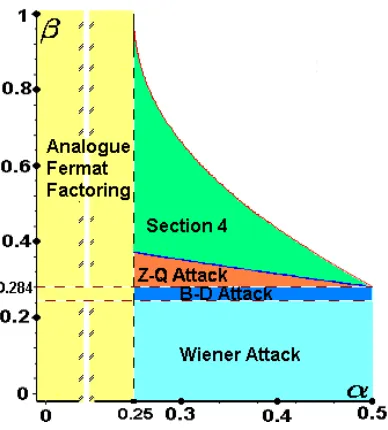
The curve of (19) is shown in Fig 1. We also show the other attacks, which includes the Wiener attack, Boneh-Durfee attack, and the Analogue Fermat factoring. As can be seen in Fig 1, ifp
and qshare the n
4 least signi…cant bits at least,i.e., 0:25, the Analogue Fermat factoring
can factorN e¢ ciently. The Wiener attack and the Boneh-Durfee attack (short for B-D attack) work in the case < 1
4 and <0:284, respectively. We should point out in B-D attack [3],
[4], Boneh and Durfee use the geometrically progressive matrices to eliminate the larger terms in the coe¢ cient matrix, and thus the upper bound is further extended from d < N0:284 to
Figure 1: Insecure Region of and for which LSBS-RSA with = 1.
5.2
Experiments
We have performed the experiments on a server containing Intel processors of 2:4 GHz Core
2 Quad, with 2 GB Memory. The lattice basis reductions are done using Shoup’s NTL [14]. We have to mention that, like the Boneh-Durfee attack, our attack is also heuristic since the resultant computations may fail even with low probability. Also, we just experimented for the samples on LSBS-RSA with short private exponent, and etN (i.e., t1). Note that the size of1024bits, or2048bits for the modulus are often used in the current computational environment. However, we just experimented for the size of128bits for the reason of simplicity. The experimental results are shown in the following.
n d m t Rank of
Lattice
Running Time
Advantage over Z-Q Attack
128bits 0:275 90bits 0:704 5 12 93 36sec 43bits
128bits 0:300 77bits 0:607 5 7 63 9:5sec 31bits
128bits 0:350 61bits 0:478 5 3 39 3:0sec 17bits
128bits 0:425 45bits 0:350 5 2 33 0:7sec 5bits
The entries for in the table are the tested values for which the attacks succeeded. As can be seen in the last column of the table, our attacks achieved the higher bounday than the one of the Zhao & Qi’s attack. In addition, we have to point out that considering LSBS-RSA with
= logN(e) = 1:0 = 0:9 = 0:86 = 0:8 = 0:7 = 0:6 = 0:55
= 0:5 0:284 0:323 0:339 0:364 0:407 0:452 0:476 = 0:4 0:437 0:468 0:480 0:500 0:534 0:571 0:590 = 0:3 0:662 0:681 0:688 0:700 0:721 0:743 0:754
= 0:25 1 1 1 1 1 1 1
Table 1: The upper bound or lower bound of for which our attack can succeed in LSBS-RSA.
5.3
Further Improvement
To further extend the boundary of our attack, we may focus on the approximation to p+q. Generally, p+q is estimated as 2dpNe. Sun, Wu, & Chen [18] proposed a method, called
EPF, to estimate the most signi…cant bits of p+q. With this technique, we may reduce the quantity of Y in (8) and this may conduct to a better boundary of LSBS-RSA for security. More precisely, suppsoe that p+q is estimated as E, with the error j(p+q) Ej < 2m,
wherem < n2, then the RSA equation can be represented as
ed=x[(N+ 1) ( E+y)] + 1,
where x0 = k, and y0 < 2m are two unknown numbers. The above equation gives us a
motivation to combine de Weger’s result [23] with our attack. Next, we brie‡y describe it.
5.4
LSBS-RSA with Small Prime Di¤erence
Recall thatp q=r 2(1
2 )n, for some integerr. In general, the quantity of ris about2 n.
Here we consider the case that bit-length of ris much smaller than n. This means pand q
share a number of the most signi…cant bits. The cryptanalysis of this RSA modulus had been analyzed by de Weger [23]. We suppose thatpandqshare the M most signi…cant bits, which
impliesp q <2n2 M, and share the
L least signi…cant bits, which implies p q=rL 2 L
for some integerrL. Thus,p qcan be represented as
p q=rL 2 L, where rL<2
n
2 ( M+ L).
And then,p+qcan be computed from the identity:
(p+q)2= (p q)2+ 4N =r2L 22 L+ 4N.
Using the representation of p+qabove may yield a better boundary for the lattice attack on this kind of RSA variant. However, we do not show the detail here but leave it in the full version.
6
Conclusion and Future Work
In this paper, we point out the error in the coe¢ cient matrix of the Zhao-Qi attack. To repair their method, we re-calculate the determinant of the coe¢ cient matrix that Zhao and Qi suggested in [25]. However, the result shows that the Zhao-Qi attack is unable for attacking RSA with prime sharing bits. We give a revised version for their attack to make it feasible. In addition, we also propose a method to further extend the security boundary of short exponents in LSBS-RSA. Our result shows that LSBS-RSA is getting more vulnerable as smaller exponents or more number of primes sharing bits.
primes randomly in order to produce desired public and private exponents. Up to now it is still an open problem to design such scheme to achieve balanced short exponents RSA with prime sharing a large number of least (or most) signi…cant bits. Conversely, the cryptanalysis of such RSA variant, if it exists, is worth to research as well.
Although LSBS-RSA is bene…cial to the computational e¢ ciency in several applications, such as server-aided signature generation [6], we have to indicate using LSBS-RSA also raises the risk in the security [20], [21], [23], [25]. We believe it is a trade-o¤ between the e¢ ciency and the security level, and thus one should be more careful in using such RSA variants.
References
[1] D. Boneh, G. Durfee and Y. Frankel, “An Attacks on RSA Given a Small Fraction of the Private Key Bits,” Advanced in Cryptology – ASIACRYPT ’98, LNCS 1514, Springer-Verlag, pp.25-34, 1998.
[2] D. Boneh, G. Durfee and Y. Frankel, “Exposing an RSA Private Key Given a Small Fraction of its Bits,” Full version of the work from Asiacrypt’98, available at
http://crypto.stanford.edu/~dabo/abstracts/bits_of_d.html, 1998.
[3] D. Boneh and G. Durfee, “Cryptanalysis of RSA with private keyd less than N0:292. In
proceedings Eurocrypt’99, LNCS, vol. 1952, Springer-Verlag, pp. 1-11, 1999.
[4] D. Boneh and G. Durfee. Cryptanalysis of RSA with private keydless thanN0:292,”.IEEE Transactions on Information Theory, 46(4):1339–1349, July 2000.
[5] J. Blömer and A. May, “New Partial Key Exposure Attacks on RSA,”Advanced in Cryp-tology –CRYPTO’03, LNCS 2729, Springer-Verlag, pp.27-43, 2003.
[6] M. Bellare and P. Rogaway, “The exact security of digital signatures: How to sign with RSA and Rabin”, Advanced in Cryptology – EUROCRYPTO’96, LNCS 1070, Springer-Verlag, pp.399-416, 1996.
[7] D. Coppersmith, “Finding a Small Root of a Bivariate Integer Equation; Factoring with High Bits Known”, Proceedings of Eurocrypt’96, LNCS 1070, pp. 178–189, 1996.
[8] J-S. Coron, “Finding Small Roots of Bivariate Integer Polynomial Equations Revisited”, Advanced in Cryptology – EUROCRYPTO’04, LNCS 3027, Springer-Verlag, pp.492-505, 2004.
[9] J-S. Coron, “Finding Small Roots of Bivariate Integer Polynomial Equations: A Direct Approach,”Advanced in Cryptology –CRYPTO’07, LNCS 4622, Springer-Verlag, pp.379-394, 2007.
[10] G. Durfee, P. Q. Nguyen, “Cryptanalysis of the RSA Schemes with Short Secret Exponent form Asiacrypt ’99,” Advances in Cryptology-Asiacrypt’00, LNCS 1976, Springer-Verlag, pp.1-11, 2000.
[11] M. Ernst, E. Jochemsz, A. May, B. de Weger, “Partial Key Exposure Attacks on RSA up to Full Size Exponents,” Advanced in Cryptology – EUROCRYPT’05, Springer-Verlag, pp.371-386, 2005.
[13] N. Howgrave-Graham, “Finding small roots of univariate modular equations revisited,”in Proceedings of Cryptography and Coding, LNCS, vol. 1355, Springer-Verlag, pp.131-142, 1997.
[14] Victor Shoup. NTL: A Library for doing Number Theory, online available at
http://shoup.net/ntl
[15] A. Lenstra, H. Lenstra, L. Lovasz, “Factoring Polynomials with Rational Coe¢ cients,” Mathematiche Annalen 261, pp.515-534.
[16] H.-M. Sun, W.-C. Yang and C.-S. Laih, “On the design of RSA with short secret exponent”, Proceedings of Asiacrypt’99, LNCS 1716, pp. 150–164, 1999.
[17] H.-M. Sun and C.-T. Yang. RSA with balanced short exponents and its application to entity authentication.Public Key Cryptography - PKC 2005, volume 3386 ofLecture Notes in Computer Science, pp. 199–215. Springer, 2005.
[18] H.-M. Sun, M.-E. Wu, and Y.-H. Chen, “Estimating the Prime Factors of an RSA Modulus and an Extension of the Wiener Attack,” in Proc. Applied Cryptography and Network Security 2007 — ACNS’07, ser. Lecture Notes in Computer Science, J. Katz et al., Eds. Heidelberg: Springer, 2007, vol. 4521, pp. 116-128.
[19] R. Rivest, A. Shamir and L. Aldeman, “A Method for Obtaining Digital Signatures and Public-Key Cryptosystems”, Communications of the ACM , Vol. 21, No.2, pp.120-126, 1978.
[20] R. Steinfeld, and Y. Zheng, “An Advantage of Low-Exponent RSA with Modulus Primes Sharing Least Signi…cant Bits,”inTopic in Cryptology - CT-RSA 2001, ser. Lecture Notes in Computer Science, D. Naccache, Ed. Heidelberg: Springer, 2001, vol. 2020, pp. 52-62.
[21] R. Steinfeld, and Y. Zheng, “On the Security of RSA with Primes Sharing Least-Signi…cant Bits,”Appl. Algebra Eng. Commun. Comput., Heidelberg: Springer, 2004, vol. 15, no. 3(4), pp. 179-200.
[22] E. R. Verheul and H. C. A. van Tilborg. Cryptanalysis of ‘less short’RSA secret exponents.
Appl. Algebra Eng. Commun.
[23] B. de Weger, “Cryptanalysis of RSA with small prime di¤erence”,Applicable Algebra in Engineering, Communication and Computing, Vol. 13, pp. 17-28, 2002.
[24] M. J. Wiener. Cryptanalysis of short RSA secret exponents. IEEE Trans. Information Theory, 36(3):553–559, May 1990.