Identication and Privacy: Zero-Knowledge is
not Enough
?Julien Bringer1, Herve Chabanne1 and Thomas Icart1;2
1Sagem Securite 2Universite du Luxembourg
Abstract. At rst glance, privacy and zero-knowledgeness seem to be similar properties. A scheme is private when no information is revealed on the prover and in a zero-knowledge scheme, communications should not leak provers' secrets.
Until recently, privacy threats were only partially formalized and some zero-knowledge (ZK) schemes have been proposed so far to ensure pri-vacy. We here explain why the intended goal is not reached. Following the privacy model proposed by Vaudenay at Asiacrypt 2007, we then re-consider the analysis of these schemes and thereafter introduce a general framework to modify identication schemes leading to dierent levels of privacy. Our new protocols can be useful, for instance, for identity documents, where privacy is a great issue.
Furthermore, we propose ecient implementations of zero-knowledge and private identication schemes based on modications of the GPS scheme. The security and the privacy are based on a new problem: the Short Exponent Strong Die-Hellman (SESDH) problem. The hardness of this problem is related to the hardness of the Strong Die-Hellman (SDH) problem and to the hardness of the Discrete Logarithm with Short Exponent (DLSE) problem. The security and privacy of these new schemes are proved in the random oracle paradigm.
1 Introduction
Contactless communications are used in many contexts: RFID tags, public transportation cards, electronic wallets or electronic passports. As these communications are based on radio frequency technology, it is often very simple to eavesdrop communications and even to impersonate a verier. This doing, an adversary could either get personal information or track someone at range.
In order to protect the users' privacy, it is necessary to encrypt com-munications between devices and readers. To do so, an identication
scheme must be used to authenticate the device and to set up a session key. Many such schemes have been proposed so far, either based on sym-metric cryptosystems [3,8,12,24,31,33,50] or asymsym-metric cryptosystems [15,17,20,35,37,41].
Among the few existing privacy models for identication devices { Juels and Weis [25], Burmenster, van Le and de Medeiros [28] and Vau-denay [48] { we choose to work with the latter as it is more general. Thereafter, we prove the soundness and the privacy of our new schemes by further adapting its model to take into account ZK specicities.
In this paper, we propose a general toolkit to achieve dierent lev-els of privacy for these schemes. We introduce three kinds of modica-tions to ZK schemes. Two of them need provers' identity to be hidden, whereas the last one can be used even when identities are public. Specic cryptographic techniques are associated to these modications. The rst modication is secure under the random oracle model [7], the second one requires a non-malleable [10] encryption scheme. The third modication is secure under the random oracle model and the Strong Die-Hellman (SDH) assumption (cf. [1]).
We also introduce the notion of public-identity privacy. The area of identity documents is an interesting example for this notion. In order to prove the authenticity of the information written on the document, an authentication protocol has to be used, for instance a proof of knowledge of an information written on the passport. Nevertheless this information cannot be considered as private. These documents are very frequently copied in order to keep traces of the owner, for instance in hotels or duty free area. Our goal is to obtain schemes where an eavesdropper cannot determine or trace any document even if he is aware of the valid identities. For instance, a classical Zero-Knowledge scheme cannot be public-identity private as the identity is enough to verify the validity of the protocol transcript.
1.1 Related Works
Zero-knowledge proofs have been introduced in [19] and zero-knowledge identication schemes in [11]. This kind of scheme is very interesting as it enables to perform an interactive proof of knowledge of secrets without revealing information. Many identication schemes have been developed and they are now envisaged in the context of travel documents. For in-stance, GPS and GQ [20] protocols have been proposed as identication schemes for passports in [32]. However, we prove that without modica-tions, such schemes do not respect privacy. In fact, this is not surprising since these protocols are not aimed at keeping the language secrets.
One idea in our propositions is to use veriers' public keys in order to ensure the privacy of the provers' outputs. Therefore the Verier is able to verify the authenticity of the prover thanks to his private key. Designated-Verier Signature (DVS) schemes have been introduced in [23] and introduce the same idea. As the aim of this paper is to nd private identication scheme, we do not investigate whether the proposed schemes can be transformed into a DVS scheme.
Depending of the scheme, a DVS scheme can be transformed into an identication scheme. There exist dierent types of DVS schemes: pri-vately veriable and publicly veriable. The publicly veriable schemes [23,29,43] have the property that given the public keys of the signer and the verier, one can verify the signature. In this case, it is possible to identify the prover during the identication process. [40,27] are examples of privately veriable DVS scheme. A weakness has been shown in [29] which implies that these schemes cannot be forward-private: given the secret of the signer, it is possible to determine whether he signs the mes-sage or not. We analyze the privacy of the scheme [40] in Appendix B([27] cannot be turned into a ZK identication scheme).
1.2 Outlines
The paper is organized as follows: Section 2 describes the identication schemes studied in this paper in a general way and illustrates the lack of privacy for these schemes. Section 3 recalls Vaudenay's model and explains our modications to it. Section 4 denes the computational as-sumption used in the paper. Section 5 denes our proposal of modied identication schemes to achieve privacy. Section 6 deals with the eec-tive privacy and security of these schemes. Section 7 presents the outlines of the GPS scheme and the dierent modication applied on it. Section 8 deals with the possible implementations and compares the computation costs and the security for the dierent GPS based schemes. Section 9 concludes. Appendix A gives some details on the Section 2. Appendix B analyzes the privacy of two identication schemes in Vaudenay's model. Appendix C describes a possible modication of Vaudenay's model. Ap-pendix D, E, F and G proves the security of the dierent schemes de-scribed in this paper. Appendix H describes another possible application of our work.
2 Zero-Knowledge and Identication Schemes
2.1 General Description
Among the dierent classes of identication protocol (ZK or closely re-lated), Fiat-Shamir-like as [11,14,20,30,35,37], Schnorr-like as [15,17,34,41], Syndrome-Decoding-like [44,45,49] or others (e.g. [11,36,42,46]), we re-strict ourselves to those based on arithmetic relations. We formalize such schemes as follows. Let P be a three-moves identication protocol be-tween a prover and a verier. Let [A; c; B] a transcript of P with A; B sent by the prover and c by the verier after reception of A. The protocol needs several algorithms:
{ SetupAuthority(1k) 7! (KAs; KAp): a polynomial algorithm which
outputs a private/public key pair for an authority. KAp denes the
group structure used in the scheme.
{ SetupProverKAp(1k) 7! (s; I): a polynomial algorithm which
out-puts a private/public key pair of a prover. s is the secret linked to the identity I thanks to a one-way function Id: Id(s) = I.
{ ComputeAs;KAp() 7! (A; rA): used to compute A thanks to a random
{ ComputeBs;KAp(rA; c) 7! B: a polynomial algorithm used to
com-pute B.
{ Verify(I; [A; c; B]) 7! x 2 f0; 1g: a function that checks whether the verier identies the prover with I.
This last algorithm checks if the following equation holds:
f(B) = A:gI(c) (1)
where f and gI are two deterministic functions that depend on KAp;
the identity I of the prover is needed to compute gI. Moreover, to avoid
computation of B without the knowledge of s, f is one-way; more precisely the function lI;A;cwhich maps B to A:gf(B)I(c) is a one-way trapdoor function:
to compute eciently B such that lI;A;c(B) = 1, it is necessary to know
the secret s and the value rA.
Remark 1. A scheme can be multiple-round as if for instance c is a single bit. However, to resist to replay attacks, it is necessary to have exponen-tially many possible veriers' outputs. In this paper, we focus on one-round protocols, but our analysis can be easily generalized to multiple-round protocols. A typical setting is c in1; : : : ; 2l . If gI is injective, two
dierent c lead to two dierent couples (A; B), therefore the probability of success of a replay attack is negligible if l is large enough.
Denition 1. A scheme is sound if there exists an extractor E which can retrieve a secret of one prover given several transcripts of the form [A; ci; Bi].
This denition means that if an adversary is able to identify himself, he is in possession of a valid secret.
Denition 2. A scheme is called honest-verier ZK if there exists a simulator S able to simulate a protocol instance given the prover's identity I and a challenge c, i.e. such that S(c; I) outputs a pair A and B, where [A; c; B] is a valid transcript identifying I.
If such a simulator exists, a legitimate verier cannot retrieve information on the secret. Indeed, because he is honest, he chooses c independently of A. As a consequence, once he has just chosen a c, if we are allowed to come back in the past and modify A to A0, the c sent by the verier is the
and these values can be used in the protocol. This simulation is perfect if the simulator's outputs are indistinguishable from the legitimate prover's outputs. As the simulation has been made without the secret, veriers have no advantage on the prover's secret.
2.2 Example of Privacy Leakage
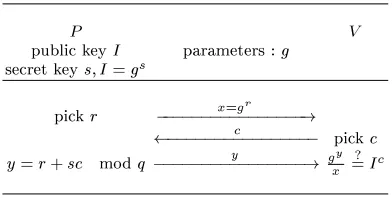
We here explain through an example why this kind of ZK schemes do not respect privacy even if identities are hidden. Consider the Schnorr Iden-tication scheme [41]: SetupAuthority outputs a pair (KAs; KAp).
KAp denes a group G, with a generator g of order q, where the
dis-crete logarithm is a hard problem. SetupProver randomly chooses s in f1; : : : ; q 1g and outputs (s; I = gs). ComputeA outputs (A = gr; r)
where r is random and ComputeBs;KAp(r; c) = r + sc mod q.
Ver-ify(I; [A; c; B]) checks whether gB= A:Ic. Here, f(B) = gB and gI(c) =
Ic.
When a prover P proves his knowledge of the secret s related to his identity I = gs(cf. Figure 1), an eavesdropper can record [A; c; B].
Therefore, he is able to recover Ic as gBA 1. If he captures transcripts
from another prover, this eavesdropper gets dierent I0c0
and c0.
Comput-ing (Ic)c0
and (I0c0
)c pairwise, the eavesdropper has a way to distinguish
whether the provers have the same identity or not, even if the group order is unknown (In the case where the group order is known, I can be easily retrieve). Therefore, this scheme is traceable. Moreover, with several cou-ples (ci; Ici), one can compute I using the Bezout identity as gcd ((ci)i)
is certainly 1.
P V
public key I parameters : g secret key s; I = gs
pick r x=gr !
c pick c
y = r + sc mod q y ! gxy = I? c
Fig. 1. Schnorr identication scheme
The same holds for other identication schemes where gI is an
share the same weakness in regard of the respect of privacy. This leakage is also valid for every generalization of these schemes, such as GQ2 [37], Ong-Schnorr [35], Okamoto [34], a generalization of Fiat-Shamir [30], a generalization of Schnorr over RSA rings [15].
3 Vaudenay's Model
We recall in this section the model for privacy, correctness and soundness as described in [48]. Note that we slightly modify it in Section 3.2 in or-der to include zero-knowledgeness and to distinguish cases when provers' identities are public or hidden.
Following [48], we consider that provers are equipped with Contact-Less Device (CLD) to identify themselves. This device may either be RFID tags or contact-less smartcards. CLDs are transponders identied by a unique Serial Number (SN). Nevertheless, during the identication phase, a random virtual serial number (vSN) is used to address them, for instance as dened in the ISO/IEC 14443-3 standard [21]. CLDs can per-form usual basic cryptographic functions. For instance, hash calculations [13], pseudo random generation [39] and public key encryption [2,4,9,16]. Furthermore, we assume CLDs can be compromised.
3.1 Description of the Model
In the model, an identication protocol is dened as functionalities, rstly to setup the system made of a verier and several CLDs, secondly to run a protocol between CLDs and veriers.
Setup Algorithms.
{ SetupAuthority(1k) 7! (KAs; KAp) outputs a private/public key
pair of an authority.
{ SetupVerifierKAp() generates a private/public key pair (KVs, KVp),
possibly none. This pair can be used to protect communication be-tween CLDs and veriers.
{ SetupCLDSecretKAp(SN) returns the parameters of the CLD
iden-tied by SN. This algorithm outputs a couple (s; I) where s is the private key of the CLD, I its public key and identity.
{ SetupCLDStateKVp(SN; s; I) returns S, some data to initialize the
internal memory of the CLD.
{ SetupCLDKVp(SN) rst uses SetupCLDSecret then
Remark 2. As SetupCLDSecretKAp does not use KVp to compute s
and I, the knowledge of KVsdoes not leak any information on the secret
s. For instance, if KAp denes a group of generator g where the
Compu-tational Die-Hellman assumption holds, if the pair (KVs; KVp) is (v; gv)
for a random v and if I = Id(s) = gs, the knowledge of v does not leak
information on s.
Communication Protocol P. The identication protocol between a CLD and a verier is made of messages sent by the two parties. At the end of the protocol, the verier checks the result. In this paper, we focus on the three-pass protocols described in Section 2.
Oracles. To formalize possible actions of adversaries, dierent oracles are dened to represent ways for adversaries to interact with veriers or CLDs, or to eavesdrop communications. The use of dierent oracles leads to dierent privacy levels.
Given a public key KVp, the adversaries have access to:
{ CreateCLD(SN): creates a CLD with serial number SN initialized via SetupCLD. At this point, it is a free CLD, i.e. not yet in the system.
{ DrawCLD(distr)7!( (vSN1,b1),...,(vSNn,bn)): this oracle moves a
ran-dom subset of CLDs from the set of free CLDs into the set of drawn CLDs in the system. Virtual serial numbers (vSN1,...,vSNn), used to
identify the drawn CLDs, are randomly chosen according to the dis-tribution distr. If bi is one, this indicates whether a CLD is used in
the system. This oracle creates and keeps a table of correspondences T where T (vSN)=SN. Adversaries have no knowledge of this table T . { Free(vSN): moves the drawn CLD vSN to the set of free CLDs. { Launch() 7! : makes the verier launch a new protocol instance . { SendVerifier(m; ) 7! m0 (resp. SendCLD(m0; ) 7! m): sends the
message m to the verier (resp. m0 to the CLD) who responds m0
(resp. m) in the protocol instance .
{ Result() 7! x: when is a complete instance of P, it returns 1 if the verier succeeds in identifying a CLD from and 0 otherwise. { Corrupt(vSN)7! S: returns the internal state S of the CLD vSN.
Types of Adversaries.
{ Strong adversary is allowed to use a priori all of the above oracles. { Destructive adversary destroys the CLDs it corrupts. Therefore,
{ Forward adversary cannot use any oracle after one Corrupt query, i.e. destructs the system when he corrupts one CLD.
{ Weak adversary is not allowed to use the Corrupt oracle. { Narrow adversary is not allowed to use the Result oracle.
This denes 8 kinds of adversaries because Narrow adversaries may also have restriction on the use of the Corrupt oracle. For instance, an adversary can be narrow and forward, he is then denoted narrow-forward. Three security notions are dened in this model: correctness, sound-ness and privacy.
Denition 3. A scheme is correct if the identication of a legitimate CLD fails only with negligible probability.
Soundness. The denition of soundness below deals with active adver-saries. Active adversaries are able to impersonate veriers, CLDs and to eavesdrop and modify communications. This property is useful for privacy (cf. Lemma 1). Soundness of ZK schemes is already widely studied, even against active adversaries, see for instance [6]. Nevertheless, this denition is very specic to the model above.
Denition 4. A scheme is sound if any polynomially bounded strong adversary cannot produce a protocol instance of a communication lead-ing to a positive result of the oracle result, but with a negligible prob-ability. must neither be equal to some eavesdropped protocol transcript between a legitimate CLD and a legitimate verier nor lead to the identi-cation of a corrupted CLD.
Remark 3. Obviously it means that a scheme is not sound if an adversary is able to modify on the y outputs from a prover without aecting the identication result. Moreover, even if not addressed by the denition, replay attacks must be mitigated, that is why the probability that a le-gitimate verier outputs twice the same values in a complete protocol instance should be negligible.
then there is a privacy leakage. A game with three phases is imposed. In the rst phase, A has access to the whole system using oracles. In a second phase, the hidden table T constructed via DrawCLD oracle is transmitted to A. In a third phase, A, which is no longer allowed to use the oracles, outputs its result. A scheme is dened as private if for any game, all adversaries are trivial (see Def. 6).
Denition 5. A blinded adversary uses simulated oracles instead of the oracles Launch, SendVerifier, SendCLD and Result. Simulations are made using an algorithm called a blinder denoted B.
To simulate oracles, a blinder has access neither to the private database nor to the secret key KVs. We denote AB the algorithm A when executed
using the blinder instead of legitimate oracles.
Denition 6. An adversary is trivial if there exist a blinder B such that the dierence jPr [A wins] PrAB wins is negligible, i.e. he makes no
clever use of the oracles.
Hence, to prove privacy, it suces to prove that an adversary cannot distinguish between the outputs of the blinder B and outputs made by legitimate oracles. As stated in [48], this denition of privacy is more general than anonymity and untraceability. As there are 8 kinds of ad-versaries, there are 8 dierent notions of privacy. In the sequel, we will always mention which notion we refer to.
Note that Corrupt queries are considered to always leak informa-tion on CLDs' identity. For instance, an adversary can systematically open CLDs in order to track them. In this model, such an adversary is considered as a trivial one because a blinded adversary will succeed the same way, as the Corrupt oracle is not simulated. Strong privacy is dened only to ensure that CLDs cannot be tracked using their outputs even if their secrets are known.
The following lemma established by Vaudenay in [48] emphasizes the link between soundness and privacy:
Lemma 1. A scheme sound and narrow-weak (resp. narrow-forward) private is weak (resp. forward) private.
3.2 Adaptation of the Model for ZK Identication Schemes
Zero-Knowledgeness. Privacy implies that an adversary gains no ad-vantage over the identity of CLD (nor on anything else in the system). Nevertheless, we still want to prove that even legitimate veriers do not have any advantage on the CLD's secret. The dierence between adver-saries and legitimate veriers is that legitimate veriers know the secret KVswhile adversaries or provers are unaware of it. To prove the privacy, it
is necessary to perfectly simulate CLDs' outputs from an adversary point of view. In the case where KVs is not used, for instance in the schemes
described in Section 2.1, it is equivalent to a verier point of view; which is not the case when KVs is needed. However our setup algorithms are
dened to ensure that secret s and KVs are independent (cf. Remark 2).
A simulator against a honest verier is thus authorized to use KVs to
simulate CLDs' outputs, as it gives it no advantage on s. In ne, the denition of honest-verier ZK schemes remains unchanged from Def. 2 but the use of KVs will be considered in the security analysis of our
modied schemes (cf. Section 6.2 and Appendix D.3).
New Adversaries: Hidden-Identity and Public-Identity.
A hidden-identity adversary does not have the list of identities chosen during the setup phase initiated by the multiple calls to SetupCLD. A public-identity adversary has access to this list. In the following, we precise HI for hidden-identity if identities stay hidden, and PI for public-identity if they are public.
4 Computational Assumptions
In the following, we will note G a group structure. We assume that G is cyclic and that its {possibly unknown{ order is q. We call g one generator of this group. The Discrete Logarithm(DL) problem can be dened as:
{ Given g and ga in G with a randomly chosen in [0; :::; q 1],
{ Compute a.
The discrete logarithm with short exponent (DLSE) problem is the usual DL problem but with short exponents instead of normal ones. It has been introduced in [47]. For instance, a is a random element in [0; :::; S 1] where S is smaller than q. This denes the DLSE(S) prob-lem.
{ Given g; ga and gb with a and b randomly chosen in [0; :::; q 1],
{ Compute gab.
There exists a similar problem where the exponents are short. This prob-lem is called the Short Exponent Computational Die-Hellman (SECDH) problem and has been introduced in [26]. It is made of two subproblems: the (short,full)SECDH problem and the (short,short)SECDH problem, following that only a is a short exponent and b is a random full expo-nent or a and b are short expoexpo-nents. We call it (S1; S2)SECDH problems
for a S1 and b S2. As a result, it is proved in [26] that the
prob-lems (S; S)SECDH and (q; S)SECDH are hard if and only if CDH and DLSE(S) problems are hard.
Let us dene the Decisional Die-Hellman (DDH) problem:
{ Given g, ga, gb with a and b randomly chosen in [0; :::; q 1],
{ Given gc= gab with probability 1=2 and gc= gdwith probability 1=2
with d randomly chosen in [0; :::; q 1], { Decide whether gab equals gc.
The hardness of the DDH problem implies the hardness of the CDH problem. As for the CDH problem, the SEDDH problem is dened in [26]. It is also made of two subproblems according to the fact that a is short or a and b are short. The hardness of the (q; S)SEDDH problem and (S; S)SEDDH problem are equivalent to the hardness of the DLSE(S) problem combined with the hardness of the DDH problem. Let us now introduce a DDH oracle ODDH
a :
{ Given g; gd with d randomly chosen in [0; :::; q 1]
{ Given g1, an element of G
{ Returns whether gad equals g 1.
This oracle ODDH
a solves the DDH problem associated to a.
The Strong Die-Hellman (SDH) problem is dened as:
{ Given g; ga and gb with a and b randomly chosen in [0; :::; q 1],
{ Given access to the oracle ODDH a
{ Compute gab.
Denition 7. We dene the (S1; S2) Short Exponent Strong
{ Given g; ga and gb with a randomly chosen in [0; :::; S
1 1] and b
randomly chosen in [0; :::; S2 1],
{ Given access to the oracle ODDH a
{ Compute gab.
As far as we know, this is the rst denition of the SESDH problem.
Proposition 1. Assume the hardness of the SDH problem and the hard-ness of the DLSE(S) problem, assume q > 2S, then the (q; S)SESDH problem is hard.
Proof. First, we need to prove a lemma. We dene an oracle ODLSE
S ,
which as inputs (g; ga) determines whether a is in [0; S 1]. As a
re-mark, this oracle can be transformed into the oracle ODLSE
S0 for S0 =
S
smaller than S and for integer. This is possible because ODLSE
S0 (g; ga) =
ODLSE
S (g; ga).
Lemma 2. Assume q > 2S, assume there exists an oracle ODLSE S , then
DLSE(S) can be solved in log2(S) calls to ODLSE
S .
Sketch of the proof. We describe an algorithm A which inputs g; ga; S and
outputs a if a in [0; S 1]. We assume S is a power of 2 to simplify the proof.
Algorithm A. INPUT=(g; ga; S), OUTPUT=a.
If gais not in [0; S 1], we stop the algorithm. If gais the neutral element,
then we output 0. Otherwise, if g2a is in [0; S 1], we output A(g; ga;S 2)
else we output S2 + A(g; ga S=2;S 2).
It is clear that this algorithm terminates in at most log2(S) calls to the oracle ODLSE
S and outputs a. ut
Now assume there exists an oracle OSESDH
S which solves in polynomial
time the (q; S)SESDH problem. As input, it receives g; ga; gb and ODDH
a .
We assume this oracle outputs an answer even if the inputs are not a valid (q; S)SESDH problem instance but a SDH problem instance. We distinguish two cases:
1. either this oracle solves the usual SDH problem with a non negligible probability,
2. or it solves the SDH problem with a negligible probability.
In the latter, we can transform the OSESDH
S into an ODLSES oracle: Given
{ We randomly choose b in [0; q 1] and we compute gb. As we have
chosen b, we can simulate the oracle ODDH
b .
{ We execute OSESDH
S (g; gb; ga; ODDHb ) which outputs gu.
{ If gu = gab, a is in [0; S 1], else a is bigger than S.
This algorithm is a ODLSE
S oracle. As demonstrated in the lemma, this
implies that the DLSE(S) problem can be solved in polynomial time. For these reasons, the hardness of the (q; S)SESDH problem is ensured by the hardness of the SDH problem and the DLSE problem. ut
We do not manage to prove the hardness of the (S; S)SESDH and (S; q) SESDH problems. Nevertheless, these problems seem hard under the same assumption. We do not deal with the Small Exponent Gap Die-Hellman (GDH) problem as we do not have application for this problem in this paper. It can be proved equivalent to the GDH problem and the DLSE problem with a similar proof.
5 General Toolkits for Privacy
In the model presented previously, there exist non trivial narrow-weak adversaries against identication schemes as the ones dened in Section 2.1, even with hidden-identities (cf. Sec 2.2). We describe here general methods to enhance privacy of these schemes. We state their correctness, soundness, privacy and zero-knowledgeness properties in the next section.
5.1 Setup Algorithms
The SetupAuthority is the algorithm of the original scheme as de-ned in Section 2.1. KAp denes a group G which is the group structure
used in the identication process. If there exists a generator, we denote it g. Its order is possibly unknown. The SetupVerifierKAp algorithm is
described in Section 3. The SetupCLDSecretKAp algorithm uses
Se-tupProver as dened in Section 2.1 and SetupCLDStateKVp outputs
the initial state S = (KAp; KVp; s).
5.2 Modication of Identication Schemes
Appendix H. We start with a protocol P as dened in Section 2.1. In the sequel, we assume that gI is an exponential function in base I (as it is
the case for Fiat-Shamir-like schemes or Schnorr-like schemes).
Modication 1: Classical Introduction of the Random Oracle [7] This well-known modication is simply to change the rst message into its hash. Let H be a random oracle. The verier possesses a list L of the form f: : : ; (I; SN); : : :g. This list is kept hidden. The protocol can be described as follows:
1. the CLD uses ComputeAs;KAp() 7! (A; rA) and outputs H(A),
2. the verier sends a random c to the CLD,
3. the CLD uses ComputeBs;KAp(rA; c) 7! B and outputs B.
A verier should check amongst identities I in L whether H(f(B)gI(c) 1)
and H(A) are equal. We prove in the sequel that this modication gives a HI weak private protocol, HI sound and ZK (this last property is already known).
Modication 2: Use of an Encryption Scheme Let (EKVp; DKVs)
be an encryption scheme. We suggest to use this scheme to cipher the rst message sent to the verier. The verier possesses a list L of the form f: : : ; (I; SN); : : :g and this list is kept hidden. The protocol can be described as follows:
1. the CLD uses ComputeAs;KAp() 7! (A; rA) and outputs EKVp(A),
2. the verier sends a random c to the CLD,
3. the CLD uses ComputeBs;KAp(rA; c) 7! B and outputs B.
A verier should check amongst identities I in L whether DKVs EKVp(A)
. gI(c) is equal to f(B). If the encryption scheme is semantically secure [18]
(IND-CPA), the modication leads to a narrow-strong private1 protocol
and ZK. Furthermore, if the encryption is non-malleable [10] (NM-CPA), the modication gives HI soundness and HI forward privacy.
Modication 3: a Public-Identity Private Protocol We present here a modication in order to obtain a PI forward private protocol, PI
1 Strong adversaries against privacy are able to get all the secrets of any CLD, so PI
sound, ZK and narrow-strong private. This modication is more specic: we assume that there exists a generator g of G and that KAp denes
an exponent e. We use the pair (v; gv) as (KVs; KVp) and the random
oracle H. The group structure must ensure the hardness of the SDH problem. Furthermore, we assume that ComputeAs;KAp() outputs (A =
(ge)rA; rA). The verier possesses a list L of the form f: : : ; (I; SN); : : :g
and this list is public. The protocol can be described as follows:
1. the CLD uses ComputeAs;KAp() twice to obtain (A1; r1) and (A2; r2),
computes Av
1 = (gv)er1, Av2 = (gv)er2 and outputs A1, H(A1; A2; Av1;
Av 2),
2. the verier sends a random c to the CLD,
3. the CLD uses ComputeBs;KAp(r1+ r2; c) 7! B and outputs B.
A verier computes A0
2 = Af(B)1gI(c) for identities I in L and checks whether
H(A1; A02; Av1; A0v2) equals H(A1; A2; Av1; Av2) using his secret v. This
tech-nique is illustrated in the Section 7 over the GPS scheme.
This modication has some similarities with the scheme in [22]. Firstly, a Die-Hellman key is used as input of the hash function. Secondly, al-most all the computations can be made oine and do not reveal infor-mation on the secret of the prover. Nevertheless the scheme in [22] is not sound and not forward-private in the model. This dierence exists because we used two Die-Hellman keys in the hash, linked to the nal output of the CLD.
We discuss in Appendix C about the possibility to modify the simula-tion of the Result oracle to get, with this modicasimula-tion, a strong private scheme.
6 Security Properties
In the sequel, we assume I is a generator of G and f is a bijection. All the proofs are detailed in the Appendix D. Note rst that the modications 1,2 and 3 in 5 keep the correctness of the original scheme.
6.1 Narrow Privacy
To prove narrow-weak privacy, it is sucient to perfectly simulate any CLD without having any identity of tags.
{ If H is a random oracle then Modication 1 denes a HI narrow-weak private scheme.
{ If EKVp is IND-CPA secure then the Modication 2 denes a PI
narrow-strong private scheme.
{ If H is a random oracle and if the SDH assumption holds then Mod-ication 3 denes a PI narrow-strong private scheme.
This is the best narrow-privacy achievable for this construction. For Modication 1, if one CLD is corrupted, its identity is retrieved and it is possible to identify it thanks to protocol instances. For modications 2 and 3, an adversary who does not know the verier's secret is not able to distinguish between simulated tags and legitimate tags even if he has all tags' secrets.
6.2 Zero-Knowledgeness
Narrow-privacy implies that no adversary is able to have an advantage on the identities. This property also implies that adversaries have no advantage over secrets as there exists a deterministic function Id such that Id(s) = I. Therefore, whatever the adversaries's strategy, they fail getting information on the secret just by eavesdropping or interrogating tags. Nevertheless, it diers from ZK so it is necessary to prove that legitimate veriers cannot nd information on these secrets:
Theorem 2. Assume there exists a simulator S(c; I) to the original sche-me, then it can be transformed into a simulator Si(c; I) for the
tion i. Hence, if the original scheme is honest-verier ZK, then modica-tions 1, 2 and 3 dene honest-verier ZK schemes.
Note that S3 uses the key KVs to simulate tags' outputs.
6.3 Soundness
Theorem 3. Assume the soundness of the original scheme.
{ If H is a random oracle and identities are kept hidden, then Modi-cation 1 denes a sound scheme.
{ If EKVp is NM-CPA secure and the identities are kept hidden then
Modication 2 denes a sound scheme.
Note that for Modication 2 with only IND-CPA encryption scheme, an adversary could modify a ciphertext. For instance, if the scheme is re-randomizable, an adversary can modify the encrypted part without changing the clear text. In this case, he is in possession of a ciphertext which has a non trivial relation with the original one. This could lead to a valid transcript, which means we cannot reach soundness.
Compared to Modication 2, identities can be public in Modi-cation 3. The main reason is that an adversary will need to know the couples (I; Iv) to be able to impersonate the identity I, whereas we can
prove that computing Iv is here as hard as the SDH assumption. In fact,
Modication 3 is a kind of generalization of Modication 1 with com-putations made in the two bases g and gv at the same time.
6.4 Privacy
Theorem 4. Assume the soundness of the original scheme.
{ If H is a random oracle then Modication 1 denes a HI weak private (and not forward) scheme.
{ If EKVp is NM-CPA secure then Modication 2 denes a HI forward
private scheme (and not destructive).
{ If H is a random oracle and if the SDH assumption holds then Modi-cation 3 denes a PI forward private scheme (and not destructive).
These results are due to Theorems 1, 3 and the Lemma 1. This is the best privacy achievable for this construction. Modication 1 cannot lead to a forward private scheme because whenever the secret from a CLD is discovered thanks to the Corrupt oracle, all the outputs of this CLD can be traced.
Modications 2 and 3 are not destructive private because we can prove there exists a way to compute transcripts such that the Result oracle cannot be simulated on them.
7 Variations Around the GPS Scheme
More precisely, we have shown that information leak on the identity of the prover involved in such schemes.
The GPS scheme falls in the scheme we have described in Section 2.1. For this reason, the modications presented in Section 5 lead to dierent schemes. We here describe the explicit schemes.
7.1 The original GPS Scheme
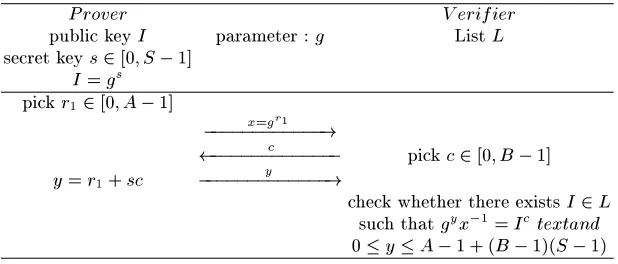
The computations are made over a group G. Let g be a basis element of G. Dene three integers A, B and S. To be secure, GPS needs a group where the DLSE(S) problem is hard. The parameter B is related to the security against replay attack. Finally, A is related to the zero-knowledgeness of the scheme. The scheme is described in Figure 2.
P rover V erifier
public key I parameter : g List L
secret key s 2 [0; S 1] I = gs
pick r12 [0; A 1]
x=gr1
!
c pick c 2 [0; B 1]
y = r1+ sc y !
check whether there exists I 2 L such that gyx 1= Ic textand
0 y A 1 + (B 1)(S 1)
Fig. 2. GPS scheme
Each prover has an identity I and a secret s smaller than S with I = gs. Because the DLSE(S) problem is hard, computing s given I = gs
is infeasible. The aim of the GPS scheme is to enable a prover to prove his knowledge of the secret associated to his identity. Furthermore, this proof is made in order to leak no information on his secret to the verier. In a rst step, the prover randomly chooses r1 in [0; A 1]. Then he
computes x = gr1 and he sends this value to the verier. The verier sends
a challenge c randomly chosen in [0; B 1]. The prover responds with y = r1+ sc. This computation is made without any modular reduction,
0 y A 1 + (B 1)(S 1). If these two conditions are veried, the prover is identied.
7.2 Modication 1: Hashed GPS
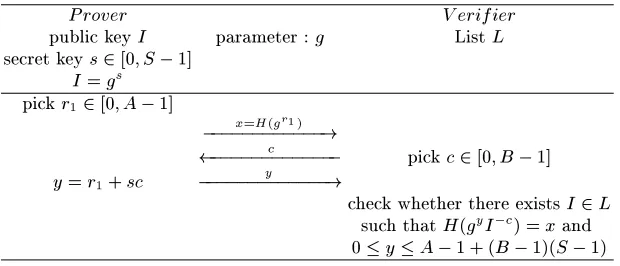
In [17], a trick is used in order to decrease the total amount of bits sent by the prover. It is possible to slightly modify the scheme using a pseudo-random function H with outputs length of l bits. The scheme is described in Figure 3.
P rover V erifier
public key I parameter : g List L
secret key s 2 [0; S 1] I = gs
pick r12 [0; A 1]
x=H(gr1) !
c pick c 2 [0; B 1]
y = r1+ sc y !
check whether there exists I 2 L such that H(gyI c) = x and
0 y A 1 + (B 1)(S 1)
Fig. 3. Hashed GPS
The dierence is that the rst message is no more gr1 but H(gr1). For
instance, if H is SHA-256, the rst message is just 256-bit long instead of 1536-bit long. Nevertheless, this gain is counterbalanced as it implies that more computations are needed during the identication process (two hash computations are needed, one on the prover side and one on the verier side).
To guarantee the security, the length of the hashed values must be bigger than B. In this case the probability to get pre-images of the func-tion is bigger than the probability to succeed in impersonating provers through a replay attack. The authors of [17] suggest B = 232 and 50-bit
long hash values.
As a result of the previous sections, we have the following lemma: Lemma 3. Assume the hardness of the DLSE(S) problem, assume H is a random oracle and assume BS
A is negligible then the hashed GPS is
7.3 Modication 2: Randomized GPS
In the sequel, we assume that the verier possesses a pair of key (gv; v)
where v is a private random exponent while gv is public. Depending on
the application, this value could be stored on the prover side or sent at the beginning of the identication process. In order to guarantee its legitimacy, it should be sent signed by an authority. As a result of the previous section:
Lemma 4. Assume the hardness of the DLSE(S) problem, the hardness of the DDH problem and assume BSA is negligible then Randomized GPS is sound against passive adversary, statistically ZK and narrow-strong private.
P V
public key I parameters : g; gv secret key v
secret key s 2 [0; S 1] List L
I = gs
pick r12 [0; S 1]
pick r22 [0; A 1] A1=g
r1;A2=(gv)r1gr2
!
c pick c 2 [0; B 1]
y = r2+ sc y ! Compute
I = (gyAv1
A2 )
1=c and
Check if I 2 L and
0 y A 1 + B(S 1)
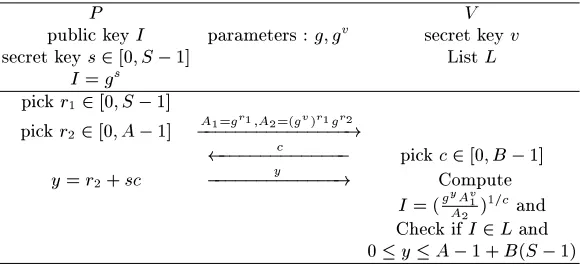
Fig. 4. Randomized GPS
Proofs can be easily deduced from the proof of the modication 2 in Section 5.
The dierence with the original GPS scheme is that we compute an encryption of gr2 thanks to the El Gamal scheme with small exponent.
This encryption scheme is IND-CPA if the SEDDH is a hard problem. If an NM-CPA encryption scheme is used, the privacy is enhanced to the HI forward privacy.
In this model, this scheme cannot be proved sound against active adversary because an adversary can compute oine a protocol transcript. This is possible because there exists a simulator of the GPS scheme. This simulator enables to compute y and A = gr2 from I and c. Then the
adversary of the Randomized GPS scheme can randomly choose r1 in
7.4 Modication 3: Randomized Hashed GPS
As for the GPS scheme, it is possible to minimize the amount of bits sent thanks to a hash function H. The use of this function increases the soundness and the privacy of the scheme.
Lemma 5. Assume the hardness of the DLSE(S), the hardness of the SDH problem, assume H is a random oracle and assume BS
A is negligible
then Randomized hashed GPS is public-identity forward private, sound against active adversaries, narrow-strong private and statistically ZK.
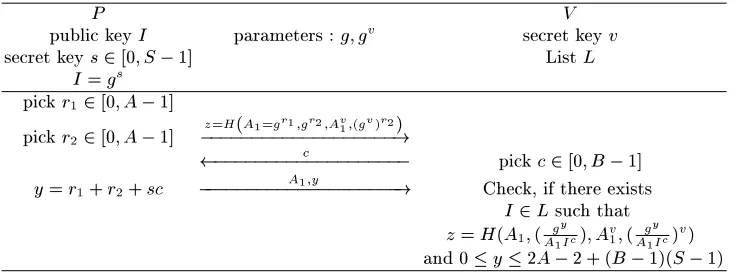
Even if the proof of this lemma is similar to the proof of the modication 3, we rewrite it in order to prove that the choice of the parameter, especially the size of the exponent, is appropriate. The proof is in Appendix E and Appendix F. The computation needed during the scheme can be
P V
public key I parameters : g; gv secret key v
secret key s 2 [0; S 1] List L
I = gs
pick r12 [0; A 1]
pick r22 [0; A 1]
z=H(A1=gr1;gr2;Av1;(gv)r2!)
c pick c 2 [0; B 1]
y = r1+ r2+ sc A1;y ! Check, if there exists
I 2 L such that z = H(A1; (Ag1yIc); Av1; ( g
y
A1Ic)
v)
and 0 y 2A 2 + (B 1)(S 1)
Fig. 5. Randomized Hashed GPS
summarized(cf. Fig 5):
1. the prover randomly chooses r1 in [0; A 1] and r2 in [0; A 1],
2. the prover computes A1 = gr1, Av1 = (gv)r1, A2 = gr2 and Av2 = (gv)r2,
3. the prover sends H(A1; A2; Av1; Av2) and keeps A1 and r1+ r2 in
mem-ory,
4. the verier sends a random c in [0; B 1], 5. the prover sends A1 and r1+ r2+ sc
6. the verier checks whether z = H(A1;Ag1yIc; Av1; ( g y
A1Ic)v) and 0 y
If the verication succeeds, the prover is identied. Furthermore, Av 1 can
be a semi-static Die-Hellman key and can be used later to derive a session key.
As the scheme is now public-identity forward private, it could be used in common applications where identities are public. Moreover if they are sent by the provers on a covert channel (think of the Machine Readable Zone (MRZ) on identity documents) which cannot be eavesdrop, then the verication is simplied as the search in the list is not needed.
8 Implementations Issues
In this section, we rstly describe the parameters size and the possible trick to optimize the schemes. Secondly, we describe two possible adap-tations of the randomized hashed GPS to get new properties.
8.1 Practical Implementation Setting
Parameters Description We describe two typical sets of parameter. Firstly, G is a subgroup of Zp where p is a prime integer of 1536 bits.
There must exist a prime integer q of at least 160-bit long that divides p 1. Let g be an element of order q and G is the group generated by g. In this implementation, S is 2160. Computing a discrete logarithm
in basis g of exponent smaller than S is assumed to require more than 280 multiplications over G. Depending on the desired level of security,
B can lie in 232; 2160. The probability of success of a replay attack is 1
p
B. Finally, A must be greater than B S 280 to ensure the
zero-knowledgeness. For instance, B = 280 gives A = 2320.
Secondly, G is the group of point of an elliptic curve Ep over Fp where
p is a 160-bit long prime. This group have a prime group order q. The values of A = 2320; B = 280 and S = 2160 can still be used. With this
setting, it is not useful to use short exponents.
Precomputations for the GPS Scheme It is essential to nd the best way to implement the schemes in order to provide a fast identication process. It is necessary to nd solutions to accelerate the computation as computational power can be limited on some devices.
Instead of computing at each identication H(gr1) as described in
(r1; H(gr1)). These couples are referred as coupons. Therefore, at each
identication, the prover only computes r1+ sc. Usually r1 is the output
of a pseudo-random function which has a seed as input. It is thus possible to store r1 eciently. Instead of storing the rst part of all the coupons,
it is possible to store only the seed used in the pseudo-random function and to update it each time. Consequently, each coupon has the size of its hash value. If 4 KBytes of memories can be allocated to the storage of coupons with coupons of 50-bit long, this leads to 640 coupons stored.
Precomputations for the Randomized Hashed GPS Scheme The previous idea can be applied to the Randomized hashed GPS scheme. It is possible to precompute multiple H(A1; A2; Av1; Av2) associated with one
seed as in the above section. Depending on the underlying group structure, it is possible to store A1. For instance, with elliptic curves over group
of order of 160 bits, a group element can be represented with 161 bits. Therefore, a coupon with a hash output of 50-bit long requires 211 bits of memory. It is noticeable that in this case no elliptic curve computation is needed on the CLD, but only two additions and one multiplication over the integer and one update of the seed.
If the underlying group is Fp with p a 1536-bit long prime number, it
does not seem realistic to store many A1. In this case, the CLDs needs
to be able to compute A1. Nevertheless, this trick enables to decrease
the computation needed. For instance with B = 232, S = 2160 and A =
S B 280= 2272, the computations needed are just an exponentiation
of 272 bits instead of an exponentiation of 4 log2(A) = 1048 bits.
8.2 Adaptation of the Randomized Hashed GPS
A Version Enabling Mutual Authentication In this paper, we con-sider that CLDs are aware of the public key gv. In an application, this
public key can be previously sent accompanied by a certicate coming from an authority. In order to ensure a mutual authentication in these schemes, it is possible to slightly modify the Randomized Hashed GPS as in [22]. Nevertheless we need to add one move to our protocol. We assume that the CLD can use two dierent hash functions H1and H2. In this case,
the CLD can compute H1(A1; A2; Av1; Av2) and H2(A1; A2; Av1; Av2). In the
rst move it sends H1(A1; A2; Av1; Av2), in the second it receives a
chal-lenge c in the third it sends A1and y. In the new forth move, it receives a
value z0 and check whether H
2(A1; A2; Av1; Av2) = z0. This authentication
A private Scheme Enabling Fast Identication In a context where no covert channel exists, the prover's identity is unknown to the verier. One would prefer that the identication does not need as many compu-tation as the size of the list of identities. It is possible to achieve such a scheme. Randomized hashed with encryption GPS uses the asymmetric encryption scheme DHIES described in [1]. Its security is based on the SDH assumption and on the security of a symmetric encryption scheme (E; D) which should be IND-CCA2 [5]. DHIES is also IND-CCA2. We chose DHIES because it can be very eciently inserted in Randomized Hashed GPS scheme.
DHIES relies on the El Gamal scheme. The public/private key pair is of the form (gv; v). To encrypt a message M:
1. a random exponent r is chosen, 2. A = gr and Av = (gv)r are computed,
3. K = H(Av) is computed
4. (A; EK(M)) is the ciphertext of M.
To decrypt:
1. Av is computed thanks to A and v,
2. K = H(Av) is computed
3. DK(EK(M)) is computed.
This scheme is secure under the SDH assumption or under the (q; S) SESDH assumption if r is always chosen smaller than S. The proof is totally equivalent to the one in [1], because the two problems have indis-tinguishable instances if the DLSE(S) problem is hard.
Lemma 6. Assume the hardness of the (q; S)SESDH problem, assume H is a random oracle, assume BSA is negligible, assume (E; D) is IND-CCA2 then Randomized hashed with Encryption GPS is public-identity forward private, sound against active adversaries, narrow-strong private and statistically ZK.
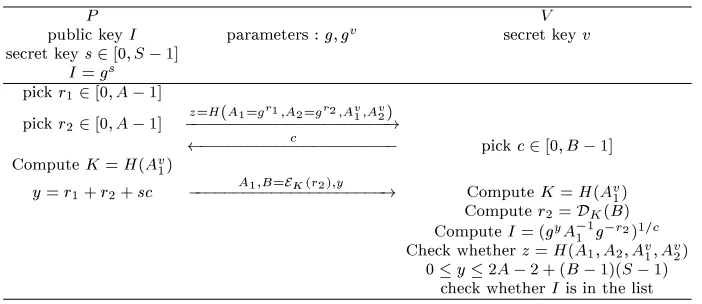
Proof are in Appendix G. In the Figure 6, we describe the resulting scheme.
P V
public key I parameters : g; gv secret key v
secret key s 2 [0; S 1] I = gs
pick r12 [0; A 1]
pick r22 [0; A 1] z=H(A1=g
r1;A2=gr2;Av 1;Av2)
!
c pick c 2 [0; B 1]
Compute K = H(Av 1)
y = r1+ r2+ sc A1;B=EK(r2);y ! Compute K = H(Av1)
Compute r2= DK(B)
Compute I = (gyA 1 1 g r2)1=c
Check whether z = H(A1; A2; Av1; Av2)
0 y 2A 2 + (B 1)(S 1) check whether I is in the list
Fig. 6. Randomized hashed with encryption GPS
8.3 Comparisons
Table 1 summarizes the computation needed for CLDs during the iden-tication. Furthermore, it sums up the soundness and the privacy of the schemes. PA and AA for passive and active adversary. A,B and S are the parameters dened for all the schemes in this paper. l is the length of the output of the hash function when it is needed. In this table, the compu-tation column represents the number of bits of exponentiation needed by the prover.
Scheme Assumption Soundness Privacy Computations Size of coupon (in bits) +Computations GPS DLSE(S) PA Not private log2(A)
Hashed GPS DLSE(S) HI AA HI weak log2(A) log2(l)
Randomized GPS (S; q)SEDDH PA Narrow-Strong 2 log2(S) + log2(A)
Randomized (q; S)SESDH PI AA Narrow-Strong 4 log2(A) log2(l)
hashed GPS PI forward log2(A)
Randomized hashed GPS (q; S)SESDH PI AA Narrow-Strong 4 log2(A) log2(A)
with encryption PI forward Encryption of log2(A) Encryption of log2(A)
Table 1. Comparisons of schemes
9 Conclusion
transform general ZK schemes into private schemes, following the desired privacy.
We also suggest several ecient identication schemes that are zero-knowledge and public-identity private. To be ecient, these schemes use short size exponents. Their securities are thus based on the (full,short) SESDH problem, a new problem equivalent to a combination of the SDH and DLSE problems.
These schemes ensure dierent levels of security. They increase the privacy of the original GPS scheme, thanks to a small amount of compu-tations. They can be used in real life applications to preserve the privacy of the owners' device.
The Randomized hashed GPS scheme seems well suited for identity documents. For instance, is seems possible to write the cryptographic identity on the document in order to transmit this public value by an op-tical covert channel. The scheme could be used in order to prove the au-thenticity of the document. As randomized hashed GPS is public-identity forward private, owner's identity is not revealed by the contactless devices.
Acknowledgments We are grateful to Jean-Sebastien Coron to help us with the SESDH problem.
References
1. Michel Abdalla, Mihir Bellare, and Phillip Rogaway. The oracle Die-Hellman assumptions and an analysis of DHIES. In David Naccache, editor, Topics in Cryptology - CT-RSA 2001, The Cryptographer's Track at RSA Conference 2001, San Francisco, CA, USA, April 8-12, 2001, Proceedings, pages 143{158. Springer, 2001.
2. Jean-Philippe Aumasson, Matthieu Finiasz, Willi Meier, and Serge Vaudenay. TCHo: A hardware-oriented trapdoor cipher. In Josef Pieprzyk, Hossein Gho-dosi, and Ed Dawson, editors, Information Security and Privacy, 12th Australasian Conference, ACISP 2007, Townsville, Australia, July 2-4, 2007, Proceedings, pages 184{199. Springer, 2007.
3. Gildas Avoine, Etienne Dysli, and Philippe Oechslin. Reducing time complexity in RFID systems. In Bart Preneel and Staord E. Tavares, editors, Selected Areas in Cryptography, 12th International Workshop, SAC 2005, Kingston, ON, Canada, August 11-12, 2005, Revised Selected Papers, pages 291{306. Springer, 2005. 4. Lejla Batina, Nele Mentens, Kazuo Sakiyama, Bart Preneel, and Ingrid
5. Mihir Bellare, Anand Desai, David Pointcheval, and Phillip Rogaway. Relations among notions of security for public-key encryption schemes. In Hugo Krawczyk, editor, Advances in Cryptology - CRYPTO '98, 18th Annual International Cryptol-ogy Conference, Santa Barbara, California, USA, August 23-27, 1998, Proceedings, pages 26{45. Springer, 1998.
6. Mihir Bellare and Adriana Palacio. GQ and Schnorr identication schemes: Proofs of security against impersonation under active and concurrent attacks. In Moti Yung, editor, Advances in Cryptology - CRYPTO 2002, 22nd Annual International Cryptology Conference, Santa Barbara, California, USA, August 18-22, 2002, Pro-ceedings, pages 162{177. Springer, 2002.
7. Mihir Bellare and Phillip Rogaway. Random oracles are practical: A paradigm for designing ecient protocols. In ACM Conference on Computer and Communica-tions Security, pages 62{73, 1993.
8. Julien Bringer and Herve Chabanne. Trusted-HB: a low-cost version of HB+ secure against man-in-the-middle attacks. CoRR, abs/0802.0603, 2008.
9. Beno^t Calmels, Sebastien Canard, Marc Girault, and Herve Sibert. Low-cost cryptography for privacy in RFID systems. In Josep Domingo-Ferrer, Joachim Posegga, and Daniel Schreckling, editors, Smart Card Research and Advanced Ap-plications, 7th IFIP WG 8.8/11.2 International Conference, CARDIS 2006, Tar-ragona, Spain, April 19-21, 2006, Proceedings, pages 237{251. Springer, 2006. 10. Danny Dolev, Cynthia Dwork, and Moni Naor. Nonmalleable cryptography. SIAM
J. Comput., 30(2):391{437, 2000.
11. Uriel Feige, Amos Fiat, and Adi Shamir. Zero-knowledge proofs of identity. J. Cryptology, 1(2):77{94, 1988.
12. Martin Feldhofer, Sandra Dominikus, and Johannes Wolkerstorfer. Strong authen-tication for RFID systems using the AES algorithm. In Marc Joye and JeanJacques Quisquater, editors, Cryptographic Hardware and Embedded Systems -CHES 2004: 6th International Workshop Cambridge, MA, USA, August 11-13, 2004. Proceedings, pages 357{370. Springer, 2004.
13. Martin Feldhofer and Christian Rechberger. A case against currently used hash functions in RFID protocols. In Robert Meersman, Zahir Tari, and Pilar Herrero, editors, On the Move to Meaningful Internet Systems 2006: OTM 2006 Workshops, Montpellier, France, October 29 - November 3, 2006. Proceedings, Part I, pages 372{381. Springer, 2006.
14. Amos Fiat and Adi Shamir. How to prove yourself: Practical solutions to iden-tication and signature problems. In Andrew M. Odlyzko, editor, Advances in Cryptology - CRYPTO '86, Santa Barbara, California, USA, 1986, Proceedings, pages 186{194. Springer, 1986.
15. Marc Girault. An identity-based identication scheme based on discrete logarithms modulo a composite number. In EUROCRYPT, pages 481{486, 1990.
16. Marc Girault and David Lefranc. Public key authentication with one (online) sin-gle addition. In Marc Joye and Jean-Jacques Quisquater, editors, Cryptographic Hardware and Embedded Systems - CHES 2004: 6th International Workshop Cam-bridge, MA, USA, August 11-13, 2004. Proceedings, pages 413{427. Springer, 2004. 17. Marc Girault, Guillaume Poupard, and Jacques Stern. On the y authentication and signature schemes based on groups of unknown order. J. Cryptology, 19(4):463{ 487, 2006.
19. Sha Goldwasser, Silvio Micali, and Charles Racko. The knowledge complexity of interactive proof systems. SIAM J. Comput., 18(1):186{208, 1989.
20. Louis C. Guillou and Jean-Jacques Quisquater. A \paradoxical\ indentity-based signature scheme resulting from zero-knowledge. In Sha Goldwasser, editor, Ad-vances in Cryptology - CRYPTO '88, 8th Annual International Cryptology Con-ference, Santa Barbara, California, USA, August 21-25, 1988, Proceedings, pages 216{231. Springer, 1988.
21. International Standards ISO/IEC. ISO 14443-3: Identication cards { Contactless Integrated Circuit(s) Cards { Proximity Cards. Part 3: Initialization and Anticol-lision. ISO, 2001.
22. Markus Jakobsson and David Pointcheval. Mutual authentication for low-power mobile devices. In Paul F. Syverson, editor, Financial Cryptography, 5th Interna-tional Conference, FC 2001, Grand Cayman, British West Indies, February 19-22, 2002, Proceedings, pages 178{195. Springer, 2001.
23. Markus Jakobsson, Kazue Sako, and Russell Impagliazzo. Designated verier proofs and their applications. In EUROCRYPT, pages 143{154, 1996.
24. Ari Juels and Stephen A. Weis. Authenticating pervasive devices with human protocols. In Victor Shoup, editor, Advances in Cryptology - CRYPTO 2005: 25th Annual International Cryptology Conference, Santa Barbara, California, USA, Au-gust 14-18, 2005, Proceedings, pages 293{308. Springer, 2005.
25. Ari Juels and Stephen A. Weis. Dening strong privacy for RFID. In PERCOMW '07: Proceedings of the Fifth IEEE International Conference on Pervasive Comput-ing and Communications Workshops, pages 342{347, WashComput-ington, DC, USA, 2007. IEEE Computer Society. http://saweis.net/pdfs/JuelsWeis-RFID-Privacy. pdf.
26. Takeshi Koshiba and Kaoru Kurosawa. Short exponent Die-Hellman problems. In Feng Bao, Robert H. Deng, and Jianying Zhou, editors, Public Key Cryptography - PKC 2004, 7th International Workshop on Theory and Practice in Public Key Cryptography, Singapore, March 1-4, 2004, pages 173{186. Springer, 2004. 27. Fabien Laguillaumie and Damien Vergnaud. Designated verier signatures:
Anonymity and ecient construction from any bilinear map. In Carlo Blundo and Stelvio Cimato, editors, Security in Communication Networks, 4th Interna-tional Conference, SCN 2004, Amal, Italy, September 8-10, 2004, Revised Selected Papers, pages 105{119. Springer, 2004.
28. Tri Van Le, Mike Burmester, and Breno de Medeiros. Universally composable and forward-secure RFID authentication and authenticated key exchange. In Feng Bao and Steven Miller, editors, Proceedings of the 2007 ACM Symposium on Informa-tion, Computer and Communications Security, ASIACCS 2007, Singapore, March 20-22, 2007, pages 242{252. ACM, 2007.
29. Helger Lipmaa, Guilin Wang, and Feng Bao. Designated verier signature schemes: Attacks, new security notions and a new construction. In Lus Caires, Giuseppe F. Italiano, Lus Monteiro, Catuscia Palamidessi, and Moti Yung, editors, Automata, Languages and Programming, 32nd International Colloquium, ICALP 2005, Lis-bon, Portugal, July 11-15, 2005, Proceedings, pages 459{471. Springer, 2005. 30. Silvio Micali and Adi Shamir. An improvement of the Fiat-Shamir
Patrick Drew McDaniel, editors, Proceedings of the 11th ACM Conference on Com-puter and Communications Security, CCS 2004, Washingtion, DC, USA, October 25-29, 2004, pages 210{219. ACM, 2004.
32. Jean Monnerat, Serge Vaudenay, and Martin Vuagnoux. About machine-readable travel documents. RFID Security, 2007.
33. Miyako Ohkubo, Koutarou Suzuki, and Shingo Kinoshita. RFID privacy issues and technical challenges. 48(9):66{71, 2005.
34. Tatsuaki Okamoto. Provably secure and practical identication schemes and corre-sponding signature schemes. In Ernest F. Brickell, editor, Advances in Cryptology - CRYPTO '92, 12th Annual International Cryptology Conference, Santa Barbara, California, USA, August 16-20, 1992, Proceedings, pages 31{53. Springer, 1992. 35. H. Ong and Claus-Peter Schnorr. Fast signature generation with a at shamir-like
scheme. In EUROCRYPT, pages 432{440, 1990.
36. David Pointcheval. A new identication scheme based on the perceptrons problem. In EUROCRYPT, pages 319{328, 1995.
37. Jean-Jacques Quisquater and Louis Guillou. The new Guillou-Quisquater Scheme. In Proceedings of the RSA 2000 conference, 2000.
38. Ronald L. Rivest. On the notion of pseudo-free groups. In Moni Naor, editor, The-ory of Cryptography, First TheThe-ory of Cryptography Conference, TCC 2004, Cam-bridge, MA, USA, February 19-21, 2004, Proceedings, pages 505{521. Springer, 2004.
39. Matthew J. B. Robshaw. Searching for compact algorithms: cgen. In Phong Q. Nguyen, editor, Progressin Cryptology - VIETCRYPT 2006, First International Conferenceon Cryptology in Vietnam, Hanoi, Vietnam, September 25-28, 2006, Revised Selected Papers, pages 37{49. Springer, 2006.
40. Shahrokh Saeednia, Steve Kremer, and Olivier Markowitch. An ecient strong designated verier signature scheme. In Jong In Lim and Dong Hoon Lee, editors, Information Security and Cryptology - ICISC 2003, 6th International Conference, Seoul, Korea, November 27-28, 2003, Revised Papers, pages 40{54. Springer, 2003. 41. Claus-Peter Schnorr. Ecient identication and signatures for smart cards. In Gilles Brassard, editor, Advances in Cryptology - CRYPTO '89, 9th Annual Inter-national Cryptology Conference, Santa Barbara, California, USA, August 20-24, 1989, Proceedings, pages 239{252. Springer, 1989.
42. Adi Shamir. An ecient identication scheme based on permuted kernels (ex-tended abstract). In Gilles Brassard, editor, Advances in Cryptology - CRYPTO '89, 9th Annual International Cryptology Conference, Santa Barbara, California, USA, August 20-24, 1989, Proceedings, pages 606{609. Springer, 1989.
43. Ron Steinfeld, Laurence Bull, Huaxiong Wang, and Josef Pieprzyk. Universal designatedverier signatures. In ChiSung Laih, editor, Advances in Cryptology -ASIACRYPT 2003, 9th International Conference on the Theory and Application of Cryptology and Information Security, Taipei, Taiwan, November 30 - December 4, 2003, Proceedings, pages 523{542. Springer, 2003.
44. Jacques Stern. An alternative to the at-shamir protocol. In EUROCRYPT, pages 173{180, 1989.
45. Jacques Stern. A new identication scheme based on syndrome decoding. In Douglas R. Stinson, editor, Advances in Cryptology - CRYPTO '93, 13th Annual International Cryptology Conference, Santa Barbara, California, USA, August 22-26, 1993, Proceedings, pages 13{21. Springer, 1993.
Inter-national Cryptology Conference, Santa Barbara, California, USA, August 21-25, 1994, Proceedings, pages 164{173. Springer, 1994.
47. Paul C. van Oorschot and Michael J. Wiener. On Die-Hellman key agreement with short exponents. In EUROCRYPT, pages 332{343, 1996.
48. Serge Vaudenay. On privacy models for RFID. In ASIACRYPT, pages 68{87, 2007.
49. Pascal Veron. Improved identication schemes based on error-correcting codes. 8(1):57{69, 1996.
50. Stephen A. Weis, Sanjay E. Sarma, Ronald L. Rivest, and Daniel W. Engels. Se-curity and privacy aspects of low-cost radio frequency identication systems. In Dieter Hutter, Gunter Muller, Werner Stephan, and Markus Ullmann, editors, Security in Pervasive Computing, First International Conference, Boppard, Ger-many, March 12-14, 2003, Revised Papers, pages 201{212. Springer, 2003. 51. Duncan S. Wong and Agnes Hui Chan. Ecient and mutually authenticated
key exchange for low power computing devices. In Colin Boyd, editor, Advances in Cryptology - ASIACRYPT 2001, 7th International Conference on the Theory and Application of Cryptology and Information Security, Gold Coast, Australia, December 9-13, 2001, Proceedings, pages 272{289. Springer, 2001.
A Formal Description of Zero-Knowledge Schemes
Denition 8. A scheme is sound if there exists an extractor such that given [A; c1; B1] and [A; c2; B2], two valid transcripts of P, it is possible
to compute the secret s linked to I.
If the equality f(B1):gI(c2) = f(B2):gI(c1) holds, it should be possible to
recover s. A usual way to achieve such a property is to compute gI(c) as
Ic. This doing, it is possible to retrieve the discrete logarithm of I in some
bases. If gI is the exponentiation function, and if identities are generator
elements of the group structure, f is a bijection.
Remark 4. Even if the discrete logarithm is not the underlying problem, it seems dicult to achieve soundness without a homomorphic function gI.
Denition 9. A scheme is honest-verier zero-knowledge if given c, it is possible to compute A and B using only I such that Equation (1) holds. A scheme is malicious verier zero-knowledge if the probability to simulate a prover thanks to its identity is non negligible whatever the challenge c.
B Privacy Analysis of Two Privately Veriable Schemes
A publicly veriable scheme is a scheme where the verication can be made thanks to the public information of the verier and the prover. In this case, if the identity are public, it is possible to track the dierent provers thanks to their identities. As one of our aim is to create a public-identity private scheme, we have looked for privately veriable scheme.
We did not nd many privately veriable ZK schemes in three moves which are the main topic of this paper. The best examples we found are the schemes by Saeednia et al's in [40], adapted from a DVS scheme and the scheme of Jakobsson and Pointcheval in [22].
After a brief description of these schemes, we analyze their privacy in the model.
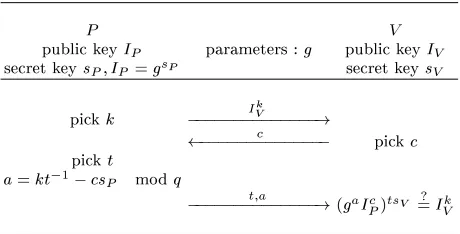
B.1 Privacy Analysis of the Saeednia et al's Scheme [40]
We describe in Figure 7 the protocol in [40]. This scheme is based on the Schnorr signature scheme. The Discrete logarithm problem is hard in the underlying group. The order of the group is a large prime q.
P V
public key IP parameters : g public key IV
secret key sP; IP = gsP secret key sV
pick k IkV !
c pick c
pick t
a = kt 1 csP mod q
t;a ! (gaIc
P)tsV = I? Vk
Fig. 7. Identication scheme from [40]
The protocol transcript is Ik V; c; t; a
. As a remark, the verication equality can be transformed into
(IsP
V )c:t= IVk at:
Therefore, given the secret sP, the transcript and IV, it is possible to
been able to nd a secret of one prover, can retrieve the data emitted by this prover. Among the eavesdropped protocol transcript, the adver-sary retrieves which protocol has been made by this prover. Therefore, a narrow-forward adversary can determine with probability near of one if the transcript has been made by the CLD associated to sP.
B.2 Privacy Analysis of the Jakobsson and Pointcheval Scheme [22]
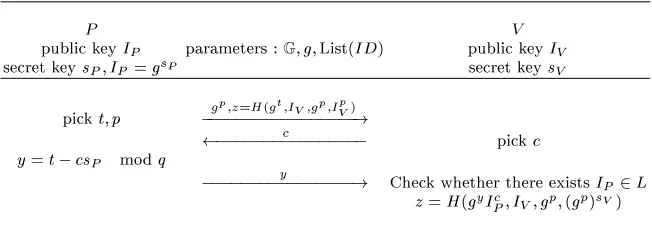
This scheme is designed to ensure mutual authentication between a CLD and a verier. Nevertheless, in the following, we focus on the authenti-cation of the prover. The underlying group structure is chosen such that the discrete logarithm is a hard problem. We describe in Figure 8 the protocol. H is a cryptographic hash function.
P V
public key IP parameters : G; g; List(ID) public key IV
secret key sP; IP = gsP secret key sV
pick t; p gp;z=H(gt;IV;gp;IVp)!
c pick c
y = t csP mod q
y
! Check whether there exists IP2 L
z = H(gyIc
P; IV; gp; (gp)sV)
Fig. 8. Jakobsson-Pointcheval identication scheme
We assume that the identities are public. In this context, the public parameters are :
{ G and g where g is a generator of the group G of order q, { IV, the identity of the verier
{ a list of identities IPi of provers.
To prove the privacy leakage, we prove it is not possible to simulate the Result oracle using the public information. This proves that this scheme is at most narrow strong private.
oracle outputs true with probability 1. Otherwise, if the system is sim-ulated, the simulation of the Result oracle, applied on this protocol transcript,7 is impossible because it is necessary to possess sV or p to
verify the validity.
To simulate the protocol transcript outputs by a prover P , we use the usual simulation of the Schnorr scheme. We assume that a challenge c is given.
1. We randomly choose y and compute T = gyIc P,
2. We randomly choose p and compute gp, Ip
V andz = H(T; IV; gp; IVp).
As for the Schnorr scheme, this simulation is perfect. The resulting transcript is [gp; z; c; y]. Nevertheless, it is not possible for any blinder,
who has only access to the public information, to distinguish whether this transcript is valid or not. It is one of the properties proved in [22].
Here, we described an adversary who creates a transcript such that a simulated Result accept with probability about 1=2 and the genuine Result accepts with probability 1. This proves that this system is dis-tinguishable from a random system.
Remark 5. Here we assume that the verier public key is known from the prover. Otherwise, if the verier has to send his public key at the begin-ning of the session, the scheme cannot be considered private anymore. If an adversary can send his own public key to the CLD, and then execut-ing the whole protocol, he can retrieve, at the end of the protocol, the identity of the prover. It is thus legitimate to consider that the blinder does not have access to the secret key sV.
Moreover in the presented model, this scheme is not sound.
These schemes do not lead to the highest level of privacy. Our aim is to propose a general toolkit enabling to adapt general ZK scheme to obtain a scheme with the desired privacy level. Furthermore, we propose an ecient scheme which achieves this privacy.
C Simulation of the Result Oracle.
the legitimate oracle from a simulated one. We relax this constraint to be able to achieve strong privacy whereas this was proved to be impossible [48] in the original model.
This doing we get a strong Private scheme in the modied model. Strong privacy can be achieved by encrypting the two messages sent by tags with a non-malleable encryption scheme [10].
Theorem 5. Let EKVp be an NM-CPA scheme. The modication dened
with the transcript EKVp(A); c; EKVp(B)
leads to a PI strong private and HI sound scheme.
Proof. Firstly, it is narrow-strong private and forward private as is the Modication 2. Furthermore, the simulation of the oracle Result is easy. To simulate this oracle, a blinder has to store all the outputs of the tag it had simulated. Once he receives a protocol transcript, either it comes from a simulated tag, and the simulated oracle answer is true or it does not come from a simulated tag, and the output of the simulated Result oracle is the output of the genuine Result oracle.
This perfectly simulates the oracle as no modication of a transcript could arise to a valid transcript because an NM-CPA scheme is used. Therefore, if a transcript is valid, it directly comes from a tag (simulated or legitimate) or it was made with a corrupted secret. ut
Remark 6. Contrary to all the other schemes presented, it is necessary to compute a ciphertext on the tag side. In the other schemes, the rst message can be pre-computed in order to minimize the computational power needed online. In this case, the minimal information needed to compute B are kept in memory.
D Proofs of Security
In the proofs, we suppose gI(c) = Ic although they can be generalized
with any bijective exponentiation in base I.
D.1 Correctness