FPGA and ASIC Implementations of the
η
T
Pairing
in Characteristic Three
Jean-Luc Beuchat, Hiroshi Doi, Kaoru Fujita, Atsuo Inomata, Piseth Ith, Akira Kanaoka, Masayoshi Katouno,
Masahiro Mambo, Eiji Okamoto, Takeshi Okamoto, Takaaki Shiga, Masaaki Shirase, Ryuji Soga, Tsuyoshi
Takagi, Ananda Vithanage, and Hiroyasu Yamamoto
Abstract—Since their introduction in constructive crypto-graphic applications, pairings over (hyper)elliptic curves are at the heart of an ever increasing number of protocols. As they rely critically on efficient implementations of pairing primitives, the study of hardware accelerators has become an active research area.
In this paper, we propose two coprocessors for the reduced ηT pairing introduced by Barretoet al.as an alternative means
of computing the Tate pairing on supersingular elliptic curves. We prototyped our architectures on FPGAs. According to our place-and-route results, our coprocessors compare favorably with other solutions described in the open literature. We also present the first ASIC implementation of the reduced ηT pairing.
Index Terms—Tate pairing,ηT pairing, elliptic curve
cryptog-raphy, finite field arithmetic, hardware accelerator.
I. INTRODUCTION
In the mid-nineties, Menezes, Okamoto & Vanstone [36] and Frey & R¨uck [18] introduced the Weil and Tate pairings in cryptography as a tool to attack the discrete logarithm problem on some classes of elliptic curves defined over finite fields. A few years later, Mitsunari, Sakai & Kasahara [39], Sakai, Oghishi & Kasahara [44], and Joux [28] discovered constructive properties of pairings. Their respective works initiated an extensive study of pairing-based cryptography, and an ever increasing number of protocols based on the Weil or the Tate pairing have appeared in the literature: identity-based encryption [11], short signature [13], and efficient broadcast encryption [12] to mention but a few. As noticed by Dutta,
J.-L. Beuchat, A. Kanaoka, P. Ith, M. Mambo, and E. Okamoto are with the Graduate School of Systems and Information Engineering, University of Tsukuba, 1-1-1 Tennodai, Tsukuba, Ibaraki, 305-8573, Japan.
H. Doi is with the Graduate School of Information Security, Institute of Information Security, 2-14-1 Tsuruya-cho Kanagawa-ku, Yokohama 221-0835, Japan.
K. Fujita, M. Katouno, R. Soga, and H. Yamamoto are with FDK Mod-ule System Technology Corporation, 1 Kamanomae, Kamiyunagaya-machi, Jyoban, Iwaki-shi, Japan.
A. Inomata is with the Graduate School of Information Science, Nara Institute of Science and Technology, 8916-5 Takayama, Ikoma, Nara, 630-0192, Japan.
T. Okamoto is with the Department of Computer Science, Tsukuba Uni-versity of Technology, 4-12-7 Kasuga, Tsukuba, Ibaraki, 305-8521, Japan.
T. Shiga and A. Vithanage are with FDK Corporation, 1 Kamanomae, Kamiyunagaya-machi, Jyoban, Iwaki-shi, Japan.
M. Shirase and T. Takagi are with the School of Systems Information Science, Future University-Hakodate, 116-2 Kamedanakano-cho, Hakodate, Hokkaido, 041-8655, Japan.
This work was supported by the New Energy and Industrial Technology Development Organization (NEDO), Japan. This paper is an extended version of [10].
Barua & Sarkar [14], such protocols rely critically on efficient algorithms and implementations of pairing primitives.
According to [22], [32], when dealing with general curves providing common levels of security, the Tate pairing seems to be more efficiently computable than the Weil pairing. In 1986, Miller described the first iterative algorithm to compute the Tate pairing [37], [38]. Significant improvements were independently proposed by Barreto et al. [4] and Galbraith et al. [19] in 2002. One year later, Duursma & Lee gave a closed formula in the case of characteristic three [15]. In 2004, Barreto et al. [3] introduced the ηT approach, which further shortens the loop of Miller’s algorithm.
This paper describes the design of two hardware accel-erators for the ηT pairing in characteristic three. Section II provides the reader with a brief overview of pairing com-putation. As detailed in that section, the considered pairing algorithm relies heavily on arithmetic over F36m, a
degree-6 extension of the base field of the curve. However, thanks to a tower field representation, all operations over F36m can be replaced by arithmetic over F3m. We describe hardware arithmetic operators over F3m and explain how to take ad-vantage of the tower field in Section III. We then propose two hardware accelerators for theηT pairing (Section IV). We have prototyped our architectures on FPGA, and propose the first ASIC implementation of theηT pairing in characteristic three. Section V summarizes our implementation results on FPGA and ASIC, and provides the reader with a comprehensive comparison with previously published architectures.
II. COMPUTATION OF THEMODIFIEDTATEPAIRING IN
CHARACTERISTICTHREE
Given a positive integer m coprime to 6, we consider a supersingular1 elliptic curve E over F3m, defined by the equation y2 = x3−x+b, withb ∈ {−1,1}. According to
[3], there is no loss of generality from considering this case since these curves offer the same level of security for pairing applications as any supersingular elliptic curve overF3m. The numberN of rational points of E over the finite fieldF3m is given byN = #E(F3m) = 3m+ 1 +µb3
m+1 2 , with
µ=
+1 ifm≡1,11 (mod 12), or −1 ifm≡5,7 (mod 12).
A. Modified Tate Pairing
Let `be the largest prime factor of N.E(F3m)[`]denotes the `-torsion subgroup ofE(F3m), i.e.the set of points P ∈
E(F3m)such that[`]P =O, whereOis the point at infinity of the elliptic curve E. The modified Tate pairing is a function that takes as input two points of E(F3m)[`] and outputs an element of the group of`th roots of unityµ`={R∈F∗3km :
R`= 1}.
Theembedding degreeorsecurity multiplieris the least pos-itive integer k for whichµ` is contained in the multiplicative group F∗3km (i.e. k is the smallest integer such that` divides
3km−1). The considered curve has an embedding degree of
k= 6, which is the maximum value possible for supersingular elliptic curves, and hence seems to be an attractive choice for pairing implementation.
The modified Tate pairing of order `is then the map
ˆ
e(·,·) :E(F3m)[`]×E(F3m)[`]→F∗36m
given by
ˆ
e(P, Q) =f`,P(ψ(Q))(3
6m−1)/` ,
where
• ψ is a distortion map (the concept of a distortion map was introduced in [48]) from E(F3m)[`]toE(F36m)[`]\
E(F3m)[`] defined asψ(xQ, yQ) = (ρ−xQ, yσ)for all
Q= (xQ, yQ)∈E(F3m)[`], whereρandσare elements of F36m satisfying the equations ρ3−ρ−b = 0 and
σ2+ 1 = 0[4]. Note that{1, σ, ρ, σρ, ρ2, σρ2}is a basis ofF36moverF3m. We will therefore represent an element
R∈F36m asR=r0+r1σ+r2ρ+r3σρ+r4ρ2+r5σρ2, where the ri’s belong toF3m.
• fn,P, forn∈NandP ∈E(F3m)[`]is a rational function defined over E(F36m)[`] with divisor (fn,P) =n(P)−
([n]P)−(n−1)(O) (see [46] or [49] for an account of divisors). We consider here the definition proposed by Barreto et al. [4], where fn,P is evaluated on a point rather than on a divisor.
• f`,P(ψ(Q)) is only defined up to `th powers, which is undesirable in most of the cryptographic applications. The powering by (36m−1)/`, referred to as final ex-ponentiation, allows one to obtain a unique value in a multiplicative subgroup of F∗36m.
Choosing an order of low Hamming weight provides com-putational savings in Miller’s algorithm. However, ` being a quotient of N by a small cofactor, it does not have a small Hamming weight. Galbraith et al. [19] noted that one can compute the modified Tate pairing of order `with respect to the group order N (note thatN divides36m−1):
f`,P(ψ(Q))(3
6m−1)/`
=fN,P(ψ(Q))(3
6m−1)/N .
In the following,M denotes the final exponent of the modified Tate pairing of order N:
M = 3 6m−1
N = 3 3m−1
(3m+ 1)3m+ 1−µb3m2+1
.
The modified Tate pairing satisfies the following properties:
• Bilinearity. For allA,B,C∈E(F3m)[`],
ˆ
e(A+B, C) = ˆe(A, C)ˆe(B, C) and
ˆ
e(A, B+C) = ˆe(A, B)ˆe(A, C).
• Non-degeneracy.e(P, Pˆ )6= 1, for allP 6=O.
• Computability. ˆecan be efficiently computed.
B. The Duursma-Lee Approach
Duursma & Lee [15] proposed to compute the order33m+1 modified Tate pairing. This approach simplifies both Miller’s algorithm and the final exponentiation2. Furthermore,
Du-ursma & Lee showed that the number of iterations of Miller’s algorithm can be reduced from3mtomiterations [15].
C. TheηT Approach
Barretoet al.[3] introduced theηT pairing as “an alternative means of computing the Tate pairing on certain supersingluar curves” [40, page 108]. They suggest to compute ˆe(P, Q)
using an order T ∈ Z that is smaller than N. Their main result is a lemma which gives a method to select T such that ηT(P, Q)M is a non-degenerate bilinear pairing [3]. In characteristic three they chooseT = 3m−N =−µb3m+12 −1 and show that their method gives a further halving of the length of the loop compared to the Duursma & Lee approach. The
ηT pairing is defined as follows:
ηT(P, Q) =
fT ,P(ψ(Q)) if T >0, or
f−T ,−P(ψ(Q)) if T <0. (1)
Defining T0 =−µbT = 3m+1
2 +µb andP0 = [−µb]P, we rewrite Equation (1) asηT(P, Q)M =fT0,P0(ψ(Q))M. Then,
the techniques proposed by Duursma & Lee [15] allow one to simplify the computation offn,P in Miller’s algorithm:
fT0,P0(ψ(Q)) =
m−1
2
Y
i=0
g[3i]P0(ψ(Q))3 m−1
2 −i
lP0(ψ(Q)),
where
• gV is the rational function introduced by Duursma & Lee [15], defined over E(F36m)[`], and having divisor
(gV) = 3(V) + ([−3]V)−4(O). For allV = (xV, yV)∈
E(F3m)[`]and(x, y)∈E(F36m)[`], it is defined as:
gV(x, y) =yV3y−(x
3
V −x+b)
2
.
• lV, for allV = (xV, yV)∈E(F3m)[`], is the equation of the line corresponding to the addition ofh3m2+1
i
V with
[µb]V. It is defined for all(x, y)∈E(F36m)[`]:
lV(x, y) =y−(−1) m+1
2 yV(x−xV)−µbyV. As pointed out by Barreto et al. [3], the computation of
fT0,P0(ψ(Q)) requires cubings over F36m because of the exponent 3m−21−i inside the main product. They suggested to bring the powering into the formulae as a Frobenius action, or to compute the product in reverse. Both approaches allow one to replace two cubings over F3m and one cubing over
F36m by two cube roots over F3m at each iteration. However, the second one turns out to be slightly more effective since it also saves three multiplications overF3m when multiplying by
lP0(ψ(Q))(see [7] for further details). Note that the
Duursma-Lee algorithm also comes in two flavors: the original one involves cube roots and Kwon proposed a cube root-free version in [34].
Algorithm 1Cube-root-free reversed-loop algorithm for com-puting theηT pairing [7].
Input: P, Q ∈ E(F3m)[`]. The algorithm involves a local variablet∈F3m, and two local variablesRandS∈F36m. Output: ηT(P, Q)M ∈F∗36m.
1. xP ←xP+b; 2. yP ← −µbyP;
3. xQ ←x3Q; yQ←y3Q; 4. t←xP+xQ;
5. R←(yPt−yQσ−yPρ)·(−t2+yPyQσ−tρ−ρ2); 6. forj←1 to m−21 do
7. R←R3;
8. xQ ←x9Q−b; yQ← −y9Q; 9. t←xP+xQ; u←yPyQ; 10. S← −t2+uσ−tρ−ρ2;
11. R←R·S; 12. end for
13. returnRM;
Fong et al. showed that extracting a square root in F2m requires approximately the time of a field multiplication and proposed an improved scheme for trinomials [17]. Barreto extended this approach to cube root in characteristic three [2]: if F3m admits an irreducible trinomialxm+fnxn+f0 (fn,
f0 ∈ {−1,1}) with the property n ≡m (mod 3), then five
shifts and five additions allow one to implement this operation. Nevertheless, even if computing a cube root is not a difficult operation, it requires specific hardware and a slightly more complex control and datapath. In this work, we decided to minimize the area of the Arithmetic and Logic Unit (ALU) and considered a cube root-free version of the reversed-loop approach described by Algorithm 1. Consider the operand
S ∈ F36m (line 10) and note that it is sparse (i.e. some of its terms are trivial). This property will allow us to optimize the computation of R·S in Section III-B2.
The relationship between the modified Tate pairing and the reduced ηT pairing is given by [6]:
ˆ
e(P, Q)M =ηT
[−µb]P,h33m2−1
i
Q
M ,
where [−µb]P = (xP,−µbyP) and h
33m2−1
i
Q =
3 √
xQ−b,(−1) m+1
2 √3yQ
. We can modify Algorithm 1 as
follows to obtain ˆe(P, Q)M:
• Since we compute the pairing with (xp,−µbyP), line 2 becomesyp← −µb·(−µbyP) =ypand can be discarded. • It is no longer necessary to compute the cube of xQ and
yQ (line 3). We have now xQ←xQ−b.
• Letx0P =xP+bandx0Q=xQ−b. Sincet=x0P+x0Q=
xP+xQ (line 4), we can actually remove lines 1 and 3. It is worth noticing that we obtain a cube root-free algorithm and that the modified Tate pairing requires less operations than the reducedηT pairing in this case.
D. Final Exponentiation
Fermat’s little theorem provides us with an effective way to perform the final exponentiation of the reducedηT pairing. As pointed out by Barretoet al., “the result of raising to33m−1 produces an element of order 33m+ 1, so that any further inversion reduces to a simple conjugation” [3, page 248]. The main loop of Algorithm 1 returns R = ηT(P, Q) ∈ F∗36m. WritingR=R0+R1σ, whereR0andR1∈F∗33m, we obtain:
V =R33m−1= (R 2
0−R21) +R0R1σ R2
0+R21
,
Algorithm 2 summarizes the computation of the final expo-nentiation. Whenµb=−1, the computation of W0 =W−µb
on line 4 is a dummy operation. Let us writeW =W0+W1σ,
whereW0 andW1 ∈F∗33m. SinceW is an element of order
33m+ 1 [3], the inversion is completely free whenµb= 1:
W0=W−1=W33m = (W0+σW1)3
3m
=W033m+σ33mW133m =W0−σW1.
It suffices to propagate the sign corrections in the product
V ·W0. Whereas the computation of ηT(P, Q)involves only sparse multiplications over F36m (Algorithm 1, line 11), the final exponentiation requires a full multiplication over F36m (Algorithm 2, line 6). Note that the computation ofV andW
involves only operations over F33m. Algorithms to compute
R33m−1 andV3m+1 are for instance detailed in [7].
Algorithm 2 Final exponentiation of the reducedηT pairing. Input: R=ηT(P, Q)∈F∗36m.
Output: RM ∈F∗36m. 1. V ←R33m−1;
2. V ←V3m+1;
3. W ←V3 m+1
2 ; 4. W0←W−µb; 5. V ←V3m+1;
6. return V ·W0;
III. ARITHMETIC OVERF3mANDF36m
Thanks to the tower field representation, all operations over F36m andF33m in Algorithms 1 and 2 can be replaced by arithmetic over F3m. For instance, 12 multiplications, 11 additions, and a single inversion overF3m allow one to carry out the inversion over F33m involved in the computation of
A. Arithmetic over F3m
In the following, elements of F3m are encoded using a polynomial basis. Given a degree-m irreducible polynomial
f(x) ∈ F3[x], we have F3m ∼=F3[x]/(f(x)). Consequently, each element ofF3m is represented as a polynomial of degree less than mwith coefficients in F3.
1) Addition and Subtraction over F3m: Since they are performed component-wise, addition and subtraction overF3m are rather straightforward operations. Each element of F3
being encoded by two bits, the addition of ai andbi∈F3 on
most of Altera or Xilinx FPGAs requires two4-input LUTs. 2) Multiplication over F3m: Among the many modular multipliers described in the open literature (see for in-stance [9], [16], [24]), we selected a Most Significant Element (MSE) first array multiplier based on Song & Parhi’s work [47] to carry out a(x)b(x) modf(x). At step i we compute a degree-(m+D−2) polynomial t(x) which is the sum of
D partial products: t(x) =
D−1
X
j=0
aDi+jxjb(x). A
degree-(m +D −1) polynomial s(x), updated according to the celebrated Horner’s rule, allows us to accumulate the partial products:
s(x)←t(x) +xD·(s(x) modf(x)).
Thus, after dm/De steps, this algorithm returns a
degree-(m+D−1)polynomials(x)which is congruent toa(x)b(x)
modulof(x). The circuit described by Song & Parhi requires dedicated hardware to compute p(x) =s(x) modf(x)[47]. We suggest to achieve the final modulo f(x) reduction by performing an additional iteration with a−j = 0,1≤j≤D. Since t(x) is now equal to zero, we have: s(x) = xD ·
(a(x)b(x) modf(x)). Therefore, it suffices to consider the
m most significant coefficients of s(x) to get the result (i.e.
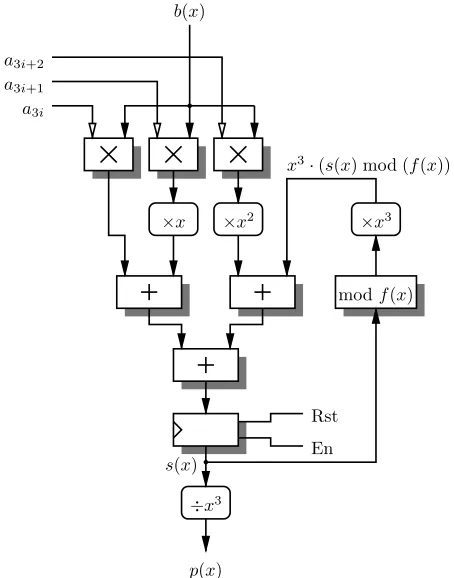
p(x) = s(x)/xD). Algorithm 3 summarizes this multiplica-tion scheme. Figure 1 describes the architecture of an array multiplier processing D= 3coefficients at each clock cycle.
Algorithm 3 MSE multiplication over F3m.
Input: A degree-m irreducible monic polynomial f(x) = xm+f
m−1xm−1+. . .+f1x+f0, two degree-(m−1)
polynomials a(x), and b(x). We assume that a−j = 0,
1≤j≤D. The algorithm requires a degree-(m+D−1)
polynomial s(x)as well as a degree-(m+D−2) poly-nomialt(x)for intermediate computations.
Output: p(x) =a(x)b(x) modf(x). 1. s(x)←0;
2. foriindm/De −1 downto−1 do
3. t(x)←
D−1
X
j=0
aDi+jxjb(x);
4. s(x)←t(x) +xD·(s(x) modf(x)); 5. end for
6. p(x)←s(x)/xD;
The cost of the modular reduction (line 4) depends on D
and f(x). Assume thatf(x)is an irreducible trinomial such
×x3
÷x3 a3i+2
a3i+1 a3i
b(x)
x3·(s(x) mod (f(x))
modf(x)
Rst En
s(x)
p(x)
×x ×x2
Fig. 1. MSE array multipliers processingD= 3coefficients at each clock cycle. Boxes with rounded corners involve only wiring.
that f(x) = xm+f
nxn+f0, where f0 and fn ∈ F3, and 0< n < m. We have:
s(x) modf(x) =
D−1
X
i=0
sm+ixm+i+ m−1
X
i=0 sixi
!
modf(x).
Sincexm≡ −f
nxn−f0 (modf(x)), we note that: sm+ixm+i≡sm+i(−fnxn−f0)xi (modf(x)).
In the following, we assume thatD ≤m−n to ensure that the degree ofsm+i(−fnxn−f0)xi,0≤i≤D−1, is at most
equal tom−1. Thus, we obtain:
s(x) modf(x) =
D−1
X
i=0
sm+i(−fnxn−f0)xi+
m−1
X
i=0 sixi
= −
D−1
X
i=0
sm+ifnxn+i− D−1
X
i=0
sm+if0xi
+
m−1
X
i=0 sixi,
and the modular reduction involves2D additions (or subtrac-tions) overF3. WhenD≤n, the degree ofxi,0≤i≤D−1,
is always smaller than the one of xn+i and the modular reduction requires a single stage of 2-input adders (or sub-tracters) over F3. Thus, selecting the parameter D such that D≤min(n, m−n)allows one to achieve the shortest critical path in the case of an irreducible trinomial.
Let us consider for instance the irreducible trinomialf(x) = x97+x12+ 2 (i.e. m= 97,n = 12, f
Since −2 is congruent to1 modulo3, we have:
s(x) modf(x) =−
D−1
X
i=0
s97+ixi+12+ D−1
X
i=0
s97+ixi+
96
X
i=0 sixi.
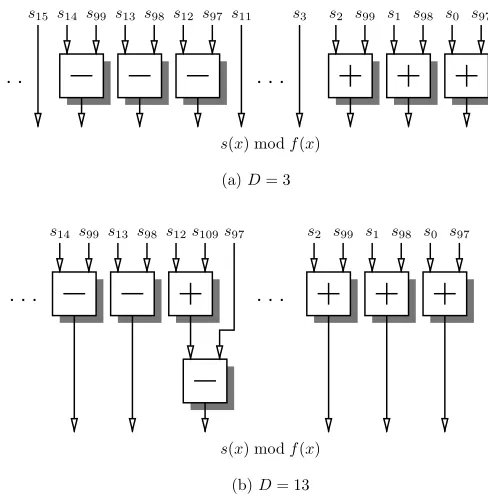
Figures 2a and 2b describe the circuits performing the modular reduction when D = 3andD = 13, respectively. In the first case, a single stage of 2-input adders allows one to carry out
s(x) modf(x). However, in the second case, a2-input adder and a2-input subtracter are required to computes13+s109− s97.
s(x) modf(x)
(b)D= 13 (a)D= 3
. . .
s(x) modf(x)
. . .
s11 s15 s14 s99 s13 s98 s12 s97
. . .
s97 s98
s99 s13
s14 s12s109
. . .
s2 s99 s1 s98 s0 s97 s3 s2 s99 s1 s98 s0 s97
Fig. 2. Computation ofs(x) modf(x)whenf(x) =x97+x12+ 2for (a)D= 3and (b)D= 13.
3) Cubing overF3m: Let us now consider the computation of b(x) = a(x)3 over F3m. Cubing over F3m consists of reducing the following expression modulof(x):
b(x) =a(x)3=
m−1
X
i=0 aix3i
!
modf(x).
A formal reduction allows us to express each coefficientbi of the result as a linear combination of the coefficient of a(x). Therefore, a cubing operator mainly consists of aD0-operand adder and some extra wiring to permute the coefficients of a(x). The main challenge here is to find an irreducible polynomial minimizing D0.
Let us consider again the irreducible trinomialf(x) =x97+ x12+ 2. Reducing a(x)3 modulof(x), we obtain:
b0=a93+a89+a0, b2=a33,
b1=a65−a61, b3=a94+a90+a1,
. . .=. . ., b96=a32.
The most complex operation involved here is the addition of
D0 = 3elements ofF3. Since we consider a cube root-freeηT pairing algorithm, f(x) =x97+x12+ 2is a good candidate: it has a simple cubing formula and allows one to perform
the modulof(x)reduction involved in the multiplication over F3m by means of a single stage of 2-input adders as long as D ≤12. However, if one intends to implement a pairing algorithm with cube roots, one should consider a further constraint to select an irreducible trinomial. Barreto noticed that the cost of computing cube roots in F3m is only O(m) if m ≡ n (mod 3) [2]. Despite of a slightly more complex cubing formula,f(x) =x97+x16+ 2is for instance a better choice in this case.
4) Inversion over F3m: Since the computation of the re-ducedηT pairing involves a single inversion overF3m in the final exponentiation, we perform this operation according to Fermat’s little theorem and Itoh & Tsujii’s algorithm [26]. Thus, inversion over F3m is carried out by means of cubings and multiplications over F3m and does not require specific hardware resources.
B. Arithmetic overF36m
1) Cubing over F36m: When we compute the ηT pairing according to Algorithm 1, we raise R = r0+r1σ+r2ρ+ r3σρ+r4ρ2+r5σρ2∈F36m to the cube at each iteration of the main loop. Since ρ3=ρ+b andσ3=−σ, we obtain:
R3 = r30+br23+r34
+ −r31−br33−r35
σ
+ r32−br34
ρ+ −r33+br35
σρ+r34ρ2−r35σρ2.
This operation involves six cubings and six additions (or subtractions) overF3m.
2) Multiplication overF36m:
a) Full Multiplication overF36m: Karatsuba-Ofman’s al-gorithm allows one to compute the product of two polynomials belonging to F36m by means of 18 multiplications and 58 additions (or subtractions) over F3m (see for instance [31]). An improvement was recently proposed by Gorlaet al.[20]: they represented elements of F36m as degree-2 polynomials with coefficients in F32m and took advantage of Lagrange interpolation to compute a product over F36m by means of
5 multiplications overF32m. Each of these multiplications is then carried out according to Karatsuba-Ofman’s scheme, and the total cost of a multiplication over F36m is equal to 15 multiplications and 67additions (or subtractions) overF3m.
b) Sparse Multiplication over F36m: Consider now the computation of the reducedηT pairing (Algorithm 1), where each iteration of the loop requires a sparse multiplication over F36m. As pointed out by Bertoni et al. [5] and Granger et al. [23], the product R·S (line 11) can be computed by means of13multiplications and50additions (or subtractions) overF3m according to Karatsuba-Ofman’s scheme. Again, the approach introduced by Gorla et al. allows one to further reduce the cost of this operation to 12 multiplications and
51 additions (or subtractions) over F3m (see [7] for details). Two further multiplications are needed to compute yPyQ as well as t2.
r1σ+r2ρ+r3σρ+r4ρ2+r5σρ2andC=c0+c1σ+c2ρ+ c3σρ+c4ρ2+c5σρ2be two elements ofF36m. We write each coefficientcias the sum of two elementsc
(0)
i andc
(1)
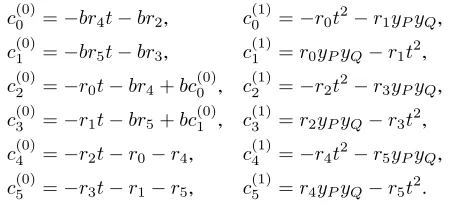
i ∈F3m. Thanks to this notation we define the productC=R·(−t2+ yPyQσ−tρ−ρ2)as follows, whereb∈ {−1,1}is a parameter of the elliptic curve:
c(0)0 =−br4t−br2, c (1)
0 =−r0t2−r1yPyQ,
c(0)1 =−br5t−br3, c (1)
1 =r0yPyQ−r1t2, c(0)2 =−r0t−br4+bc
(0) 0 , c
(1)
2 =−r2t2−r3yPyQ,
c(0)3 =−r1t−br5+bc (0) 1 , c
(1)
3 =r2yPyQ−r3t2, c(0)4 =−r2t−r0−r4, c
(1)
4 =−r4t2−r5yPyQ,
c(0)5 =−r3t−r1−r5, c (1)
5 =r4yPyQ−r5t2.
Note that the computation of the c(0)i ’s, 0 ≤i ≤5, requires six multiplications overF3m and depends neither ont2nor on
yPyQ. Thus, we can perform eight multiplications over F3m in parallel (t2, y
PyQ, and rit, 0 ≤ i ≤ 5). Consider now
c(1)0 andc(1)1 and assume that(r0+r1) and(yPyQ−t2)are stored in registers. Karatsuba-Ofman’s algorithm allows one to compute c(1)0 andc(1)1 by means of three multiplications and three additions over F3m:
c(1)0 = −r0t2−r1yPyQ,
c(1)1 = (r0+r1)(yPyQ−t2) +r0t2−r1yPyQ
= r0yPyQ−r1t2.
Therefore, the computation of the c(1)i ’s involves nine mul-tiplications over F3m, which can be carried out in parallel. Algorithm 4 summarizes this multiplication scheme involving
17multiplications and29additions (or subtractions) overF3m. Since the computation of the nine products pi,8≤i≤16, depends onp6 andp7, we can not perform the 17
multiplica-tions over F3m in parallel and have to proceed in two steps (Algorithm 4, lines 1 and 3). Therefore, we suggest to design a coprocessor embedding nine multipliers overF3m, denoted by
Mi,0≤i≤8, in the following. A control unit will contain the instructions required to implement the sparse multiplication over F36m on such an architecture.
A careful scheduling allows one to share operands between up to three multipliers, thus saving hardware resources (Ta-ble I): during the first step (9multiplications overF3m),M0,
M1, andM2respectively computer0t,r2t, andr4t. The MSE
multiplier described in Section III-A2 stores its first operand in a shift register, and its second operand in a standard register. Since a shift register is more complex (an operand is loaded in parallel, and then shifted), we load the common operand
t in this component. At the end of these multiplications, the three registers still containr0,r2, andr4. Therefore it suffices
to load t2 in the shift register before starting the second step
(9 multiplications overF3m). Figure 3a describes the operator we designed to perform three multiplications with a common operand. The same architecture allows for computing r1t, r3t, r5t, r1yPyQ, r3yPyQ, and r5yPyQ. The five remaining multiplications involve a slightly more complex component (Figure 3b): two shift registers are required to compute t2
andyPyQ since there is no common operand. At the end of the first multiplication cycle, a dedicated subtracter computes
yPyQ−t2 and stores the result in the shift registers.
TABLE I
SPARSE MULTIPLICATION OVERF36m:SCHEDULING. 1st step:8multiplications 2nd step:9multiplications
overF3m overF3m
M0 p0=r0·t p8=r0·t2
M1 p2=r2·t p11=r2·t2
M2 p4=r4·t p14=r4·t2
M3 p1=r1·t p9=r1·yPyQ
M4 p3=r3·t p12=r3·yPyQ
M5 p5=r5·t p15=r5·yPyQ
M6 p6=t·t p10= (r0+r1)·(yPyQ−t2) M7 p7=yP·yQ p13= (r2+r3)·(yPyQ−t2)
M8 – p16= (r4+r5)·(yPyQ−t2)
Consider the additions occurring in the fourth step of Algorithm 4. Interestingly enough, they involve at most one result of each block of three multipliers (Figure 3). Instead of a large multiplexer selecting the output of one multiplier among nine, we include a multiplexer in each block and connect a
3-operand adder to the outputs of our multiplication units. In order to also take advantage of these adders while performing a multiplication, each block of three multipliers has an additional input D1that allows for bypassing the multipliers.
IV. HARDWAREIMPLEMENTATION
In this section, we propose two architectures to compute the reducedηT pairing for the fieldF3[x]/(x97+x12+ 2)and the
curvey2=x3−x+ 1(i.e.b= 1). This choice of parameters
allows us to easily compare our work against the many pairing accelerators for m = 97 described in the open literature. It is nonetheless important to note that the architectures and algorithms presented here can be easily adapted to different parameters.
Algorithm 4 Sparse multiplication over F36m.
Input: R = r0+r1σ+r2ρ+r3σρ+r4ρ2+r5σρ2 ∈ F36m; t, yP, and yQ ∈ F3m; the parameter b ∈ {−1,1} of the supersingular elliptic curve.
Output: C=R·(−t2+yPyQσ−r0ρ−ρ2).
1. Compute in parallel (8multiplications and 3 additions overF3m):
pi←ri·t,0≤i≤5; p6←t·t; p7←yP ·yQ;
s0←r0+r1; s1←r2+r3; s2←r4+r5;
2. Compute in parallel (7additions over F3m):
s3←p7−p6; // yPyQ−t2 c2←br4+p0; //br4+r0t c4←r0+p2; //r0+r2t c0←br2+bp4; // br2+br4t c3←br5+p1; //br5+r1t c5←r1+p3; //r1+r3t
c1←br3+bp5; // br3+br5t
3. Compute in parallel (9multiplications and 4 additions overF3m):
p8←r0·p6; // r0t2 p13←s1·s3; //(r2+r3)(yPyQ−t2) c2←c2+bc0; p9←r1·p7; // r1yPyQ p14←r4·p6; // r4t2 c3←c3+bc1; p10←s0·s3; // (r0+r1)(yPyQ−t2) p15←r5·p7; // r5yPyQ c4←c4+r4; p11←r2·p6; // r2t2 p16←s2·s3; //(r4+r5)(yPyQ−t2) c5←c5+r5; p12←r3·p7; // r3yPyQ
4. Compute in parallel (15additions overF3m):
c0← −c0−p8−p9; c2← −c2−p11−p12; c4← −c4−p14−p15;
c1← −c1+p10+p8−p9; c3← −c3+p13+p11−p12; c5← −c5+p16+p14−p15;
and 4. When m= 97andD= 3, we need 4849clock cycles to compute ηT(P, Q)according to Algorithm 1.
Since algorithms for multiplication overF33m andF36m do not share operands between several multipliers, it turns out to be impossible to take advantage of the full parallelism of our architecture when performing the final exponentia-tion (Algorithm 2). Thus, it seems attractive to supplement the ηT pairing accelerator with dedicated hardware to raise
ηT(P, Q) to the Mth power. Beuchat et al. [8] proposed a unified arithmetic operator performing addition, subtraction, accumulation, cubing, and multiplication over F3m. When
m = 97 and D = 3, this coprocessor performs the final exponentiation in4082clock cycles. We can therefore pipeline the computation of theηT pairing and the final exponentiation. In the following, we assume that we keep the pipeline busy and that we obtain a new result after 4849 clock cycles (i.e. we neglect the overhead introduced by our approach to get the first result). This coprocessor for the final exponentiation requires 64 registers to store elements of F3m. On FPGA, they are efficiently implemented using the embedded memory blocks.
B. A Coprocessor for Arithmetic over F3m
We also investigated a second architecture based on a coprocessor for arithmetic over F3m embedding nine multi-pliers, an addition unit (able to carry out addition, subtraction, and accumulation), and a cubing unit (Figure 5). Since we implement the main loop of theηT pairing (Algorithm 1) and the final exponentiation (Algorithm 2) on the same hardware,
each multiplier must have two input registers and we cannot share shift registers between up to three multipliers overF3m anymore.
The sparse multiplications overF36mare carried out accord-ing to Algorithm 4. Since performaccord-ing15or18multiplications over F3m requires the same number of clock cycles on our coprocessor, we implemented the multiplication over F36m of the final exponentiation according to Karatsuba-Ofman’s scheme in order to minimize the number of additions over F3m. Whenm= 97andD= 3, the computation ofηT(P, Q) and the final exponentiation require 6560 clock cycles and
2527clock cycles, respectively.
This coprocessor for arithmetic overF3m is of course slower than the architecture described in the previous section when considering the computation of theηT pairing (Algorithm 1). However, it is much more versatile and allows for the im-plementation of a wider range of algorithms: besides pairing computation, it is for instance possible to perform a scalar multiplication, which is a crucial operation in pairing-based cryptography.
V. RESULTS ANDCOMPARISONS
A. FPGA Implementation
Our reducedηT pairing accelerator and the coprocessor for arithmetic over F3m were captured in the VHDL language and prototyped on Altera Cyclone II and Xilinx Virtex-II Pro FPGAs. Table II summarizes our place-and-route results.
(a) (b) Rst1
En1
11 10 01 00
Ld3 Ld2 Ld1 Ld0
Shift D0
D1
M0
M2 M1
M8 M7 M6
Rst1
En1
10 01 00
11 Ld3 Shift
Ld2 Ld1 Ld0
D1 D0
Rst0 En0
Array multiplier
Array multiplier
Array multiplier
Array multiplier
Array multiplier
Array multiplier Rst0
En0
Sel Sel
0 1 0 1
Fig. 3. Building blocks for sparse multiplication overF36m. (a) Three multipliers with a common operand. (b) Two multipliers with a common operand.
M0, M1, and M2 M3, M4, and M5 M6, M7, and M8
D0 D1 D2
±D0±D1±D2
D1 D0 D1 D0 D1 D0
IOs
Host computer QA
QB
AddrA
DA
WenA
AddrB
DB
WenB
DPRAM Unit (ALU)
Arithmetic and Logic
Register file
2mbits
2mbits
1 0
0 1
1 0
Pairing algorithm Sparse multiplication scheme
(Figure 3a) (Figure 3a) (Figure 3b)
x3
Control unit
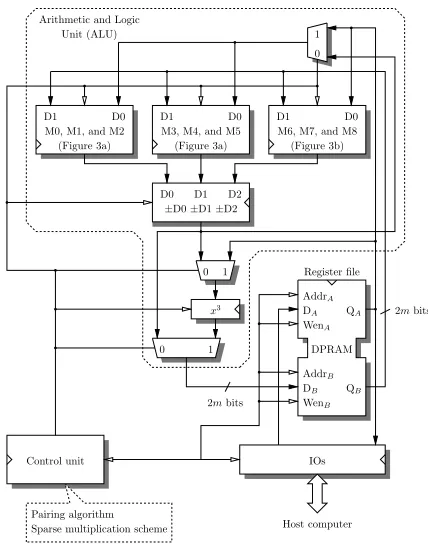
Fig. 4. Architecture of the coprocessor for the ηT pairing calculation. The ALU embeds the building blocks for sparse multiplication overF36m described by Figure 3.
published. Since e(P, Q)ˆ can be computed from ηT(P, Q)M at almost no extra cost (Section II-C), we can compare our architectures against all these results. Note that the hardware accelerators proposed by other researchers are always imple-mented on Xilinx FPGAs. Therefore, we decided to compute the Area-Time (AT) product in terms of slices to provide the reader with a fair comparison (each slice of a II, Virtex-II Pro, or Virtex-4 embeds two4-input function generators and
9 multipliers
. . .
Register File
(RAM) (FSM & ROM) Control Multiplier Cubing unit Multiplier
Addition, subtraction & accumulation
Fig. 5. Coprocessor for arithmetic overF3m amenable for pairing compu-tation.
two storage elements). Note that register files implemented in memory blocks are not included in the AT product.
To our best knowledge, Jiang [27] designed the fastest ηT pairing core (Table II). However, our processors achieves a better area-time trade-off. Additionally, our approach allows for reaching higher levels of security without risking to exhaust the FPGA resources. Jiang’s coprocessor already requires one of the largest FPGAs available now.
In order to easily study the trade-off between calculation time and circuit area, Ronan et al. [41] wrote a C pro-gram which automatically generates a VHDL description of a coprocessor and its control according to the number of multipliers to be included and D. The ALU also embeds an adder, a subtracter, a cubing unit, and an inversion unit. Their fastest architecture embeds 8 multipliers (D = 4) and is very similar to the hardware accelerator for the reduced
TABLE II
HARDWARE ACCELERATORS FOR THE REDUCEDηTPAIRING(POST-PLACE-AND-ROUTE FIGURES). THE PARAMETERDREFERS TO THE NUMBER OF COEFFICIENTS PROCESSED AT EACH CLOCK CYCLE BY A MULTIPLIER.
Curve Technology # mult. Area [MHz]Freq. time [Calc.µs] productAT
Ronanet al.[43] C(F2103) Virtex-II Pro 100 20(D= 4) 21021slices 51 206 4.33
20(D= 8) 24290slices 46 152 3.79
20(D= 16) 30464slices 41 132 4.02
Ronanet al.[41] E(F397) Virtex-II Pro 100 5(D= 4) 10540slices 84.8 187 1.97
8(D= 4) 15401slices 84.8 183 2.81
Beuchatet al.[6] E(F397) Virtex-II Pro 20 1(D= 3) 1896slices 156 178 0.34 1(D= 7) 2711slices 128 117 0.32 1(D= 15) 4455slices 105 92 0.41
E(F2239) Virtex-II Pro 20 1(D= 7) 2366slices 199 196 0.46 1(D= 15) 2736slices 165 127 0.35 1(D= 31) 4557slices 123 107 0.49
Jiang [27] E(F397) Virtex-4 LX 200 Not specified 74105slices 77.7 20.9 1.55
Coprocessor for the ηT pairing & coprocessor for the final exponentiation
E(F397) Cyclone II EP2C35 9(D= 3) 18000LEs 149 33 – E(F397) Virtex-II Pro 30 9(D= 3) 10897slices 147 33 0.36
Coprocessor for arithmetic over F3m – PairingLite
FPGA E(F397) Virtex-II Pro 30 9(D= 3) 10262slices 142 64 0.66 Cyclone II EP2C70 9(D= 3) 15293LEs 240 39.6 –
ASIC E(F397) 0.18µm CMOS 9(D= 3) 193765 NAND 200 46.7 –
TABLE III
HARDWARE ACCELERATORS FOR THETATE PAIRING(POST-PLACE-AND-ROUTE FIGURES). THE PARAMETERDREFERS TO THE NUMBER OF COEFFICIENTS PROCESSED AT EACH CLOCK CYCLE BY A MULTIPLIER. THE ARCHITECTURE PROPOSED BYK ¨OMURC¨ U¨& SAVAS[33]DOES NOT IMPLEMENT THE FINAL EXPONENTIATION. BARENGHIet al.[1]COMPUTE THETATE PAIRING OVERFp,WHEREpIS A512-BIT PRIME NUMBER.
Curve Technology # mult. Area [MHz]Freq. time [Calc.µs] productAT
Kelleret al.[30] E(F2251) Virtex-II 6000 1(D= 6) 3788slices 40 4900 18.56 3(D= 6) 6181slices 40 3200 19.78
9(D= 6) 13387slices 40 2600 34.81
Kelleret al.[29] E(F2251) Virtex-II 6000 13(D= 1) 16621slices 50 6440 107.04
13(D= 6) 21955slices 43 2580 56.64
13(D= 10) 27725slices 40 2370 65.71
Kerinset al.[31] E(F397) Virtex-II Pro 125 18(D= 4) 55616slices 15 850 47.27 Liet al.[35] E(F2283) Virtex-4 FX 140 12(D= 32) 55844slices 159.8 590 32.95 K¨om¨urc¨u & Savas [33] E(F397) Virtex-II Pro 4 20(D= 1) 14267slices 77.3 250.7 3.58
0.25µm CMOS 20(D= 1) 10mm2 78 250 –
Grabher & Page [21] E(F397) Virtex-II Pro 4 1(D= 4) 4481slices 150 432.3 1.94 Ronanet al.[42] E(F2313) Virtex-II Pro 100 14(D= 4) 34675slices 55 203 7.04
14(D= 8) 41078slices 50 124 5.09
14(D= 12) 44060slices 33 146 6.43
Shuet al.[45] E(F2239) Virtex-II Pro 100 6(D= 16), 25287slices 84 41 1.04
1(D= 4),
1(D= 2), and
1(D= 1)
Barenghiet al.[1] E(Fp) Virtex-II 8000 4(Montgomery) 33857slices 135 1610 54.51
little theorem, we achieve a smaller area. Furthermore, thanks to our sparse multiplication algorithm, we compute the ηT pairing in6560clock cycles, whereas Ronanet al.need10089
clock cycles to complete the same task. They unrolled the exponent M and grouped the inversions together. Their final exponentiation is therefore much more expensive than ours:
5440 clock cycles against2527.
Grabher and Page designed a coprocessor dealing withF3m arithmetic, which is controlled by a general purpose proces-sor [21]. Their hardware accelerator embeds a single multiplier over F3m. Our architectures requires roughly 2.5 times as
many slices, while performing up to nine multiplications in parallel.
B. ASIC Implementation
We designed the first ASIC implementation of the reduced
implemented using the numerous memory blocks available in modern FPGAs, they are not taken into account in our area measurement. We decided to minimize the area of the chip and selected the coprocessor for arithmetic over F3m with
D = 3. Furthermore, this architecture is more versatile than theηT pairing accelerator described in Section IV-A. A simple modification of the control unit would allow us to support scalar multiplication in a new version of the ASIC. Table IV summarizes our place-and-route results. The PairingLite chip computes the reduced ηT pairing (Algorithms 1 and 2) in
46.7µs. This timing includes the 52 and 78 clock cycles required to write the coordinatesP andQin the register file and to read the result, respectively.
TABLE IV
ASICIMPLEMENTATION OF THE REDUCEDηTPAIRING (PLACE-AND-ROUTE FIGURES).
Process TSMC CL018G (0.18µm CMOS)
Area 1937652NAND gates
Frequency 200 MHz
Calculation time 46.7µs
Core size 3849.6µm×3849.6µm
Package TSMC CQFP100pin
Operating voltage VDD CORE:1.8V, VDD IO:3.3V Power consumption Total power:671.739mW Consumption current Total current:373.188mA Temperature conditions 25oC
Output terminal Drive capability4mA
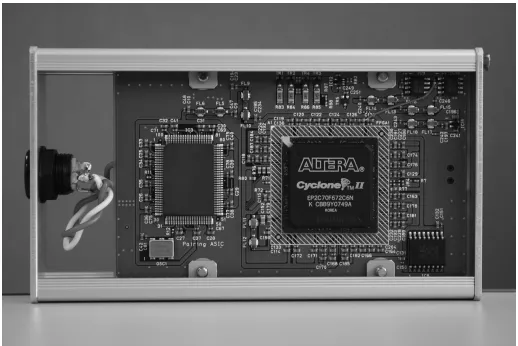
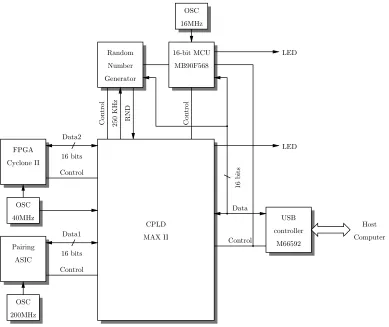
Figures 6 and 7 describe the evaluation board we designed to test the PairingLite ASIC (on the left on Figure 6). We also included a Cyclone II device (on the right on Figure 6) to test our FPGA architectures, and a true random number generator manufactured by FDK corporation to produce secret keys. A USB port allows one to connect the board to a computer. The figures reported in Table IV were measured using this board. In order to check that it is possible to correctly compute the reduced ηT pairing, we implemented the BLS short signature scheme [13]. The map-to-point function is computed in soft-ware. Then, the two pairings involved in the verification are performed in hardware on our evaluation board and in software on a desktop computer. We compare the results returned by the ASIC, the FPGA and the software. It takes 0.8ms to send the coordinates of points P and Q, compute the pairing on the ASIC, and read the result. Communications are clearly a bottleneck here, however, recall that the only purpose of our board is to serve as a prototype.
VI. CONCLUSION
We proposed two parallel architectures to compute the reduced ηT pairing in characteristic three and reported the first ASIC implementation of a pairing accelerator. Our co-processors take advantage of a novel sparse multiplication algorithm over F36m. Instead of minimizing the number of multiplications over F3m, we tried to find a good trade-off between the number of multiplications and additions over F3m. Our method also allows for sharing operands between up to three multipliers and reduces the number of accesses to memory compared to other algorithms.
Our next challenge is to design a pairing accelerator pro-viding the level of security of AES-128. We plan to make a thorough comparison between supersingular curves over F2m and F3m. We will consider several architectures: small processors based on a single unified operator [7], accelerators embedding several parallel-serial multipliers, and massively parallel architectures based on a Karatsuba-Ofman multiplier. The study of the Ate pairing [25] would also be of interest, for it presents a large speedup when compared to the Tate pairing and also supports non-supersingular curves. Once the best curve and architecture will be defined, we’d like to design a coprocessor for pairing-based cryptography supporting the most widely used primitives (e.g. pairing, random number generation, scalar multiplication, hashing, etc).
REFERENCES
[1] A. Barenghi, G. Bertoni, L. Breveglieri, and G. Pelosi. A FPGA coprocessor for the cryptographic Tate pairing overFp. InProceedings of the Fourth International Conference on Information Technology: New Generations (ITNG’08). IEEE Computer Society, 2008.
[2] P.S.L.M. Barreto. A note on efficient computation of cube roots in characteristic3. Cryptology ePrint Archive, Report 2004/305, 2004. [3] P.S.L.M. Barreto, S.D. Galbraith, C. ´O h ´Eigeartaigh, and M. Scott.
Ef-ficient pairing computation on supersingular Abelian varieties.Designs, Codes and Cryptography, 42:239–271, 2007.
[4] P.S.L.M. Barreto, H.Y. Kim, B. Lynn, and M. Scott. Efficient algorithms for pairing-based cryptosystems. In M. Yung, editor,Advances in Cryp-tology – CRYPTO 2002, number 2442 in Lecture Notes in Computer Science, pages 354–368. Springer, 2002.
[5] G. Bertoni, L. Breveglieri, P. Fragneto, and G. Pelosi. Parallel hardware architectures for the cryptographic Tate pairing. In Proceedings of the Third International Conference on Information Technology: New Generations (ITNG’06). IEEE Computer Society, 2006.
[6] J.-L. Beuchat, N. Brisebarre, J. Detrey, E. Okamoto, and F. Rodr´ıguez-Henr´ıquez. A comparison between hardware accelerators for the modified Tate pairing overF2m andF3m. InProceedings of Pairing 2008, Lecture Notes in Computer Science. Springer, 2008. To appear. An extended version is available as Report 2008/115 of the Cryptology ePrint Archive.
[7] J.-L. Beuchat, N. Brisebarre, J. Detrey, E. Okamoto, M. Shirase, and T. Takagi. Algorithms and arithmetic operators for computing the ηT pairing in characteristic three. IEEE Transactions on Computers, 57(11):1454–1468, November 2008.
[8] J.-L. Beuchat, N. Brisebarre, M. Shirase, T. Takagi, and E. Okamoto. A coprocessor for the final exponentiation of theηT pairing in charac-teristic three. In C. Carlet and B. Sunar, editors,Proceedings of Waifi 2007, number 4547 in Lecture Notes in Computer Science, pages 25–39. Springer, 2007.
[9] J.-L. Beuchat, T. Miyoshi, J.-M. Muller, and E. Okamoto. Horner’s rule-based multiplication over GF(p)and GF(pn): A survey.International
Journal of Electronics, 2008. To appear.
[10] J.-L. Beuchat, M. Shirase, T. Takagi, and E. Okamoto. An algorithm for the ηT pairing calculation in characteristic three and its hardware implementation. In P. Kornerup and J.-M. Muller, editors,Proceedings of the 18th IEEE Symposium on Computer Arithmetic, pages 97–104. IEEE Computer Society, 2007.
[11] D. Boneh and M. Franklin. Identity-based encryption from the Weil pairing. In J. Kilian, editor,Advances in Cryptology – CRYPTO 2001, number 2139 in Lecture Notes in Computer Science, pages 213–229. Springer, 2001.
[12] D. Boneh, C. Gentry, and B. Waters. Collusion resistant broadcast encryption with short ciphertexts and private keys. In V. Shoup, editor,
Advances in Cryptology – CRYPTO 2005, number 3621 in Lecture Notes in Computer Science, pages 258–275. Springer, 2005.
[13] D. Boneh, B. Lynn, and H. Shacham. Short signatures from the Weil pairing. In C. Boyd, editor,Advances in Cryptology – ASIACRYPT 2001, number 2248 in Lecture Notes in Computer Science, pages 514–532. Springer, 2001.
Fig. 6. Evaluation board for the PairingLite chip.
[15] I. Duursma and H.S. Lee. Tate pairing implementation for hyperelliptic curvesy2=xp−x+d. In C. S. Laih, editor,Advances in Cryptology –
ASIACRYPT 2003, number 2894 in Lecture Notes in Computer Science, pages 111–123. Springer, 2003.
[16] S.E. Erdem, T. Yamk, and C¸ .K. Koc¸. Polynomial basis multiplica-tion over GF(2m). Acta Applicandae Mathematicae, 93(1–3):33–55, September 2006.
[17] K. Fong, D. Hankerson, J. L´opez, and A. Menezes. Field inversion and point halving revisited.IEEE Transactions on Computers, 53(8):1047– 1059, August 2004.
[18] G. Frey and H.-G. R¨uck. A remark concerningm-divisibility and the discrete logarithm in the divisor class group of curves.Mathematics of Computation, 62(206):865–874, April 1994.
[19] S.D. Galbraith, K. Harrison, and D. Soldera. Implementing the Tate pairing. In C. Fieker and D.R. Kohel, editors,Algorithmic Number Theory – ANTS V, number 2369 in Lecture Notes in Computer Science, pages 324–337. Springer, 2002.
[20] E. Gorla, C. Puttmann, and J. Shokrollahi. Explicit formulas for efficient multiplication inF36m. In C. Adams, A. Miri, and M. Wiener, editors,
Selected Areas in Cryptography – SAC 2007, number 4876 in Lecture Notes in Computer Science, pages 173–183. Springer, 2007.
[21] P. Grabher and D. Page. Hardware acceleration of the Tate pairing in characteristic three. In J. R. Rao and B. Sunar, editors,Cryptographic Hardware and Embedded Systems – CHES 2005, number 3659 in Lecture Notes in Computer Science, pages 398–411. Springer, 2005. [22] R. Granger, D. Page, and N.P. Smart. High security pairing-based
cryptography revisited. In F. Hess, S. Pauli, and M. Pohst, editors,
Algorithmic Number Theory – ANTS VII, number 4076 in Lecture Notes in Computer Science, pages 480–494. Springer, 2006.
[23] R. Granger, D. Page, and M. Stam. On small characteristic algebraic tori in pairing-based cryptography. LMS Journal of Computation and Mathematics, 9:64–85, March 2006.
[24] J. Guajardo, T. G¨uneysu, S. Kumar, C. Paar, and J. Pelzl. Efficient
hard-ware implementation of finite fields with applications to cryptography.
Acta Applicandae Mathematicae, 93(1–3):75–118, September 2006. [25] F. Hess, N. Smart, and F. Vercauteren. The Eta pairing revisited. IEEE
Transactions on Information Theory, 52(10):4595–4602, October 2006. [26] T. Itoh and S. Tsujii. A fast algorithm for computing multiplicative inverses in GF(2m)using normal bases.Information and Computation, 78:171–177, 1988.
[27] J. Jiang. Bilinear pairing (Eta T Pairing) IP core. Technical report, City University of Hong Kong – Department of Computer Science, May 2007.
[28] A. Joux. A one round protocol for tripartite Diffie-Hellman. In W. Bosma, editor,Algorithmic Number Theory – ANTS IV, number 1838 in Lecture Notes in Computer Science, pages 385–394. Springer, 2000. [29] M. Keller, T. Kerins, F. Crowe, and W.P. Marnane. FPGA implemen-tation of a GF(2m) Tate pairing architecture. In K. Bertels, J.M.P. Cardoso, and S. Vassiliadis, editors,International Workshop on Applied Reconfigurable Computing (ARC 2006), number 3985 in Lecture Notes in Computer Science, pages 358–369. Springer, 2006.
[30] M. Keller, R. Ronan, W.P. Marnane, and C. Murphy. Hardware archi-tectures for the Tate pairing over GF(2m). Computers and Electrical
Engineering, 33(5–6):392–406, 2007.
[31] T. Kerins, W.P. Marnane, E.M. Popovici, and P.S.L.M. Barreto. Efficient hardware for the Tate pairing calculation in characteristic three. In J. R. Rao and B. Sunar, editors,Cryptographic Hardware and Embedded Systems – CHES 2005, number 3659 in Lecture Notes in Computer Science, pages 412–426. Springer, 2005.
[32] N. Koblitz and A. Menezes. Pairing-based cryptography at high security levels. In N. P. Smart, editor,Cryptography and Coding, number 3796 in Lecture Notes in Computer Science, pages 13–36. Springer, 2005. [33] G. K¨om¨urc¨u and E. Savas. An efficient hardware implementation of
CPLD
MAX II Control
Pairing
ASIC
Control
Con
trol
250
KHz
RND
Data
Control
Con
trol
LED LED
Computer Host
16
bits
Data2
Data1 16 bits
16 bits
16MHz OSC
FPGA
Cyclone II
40MHz OSC
200MHz OSC
Random
Number
Generator
16-bit MCU
MB90F568
USB
controller
M66592
Fig. 7. Architecture of the evaluation board.
binary fields. In C. Boyd and J. M. Gonz´alez Nieto, editors,Information Security and Privacy – ACISP 2005, volume 3574 ofLecture Notes in Computer Science, pages 134–145. Springer, 2005.
[35] H. Li, J. Huang, P. Sweany, and D. Huang. FPGA implementations of elliptic curve cryptography and Tate pairing over a binary field.Journal of Systems Architecture, 54:1077–1088, 2008.
[36] A. Menezes, T. Okamoto, and S.A. Vanstone. Reducing elliptic curves logarithms to logarithms in a finite field. IEEE Transactions on Information Theory, 39(5):1639–1646, September 1993.
[37] V.S. Miller. Short programs for functions on curves. Available at http: //crypto.stanford.edu/miller, 1986.
[38] V.S. Miller. The Weil pairing, and its efficient calculation. Journal of Cryptology, 17(4):235–261, 2004.
[39] S. Mitsunari, R. Sakai, and M. Kasahara. A new traitor tracing.IEICE Trans. Fundamentals, E85-A(2):481–484, Feb 2002.
[40] C. ´O h ´Eigeartaigh. Pairing Computation on Hyperelliptic Curves of Genus2. PhD thesis, Dublin City University, 2006.
[41] R. Ronan, C. Murphy, T. Kerins, C. ´O h ´Eigeartaigh, and P.S.L.M. Barreto. A flexible processor for the characteristic3ηT pairing.Int. J.
High Performance Systems Architecture, 1(2):79–88, 2007.
[42] R. Ronan, C. ´O h ´Eigeartaigh, C. Murphy, M. Scott, and T. Kerins. FPGA acceleration of the Tate pairing in characteristic2. In Proceedings of the IEEE International Conference on Field Programmable Technology – FPT 2006, pages 213–220. IEEE, 2006.
[43] R. Ronan, C. ´O h ´Eigeartaigh, C. Murphy, M. Scott, and T. Kerins. Hardware acceleration of the Tate pairing on a genus2 hyperelliptic curve. Journal of Systems Architecture, 53:85–98, 2007.
[44] R. Sakai, K. Ohgishi, and M. Kasahara. Cryptosystems based on pairing. In2000 Symposium on Cryptography and Information Security (SCIS2000), Okinawa, Japan, pages 26–28, January 2000.
[45] C. Shu, S. Kwon, and K. Gaj. FPGA accelerated Tate pairing based cryp-tosystem over binary fields. InProceedings of the IEEE International Conference on Field Programmable Technology – FPT 2006, pages 173– 180. IEEE, 2006.
[46] J.H. Silverman. The Arithmetic of Elliptic Curves. Number 106 in Graduate Texts in Mathematics. Springer-Verlag, 1986.
[47] L. Song and K.K. Parhi. Low energy digit-serial/parallel finite field multipliers. Journal of VLSI Signal Processing, 19(2):149–166, July 1998.
[48] E.R. Verheul. Evidence that XTR is more secure than supersingular elliptic curve cryptosystems. Journal of Cryptology, 17(4):277–296, 2004.