CONSTRAINTS
FACING THE MICRO
AND
SMALL ENTERPRISES
A Case
Study of Selected Small Enterprises in Mwiki,
Kasarani
By
OBWOCHA
SOPHIAI
BITUTU
REG. No.
DS3/76.L91I/L.!jQu.2_---A Research Project Submitted In Partial Fulfilment ofthe Requirement of the Degree of Masters of Business Administration (Entrepreneurship
Option)
Kenyatta
University.
DECLARATION
This Research Project is my original work and has not been submitted in any University for defence or award of a degree.
Signed
~
.
4
.
:
Date~./.?
.'j
.
t.~
.
Sophia Bitutu Obwocha
SUPERVISORS APPROVAL
This Research project has been submitted for examination with our approval as the University supervisors.
/"" "
.
cID~
~<t '" ?r~
..
.s>
.
0,",SIgnature Date .
Dr. George Gongera
(
/Signature ~ Date
x.1.~
P..1.
~
..
~
.
?
Lucy Kavindah
Signature tx0.lTX".~~y.~ Date
f!:
.
?
:
.~
'O J-Dr. George GongeraChairman, Business Administration Department
ABSTRACT
The essence of this research was to determine the major constraints that influence the development of Micro and Small Enterprises in Mwiki-Kasara i. During the past two decades a lot of attention has been drawn to the important role that MSEs play in employment creation. The government and other key players have taken positive steps to create an enabling environment to support the creation and existence of MSEs. However the growth and development of this sector has stagnated. Many eitrepreneurs fail for reasons unrelated to the underlying viability of the business, but instead for reasons such as the inability to manage cash fl wand lack of skills. The purpose of this study was to determine the constraints facing the micro and small enterprises in Mwiki. The literatur ~ review looked at the existing constraints, which inhibit the operations of MSEs and some of the positive measures that have been institute by key players. The study used descriptive survey and simple random sampling to create an appropriate sample. Data was collected using cuestionnaires, interviews and through observation and then analysed using descriptive statistics.
taxation, insecurity, unwillingness to take financial risk and
inacces ibility to credit facilities, high cost of electricity and frequent
blackouts.
The study concluded that the MSEs in Mwiki require support services as
identified by the study to overcome these constraints. Therefore a
concerted effort between the local community of entrepreneurs, policy
makers and NGOs is recommended to facilitate growth and better
ABB
E
VIATIONS
MSEs
OECD
ILO
NGOs
Micro and Small Enterprises
Organisation of Economic Co-operation and Development
International Labour Organisation
ACKNOWLEDGEMENT
First and foremost I wish to thank the residents ofMwiki, Nairobi for the
support they accorded me during the period of collecting data. Secondly,
I wish to thank Kenyatta University for all the support. More
particularly, I wish to single out my supervisors: Dr. George Gongera
and Ms' Lucy Kavindah for their dedication and support in supervision
through the period of my project proposal writing, data analysis and final
report writing. Their knowledge was very valuable to the shaping of my
proposal, research techniques and report writing.
Also I wish to extend my sincere thanks to all the post-graduate
I colleagues during my time at Kenyatta University for the support and
constructive critique they provided towards my work that actually and
tremendously improved its content, form and general outlook.
Lastly but not least I wish to thank my family members for all the
DEDICATION
This project is dedicated to all my family members. They include my
dear husband, Dr
.
Bernard Otoki Moirongo, children Vaneyck, Violet
TABLE OF CONTENTS
Declaration
iAbstract.
ii
Abbreviations
iv
Acknowledgement
v
Dedication
'
"
vi
Table
of Contents
vii
Chapter
One
1.0
Introduction
1
1
.
1
Background of
the
Study
1
1.2
The Problem Statement
3
1
.
3
Purpose of Study
4
1
.
4
Objective of Study
4
1.
5
Research Questions
5
1.6
Justification/Significance of Study
5
1.
7
Limitations and Assumptions
6
Chapter Two
2.0
Literature Review
7
2.1
Introduction
7
2.2
Lack of Knowledge and Relevant
8
2.3
Low
Value
of Housing
9
2.4
Access to Credit
9
2.5
Technology Development
11
2.6
Access to Land and Infrastructure
12
2.7
Access
to Markets
and Market Saturation
13
2.
8
Compliance Costs
14
2
.
9
Legal and Regulatory Framework
14
2.10
Gender Equity
15
2
.
11
Intervention Mechanism
,
15
2.12
Conceptual Framework
19
Chapter Three
3.
a
Research Methodology
21
3.1
Research Design
21
3.2
Target Population
.21
3
.
3
Sampling Strategy
21
3.6 Expected Output 22
Chapter Four
4.0 Data Presentation and Analysis 24
4.1 Access to Pretnise Work Space 24
4.2 Credit Accessibility 25 4.3 Access to Training and Skills .. . . .... . . ... . ... . .. 26
4.4 Markets 28
4.5 Policies and Regulations 29
4.6 Compliance Cost 30
4.7 Access to Information and Technology 31 4.8 Government Rating on Provision of Services 33
4.9 Support Services and Programmes Required
MSEs in Mwiki to Overcome the Constraints 34
Chapter Five
5.0 Conclusion and Recommendations 36
References 39
Appendices
Appendix
A
:
Work Plan 42CHAPTER ONE
INTRODUCTION
1.1 Background
For over a decade, Kenya has been facing a worsening employment crisis,
in the face of a rapidly growing labour force. Public sector hiring has
slowed and the growth of the large modem sector has stagnated, Attention
has turned to the Micro and Small Enterprise (MSE) sector as a provider
of employment. The births of new enterprises and expansion of existing
ones is rapidly increasing. The Government and Non-Governmental
Organisations pursue programs of assistance to Micro and Small
Enterprises (MSEs) in expectation that, they raise incomes and welfare
levels among low-income people and generate the much-needed
employment, (Mann, et, aI1999).
In Kenya there IS a growmg recognition of the economic and social
contribution of MSEs as articulated and envisaged in the vanous
government policy documents, (Sessional Paper No.2 of 1992, The Sixth
National Development Plan 1989-1993 and Seventh National
Development Plan). Between two -thirds and three-fifths of all new
The Government of Kenya has chosen to support the MSE sector by
providing an enabling environment and support programs that develop this
sector. These Support programs entail financial aid, training, consultancy
services, technology and association building (Kantor, 2001: Ayiemba et
al), Since independence, substantial funds have been spent to implement
government policies and programs and to build institutions specifically
aimed at promoting the small enterprises sector. However,
.
.tlie results---."
'c
,-.
,
have not been satisfactory due to poor co-ordination among implementing
agencies. (Sessional Paper No.2 1992)
Recent studies have shown that MSEs in developed and developing
countries are affected by similar constraints though to different extents,
(Levitsky: 1996). Schiffer et al., (2001) and Beck et al., (2002) in their
survey of over 80 developed, developing and transitional economies found
out that small enterprises experience significantly higher growth obstacles
in several areas such as financing, taxation and regulation, corruption,
political and legal.
The growth and development of the small enterprise sector depends on
whether there is a level playing ground between small and large
enterprises among other factors. It has also been established that, other
than money, business success is most critically dependent on personal
attributes like: self-confidence, creativity, innovation, and drive to take
1.2 The Problem Statement
It has been observed that MSEs are all over estates in urban areas as well
as in rural areas. This is due to the fact that there are many unemployed
people and who find it easier to involve themselves in MSEs. As
mentioned above, they are easier to initiate with any level of capital, skill,
education, in any form of structure or building, and not many regulations
are involved or are required to be observed. However, these MSEs hardly
grow or expand, cannot sustain themselves, neither do they create the
employment they were intended for in terms of sustaining salary for those
inVO]Ved.Qhis implies that whereas there is demand for MSEs, there exist
constraints that hinder their establishment. It is therefore the intention of
this research to establish these constraints.
Despite the concerns that MSEs researchers have devoted on the subject of
constraints affecting MSEs, little consideration has been directed towards
exploring the nexus of constraints. Some of these constraints emanate
from the low-income levels, which reduce the propensity to save. This
means that there is little or no income for starting or to expand business.
This also translates to low demand for goods and services. Poor
infrastructure, lack of electricity and other social facilities lead to fear and
insecurity, lack of skills, poor implementation and co-ordination of
Government policies are major limiting factors to the small businesses,
(Kinyanjui, 1996).
According to a study by International Center for Economic Growth
(ICEG), MSEs require a variety of auxiliary business development
services to promote and improve the performance of their businesses such
as training, advice, consultancy, information, networks and
subcontracting.
In the light of the above it is necessary to carry out this study to determine
the constraints which affect the small enterprises operating in the region
and what support programs they need to maximise their business
opportunities.
1.3 Purpose of the study
The purpose of the study is to determine the constraints facing Micro and
Small Enterprises operating in Mwiki -Kasarani of the Nairobi region.
1.4 Objectives of the Study
a. To identify the constraints facing MSEs in Mwiki, Kasarani.
b. To identify the causes of the constraints identified in (a) above;
c. To establish the support services programs MSEs in Mwiki require
1.5 Research Questions
From the above research objectives, the research questions are:
a. What are the constraints that face the MSEs in Mwiki?
b. What Support programs do MSEs in Mwiki require to overcome
these constraints?
1.6 Significance of the Study
This study is expected to benefit various stakeholders in the promotion
and development of MSEs for income generation, poverty eradication and
creation of employment.
The government as the major key player has formulated various policies
(Sessional Papers) to promote the activities of MSEs. This study therefore
is of importance to the government in guiding planning, resource
allocation and also in reviewing some of the policies.
Also this study assists the government to assess the success of the
implementation and coordination of the policies on MSEs.
This study is also of importance to other development partners and/or
NGOs, such as, K-REP, K-MAP, ILO, and World Bank in pointing out
The study findings and recommendations are of interest to the MSEs
themselves especially on how they can overcome the constraints and the
support services available.
1.7 Limitations and Assumptions of the Study
a. Some respondents as in most researches were unwilling to divulge
all information required, and
b. Due to lack of enough funds, a wider sample would not be picked
and this limits the generalisation of the findings to the whole
CHAPTER
TWO
LITERA TURE REVIEW
2.1 Introduction
This section looks at the existing constraints affecting MSEs and the
intervention mechanisms that have been instituted by key players in the
informal- sector.
MSEs in different regions whether in developed or developing countries
face somehow similar constraints. However, these constraints differ in
magnitude depending on the countries (Levitsky, 1996: Beck et al., 2002).
Although in developing countries MSEs face many constraints than those
in developed countries. A tightly regulated economy works to the
disadvantage of small businesses. While the larger businesses have the
capacity and the resources to get round the regulations when necessary or
bend the rules in their favour, small enterprises get caught in them and are
frequently excluded from the mainstream of economic activity, (Sessional
Paper No.2, 1992).
In Kenya some of the constraints identified, which inhibit the growth of
MSEs, include:
• Lack of knowledge and relevant skills;
• Low value of housing; -/
J
Technology development; /• Access to land and infrastructure; ./
./' Access to markets and market saturation; ./
• Compliance costs; 'v
../' Legal regulatory framework; and ../
• Gender equity v
These constraints have briefly been discussed as follows:
2.2 Lack of Knowledge and Relevant Skills
Lack of relevant skills inhibits the growth of potential MSEs compounded
by the deficiencies in basic education (Mayoux, 1995 and Levitsky, 1996).
Many entrepreneurs tend to be less likely to have had education and
experience relevant to starting and managing a business and thus less
potential for success. Due to lack of physical facilities, equipments,
trained personnel, ill-defined management, the small business centres have
not enjoyed institutional sustainabi1ity in promoting entrepreneurship in
most areas. This is compounded by poor coordination of training
programmes leading to duplication of activities. There is also lack of
inter-industry linkages, which is due to poor product quality, failure to honour
2.3 Low Value of Housing
Potential entrepreneurs live in rented accommodation. This inhibits
enterprise growth given that housing is an important source of collateral
for many start-ups. Most of the work sites for entrepreneurs are rented so
they cannot use it as collateral. Most of the structures are low cost
structures that do not sacrifice the aesthetic appeal of facilities that should
be incorporated in the policy development for markets (Bokea and Mullei,
1999). In most of these areas, lack of other physical infrastructure
facilities such as electricity, telephone connections are often the main
reason why businesses and other financial services are unavailable in those
areas.
2.4 Access to Credit
Working capital is the most common constraint identified by
entrepreneurs of existing small businesses. To access working capital,
micro-entrepreneurs often borrow from informal financial sources, such
as, family, friends, suppliers, or local moneylenders who charge relatively
high interest.
Entrepreneurs often have difficult gammg access to credit (Abuodha,
1996). In some cases this is due to the smaller loans requested by
entrepreneurs, which are not profitable for the formal financial institutions
about clients making them unwilling to lend money due to perceived risks
involved. Lack of collateral and small credit requested also make banks
not to lend to MSEs.
Low incomes and limited savmgs constraints start-ups, expansion and
growth of business. Typically, most enterprise start-up finance comes
from own-resources, family or friends. Due to the limited access ofMSEs
to credit and financial services, few of them graduate to medium and large
enterprises (ILO, 1989). Lack of proper assessment of loan beneficiaries
gives inaccurate information to financial institutions. Most of the MSEs
are ignorant of the credit and financial services available. .
A small percentage of poor people have access to financial services other
than moneylenders, while a few others going into small enterprises have
access to loans or saving facilities. Felsestain and Schwartz (1993) in
their study on constraints to small business development concluded that
the maj or constraint facing all entrepreneurs at the start up and sustained
operations stages, is a shortage of capital. In their research, lack of capital
was cited as a principal obstacle by over seventy percent of the
respondents.
World Bank lending for MSEs provides credit under the assumption that
financial markets are working imperfectly and that lack of access to
2.5 Technology Development
This brings about technology transfer and development of skills. The
improvement of technology results in high quality production, leading to
an increase in sales. Lack of a comprehensive industrial technology policy
in Kenya has contributed negatively to the vertical growth of MSEs. The
major consequences have been and still are the difficulties experienced by
MSEs to access appropriate technologies (Bokea & Mullei 1999). This is
due to lack of partnerships and linkages between the micro and small
enterprises on one hand and medium and large enterprises on the other. In
spite of the usefulness of such partnerships, technology transfer IS
considered to be a primary problem (Bokea and Mullei 1999).
The MSE sector is characterized by the use of inappropriate technologies,
which has resulted in a non-competitive and low quality products, limited
variety and product diversification, and high costs of production (ICEG).
Lack of effective means for disseminating information to informal and
formal MSEs on new products and techniques that are within their
capabilities is a primary constraint to their growth. Most of them have a
low propensity to seek out new information coupled by their low level of
education and experience-based approach to learning (OECD 1998). Lack
of an enabling environment to facilitate technology development and
business support services, and limited capacity to absorb and use available
technology still remain a challenge to the MSEs (Nolana, 2002).
2.6 Access to Land & Infrastructure
Lack of land and security of work space for MSEs have far reaching and
inhibiting effects on their growth and sustainability, land not just space,
but legal use of it is the overriding constraint on insecure informal MSEs.
Their main problem is the constant hazard eviction that introduces the
elements of having no incentives to invest on equipment or to try to
upgrade skills or production process (ILO 1999). Similarly, for small-scale
enterprises and established micro enterprises, low availability of suitable
premises constrain MSEs that are growing rapidly or moving into new
markets. In crowded areas where there is limited space for micro and
small enterprises that are too big for backyard operation, investments in
low-cost facilities for rent have a payoff in facilitating growth of MSE
(lkiara, 2001). This concurs with the Government's findings as cited in its
official document that inappropriate physical infrastructure poses a major
challenge to the MSEs and these include things like low or ineffective
access to the supply of electricity, poor maintenance of access roads to
MSEs premises, inadequate availability of industrial land/sites,
2.7 Access to Markets and Market Saturation
Lack of markets for MSE products and services is explicitly identified in
the Sessional Paper No.2 of 1996 on industrial transformation to the year
2020. Due to poor market research, there is frequently a big discrepancy
between the supply of and the demand for MSE products. Over supply,
often occasioned by too many enterprises producing too many similar
products leads to dead stock and business stagnation. Also failure to
respond to market demand in line takes business away to more established
firms (Bokea and Mullei 1999).
Access to markets for both final goods and inputs for MSEs results from
lack of information (Downing, 1990 and Loucks, 1999). Market saturation
is also a major problem for MSEs related to lack of innovation.
Sectoral clustering, that is, an excess of firms in easy-entry markets
requiring limited capital and skills leads to cut throat competition (OEeD,
2002). Entrepreneurs who maintain. and develop contacts with other
entrepreneurs tend to outperform those who don't, due to limited social
and business networks. Lack of sub-contracting partnership exchange
programme to facilitate transfer of information and exposure leaves MSEs
2. 8 Compliance Costs
Compliance costs relate to the time and money involved in learning about
and meeting government regulations and the cost of receiving informal
penalty costs from things like favours requested by government officials
(0 E C D 1998).
Constraints that have been cited, in relation to compliance costs include
high interest rates on loans charged by commercial banks, high taxation
levels in management, failure to acquire new technology, political
disruptions such as the recent demolition of kiosks (Sisule, 2001 and
Ikiara, 2001), and poor physical infrastructure.
World Bank defines physical infrastructure as services accrumg from
public utilities, such as, power, telecommunication, piped water supply,
sanitation and sewerage, solid waste collection and disposal and piped gas
and public works, which comprise of roads and major dams and canal
works for irrigation and drainage. The
poor
status of such facilities and theassociated high costs similarly inhibit the development ofMSEs.
2.9 Legal Regulatory Framework
Despite the efforts to consolidate the process of trade licensing and
business registration, the entire legal and regulatory harmonisation
remains a nightmare. Examining laws, regulations and procedures have
made in the areas of business registration of names, business regulation,
labour laws and insecurity of tenure for MSEs. Laws and institutional
procedures to protect rights and interest of local operators in the MSEs do
not exist.
2.10
Gender Equity
In Kenya, gender bias and disparities are evident especially in limited
access, control and management of resources by women. Women enjoy
less than full access to land ownership, factors of production, such as,
land, jobs and credit facilities. They also do not have full access to
markets, information and technology. Women entrepreneurs are
constrained by such discriminatory laws affecting credit, land,
employment and deep-rooted cultural practices, social norms and negative
male attitude. Since most MSEs are owned or operated by women then
such constraints relating to gender equity feature prominently.
2.11
Intervention Mechanisms
./
Many intervention mechanisms have been put in place in order to counter
the constraints, which affect MSEs. ILO refers to them as developmental
activities, that is, technology, marketing, finance, training and extension,
labour and social aspects and association building (ILO 1986; 97). These
interventions are broadly referred to, as a framework for judging the
development (Gibb, 1981), that compnses of four interventions listed
below.
1) Policies
2) Assistance activities
3) Recognized needs of Entrepreneurs
4) Institutional framework
Policy refers to the explicit statements made by the government and other
organizations in support of the informal sector. Such policies tend to depict this sector as a vehicle for economic development and a source of
employment and income. Examples of such statements include sessional
papers and development plans.
In Kenya the government came up with Sessional Paper No. 1 of 1994,
Sessional Papers No.2 of 1992 and Sessional Paper No. 2 of 1994. The
Sessional Paper No. 2 of 1992 on' Small Enterprises and Jua Kali
development in Kenya (Kenya, 1992) in Chapter Six identifies constraints
affecting MSEs as lack of coherent policy guidelines and unfavourable
regulatory environment, inadequate physical infrastructure, poor
information gathering and dissemination, including lack of adequate
extension services, lack of an enterprise culture, poor project and
life span of 12-24 months after adoption of the paper was to be
undertaken, the process remains incomplete and MSEs still experience the
same constraints (Wegulo, 1997).
The Sessional Paper No. 1 of 1994 on recovery and sustainable
development to the year 2010 (Kenya, 1994) reported that MSEs were to
be given land near commercial centres. Despite Land being made
available, the issue of genuine title deeds showing the real owners remains
controversial. This has led to clashes between entrepreneurs and other
people interested in this land. The Sessional Paper No.2 of 1996 on
industrial and transformation to the year 2020 noted that despite the effort
of the government, donors, and other private sector organizations to
support and promote development of the MSE sector in Kenya, a number
of policy constraints continue to inhibit the sector realization of it's full
potential (GOK, 1996).
In spite of these papers reporting the constraints and measures to be
adopted to solve them, their frameworks are too general and difficult to
implement. Also these frameworks are hardly followed by budgetary allocations or the institutions to implement them thereby rendering them
mere rhetoric (Maitha et al, 1997).
Assistance frameworks are support programs, which are put in place to
monitoring and credit schemes. Some of the programs that have been
initiated to assist entrepreneurs to overcome constraints they experience
include credit schemes by K-REP, training programs by K-MAP, World Bank and United Nation Development Program (UNDP) and Association Building in Small Enterprises by International Labour Organization.
Various task forces have been formed to review Nairobi City Council By-Laws, such as, Task Force on Land Reform, Inter-Ministerial Consultative Committee on Rationalisation of Trade Licenses, and the Committee for the Improvement of Small Business Environment (Bokea and Mullei,
1999). Various attempts have been made to make land available, work space and infrastructure facilities for MSEs, such as, the open-air markets
and the market stalls of the Local Authorities.
Recognized needs of the entrepreneurs can be considered from the view
point of society as a whole and at the level of local community as well in
terms of requirements of group or individuals wishing to start a new
enterprise. Existing programs articulate these needs or institutions
interested in informal sector work in order to overcome constraints
affecting them.
Recognitions of MSEs III the organisational structure of most Local
Authorities are neither here nor there. This also brings about the problem
2.12. Conceptual Framework
It is evident from the literature review that the performance and growth of
MSEs is influenced by various independent variables such as markets,
technology, knowledge and skills, availability of credit and finance, work
space, gender and regulatory/policy framework as illustrated in figure 2.1
below.
Figure 2.1 Conceptual Framework showing Independent and Dependent Variables
Independent Variable Dependent Variable
eV£and and Work-Space Poor
e/'Technology Development Performance
e~arkets and Marketing Effect and Growth
Credit and Finance e Education and Skills
Legal and Policy Framework yGender Inequality
'"
Source: Researcher, (2005)
Generally performance and growth are measured by amount of sales and
by the number of employees or a number of persons benefiting from the
business. Good performance is judged with increased sales and poor
performance by low sales. Lack of suitably located land, workspace and
infrastructure facilities impedes growth of MSEs. Most entrepreneurs lack
they are unable to access, absorb and use appropriate technology that is available and this in turn affects their overall performance. Education sharpens and improves the entrepreneur perceptions to be able to initiate enterprise creation, undertake risk and manage resources/business to a level of self-sustenance. Lack of training of entrepreneurs slows down skill development. Limited skills and use of appropriate technology has resulted in non-competitive and low quality products, limited variety and high cost of production for MSEs. Unfavourable government policies and regulation have adverse impacts on the MSEs. Such policies have denied the MSEs a chance to compete on an equal footing with well-established business.
CHAPTE
R
TH
R
EE
3.0 RESEARCH METHODOLOGY
3.1 Research Design
The study adopted a descriptive survey method to enable generalization of
data to be made and also to allow collection of data by use of interview
schedules (Mug end a et al., 1999).
3.2 Target Population
This study was carried out in Mwiki-Kasarani on selected businesses. The
target population was all businesses, which had been in existence for a
minimum of two years. There were 240 businesses registered with the Jua
Kali association of Mwiki. This list was screened to establish those that
had been in operation for over two years.
3.3 Sampling Strategy
The study sample was obtained from the target population of 240
businesses. The researcher used simple random sampling to obtain a
representative sample. This method was preferred because it permitted the
researcher to generalize the results to a larger population with least bias.
Under this method also each and every item in the population had an equal
3.4 Data Collection
This study employed the use of both pnmary and secondary data.
Questionnaires, personal interviews and observation were used to collect
data. Questionnaires were administered and the researcher waited for them
to be filled. In cases where the respondents were semi-illiterate the
researcher used personal interview and observation to fill the
questionnaire. Also drop and pick method was used to distribute the
questionnaire.
3.5 Data Analysis
Data was analysed using descriptive statistics. First step in the analysis
was to classify and tabulate the information collected. After tabulating the
information was presented in form of diagrams and/or tables in form of
descriptive statistics, such as, percentages, frequencies, means, etc., to
facilitate comparison of data. These are well illustrated in Table 4.1 to
4.11 in Chapter Four and in the Appendix.
3.6 Expected Output
This project has established the nature and causes of the constraints that
inhibit the growth of small businesses and what could be done to facilitate
their expansion and sustainability. MSEs need training and relevant skills
to be able to compete in the liberalized markets/economy. Skills and
and make them sensitive to the changing and demanding markets. It is also
expected that the government could have well trained implementing
agents sensitive to the needs of MSEs. To close the gap between MSEs
and the government by establishing regional offices where MSEs consult,
get information on policies and any other assistance. It is also necessary
for the government and other development partners to give support
programmes or assistance frameworks. These support services should be
made affordable or some free of charge to encourage the growth and
development ofMSEs. These services should be made accessible, close to
the MSEs, to be decentralized to local towns and markets. These issues
CHAPTER FOUR
4.0 Results and Data Analysis
This chapter presents the findings on the constraints affecting
entrepreneurs in Mwiki in reference to each of the factors studied. The
findings also present the respective causes of the constraints where
appropriate. A sample of seventy-two respondents out of a total of two
hundred and forty was used to provide required information. This was 30% of the total population.
4.1 Access to Premise Workspace
Access to premise or workspace was rated as a major constraint by most of the entrepreneurs with actual results indicating that it is very costly.
Most of the entrepreneurs operated from rented space with a few which were self owned. 65% of the business premises were rented, 18% owned
by parents, 11%self owned 2% relative as shown in table 4.1 Table 4. 1:Access to Premise
Access to premise Frequency Percentage
Self 8 15
Parents 13 18
Rented 47 65
Relative 4 2
This shows that non-availability and lack of access to adequate space
inhibits the growth of MSEs in Mwiki that consequently translates to low
performance. This is due to high cost of space and land or high levels of
poverty.
In terms of work-space, the space available for rent is very small and
costly. Most of the businesses operate in area of less than four- square
metres. This means that growth and expansion is a dream for most of them
because itwill translate to acquiring more space and paying more in terms
of rent and the returns may not payoff.
4.2 Credit Accessibility
Access to credit amongst MSE entrepreneurs has been regarded as a major
constraint (Kibas, 1995). This study discovered that the inability to access
credit had a descriptive a statistic of 83 percent of respondents rating
access to credit as a major constraint to enterprise operation. This is
illustrated in Table 4.2 below.
Table 4.2: Access to Credit
Access to credit Frequency Percentage
Very hard 59 83
Hard 7 10
Easy 3 4
Very easy 2 3
Source: FIeld Data
These results signify that, there is a strong relationship between enterprise
growth/performance and availability of capital/or access to credit. This
also means that entrepreneurs who do not access credit, do not expand and
hence not responsive to greater performance.
The study explored whether actually the respondents have tried to get
loans from any source. Majority were affirmative that they've tried but in
vain because of the stringent conditions such as long procedure, lack of
collateral, and lack of guarantors as all of their relatives and
friends/colleagues decline to act as guarantors. While others have a phobia
that they will be auctioned if they default, so they have never even tried to
apply for one. As such they were content with the self help
Mary-go-rounds.
Some women respondents claimed that they have been denied credit
because of scanty information about their backgrounds and as such there is
that element of discrimination. These findings are in agreement with (ILO
1999) ICEG and KREP.
4.3 Access to Training & Skills.
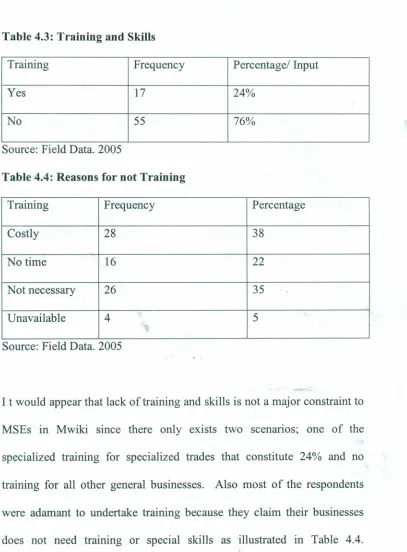
Skills and training are important for the success of an enterprise. This
study discovered that training is not very necessary to most of the
entrepreneurs in Mwiki except for a few who operate specialize: 'rusiness
that 24% of the respondents have some form of training while 76% of
them have none. The majority of those with some training operate
specialized businesses like salon, tailoring and cyber cafes.
Table 4.3: Training and Skills
Training Frequency Percentage/ Input
Yes 17 24%
No 55 76%
Source: Field Data. 2005
Table 4.4: Reasons for not Training
Training Frequency Percentage
Costly 28 38
No time 16 22
Not necessary 26 35
Unavailable 4 ,. 5
.
Source: Field Data. 2005
I t would appear that lack of training and skills is not a major constraint to
MSEs in Mwiki since there only exists two scenarios; one of the
.specialized training for specialized trades that constitute 24% and no
training for all other general businesses. Also most of the respondents
were adamant to undertake training because they claim their businesses
However, lack of basic bookkeeping skills has been cited as a problem because some could not tell how much profit they make in a month. Some form of training is therefore necessary and this concurs with Kinyanjui (1996) who discovered that lack of skills and training impedes enterprise performance.
4.4 Markets
Table 4.6 illustrates that restocking of business is not regular and takes place after along duration of time whereas, Table 4.5 illustrates that the market is not good. Therefore it is appropriate to infer that the influence of access to and availability of markets on enterprise performance has strong and positive relationship. 43% and 35% of the respondents indicated that their businesses are poor or fair respectively. 19% and 3% said that the businesses are good and very good as illustrated in Table 4.5 below.
Table 4.5: Markets
.
Market for goods/services Percentage
Very good 3
Good 19
Fair 35
Poor 43
Table 4.6: Restocking Frequency
Restocking Frequency Percentage
Daily 12 17
Weekly 19 28
Two weeks 17 25
Monthly 21 30
Source: FIeld Data. 2005
Table 4.6 shows how often the businesses are restocked. The restocking
parameter indicates the performance of the business. The findings show
that most entrepreneurs experience a problem in marketing their goods and
services. Most entrepreneurs attribute this to lack of demand, due to the low-income class of people who reside in the area. Lack of market for
products is regarded as a major problem in Mwiki because they are located
in low value markets where there are few barriers to entry. These findings
concur with the findings of (Dawson 1997). This is a problem attributed to
poverty and low level of earnings.
4.5 Policies and Regulations
Policies are normally expressed m government documents, such as,
sessional papers and development plans. Most entrepreneurs are not aware
relating to MSEs. This problem is attributed to lack of knowledge and
information on the policies related to the MSE sector.
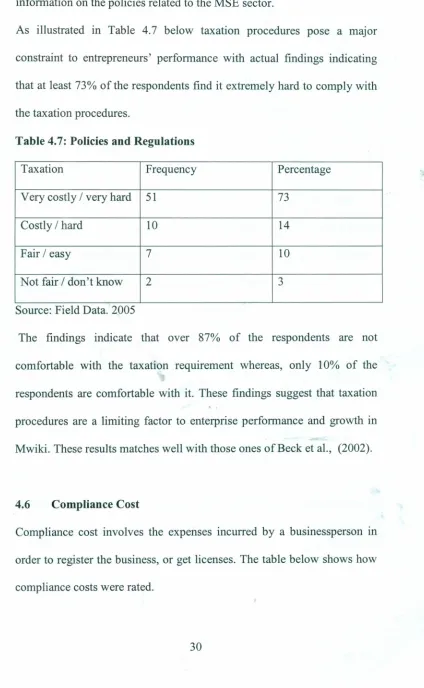
As illustrated in Table 4.7 below taxation procedures pose a major
constraint to entrepreneurs' performance with actual findings indicating
that at least 73% of the respondents find it extremely hard to comply with
the taxation procedures.
Table 4.7: Policies and Regulations
Taxation Frequency Percentage
Very costly / very hard 51 73
Costly / hard 10 14
Fair /easy 7 10
Not fair / don't know 2 3
Source: Field Data. 2005
The findings indicate that over 87% of the respondents are not
comfortable with the taxation requirement whereas, only 10% of the
respondents are comfortable with it. These findings suggest that taxation
procedures are a limiting factor to enterprise performance and growth in
Mwiki. These results matches well with those ones of Beck et al., (2002).
4.6 Compliance Cost
Compliance cost involves the expenses incurred by a businessperson in
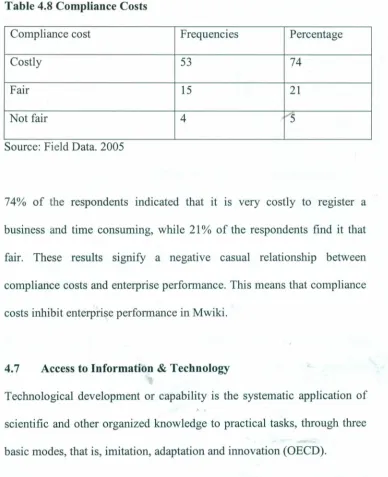
Table 4.8 Compliance Costs
Compliance cost Frequencies Percentage
Costly 53 74
Fair 15 21
Not fair 4 /5
Source: Fleld Data. 2005
74% of the respondents indicated that it is very costly to register a
business and time consuming, while 21% of the respondents find it that
fair. These results signify a negative casual relationship between
compliance costs and enterprise performance. This means that compliance
costs inhibit enterprise performance in Mwiki.
4.7 Access to Information &Technology
Technological development or capability is the systematic application of
scientific and other organized knowledge to practical tasks, through three
basic modes, that is, imitation, adaptation and innovation (GECD).
Most respondents indicated that lack of access to general information is
due to lack of interest in search of the information and non-availability of
Table 4.9: Access to Information and Technology
Access to information and technology Frequency Percentage
Availability
7
10Not available 54
77
No interest 9 13
Source: Field Data. 2005
The findings indicate that a total of 90% of the respondents do not have
access to information and technology. This clearly shows that there is lack
of appropriate technical skills among entrepreneurs. They lament that they
do not know where to get information and for those who have access to
the information indicate that it is a long process to access that information.
However, a number of entrepreneurs in Mwiki do not see the need to adapt
new technology because of the nature of their business, since they only
deal with simple consumer products and therefore think that no extra
knowledge is required to sell items, such as, vegetables, cereals, etc. While
those in the service business show keen interest in embracing new
technology, which happens to be missing. The findings indicate that lack
of information and technology is a major constraint to most entrepreneurs
4. 8 Government Rating on Provision of Services.
The respondents were requested to rate the government on how well it has
provided an enabling environment for MSEs in provision of services, such
as, training, credit facilities, sheds/stalls, electricity, marketing of the
products, information and technology, security and infrastructure.
Generally the government scores poorly n the provision of these services.
The results are compiled in Table 4.10 and briefly discussed afterwards.
Table 4. 10 Government Rating on Provision of Services
Services Very well Well Fairly Poor
Training Frequency 0 5 17 52
Percentage 0 7 23 70
Credit Frequency 0 0 0 51
Percentage 0 0 0 100
Sheds/stalls Frequency 0 0 0 67
Percentage 0 0 0 100
Electricity Frequency 0 2 27 43
Percentage 0 3 37 60
Marketing Frequency 0 0 5 69
Percentage 0 0 7 93
Information & Frequency 0 6 9 54
technology Percentage 0 9 13 78
Security Frequency 2 11 18 37
Percentage 3 16 27 54
Infrastructure Frequency 3 9 17 39
Percentage 4 13 25 58
Source: FIeld Data. 2005
70% of the respondents indicate that there is no training offered by the
government. 23% of which indicated that the training is fairly provided
.were quick to point out that training opportunities are very scarce and
expensive since they have to pay indirectly to secure a place even though
the colleges are free, for instance, in the National Youth Service.
Electricity is available in the area but expensive to install and use. For
hence its unreliability This means that access to power is a major
constraint to many entrepreneurs in Mwiki both for operation of the
business and security purposes; thus consequently contributing to poor
enterprise performance.
Provision of information and technology has been rated poorly by 78% of
the respondents. Most respondents expressed either ignorance or lack of
interest while others complained of unavailability of information at
regional offices. One has to go to the headquarters to access such
information and before one gets it, a lot of time is wasted for being
referred from one officer to another. Similarly, provision of security and
infrastructure are poorly rated at 54% and 58% of the respondents
respectively as shown in Table 4.10.
4.9 Support Services and Programmes Required. by MSEs in
Mwiki to Overcome the Constraints
The respondents were requested to rate services compiled for this aspect,
such as, lowering of taxation, improving of security and markets,
facilitation of credit, and provision of electricity, information and
technology, work- space, and training in regard to their importance for the
purpose of improving their MSEs. Table 4.11 compiles the findings for
Table 4.11 Table on Support Requirements
Services Very Important Fairly Not
important important important
Lower taxes Frequency 51 9 7 3
Percentage 73 13 10 4
Improve Frequency 53 8 6 2
Security Percentage 77 11 9 3
Credit Frequency 38 25 9 1
Percentage 52 34 12 1
Electricity Frequency 41 23 5 0
Percentage 60 33 7 0
Information& Frequency 31 29 9 1
Technology Percentage 44 41 13 2
Workspace Frequency 56 15 0 0
Percentage 79 21 0 0
Training Frequency 12 29 18 11
Percentage 17 41 26 16
Market Frequency 28 29 12 7
Percentage 37 38 16 9
Source: Field Data. 2005
All the above services were regarded very important. The provision of an
enabling environment by the government and other stakeholders therefore
has a positive relationship with enterprise performance. Enterprises in
Mwiki need support systems that will bridge the gaps in production,
demand and availability of goods and services. These findings concur with
(Gibb: 1981) who advocates for the intervention mechanisms in form of
CHAPTER FIVE
5.0 Conclusion and Recommendations
This study explored the constraints faced by the MSEs in Mwiki Kasarani
area of Nairobi. The results show that there is a strong relationship
between the constraints and enterprise performance. It is also indicative
that provision or availability of some of factors, such as, training, market
information and technology and markets may not necessarily lead to better
enterprise performance. Enterprise growth and better performance is
constrained by such factors as lack of credit, limited workspace, security
and high taxes among others.
Most of the respondents were of the view that if adequate workspace is
provided at reasonable cost by the government, they can do better business
by investing extra or more resources. Also if the procedures and
requirements of applying for credit facilities are made easier, they can
innovatively start up new or alternative businesses or expand the existing
ones.
Although most financial institutions are appealing to MSEs to apply for
short-term loans, entrepreneurs tend to shy off without even trying to
attached to the traditional feeling that if their businesses fail, everything
they own will be taken away.
Also, respondents were requested to provide suggestions to policy makers
and stakeholders as regards to their needs. These are some of the
suggestions they came up with:
I. Relaxing laws which discriminate against small scale businesses,
for instance operating licenses, business name registration,
II. Be provided with work-space at subsidized rent, and
III. To be given special electricity rates.
This study recommends the need to improve security in the area. To
improve security in Mwiki area this study recommends the formation of
vigilante groups to work with the police and chiefs to reinforce order.
There is also need to start a vocational training centre to train the youth
who have dropped out of school or school leavers to get jobs or equip
them with basic skills that can enable them to start and manage their own
businesses.
The government and other proponents of MSEs need to set up an
information centre that is accessible to the people to disseminate
information. This centre should offer advisory services on various issues
like government policies on MSEs, importance of loans, basic managerial
skills and bookkeeping, avail some literature on appropriate technology
with illustrations and practical demonstrations if possible.
Another suggestion is for NGOs to provide pre-loan training to reduce
cases of defaulters and monitoring expenses. More research is needed in
this area because the study did not investigate the details of the causes and
REFERENCES
Beck, T., Asli Demirguc-Kunt, and Levine R., (2003) MSEs, Growth, and
Poverty: Cross Country Evidence: World Bank Policy Research Paper No.
01,02, Lll, L25
Bokea, C., and Mullei, A., (1999) Micro and Small Enterprise in Kenya,
Nairobi: ICEG
Downing, J. (1990) Gender and the Growth and Dynamics of Micro
Enterprises.
Gibb, A. 1981 A framework for judging the current capability and interest
of the society in New Small Business Development. United Kingdom:
Durham University Business School.
GOK. (1992) Kenya, Republic of Sessional Paper 2 of 1992, on Small
Enterprises and Jua Kali Development-Nairobi. Nairobi: The Government
Printers.
GOK. (1994) Kenya, Republic of Sessional Paper No. 1 of 1994 on
Recovery and Sustainable Development to the year 2010. Nairobi:
Government Printers.
GOK (1996) Kenya, Republic of, Sessional Paper No. 2 of 1996 on
Industrial Transformation to the year 2020, Nairobi: Government Printers.
ICEG &KREP Holdings Limited (1999) National Micro and Small
Enterprises. Baseline Survey: 1999 Survey results Nairobi, CBS, ICEG,
Ikiara, G. K. (2001) Economy Gloom still Persists. "Kenyans to Continue Grappling with unfulfilled Expectations due to Mismanagement" Special Report in Sunday Nation December 30th 2001. Nairobi: Nation Press.
ILO (1986) The Promotion of Small and Medium Sized Enterprises. Report VI Geneva: International Labour Office.
ILO (1997) The Promotion of Small and Medium Sized Enterprises. Report VI. Geneva: International Labour Office.
ILO (1999a) The Promotion of Small and Medium Sized Enterprises.
Report VI.Geneva: International Labour Office.
ILO (1999b) Gender Issues in the World of Work: Gender issues in Micro Enterprise Development Geneva International Labour office.
Jhingan, M.L., (1993) Micro Economical Theory 4th Revised and Enlarged
Edition Main Vikas Mang Delhi 110092: Konark Publishers PVT LTD.
Levitsky, J., (1996) Support Systems for MSEs in Developing Countries: A Review, Vienna: UNIDO 2.
Loucks, K. E., (1999) Designing and Delivering High-Impact, Cost-effective Business Development Services for Small and Medium-Scale
Enterprises. Pars: OECD.
Mugenda, O. M., and A. G. Mugenda (1999) Research Methods:
Quantitative and Qualitative Approaches. Nairobi: Acts Press.
Nolan,
A.,
(2002), Self-Employment, micro-enterprise and localDevelopment France (www.srnartlink.net.all).
DE
CD (1998) Fostering Entrepreneurship. Paris:DECD.
Sisule, T. P. M., (2000) Poverty The Eyes of Kenyans ": An insight into
Appendix A: Work Plan
Phase 1. Pilot study and adjustment
Phase 2.
Phase 3.
Phase 4.
Data collection
Data analysis
Report writing and compilation
1 week
4 weeks
2 weeks
2 weeks
PHASE NO. OF WEEKS
DESCRIPTION 3 4 567
8
1 Pilot Study and Adjustment
2 Data Collection
3 Data Analysis
4 Report Writing and
Compilation
BUDGET
COST OF PROPOSAL
1 Printing and Typing @ Shs 40/= per page 2000.00
2 Photocopying @ Shs 3/= per page of 12 copies 2500.00
3 Binding 800.00
4 Travelling 5000.00
PROJECTED COST OF THE PROJECT
1 Travelling Expenses 8000.00
2 Cost of Processing Data 6000.00
3 Cost of Typing final document 1000.00
4 Cost of Printing and Photocopying final 2000.00
document
5
6
7
Cost of Binding final document
SUB-TOTAL
Contingencies (10%) of sub-total
1000.00
28300.00
2830.00
Appendix B: Questionnaire
The objective of this study is to identify the constraints that inhibit the growth and expansion of micro and small businesses. This questionnaire is expected help collect necessary data for analysis
All information obtained vide this questionnaire will be treated with utmost Confidentiality and used for academic purposes only.
Kindly fill inthe information required as accurately as possible. Your co-operation will be highly appreciated.
Instructions
Where necessary tick appropriately. In other cases please provide the information in the space provided
Background Information
Questionnaire
No .
Date .
Name of respondent .
Name of Business .
Gender of Respondent:
Male .
Female .
What level of educational do you have? No formal education Primary education Secondary education College education University education You fallbetween which ages?
a) Less 30 b) 31-50
.~
c) Over 50 years
I.Who owns the business? (Please tick)
a) Self
b) Parents
c) Wife
d) Husband
e) Any other (Specify please) .
2. For how long have you been in business?
a) Below two years
b) Two to four years
c) Above four years
3. Whom does this premise belong to?
a) Self
b) Rented
c) Parents
d) Relative
4. (i) Approximately what is the area of your shop?
a) Less than 4m2
b) 4m2 to 10m2
c) Above 10m2
(ii) How much rent do you pay every month in Ksh.?
a) Less than 5000
b) 5000- 10,000
c) Above 10,000
5. How did you get capital to start the business? (please tick)
a) Personal Savings
b) Loan from a CooperativelBank
c) Family and Friends
6.Indicate the value of your business according to table below
,
Starting Below starting Same as staring Above statingCapital (Ksh.) capital now capital now capital now
Tick
one
Less 10,000
10,000-30,000
31,000-50,000
Above 50,000
7. How easy IS it for you to access a loan from banks or financial
institutions?
a) Very hard
b) Hard
c) Easy
d) Very easy
8.How many licenses do you require to start and operate a business?
a) 1 to 3
b) 4 to 5
c) More than five
9. i) How long does it take to get business licenses?
a) Less than a week
b) Two weeks to one month
c) More than one month
ii) How costly are the licenses?
a) Very costly
b) Costly
c) Not costly
iii). How often are the licenses renewed?
a) One year
b) Two years
c) Three years
10. i) Are there other levies or indirect taxes from the
a) Yes
b) No
ii) Ifyes, how costly?
a) Very costly
b) Costly
c) Not costly
d) Don't know
11.i) Do you have any form of training? (Please tick)
a) Yes b) No
ii) If yes to (i) above, is the training assisting you to do business
better? a) Yes b) No
iii) If no to (i) above, why?
a) Training is costly
b) There are no training opportunities
c) Don't have time for training
d) Training is not necessary
12.i) How is the market for your goods/services?
a) Very good
b) Good
c) Fair
d) Poor
ii) How often do you add stock?
a) Daily
b) Weekly
c) After two weeks
13. Rate the government in providing the following by ticking the
appropriate box.
Very good Good Fair Poor
Training
Sheds/Stalls
Electricity
Communication facilities
Marketing &information
14. What kind of assistance would you like to receive from the
government or other organisations in order to improve your business?
(Tick according to importance)
Very Important Fairly Unimportant
important important
Lower tax
Improve security
Improve social
services
Lower the rents
Lower license fees
Assist in marketing
=The
Appendix C
Summary of Data Collected
Background Information
Age <30 30 - 50 >50
Frequency 21 27 24
% 29 38 33
01 Self Parents Wife Husband Other
Frequency 29 11 6 17 10
% 40 15 8 24 14
02 <2 yrs Between 2 & 4 >4 yrs
Frequency 0 31 41
% 0 43 57
03 Self Rented Parents Relative
Frequency 8 47 13 4
% 11 65 18 6
04 (i) <4 4 10 >10
Frequency 56 11 5
% 78 15 7
04 (ii) <5000 5000-10000 >10000
Frequency 43\ 17 12
% 60 24 17
Personal Personal
05 savings Loan Family/friends Don't know savings
Frequency 28 24 13 7 39
% 39 33 18 10
06 Start Now below Now same Now above
<10000 16 5 2 9
10000-30000 27 7 9 11
30000-50000 18 3 13 2
>50000 11 5 3 3
Loan Family/friends Don't know
33 18 10
Allin%
Start Now below Now same Now above
22 31 13 56
% Of all
Now below Now same Now above
28 38 35
07 Very hard Hard Easy Very easy
Frequency 28 36 6 2
% 39 50 8 3
08 1 3 4 5
Frequency 47 25
% 65 35
09 <wk 1wk-1 mth >1mth
Frequency 11 43 18
% 15 60 25
010 (i) V costly Costly Not costly Not know
Frequency 51 10 8 3
% 71 14 11 B
010 (ii) 1yr 2yrs 3yrs
Frequency 63 7 2
% 88 10 3
010 (iii) V costly Costly Not costly Not know
Frequency 44 13 11 4
% 61 18 15 6
011 (a) Yes No
Frequency 17 55
% 24 76
011 (b) (i) Yes No
Frequency 13 4
% 76 24
011 (b) (ii) Costly Unavaiiable Unnecessary No time
Frequency 28 4 26 16
% 39 6 36 22
012 (i) Very good Good Fair Poor
Frequency 3 13 31 25
% 4 18 43 35
012 (ii) Daily Weekly After 2 wks Monthly
Frequency 12 9 13 17
% 17 13 18 24
013 Training Credit Security Sheds/stalls
Very high
0
0
5
0
High
5
8
10
8
Low 9
13
45
31
Very low
58
51
12
33
Improve
Improve Social
014 Lower Tax Security Services Lower Rent
Very important
60
20
32
27
Important
10
40
35
27
Fairly important
2
11
5
11
Not-important
0
1
0
7
Communication facilities
3
21
42
6
Information & marketing
5
15
36
17
Assist in marketing