Available Online atwww.ijcsmc.com
International Journal of Computer Science and Mobile Computing
A Monthly Journal of Computer Science and Information Technology
ISSN 2320–088X
IMPACT FACTOR: 5.258
IJCSMC, Vol. 5, Issue. 6, June 2016, pg.87 – 94
A New Framework and Algorithms
for Secure Cloud Transactions
Naveen Bugga
1, A. Siva Kumar
2Computer Science & Engineering, JNTU Hyderabad
TUDI RAM REDDY INSTITUTE OF TECHNOLOGY & SCIENCES
Abstract: Transactions over communication networks play a vital role. It does mean that these
transactions are distributed transactions pertaining to relational databases. Cloud computing is in
distributed environment where the database transactions are to be carried out with high level of
integrity. In this paper we investigate the problem of security in distributed transactions and provide
a framework for data integrity and security. The concept of trusted transactions is given importance.
The security policies and other constraints are to be considered. The proposed framework takes care
of integrity of transactions besides security. Towards this end, two phase commit protocol is
implemented which takes care of ACID properties to ensure integrity of data. We built a prototype
application that demonstrates the proof of concept. The empirical results revealed that our two phase
commit protocol and other mechanisms are able to support data integrity and security in distributed
environment in cloud computing.
Keywords: Cloud, database transactions, two phase commit, security
I. INTRODUCTION
RDBMS provides security to the data in the form of access control mechanism. It has abilities to support users, roles and access privileges. Thus only authorized users can access the database. When applications gain access to database, they actually use Structure Query Language (SQL) as an underlying language to interact with relational databases. This language is used along with frond end so as to interact with relational databases.
Later on distributed databases and distributed computing came into existence. Cloud computing is one of the examples for distributed computing. The computing resources are commoditised effectively using cloud computing technology. The cloud computing is based on the concept of virtualization. Virtualization is responsible for optimal utilization of resources and cloud computing is complemented with this technology. As explored in [1] and [2] the cloud computing took time to come into existence. However, now it is a reality and we are able to use cloud computing platforms from different vendors. Some of the popular cloud platforms are Amazon’s EC2, AMAZON web server, Google Apps and Microsoft Azure [1].
In cloud computing resources are rendered on demand. It provides support for IT with low cost [2], [3]. There are many advantages to cloud users as it provides many services at low cost with unlimited storage and computing resources [2], [4].
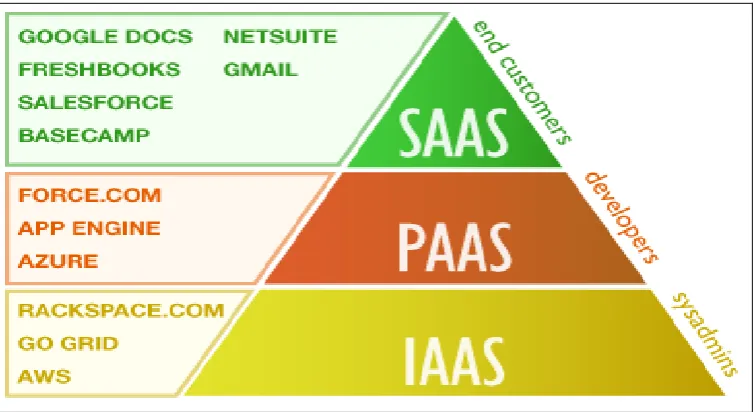
Figure 1 – Cloud computing services
II. PROPOSED SOLUTION
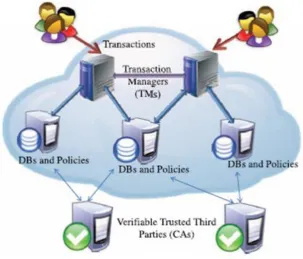
We proposed architecture for secure distributed transactions in cloud computing environment. The architecture is shown in Figure 2. It throws light into the basic flow of transactions in the distributed environment. We proposed algorithm that focuses on the secure transactions with ACID properties ensured. Two phase validation commit protocol proposed is responsible for many things. It ensures authentication, authorization, security policies, transaction management, inconsistencies and importantly transactions. Transaction is a set of activities that are carried out in a server. They are to be carried out as a single unit. We enhanced two phase commit protocol that provide secure transactions in distributed environment.
Figure 2 – Our solution is on top of this architectural overview
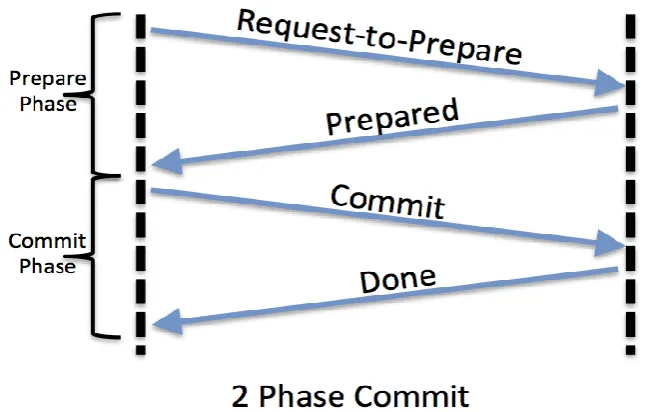
Figure 3 – Illustrates flow of 2 Phase Commit
Our algorithm is in the similar lines of the algorithm presented in [12] and [13]. It is presented in Figure 4. Their algorithm and our algorithms are almost same with small differences. The validations are more in the proposed algorithm. When transactions are taken place in a single machine, no such protocol is required. When transactions take place in multiple servers then this protocol plays a vital role in ensuring secure and complete transactions in distributed environment. The proposed protocol takes confirmations from the participating servers. The time is also considered and both servers where transactions are taken place are to provide similar kind of response. If not the whole transaction is rolled back. Incremental punctual proofs provide additional means of ensuring consistency in distributed transactions.
The TM checks version number as well when it is received from participating servers. This is important for view consistency in distributed environment where multiple users are presented the data. Policies are enforced when transactions are committed or rolled back. The case of global consistency is ensured by the TM with policy revisions and validates and latest versions available in the master policy servers. Data integrity constraints are verified and continuous proof of inconsistencies are taken into consideration.
III. RELATED WORKS
This section provides review of literature on data integrity and security transactions in cloud computing. It throws light into different categories of cloud services such as IaaS, PaaS and SaaS.
3.1 Security Challenges in IaaS
There are many things involved in the infrastructure. It includes both hardware and software. In this service layer of cloud there are security challenges. However, it has much importance as it can store data and allows data retrieval. Since cloud servers are untrusted, the security issues arise when data is outsourced. There are issues when data is illegally modified or tampered. This needs to be prevented in order to ensure data integrity. The intrusions to databases are to be avoided and thus the distributed transactions that take place in the confines of IaaS. The security issues in the service layer include data intrusion, service availability, and data integrity [1]. Trust is one of the concerns in IaaS. The trust levels provided by the cloud service providers are different. There are many issues with respect to stakeholder rights and security issues in safeguarding the interests of cloud users [3]. Moreover there are many kinds of attacks that can occur on cloud services. In this context user access policies are very important as they play vital role in it [4]. As cloud is based on virtualization, the virtualization manager is in IaaS layer and it causes many security issues [6].
3.2 Security Challenges in SaaS
3.3 Security Challenges in PaaS
This service provides the required cloud platform with API for application development. It throws many challenges related to security. They are service life cycle optimization, market and legislative issues, multi-cloud architectures, adaptive self-preservation, and dependable sociability [2]. The usage of web services and the applications that are built on the cloud platform API are vulnerable to many security threats. Earlier Cloud Security Alliance (CSA) reported around 10 important security issues in cloud computing.
Many solutions came into existence to overcome all these security issues. They are related to data integrity which focused on the consistency of data in the data
dynamics. These
solutions were explored in [7], [8], [9], [10], [11], [12] and [13] and [14]. In this paper, based on the solution in [14] we designed and implemented a security mechanism for data integrity in cloud computing. We also built an algorithm for safe and secure cloud transactions. We built a prototype application that show how the proposed framework ensures secure transactions in the distributed environment.
IV. EXPERIMENTAL RESULTS
Our prototype application is used to perform experiments with database transactions in distributed environment. Experiments are made in terms of safe and secure transactions. The observations in the transactions include the consistency of data in a distributed environment.
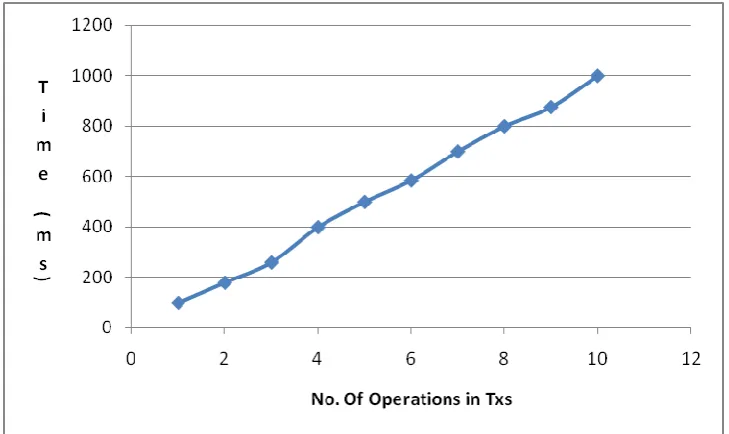
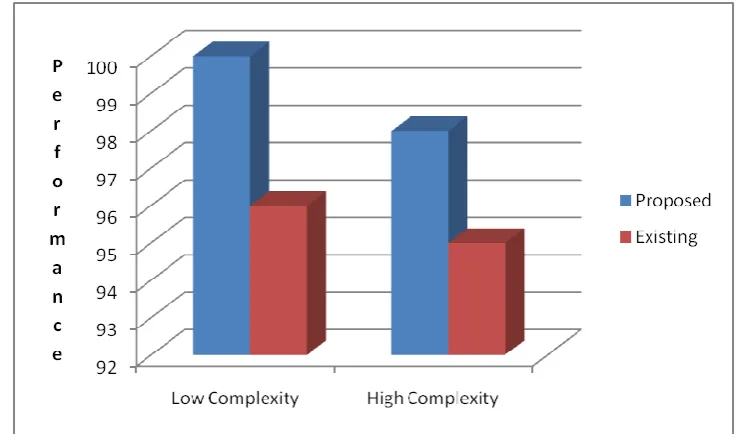
Figure 6 – Performance comparison in low and high complexity in distributed environments
As shown in Figure 5 and 6, it is evident that the proposed solution shows higher performance in terms of performance and the time taken with number of underlying operations in distributed transactions.
V. CONCLUSIONS AND FUTURE WORK
There are many security and data integrity concerns when data is outsourced to cloud. There are mechanisms and algorithms to ensure secure and data dynamics. The mechanisms enforce precision of authorization, accuracy, consistency and trustworthiness in transactions. Especially in distributed environment, it is essential to have consistency of transactions. In this paper we proposed a framework with underlying algorithm to ensure that ACID properties with additional validations are carried out in distributed environment like cloud computing. Safe and secure transactions are carried out with an improved two phase commit protocol. This protocol has two basic phases. In the first phase all participant servers provide the response. Based on the response of multiple servers, the second phase will take care of decisions like commit or rollback. In addition to this TM is responsible to ensure valid view and consistency in transactions. We built an application that demonstrates the concept and the empirical results are show that proposed algorithm is very useful. In future this research can be extended further to include more security policies and verify the distributed transactions.
REFERENCES
-http://www.javatpoint.com/history John MacCharty. (1961). History of Cloud Computing.
[1]
56. -, p.45 computing
-cloud -of
[2] techinmind. (2014). What Is Cloud Computing? What are It’s Advantages and Disadvantages?. Cloud computing security issues, p.12-19.
[4] John MacCharty. (1961). Advantages of Cloud Computing. Cloud computing security issues, p.90-101. [5] MacCharty. (1961). Virtualization in Cloud Computing. Cloud computing security issues,
p.45-56.
[6] ohn MacCharty. (2014). Virtualization and Cloud Computing. ntel IT Center Planning Guide | Virtualization and Cloud Computing, p.20-30.
[7] Binali Yıldırım. (2016). Cloud computing
19. -, p.12 https://en.wikipedia.org/wiki/Main_Page security.
[8]. Philip A. Bernstein, Vassos Hadzilacos, Nathan Goodman (1987): Concurrency Control and Recovery in Database Systems, Chapter 7, Addison Wesley Publishing Company, ISBN 0-201-10715-5.
[9].Gerhard Weikum, Gottfried Vossen (2001): Transactional Information Systems, Chapter 19, Elsevier, ISBN 1-55860-508-8.
[10].Philip A. Bernstein, Eric Newcomer (2009): Principles of Transaction Processing, 2nd Edition, Chapter 8, Morgan Kaufmann (Elsevier), ISBN 978-1-55860-623-4
[11].http://en.wikipedia.org/wiki/Two-phase_commit_protocol.
[12]. P.K. Chrysanthis, G. Samaras, and Y.J. Al-Houmaily, “Recovery and Performance of Atomic Commit Processing in Distributed Database Systems,” Recovery Mechanisms in Database Systems, Prentice Hall PTR, 1998.
[13]. M.K. Iskander, D.W. Wilkinson, A.J. Lee, and P.K. Chrysanthis, “Enforcing Policy and Data Consistency of Cloud Transactions,” Proc. IEEE Second Int’l Workshop Security and Privacy in Cloud Computing (ICDCS-SPCCICDCS-SPCC), 2011.