An extended abstract of this paper is published in the proceedings of the 13th International Conference on Cryptology in India [21] – Indocrypt 2012. This is the full version.
On the Non-malleability of the
Fiat-Shamir Transform
Sebastian Faust1, Markulf Kohlweiss2, Giorgia Azzurra Marson3, and Daniele Venturi1 1Aarhus University
2Microsoft Cambridge
3Technische Universit¨at Darmstadt
Abstract
Contents
1 Introduction 3
2 Preliminaries 4
3 Properties of NIZKs in the Random Oracle Model 7
4 On the Non-malleability of the Fiat-Shamir Transform 10
4.1 Simulation Soundness . . . 10
4.2 Weak Simulation Extractability . . . 13
5 Applications 14 5.1 Leakage Resilience . . . 14
5.2 Key-Dependent Message Security . . . 16
A Defining Proofs of Knowledge 21 B Honest-verifier zero-knowledge and neighborhood 21 C Proof of Proposition 1 22 D Details Omitted from Applications 24 D.1 Definitions of Leakage-Resilient Primitives . . . 24
D.2 Proof of Theorem 4 . . . 25
D.3 Revisiting Naor-Segev in the ROM . . . 26
D.4 Σ-Protocol for BHHO . . . 29
1
Introduction
Zero-knowledge proof systems [27] are a powerful tool for designing cryptographic primitives and protocols. They force malicious parties to behave according to specification while allow-ing honest parties to protect their secrets. Non-interactive zero-knowledge (NIZK) proofs [11] consist of a single proof message passed from the prover to the verifier. They are particularly useful for designing public-key encryption and signature schemes as the proof can be added to the ciphertext and signature respectively. Understanding the most efficient NIZK proofs that are sufficiently strong, i.e., sufficiently non-malleable, for building signature and encryption schemes with strong security properties is thus of fundamental importance in cryptography. It was shown by Goldreich and Oren [26] that NIZK proofs are unattainable in the standard model. To avoid this impossibility result, one must rely on additional assumptions, such as common reference strings [10] (CRS model) or idealizations of hash functions [8] (random oracle model, ROM).
With the aim of finding the “right” definition in the non-interactive case, several flavors of non-malleability [20] have been introduced for NIZK in the CRS model [39, 40, 25, 32]. The notion of simulation soundness, which bridges soundness and zero knowledge, guarantees that soundness holds even after seeing accepting proofs, for both true and false statements, produced by the simulator. This strengthened soundness notion was first proposed by Sahai in [39], and later improved by De Santis et al. [40]. The notion of simulation extraction [40, 29] in addition requires that accepting proofs allow to extract witnesses. Different variants of simulation extraction have been proposed by [16, 19].
Until recently, zero-knowledge in general and NIZK in particular were considered to be primarily of theoretical interest. Significant exceptions being efficient Σ-protocols [17, 18] and their non-interactive relatives based on the Fiat-Shamir (FS) transform [22]. A Σ-protocol is a three-move interactive scheme where the prover sends the first message and the verifier sends a random challenge as the second message. In a nutshell, the Fiat-Shamir transform removes the interaction by computing the challenge as the hash value of the first message and the theorem that is being proven. Σ-protocols and the Fiat-Shamir transform are widely used in the construction of efficient identification [22], anonymous credential [15], signature [37, 1], e-voting schemes [9], and many other cryptographic constructions [12, 6, 24].
Most work on the provable security of zero-knowledge has, however, been conducted either on interactive proof systems in the plain model or on NIZK in the CRS model, while practitioners often preferred Fiat-Shamir based NIZK proofs for their simplicity and efficiency. The use of the Fiat-Shamir transform was most thoroughly explored in the security proofs of signature schemes in the random oracle model [37, 1], but was otherwise often used heuristically. The question thus arises whether one can lay sound foundations for the FS transform in the light of recent research on CRS-based NIZKs. To this end, we provide non-malleability definitions for NIZK in the random oracle model that closely follow the established CRS-based definitions [29]. An earlier result oriented in the same direction, but concerning a Σ-protocol for aspecific language,1 was given by Fouque and Pointcheval [24]. Their proof strategy relies on the forking lemma [37] and (implicitly) on the fact that the Σ-protocol they consider has a particular property called
strong special honest-verifier zero-knowledge (SS-HVZK). Since there exist Σ-protocols that
do not satisfy the SS-HVZKproperty, Fouque and Pointcheval’s proof cannot be immediately
extended to the general case. Moreover, we make the random oracle explicit in our definition, which is crucial as definitions in the random oracle model can be brittle [42].
Our first observation is that much less is required to show simulation soundness for any FS-NIZK proof. Namely, in the random oracle model, simulation soundness simply follows from
1
the soundness and the HVZK properties of the underlying interactive protocol. In particular, it is neither necessary to rely on the forking lemma, nor on the strong2property of
SS-HVZK.
We also show that the proof strategy of [24], when generalized properly to any Σ-protocol, yields something more than just simulation soundness. In fact, one gets some form of simula-tion extractability, which we call weak simulation extractability. In a nutshell, full simulation extractability requires that even after seeing many simulated proofs, whenever an adversary outputs a new accepted proof, we can build an algorithm to extract a valid witness. Sometimes, such a strong extraction property is calledonline extraction [23] because the extractor outputs a witness directly after receiving the adversary’s proof. In comparison, our notion is weaker in that it allows the extractor to fully control the adversary (i.e., rewind it).
Our contribution. Our contributions are threefold. First, we formally define the notions of zero-knowledge (which holds trivially for the Fiat-Shamir transform), simulation soundness, and simulation extractability for NIZKs in the random oracle model. Second, we show that simulation soundness and a weak form of simulation extractability come for free if one uses the FS-transform for turning Σ-protocols into NIZK proof systems. Third, we investigate the con-sequences of this result by showing that our definitions are sufficient for instantiating the Naor-Yung paradigm for constructing CCA2-secure encryption schemes, and generic construction for signature schemes from hard relations and simulation-extractable NIZK proof systems [19]. These two constructions are particularly interesting as the former preserves both leakage re-silience and key-dependent message security of the underlying CPA-secure encryption scheme, while the latter lifts the leakage resilience of the hard relation to the leakage resilience of the resulting signature scheme. To our knowledge, these are the most efficient schemes having such properties, if one is willing to rely on the ROM.3
Related work. The only other efficient transform for Σ-protocols yielding simulation sound-ness (again in the random oracle model) is Fischlin’s transform [23] which is designed with the purpose of online extraction and is less efficient than the classical Fiat-Shamir transform. Therefore, it would be interesting to investigate whether Fischlin’s transform achieves a stronger form of simulation extractability. We notice that in the interactive case, a general transform from any Σ-protocol to an (unbounded) simulation-sound Σ-protocol using one-time signatures has been proposed [25]. In the common reference string model the most efficient simulation-sound or simulation extractable NIZK proof system are based on Groth-Sahai proofs [30]. One has however to pay the price of proving a structure-preserving CCA secure encryption [19] (for true-simulation extraction) or a structure-preserving signature scheme [3] (for full simulation extraction).
2
Preliminaries
Notation. Letk be a security parameter. A function ν is called negligible ifν(k)≤k−c for any c > 0 and sufficiently large k. Given two functions f, g, we write f ≈ g if there exists a negligible function ν such that |f(k)−g(k)|< ν(k). Given an algorithm A,y ← A(x) means that y is the output ofA on input x; whenA is randomized, then y is a random variable. We write AH to denote the fact that A has oracle access to some function H. PPT stands for
2In Appendix B, we show a separation between the two notions of special HVZK [17] (
S-HVZK) and SS-HVZK, by showing that any S-HVZK Σ-protocol can be turned into another Σ-protocol which is still
S-HVZKbut notSS-HVZK, assuming that one-way functions exist. 3
Prover P(x, w; 1k) Verifier V(x; 1k) α← P0(x, w;ρ) −→α
β
←− β ← V$ 0(x, α)
γ ← P1(α, β, x, w;ρ) −→γ Accept iff V1(x, α, β, γ) = 1
Figure 1: A Σ-protocol for a languageL.
probabilistic-polynomial time. A decision problem related to a language L ⊆ {0,1}∗ consists
in determining whether a string x is inL or not. Given an instance x, we say that A decides (or recognizes) L if, after a finite number of steps, the algorithm halts and outputs A(x) = 1 if x ∈ L, otherwise A(x) = 0. (Sometimes, we may call “theorem” a string belonging to the language at hand.) We can associate to any NP-language L a polynomial-time recognizable relationRL defining Litself, that is L={x:∃w s.t. (x, w)∈ RL}, where |w| ≤poly(|x|). The
string w is called a witness orcertificate for membership of x ∈ L. For NP, w corresponds to the non-deterministic choices made by A.
Interactive protocols. An interactive proof system (IPS) for membership inLis a two-party protocol, where a prover wants to convince an efficient verifier that a stringxbelongs toL. In a zero-knowledge interactive proof system, a proverPcan convince a verifierV thatx∈ Lwithout revealing anything beyond the fact that the statement is indeed true. Informally, this means that V cannot exploit the interaction with P for gaining extra-knowledge. Such a property is formalized by requiring the existence of an efficient algorithmS, thezero-knowledge simulator, which produces messages indistinguishable from conversations between an honest proverP and a malicious verifier V∗. Besides the zero-knowledge property, any proof system satisfies two standard requirements: proving true statements is always possible, while it should be infeasible to convince the verifier to accept a false statement as correct. These two conditions are called
completeness and soundness respectively. Related to the concept of interactive proof systems, but even more subtle, is the notion of proof of knowledge. In a proof of knowledge (PoK), P wants to convinceV that heknows a secret witness which implies the validity of some assertion, and not merely that the assertion is true. To formalize the fact that a prover actually “knows something”, we require that there exists an efficient algorithm E, called knowledge extractor, that when given complete access to the program of the prover can extract the witness.
An IPS or an interactive PoK is called public-coin when the verifier’s moves consist merely of tossing coins and sending their outcomes to the prover. (In contrast, in a private-coin IPS the verifier does not need to show the outcome of the coins to the prover [28].) We are mainly interested in a specific class of public-coin interactive PoK systems for NP-languages, called Σ-protocols. Here, the parties involved share a stringx belonging to a language L ∈NP and the prover also holds a witnesswfor membership ofx∈ L. Thus, the proverP wants to convince the verifierV that it “knows” a witnesswforx, i.e. thatxis in the language, without revealing the witness itself. Σ-protocols have a 3-move shape where the first message α, called commitment, is sent by the prover and then, alternatively, the parties exchange the other messages β and γ, called (respectively) challenge and response. The interaction is depicted in Figure 1. Besides the standard properties held by any IPS, Σ-protocols satisfy a flavour of zero-knowledge — called honest-verifier zero knowledge (HVZK) — saying that an honest verifier taking part in the protocol does not learn anything beyond the validity of the theorem being proven.
additional proprieties:
Completeness. If x∈ L, any proper execution of the protocol betweenP andV ends with the verifier accepting P’s proof.
Honest-verifier zero knowledge (HVZK). There exists an efficient algorithm S, called zero-knowledge simulator, such that for any PPT distinguisher D = (D0,D1) and for any(x, w)∈ RL, the view of the following two experiments, real and simulated, are com-putationally indistinguishable:
Experiment Expreal
Σ,D (1k)
(x, w, δ)← D0(1k)
π← hP(x, w; 1k),V(x; 1k)i
Output D1(π, δ)
Experiment Expsim
Σ,D(S,1k)
(x, w, δ)← D0(1k) π← S(x,1k)
Output D1(π, δ)
where hP(x, w),V(x)idenotes the verdict returned at the end of the interaction between P
and V on common input x and private input w.
Soundness. If x /∈ L then any malicious (even unbounded) prover P∗ is accepted only with negligible probability.
Special soundness. There exists an efficient algorithm E, called special extractor, such that given two accepting conversations (α, β, γ) and (α, β0, γ0) for a string x, where β 6= β0, thenw← E(α, β, γ, β0, γ0, x) is such that (x, w)∈ RL.
The special soundness property is strong enough to imply both soundness and that Σ-protocols are PoK [18]. Sometimes Σ-protocols are required to meet stronger notions of HVZK.4
A non-standard condition that many Σ-protocols satisfy, introduced by Fischlin in [23], requires that responses are quasi unique, i.e. given an accepting proof it should be infeasible to find a new valid response for that proof.
Definition 2 (Quasi unique responses). A Σ-protocol has quasi unique responses if for any PPT A and for any security parameter k it holds:
Prob[(x, α, β, γ, γ0)← A(1k) : V(x, α, β, γ) =V(x, α, β, γ0) = 1 ∧ γ 6=γ0]≈0.
A Σ-protocol has unique responses if the probability above is zero. The latter condition, defined by Unruh in [41], is also known asstrict soundness.
Min-entropy of commitments. Following [1, 2], we use the concept of min-entropy to measure how likely it is for a commitment to collide with a fixed value.
Definition 3 (Min-entropy of commitment). Let k be a security parameter and L be an
NP-language with relation RL. Consider a pair (x, w) ∈ RL and let (P,V) be an arbitrary three-round IPS. Denote with Coins(k) the set of coins used by the prover and consider the set A(x, w) ={P0(x, w;ρ) :ρ ← Coins(k))} of all possible commitments associated to w. The min-entropy function associated to(P,V)is defined asε(k) = min(x,w)(−log2µ(x, w)),where the
minimum is taken over all possible(x, w)drawn fromRLandµ(x, w)is the maximum probability that a commitment takes on a particular value, i.e., µ(x, w) = maxα∈A(x,w)(Prob[P0(x, w;ρ) = α:ρ←Coins(k))]).
We say that (P,V) is non-trivial if ε(k) = ω(log(k)) is super-logarithmic in k. Often, the commitment is drawn uniformly from some set. In order for (P,V) to be non-trivial, this set must have size exponential ink. Notice that most of natural Σ-protocols meet such a condition and, in fact, non-triviality is quite easy to achieve, e.g. by appending redundant random bits to the commitment.
Forking lemma. To prove our second main result, we make use of the following version of the forking lemma, which appeared in [6].
Lemma 1 (General forking lemma). Fix an integer Q and a set H of size h ≥2. Let P be a randomized program that on input y, h1, . . . , hQ returns a pair, the first element of which is an
integer in the range 0, . . . , Q and the second element of which we refer to as a side output. Let
IG be a randomized algorithm that we call the input generator. The accepting probability of P, denoted acc, is defined as the probability that J ≥ 1 in the experiment y ← IG;h1, . . . , hQ ← H; (J, s)←P(y, h1, . . . , hQ).
The forking algorithmFP associated toPis the randomized algorithm that on inputyproceeds as follows.
Algorithm FP(y)
Pick coins ρ for P at random
h1, . . . , hQ ← H
(I, s)←P(y, h1, . . . , hQ;ρ)
If I = 0 return(0,⊥,⊥) h0I, . . . , h0Q ← H
(I0, s0)←P(y, h1, . . . , hI−1, h0I, . . . , h0Q;ρ)
If (I =I0)∧(hI 6=h0I) return (1, s, s0) else return (0,⊥,⊥)
Let ext = Prob[b= 1 :y ←IG; (b, s, s0)←FP(y)], then ext≥acc
acc Q −
1 h
.
3
Properties of NIZKs in the Random Oracle Model
Removing interaction. The Fiat-Shamir transform was originally designed to turn three-round identification schemes into efficient signature schemes. As Σ-protocols are an extension of three-round identification schemes, it is not surprising that they can be considered as a starting point for the Fiat-Shamir transform. The Fiat-Shamir paradigm applies to any Σ-protocol (and more generally to any three-round public-coin proof system): We start from an interactive protocol (P,V) and remove the interaction betweenP andV by replacing the challenge, chosen at random by the verifier, with a hash value H(α, x) computed by the prover, where H is a hash function modeled as a random oracle. Thus, the interactive protocol (P,V) is turned into a non-interactive one: The resulting protocol, denoted (PH,VH), is called Fiat-Shamir proof
system.
Definition 4(Unbounded non-interactive zero knowledge). LetLbe a language inNP. Denote with (S1,S2) the oracles such that S1(qi) returns the first output of (hi, st) ← S(1, st, qi) and S2(x, w) returns the first output of (π, st) ← S(2, st, x) if (x, w) ∈ RL. We say a protocol
(PH,VH) is a NIZK proof for language L in the random oracle model, if there exists a PPT
simulator S such that for all PPT distinguishers D we have
Prob[DH(·),PH(·,·)(1k) = 1]≈Prob[DS1(·),S2(·,·)(1k) = 1],
where both P and S2 oracles output ⊥if (x, w)∈ R/ L.
A well known fact is that, in the random oracle model, the Fiat-Shamir transform allows to efficiently design digital signature schemes [22] and non-interactive zero-knowledge protocols. In fact, an appealing characteristic of this transform is that many properties of the starting protocol are still valid after applying it. In particular, it has been proven that the Fiat-Shamir transform turns any three-round public-coin zero-knowledge interactive proof system into a
NIZK proof system [8]. It is straightforward to prove that the same holds when the starting
protocol is ZK only with respect to a honest verifier, as stated in the following Theorem. Theorem 1 (Fiat-Shamir NIZKs). Letkbe a security parameter. Consider a non-trivial three-round public-coin honest-verifier zero-knowledge interactive proof system (P,V) for a language
L ∈ NP. Let H be a function with range equal to the space of the verifier’s coins. In the random oracle model the proof system (PH,VH), derived from (P,V) by applying the
Fiat-Shamir transform, is unbounded non-interactive zero-knowledge.
sketch. To prove that the proof system (PH,VH) is non-interactive zero-knowledge it is sufficient to show that there exists a simulatorS as required in Definition 4. This can be done by invoking the HVZK simulator associated with the underlying interactive proof system. In particular, S works as follows:
• To answer queryq = (x, α) toS1,S(1, st, q) lazily samples a lookup tableTH kept in state st. It checks whetherTH(q) is already defined. If this is the case, it returns the previously assigned value; otherwise it returns and sets a fresh random value (of the appropriate length).
• To answer queryxtoS2(respectivelyS20),S(2, st, x) calls the HVZK simulator of (P,V) on inputx to obtain a proof (α, β, γ). Then, it updatesTH in such a way that β=TH(x, α). IfTH happens to be already defined on this input,S returnsfailure and aborts.
We call this simulator canonical. The main result of Fiat-Shamir [22] (expressed for their particular identification protocol) is thatS is a “good” NIZK simulator. The crucial step in the proof is that the starting protocol (P,V) is non-trivial (cf. Definition 3), thus the probability of
failurein each of the queries toS0
2 is upper-bounded by Prob[failure]≤2−ε(k),which is negligible ink.
Simulation soundness. The soundness property of a proof system ensures that no malicious prover can come up with an accepting proof for a string that does not belong to the language in question (i.e., for a false theorem). However, it is not clear whether this condition still holds
after the attacker observes valid proofs for adaptively chosen (true or false) statements. The notion of simulation soundness deals with this case.
Definition 5(Unbounded simulation soundness). Let Lbe a language inNP. Consider a proof system(PH,VH)for L, with zero-knowledge simulator S. Denote with(S
thatS1(qi) returns the first output of (hi, st)← S(1, st, qi) andS20(x) returns the first output of (π, st)← S(2, st, x). We say that(PH,VH)is simulation sound with respect to S in the random
oracle model, if for all PPT adversaries A the following holds:
Prob[(x?, π?)← AS1(·),S20(·): (x?, π?)∈ T ∧/ x? ∈ L ∧ V/ S1(x?, π?) = 1]≈0,
where T is the list of pairs(xi, πi), i.e., respectively queries asked to and proofs returned by the
simulator.
We stress that the above definition relies crucially on the zero-knowledge property of (PH,VH), as we use a probability experiment that defines a property of S to define a property about (PH,VH). In particular the definition is most meaningful for a simulator S for which the sim-ulation of the random oracle of S1 is consistent with a truly random oracle H. Also note that S20 allows A to ask for simulated proofs of false statements.
The possibility to request proofs of false statements has an interesting consequence: simu-lation soundness holds only with respect to specific simulators and not in general for all NIZK simulators. In particular, one can construct a NIZK proof system (PH,VH) that is simulation sound with respect to a simulator S but for which there exists a valid NIZK simulator ˆS, such that (PH,VH) cannot be simulation sound with respect to ˆS. To see this, consider a VH that accepts all proofs if H(0) = 0. ˆS simulates a consistent random oracle until it receives a proof of a false statement (one of which could be hard-coded in ˆS or easy to recognize) at which point it setsTH(0) = 0. Note that a similar counterexample exists for CRS-based NIZK [29]: ˆS2 can simply return the simulation trapdoor when queried on a false statement.
Simulation extractability. Combining simulation soundness and knowledge extraction, we may require that even after seeing (polynomially) many simulated proofs, wheneverAmakes a new proof it is possible to extract a witness. This property is called simulation extractability, and implies simulation soundness. Indeed, if we can extract a witness from the adversary’s proof even with small probability, then obviously the statement must belong to the language in question. We introduce a weaker flavor of simulation extractability which we call weak simulation extractability. The main difference with full simulation extractability is that the extractorEA is now given complete control over the adversary A, meaning that it is allowed to
rewind A and gets to see the answers of (S1,S0
2). Moreover, we require that if A outputs an accepting proof with some probability, then EA can extract with almost the same probability.
Definition 6 (Weak simulation extractability). Let L be a language inNP. Consider a NIZK proof system (PH,VH) for Lwith zero-knowledge simulatorS. Let(S
1,S20) be oracles returning
the first output of (hi, st) ← S(1, st, qi) and (π, st) ← S(2, st, x) respectively. We say that (PH,VH) is weakly simulation-extractable with extraction errorν and with respect toS in the
random oracle model, if for all PPT adversaries A there exists an efficient algorithm EA with access to the answersTH, T of (S1,S0
2) respectively such that the following holds. Let: acc = Prob
(x?, π?)← AS1(·),S0
2(·)(1k;ρ) : (x?, π?)6∈ T;VS1(x?, π?) = 1
ext = Prob
(x?, π?)← AS1(·),S0
2(·)(1k;ρ);
w? ← EA(x?, π?;ρ,TH,T) : (x?, π?)6∈ T; (x?, w?)∈ RL,
where the probability space in both cases is over the random choices of S and the adversary’s random tape ρ. Then, there exist a constant d > 0 and a polynomial p such that whenever
acc≥ν, we haveext≥ 1
The above definition is inspired by similar notions in the context of proofs of knowledge [5, 31, 41]. The value ν is calledextraction error of the proof system. We omit for better readability that values acc,ext, p, ν all depend on the security parameter k. Note that a non-negligible extractor error can be made exponentially small by sequential repetitions (see Appendix C for a proof).
Proposition 1 (Extraction error amplification). Let (PH,VH) be a weakly simulation
ex-tractable NIZK proof system with extraction error ν. Then, the proof system (P0H,V0H)
ob-tained by repeating sequentially (PH,VH) for a number n of times yields a weakly simulation
extractable NIZK proof system with extraction error νn.
It is useful to look at the relation between weak simulation extractability and the following stronger property modeling online-extraction.
Definition 7 (Full Simulation extractability). Let L be a language in NP. Consider a NIZK proof system (PH,VH)for Lwith simulator S. Let(S
1,S20)be oracles returning the first output
of (hi, st)← S(1, st, qi) and(π, st)← S(2, st, x) respectively. We say that(PH,VH) is strongly simulation extractable with respect to S in the random oracle model, if there exists an efficient algorithmE such that for all PPT adversaries A the following holds. Let:
Prob
w? ← E(st, x?, π?) : (x?, π?)← AS1(·),S20(·)(1k;ρ); (x?, π?)6∈ T; VS1(x?, π?) = 1; (x?, w?)∈ R/
L≈0
where T is the list of transcripts (xi, πi) returned by the simulator and the probability space is
over the random choices of S and the adversary’s randomness ρ.
Note that both our unbounded simulation soundness and our full simulation extractability definitions can be instantiated by common reference string based schemes. H turns into a random constant function that always returns the reference string, and the statestconsists of the simulation and extraction trapdoors.
4
On the Non-malleability of the Fiat-Shamir Transform
4.1 Simulation Soundness
We now show that NIZK proofs obtained via the Fiat-Shamir transform from any IPS of the public-coin type additionally satisfying the HVZK property are simulation sound. Since Σ-protocols are a special class of HVZK public-coin IPSs, we get as a corollary that Fiat-Shamir NIZK proofs obtained from Σ-protocols are simulation-sound.
Theorem 2(Simulation soundness of the Fiat-Shamir transform). Consider a non-trivial three-round public-coin HVZK interactive proof system (P,V) for a language L ∈ NP, with quasi unique responses. In the random oracle model, the proof system (PH,VH) derived from (P,V)
via the Fiat-Shamir transform is a simulation-sound NIZK with respect to its canonical simu-lator S.
Proof. We assume that (PH,VH) is a non-interactive zero-knowledge proof system with the sim-ulatorSdescribed in the proof of Theorem 1, and show that (PH,VH) is simulation sound. We proceed by contradiction. Suppose there exists a PPT adversary Athat breaks the simulation soundness of the non-interactive protocol with non-negligible probability
:= Prob
(x?, π?)← AS1(·),S0
2(·) : (x?, π?)∈ T ∧/ x? ∈ L ∧ V/ S1(x?, π?) = 1
In such a case, we are able to build two reductions ˆP andP∗ which, by usingAas a black-box,
violate either the quasi unique response or the soundness properties of the underlying interactive protocol (P,V) respectively, contradicting our hypothesis. Recall thatS1 simulates answers to the RO, whileS0
2 replies with an accepting proof π. Without loss of generality we assume that whenever adversary A succeeds and outputs an accepting proof (α?, γ?), she has previously queried the oracle S1 on input (x?, α?). The argument for this is that it is straightforward to transform any adversary that violates this condition into an adversary that makes one additional query to S1 and wins with the same probability.
A simple but crucial observation is that adversary A may have learned α? by querying the oracleS20 on inputx? or might have computed it itself. We denote the first by the eventproof, the second by the eventproof. As these events are mutually exclusive and exhaustive, we have:
Prob[A wins] = Prob[Awins ∧ proof] + Prob[Awins ∧ proof].
Now we have two different cases to analyze, each of them corresponding to the probability in the expression above.
In the first case (when proof happens), we assume that x? is asked to S0
2 and the answer is a proof of the type (α?,−). We show how to use an adversary A that makes use of (x?, α?) in its fake proof to build a reduction ˆP. In this way we bound Prob[A wins ∧ proof] by the probability that ˆP wins in breaking the quasi unique response property. First, observe that ifA wins with a proof (α?,−) and makes the query x? toS20, she implicitly has to set also the value S1(x?, α?) := β such that H(α?, x?) = β. This forces her to use such values for producing a proofx?, π?. Thus, the fake proof she outputs must be of the typeπ? = (α?,−) forx? such that H(x?, α?) =β. On the other hand, such a proof cannot be the same returned by the simulator, since a forgery cannot appear in the list T. This means that a fake proof for x? produced by A must have the first argument equal to α?, gives by the simulator S0
2. But as the proof of A is accepted the responses must be different, and so ˆP must be successful in breaking the quasi unique response property. This intuition can be formalized by giving an explicit reduction from A to ˆP.
Consider an algorithm ˆP which runs A internally as a black-box. Thus, ˆP sees all queries A makes to the oracles S1 and S20 and produces their answers. The internal description of ˆP follows:
• PˆanswersS1 andS20 and keeps listsTH andT respectively as the real simulatorS would. • When A outputs a fake proof (α?, γ?) forx?, ˆP looks through its lists T and TH until it
finds (x?,(α?, γ)) and ((x?, α?), β) respectively; • It returns (x?, α?, β, γ?, γ).
We claim that algorithm ˆP breaks the quasi unique response property. Indeed, the proof produced by A is accepting by VH on common input x?. On the other hand, the proof (α?, γ) is given by the simulator, therefore it must be accepting for x?. Given this, it holds VH(x?, α?, γ?) = VH(x?, α?, γ) = 1, that means
V(x?, α?, H(x?, α?), γ?) = V(x?, α?, H(x?, α?), γ) = 1,
whereH(x?, α?) =β. The conclusion is that eitherγ =γ?, that is excluded sinceAcannot win by printing a simulated proof, or algorithm ˆP succeeds in breaking the quasi unique response property. We obtain:
In caseproof does not happen, we can use adversaryAthat does not queryS0
2with inputx? to build a reductionP∗ and bound Prob[Awins ∧ proof] by the probability Prob[P∗ wins]·Qof
breaking the soundness of the underlying interactive scheme. P∗ runsAas a black-box and has to simulate its environment by answering the queries to S1 and S0
2 in a consistent way. More precisely, P∗ works as follows. It guesses uniformly at random an index j ∈[Q] and replies to
queries toS1 andS20 in the following way: 1. Answer query (xi, αi) to S1:
(a) Query 1≤i≤j−1: Returns H(xi, αi) if it is already defined; otherwise it samples a random valueβi and setsH(xi, αi) :=βi.
(b) Queryj: Runs the protocol with the honest verifier V for statement xj, using as a commitment the value αj. Obtains challenge βj from V and program the oracle as H(xj, αj) :=βj. The answer to A’s query isβj.
(c) Query j+ 1≤i≤Q: Proceed as in Step 1a.
2. Answer query x to S20: Run the HVZK simulator of the interactive protocol on input x to obtain an accepting proof (α, β, γ), and program the oracle H in such a way that H(x, α) := β. If the NIZK simulator returns failure, which happens when H(x, α) is already defined, outputfailure and abort, otherwise output (α, γ).
3. AnswerV’s challenge: Letx?,(α?, γ?) be the instance and the proof output byA. Return γ? toV as the response to challenge βj in step 1b.
We need to estimate the probability thatP∗succeeds in breaking the soundness of the interactive scheme (P,V) in terms of the probability thatAoutputs an accepting proof (α?, γ?) for a false statement x?. Suppose that (x?, α?) has been asked to the random oracle as the j?-th query and we have j=j?, i.e.,P∗ guesses the correct index for which A outputs an accepting proof
for a false statement x?. In such a case,P∗ breaks the soundness of (P,V). Hence, we get: Prob[P∗ wins] = Prob[A wins ∧ j=j? ∧ proof]
= Prob[A wins ∧ proof]·Prob[j =j?],
where the second equality comes from the fact thatP∗guessesj? correctly indipendently of the event thatA is successful andproof happens. Since the indexj is chosen at random in [Q], we have Prob[P∗wins] = Q1 ·Prob[Awins ∧ proof]. WheneverP∗ wins, it breaks the soundness of the interactive scheme: by hypothesis, this happens only with negligible probability. Therefore:
Prob[Awins ∧ proof] = Q·Prob[P∗ wins]≤negl(k).
Now we can bound the probability that A succeeds. As we assume, A breaks the simulation soundness of the scheme with non-negligible probability :
Prob[Awins] ≤ Prob[A wins ∧ proof] + Prob[A wins ∧ proof]≤negl(k), thus≤negl(k), that is a contradiction.
4.2 Weak Simulation Extractability
The argument Fouque and Pointcheval use in [24] to show that the proof system they consider is simulation sound is roughly as follows. Assume there exists an adversary A which outputs a pair (x?, π?) breaking the simulation soundness, as in the experiment of Definition 5. Then, one can invoke a suitable version of the forking lemma to show that it is possible to “extract” a witnessw? forx? from such an adversary, contradicting the fact thatx? is false. The reduction simulates the listT forAin the simulation soundness experiment, in particular one needs to fake accepting proofs for (adaptively chosen and potentially false) theorems selected by the attacker. In order to do so, Fouque and Pointcheval (implicitly) rely on the SS-HVZK property. The
next theorem is a generalization of the above strategy which does not rely on the SS-HVZK
property and indeed applies to arbitrary languages. Moreover, we are able to prove a stronger statement, namely that Fiat-Shamir proofs satisfy weak simulation extractability (and not only simulation soundness). For simplicity the following theorem assumes (perfect) unique responses, but could be generalized using the same reduction as for Theorem 2.
Theorem 3 (Weak simulation extractability of the Fiat-Shamir transform). LetΣ = (P,V) be a non-trivial Σ-protocol with unique responses for a language L ∈ NP. In the random oracle model, theNIZKproof systemΣFS = (PH,VH)resulting by applying the Fiat-Shamir transform
toΣis weakly simulation extractable with extraction errorν = Qh for the canonical simulatorS. Here, Q is the number of random oracle queries and h is the number of elements in the range of H. Furthermore, the extractor EA needs to run AS1(·),S
0
2(·) twice, where A and EA are both
defined in Definition 6.
Proof. Let S be the canonical zero-knowledge simulator described in the proof of Theorem 2. Denote with (x?, α?, γ?) the pair statement/proof returned by AS1(·),S0
2(·); we describe an ex-tractor EA, able to compute a witnessw? by rewindingA once.
We want to exploit the general forking lemma1. In order to do so, we define program
P(1k, h1, . . . , hQ;ρP) as follows: P virtually splits ρP into two random tapes ρ and ρS (e.g.
by using even bits for ρ and odd bits for ρS) and runs internally AS1(·),S 0
2(·) with randomness ρ. P uses values (h1, . . . , hQ) to simulate fresh answers of S1, and ρS to simulate answers
of S2. If AS1(·),S0
2(·) outputs (x?,(α?, γ?)), P checks that it is a valid proof and not in T (otherwise it returns (0,⊥)). Then, because of the unique response property, (x?, α?) must correspond to some fresh query to S1 and P outputs (J,(x?, α?, γ?)), whereJ >0 is the index corresponding to the random oracle query (x?, α?). We say that P is successful whenever J ≥ 1, and we denote with acc the corresponding probability. Given program P, we consider two related runs of P with the same random tape but different hash values, as specified by the forking algorithmFP of Lemma 1. Denote with (I,(x?, α?, γ?))← P(1k, h1, . . . , hQ;ρ) and (I0,(x??, α??, γ??))← P(1k, h1, . . . , hI−1, h0I, . . . , h0Q;ρ) the two outputs of A in these runs. By the forking lemma we know that with probability ext≥acc(acc/Q−1/h) the forking algorithm will return indexes I, I0 such thatI =I0,I ≥1 and hI 6=h0I.
Notice that since FP’s forgeries are relative to the same random oracle query I = I0, we
must have x? = x?? and α? = α??; on the other hand we have hI 6= h0I. We are thus in a position to invoke the special extractor E for the underlying proof system, yielding a valid witnessw?← E(α?, hI, γ?, h0I, γ??, x?) such that (x?, w?)∈ RL.
Assume now that acc ≥ν. By applying the general forking lemma1 we obtain that ext ≥ acc2/Q−acc/h. SinceQis polynomial whilehis exponentially large in the security parameter, for sure Qh <1 (in particular, it is negligible in k). Asν := Qh, we have:
acc2 Q −
acc h =
1 Q(acc
Now, since acc≥ν, we have acc·ν ≥ν2, that is ν2−acc·ν≤0. Hence, 1
Q(acc
2−acc·ν)≥ 1 Q(acc
2−2acc·ν+ν2) = 1
Q(acc−ν) 2.
The previous inequality matches the definition of weak extractability with values p = Q and d= 2.
5
Applications
In the literature there is a large number of applications for simulation-sound or extractable NIZKs. One of the first request for simulation soundness comes from the setting of public key encryption, for the design of encryption schemes withchosen-ciphertext security using the Naor-Yung (NY) paradigm [36]. At a high level, the NY works as follows: given two key pairs (sk,pk) and (sk0,pk0) for CPA-secure encryption schemes Π and Π0 respectively, a ciphertext consists of two encryptionsc, c0 of the same messagem, under different keyspk,pk0, and a NIZK proof π that bothcandc0encryptm. In order to achieve security againstadaptivechosen-ciphertext at-tacks (CCA2), the underlying NIZK must be simulation-sound. While achieving CCA2 security is probably one of the most prominent application of simulation soundness, simulation-sound or extractable proofs have been used, e.g., to build also leakage-resilient signatures or KDM secure encryption. In this section, we review some important applications of such proof systems and show how our result provides more efficient constructions in the ROM or generalizes earlier results that use the Fiat-Shamir transform.
5.1 Leakage Resilience
Simulation-sound and simulation-extractable NIZK proofs have been very useful in constructing leakage-resilient encryption and signature schemes [19, 33, 35]. Here, we consider these works and show that our result immediately yields efficient leakage-resilient schemes in the random oracle model.
Leakage-resilient signatures. A signature scheme is leakage resilient if it is hard to forge a signature even given (bounded) leakage from the signing key. Obviously, this requires that the amount of leakage given to the adversary has to be smaller than the length of the secret key, as otherwise the leakage may just reveal such a key, trivially breaking the security of the signature scheme.
We instantiate the generic construction of resilient signatures based on leakage-resilient hard relations and simulation-extractable NIZKs of [19] using the Fiat-Shamir trans-form. LetR be aλ-leakage-resilient hard relation with sampling algorithmGenR (for detailed
definitions, see Definition 9 and Definition 10 in Appendix D.1). Let (PH,VH) be a NIZK argu-ment5 for relationR0 defined byR0((pk, m),sk)⇔ R(pk,sk). Consider the following signature scheme:
KeyGen(1k) : Calls (pk,sk)←GenR(1k) and returns the same output.
Sign(sk, m) : Outputsσ ← PH((pk, m),sk).6
5As opposed to a proof system where soundness needs to hold unconditionally, in anargument system it is
sufficient that soundness holds with respect to a computationally bounded adversary.
Vrf(pk, m, σ): Verifies the signature by invokingVH((pk, m), σ).
Notice that σ ← PH((pk, m),sk) is a NIZK proof for the hard relation obtained by applying the Fiat-Shamir transform.
We chose to state the theorem below using an argument system as this is the minimal requirement under which leakage resilience of the scheme can be proven. Since our FS-based protocols are weakly simulation-extractable NIZKproof systems, they automatically satisfy the hypothesis of Theorem 4.
Theorem 4. If Ris a 2λ-leakage-resilient hard relation and (PH,VH) is a weakly
simulation-extractable NIZK argument with negligible extraction error for relationR0((pk, m),sk)⇔ R(pk,sk), then the above scheme is a λ-leakage-resilient signature scheme in the random oracle model.
The proof of the theorem from above follows the one of Theorem 4.3 in [19]. A couple of subtleties arise, though. The main idea of the proof is to build a reduction from an adversaryA breaking λ-leakage resilience of the signature scheme to an adversaryB breaking the hardness of the 2λ-leakage-resilient hard relationR. Roughly speaking, in the reductionB is given some instancepk and simulates the signing queries ofAby using the zero-knowledge simulator of the NIZK, and the leakage queries by using the leakage oracle for the relation R. At some point A outputs a forgery σ? and B invokes the extractor of Theorem 3 to get sk? ← EA(pk, σ?).
The first issue is that we are only guaranteedweak simulation-extractability, whereas the proof of [19] relies on full simulation-extractability. 7 However, this is not a problem because we just need to show that B outputs a valid witness with non-negligible probability. A second issue involves the extractor of Theorem 3, which needs to rewindAonce and, thus, to simulate twice its environment (including the leakage queries). This causes the loss of a factor 2 in the total amount of tolerated leakage. We refer the reader to Appendix D.2 for the details.
We emphasize that the leakage-resilient signature scheme of Alwen et al. [4], obtained by applying the Fiat-Shamir transform to the Okamoto identification scheme, follows essentially the above paradigm. Here, one may view the public and secret keys of the Okamoto ID scheme as forming an instance of a leakage-resilient hard relation, while the NIZK proof corresponds to the Fiat-Shamir transform applied to the Okamoto identification protocol.
Naor-Yung with leakage. The definition of IND-CPA and IND-CCA security of an en-cryption scheme can be extended to the leakage setting by giving the adversary access to a leakage oracle. Naor and Segev [35] show that the Naor-Yung paradigm instantiated with a simulation-soundNIZKallows to leverage CPA-security to CCA-security even in the presence
of leakage. In other words, if Π is CPA-secure against λ-key-leakage attacks, the encryption scheme obtained by applying the Naor-Yung paradigm to (Π,Π), using a simulation-sound
NIZK, is CCA2-secure against λ-key-leakage attacks. In Appendix D.3 we revisit their proof
in the ROM, dealing with the issue that the leakage queries can potentially depend on H. We stress that for the proof only simulation soundness is needed (i.e., our result from Theorem 2) and not weak simulation extractability.
In what follows, we propose a concrete instantiation of the result above, relying on the BHHO encryption scheme from [13]. LetGbe a group of prime-orderq. For randomly selected
generatorsg1, . . . , g` $
←G, the public key is a tuplepk = (g1, . . . , g`, h), whereh=Q`i=1g zi
i for a secret keysk = (z1, . . . , z`)∈Z`q. To encrypt a messagem∈G, choose a randomr
$
←Zq and output c= (c1, . . . , c`+1) = (g1r, . . . , gr`, m·hr). The messagem can be recovered by computing m=c`+1·(
Q`
i=1c zi
i )
−1.
Assuming that the DDH problem is hard inG, Naor and Segev [35] showed that the BHHO
encryption scheme is CPA-secure againstλ-key-leakage attacks for any`= 2 +λ+ω(loglogq k), where kis the security parameter. Applying the Naor-Yung paradigm, consider the language:
L=(c,pk, c0,pk0) : ∃r, r0 ∈Zq, m∈Gs.t.
c= (g1r, . . . , g`r, hr·m), c0 = (gr10, . . . , g`r0, h0r0·m) ,
where c = (c1, . . . , c`+1) and c0 = (c01, . . . , c0`+1) are BHHO encryptions with randomness r and r0, using public keys pk = (g1, . . . , g`, h) and pk0 = (g1, . . . , g`, h0) respectively. The pair w = (r, r0) is a witness for a string x = (c,pk, c0,pk0) ∈ L. Consider the following interactive protocol Σ = (P,V) for the above language:
1. P choosess, s0 at random fromZq and computes the commitment: ~
α= ((α1, ..., α`),(α01, ..., α
0
`), α
00
) = ((gs1, ..., g`s),(g1s0, ..., g`s0), hs·(h0)s0). 2. The verifierV chooses a random challenge β←$ Zq.
3. The prover computes the response~γ = (γ, γ0) = (s−β·r, s0+β·r0). 4. Given a proof π= (~α, β, ~γ), the verifier V checks that:
(α1, . . . , α`) = (g1γ·c β 1, . . . , g
γ ` ·c
β `)
(α01, . . . , α0`) = (g1γ0·(c10)−β, . . . , gγ`0·(c0`)−β) α00=hγ·(h0)γ0·(c`+1·(c0`+1)−1)β.
In Appendix D.4 we prove that the above protocol is a Σ-protocol for the language L. With the Naor-Yung paradigm applied to the BHHO encryption scheme we get a ciphertext (c, c0, π) consisting of 4`+ 3 elements in G plus 2 elements in Zq. Moreover, the fact that the BHHO
encryption scheme is CPA-secure against key leakage together with the result of Naor-, show that the above instantiation is CCA-secure against key-leakage attacks.
Corollary 1. Letk be a security parameter. Assuming that the DDH problem is hard inG, the
Naor-Yung paradigm applied to the BHHO encryption scheme yields an encryption scheme that is CCA-secure against λ-key-leakage attacks in the random oracle model for λ=`logq(1−2`−
ω(logk)
`logq ) =L(1−o(1)), where L is the length of the secret key. An encryption consists of4`+ 3
elements inG plus 2 elements inZq.
5.2 Key-Dependent Message Security
Key-dependent message (KDM) security of a public-key encryption scheme requires that the scheme remains secure even against attackers allowed to see encryptions of the value f(sk), wheref ∈ F for some class of functions F.
Camenisch, Chandran and Shoup [14] show that a variation of the Naor-Yung paradigm instantiated with a simulation-sound NIZK can still leverage CPA-security to CCA-security,
even in the context of KDM security. We revisit their proof in the random oracle model in Appendix D.5. Also in this case, onlysimulation soundness is needed for the proof.
is a simulation-sound NIZK proof thatcand c0 encrypt the same message — isKDM[F]-CCA
secure.
Letski[j] denote thej-th bit of ski. The BHHO encryption scheme was the first KDM-CPA secure encryption scheme, with respect to the class of all projection functionsF↓ =Fread∪ Fflip, where
Fread =
n
fi,j : sk~ →ski[j]
o
i,j and Fflip=
n
fi,j : sk~ →1−ski[j]
o
i,j.
More generally, when the message space is a linear space over Zq, we define the function class
PJ(F↓) as the class of all affine combinations of elements in F↓.
Now we can instantiate the general transform of [14] as follows. We choose Π to be BHHO, Π0 to be ElGamal (say with pk0 = h0 = gz
0
1
1 ) and we build a Σ-protocol Σ0 for the Naor-Yung language relative to Π and Π0. Protocol Σ0 can be easily derived from protocol Σ of the last section, by just compressing the commitment as in α~ = ((gs1, . . . , g`s), g1s0, hs·(h0)s0) (and simplifying the verification procedure accordingly). Hence, Theorem 2 yields the following result.
Corollary 2. Assuming that the DDH problem is hard in G, the Naor-Yung paradigm
in-stantiated with BHHO and ElGamal encryption schemes yields a KDM[PJ(F↓)]-CCA secure encryption scheme in the random oracle model. An encryption consists of `+ 3 elements inG
plus 3 elements inZq.
Beyond Naor-Yung. Another paradigm that yields chosen-ciphertext security from NIZKs, based on proving knowledge of the plaintext, was suggested by Rackoff and Simon [38]. Such a construction is somewhat more natural and more efficient than the twin-encryption paradigm: a message m is encrypted (only once) under a CPA-secure encryption scheme, and a NIZK proof of knowledge of the plaintext is attached to the ciphertext. However, (to the best of our knowledge) truly efficient constructions for sufficiently strong NIZK proofs of knowledge are not available even using random oracles. One can hope that using the weaker from of extractability afforded by the Fiat-Shamir transform one could at least obtain NM-CPA secure encyption, and this is indeed what is aimed at in the ongoing work of [9].
Acknowledgments
We thank Marc Fischlin and Ivan Damg˚ard for the useful feedbacks provided on earlier ver-sions of the paper. Sebastian Faust and Daniele Venturi acknowledge support from the Danish National Research Foundation and The National Science Foundation of China (under the grant 61061130540) for the Sino-Danish Center for the Theory of Interactive Computation, and also from the CFEM research center (supported by the Danish Strategic Research Council) within which part of this work was performed.
References
[1] Michel Abdalla, Jee Hea An, Mihir Bellare, and Chanathip Namprempre. From identifi-cation to signatures via the Fiat-Shamir transform: Minimizing assumptions for security and forward-security. InEUROCRYPT, pages 418–433, 2002.
[3] Masayuki Abe, Georg Fuchsbauer, Jens Groth, Kristian Haralambiev, and Miyako Ohkubo. Structure-preserving signatures and commitments to group elements. InAdvances in Cryp-tology - CRYPTO ’10, pages 209–237, 2010.
[4] Jo¨el Alwen, Yevgeniy Dodis, and Daniel Wichs. Leakage-resilient public-key cryptography in the bounded-retrieval model. InCRYPTO, pages 36–54, 2009.
[5] Mihir Bellare and Oded Goldreich. On defining proofs of knowledge. In CRYPTO, pages 390–420, 1992.
[6] Mihir Bellare and Gregory Neven. Multi-signatures in the plain public-key model and a general forking lemma. InACM Conference on Computer and Communications Security, pages 390–399, 2006.
[7] Mihir Bellare and Todor Ristov. Hash functions from sigma protocols and improvements to VSH. In ASIACRYPT, pages 125–142, 2008.
[8] Mihir Bellare and Phillip Rogaway. Random oracles are practical: A paradigm for designing efficient protocols. InACM Conference on Computer and Communications Security, pages 62–73, 1993.
[9] David Bernhard, Olivier Pereira, and Bogdan Warinschi. On necessary and sufficient con-ditions for private ballot submission. Cryptology ePrint Archive, Report 2012/236, 2012.
http://eprint.iacr.org/.
[10] Manuel Blum, Paul Feldman, and Silvio Micali. Non-interactive zero-knowledge and its applications (extended abstract). InSTOC, pages 103–112, 1988.
[11] Manuel Blum, Alfredo De Santis, Silvio Micali, and Giuseppe Persiano. Noninteractive zero-knowledge. SIAM J. Comput., 20(6):1084–1118, 1991.
[12] Dan Boneh, Xavier Boyen, and Hovav Shacham. Short group signatures. In CRYPTO, pages 41–55, 2004.
[13] Dan Boneh, Shai Halevi, Michael Hamburg, and Rafail Ostrovsky. Circular-secure encryp-tion from decision Diffie-Hellman. InCRYPTO, pages 108–125, 2008.
[14] Jan Camenisch, Nishanth Chandran, and Victor Shoup. A public key encryption scheme secure against key dependent chosen plaintext and adaptive chosen ciphertext attacks. In
EUROCRYPT, pages 351–368, 2009.
[15] Jan Camenisch and Anna Lysyanskaya. An efficient system for non-transferable anonymous credentials with optional anonymity revocation. InProceedings of Eurocrypt 2001, volume 2045, pages 93–118. Springer-Verlag, 2001.
[16] Melissa Chase and Anna Lysyanskaya. On signatures of knowledge. In Cynthia Dwork, ed-itor,CRYPTO, volume 4117 ofLecture Notes in Computer Science, pages 78–96. Springer, 2006.
[17] Ronald Cramer, Ivan Damg˚ard, and Berry Schoenmakers. Proofs of partial knowledge and simplified design of witness hiding protocols. InCRYPTO, pages 174–187, 1994.
[18] Ivan Damg˚ard. On Σ-protocols, 2002. Available at http://www.daimi.au.dk/~ivan/
[19] Yevgeniy Dodis, Kristiyan Haralambiev, Adriana L´opez-Alt, and Daniel Wichs. Efficient public-key cryptography in the presence of key leakage. In ASIACRYPT, pages 613–631, 2010.
[20] Danny Dolev, Cynthia Dwork, and Moni Naor. Nonmalleable cryptography. SIAM J. Comput., 30(2):391–437, 2000.
[21] Sebastian Faust, Markulf Kohlweiss, Giorgia Azzurra Marson, and Daniele Venturi. On the non-malleability of the Fiat-Shamir transform. InINDOCRYPT, pages 60 – 79, 2012. [22] Amos Fiat and Adi Shamir. How to prove yourself: Practical solutions to identification
and signature problems. InCRYPTO, pages 186–194, 1986.
[23] Marc Fischlin. Communication-efficient non-interactive proofs of knowledge with online extractors. InCRYPTO, pages 152–168, 2005.
[24] Pierre-Alain Fouque and David Pointcheval. Threshold cryptosystems secure against chosen-ciphertext attacks. InASIACRYPT, pages 351–368, 2001.
[25] Juan A. Garay, Philip D. MacKenzie, and Ke Yang. Strengthening zero-knowledge proto-cols using signatures. J. Cryptology, 19(2):169–209, 2006.
[26] Oded Goldreich and Yair Oren. Definitions and properties of zero-knowledge proof systems.
J. Cryptology, 7(1):1–32, 1994.
[27] Shafi Goldwasser, Silvio Micali, and Charles Rackoff. The knowledge complexity of inter-active proof systems. SIAM J. Comput., 18(1):186–208, 1989.
[28] Shafi Goldwasser and Michael Sipser. Private coins versus public coins in interactive proof systems. InSTOC, pages 59–68, 1986.
[29] Jens Groth. Simulation-sound NIZK proofs for a practical language and constant size group signatures. InProceedings of Asiacrypt 2006, volume 4284, pages 444–459. Springer-Verlag, 2006.
[30] Jens Groth and Amit Sahai. Efficient non-interactive proof systems for bilinear groups. In
EUROCRYPT, pages 415–432, 2008.
[31] Shai Halevi and Silvio Micali. More on proofs of knowledge. Cryptology ePrint Archive, Report 1998/015, 1998. http://eprint.iacr.org/.
[32] Abhishek Jain and Omkant Pandey. Non-malleable zero knowledge: Black-box construc-tions and definitional relaconstruc-tionships. Cryptology ePrint Archive, Report 2011/513, 2011.
http://eprint.iacr.org/.
[33] Jonathan Katz and Vinod Vaikuntanathan. Signature schemes with bounded leakage re-silience. InASIACRYPT, pages 703–720, 2009.
[34] Yehuda Lindell. A simpler construction of CCA2-secure public-key encryption under gen-eral assumptions. J. Cryptology, 19(3):359–377, 2006.
[35] Moni Naor and Gil Segev. Public-key cryptosystems resilient to key leakage. InCRYPTO, pages 18–35, 2009.
[37] David Pointcheval and Jacques Stern. Security arguments for digital signatures and blind signatures. J. Cryptology, 13(3):361–396, 2000.
[38] Charles Rackoff and Daniel R. Simon. Non-interactive zero-knowledge proof of knowledge and chosen ciphertext attack. InCRYPTO, pages 433–444, 1991.
[39] Amit Sahai. Non-malleable non-interactive zero knowledge and adaptive chosen-ciphertext security. InFOCS, pages 543–553, 1999.
[40] Alfredo De Santis, Giovanni Di Crescenzo, Rafail Ostrovsky, Giuseppe Persiano, and Amit Sahai. Robust non-interactive zero knowledge. InCRYPTO, pages 566–598, 2001.
[41] Dominique Unruh. Quantum proofs of knowledge. InEUROCRYPT, pages 135–152, 2012. [42] Hoeteck Wee. Zero knowledge in the random oracle model, revisited. In ASIACRYPT,
A
Defining Proofs of Knowledge
Many different definitions of proof of knowledge have been proposed in the literature. According to Unruh [41], it is possible to identify three main distinct notions, which he refers to as A, B and C-style PoKs.
Definition 8 (PoK). Let ν : {0,1}∗ → [0,1] be a function and R be a binary relation, with corresponding language LR. A protocol (P,V) is a proof of knowledge for R, with knowledge error ν if the following properties hold:
Completeness. For any pair(x, w)∈ R, ifP and V follow the protocol specification on public input x and private inputw (held by P), then the verifier accepts.
Validity. There exist a probabilistic oracle machine E and a constant c > 0 such that, for any x ∈ LR, whenever a prover P∗ convinces V on common input x with probability
(|x|) > ν(|x|), then the extractor EP∗
, taking x as an input and having oracle access to
P∗, outputs a witness w such that R(x, w) = 1,
(A-style) working in strict polynomial time, with probability at least
((|x|)−ν(|x|))c p
for c >0 and a polynomialp.
(B-style) within expected number of steps bounded by
xc (|x|)−ν(|x|).
(C-style) working in expected polynomial time, with probability at least
(|x|)−ν(|x|)
p .
B
Honest-verifier zero-knowledge and neighborhood
The HVZK property essentially says there exists a simulator S that produces, on input x, transcripts that are indistinguishable from real conversations between P and V sharing input x, as long as V behaves honestly. It is possible to give stronger flavors of this property. A first example is the case of special honest-verifier zero-knowledge (SHVZK), as introduced by Cramer, Damg˚ard and Schoenmakers [17]. Intuitively, this property says that the simulator S can take any β as input and produce a conversation indistinguishable from the space of all conversations between honest parties in which β is the challenge. To formalize this, the experiments of Definition 1 are modified in such a way that both the verifier and the simulator get also β as input. Even though the S-HVZK property is seemingly stronger than the plain HVZK property, the two notions are essentially equivalent. In fact, as Fischlin showed in [23],
any Σ-protocol where the challenge has size logarithmic in the security parameter, satisfies the stronger requirement ofS-HVZK.
A stronger variant of zero-knowledge — first introduced by Bellare and Ristov [7] — isstrong special honest-verifier zero-knowledge (SS-HVZK), which differs from the previous one in the
Prover P0(x, w) Verifier V0(x) r← {0$ ,1}∗,α← P0(x, w)
α0=(α,r)
−→
β
←− β ← V0(x, α)
z=f(r),γ← P1(α0, β0, x, w)
γ0=(γ,z)
−→ Accept iff
V1(x, α, β, γ) = 1
and z=f(r)
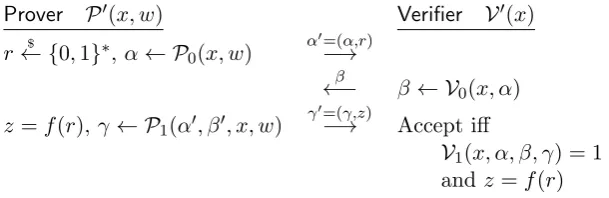
Figure 2: The protocol Σ0, separatingSS-HVZKand S-HVZK.
x, β and γ, i.e.α :=φ(x, β, γ). We exhibit a separation between the SS-HVZKand S-HVZK
properties, by showing that any Σ-protocol which is SS-HVZK can be turned into another
Σ-protocol which is stillS-HVZKbut not SS-HVZK. For proving such a claim, we just need
to assume the existence of one-way functions. The transform is depicted in Figure 2. Let f : {0,1}∗→ {0,1}∗ be a one-way function. We start with an arbitrary Σ-protocol Σ = (P,V)
which satisfies theSS-HVZKproperty. The protocol Σ0= (P0,V0) is essentially identical to Σ,
however the prover now also samples a randomr and addsr to the commitmentα; moreover it also appends z=f(r) to the last message. The verifier V0 runs the verifierV, but also checks thatz=f(r).
Proposition 2(Separation betweenS-HVZKandSS-HVZK). Assuming the existence of one-way functions, there exists aΣ-protocol which is S-HVZKbut not SS-HVZK. More precisely, let Σ = (P,V) be a Σ-protocol which is SS-HVZK and f be a one-way function. Then, the protocol Σ0= (P0,V0) of Figure 2 is
S-HVZK but notSS-HVZK.
Proof. We show that the protocol Σ0 cannot satisfy the stronger SS-HVZK property, even if
the original protocol Σ does. The intuition for this is that, if it could be possible to compute the commitmentα0 after having chosen the challengeβ and the responseγ0, then it could also be possible to invert f. We now turn this intuition into a formal proof. Assume, towards a contradiction, that Σ0 is SS-HVZK. This means that there exists a simulator S0 which can
choose γ0 at random (for all β), and compute α0 = (α, r) as a deterministic function α0 = φ(x, β, γ0) of the other values. We now show how to useS0 to build a PPT adversary Bable to break one-wainess of the functionf. The attackerBsimply chooses a random imagez← {0$ ,1}∗, samples β, γ at random and runs S0(x, β, γ0 = (γ, z),1k) which returns α0 = φ(x, β, γ0). Since
α0= (α, r) is such thatf(r) =z, the adversaryBhas found a pre-image ofz, namelyr=f−1(z), breaking the one-wayness of f. Note, however, that the protocol Σ0 is still S-HVZK. In fact,
for every β, the (special) HVZK simulator S0 can just run the
SS-HVZK simulator S of the
underlying protocol Σ, yielding α ← S(x, β, γ,1k), and later append r ← {0$ ,1}∗ to α and z=f(r) to γ by itself.
C
Proof of Proposition 1
The proof is similar to the proof of [41, Theorem 2]. Consider an adversaryA having access to (S1,S0
an indexi∈[n] uniformly at random and internally simulates the firsti−1 executions of the composed system (with A1, . . . ,Ai−1). Let st= (π, ρ) be the state that Ai−1 passes to Ai. E0 computes w← EAi(x, st) =EAi(x, π;ρ).
Denote with ai the probability that A is successful in the first i executions. (Note that in particular ai−1 is the probability that in an execution of E0 the internal simulation of the first i−1 executions succeeds.) Let ci denote the probability that the i-th execution of the composed system succeeds, conditioned on the event that the firsti−1 executions succeed. We have a0 = 1 and ai =ci·ai−1 for alli= 1, . . . , n.
Denote with ext0 the probability that E0 extracts a witness and with acc0 the probability that A is successful in the composed system. Moreover, for some fixed index i, let ext0i be the probability that E0 succeeds given that index i was chosen. Hence, we must have ext0 = Pn
i=1 1 next
0
i≥max1≤i≤n1next0i.
We proceed to bound ext0i. Denote with Di−1 the probability distribution of the state output byAi−1 conditioned on the fact that the first i−1 executions were successful. Clearly, the probability that E0 succeeds conditioned on the event that the first i−1 executions were successful is E[exti(st)], where exti(st) denotes the probability thatEAi(x, st) outputs a witness.
Hence, ext0i=ai−1E[exti(st)], wherestis distributed accordingly toDi−1. Using the hypothesis that (P,V) has extraction error ν, we get that there exists a constant d >0 and a polynomial psuch that exti(st)≥ 1
p(acci(st)−ν)
dfor allst, where acci(st) denotes the probability that A i is successful using state st. Putting all together, we can conclude:
ext0i =ai−1E [exti(st)]≥ai−1·E
1
p(acci(st)−ν) d
≥ ai−1
p (E [acci(st)]−ν) d
= ai−1
p (ci−ν) d,
where the second inequality in the chain is obtained by applying Jensen’s inequality E[f(X)]≥ f(E[X]) (for any random variableX and convex function f).
Let now δ= (acc0−νn). Assume that δ >0 otherwise there is nothing to prove. Claim 1. There exists an index i∈[n]such that
ai−1 < νi−1+ (i−1) δ
n and ai ≥ν i+iδ
n.
Proof of claim. We need to prove that there exists somei∈[n] such that ai−1−ai ≤νi−1+ (i−1)
δ n−ν
i−iδ n =ν
i−1−νi− δ n.
Assume, towards a contradiction, that for all indexesi∈[n] we haveai−1−ai> νi−1−νi−nδ. Then, we get
a0−an= n
X
i=1
(ai−1−ai)> n
X
i=1
νi−1−νi− δ n =−δ+ n X i=1
(νi−1−νi) =νn−acc0+ 1−νn= 1−acc0.
However this is impossible, because by construction a0−an= 1−acc0. For the index iof the above claim, we have
ai−1(ci−ν) =ai−ai−1ν ≥
νi+iδ n
−
νi−(i−1)δ n
and hence
ext0 ≥ 1 n1max≤i≤n
ai−1
p (ci−ν) d≥ 1
n1max≤i≤n adi−1
p (ci−ν) d
≥ 1 n1max≤i≤n
δ n
d
= 1
p·nd+1(acc
0−νn)d.
Since p·nd+1 =p0, the proposition follows.
D
Details Omitted from Applications
D.1 Definitions of Leakage-Resilient Primitives
Leakage-Resilient Hard Relations and Signatures. For completeness, we recall some definitions from [19] that we mention in section 5.1.
Definition 9 (Leakage-resilient hard relation). A binary relationR ⊂ {0,1}∗× {0,1}∗ is called
λ-leakage-resilient hard relation if: (i) there exists an efficient sampling algorithm GenR such that for any pair (pk,sk) ← GenR(1k), it holds R(pk,sk) = 1, (ii) deciding whether a pair satisfies R(pk,sk) = 1 or not can be done in polynomial time, (iii) any efficient adversary A
has negligible advantage in winning the experiment defined below:
Experiment ExpLK-REL
R,A (1k)
(pk,sk)←GenR(1k) sk? ← AOλsk(·)(pk)
Output 1 if R(pk,sk?) = 1
that is, for any PPT A, it holds:
Prob[ExpLK-REL
R,A (1k) = 1]≤negl(k)
Definition 10 (Leakage-resilient signature). Let Π = (Gen,Sign,Vrf) be a signature scheme. The following experiment models an unforgeability game where the adversary gets leakage infor-mation on the signing key.
Experiment ExpLKR-SIGN
Π,A (1k)
(pk,sk)←KeyGen(1k) (m?, σ?)← ASign(sk,·),Oλ
sk(·)(pk) Output 1 if and only if:
1. Vrf(pk, m?, σ?) = 1
2. (m?, σ?)∈ T/
In the experiment above, T is a list containing queries to Sign and corresponding answers. A signature schemeΠ is λ-leakage resilientif any PPT adversaryA has only negligible advantage in winning the unforgeability game:
Prob[ExpLKR-SIGN
Leakage-Resilient Public-Key Encryption. We recall the definitions of CPA and CCA security against λ-key-leakage attacks from [35]. Let Π = (Gen,Enc,Dec) be a public key encryption scheme and denote withPKk,SKk the sets of public/secret keys that are produced byGen(1k). We define an oracleOλ
sk depending on a secret keysk ∈ SKk, which takes as input (the description of) functions fi : SKk → {0,1}λi. An oracle machine A is a λ-key-leakage adversary if Ahas access to Oλ
sk and the total leakage is bounded by
P
iλi ≤λ. Consider the following experiments:
Experiment ExpLKG-CPA
Π,A (1k)
(pk,sk)←Gen(1k) (m0, m1)← A
Oλ
sk(·)
0 (pk) cb←Enc(pk, mb) for b
$ ← {0,1} b0← A1(cb)
Output 1 if and only if: 1. b0 =b
2. |m0|=|m1|
ExperimentExpLKG-CCA
Π,A (1k)
(pk,sk)←Gen(1k) (m0, m1)← A
Dec(sk,·),Oλ
sk(·)
0 (pk)
cb←Enc(pk, mb) for b $ ← {0,1} b0← ADec1 (sk,·)(cb)
Output 1 if and only if: 1. b0 =b
2. |m0|=|m1|
3. cb is never submitted toDec(sk,·)
We stress that in the experiments above, A is not allowed to query the leakage oracle after seeing the challenge ciphertext. (In fact, a single bit of leakage on the challenge ciphertext would allow her to win the game with probability 1.)
Definition 11(ATK-secure encryption againstλ-key-leakage attacks). ForATK∈ {CPA,CCA}, we say a public key encryption schemeΠ = (Gen,Enc,Dec)isATK-secure againstλ-key-leakage attacks if, for every PPT λ-key-leakage adversary A= (A0,A1) as above, we have:
Prob[ExpLKG-ATK
Π,A (1k) = 1]≤
1
2 +negl(k). D.2 Proof of Theorem 4
This proof follows the same strategy given in [19], Theorem 4.3, with minor changes. We consider the following two games:
Game 0: This is the unforgeability game of Definition 10 tailored for leakage-resilient signa-tures described in 5.1.
Game 1: In this game, we change the way in which the signing oracle answers toA’s queries. Instead of giving valid proofs πi, it answers signature queries mi with simulated proofs S(pk, mi). Notice that we use a simplified notation and denote S the simulator that combines S1 (which answers queries to the random oracle) and S2 (which generates the proofs) from Definition 4.