Available Online atwww.ijcsmc.com
International Journal of Computer Science and Mobile Computing
A Monthly Journal of Computer Science and Information Technology
ISSN 2320–088X
IMPACT FACTOR: 6.017
IJCSMC, Vol. 5, Issue. 10, October 2016, pg.97 – 103
Smart Applications for Smart Live
Ahmed Khalid
Department of Computer, Najran Community College Najran University, Najran, KSA
Abstract-
Electronic services and applications of informatics has become a new way of life and interaction between individuals and government. The blending of technology with human resources has led to the emergence of a smart life moving, at an accelerated pace and easily in the style and form, that characterized by the ease, speed and accuracy in the delivery of public services and do business. This paper presents the main applications of smart live that ranging from domiciles, workplaces and the way people are transported, living and learning within cities.
I-Introduction
The evolution of human life is an examples of the stages of development witnessed by the earth and its surroundings, it is no secret that a man from the beginning of creation and saw his sophisticated aware in two aspects: the physical side and the side of knowledge. Where human life in the physical part, has continued to evolve and grow, and according to the conditions and the environment and adapt theories and has been followed by a series of laws and regulations existential material is still in the stages of innovation and creativity. At the side of intellect and knowledge, science did there not limits to humans in the field of cognitive, intellectual and scientific development is still innovates, invents, looking, studying life in the fields and all aspects, tirelessly and preserves are reached and adds to the past and the present are predicted into the future through the present experiments which reach an outcome, despite this development in the physical and cognitive aspect of human life in general and in particular human.
quality of life for users [10]. According to a new report from Information Handling Services (HIS), global unit shipments of smart cards which are the main factor in smart life are expected to rise by 2.1 billion from 2014 to 2019. In a statement, the research firm said that smart card shipments will rise to 10.9 billion units in 2019, up from the 8.8 billion that are shipped at 2014. "The key end-user sectors that will drive growth over the next five years include payment and banking, e-government, and healthcare and transportation[1].
This paper introduce the smart applications for smart live some of these applications are already take place in the live other will be established in the future. The rest of this paper is organize as follow: section two presents smart city. Section three describes smart hospital. Smart Hotels is discusses in section four. Section five gives details smart cars. Smart school is presents in section six. Finally, the last section concludes this paper.
II-Smart City
More than half of the World’s population now lives in urban areas [14,15]. the concept of a smart city itself is still emerging, and the work of defining and conceptualizing it is in progress [17,16]. The concept is used all over the world with different nomenclatures. The term smart city is define in [18] as: A city that monitors and integrates conditions of all of its critical infrastructures, including roads, bridges, tunnels, rails, subways, airports, seaports, communications, water, power, even major buildings, can better optimize its resources, plan its preventive maintenance activities, and monitor security aspects while maximizing services to its citizens. The core infrastructure elements in a smart city [21] would include:
i. adequate water supply, ii. assured electricity supply,
iii. sanitation, including solid waste management, iv. efficient urban mobility and public transport, v. affordable housing, especially for the poor, vi. robust IT connectivity and digitalization,
vii. good governance, especially e-Governance and citizen participation, viii. sustainable environment,
ix. safety and security of citizens, particularly women, children and the elderly, and x. health and education.
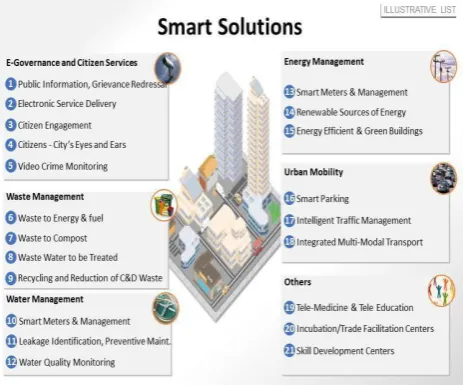
These infrastructure need smart solutions as seen in figure1 below.
ICTs are key drivers of smart city initiatives [16]. The integration of ICT with development projects can change the urban landscape of a city [20] and offer a number of potential opportunities [19], they can enhance the management and functioning of a city [19].
The following table illustrates the six characteristics and their assigned factors. Smart Economy includes factors all around economic competitiveness as innovation, entrepreneurship, trademarks, productivity and flexibility of the labour market as well as the integration in the (inter-)national market. Smart People is not only described by the level of qualification or education of the citizens but also by the quality of social interactions regarding integration and public life and the openness towards the ―outer‖ world. Smart Governance comprises aspects of political participation, services for citizens as well as the functioning of the administration. Smart cities – Ranking of European medium-sized cities 12 Local and international accessibility are important aspects of Smart Mobility as well as the availability of information and communication technologies and modern and sustainable transport systems. Smart Environment is described by attractive natural conditions (climate, green space etc.), pollution, resource management and also by efforts towards environmental protection. Finally, Smart Living comprises various aspects of quality of life as culture, health, safety, housing, tourism etc.
Figure 2: characteristics and factors of smart city
III- Smart Hospitals
The smart hospital [9] is a type of hospital that is able to share the domain’s knowledge with same or other’s domain and fulfill the requirement of the ubiquitous and pervasive computing
[8]
environment.
Today, many patients and family members sitting in waiting rooms use personal mobile devices for entertainment, to review and update personal health information, or to make payments and arrange future appointments. Institutions must accommodate this constant interaction via mobile technology— and find ways to utilize the connectivity to their advantage. To respond to a technologically driven environment of care and prepare for its evolution in the future, healthcare providers must consider bolstering the patient experience both inside their facilities and out through a keen focus on connectivity, communication, and access to information [13].The goal for patient rooms is to make them more patient-centered, improving the patient experience by helping patients take a more active role in their own health care. Figure 3 shows the patient screen.
Figure 3: patient screen
IV- Smart Hotels
Hotels are always looking to give guests the feeling and comfort of being at home. One way to achieve this is by replicating the feeling of being at home. Smart homes are the future and hotels should embrace change and be at the forefront of this technological innovation. The concept of the smart hotel is to automate everything you want to forget about, allowing you to have more time to enjoy the great aspects of traveling. Here are a few of the things the hotel app, in addition to the iBeacon technology, will take care of:
Find your room – Having trouble navigating the winding halls of an expansive luxury hotel? Beacons are great for determining your position in large hotels, helping to guide you to your room.
Room Service –Check out the menu for the evening and order a movie all from the comfort of your bed.
Messaging –Communicate quickly and efficiently with the front desk in a WhatsApp-like messaging style.
Lights –This system will help save energy by automatically turning on and off room lights when you enter or leave your room.
Check In – If I have said it once, I have said it 1,000 times: people want to avoid a check-in wait at all costs. Your information is entered when you book the room and you are provided with your electric room key because of the beacon at the entrance.
Room Cleaning –When a guest has checked out of their room, the beacons can notify the cleaners ensuring they never have to knock on a door again.
In-Room Entertainment – Playing your own music straight from your phone and watching
your favorite series on the television is just the beginning. There are more perks to using the iBeacon system, but all of them lend to the idea of making the travel experience easier and more convenient. Smart housing has been a concept of the future for quite some time, but now it is becoming mainstream. The next step will be to determine whether this technology is cost-efficient for hoteliers to incorporate into their revenue strategy.
V- Smart cars
Figure4: type of smart car
VI- Smart schools
VII- Conclusion
Life on this planet is going forward from the start, and even the promised day, and this march is not the march of time, but also is the quality of the march. Human has passed many events during the development journey which he lived. Since the man was found on this earth began to search for ways to coexist with the environment, and in many cases he found this way by accident linked implicitly with the natural evolution of the law, and in so many other times it was the environment plays a significant role in the guidance to the path of development, and because sane human being and not an innate and instinctive only lost in the innovation process, and he had the ability to conclusion and analysis, and was able to benefit from the accumulation of experts. The blending of technology with human resources has led to the emergence of a smart life moving. This paper introduced the smart applications for smart live.
References:
[1] http://www.securityinfowatch.com/news/11669147/ihs-says-smart-card-shipments-will-rise-by-21-billion-over-the-next-five-years [visited on 21 April 2016]
[2] Oeppen, J., Vaupel, J.W.: Demography - Broken limits to life expectancy. Science 296(5570), 1029 (2002)
[3] Mathers, C.D., Stevens, G.A., Boerma, T., White, R.A., Tobias, M.I.: Causes of international increases in older age life expectancy. The Lancet in print (2014)
[4] Röcker, C., Ziefle, M., Holzinger, A.: From Computer Innovation to Human Integration: Current Trends and Challenges for Pervasive HealthTechnologies. In: Holzinger, A., Ziefle, M., Röcker, C. (eds.) Pervasive Health, pp. 1-17. Springer London (2014)
[5] http://business.resortsandlodges.com/smart-hotels-longer-idea-future [ visted on 21- April 2015. [6]imitrakopoulos,G., Tsagkaris,K., Stavroulaki,V., Katidiotis,A., Koutsouris,N., Demestichas, P., Merat,V. and Walter,S. (2008) "A Management Framework for Ambient Systems Operating in Wireless B3G Environments", Springer Mobile Networks and Applications, Vol. 13 , No. 6, pp. 555-568.
[7] Savic, S. and Shi, H. (2011) An Intelligent Object Framework for Smart Living, Procedia Computer Science 5 (2011) 386–393.
[8] Weiser, M. 1993b. ―Ubiquitous Computing”. IEEE Computer, 26(10):71--72.
[9] Press Release - The Smart Hospital at The University of Texas at Arlington School of Nursing becomes a Laerdal IJCSI International Journal of Computer Science Issues, Vol. 7, Issue 5, September 2010
[10] Laurent Probst, Erica Monfardini, Laurent Frideres, Daniela Cedola, PwC Luxembourg," Smart Living Smart construction products and processes", European Union, February 2014.
[11] www.renesas.eu/media/edge_ol/feature/12/r70pf0064ej0101edge.pdf, [ visited on 24 April 2016].
[12] Samsung Smart Education http://www.samsung.com/global/business/business-images/resource/RR-BC/2012/10/SamsungSmartSchoolLeaflet-0.pdf [visited on 23 April 2016. [13] Jennifer Kovacs Silvis, "2014: The Year Of The Patient", December 17, 2014, [online]
http://www.healthcaredesignmagazine.com/blogs/jennifer-kovacs-silvis/2014-year-patient.
[14] Dirks, S., Gurdgiev, C., & Keeling, M. (2010). Smarter Cities for Smarter Growth: How Cities Can Optimize Their Systems for the Talent-Based Economy. Somers, NY: IBM Global Business Services.
[15] Dirks, S., Keeling, M., & Dencik, J. (2009). How Smart is Your City?: Helping Cities Measure Progress. Somers, NY: IBM Global Business Services.
[16] Hollands, R.G. (2008). Will the real smart city please stand up? City, 12(3), 303-320.
[17] Boulton, A., Brunn, S.D., & Devriendt, L. (2011). Cyberinfrastructures and ―smart‖ world cities: Physical, human, and soft infrastructures. In Taylor, P., Derudder, B., Hoyler, M., & Witlox, F. (Eds.),
International Handbook of Globalization and World Cities. Cheltenham, UK: Edward Elgar. Available from http://www.neogeographies.com/documents/cyberinfrastructure_smart_world_cities.pdf.
[18] Hall, R. E. (2000). The vision of a smart city. In Proceedings of the 2nd International Life Extension Technology Workshop, Paris, France, September 28.
[19] Odendaal, N. (2003). Information and communication technology and local governance: Understanding the difference between cities in developed and emerging economies. Computers,
[20] Vasseur, J. (2010). Smart cities and urban networks. In Vasseur, J. & Dunkels, A. (Eds.),
Interconnecting Smart Objects with IP: The Next Internet (pp. 360- 377). Burlington, MA: Morgan Kaufmann.
[21] "Smart Cities Mission Statement & Guidelines", Government of India, Ministry of Urban Development (June, 2015).