Scholarship@Western
Scholarship@Western
Electronic Thesis and Dissertation Repository
3-23-2018 10:30 AM
Capacity for Sport for Development
Capacity for Sport for Development
Ryan Clutterbuck
The University of Western Ontario Supervisor
Doherty, Alison J.
The University of Western Ontario Graduate Program in Kinesiology
A thesis submitted in partial fulfillment of the requirements for the degree in Doctor of Philosophy
© Ryan Clutterbuck 2018
Follow this and additional works at: https://ir.lib.uwo.ca/etd Part of the Sports Management Commons
Recommended Citation Recommended Citation
Clutterbuck, Ryan, "Capacity for Sport for Development" (2018). Electronic Thesis and Dissertation Repository. 5344.
https://ir.lib.uwo.ca/etd/5344
This Dissertation/Thesis is brought to you for free and open access by Scholarship@Western. It has been accepted for inclusion in Electronic Thesis and Dissertation Repository by an authorized administrator of
Abstract
The purpose of this dissertation was to explore the management of local sport for
development (SFD) in Canada. Specifically, this dissertation uncovers the organizational
capacity for local (or domestic) SFD, the processes involved in building capacity to achieve
social change objectives through sport, and the perceptions and experiences of National Sport
Organization (NSO) leaders regarding SFD. This dissertation is organized using the integrated
article format, which includes three separate, but related studies described below.
Study 1 explored the organizational capacity for local SFD. Following Hall et al.’s (2003)
framework for non-profit organizational capacity, which includes five broad capacity dimensions
including human resources, finances, relationship and networks, infrastructure, and planning and
development, the study’s co-authors uncovered several critical and unique elements within the
local SFD context. Semi-structured interviews were conducted with representatives from 17 local
SFD organizations from across Canada. Participants were asked to describe specific organizational
aspects that enabled them to achieve their goals – and they identified: familiarity with development
issues; grant funding; social capital; facilities; and strategic planning as critical elements, among
others.
Study 2 built upon the findings of Study 1, and sought to build capacity at two local SFD
organizations from the Study 1 sample. Study 2 used an action research method that enabled
researchers and participants to work collaboratively to achieve goals identified as meaningful by
participants. Specifically, the goals for Study 2 were to build human resources capacity, financial
capacity, and relationship and network capacity in three separate interventions. Study 2 followed
Ferkins, Shilbury, and McDonald’s (2009) action research framework, which includes four distinct
research phases: issue identification; context analysis; intervention and action; and evaluation.
intervention, culminating in three unique stories of capacity building for local SFD.
Study 3 explored the perspectives and experiences of Canadian National Sport Organization
(NSO) leaders regarding SFD in Canada. Semi-structured interviews were conducted with a key
person(s) from 13 NSOs (n=14), who were asked: to define SFD; to describe how their NSO
addresses SFD; and to what extent SFD represents a conflicting or divergent demand. Study 3
followed Pache and Santos’ (2010) model of organizational responses to institutional pluralism,
which suggests organizations facing divergent demands respond by acquiescing to, avoiding,
manipulating, or defying new demands. According to Pache and Santos (2010), organizations
respond based on the nature of the demands (either ideological or functional), and the internal
dynamics of the organization experiencing pluralism. In Study 3, NSO leaders indicated that SFD
goals align with their mandates for high performance and sport development, and that they are
addressing SFD by offering and supporting inclusive programs and initiatives.
Together, these three studies offer an analysis of local SFD in Canada from the perspectives
of grassroots implementers and national leaders in Canadian sport. Findings from these studies
contribute to the growing literature in managing SFD, and may also benefit local SFD practitioners
interested in developing their organizations through capacity building. Findings from these studies
may also support local SFD partners, granting agencies, and policy makers interested in developing
local SFD by addressing areas of identified need.
Co-Authorship Statement
This dissertation is my original work, and I am the lead author on each of its three studies.
However, my doctoral advisor, Dr. Alison Doherty, was an integral contributor and thus the
studies in this document reflect our collective efforts. Throughout, I use “we” to refer to Dr.
Acknowledgements
Thank you to my supervisor, Dr. Alison Doherty. Your encouragement and guidance
made this day possible, and your friendship made the journey worthwhile. I am forever grateful
and proud to be a card-carrying member of ‘Team Doherty’. Thank you, Alison.
Thank you to Dr. Karen Danylchuk and Dr. Craig Hall for your mentorship and support
as part of my advisory committee. And, thank you Dr. Jim Weese, Dr. Laura Misener, Dr. Lucie
Thibault, and Dr. Jennifer Irwin for your insightful comments that strengthened this document.
Thank you, Dr. Patti Millar.
Thank you to everyone at the Teaching Support Centre.
Thank you to my extended football family, which includes former teammates and now
lifelong friends, coaches and administrators, support staff, and countless players that I have been
so fortunate to coach. A special thanks to Coach Larry Haylor, whose persistence brought me to
Western in the first place, and to Coach Marshall and Dr. Bob La Rose for bringing me back.
Thank you to my friends and family, including John and Heather Vouvalidis.
Thank you to my supportive partner, Kaitlyn Armstrong.
Table of Contents
Abstract… ... ii
Co-Authorship Statement… ... iv
Acknowledgements… ... v
Table of Contents… ... vi
List of Figures… ... ix
List of Tables… ... x
List of Appendices… ... xi
Introduction ... 1
References… ... 9
Study 1… ... 15
Organizational Capacity for Local Sport for Development… ... 15
Organizational Capacity ... 17
Capacity for SFD Literature ... 20
Methods...22
Participants… ... 22
Data Collection and Analysis… ...24
Findings & Discussion… ... 26
Human Resources Capacity ...28
Financial Capacity ...34
External Relationship and Network Capacity ...37
Infrastructure and Process Capacity ... 41
Limitations and Future Research… ...47
Implications for Practitioners… ... 48
References… ... 50
Study 2… ...55
Action Research for Sport for Social Change ... 55
Introduction… ... 56
Review of Literature ...58
Participatory Action Research… ...58
Organizational Capacity Building ...60
Method… ... 62
Participant Selection… ...63
Researcher Positionality and Validity ... 64
Results… ... 65
Junior Knockouts ...65
Issue Identification and Context Analysis ... 66
Intervention and Action ...69
The Investing in Communities Grant… ... 70
Evaluation… ... 73
The Investing in Communities Grant… ... 73
Intervention and Action II ... 74
Evaluation… ... 76
The Sting Like a Bee Fundraising Campaign… ...76
City Tennis… ... 77
Issue Identification and Context Analysis ...77
A Leadership Change ... 81
Intervention… ... 82
Building a City Tennis Community ... 82
Evaluation… ... 85
Building a City Tennis Community ... 85
Discussion… ... 86
Reflections from a Process Model of Capacity Building ...87
Stimulus to Capacity Building ... 87
Needs Assessment and Organizational Readiness ... 88
Capacity Building Outcomes ... 91
Conclusion… ... 93
References… ... 97
Study 3: National Sport Organizations Perspectives on SFD in Canada ... 102
Introduction… ... 102
SFD and High Performance Sport in the Canadian Sport Policy ...104
Domestic SFD in Canada: An Example ... 107
Managing Conflicting Objectives of SFD and High Performance Sport… ... 108
Methods...112
Participant Selection… ...114
Results… ... 114
RQ1: How Do NSOs Define SFD… ...115
RQ2: How Do NSOs Address SFD… ... 117
RQ3: To What Extent Does SFD Represent a Divergent Expectation for NSOs… ... 128
The Future of SFD in Canada ... 131
Discussion… ... 133
Defining SFD… ... 134
Leveraging SFD… ... 136
Organizational Responses to SFD… ...137
Conclusion… ...139
References… ... 141
Summary ... 146
Contribution to Theory and Knowledge ... 148
Implications for Practice ... 150
Directions for Future Research… ...152
References… ... 154
Appendices… ... 156
List of Figures
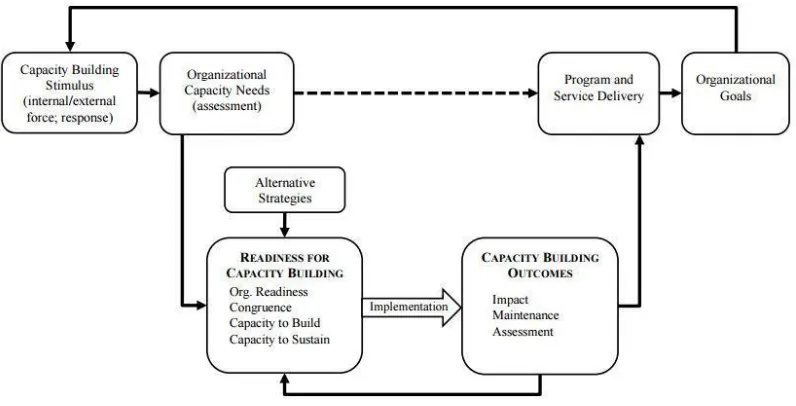
Study 2 Figure 1. Organizational capacity for local sport for development…… 57
List of Tables
Study 1 Table 1. Description of Sample… ... 23
List of Appendices
Appendix A: Western University Ethics Approval Notices ... 156
Appendix B: Letters of Information (Study 1) ... 162
Appendix C: Interview Guide (Study 1) ... 166
Appendix D: Coding Framework (Study 1) ...170
Appendix E: Letters of Information (Study 2) ... 174
Appendix F: Letters of Information (Study 3) ... 181
Appendix G: Interview Guide (Study 3) ... 185
By its very nature, sport is about inclusion and citizenship. It stands for human values such
as respect for the opponent, acceptance of binding rules, teamwork, and fairness, all of
which are principles which are also contained in the Charter of the United Nations.
(United Nations, 2014, np)
Introduction
Sport for development (SFD) scholarship has evolved over the last 15 years (Schulenkorf,
Sherry, & Rowe, 2016), following the creation of the United Nations (UN) Office for SFD in
2001, the establishment of the Sport for Development and Peace International Working Group
(SFDP IWG) in 2004, and the UN declaration that 2005 was the Year of Sport (Schulenkorf,
2017). Famously, then UN Secretary General Kofi Annan proclaimed:
Sport is a universal language. At its best it can bring people together, no matter what their
origin, background, religious beliefs, or economic status…[and] that is why the United
Nations is turning more and more to the world of sport for help in our work for peace and
to achieve the Millennium Development Goals. (United Nations, 2004, np)
The Millennium Development Goals (now Sustainable Development Goals) were an
ambitious list of eight goals agreed to by all 191 UN member states, to be achieved by 2015. The
Goals included: eradicating extreme poverty; achieving universal primary education; promoting
gender equity; reducing child mortality; improving maternal health; combating HIV/AIDS and
other communicable diseases; ensuring environmental sustainability; and developing global
partnerships for development (World Health Organization, 2017).
With UN support, increased awareness and funding for SFD triggered the rapid growth of
SFD organizations around the world, and today, the website sportanddev.org lists over 500 SFD
However, as of May 4, 2017, the UN Office for SFD has closed and its objectives are now under
the purview of the International Olympic Committee (The sportanddev.org Operating Team,
2017), and the implications from that change (or reorganization) remain uncertain.
Broadly, these SFD organizations work to improve public health, socialize children, youth,
and adults from disadvantaged groups, develop local, regional, and national economies, and
facilitate intercultural exchange and conflict resolution through sport (Lyras & Welty Peachey,
2011; Schulenkorf, 2017; Schulenkorf, Sherry, & Rowe, 2016). According to Sherry,
Schulenkorf, and Chalip (2015), “the popularity of sport for development stems from its ability
to capture or “hook” a variety of people...and use the momentum in and around sport as a
strategic vehicle to achieve nonsport development goals” (p. 1). Moreover, SFD programs are
being implemented in both developed and developing nations:
with varied aims and objectives…directed toward communities identified as marginalized
or at-risk, or those communities requiring development and regeneration, including
socially and economically disadvantaged groups, at-risk youth, indigenous communities,
recently arrived refugees, and culturally and linguistically diverse communities. (Sherry,
Schulenkorf, & Chalip, 2015, p. 1)
Concurrently, SFD scholarship has grown “substantially, from as little as a handful of dedicated
studies conducted in the early 2000s to around 100 research pieces published in academic
journals in 2013 alone” (Schulenkorf, 2017, p. 244). Collectively, “these SFD studies may be
classified within seven broad thematic areas, including sport and disability, education, gender,
health, livelihoods, sport and peace, and sport and social cohesion” (Schulenkorf, 2017, p. 244).
SFD in Canada
Policy (CSP), that “sets [the] direction for the period 2012-2022 for all governments, institutions
and organizations that are committed to realizing the positive impacts of sport on individuals,
communities, and society” (Canadian Heritage, 2012, p. 2), and historically, Canadian support
for SFD has included: applying coaching development curricula in other countries and cultures;
lobbying diplomats at the United Nations to include SFD on their agendas; and creating policies
that support SFD at home and abroad (Kidd, 2013). Regarding SFD, the CSP indicates that
“sport is used as a tool for social and economic development, and the promotion of positive
values at home and abroad” (p. 3), and that “a desired outcome of the Policy is that both the
number and diversity of Canadians participating in sport will increase over the timeframe of
2012-2022” (Canadian Heritage, 2012, p. 8). In practice, SFD in Canada is supported by several
high-profile organizations, including (but not limited to): Maple Leaf Sports and Entertainment
(MLSE), that in 2017 opened the MLSE LaunchPad to “serve as an ambitious ‘living lab’ to
explore and measure how sport can improve the lives of youth” (MLSE LaunchPad, 2017); the
Toronto Blue Jays’ Jays Care Foundation, that “uses baseball to teach life skills and create
lasting social change for children in marginalized communities across Canada” (Jays Care
Foundation, 2017); and the Vancouver Whitecaps, that address social issues as part of the MLS
Works Community Outreach Initiative that “seeks to establish Major League Soccer as a leader
for improving the lives of people through sport” (MLS Works, 2017). Also, international
non-governmental organization (INGO) Right To Play has its headquarters in Toronto, Ontario, and
reaches over 5,000 Aboriginal youth participants through its Promoting Life-skills for Aboriginal
Youth (PLAY) initiative across Canada (Right To Play, 2017).
SFD scholarship in Canada has evolved alongside the SFD literature (Schulenkorf, 2017)
Gaudet, in press; Scherer, Koch, & Holt, 2016); leveraging SFD outcomes (Cowell, 2007; Study
3); SFD management and capacity building (Edwards, 2015; Hayhurst & Frisby, 2010;
MacIntosh, Arellano, & Forneris, 2016; MacIntosh & Spence, 2012; Mackinnon, 2009; Study 1;
Study 2); and theoretical advancements (Darnell & Hayhurst, 2011). SFD scholars in Canada
have also contributed critical SFD analyses (Darnell, 2007), and works dedicated to uncovering
and improving SFD programs for Aboriginal Peoples (Gardham, Giles, & Hayhurst, 2017;
Halsall & Forneris, 2016; Hayhurst, Giles, & Radforth, 2015; Kope & Arellano, 2016;
MacIntosh et al., 2016).
Managing SFD
Within the literature, broadly, “academics are now analysing the specific management and
organisational aspects of SFD projects, including the specific tactics, strategies, and implications
of sport-related development work which underpin many contemporary projects” (Schulenkorf,
2017, p. 245). For example, scholars have explored aspects of leadership in SFD (Meir, 2017;
Welty Peachey & Burton, 2017), organizational capacity for SFD (Study 1; Svensson &
Hambrick, 2016; Svensson, Hancock, & Hums, 2017), capacity building in SFD (Edwards,
2015; Rosso & McGrath, 2017; Study 2), and partnerships for SFD (Bruening et al., 2015;
Hayhurst & Frisby, 2010; MacIntosh et al., 2016; Waldman & Wilson, 2015) as well. Taken
together, these studies indicate how SFD organizations are achieving their goals – by identifying,
developing, managing, and deploying their critical resources.
According to Hall et al., the “ability to draw on or deploy a variety of types of
organizational capital” (2003, p. 4) is organizational capacity, and it includes organizations’
human resources, finances, infrastructure, relationships and networks, and planning and
organization’s overall capacity to fulfill its mission depends on a variety of specific capacities”
(Hall et al., 2003, p. 3). According to Doherty et al. (2014), despite “generally common
dimensions…the elements within each dimension are context specific…what is critical in one
context, such as food banks, may not be as relevant in other contexts, such as arts and culture or
health organizations” (p. 125S-126S). Therefore, a goal for this dissertation (and Study 1 in
particular), was to uncover the critical elements of organizational capacity necessary for local
SFD organizations to achieve their goals. Following Doherty et al. (2014), I believe this work is
necessary, because “it is important to understand the nature of those resources so that capacity
may be accurately assessed, and capacity building efforts may be effectively focused” (p. 125S).
Study 1 (Organizational Capacity for Local SFD) uncovered critical capacity elements that
enable local SFD organizations to achieve their goals. It followed Hall et al.’s (2003) framework
for nonprofit organizational capacity, that has been used in the community sport context
(Doherty et al., 2014; Misener & Doherty, 2009), in international sport for development and
peace (SFDP) (Svensson & Hambrick, 2016), and in domestic SFD (Svensson et al., 2017) as
well. In Study 1, I interviewed representatives from 17 local SFD organizations (n=17) that used
multiple sports in their programs (n=10), and were from urban and rural settings across Canada,
using a semi-structured interview methodology (Patton, 2015). Within each of Hall et al.’s
(2003) five broad capacity dimensions, critical context specific elements were uncovered that
enable local SFD organizations to achieve their goals, including: familiarity with development
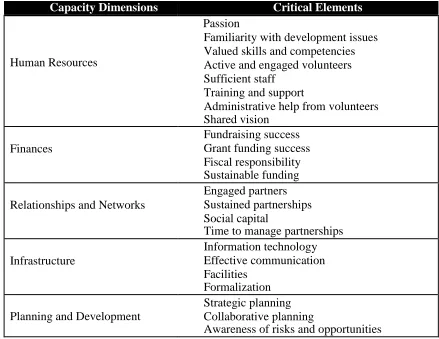
issues, grant funding, sustained partnerships, and strategic planning, among others (see Table 2).
Having identified the specific elements local SFD organizations need to achieve their
goals, a logical next phase of inquiry was capacity building (Study 2). Capacity building is “a
Sripirabaa, 2008, p. 2), and may comprise a variety of activities including board development,
management training, and upgrading technology (Light, 2004). According to Millar and Doherty
(2016), successful capacity building requires a needs assessment, and organizational readiness –
as capacity to build and sustain organizational changes – and congruence with organizational
goals and internal processes. As an impetus for Study 2, Millar and Doherty (2016) indicated
capacity building research had,
focuse[d] predominantly on its conceptualization, and on the assessment of particular
strategies, such as workforce development and partnership enhancement, with little
reflection or examination of the factors or conditions associated with the process of
effective capacity building. (p. 366)
Therefore, the purpose of the second article in this dissertation was to examine the full process
(from inception through implementation) of capacity building at two local SFD organizations.
Study 2 (Action Research for Sport for Social Change) used an action research
methodology (Ferkins, Shilbury, & McDonald, 2009) to capture the processes of capacity
building at two local SFD organizations. I followed Ferkins et al.’s (2009) action research
framework that includes four research phases: issue identification; context analysis; intervention
and action; and evaluation. At each stage of the process, co-researchers (participants from each
organization and Ryan Clutterbuck as lead researcher) generated qualitative data through
attempts at building capacity. Together, the two organizations identified several organizational
weaknesses and pursued three separate capacity building interventions focused on developing
human resources capacity, financial capacity, and relationship and network capacity. Study 2
results are presented as two case studies of capacity building, with reflections on the
process model of capacity building. The findings support Millar and Doherty’s (2016) process
model of capacity building as a tool local SFD organizations can follow to successfully build
capacity. Implications for practitioners and scholars interested in action research and capacity
building are offered by co-researchers as well.
Together, findings from Study 1 and Study 2 revealed the experiences and management
challenges (also strengths) facing local SFD implementers. In each case, local SFD organizations
indicated relying on external partners for support, including finances, but also to enhance
infrastructure capacity, planning and development capacity, and human resources capacity as
well. So, building on Study 1 and Study 2, a goal for Study 3 was to explore the perspectives and
SFD experiences of National Sport Organization leaders (potential partners) whose position in
the Canadian sport system is to “govern all aspects of a sport within Canada…[and] implement
national initiatives to develop and promote their sport” (Government of Canada, 2017, np). Prior
research (Hayhurst & Frisby, 2010; Svensson, 2017; Waldman & Wilson, 2015) indicated SFD
may represent conflicting or divergent demands to NSOs that are also responsible for enhancing
high performance outcomes. But, empirical research regarding NSO leaders’ perspectives and
experiences in SFD was scarce. So, I was interested to know: how NSO leaders define SFD; how
NSOs address SFD; and to what extent SFD represents a conflicting or divergent demand.
Study 3 (NSO Leaders Perspectives on SFD in Canada) explored NSO leaders perspectives
and experiences regarding SFD in Canada, using a semi-structured interview methodology
(Patton, 2015). Following Pache and Santos’ (2010) model of organizational responses to
institutional pluralism, I was interested in determining whether NSO leaders viewed SFD as a
divergent expectation. So I asked NSO representatives (n=14) to define SFD, and to describe
NSO leaders indicated SFD aligns with their organization’s goals for high performance and sport
development, and where pressures were reported, they were internal pressures to allocate scarce
resources among multiple deserving programs and initiatives. Representatives from the NSOs
described addressing SFD by offering accessible and inclusive programs to underrepresented
groups, including women and girls, athletes with a disability, youth at risk, and Aboriginal
Peoples. NSO leaders also described benefiting from supporting SFD – broadening their
participation base, finding talented athletes for high performance teams, and from the satisfaction
of knowing they were doing the right thing by helping youth at risk.
Collectively, findings from these studies should benefit local SFD practitioners and their
participants. For local SFD practitioners, Study 1 indicates an organizational capacity framework
that may be used to identify local SFD strengths and limitations. Lessons from the Study 2 case
studies may also inform local SFD practitioners who are developing their programs through
strategic capacity building. And, understanding NSO leaders’ (and other partners’) motivations
and expectations to partner with and pursue SFD may also inform local SFD organizations that
rely on external partnerships to sustain their programs and to develop their capacity.
This dissertation follows an integrated article format, and some of the material covered in
this introduction is repeated elsewhere. The three studies were conducted with the approval of
Western University’s Research Ethics Board (Appendix A). The findings endeavor to extend
research in management for local SFD, organizational capacity, capacity building, action
research in the SFD context, and SFD policy in Canada as well. Following the presentations of
Study 1, Study 2, and Study 3, the dissertation concludes with a summary of its key findings, its
References
Arellano, A., Halsall, T., Forneris, T., & Gaudet, C. (in press). Results of a utilization-focused
evaluation of a Right To Play program for Indigenous youth. Evaluation and Program
Planning, 66, 156-164.
Bruening, J.E., Peachey, J.W., Evanovich, J.M., Fuller, R.D., Murty, C.J.C., Percy, V.E., &
Chung, M. (2015). Managing sport for social change: The effects of intentional design and
structure in a sport-based service learning initiative. Sport Management Review, 18(1),
69-85.
Canadian Heritage. (2012). The Canadian Sport Policy. Retrieved from:
https://sirc.ca/sites/default/files/content/docs/pdf/csp2012_en_lr.pdf
Cowell, J. (2007). Sport and social capital in disadvantaged communities. Canberra, ACT: The
Winston Churchill Memorial Trust of Australia.
Darnell, S.C. (2007). Playing with race: Right to Play and the production of whiteness in
‘development through sport’. Sport in Society, 10(4), 560-579.
Darnell, S.C., & Hayhurst, L.M.C. (2011). Sport for decolonization: Exploring a new praxis of
sport for development. Progress in Development Studies, 11(3), 183-196.
Doherty, A., Misener, K., & Cuskelly, G. (2014). Toward a multidimensional framework of
capacity in community sport organizations. Nonprofit and Voluntary Sector Quarterly,
43(2), 124-142.
Edwards, M.B. (2015). The role of sport in community capacity building: An examination of
sport for development research and practice. Sport Management Review, 18, 6-19.
Ferkins, L., Shilbury, D., & McDonald, G. (2009). Board involvement in strategy: Advancing
Gardham, K., Giles, A.R., & Hayhurst, L.M.C. (2017). Sport for development for Aboriginal
youth in Canada: A scoping review. Journal of Sport for Development, 5(8), 30-40.
Hall, M.H., Andrukow, A., Barr, C., Brock, K., de Wit, M., Embuldeniya, D. et al. (2003). The
capacity to serve: A qualitative study of the challenges facing Canada’s nonprofit and
voluntary organizations. Toronto, ON: Canadian Centre for Philanthrophy; 2003.
Halsall, T.G., & Forneris, T. (2016). Behind the scenes of youth-led community events: A
participatory evaluation approach using photovoice in a Canadian First Nation community.
Youth Engagement in Health Promotion, 1(2), 1-40.
Hayhurst, L.M.C., & Frisby, W. (2010). Inevitable tensions: Swiss and Canadian sport for
development NGO perspectives on partnerships with high performance sport. European
Sport Management Quarterly, 10(1), 75-96.
Hayhurst, L.M.C., Giles, A.R., Radforth, W., & The Vancouver Aboriginal Friendship Centre
Society. (2015). “I want to come here to prove them wrong”: Using a postcolonial feminist
participatory action research (PFPAR) approach to studying sport, gender, and
development programs for urban Indigenous young women. Sport in Society, 18(8),
952-967.
Jays Care Foundation. (2017). Our Mission. Retrieved from:
http://toronto.bluejays.mlb.com/tor/jays-care/about/mission/
Kidd, B. (2013). Chapter III. Canada and Sport for Development and Peace. In Thibault, L., &
Harvey, J. (Eds.), Sport Policy in Canada. Les Presses de l’Universite d’Ottawa |
University of Ottawa Press. Retrieved from http://books.openedition.org/uop/701
Kope, J., & Arellano, A. (2016). Resurgence and critical youth empowerment in Whitefish River
Kraatz, M.S., & Block, E.S. (2008). Organizational implications of institutional pluralism. In
Greenwood, R., Oliver, C., Suddaby, R., & Sahlin, K. (Eds.), The Sage Handbook of
Organizational Institutionalism (pp. 243-276). Thousand Oaks, CA: Sage Publications.
Krishnaveni, R., & Sripirabaa, B. (2008). Capacity building as a tool for assessing training and
development activity: An Indian case study. International Journal of Training and
Development, 12(2), 121-134.
Light, P. (2004). Sustaining nonprofit performance. Washington, DC: Brookings Institution
Press.
Lyras, A., & Welty Peachey, J. (2011). Integrating sport-for-development theory and praxis.
Sport Management Review, 14, 311-326.
MacIntosh, E., Arellano, A., & Forneris, T. (2016). Exploring the community and external-
agency partnership in sport-for-development programming. European Sport Management
Quarterly, 16(1), 38-57.
MacIntosh, E., & Spence, K. (2012). An exploration of stakeholder values: In search of common
ground within an international sport and development initiative. Sport Management
Review, 15(4), 404-415.
MacKinnon, S. (2009). Building capacity through participatory action research: The state of the
inner-city research project. Community Development Journal, 46(2), 154-167.
Meir, D. (2017). “Leadership and empowerment through sport”: The intentions, hopes,
ambitions and reality of creating a sport-for-development organisation in Cape Town.
Journal of Sport for Development, 8(5), 19-29.
Millar, P., & Doherty, A. (2016). Capacity building in nonprofit sport organizations:
Misener, K., & Doherty, A. (2009). A case study of organizational capacity in nonprofit
community sport. Journal of Sport Management, 23, 457-482.
MLS Works. (2017). About MLS Works. Retrieved from: https://www.mlssoccer.com/mls-
works
MLSE LaunchPad. (2017). Our Approach. Retrieved from: http://mlselaunchpad.org/MLSE-
Launchpad/Our-Approach
Pache, A.C., & Santos, F. (2010). When worlds collide: The internal dynamics of organizational
responses to conflicting institutional demands. The Academy of Management Review,
35(3), 455-476.
Patton, M.Q. (2015). Qualitative research & evaluation methods: Integrating theory and
practice (4th edition). Washington; DC. SAGE Publications.
Right To Play. (2017). Our Impacts. Retrieved from:
http://www.righttoplay.ca/Learn/ourstory/Pages/PLAY-Program.aspx
Rosso, E.G.F., & McGrath, R. (2017). Community engagement and sport? Building capacity to
increase opportunities for community-based sport an d physical activity. Annals of Leisure
Research, 20(3), 349-367.
Scherer, J., Koch, J., & Holt, N.L. (2016). The uses of an inner-city sport-for-development
program: Dispatches from the (real) creative class. Sociology of Sport Journal, 33, 185-
198.
Schulenkorf, N. (2017). Managing sport-for-development: Reflections and outlook. Sport
Management Review, 20, 243-251.
Schulenkorf, N., Sherry, E., & Rowe, K. (2016). Sport for development: An integrated literature
Sherry, E., Schulenkorf, N., & Chalip, L. (2015). Managing sport for social change: The state of
play. Sport Management Review, 18(1), 1-5.
Sobeck, J., & Agius, E. (2007). Organizational capacity building: Addressing a research and
practice gap. Evaluation and Program Planning, 30, 237-246.
Svensson, P.G., & Hambrick, M.E. (2016). “Pick and choose our battles” – Understanding
organizational capacity in a sport for development and peace organization. Sport
Management Review, 19, 120-132.
Svensson, P.G., Hancock, M.G., & Hums, M.A. (2017). Elements of capacity in youth
development nonprofits: An exploration study of urban sport for development and peace
organizations. Voluntas, 28(5), 2053-2080.
Svensson, P.G. (2017). Organizational hybridity: A conceptualization of how sport for
development and peace organizations respond to divergent institutional demands. Sport
Management Review, 20(5), 443-454.
Svensson, P.G., & Selfried, C.S. (2017). Navigating plurality in hybrid organizing: The case of
sport for development and peace entrepreneurs. Journal of Sport Management, 31, 176-
190.
The sportanddev.org Operating Team. (May 15, 2017). The quiet demise of the UNOSDP:
Where do we go from here? Retrieved from:
https://www.sportanddev.org/en/article/news/quiet-demise-unosdp-where-do-we-go-here
United Nations. (November 5, 2004). Universal language of sport brings people together, teaches
teamwork, tolerance, Secretary-General says at launch of international year. United
Nations Press Release. Retrieved from:
United Nations. (2014). Office of Sport for Development and Peace. Retrieved from:
https://www.un.org/sport/content/why-sport/overview
Waldman, D., & Wilson, B. (2015). Behind the scenes of sport for development: Perspectives of
executives of multinational sport organizations. International Review for the Sociology of
Sport, 52(6), 651-674.
Welty Peachey, J., & Burton, L. (2017). Servant leadership in sport for development and peace:
A way forward. Quest, 69(1), 125-139.
World Health Organization. (2017). The Millennium Development Goals. Retrieved from:
Study 1:
Organizational Capacity for Local Sport for Development1
Sport for development (SFD) research has evolved over 15 years – moving beyond simply
mapping the territory (Levermore & Beacom, 2012), to include studies in program design,
sustainable development and capacity building, creating and leveraging impacts, and theoretical
advancements in the field (Schulenkorf, 2017). In their integrated literature review, Schulenkorf,
Sherry, and Rowe (2016) noted the leading outlets for SFD research were, at the time, Sport in
Society and the International Review for the Sociology of Sport, suggesting researchers’ (and
readers’) interests in the social aspects of SFD. However, more often “academics are now
analysing the specific management and organisational aspects of SFD projects, including the
specific tactics, strategies, and implications of sport related development work” (Schulenkorf,
2017, p. 245). For example, Svensson and Hambrick (2016) identified critical elements of
organizational capacity at a small US-based SFD organization with operations in East Africa.
Svensson, Hancock, and Hums (2017) also uncovered critical elements of organizational
capacity for SFD by interviewing leaders from 29 US-based SFD organizations operating in
urban (densely populated) settings. In these two studies, researchers utilized Hall et al.’s (2003)
multidimensional framework for non-profit organizational capacity to identify context-specific
elements within broad capacity dimensions that enable SFD organizations to achieve their goals.
The framework contends that critical elements of organizational capacity are context-specific
and fall under the broader dimensions of capacity – including human resources, financial,
relationship and network, infrastructure and process, and planning and development capacity. In
the current study as well, we utilize Hall et al.’s (2003) framework to guide our investigation of
capacity for local SFD. Specifically, building on existing literature in community sport (Doherty,
Misener, & Cuskelly, 2014; Misener & Doherty, 2009; Sharpe, 2006) and extending research in
the SFD context (Svensson et al., 2017; Svensson & Hambrick, 2016), we set out to answer the
question: Within the dimensions of human resources, finances, external relationships and
networks, infrastructure and process, and planning and development, what are the critical
elements of capacity for local SFD?
In this study, we use the term “local SFD organization” to refer to community
organizations that deliver SFD programs and initiatives that are designed to meet the specific
needs of their communities. Local SFD programs are developed and implemented by people
from the community and include sport plus initiatives that add social development goals to
traditional sport programs (e.g., earning “points” for volunteering and participating in HIV/AIDS
awareness sessions within the Mathare Youth Sport Association) and plus sport initiatives that
use sport to attract participants to education-first programs (e.g., Pathways to Education
programs at MLSE LaunchPad) (Coalter, 2010). Local SFD organizations include social service
agencies, community sport organizations (CSOs), grassroots SFD organizations, charities, and
foundations with mandates to achieve community development and social change through sport.
Local SFD organizations may work independently, or be affiliated with a national
partner/umbrella-organization (MacIntosh, Arellano, & Forneris, 2016; Svensson et al., 2017).
However, regardless of resources or size, they share a mission to improve local communities by
addressing local issues. In this setting, community development includes promoting education
and post-secondary enrolment, increasing awareness for mental health services, developing
leadership and other life skills, improving new immigrant and refugee integration, improving
populations. These community-focused SFD outcomes align with Guest’s view that SFD
programs “simply [provide] the social space for communities to enact their own versions of
healthy and positive development” (2009, p. 1347). However, empirical research focusing on the
organizational aspects of SFD organizations remains scarce (Schulenkorf, 2017; Svensson et al.,
2017). Thus, this study aims to deepen and extend our understanding of this aspect. By knowing
the organizational strengths and challenges facing local SFD organizations, key stakeholders,
including government agencies and private donors that provide funding for local SFD, program
delivery partners, and scholars, may be better positioned to support local SFD organizations to
achieve their goals.
Organizational Capacity
Organizational capacity is the extent to which an organization has certain attributes that
have been identified as critical to goal achievement (Horton et al., 2003; Misener & Doherty,
2009). Hall et al. (2003) contend those critical elements (or attributes) may be categorized under
the broad dimensions of human resources, financial, and structural capacity which includes
infrastructure/process capacity and planning/development capacity. In this study, we used Hall et
al.’s (2003) framework, following our colleagues in community sport (Doherty, Misener, &
Cuskelly, 2014; Misener & Doherty, 2009; Sharpe, 2006), and SFD (Svensson et al., 2017;
Svensson & Hambrick, 2016). The framework builds on traditionally isolated indicators of
organizational effectiveness (e.g., Chelladurai, 1987), and considers a range of factors that
contribute to goal attainment. Hall et al.’s framework was conceptualized specifically for the
non-profit voluntary sector and drew from the literature on human, financial and structural
capital, as key resources in this broad context. Each of the five capacity dimensions associated
its mandate (Hall et al., 2003). The premise of the framework is that dimensions should not be
considered in isolation from each other. Further, the broad capacity dimensions are themselves
interconnected and impact one another in a multitude of ways (Hall et al., 2003; Misener &
Doherty, 2009; Svensson et al., 2017; Svensson & Hambrick). Importantly, the specific elements
within each dimension are expected to vary by the particular non-profit voluntary context:
Doherty et al. (2014) note that,
There is consensus that the elements within each dimension are context specific [and so]
what is critical in one context…may not be as relevant in other contexts…Therefore, it is
important to understand the particular nature of capacity in a given type of
organization…before efforts can begin to address building that capacity. (p. 125S- 126S)
Research has explored the critical elements of capacity in the community sport and SFD
contexts. Beginning with local grassroots sport clubs, Sharpe (2006), Misener and Doherty
(2009) and Doherty et al. (2014) uncovered particular elements within the dimensions of Hall et
al.’s framework that represent the key strengths and challenges experienced by these
organizations. These clubs are small non-profit, voluntary membership associations that deliver
recreational and competitive sport programs in the community. They rely predominantly on their
members for revenues (registration) and volunteering (Doherty et al., 2014). Together, these
studies identified as critical elements of club capacity for goal achievement: sufficient and
continuing, enthusiastic and skilled volunteers who have a common focus for, and are supported
by, the organization (human resources capacity); stable revenues and expenses, alternative
sources of funding and fiscal responsibility (financial capacity); effective communication,
formalization, and adequate facilities (infrastructure capacity); creative strategic planning and
engaged, dependable and balanced partnerships (external relationship capacity).
Following the work of Doherty and colleagues (2014; Misener & Doherty, 2009),
Svensson and Hambrick (2016) and Svensson et al. (2017) explored the nature of capacity within
the SFD organization context. Unlike membership-based CSOs, SFD organizations (generally)
do not have paying members, and as a result “face considerable challenges in fund development,
volunteer recruitment, and staffing” (Svensson et al., 2017, p. 4). Svensson and Hambrick
uncovered critical elements within a North American-based organization that operates programs
in a developing country. Interviews were conducted with staff in North America and thus the
focus is limited to capacity of the host organization rather than local SFD sites. Critical elements
of capacity included: paid staff, and sufficient engaged, knowledgeable volunteers with shared
values; sufficient and sustainable funding from a variety of sources, including fundraising;
formalized organizational structure; critical, self-reflective strategic planning and sustained
implementation; and mutually respectful, collaborative partnerships. Svensson et al. (2017)
focused on the capacity of local organizations with membership in a national coalition of SFD
institutions and operating within large metropolitan areas in the US. They found that the critical
elements of capacity of SFD organizations operating programs within their own communities
included: paid staff and engaged personnel; sufficient revenues, particularly large-scale funding,
and budget management; formalization, access to facilities, technology, and an informal, flexible
organizational culture; strategic planning and implementation; and balanced, aligned
relationships with a variety of external partners.
There are many parallels yet some unique features of organizational capacity in the
community sport and SFD context, supporting the notion that a ‘one size’ capacity framework
positively or negatively impact learning outcomes” (Svensson et al., 2017, p. 10), so uncovering
the specific organizational capacity elements that contribute to successful SFD programs may be
especially important in this context. Thus, prompted by the rich and still- growing body of
research examining organizational capacity in SFD, the current study contributes to the literature
by broadening its investigation to consider a range of independent community organizations that
offer programming in diverse settings. This study also examines plus sport and sport plus
programs that are being implemented using a variety of sports that represent the breadth of local
SFD organizations and their programs. This study extends knowledge and understanding of the
critical capacity elements in this context, providing a stronger platform to support local SFD and
to build capacity for these important organizations.
Related Capacity for Sport for Development Literature
With the growing focus on management considerations for SFD, a number of studies have
examined factors that influence program delivery and organizational sustainability, and which
resonate with the capacity dimensions in the Hall et al. (2003) framework. Research and
conceptual reflections corroborate the importance of certain dimensions and elements in the
capacity of SFD organizations across a variety of contexts. An indicative, although not
exhaustive, review of that literature is presented here.
Similar to the consideration of capacity in community sport organizations (Doherty et al.,
2014), the greatest attention has been given to human resources and partnerships in SFD
organizations. Corresponding with human resource capacity, SFD researchers have considered
and identified sufficient volunteers and paid staff (Casey, Payne, & Eime, 2012; Spaaij, 2013),
important characteristics (leadership style, motives, skills) of staff and volunteers (Spaaij, 2013;
(MacIntosh & Spence, 2012) as critical to SFD outcomes in a variety of contexts. With regard to
external relationships capacity, the focus has been on mutual or shared understanding by both
parties with regard to the goals and values associated with SFD (Spaaij, 2013), effective
communication between partners (Giulianotti, 2011; Hayhurst & Frisby, 2010), and engaged
partnerships characterized by collaboration (MacIntosh et al., 2016; Meir, 2017; Schulenkorf,
2012; Skinner, Zakus, & Cowell, 2008; Thomson, Darcy, & Pearce, 2010). Relatively less
consideration has been given to date to financial, infrastructure or planning capacity. Related
work has considered long term financial sustainability (Casey et al., 2012; Giulianotti, 2011;
Thomson et al., 2010) and alternative funding sources (Spaaij, 2013), formalization (Casey et al.,
2012), access to facilities (Welty Peachey, Borland, Lobpries, & Cohen, 2015), monitoring and
evaluation (Sanders, 2016), and strategic planning (Giulianotti, 2011; Skinner et al., 2008) as
critical to SFD organizational goal achievement. Together, these and other studies (e.g., Rosso &
McGrath, 2017; Schulenkorf & Edwards, 2012; Sherry, Schulenkorf, & Chalip, 2015; Svensson
& Seifried, 2017; Welty Peachey & Burton, 2017) indicate a movement in SFD scholarship
towards “a focus on management [that] shifts the emphasis from merely investigating specific
program contexts or impacts to factors involved in strategically designing, managing, and
leveraging SFD initiatives” (Schulenkorf, 2017, p. 245). As part of this new management
movement in SFD, and with a focus on better understanding and ultimately strengthening local
SFD organizations, the purpose of this study is to uncover the critical elements of organizational
capacity that enable them to achieve their goals. In the following sections, we describe this
study’s methods, and present its findings in relation to existing research in organizational
Methods
Participants
A total of 17 organizations, representing a diversity of organizational structures,
locations, and mandates that reflect local SFD, agreed to participate in the study.Organizations
were from across Canada, with a majority operating in or close to major cities (Toronto, Ottawa,
and Vancouver). Participating organizations ranged from small kitchen- table structures, to fully
developed social service providers with multi-million-dollar annual budgets and a network of
resources and mandates beyond SFD. Yet they nonetheless share a mandate to offer
programming that focuses on the development of individuals and their communities through
participation in sporting activities. The development focus of the respective sport programs
hosted by these local SFD organizations include: promoting education and pathways to
post-secondary education; mentoring programs designed to steer at-risk youth away from violence
and gang affiliation; suicide and mental health awareness; new immigrant and refugee
integration; and facilitating positive police-to-community relationships. The sample also
represents a wide variety of sports (n = 10) through which these objectives are delivered. Further,
and following Coalter (2010), we classified the organizations as offering “plus sport” programs
(n= 7) based on the delivery of development/training/education-first initiatives where sport is
used to attract young people, and “sport plus” initiatives (n = 10) where sport-first programs
were adapted to achieve SFD goals. Interviews were conducted with an individual in each
organization involved in a key role with respect to the coordination or delivery of the SFD
program. A pseudonym for each interviewee and the organization/program, the individual’s role
Table 1: Description of Sample
Interviewee & Organization/Program
Pseudonyms
Interviewee Role Sport Activity Program Description
Cindy Hoop Mentors
Project Coordinator Basketball Combining traditional mentoring programs
with sport (Plus Sport) Donna Jean Basketball Buddies Director of Programs and Special Events Basketball & Soccer
Building social capital through inclusive sport
activities (Plus Sport) Brian Strong Runners Program Manager Distance Running
Raising awareness for mental health services through sport (Sport Plus)
John
Football Playwrights
Executive Director Soccer Combining soccer training with educational/writing
objectives (Sport Plus)
Susie
Downhill Life Skills
Program Coordinator
Snowboarding Combining life skills training with recreational
sport (Sport Plus) Alison
Sporting Chance
Executive Director Basketball Offering sport programs to facilitate positive police-
community/youth interaction (Plus Sport)
Kaitlyn Safe Hoops
Executive Director Basketball & Cricket
Offering sport programs through a traditional social service agency (Plus Sport)
Barb
Empowering Fitness
Program Coordinator
Fitness & Dance Building social capital through inclusive fitness
programs (Sport Plus) Lori Junior Knockouts Executive Director & Founder Non-Contact Boxing
Teaching life skills, and leadership through sport
Larry
Basketball Bookworms
Director Basketball Combining traditional sport programs with educational and leadership
training (Sport Plus) Ashley
Leading Communities
Child & Youth Engagement
Worker
Basketball Offering inclusive sport at a neighbourhood community centre (Plus
Sport) Colleen
City Tennis
Executive Director Tennis Offering inclusive sport programs to underserved
youth (Sport Plus) Eddy All-Rounder Citizens Director of Programs Soccer & Cricket
Combining mentoring programs with sport activities to at-risk youth
(Plus Sport) Trevor
Slap Shot Success
Youth Program Coordinator
Hockey Combining new immigrant services with sport programs (Plus Sport)
Chris
Community Champs
Executive Director Basketball Offering sport programs with traditional social services in marginalized communities (Sport Plus)
Paul
Slam Dunk Education
Director & Founder Basketball Traditional competitive sport programming with educational goals for participants (Sport Plus)
Marilyn
Squash for Social Change
Executive Director Squash Inclusive sport activities with educational goals for
at-risk youth (Sport Plus)
Data Collection and Analysis
A semi-structured interview methodology, following Patton (2015), was utilized to explore
search of publicly available information on the worldwideweb that identified organizations that
were implementing a local SFD program. Without compromising the anonymity of our sample, a
Google search for “sport for development + canada” revealed organizations implementing local
SFD initiatives, government agencies that support local SFD, and private donors/philanthropists
working in SFD as well. Key representatives (e.g., executive directors, program coordinators)
from 33 organizations were contacted via email with a letter of information and an invitation to
participate in a research study. A follow-up phone call was placed one week later to determine
the interest and willingness of the representative to contribute to the study. Ultimately, 17
representatives from 17 local SFD organizations agreed to participate.
Following an interview guide based on Doherty et al.’s capacity research in community
sport (Doherty et al., 2014), participants were asked to identify particular strengths and
challenges in the delivery of SFD programming within their organization, with respect to each of
Hall et al.’s (2003) five capacity dimensions. For example, participants were asked “what are the
critical planning and development strengths of your organization? And what are the critical
challenges?” Both the strengths and challenges indicated by participants represent critical factors
for the organizations. The semi-structured, conversational nature of the interviews also probed
for examples and allowed for follow-up questions and points of clarification that resulted in a
“thick description” (Lincoln & Guba, 1985, p. 328) of capacity in these organizations. The
audio-recorded interviews lasted between 45 and 75 minutes, and were conducted by phone
(n=16) and in-person (n=1) by the study’s first author. Interviews were transcribed verbatim,
removing all organization names and personal identifiers to protect the anonymity of the
organizations and interviewees. Once the transcripts were complete, and for the purpose of
were sent to participants to review their statements for clarity and to ensure the transcripts
matched their true perspectives and experiences.
A priori coding of the transcripts followed the five dimensions of Hall et al.’s framework,
and categorizing first by identified strengths and by challenges within each dimension. Emergent
coding for sub-themes within each dimension, accounting for strengths and challenges as
representative of critical factors, was then undertaken. The emergent coding scheme developed
over time, with new sub-theme codes agreed to and applied with each transcript until the
co-authors agreed the codes were accurate, and were represented and applied uniformly across each
of the 17 transcripts. For example, with respect to human resources capacity strengths, emergent
codes included 3.1.1 passion, 3.1.1.1 passion for helping others, and 3.1.1.2 passion for (the)
sport. Ultimately, codes 3.1.1, 3.1.1.1, and 3.1.1.2 were merged to capture the theme/critical
human resource capacity element of “passion”. To further ensure the trustworthiness of the
findings (Lincoln & Guba, 1985; Patton, 2015), the study’s co-authors reviewed each transcript
independently and then reviewed each other’s coding in a series of back-and-forth exchanges and
meetings until the interpretation and application of each a priori and emergent code was agreed
upon. Although the sample represents a range of organizations offering different sports, and
sport plus or plus sport programs, the purpose of this study was to identify patterns of common
themes and sub- themes across these local SFD organizations.
Findings and Discussion
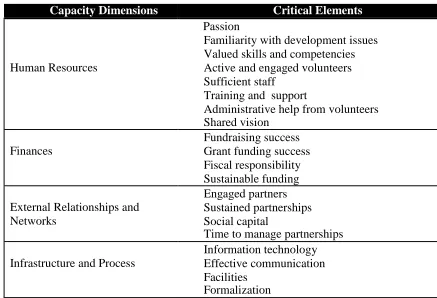
Multiple critical elements were identified within each of the five dimensions of
organizational capacity (see Table 2). The findings are presented here, along with a sample of
quotations that are indicative and representative of these elements in the local SFD organization
importance of the particular elements. The findings coincide with existing research on capacity
in CSOs (Doherty et al., 2014; Misener & Doherty, 2009; Sharpe, 2006) and SFD organizations
(Svensson et al., 2017; Svensson & Hambrick, 2016), and provide additional insights that appear
to be unique in this context. As such, this study extends organizational capacity theorizing by
advancing a framework of critical elements specific to local SFD, while providing a platform for
the further examination and management of organizational capacity in this unique context.
Following the presentation of critical elements, we discuss the findings within each dimension in
relation to existing capacity (and management) for SFD literature to highlight areas of consensus
and offer new insights as well.
Table 2 Summary of findings
Capacity Dimensions Critical Elements
Human Resources
Passion
Familiarity with development issues Valued skills and competencies Active and engaged volunteers Sufficient staff
Training and support
Administrative help from volunteers Shared vision
Finances
Fundraising success Grant funding success Fiscal responsibility Sustainable funding
External Relationships and Networks
Engaged partners Sustained partnerships Social capital
Time to manage partnerships
Infrastructure and Process
Information technology Effective communication Facilities
Planning and Development
Strategic planning Collaborative planning
Awareness of risks and opportunities
Human Resources Capacity
Critical elements of human resources capacity that impact the ability of local SFD
organizations to achieve their mandate were indicated. Those elements include: (a) Passion for
helping others and for the sport itself, (b) Familiarity with development issues, (c) Valued skills
and competencies, (d) Active and engaged volunteers, (e) Sufficient staff, (f) Training and
support from the organization, (g) Administrative help from volunteers, and (h) Shared vision.
Passion, particularly for helping others but also for the sport itself, was identified as an
essential trait for paid staff and volunteers. Colleen from City Tennis described her volunteers:
“They’re coming to the table with this whole sense of wanting to be part of something bigger
than themselves, and wanting to give back, and wanting to make a difference in the lives of
children.” Susie (Downhill Life Skills) also shared that, “We do have volunteers each night that
volunteer their time…and those people are awesome! They just have such a passion for the sport
and for giving back to the sport!”
Familiarity with development issues in the local community is another critical trait for
these organizations’ human resources. Specifically, familiarity with the community’s culture, the
unique needs of participants, the organization’s development objectives, and experience working
in (or being from) the target community was indicated as valuable for volunteers and staff. Paul
from Slam Dunk Education stated that, “One of our biggest strengths is a lot of volunteers are
alumni…they’ve come up through the [SFD] program and they’ve benefited from the program,
thing” about her staff:
The best thing… [is] we recruited from the community, or similar communities as our
youth. The workers, the volunteers, the leaders have an experience [that is] similar in terms
of their growing up to the youth that they’re working with, and that seems to be pretty
important for them to develop that relationship.
Valued skills and competencies was another element identified as critical to the local SFD
organizations, and particularly at the board level. These include relevant education and
professional experience, and expertise in marketing, social media, financial management, and
fundraising. For example, John (Football Playwrights) described the professional experience of
his board members as critical to his organization’s success:
We do have a well-established board of directors and they have a lot of expertise in their
areas of work. So, for example, we have a Principal; somebody from the Education
Department…and we have a couple of CFOs on our board as well.
Notably, knowledge related to communication and particularly social media was identified as
important in this study: Eddy (All-Rounder Citizens), who had staff with communications
experience handling his organization’s Facebook, Twitter, and website explained: “We’re getting
more exposure, and the professionalism is coming through a little better than before because we
now have people [who] have the experience and the knowledge and the ability to deliver [our]
message.”
Active and engaged volunteers are hardworking people who turn passion into action.
These volunteers ‘go above and beyond’ to positively impact participants’ experiences in local
SFD programs. They are “the most experienced, hard working group of people you’ll ever meet”
driven, right, so they’re our volunteers…we advise them of the opportunity, but they’re the ones
who actually decide whether to do it, and most of the officers do it off- duty…[they’re]
exceptional volunteers” (Alison).
Sufficient staff was identified by interviewees as critical to administer operations, deliver
programming, and grow their organizations. Many described challenges resulting from having
insufficient staff. For example, Cindy (Hoop Mentors) shared:
I mean, one of the challenges is I’m the only person working on this. I’m the only
coordinator working on this program. So, in terms of actual capacity, I’m running four
different sport programs and I’m trying to plan these events and I’m trying to apply to
grants. So, looking to the future it’s really dependent on [whether] I have time to continue
applying to grants.
Eddy described his organization’s challenge with insufficient staff, noting the growing wait list
for their services: at All-Rounder Citizens, “we have a lot of kids [who] are waiting…almost 400
kids…I’m down to one social worker as well, so, those are the challenges we have.”
Volunteer and staff training and support from the organization was identified by
interviewees as critical for the success of their programs. At Leading Communities, “all of our
staff have been trained in the fundamental movement skills…so when we have the youth here,
we’re providing quality recreation experiences” (Ashley). Eddy discussed his organization’s
formalized volunteer training program:
We talk about child behaviour management…. And we also talk about
multiculturalism…and [we have] a really thorough child abuse training segment. We do a
learning challenges [and] learning disabilities piece, as well as a mental health piece. So,
for what they may encounter.
For local SFD, training may be required to become familiar with the sport, achieve or improve
coaching certifications, and to become familiar with relevant development strategies. Training
can be formal or informal, and includes mentoring from leaders within the organization, and
training from the provincial or national sport organization.
Administrative help from volunteers was also identified as a critical element. Local SFD
volunteers help to write and review grant applications, assist with registration and
communications to participants and volunteers, and may be responsible for other administrative
tasks as well. Larry (Basketball Bookworms) described the important role volunteer parents have
assisting with administrative tasks at his organization:
One of the parents has taken on all the registration and database so we can become so
much more organized. We have another parent who [has] just taken on the role of
tournament facilitator…and he’s taken care of all of that, again, on a volunteer basis.
Finally, shared vision among staff and volunteers was identified as a critical element,
although it was indicated by the challenge of lacking shared vision. In this study, lacking shared
vision was predominantly the case with volunteers at organizations that were implementing SFD
initiatives for the first time. At Slam Dunk Education, volunteer coaches had been removed from
the organization based on an unwillingness to embrace the education- first mission of the
program. Paul described: “We’ve had to get rid of coaches before [who] didn’t really get this –
that you and the tutors are working together.” Colleen described conflicting values at her board,
stating “Every board member comes to the table with a different vision of what they feel City
Tennis should become.” At Hoop Mentors, Cindyshared:
program…like, I’m coming at this from a phys. ed. background and everyone is coming at
it from a social work or an educational background… [and] people with a social work
background are really wanting to emphasize the mentorship component – well, I’m coming
at it from a sport background and I really want to emphasize the sport component. So, I
think that’s an organizational challenge.
Several of the critical elements of human resources capacity are consistent with what has
been uncovered in research on SFD capacity (Svensson et al., 2017; Svensson & Hambrick,
2016) and the community sport club context where the focus is on sport development (Doherty et
al., 2014; Misener & Doherty, 2009; Sharpe, 2006; Wicker & Breuer, 2011), and in the literature
on management issues for SFD (Casey et al., 2012; Spaaij, 2013; Wells & Welty Peachey, 2016;
Welty Peachey et al., 2017; Welty Peachey et al., 2013). Similar elements include having
passionate (enthusiastic) volunteers and staff with valued skills and competencies (Doherty et al.,
2014; Spaaij, 2013; Wicker & Breuer, 2011), who are active and engaged in the organization and
share a common vision (Doherty et al., 2014; Svensson et al., 2017; Wicker & Breuer, 2011),
and support for those volunteers and staff through necessary training and development (Wicker
& Breuer, 2011). The value of passionate volunteers to the SFD organization is encouraging
because research indicates this is one of the primary reasons they become and stay involved
(Spaaij, 2013; Wells & Welty Peachey, 2016; Welty Peachey et al., 2017). The importance of the
knowledge, skills, attitudes, shared vision, and effort of sufficient volunteers and staff are
consistent themes across much of the SFD literature (Casey et al., 2012; Spaaij, 2013; Svensson
et al., 2017; Svensson & Hambrick, 2016) and non-profit sector at large (e.g., Brown, Anderson,
& Jo, 2016; Hall et al., 2003; Wicker & Breuer, 2014). Interestingly, although both volunteers