How to Tell if Your Cloud Files
Are Vulnerable to Drive Crashes
Kevin D. Bowers
RSA Laboratories[email protected]
Marten van Dijk
RSA Laboratories[email protected]
Ari Juels
RSA Laboratories[email protected]
Alina Oprea
RSA Laboratories
[email protected]
Ronald L. Rivest
MIT CSAIL[email protected]
ABSTRACT
This paper presents a new challenge—verifying that a remote server is storing a file in a fault-tolerant manner, i.e., such that it can sur-vive hard-drive failures. We describe an approach called the Re-mote Assessment of Fault Tolerance(RAFT). The key technique in a RAFT is to measure thetime takenfor a server to respond to a read request for a collection of file blocks. The larger the num-ber of hard drives across which a file is distributed, the faster the read-request response. Erasure codes also play an important role in our solution. We describe a theoretical framework for RAFTs and show experimentally that RAFTs can work in practice.
1.
Introduction
Cloud storage offers clients a unified view of a file as a single, integral object. This abstraction is appealingly simple. In reality, though, cloud providers generally store files with redundancy or error correction to protect against data loss. Amazon, for example, claims that its S3 service stores three replicas of each file1. Ad-ditionally, cloud providers often spread files across multiple stor-age devices. Such distribution provides resilience against hardware failures, e.g., drive crashes (and can also lower latency across dis-parate geographies).
The single-copy file abstraction in cloud storage, however, con-ceals file-layout information from clients. It therefore deprives them of insight into the true degree of fault-tolerance their files enjoy. Even when cloud providers specify a storage policy (e.g., even given Amazon’s claim of triplicate storage), clients have no technical means ofverifyingthat their files aren’t vulnerable, for instance, to drive crashes. In light of clients’ increasingly critical reliance on cloud storage for file retention, and the massive cloud-storage failures that have come to light, e.g., [5], it is our belief that remote testing of fault tolerance is a vital complement to contrac-tual assurances and service-level specifications.
In this paper we develop a protocol for remote testing of fault-tolerance for stored files. We call our approach theRemote Assess-ment of Fault Tolerance(RAFT). A RAFT enables a client to obtain proof that a given fileF is distributed across physical storage de-vices to achieve a certain desired level of fault tolerance. We refer to storage units asdrivesfor concreteness. For protocol parameter t, our techniques enable a cloud provider to prove to a client that the fileF can be reconstructed from surviving data given failure of any set oftdrives. For example, if Amazon were to prove that it stores a fileF fully in triplicate, i.e., one copy on each of three
1Amazon has also recently introduced reduced redundancy storage
that promises less fault tolerance at lower cost
distinct drives, this would imply thatF is resilient tot= 2drive crashes.
At first glance, proving that file data is stored redundantly, and thus proving fault-tolerance, might seem an impossible task. It is straightforward for storage serviceSto prove knowledge of a file F, and hence that it has stored at least one copy.Scan just transmit F. But how canS prove, for instance, that it hasthree distinct copies ofF? TransmittingF three times clearly doesn’t do the trick! Even proving storage of three copies doesn’t prove fault-tolerance: the three copies could all be stored on the same disk!
To show thatF isn’t vulnerable to drive crashes, it is necessary to show that it is spread across multiple drives. Our approach, the Remote Assessment of Fault Tolerance, proves the use of multiple drives by exploiting drives’ performance constraints—in particular bounds on thetimerequired for drives to perform challenge tasks. A RAFT is structured as a timed challenge-response protocol. A short story and Figures 1 and 2 give the intuition. Here, the aim is to ensure that a pizza order can toleratet= 1oven failures.
A fraternity (“Eeta Pizza Pi”) regularly orders pizza from a local pizza shop, “Cheapskate Pizza.” Recently Cheapskate failed to deliver pizzas for the big pregame party, claiming that their only pizza oven had suffered a catastrophic failure. They are currently replacing it with two new BakesALot ovens, for increased capacity and reliability in case one should fail.
Aim O’Bese, president of Eeta Pizza Pi, wants to verify that Cheapskate has indeed installed redundant pizza ovens, without having to visit the Cheapskate premises himself. He devises the following clever ap-proach. Knowing that each BakesALot oven can bake two pizzas every ten minutes, he places an order for two dozen pizzas, for delivery to the fraternity as soon as possible. Such a large order should take an hour of oven time in the two ovens, while a single oven would take two hours. The order includes various un-usual combinations of ingredients, such as pineapple, anchovies, and garlic, to prevent Cheapskate from de-livering warmed up pre-made pizzas.
t = 1 1 O2
p1 p2
p2 p1
Bake(p1,p2) Order(p1,p2)
EPP CP
time t = 0 O
Figure 1: Resilient pizza shop with two ovens
time 1
p1
p2 p2
p1
Bake(p1,p2) Order(p1,p2)
EPP CP
t = 0
t = 1
t = 2 O
Figure 2: Failure-prone pizza shop with only one oven
enough,S proves that it has distributedF across a certain, mini-mum number of drives. Suppose, for example, thatSis challenged to pull 100 random blocks fromF, and that this task takes one sec-ond on a single drive. IfScan respond in only half a second2, it is clear that it has distributedFacross at least two drives.
Again, the goal of a RAFT is forSto prove to a client thatFis recoverable in the face of at leasttdrive failures for somet. Thus
Smust actually do more than prove thatF is distributed across a certain number of drives. It mustalsoprove thatFhas been stored with a certain amount ofredundancyand that the distribution ofF across drives iswell balanced. To ensure these two additional prop-erties, the client and server agree upon a particular mapping of file blocks to drives. An underlying erasure code provides redundancy. By randomly challenging the server to show that blocks ofF are laid out on drives in the agreed-upon mapping, the client can then verify resilience totdrive failures.
The real-world behavior of drives presents a protocol-design chal-lenge: The response time of a drive can vary considerably from read to read. Our protocols rely in particular on timing measure-ments of disk seeks, the operation of locating randomly accessed blocks on a drive. Seek times exhibit high variance, with multiple factors at play (including disk prefetching algorithms, disk internal buffer sizes, physical layout of accessed blocks, etc.). To smooth out this variance we craft our RAFTs to samplemultiplerandomly selected file blocks per drive. Clients not only check the correct-ness of the server’s responses, but also measure response times and accept a proof only if the server replies within a certain time inter-val. We also empirically explore another real-world complication, variance in network latencies between remotely located clients and servers. Despite these design challenges, we propose and experi-mentally validate a RAFT that can, for example, distinguish sharply between a four-drive system with fault tolerancet= 1and a three-drive system with no fault tolerance in less than 500ms.
RAFTs aim primarily to protect against “economically rational” service providers / adversaries, which we define formally below. Our adversarial model is thus a mild one. We envision scenarios in which a service provider agrees to furnish a certain degree of fault tolerance, but cuts corners. To reduce operating costs, the provider might maintain equipment poorly, resulting in unremedi-ated data loss, enforce less file redundancy than promised, or use fewer drives than needed to achieve the promised level of fault tol-erance. (The provider might even use too few drives accidentally, as
2Of course, S can violate our assumed bounds on drive
perfor-mance by employing unexpectedly high-grade storage devices, e.g., flash storage instead of rotational disks. As we explain below, though, our techniques aim to protect against economically rational adversariesS. Such anSmight create substandard fault tolerance to cut costs, but would not employ more expensive hardware just to circumvent our protocols. (More expensive drives often mean higher reliability anyway.)
virtualization of devices causes unintended consolidation of phys-ical drives.) An economphys-ically rational service provider, though, onlyprovides substandard fault tolerance when doing so reduces costs. The provider does not otherwise, i.e., maliciously, introduce drive-failure vulnerabilities. We explain later, in fact, why protec-tion against malicious providers is technically infeasible.
1.1
Related work
Proofs of Data Possession (PDPs) [1] and Proofs of Retrievabil-ity (PORs) [6, 7, 16, 24] are challenge-response protocols that ver-ify the integrity and completeness of a remotely storedF. They share with our work the idea of combining error-coding with ran-dom sampling to achieve a low-bandwidth proof of storage of a file F. This technique was first advanced in a theoretical framework in [21]. Both [18] and [3] remotely verify fault tolerance at a logi-cal level by using multiple independent cloud storage providers. A RAFT includes the extra dimension of verifying physical layout of Fand tolerance to a number of drive failures at a single provider.
Cryptographic challenge-response protocols prove knowledge of a secret—or, in the case of PDPs and PORs, knowledge of a file. The idea of timing a response to measure remote physical resources arises in cryptographic puzzleconstructions [8]. For instance, a challenge-response protocol based on a moderately hard computa-tional problems can measure the computacomputa-tional resources of clients submitting service requests and mitigate denial-of-service attacks by proportionately scaling service fulfilment [15]. Our protocols here measure not computational resources, but the storage resources devoted to a file. (Less directly related is physical distance bound-ing, introduced in a cryptographic setting in [4]. There, packet time-of-flight gives an upper bound on distance.)
We focus on non-Byzantine, i.e., non-malicious, adversarial mod-els. We presume that malicious behavior in cloud storage providers is rare. As we explain, such behavior is largely irremediable any-way. Instead, we focus on an adversarial model (“cheap-and-lazy”) that captures the behavior of a basic, cost-cutting or sloppy storage provider. We also consider an economically rational model for the provider. Most study of economically rational players in cryptogra-phy is in the multiplayer setting, but economical rationality is also implicit in some protocols for storage integrity. For example, [1,11] verify that a provider has dedicated a certain amount of storage to a fileF, but don’t strongly assure file integrity. We formalize the concept of self-interested storage providers in our work here.
1.2
Organization
Section 2 gives an overview of key ideas and techniques in our RAFT scheme. We present formal adversarial and system models in Section 3. In Section 4, we introduce a basic RAFT in a sim-ple system model. Drawing on experiments, we refine this system model in Section 5, resulting in a more sophisticated RAFT which we validate against the Mozy cloud backup service in Section 6. In Section 7, we formalize an economically rational adversarial model and sketch matching RAFT constructions. We conclude in Sec-tion 8 with discussion of future direcSec-tions.
2.
Overview: Building a RAFT
We now discuss in further detail the practical technical chal-lenges in crafting a RAFT for hard drives, and the techniques we use to address them. We view the fileFas a sequence ofmblocks of fixed size (e.g., 64KB).
File redundancy / erasure coding. To tolerate drive failures, the fileF must be stored with redundancy. A RAFT thus includes an initial step that expandsFinto ann-block erasure-coded represen-tationG. If the goal is to place file blocks evenly acrosscdrives to tolerate the failure of anytdrives, then we needn=mc/(c−t). Our adversarial model, though, also allows the server to drop a por-tion of blocks or place some blocks on the wrong drives. We show how to parameterize our erasure coding at a still higher rate, i.e., choose a largern, to handle these possibilities.
Challenge structure. (“What order should Eeta Pizza Pie place to challenge Cheapskate?”) We focus on a “layout specified” RAFT, one in which the client and server agree upon an exact placement of the blocks ofGoncdrives, i.e., a mapping of each block to a given drive. The client, then, challenges the server with a queryQthat selects exactly one block per drive in the agreed-upon layout. An honest server can respond by pulling exactly one block per drive (in one “step”). A cheating server, e.g., one that uses fewer thanc drives, will need at least one drive to servicetwoblock requests to fulfillQ, resulting in a slowdown.
Network latency. (“What if Cheapskate’s delivery truck runs into traffic congestion?”) The network latency, i.e., roundtrip packet-travel time, between the client and server, can vary due to changing network congestion conditions. The client cannot tell how much a response delay is due to network conditions and how much might be due to cheating by the server. We examine representative Inter-net routes experimentally and find that Inter-network latency is, for our purposes, quite stable; it has little impact on RAFT design.
Drive read-time variance. (“What if the BakesALot ovens bake at inconsistent rates?”) The read-response time for a drive varies across reads. We perform experiments, though, showing that for a carefully calibrated file-block size, the response time follows a probability distribution that is stable across time and physical file positioning on disk. (We show how to exploit the fact that a drive’s “seek time” distribution is stable, even though its read bandwidth isn’t.) We also show how to smooth out read-time variance by con-structing RAFT queriesQthat consist ofmultipleblocks per drive.
Queries with multiple blocks per drive. (“How can Eeta Pizza Pie place multiple, unpredictable orders without phoning Cheap-skate multiple times?”) A naïve way to construct a challengeQ consisting of multiple blocks per drive (say,q) is simply for the client to specifycq random blocks inQ. The problem with this approach is that the server can then schedule the set ofcqblock ac-cesses on its drives to reduce total access time (e.g., exploiting drive efficiencies on sequential-order reads). Alternatively, the client could issue challenges inqsteps, waiting to receive a response
be-fore issuing a next, unpredictable challenge. But this would require crounds of interaction.
We instead introduce an approach that we calllock-step chal-lenge generation. The key idea is for the client to specify queryQ in an initial step consisting ofcrandom challenge blocks (one per drive). For each subsequent step, the set ofcchallenge blocks de-pends on thecontentof the file blocks accessed in the last step. The server can proceed to the next step only after fully completing the last one. Our lock-step technique is a kind of repeated application of a Fiat-Shamir-like heuristic [9] for generatingqindependent, un-predictable sets of challenges non-interactively. (File blocks serve as a kind of “commitment.”) The server’s response toQthen is simply the aggregate (hash) of all of thecqfile blocks it accesses.
3.
Formal Definitions
A Remote Assessment of Fault ToleranceRAFT(t) aims to enable a service provider to prove to a client that it has stored file F with tolerance againsttdrive failures. In our model, the file is first encoded by adding some redundancy. This can be done by ei-ther the client or the server. The encoded file is then stored by the server using some number of drives. Periodically, the client issues challenges to the server, consisting of a subset of file block indices. If the server replies correctly and promptly to challenges (i.e., the answer is consistent with the original fileF, and the timing of the response is within an acceptable interval), the client is convinced that the server stores the file with tolerance againsttdrive failures. The client can also reconstruct the file at any time from the encod-ing stored by the server, assumencod-ing at mosttdrive failures.
3.1
System definition
To define our system more formally, we start by introducing some notation. A file block is an element inB = GF[2ℓ]. For convenience we also treatℓas a security parameter. We letfi
de-note theithblock of a fileFfori∈ {1, . . . ,|F|}. The RAFT system comprises these functions:
• Keygen(1ℓ) R
→ κ: A key-generation function that outputs keyκ. We denote a keyless system byκ=ϕ.
• Encode(κ, F = {fi}mi=1, t, c) → G = {gi}ni=1: An en-coding function applied to anm-block fileF ={fi}mi=1; it takes additional inputs fault tolerancetand a number ofc logical disks. It outputs encoded fileG ={gi}ni=1, where n≥m. The functionEncodemay be keyed, e.g., encrypt-ing blocks underκ, in which case encoding is done by the client, or unkeyed, e.g., applying an erasure code or keyless cryptographic operation toF, which may be done by either the client or server.
• Map(n, t, c)→ {Cj}cj=1: A function computed by both the client and server that takes the encoded file sizen, fault tol-erancetand a numbercof logical disks and outputs a logical mapping of file blocks tocdisks or⊥. To implementMap
the client and server can agree on a mapping which each can compute, or the server may specify a mapping that the client verifies as being tolerant totdrive failures. (A more general definition might also includeG = {gi}ni=1as input. Here we only consider mappings that respect erasure-coding struc-ture.) The output consists of setsCj⊆ {1,2, . . . , n}
denot-ing the block indices stored on drivej, forj∈ {1, . . . , c}. If the output is not⊥, then the placement is tolerant totdrive failures.
number of logical drivescand generates a challengeQ con-sisting of a set of block indices inG. The aim of the chal-lenge is to verify disk-failure tolerance at leastt.
• Response(Q) → (R, T): An algorithm that computes a server’s responseRto challengeQ, using the encoded file blocks stored on the server disks. The timing of the response T is measured by the client as the time required to receive the response from the server after sending a challenge.
• Verify(G, Q, R, T) → b∈ {0,1}: A verification function for a server’s response(R, T)to a challengeQ, where 1 de-notes “accept,” i.e., the client has successfully verified cor-rect storage by the server. Conversely 0 denotes “reject.” In-putGis optional in some systems.
• Reconstruct(κ, r,{g∗i}ri=1) → F∗ = {fi∗}mi=1: A recon-struction function that takes a set ofrencoded file blocks and either reconstructs an m-block file or outputs failure sym-bol ⊥. We assume that the block indices in the encoded file are also given to theReconstructalgorithm, but we omit them here for simplicity of notation. The function is keyed if
Encodeis keyed, and unkeyed otherwise.
Except in the case ofKeygen, which is always probabilistic, func-tions may be probabilistic or deterministic. We defineRAFT(t) =
{Keygen,Encode,Map,Challenge,Response,Verify,Reconstruct}.
3.2
Client model
In some instances of our protocols calledkeyed protocols, the client needs to store secret keys used for encoding and reconstruct-ing the file.Unkeyed protocolsdo not make use of secret keys for file encoding, but instead use public transforms.
If theMapfunction outputs a logical layout{Cj}cj=1̸=⊥, then we call the modellayout-specified. We denote alayout-freemodel one in which theMapfunction outputs⊥, i.e., the client does not know a logical placement of the file oncdisks. In this paper, we only consider layout-specified protocols, although layout-free pro-tocols are an interesting point in the RAFT design space worth ex-ploring.
For simplicity in designing theVerifyprotocol, we assume that the client keeps a copy ofFlocally. Our protocols can be extended easily via standard block-authentication techniques, e.g., [19], to a model in which the file is maintained only by the provider and the client deletes the local copy after outsourcing the file.
3.3
Drive and network models
The response timeT of the server to a challengeQas measured by the client has two components: (1) Drive read-request delays and (2) Network latency. We model these two protocol-timing com-ponents as follows.
Modeling drives.
We model a server’s storage resources forF as a collection of dindependent hard drives. Each drive stores a collection of file blocks. The drives are stateful: The timing of a read-request re-sponse depends on the query history for the drive, reflecting block-retrieval delays. For example, a drive’s response time is lower for sequentially indexed queries than for randomly indexed ones, which induce seek-time delays [23]. We do not consider other forms of storage here, e.g., solid-state drives3.
3
At the time of this writing, SSDs are still considerable more expensive than rotational drives and have much lower capacities. A typical rotational drive can be bought for roughly $0.07/GB in capacities up to 3 TBs, while most SSDs still cost more than $2.00/GB are are only a few hundred GBs in size. For a econom-ically rational adversary, the current cost difference makes SSDs impractical.
We assume that all the drives belong to the same class, (e.g. en-terprise class drives), but may differ in significant ways, including seek time, latency, throughput, and even manufacturer. We will present disk access time distributions for several enterprise class drive models. We also assumes that when retrieving disk blocks for responding to client queries in the protocol, there is no other workload running concurrently on the drive, i.e. the drive has been "reserved" for the RAFT4. Alternatively, in many cases, drive
con-tention can be overcome by issuing more queries. We will demon-strate the feasibility of both approaches through experimental re-sults.
Modeling network latency.
We assume in our model that we can accurately estimate the net-work latency between the client and the server. We will present some experimental data on network latencies and adapt our proto-cols to handle observed small variations in time.
3.4
Adversarial model
We now describe our adversarial model, i.e., the range of behav-iors ofS. In our model, them-block fileF is chosen uniformly at random. This reflects our assumption that file blocks are already compressed by the client, for storage and transmission efficiency, and also because our RAFT constructions benefit from random-looking file blocks. Encodeis applied toF, yielding an encoded fileGof sizen, which is stored withS.
Both the client and server compute the logical placement{Cj}cj=1 by applying the Map function. The server then distributes the blocks ofGacrossdreal disks. The number of actual disksdused bySmight be different than the number of agreed-upon drivesc. The actual file placement{Dj}dj=1performed by the server might also deviate arbitrarily from the placement specified by theMap
function. (As we discuss later, sophisticated adversaries might even store something other than unmodified blocks ofG.)
At the beginning of a protocol execution, we assume that no blocks ofGare stored in the high-speed (non-disk) memory ofS. Therefore, to respond to a challengeQ,S must query its disks to retrieve file blocks. The variableT denotes the time required for the client, after transmitting its challenge, to receive a responseR fromS. TimeT includes both network latency and drive access time (as well as any delay introduced byScheating).
The goal of the client is to establish whether the file placement implemented by the server is resilient to at leasttdrive failures.
Our adversarial model is validated by the design and implemen-tation of the Mozy online backup system, which we will discuss further in Section 6.2. We expect Mozy to be representative of many cloud storage infrastructures.
Cheap-and-lazy server model.
For simplicity and realism, we focus first on a restricted adver-sarySthat we calllazy. The objective of a cheap-and-lazy adversary is to reduce its resource costs; in that sense it is “cheap.” It is “lazy” in the sense that it does not modify file con-tents. The adversary instead cuts corners by storing less redundant data on a smaller number of disks or mapping file blocks unevenly across disks, i.e., it may ignore the output ofMap. A cheap-and-lazy adversary captures the behavior of a typical cost-cutting or negligent storage service provider.
4
To be precise, we specify a cheap-and-lazy serverSby the fol-lowing assumptions on the blocks of fileF:
• Block obliviousness: The behavior ofS i.e., its choice of internal file-block placement (d,{Dj}dj=1) is independent of the content of blocks in G. Intuitively, this means that
S doesn’t inspect block contents when placing encoded file blocks on drives.
• Block atomicity: The server handles file blocks as atomic data elements, i.e., it doesn’t partition blocks across multiple storage devices.
A cheap-and-lazy server may be viewed as selecting a mapping fromnencoded file blocks to positions onddrives without knowl-edge ofG. Some of the encoded file blocks might not be stored to drives at all (corresponding to dropping of file blocks), and some might be duplicated onto multiple drives.Sthen applies this map-ping to thenblocks ofG.
General adversarial model.
It is also useful to consider a general adversarial model, cast in an experimental framework. We define the security of our sys-temRAFT(t) according to the experiment from Figure 3. We letO(κ) ={Encode(κ,·,·,·),Map(·,·,·),Challenge(·,·,·,·),
Verify(·,·,·,·),Reconstruct(κ,·,·)}denote a set of RAFT-function oracles (some keyed) accessible toS.
ExperimentExpRAFTS (t)(m, ℓ, t): κ←Keygen(1ℓ);
F={fi}mi=1←RBm;
G={gi}ni=1←Encode(κ, F, t, c);
(d,{Dj}dj=1)← SO(κ)(n, G, t, c,“store file”); Q←Challenge(n, G, t, c);
(R, T)← S{Dj}dj=1(Q,“compute response”);
ifAccSandNotFTS
then output 1, else output 0
Figure 3: Security experiment
We denote byAccSthe event thatVerify(G, Q, R, T) = 1in a given run ofExpRAFTS (t)(m, ℓ, t), i.e., that the client / verifier accepts the response ofS. We denote byNotFTSthe event that there exists{Dij}
d−t
j=1⊆ {Dj}dj=1s.t.
Reconstruct(κ,|{Dij}
d−t j=1|,{Dij}
d−t j=1)̸=F,
i.e., that the allocation of blocks selected bySin the experimental run is nott-fault tolerant.
We defineAdvRAFTS (t)(m, ℓ, t) =Pr[ExpRAFTS (t)(m, ℓ, t)= 1] =Pr[AccSandNotFTS]. We define thecompletenessofRAFT(t)
asCompRAFT(t)(m, ℓ, t) = Pr[Acc
Sand¬NotFTS]over exe-cutions of honestS(a server that always respects the protocol spec-ification) inExpRAFTS (t)(m, ℓ, t).
Our general definition here is, in fact, a little too general for prac-tical purposes. As we now explain, there is no good RAFT for a fully maliciousS. That is why we restrict our attention to cheap-and-lazyS, and later, in Section 7, briefly consider a “rational”S.
Why we exclude malicious servers.
Amaliciousor fully Byzantine serverSis one that may expend arbitrarily large resources and manipulate and storeGin an arbi-trary manner. Its goal is to achieve≤t−1fault tolerance forF while convincing the client with high probability thatFenjoys full tfault tolerance.
We do not consider malicious servers because there is no effi-cient protocol to detect them. A malicious server can convert any
t-fault-tolerant file placement into a0-fault-tolerant file placement very simply. The server randomly selects an encryption keyλ, and encrypts every stored file block underλ. Sthen adds a new drive and storesλon it. To reply to a challenge,S retrievesλand de-crypts any file blocks in its response. If the drive containingλfails, of course, the fileFwill be lost. There is no efficient protocol that distinguishes between a file stored encrypted with the key held on a single drive, and a file stored as specified, as they result in nearly equivalent block read times.5
3.5
Problem Instances
A RAFTproblem instancecomprises a client model, an adver-sarial model, and drive and network models. In what follows, we propose RAFT designs in an incremental manner, starting with a very simple problem instance—a cheap-and-lazy adversarial model and simplistic drive and network models. After experimentally exploring more realistic network and drive models, we propose a more complex RAFT. We then consider a more powerful (“ratio-nal”) adversary and further refinements to our RAFT scheme.
4.
The Basic RAFT Protocol
In this section, we construct a simple RAFT system resilient against the cheap-and-lazy adversary. We consider very simple disk and network models. While the protocol presented in this section is mostly of theoretical interest, it offers a conceptual framework for later, more sophisticated RAFTs.
We consider the following problem instance:
Client model: Unkeyed and layout-specified.
Adversarial model: The server is cheap-and-lazy.
Drive model: Time to read a block of fixed lengthℓfrom disk is constant and denoted byτℓ.
Network model: The latency between client and server (denoted
L) is constant in time and network bandwidth is unlimited.
4.1
Scheme Description
To review: Our RAFT construction encodes the entirem-block fileFwith an erasure code that tolerates a certain fraction of block losses. The server then spreads the encoded file blocks evenly over cdrives and specifies a layout. To determine that the server respects this layout, the client requestscblocks of the file in a challenge, one from each drive. The server should be able to access the blocks in parallel fromcdrives, and respond to a query in time close toτℓ+L. If the server answers most queries correctly and promptly, then blocks are spread out on disks almost evenly. A rigorous formal-ization of this idea leads to a bound on the fraction of file blocks that are stored on anytserver drives. If the parameters of the era-sure code are chosen to tolerate that amount of data loss, then the scheme is resilient againsttdrive failures.
To give a formal definition of the construction, we use a max-imum distance separable (MDS), i.e., optimal erasure code with encoding and decoding algorithms(ECEnc,ECDec) and expan-sion rate1 +α. ECEncencodesm-block messages inton-block codewords, withn=m(1 +α). ECDeccan recover the original message given anyαmerasures in the codeword.
The scheme is the following:
• Keygen(1ℓ)outputsϕ.
• Encode(κ, F ={fi}mi=1, t, c)outputsG={gi}ni=1withn a multiple ofcandG=ECEnc(F).
5The need to pullλfrom the additional drive may slightly skew the
• Map(n, t, c) outputs a balanced placement{Cj}cj=1, with
|Cj|=n/c. In addition∪cj=1Cj = {1, . . . , n}, so
conse-quentlyCi∩Cj=ϕ,∀i̸=j.
• Challenge(n, G, t, c)outputsQ = {i1, . . . , ic}consisting
ofcblock indices, eachijchosen uniformly at random from
Cj, forj∈ {1, . . . , c}.
• Response(Q)outputs the responseRconsisting of thecfile blocks specified byQ, and the timingT measured by the client.
• Verify(G, Q, R, T) performs two checks. First, it checks correctnessof blocks returned inRusing the file stored lo-cally by the client6. Second, the client also checks the prompt-ness of the reply. If the server replies within an interval τℓ+L, the client outputs 1.
• Reconstruct(κ, r,{g∗i} r
i=1)outputs the decoding of the file blocks retained byS(after a possible drive failure) under the erasure code:ECDec({g∗i}ir=1)forr≥m, and⊥ifr < m.
4.2
Security Analysis
We start by computingPr[AccS]andPr[NotFTS]for an honest server. Then we turn our attention to bounding the advantage of a cheap-and-lazy server.
LEMMA 1. For an honest server,Pr[AccS] = 1.
PROOF. An honest server respects the layout specified by the client, and can answer all queries in timeτℓ+L.
LEMMA 2. Ifα ≥ t/(c−t), thenPr[NotFTS] = 0for an honest server.
PROOF. An honest server stores the file blocks to disks deter-ministically, as specified by the protocol. Then any set oftdrives storestn/cblocks. From the restriction onα, it follows that anyt drives store at mostαmblocks, and thus the file can be recovered from the remainingc−tdrives.
LEMMA 3. Denote byϵSthe "double-read" probability that the cheap-and-lazy serverScannot answer ac-block challenge by per-forming single block reads across all its drives. For fixedc, tand αwithα≥t/(c−t), if
ϵS≤B(c, t, α) = α(c−t)−t (1 +α)(c−t),
thenPr[NotFTS] = 0.
Our timing assumptions (constant network latency and constant block read time) imply thatϵSis equal to the probability that the server does not answerc-block challenges correctly and promptly, i.e.,ϵS = 1−Pr[AccS].
PROOF. The server might use a different placement than the one specified byMap; the placement can be unbalanced, and encoded file blocks can be duplicated or not stored at all. Our goal is to show that the server stores a sufficient number of blocks on any d−tdrives. LetXbe a fixed set oftout of thedserver drives. LetY be the remainingd−tdrives and denote byδthe fraction of encoded file blocks stored on drives inY. We compute a lower bound onδ.
For a queryQconsisting ofcencoded file block indices, letδQ
denote the fraction of encoded file blocks indexed byQstored on drives inY. LetQbe the query space consisting of queries com-puted byChallenge. Since every block index is covered an equal number of times by queries inQ, if we considerδQa random
vari-able with all queries inQequally likely, it follows thatE[δQ] =δ.
6
Recall we assume a copy of the file is kept by the client to sim-plify verification. This assumption can be removed by employing standard block-authentication techniques.
Consider a queryQrandomly chosen fromQ. With probability
1−ϵS, the server can correctly answer queryQby performing sin-gle reads across all its drives. SinceSsatisfies the block oblivious-ness and block atomicity assumptions,Sdoes not computationally process read blocks. This means that at mosttout of thecblocks indexed byQare stored on drives inX. Or, equivalently, at least c−tencoded file blocks indexed byQare stored on drives inY. We can infer that for queries that succeed,δQ ≥(c−t)/c. This
yields the lower boundδ=E[δQ]≥(1−ϵS)(c−t)/c.
From the bound onϵSassumed in the statement, we obtain that δn ≥ m. From the block obliviousness and block atomicity as-sumptions forS, it follows that drives inYstore at leastmencoded file blocks. We can now easily infert-fault tolerance: if drives in Xfail, fileFcan be reconstructed from blocks stored on drives in Y, for any suchY viaECDec.
Based on the above lemmas, we prove the theorem:
THEOREM 1. For fixed system parametersc, tandαsuch that α ≥ t/(c−t) and for constant network latency and constant block read time, the protocol satisfies the following properties for a cheap-and-lazy serverS:
1. The protocol is complete:CompRAFT(t)(m, ℓ, t) = 1. 2. IfSusesd < cdrives,AdvRAFTS (t)(m, ℓ, t) = 0.
3. IfSusesd≥cdrives,AdvSRAFT(t)(m, ℓ, t)≤1−B(c, t, α). PROOF. 1. Completeness follows from Lemmas 1 and 2. 2. Ifd < c, assume thatSneeds to answer queryQconsisting of cblocks. ThenS has to read at least two blocks in Qfrom the same drive. This results in a timing of the response of at least
2τℓ+L. Thus,Sis not able to pass the verification algorithm and
its advantage is 0.
3. Lemma 3 states thatS satisfies 1−Pr[AccS] = ϵS > B(c, t, α)orPr[NotFTS] = 0. So, the server’s advantage, which is defined asPr[AccSandNotFTS], is at most the minimum
min{Pr[AccS],Pr[NotFTS]} ≤1−B(c, t, α).
Multiple-step protocols.
We can make use of standard probability amplification techniques to further reduce the advantage of a server. For example, we can run multiple steps of the protocol. A step for the client involves sending ac-block challenge, and receiving and verifying the server response. We need to ensure that queried blocks are different in all steps, so that the server cannot reuse the result of a previous step in successfully answering a query.
We define two queriesQandQ′to benon-overlappingifQ∩ Q′ = ∅. To ensure that queries are non-overlapping, the client running an instance of a multiple-step protocol maintains state and issues only queries with block indices not used in previous query steps. We can easily extend the proof of Theorem 1 (3) to show that aq-step protocol with non-overlapping queries satisfies
AdvRAFTS (t)(m, ℓ, t)≤(1−B(c, t, α))q
for a serverSusingd≥cdrives.
5.
Network and drive timing model
Figure 4: Ping times between Boston, MA and Santa Clara, CA (left), and between Boston, MA and Shanghai, China (right)
how to cast our RAFT protocol as a statistical hypothesis testing problem, a view that aids analysis of our practical protocol con-struction in the next section.
5.1
Network model
We present some experimental data on network latency between hosts in different geographical locations, and conclude that it ex-hibits fairly limited variance over time. We discuss approaches to factoring this variance out of our protocol design. We also show how to reduce the communication complexity of our protocol— thereby eliminating network-timing variance due to fluctuations in network bandwidth.
Network latency model.
To measure network latency over time, we ping two hosts (one in Santa Clara, CA, USA and one in Shanghai, China) from our Boston, MA, USA location during a one week interval in March 2010. Figure 4 shows the ping times for the one week interval, as well as cutoffs for various percentages of the data. The y-axis is presented in log-scale.
The ping times to Santa Clara during the week in question ranged from 86 ms to 463 ms. While only 0.1% of measured ping times come in at the minimum, 65.4% of the readings were 87 ms, and 93.4% of readings were 88 ms or less. The ping-time distribution is clearly heavy tailed, with 99% of ping times ranging within 10% of the average. Moreover, spikes in ping times are correlated in time, and are most likely due to temporary network congestion.
Ping times to Shanghai exhibit more variability across the larger geographical distance. Round-trip ping times range between 262 ms and 724 ms. The ping time distribution is also heavy tailed, however, with spikes correlated in time. While daily spikes in la-tency raise the average slightly, 90% of readings are still less than 278 ms. These spikes materially lengthen the tail of the distribu-tion, however, as the 99% (433 ms) and 99.9% (530 ms) thresholds are no longer grouped near the 90% mark, but are instead much more spread out.
We offer several possible strategies to factor the variability in network latency out of our protocol design. A simple approach is to abort the protocol in the few cases where the response time of
S exceeds 110% of the average response time (or another prede-termined threshold). The protocol could be restarted at a later, un-predictable time. A better approach exploits the temporal and geo-graphical correlation of ping times. The idea is to estimate network latency to a particular host by pinging a trusted machine located nearby geographically. Such measurement of network congestion
would determine whether the route in question is in a stable interval or an interval of ping-time spiking. To test this idea, we performed an experiment over the course of a week in April 2010, pinging two machines in Santa Clara, and two machines in Shanghai simul-taneously from our Boston machine. We observed that, with rare exceptions (which we believe to be machine dependent), response times of machines in the same location (Santa Clara or Shanghai) exhibited nearly identical ping times.
A more general and robust approach, given a trusted measure-ment of the network latency over time between two hosts, is to consider a response valid if it arrives within the maximum charac-terized network latency. We could then adopt the bounding assump-tion that the difference between minimum and maximum network latency (377 ms for Santa Clara, and 462ms for Shanghai) is “free” time for an adversarial server. That is, during a period of low la-tency, the adversary might simulate high lala-tency, using the delay to cheat by prefetching file blocks from disk into cache. This strat-egy would help the server respond to subsequent protocol queries faster, and help conceal poor file-block placement. We quantify the effect of such file-block prefetching in Appendix A.
Limited network bandwidth.
In the basic protocol from Section 4, challenged blocks are re-turned to the client as part of the server’s response. To minimize the bandwidth used in the protocol, the server can simply apply a cryptographically strong hash to its response blocks together with a nonce supplied by the client, and return the resulting digest. The client can still verify the response, by recomputing the hash value locally and comparing it with the response received from the server.
5.2
Drive model
We now look to build a model for the timing characteristics of magnetic hard drives. While block read times exhibit high variabil-ity due to both physical factors and prefetching mechanisms, we show that for a judicious choice of block size (64KB on a typical drive), read times adhere to a stable probability distribution. This observation yields a practical drive model for RAFT.
Drive characteristics.
set of fixed-size (512 byte) sectors. Outer tracks store more sectors than inner tracks, and have higher associated data transfer rates.
To read or write to a particular disk sector, the drive must first perform aseek, meaning that it positions the head on the right track and sector within the track. Disk manufacturers report average seek times on the order of 2 ms to 15 ms in today’s drives. Actual seek times, however, are highly dependent on patterns of disk head movement. For instance, to read file blocks laid out in sequence on disk, only one seek is required: That for the sector associated with the first block; subsequent reads involve minimal head movement. In constrast, random block accesses incur a highly variable seek time, a fact we exploit for our RAFT construction.
After the head is positioned over the desired sector, the actual data transfer is performed. The data transfer rate (or throughput) depends on several factors, but is on the order of 100MB per sec-ond for high-end drives today. The disk controller maintains an in-ternal cache and implements some complex caching and prefetch-ing policies. As drive manufacturers give no clear specifications of these policies, it is difficult to build general data access models for drives [23].
The numbers we present in this paper are derived from experi-ments performed on a number of enterprise class SAS drives, all connected to a single machine running Red Hat Enterprise Linux WS v5.3 x86_64. We experimented with drives from Fujitsu, Hi-tachi, HP7, and Seagate. Complete specifications for each drive can be found in Table 1.
Modeling disk-access time.
Our basic RAFT protocol is designed for blocks of fixed-size, and assumes that block read time is constant. In reality, though block read times are highly variable, and depend on both physical file layout and drive-read history. Two complications are particu-larly salient: (1) Throughput is highly dependent on the absolute physical position of file blocks on disk; in fact, outer tracks exhibit up to 30% higher transfer rates than inner tracks [22] and (2) The transfer rate for a series of file blocks depends upon their relative position; reading of sequentially positioned file blocks requires no seek, and is hence much faster than for scattered blocks.
We are able, however, to eliminate both of these sources of read-time variation from our RAFT protocol. The key idea is torender seek time the dominant factorin a block access time. We accom-plish this in two ways: (1) We readsmallblocks, so that seek time dominates read time and (2) We access arandompattern of file blocks, to force the drive to perform a seek of comparable diffi-culty for each block.
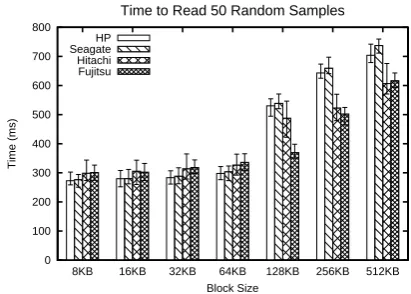
As Figure 5 shows, the time to sample a fixed number of random blocks from a 2GB file is roughly constant for blocks up to 64KB, regardless of drive manufacturer. We suspect that this behavior is due to prefetching at both the OS and hard drive level. Riedel et al. also observe in their study [22] that the OS issues requests to disks for blocks of logical size 64KB, and there is no noticeable difference in the time to read blocks up to 64KB.
For our purposes, therefore, a remote server can read 64KB ran-dom blocks at about the same speed as 8K blocks. If we were to sample blocks smaller than 64KB in our RAFT protocol, we would give an advantage to the server, in that it could prefetch some addi-tional file blocks essentially for free. For this reason, we choose to use 64KB blocks in our practical protocol instantiation.
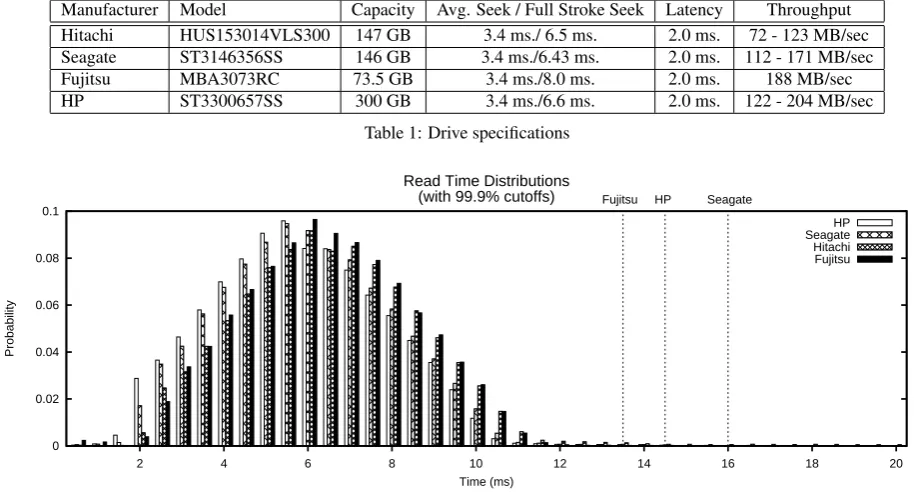
Figure 6 depicts the read time distributions for a random 64KB block chosen from a 2GB file. To generate this distribution, 250
7
Upon further inspection, the HP drive is actually manufactured by Seagate. Nearly all drives available today are in fact made by one of three manufacturers
0 100 200 300 400 500 600 700 800
8KB 16KB 32KB 64KB 128KB 256KB 512KB
Time (ms)
Block Size
Time to Read 50 Random Samples
HP Seagate Hitachi Fujitsu
Figure 5: Read time for 50 random blocks
random samples were taken from a 2GB file. The read time for each request was recorded. This was repeated 400 times, for a total of 100,000 samples, clearing the system memory and drive buffer between each test. The operating system resides on the Hitachi drive, and occasionally contends for drive access. This causes out-liers in the tests (runs which exceed 125% of average and contain several sequential reads an order of magnitude larger than average), which were removed. Additional tests were performed on this drive to ensure the correctness of the results. By comparison, the vari-ability between runs on all other drives was less than 10%, further supporting the OS-contention theory.
Read times for blocks of this size are dominated by seek time and not affected by physical placement on disk. We confirmed this experimentally by sampling from many files at different locations on disk. Average read times between files at different locations differed by less than 10%.
While the seek time average for a single block is around 6 ms, the distribution exhibits a long tail, with values as large as 132 ms. (We truncate the graph at 20 ms for legibility.) This long tail does not make up a large fraction of the data, as indicated by the 99.9% cutoffs in figure 6, for most of the drives. The 99.9% cutoff for the Hitachi drive is not pictured as it doesn’t occur until 38 ms. Again, we expect contention from the OS to be to blame for this larger fraction of slow reads on that drive. Later, in Section 6, we modify our RAFT to smooth out seek-time variance. The idea is to sample (seek) many blocks in succession.
5.3
Statistical framework
The nub of our RAFT is that the client tries, by measuring the timing of a response, to distinguish between an honest server and a cheap-and-lazy adversary who may not betfault-tolerant. It is helpful to model this measurement as a statistical hypothesis testing problem for the client. The client sends a challengeQand measures the timing of the server’s responseT.
LetDsbe a random variable denoting the time for the server to
answer a query by performing single block reads across its drives. LetDdbe the time for the server to answer a query by performing a
double block read on at least one drive. Let1−ϵbe the probability that the server can answer a query with only single block reads on its drives. ThenD(ϵ) = (1−ϵ)Ds+ϵDdis the random variable
Manufacturer Model Capacity Avg. Seek / Full Stroke Seek Latency Throughput Hitachi HUS153014VLS300 147 GB 3.4 ms./ 6.5 ms. 2.0 ms. 72 - 123 MB/sec Seagate ST3146356SS 146 GB 3.4 ms./6.43 ms. 2.0 ms. 112 - 171 MB/sec Fujitsu MBA3073RC 73.5 GB 3.4 ms./8.0 ms. 2.0 ms. 188 MB/sec HP ST3300657SS 300 GB 3.4 ms./6.6 ms. 2.0 ms. 122 - 204 MB/sec
Table 1: Drive specifications
0 0.02 0.04 0.06 0.08 0.1
2 4 6 8 10 12 14 16 18 20
Probability
Time (ms)
Read Time Distributions
(with 99.9% cutoffs) Fujitsu HP Seagate
HP Seagate Hitachi Fujitsu
Figure 6: Read time distribution for 64KB blocks
whether the timing of the server’s response is an instance ofT(ϵ= 0)(honest server) orT(ϵ > B)(a cheap-and-lazy server who may not betfault-tolerant).
In this statistical hypothesis-testing view, a false positive occurs when the client labels an honest server as adversarial; the com-pleteness of the protocol is the probability that this misclassifica-tion doesn’t take place. A false negative occurs when the client fails to detect an adversarial server who is nottfault-tolerant; this probability is the adversarial advantage.
In the practical RAFT protocol we consider below, we craft a queryQsuch that the server must read multiple blocks in succes-sion in order to return its response. Thus, the response timeTis an aggregate across many reads, i.e., the sum of multiple, independent instances ofD(ϵ) (plusL). The effect of summing independent, identically distributed random variables in this way is to lower the variance ofT. Reducing the variance ofThelps the client separate the timing distribution of an honest server from that of a cheap-and-lazy server who may not betfault-tolerant.
Remark:If the network latencyLis variable, then an adversary may feign a high network latencyLAin order to fetch additional blocks.
In this regime, we have a new boundBA(c, t, α); see Appendix A. The client then needs to distinguishT(ϵ = 0)fromTA(ϵ >
BA) =D(ϵ > BA) +LA.
6.
Practical RAFT Protocol
In this section, we propose a practical variant of the basic RAFT protocol from Section 4. As discussed in Section 5 the main chal-lenge in practical settings is the high variability in drive seek time. (While network latency also exhibits some variability, recall that in Section 5.1 we proposed a few approaches to handle occasional spikes.) The key idea in our practical RAFT here is to smooth out the block access-time variability by requiring the server to access multiple blocks per drive to respond to a challenge.
In particular, we structure queries here in multiplesteps, where a step consists of a set of file blocks arranged such that an (honest) server must fetch one block from each drive. We propose in this
section what we call alock-step protocolfor disk-block scheduling. This lock-step protocol is a non-interactive, multiple-step variant of the basic RAFT protocol from Section 4. We show experimentally that with enough steps, the client can with high probability distin-guish between a correct server and an adversarial one in our statis-tical framework of Section 5.3. We also discuss pracstatis-tical parameter settings and erasure-coding choices.
6.1
The lock-step protocol
A naïve approach to implementing a multiple-step protocol with qsteps would be for the client to generateq(non-overlapping) chal-lenges, each consisting ofcblock indices, and send allqcdistinct block indices to the server. The problem with this approach is that it immediately reveals complete information to the server about all queries. By analogy with job-shop scheduling [20], the server can then map blocks to drives to shave down its response time. In par-ticular, it can take advantage of drive efficiencies on reads ordered by increasing logical block address [26]. Our lock-step technique reveals query structure incrementally, and thus avoids giving the server an advantage in read scheduling. Another possible approach to creating a multi-step query would be for the client to specify steps interactively, i.e., specify the blocks in stepi+ 1when the server has responded to stepi. That would create high round com-plexity, though. The benefit of our lock-step approach is that it generates steps unpredictably, but non-interactively.
The lock-step protocol hasKeygen,Encode,Map, andReconstruct
algorithms similar to our basic RAFT. Assume for simplicity that the logical placement generated byMapin the basic RAFT proto-col isCj ={jn/c, jn/c+ 1, . . . , jn/c+n/c−1}. We usec
collision-resistant hash functions that output indices inCj: hj ∈
{0,1}∗ →Cj. Lethbe a cryptographically secure hash function
with fixed output (e.g., from the SHA family).
TheChallenge,Response, andVerifyalgorithms of the lock-step protocol withqsteps are the following:
- InChallenge(n, G, t, c), the client sends an initial challenge Q= (i11, . . . , i1c)with eachi1jselected randomly fromCj, for
j∈ {1, . . . , c}.
- AlgorithmResponse(Q)consists of the following steps: 1.Sreads file blocksfi1
1, . . . , fi1cinQ.
2. In each stepr= 2, . . . , q,Scomputes ir
j ←hj(ir1−1||. . .||i
r−1
c ||fir1−1||. . .||firc−1). If any of the block
indicesirjhave been challenged in previous steps,Sincrementsirj
by one (in a circular fashion inCj) until it finds a block index that
has not yet been retrieved.Sschedules blocksfir
j for retrieval, for
allj∈ {1, . . . , c}.
3. S sends responseR =h(fi1
1||. . .||fi1c||. . .||fiq1||. . .||fi
q c)
to the client, who measures the timeT from the moment when challengeQwas sent.
- InVerify(G, Q, R, T), the client checks first correctness ofR by recomputing the hash of all challenged blocks, and comparing the result withR. The client also checks the timing of the reply T, and accepts the response to be prompt if it falls within some specified time interval (experimental choice of time intervals within which a response is valid is dependent on drive class and is dis-cussed in Section 6.2 below).
Security of lock-step protocol.We omit a formal analysis. Briefly, derivation of challenge values from (assumed random) block con-tent ensures the unpredictability of challenge elements across steps inQ.Scomputes the final challenge result as a cryptographic hash of allqcfile blocks retrieved in all steps. The collision-resistance ofhimplies that if this digest is correct, then intermediate results for all query steps are correct with overwhelming probability.
6.2
Experiments for the lock-step protocol
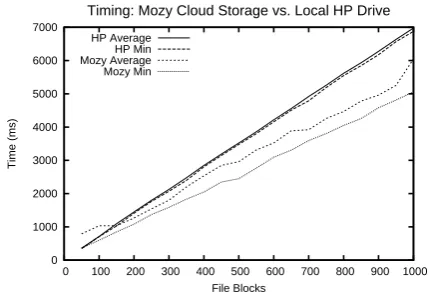
In this section, we perform experiments to determine the number of steps needed in the lock-step protocol to distinguish an honest server usingcdrives from an adversarial server employingd < c drives. We show results in the "reserved" drive model for a number of drivescranging from 2 to 20, as well as detailed experimental data on disk access distribution for honest and adversarial servers forc= 4drives. We also consider increasing the number of steps in the protocol in order to overcome contention from other users, which we test against the Mozy online backup service.
As described in Section 5.2, we collected 100,000 samples of 64KB block reads randomly chosen from a 2GB file stored on each of our test drives to generate the distributions in Figure 6. From this data, we now simulate experiments on multiple homogenous drives. To give the adversary as much advantage as possible, we compare an adversary using only HP drives (fastest average re-sponse times) against an honest server using only Fujitsu drives (slowest average response times).
In our tests, read time is primarily affected by the distance the read head has to move. Our test files are all 2GB in size (rela-tively small compared to the drive’s capacity), and thus there is limited head movement between random samples. The first read in any test, however, results in a potentially large read-head move
0 50 100 150 200 250 300
2 3 4 5 6 7 8 9 10 11 12 13 14 15 16 17 18 19 20
Steps
Number of Honest Server Drives
Steps to Achieve 95% Separation
1 ms. 100 ms. 200 ms. 300 ms. 400 ms.
Figure 7: Effect of drives and steps on separation
as the head may be positioned anywhere on the disk. We account for this and other order-sensitive results in all our simulated tests by simulating a drive using a randomly selected complete run from our previous tests. There are 400 such runs, and thus 400 poten-tial "drives" to select in our tests. Each test is repeated 500 times, selecting different drives each time.
Number of steps to ensure timing separation.
The first question we attempted to answer with our simulation is if we are able to distinguish an honest server from an adversarial one employing fewer drives based only on disk access time. Is there a range where this can be done, and how many steps in the lock-step protocol must we enforce to achieve clear separation? Intuitively, the necessity for an adversarial server employingd≤c−1drives to read at least two blocks from a single drive in each step forces the adversary to increase its response time when the number of steps performed in the lock-step protocol increases.
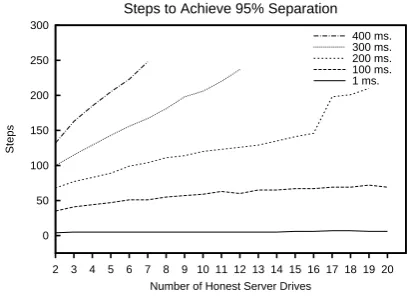
Figure 7 shows, for different separation thresholds (given in mil-liseconds), the number of steps required in order to achieve 95% separation between the honest server’s read times and an adver-sary’s read times. The honest server stores a 2GB file fragment on each of itscdrives, while the adversarial server stores the file on onlyc−1drives, using a balanced allocation across its drives optimized given the adversary’s knowledge ofMap.
The graph shows that the number of steps that need to be per-formed for a particular separation threshold increases linearly with the number of drivescused by the honest server. In addition, the number of steps for a fixed number of drives also increases with larger separation intervals. To distinguish between an honest server using 4 drives and an adversarial one with 3 drives at a 95% sepa-ration threshold of 100ms, the lock-step protocol needs to use less than 50 steps. On the other hand, for a 400ms separation threshold, the number of steps increases to 185.
The sharp rise in the 200 ms. line at 17 drives in Figure 7 is due to the outlying 132 ms. read present in the Fujitsu data. That read occurred at step 193 in one of the 400 runs. With 17 drives, that run was selected in more than 5% of the 500 simulated tests, and so drove up the 95th percentile difference between honest and adversarial. No such outlier was recorded in the 100,000 samples taken from the HP drive, and the affect is not visible in the 300 and 400 ms. lines due to the lower number of drives.
Detailed experiments forc= 4drives.
-50 0 50 100 150 200 250 300 350
0 20 40 60 80 100
107 234 307 18
Time (ms)
Steps
Difference Between Honest and Adversarial Read Times
Average Difference 95% Separation 100% Separation
Figure 8: Separation as number of steps increases
0 0.05 0.1 0.15 0.2 0.25 0.3 0.35 0.4
750 800 850 900 950 1000 1050 1100 1150 1200 1250 1300
Honest Max Adversary Min
Probability
Time (ms)
100 Step Response Time Distributions
107 ms.
Honest (4 Drives) Adversary (3 Drives)
Figure 9: Distribution of 500 simulated runs
honest and adversarial servers.
For this case, it is worth further analyzing the effect of the num-ber of steps in the protocol on the separation achieved between the honest and adversarial server. Figure 8 shows the difference be-tween the adversarial read time and the honest server read time (computed over 500 runs). Where the time in the graph is negative, an adversary using fewer than 4 drives could potentially convince the client that he is using 4 drives. The average adversarial read time is always higher than the average honest read time, but there does exist some overlap in the read access distributions where false positives are possible for protocols shorter than 18 steps. Above that point, the two distributions do not overlap, and in fact using only 100 steps we are able to achieve a separation of 107 ms. be-tween the honest server’s worst run, and the adversary’s best.
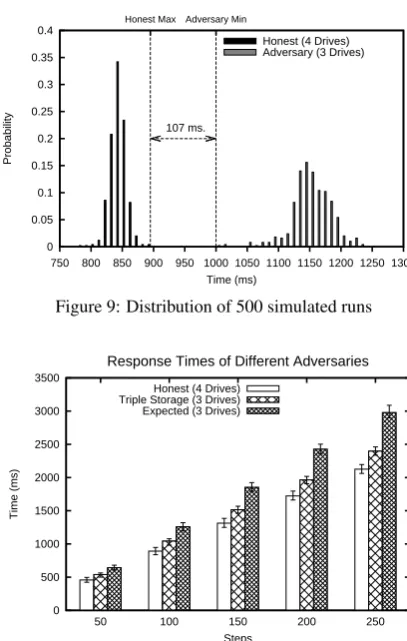
We plot in Figure 9 the actual read time distributions for both honest and adversarial servers for 100 steps in the lock-step proto-col. We notice that the average response time for the honest server is at around 840 ms, while the average response time for the ad-versarial server is close to 1150ms (a difference of 310 ms, as ex-pected).
More powerful adversaries.
In the experiments done so far we have considered an “expected” adversary, one that usesd=c−1drives, but allocates file blocks on disks evenly. Such an adversary still needs to perform a double read on at least one drive in each step of the protocol. For this adversary, we have naturally assumed that the block that is a double read in each step is stored equally likely on each of thec−1server drives. As such, our expected adversary has limited ability to select the drive performing a double read.
One could imagine a more powerful adversary that has some control over the drive performing a double read. As block read times are variable, the adversary would ideally like to perform the double read on the drive that completes the first block read fastest (in order to minimize its total response time).
We show in Figure 10 average response times for an honest server withc= 4drives, as well as two adversarial servers usingd= 3
drives. The adversaries, from right to left, are the expected adver-sary and the adveradver-sary for which double-reads always take place on the drive that first completes the first block read in each step of the protocol. In order for the adversary to choose which drive per-forms the double read the entire file must be stored on each drive. Otherwise the adversary cannot wait until the first read completes and then choose the drive that returns first to perform the double read, as the block necessary to perform the double read may not be available on that drive. Thus, although this adversary is achievable in practice, in thec= 4case, he requires three times the storage of
0 500 1000 1500 2000 2500 3000 3500
50 100 150 200 250
Time (ms)
Steps
Response Times of Different Adversaries
Honest (4 Drives) Triple Storage (3 Drives) Expected (3 Drives)
Figure 10: Time to complete lock-step protocol
an honest server.
The bars in the graph indicate the average read times for the given number of steps, with the error bars indicating the 5th and 95th percentile of the data, as collected over 100 actual runs of the protocol. To model the honest server, we used all 4 of our test drives, issuing a random read to each in each step of the protocol. We then removed the OS drive (Hitachi) from the set, and repeated the tests as the adversary, either allowing it to select the fastest drive to perform the double read, or randomly selecting the double read drive in each round. This graph thus indicates the actual time nec-essary to respond to the protocol, including the threading overhead necessary to issue blocking read requests to multiple drives simul-taneously.
Figure 10 shows that even if an adversarialSis willing to store triple the necessary amount of data, it is still distinguishable from an honestS with a better than 95% probability using only a 100-step protocol. Moreover, the number of false negatives can be fur-ther reduced by increasing the number of steps in the protocol to achieve any desired threshold.
Contention model.