Practical Relay Attack on Contactless Transactions
by Using NFC Mobile Phones
Lishoy Francis, Gerhard Hancke, Keith Mayes, Konstantinos Markantonakis
Information Security Group, Smart Card Centre
Royal Holloway University of London
Egham Hill, TW20 0EX, Surrey, United Kingdom
[email protected], (Gerhard.Hancke, Keith.Mayes, K.Markantonakis)@rhul.ac.uk
Abstract
Contactless technology is widely used in security sensi-tive applications, including identification, payment and access-control systems. Near Field Communication (NFC) is a short-range contactless technology allowing mobile devices to act primarily as either a reader or a to-ken. Relay attacks exploit the assumption that a contact-less token within communication range is in close prox-imity, by placing a proxy-token in range of a contactless reader and relaying communication over a greater dis-tance to a proxy-reader communicating with the authen-tic token. It has been theorised that NFC-enabled mo-bile phones could be used as a generic relay attack plat-form without any additional hardware, but this has not been successfully demonstrated in practice. We present a practical implementation of an NFC-enabled relay at-tack, requiring only suitable mobile software applica-tions. This implementation reduces the complexity of relay attacks and therefore has potential security impli-cations for current contactless systems. We also discuss countermeasures to mitigate the attack.
1
Introduction
Radio Frequency Identification (RFID) technology has become increasingly prevalent in everyday applications. Contactless technology is a subset of RFID systems op-erating at 13.56 MHz, with an opop-erating range of up to 10 cm. This technology comprises mature standards and in-dustry specifications and is widely used by the smart card sector in security sensitive systems. Contactless technol-ogy is currently used in credit card payment [1–3], e-ID and e-passport systems [4, 5], transport ticketing [6, 7] and access control systems [8, 9]. The practical secu-rity of contactless systems is therefore an active research area, both in terms of the actual channel [10–12] and de-ployed applications [13–15].
Relay attacks are especially of interest with regards
to contactless application security [16]. Contactless sys-tems, as a result of the limited operational range, operate on the implicit assumption that successful communica-tion with a token proves that the token is in close proxim-ity of the contactless reader. Therefore, once authentica-tion has been achieved at the applicaauthentica-tion layer, the reader will approve a transaction or render a service as it be-lieves that the legitimate token is in its presence. A relay attack exploits this assumption by placing a proxy-token within the communication range of the reader, which communicates with a proxy-reader located in close prox-imity to the legitimate token. The proxy-token is always able to answer with a valid response to any reader com-mand because it simply forwards the comcom-mand to the proxy-reader, which in turn sends it to the legitimate to-ken and returns the valid response from the legitimate token to the proxy-token. For the duration of the relay attack the proxy-token exhibits the same behaviour as a legitimate token from the reader’s perspective. This attack effectively circumvents application layer security mechanisms. For example, an attacker can circumvent an authentication protocol by simply relaying a challenge to the real token, which will provide him with the correct response, which can then be relayed back to the reader via the proxy-token. It does not matter what application layer protocols or security algorithms are used, as the at-tacker just relays all the application layer data, thereby ensuring that both the legitimate reader and the legiti-mate token always receive the data they expect.
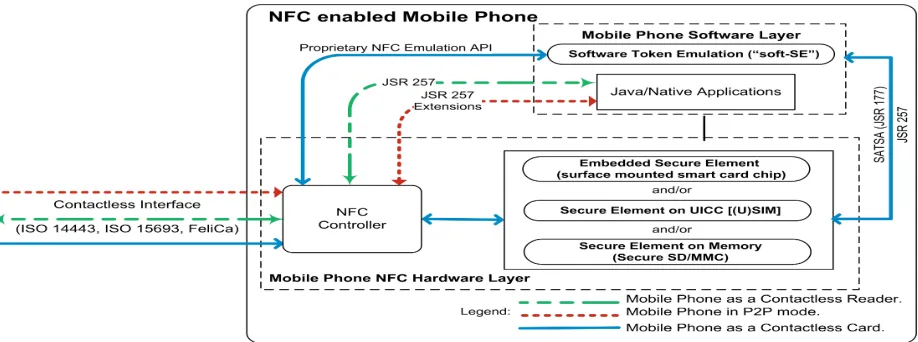
Figure 1: NFC architecture options with SE available as a software emulation (“soft-SE”) via mobile phone APIs.
a decade ago and actively promoted by the NFC Fo-rum [17] since 2004. NFC has been the focus of nu-merous worldwide trials and proof-of-concept demon-strations, but large scale deployment was hampered by disagreement regarding NFC-device architecture, appli-cation management and the resultant lack of NFC de-vices. In 2011 NFC has, however, become increasingly prominent with a number of phone manufacturers re-leasing NFC-enabled smart phones, such as the Nokia C7 [18], RIM Blackberry 9900/9930 [19] and Google Nexus S [20]. At the same time, NFC has also made rapid strides in enabling mainstream applications, as il-lustrated by the release of Google Wallet [21] and Or-ange Quick Tap [22] payment systems in the USA and UK respectively.
As the deployment of NFC gathers speed the secu-rity of NFC devices and applications becomes increas-ingly important [23], and in addition the security impli-cations of providing access to what is essentially a pro-grammable contactless reader and token emulation plat-form should also be considered. For example, it has been shown that an NFC-enabled mobile phone can be used as an effective token skimming and cloning platform [24]. The ability of an NFC-enabled device to act as both a to-ken and a reader potentially makes such device an ideal platform for implementing software relay attacks, as the-orised in multiple publications [25, 26], but this has not been proven to be practically possible in a generic man-ner. This paper describes a relay attack implementation using unmodified NFC-enabled mobile phones, which only requires an attacker to write suitable mobile plat-form applications using publicly available APIs. Our relay attack implementation significantly demonstrates a reduced complexity of attack as it does not require spe-cial attack hardware, as in some previous relay attack ex-periments [27]. This implementation also results in an
attack that cannot be visibly detected in contrast with at-tacks with PC-controlled NFC-enabled devices acting as proxy-token [28,29] since an NFC phone is (or will soon be) an accepted token form factor. The attack imple-mentation is application independent and works against widely deployed, conventional contactless system con-figurations, i.e. a reader and a passive contactless token, and not only against the NFC peer-to-peer communica-tion mode [30]. The practical simplicity of such a re-lay attack implementation increases the likelihood of this exploit being used in practice and places real-world sys-tems at risk. Modern contactless credit card and m-wallet payment systems, ticketing, access control and electronic identification schemes are vulnerable to relay attacks, and an attack that can effectively be executed by un-skilled attackers using off-the-shelf hardware represents a credible threat. This work could potentially change sys-tem implementers’ view of preceding work on relay at-tacks, which is mostly dismissive and can be summarised by the quote “There’s been no example of it happening in the real world, and we find it highly unlikely that it will happen” [31]. This paper challenges the currently held opinion that relay attacks require advanced skill and custom hardware that is unlikely to transition from a lab-oratory to the real world [32]. Apart from the risks a relay attack poses, practically implementing a ‘proof-of-concept’ attack using NFC mobile phones serves to em-phasise the current weaknesses in NFC architecture that would need addressing.
2
Background
In this section, we present a brief overview of NFC tech-nology. We then go on to discuss relay attacks and re-lated work.
2.1
NFC Technology
NFC facilitates the integration of contactless technol-ogy into active device platforms, such as mobile phones. NFC is a short-range RFID technology operating at the 13.56 MHz radio frequency (RF) band and is de-scribed in the ISO 18092/ECMA 340 [33] and in ISO 21481/ECMA 352 [34] standards. NFC is specified to be compatible with existing contactless systems adher-ing to ISO 14443 [35], ISO 15693 [8] and FeliCa [36]. The standards specify both ‘passive’ and ‘active’ opera-tion. Passive operation corresponds to the operation of conventional contactless systems. The NFC device can therefore either act like a contactless token, interacting with a reader, or act like a reader, powering and interact-ing with a contactless token. Two NFC devices can also interact with each other in active, or peer-to-peer (P2P) mode, when brought in close proximity. In this active mode, devices take turns to transmit an RF field, e.g. de-vice 1 turns on its RF field and transmits data to dede-vice 2, followed by device 1 turning off its field and device 2 turning on its field and transmitting data to device 1. Peer-to-peer relay has been covered in a previous publi-cation and is not the focus for this paper [30]. It is ex-pected that NFC will be deployed in existing contactless applications, such as payments, ticketing, access control, identification and logistics. NFC in conjunction with the additional functionality of its host platform could also enable additional applications, such as one of the early proposals of using NFC for quickly pairing Bluetooth de-vices [37].
Today, there are a number of NFC-enabled devices available but mobile phones are the main focus of in-dustry and this paper. More details of the NFC phone platform as relevant to our implementation are discussed in Section 3. There are three main components that com-prise an NFC-enabled phone platform [38] (an overview is shown in Figure 1):
• Application Execution Environment (AEE): The
general application area of the mobile phone pro-viding data storage and processing capabilities alongside basic mobile phone services.
• Trusted Execution Environment (TEE): The TEE
is usually realised through the use of a secure el-ement (SE) and provides secure data storage, exe-cution and application management. A SE is essen-tially a smart card supporting Java Card 2.2.1 [39]
(Java Card Open Platform [40]), Global Platform 2.1.1 [41] and selected legacy products such as the Mifare Classic [42] emulation. An SE is most com-monly implemented as an embedded module, i.e. a surface-mounted module soldered into the phone, as an integrated component on the (U)SIM (Uni-versal/Subscriber Identity Module) [43], or as a re-movable secure memory token [44]. A new devel-opment is the concept of a “soft-SE” located within the mobile phone application area. The “soft-SE” is open for development, in contrast to earlier SE mod-ules that had to be unlocked for development use. For example, using an “unlock” application sup-plied by the phone manufacturer. Once unlocked, an SE is forever considered as untrusted and can sub-sequently be used only for development purposes. An NFC phone will contain one or more of these SE implementations.
• NFC Controller (low level stacks): The NFC
Con-troller handles the physical transmitting and receiv-ing of data over the RF interface. The card em-ulation stack, reader/writer stack and peer-to-peer stack allow for communication between the con-troller and the AEE/TEE as required by the respec-tive mode of operation. Reader and peer-to-peer op-erations are generally controlled via applications in the AEE, with card emulation being controlled via applications in the TEE, i.e. executing within an SE.
With the exception of the application management on the SE and the Signature Record Type Definition (SRTD) [45], which aims to provide data authentication for data in NFC Data Exchange Format (NDEF) [46], the NFC specifications and standards leave application security in the hands of the developer. There have been several re-search papers discussing NFC security, such as [23]. Re-search work has been published both on vulnerabilities in the specifications, such as the vulnerabilities in the SRTD [47], and NFC software stacks allowing tags to redirect to spoofed web addresses or load malicious soft-ware [48, 49]. Given the computational capabilities of the phone platform, and the added capabilities of NFC to act as a reader and a token, the possibility of using an NFC phone as a platform for contactless “skimming” and “cloning” platforms has also been [24] considered.
2.2
Relay Attack
Figure 2: Practical relay setup using only NFC mobile phones.
grand master to the other, effectively making them play against one another. Each grand master would think that they are playing said person, but in reality they are play-ing against each other. The application of this scenario to security protocols was first presented and discussed in [51]. In the literature, this attack has subsequently been referred to as a ‘wormhole attack’ [52] or as a ‘re-lay attack’ [53].
A relay attack has serious security implications as the attacker is able to bypass any application layer security protocol, even if such protocols were based on strong cryptographic principles. For example, an attacker can circumvent an authentication protocol by simply relay-ing a challenge to a legitimate token, which will provide him with the correct response, which can then be relayed back to the verifier. It does not matter what application layer protocols or security algorithms are used, in fact the attacker requires no prior knowledge about the data he is relaying, as the attacker just relays all the appli-cation layer data, thereby ensuring that both the reader and the token always receive the data they expect. If the overarching protocol contains a security vulnerability the attacker could also modify the relayed data in real time to exploit this vulnerability, an action often referred to as an ‘active’ relay [16].
To execute a relay attack, the adversary needs two de-vices, which act as a token and a reader respectively. These devices are connected via a suitable communica-tion channel in order to relay informacommunica-tion over a greater distance. The proxy-reader is used to communicate with the real token, while the proxy-token is placed near the real reader. Any information transmitted by the reader is received by the token and relayed to the proxy-reader, which will transmit the information to the to-ken. The token assumes that it is communicating with the reader and responds accordingly. The token’s re-sponse is then relayed back to the proxy-token, which will transmit the information to the reader. The intention of the attacker is to ensure that the reader is unable to distinguish between the real token and the proxy. If he
succeeds the reader will assume that the token and its as-sociated owner are in close proximity and grant access to the attacker.
re-laying conventional contactless transactions.
3
Practical Relay Implementation
In this section, we describe the practical implementation of a relay attack using only off-the-shelf NFC mobile phones. We implemented the attack with two commer-cially available NFC-enabled mobile phones and con-ducted several controlled relay experiments to verify the effectiveness of the attack. Both the proxy-token and proxy-reader mobile phones are configured simply by installing mobile phone applications that we developed. The attack implementation requires no unlocking of de-vices or secure elements, no hardware or software mod-ification to the phone platform, and minimal knowledge of the data that is to be relayed. We also chose to im-plement the relay channel in such a way that it could be set up between the two phones without the need for re-lying on access to a mobile network. The relay setup for attacking a contactless system, as implemented in this paper, is shown in Figure 2.
3.1
Proxy Communication Channel using
NFC Mobile Phones
In a relay attack, the attacker and his/her accomplice uses proxy-devices that communicate over a proxy channel. The relay experiment thus requires a high-speed and re-liable communication link between the two NFC mobile phones implementing the proxy-reader and proxy-token. Bluetooth was chosen as communication channel for our relay experiments. Bluetooth, or IEEE 802.15, is a short-range radio technology developed by the Bluetooth Special Interest Group (SIG). It utilises unlicensed radio spectrum in the frequency band of 2.45 GHz, offering bandwidth in the range of 720 kilobits per second and an effective operating range typically in the region of 10 m to 100 m. Point-to-point Bluetooth is simple to set up and the communication latency offered by the chan-nel is relatively low. Although the communication range offered by Bluetooth could be seen as a limitation our aim was to demonstrate the feasibility of establishing a relay channel between two mobile phones. In reality, the proxy channel could be realised via other technologies such as IEEE 802.11 or mobile Internet over GPRS/E-GPRS (Enhanced General Packet Radio Service). Relay-ing data via mobile Internet requires no user-interaction and potentially offers both increased bandwidth and low latency if good network coverage is available. It would therefore appear to be a good alternative channel option but it introduces a reliance on the mobile network, i.e. the attack is only effective if there is network coverage and a reliable data service. It could also be argued the when using mobile Internet data leaves an audit trail of
relayed data, whereas the use of Bluetooth channel does not relay on third party infrastructure.
The mobile applications installed on the proxy-reader and proxy-token implemented Bluetooth communication using the JSR 82 API. We used L2CAP (Logical Link Control and Adaption Protocol) that is available within the host stack of Bluetooth protocol. L2CAP is layered over the Baseband Protocol, and operates at the data-link layer within the OSI (Open System Interconnection) Ref-erence Model. The supported data capacity of the chan-nel, for individual packets, is up to 64 kilobytes in length. The default Maximum Transmission Unit (MTU) is 672 bytes, and 48 bytes is the minimum mandatory MTU. More details for implementing the Bluetooth API can be found in [30, 37, 57].
3.2
NFC Mobile Phone as Proxy-Reader
A Nokia 6131 NFC phone was configured as a proxy-reader (controlled with an MIDP/J2ME Application [58]) capable of interacting with contactless tokens. This involved developing a MIDP 2.0 application (which is commonly known as a MIDlet) to emulate a contact-less reader using a standard NFC contactcontact-less communi-cation API - JSR 257 [59]. This applicommuni-cation was devel-oped by using a freely available Nokia NFC Software Development Kit (SDK) [60]. The MIDlet was designed to exchange ISO 14443-4 based Application Protocol Data Unit (APDU), such as those received from a proxy-token over the relay communication channel, with exter-nal contactless smart cards. For using the JSR 257 API and JSR 82 Bluetooth API in the MIDlet, it did not re-quire any code signing [61] in order to install and execute the application.
3.3
NFC Mobile Phone as Proxy-Token
de-(a) Contactless credit card transaction (b) e-Passport transaction
Figure 3: Testing relay attack implementation on real systems.
velopment is difficult, which inherently limits the appeal of such an attack implementation.
The release of the NFC-enabled Google Nexus S and BlackBerry 9900/9930 phones has provided more free-dom in developing applications requiring card emula-tion funcemula-tionality. Although the Nexus S does not yet support card emulation functionality as standard, it has been shown that it is possible modify the phone firmware to allow for user controlled card emulation as a re-sult of the open nature of the Android OS [62]. The BlackBerry phones, running Blackberry OS v7.0.0, al-low user-controlled card emulation without modifica-tion. We therefore chosen to implement the proxy-token on a BlackBerry 9900 phone, keeping with our goal of demonstrating a simple, software-only NFC relay attack.
The BlackBerry v7.0.0 NFC API (net.rim.device.api. io.nfc.emulation) provides for the emulation of contact-less applications based on a “soft-SE”. This approach offers greater flexibility in application development but also increases the likelihood that the phone could be used as an attack platform. To start with, we tested whether it was possible to create a contactless application with a reserved Application Identifier (AID), i.e. an AID as-sociated with a sensitive application such as credit card payments [24]. The ability to set the AID in such a way provides an ideal entry point for the relay process, as the reader would inherently select and start communicating with the relay application. We found that no security controls were in place to prevent spoofing a legitimate re-served AID and also that this emulation method allowed the emulation application to be in session with the reader while also accessing other system components, thereby making it possible to relay received commands. The BlackBerry NFC mobile phone was thus configured as a
proxy using a BlackBerry Java Application we developed that utilised the BlackBerry-specific NFC emulation API v7.0.0 [63], and implemented Bluetooth communication using the JSR 82 API [57].
The NFC emulation API [63] did not require manda-tory code-signing, although the underlying Runtime API was required to be signed in order to install and run the application on the device. The registration process and subsequent acquiring of the signing certificate did how-ever not involve any formal organisational or personal vetting [64].
3.4
‘Proof-of-Concept’ Relay Experiment
Initially, we simply tested whether our implementation would relay a single command response transaction us-ing a test setup involvus-ing a contactless reader and a token containing a simple Java Card [39] applet. The proxy-token was presented to the contactless reader and the le-gitimate contactless token was presented to the proxy-reader and it was determined that the proxy-reader obtained an acceptable response (correct content and adequate re-sponse timing). Subsequently we managed to perform a relay involving multiple commands from the reader, reli-ably completing a full legitimate contactless transaction during each run. Using the Bluetooth channel in a non line-of-sight environment the attack worked up to a range of 15m. In an open plan room with some minor obstacles the attack worked up to a range of 35m.
Table 1: Timing Measurements of a Sample Transaction (APDU Command/Responses) (in milliseconds) (a) Contactless Smart Card (b) Embedded SE (c) “soft-SE” (d) Relay
(Proxy-Token on “soft-SE”)
Command 1 113.3917 190.5490 181.1386 246.0
Command 2 12.1902 20.2325 12.8123 114.0
Command 3 4.1948 5.2614 10.7270 109.0
Command 4 17.0420 18.5147 38.3187 118.0
Command 5 4.8180 5.8939 15.4194 78.0
Total 151.6367 240.4515 258.416 665.0
card data profile. Cards using static authentication in this way are no longer best-practice but the objective of the experiment was more focused on whether the POS would accept a delayed relayed response as valid. Newer cards using dynamic authentication protocols are equally vul-nerable to relay attacks as the dynamic challenge and re-sponse is as easily relayed. The relay experiment on a payment transaction using a POS reader, and a contact-less smart card with a sample payment application in-stalled is shown in Figure 3(a). In the second experiment, we tested the relay against an e-passport demonstration system using a sample passport and authentic reader soft-ware. The emphasis in this case was once again whether the reader would accept a relay response, and in addition this setup also tested whether longer data APDUs, such as the passport record including a JPEG picture, could be reliably relayed. The test setup is shown in Figure 3(b). In both cases the relay attack executed successfully and the reader/POS accepted the proxy-token’s responses. We would like to highlight the fact that these two systems were not chosen because they are known to be vulnera-ble to relay attacks, these are just systems we had access to. The attack as implemented would work on any sys-tem with communication fully compatible to NFC or ISO 14443 contactless technology, which includes most pay-ment and m-wallets, electronic identity, ticketing and ac-cess control systems deployed today. Some legacy con-tactless products that are only partially compatible with the standard, and use proprietary APDUs, might be re-sistant to this attack implementation. Relaying contact-less transaction data relies on the attack application re-ceiving the received data from the NFC communication module, which is responsible for demodulation, decod-ing and strippdecod-ing off frame information such as CRCs, parity bits and stop/start patterns and providing data left to the application layer. Some contactless card systems use proprietary framing, which means that the NFC mod-ule would not be able retrieve the data in the normal way. Additional detail on this attack restriction is given in Sec-tion 4.2.2.
3.5
Experimental Analysis and Further
Tests
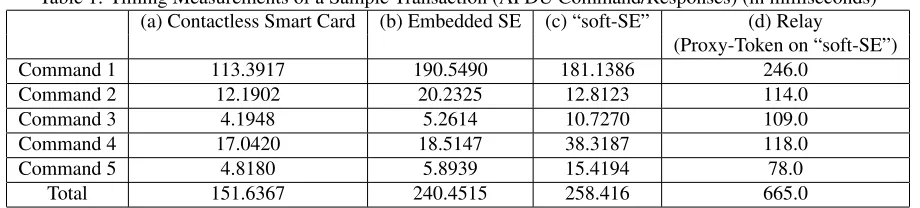
The attack parameter of most interest is the round-trip time required by the relay process. The main delay is caused by the relay communication channel. The Blue-tooth channel introduces approximately 50 ms into the the round-trip-time of the challenge-response. Although all the readers we tested accepted the delayed responses of the proxy-token, we wanted to quantify this delay and compare the performance of a proxy-token to other em-ulation implementations as a matter of scientific inter-est. Table 1 shows the response times of several com-mand and response message sequences on different em-ulation platforms, with respect to the payment test sys-tem discussed in the previous section. The times shown in the Table is ‘best-case’, the shortest times observed over several measured transaction runs. In the worst case about 30 ms is added to response times. We measured the response time of a sample payment application im-plemented on a programmable contactless smart card, on an embedded SE and on a “soft-SE”. Although timing measurements varied between protocol runs, these im-plementations were in general all significantly quicker than the response time of the proxy-token, but this is to be expected taking into account the overhead involved with the relay process. We believe that the response time for the proxy-token could potentially be made faster, as there is some room for optimisation of our application with regards to the implementation of the relay commu-nication channel.
channel implemented using a WiFi access point and esti-mate that such a channel, including initial connection and session setup, would introduce about a 1.5 second delay to the attack. This time increase is still acceptable to the readers we tested, with the implication that the proxy-reader and proxy-token can now be situated anywhere in the world and still relay acceptable transactions.
4
Security Countermeasures for Relay
At-tack
In this section we discuss potential security countermea-sures and their effectiveness in mitigating the relay at-tack presented in Section 3. We only consider counter-measures that can be implemented without degrading the user experience, which is one of main advantages of con-tactless technologies. We therefore do not discuss mea-sures that shift the responsibility of security to the end user, such as shielding tokens or performing two-factor authentication with a PIN. The countermeasures can be divided into two main categories:
• Contactless Platform Countermeasures:
counter-measure proposals for treating the phone as a resource-limited contactless token, i.e. simple mechanisms implemented by the reader and back-end infrastructure.
• Mobile Phone Platform Countermeasure: counter-measures leveraging the capabilities of the mobile phone platform to enhance the security of the con-tactless transaction.
4.1
Contactless
Platform
Countermea-sures
This section briefly examines security countermeasures proposed for making contactless systems resistant to re-lay attacks.
4.1.1 Timing
One of the intuitive countermeasures is enforcing stricter timing restraints on responses. This is based on the valid observation that a relayed transaction will have an increased response time in comparison to a legitimate transaction. It is, however, difficult to implement this in practice. Firstly, obtaining accurate transaction tim-ing information on current readers is a challenge, con-sidering the number of underlying process components adding overhead. Accurate response timing would likely require dedicated hardware that directly monitors the RF channel. In real world systems there is also a need to ac-commodate a variety of contactless tokens, which vary
in terms of performance, so setting a restrictive timeout value could lead to valid transactions being rejected. The method that ISO 14443 (which is the contactless stan-dard used in the majority of security sensitive contactless applications and serves as the basis for NFC) mandates for negotiating communication parameters between the reader and token also negates the use of timeouts. ISO 14443 Part 4 specifies a Frame Waiting Time (FWT) variable that sets the time within which a token shall start its response after the end of the reader’s data. FWT is de-fined as(256·16/fcarrier)×2FW I, whereFW Iis a value
from 0 (FWT = 300µs) to 14 (FWT = 5 s) with a default
of 4 (FWT=4.8 ms). The value of the Frame Waiting IntegerFW Iis defined by the token in theATSresponse. If implemented, the Frame Waiting Time defines an up-per bound on the relay delay. Even though this value is set it is seldom enforced by the reader, as was seen in our experimented, and instead replaced by a much longer timeout. Even if a reader did enforce the FWT it is not a suitable countermeasure because it is the token that spec-ifies the Frame Waiting Time (FWT) during the commu-nication setup. As the token specified the time within which it shall start its response a proxy-token could sim-ply specify a FWT of up to 5 seconds [16], more than enough time to complete the relay process.
4.1.2 Distance Bounding
Distance-bounding protocols determine an upper bound for the physical distance between two communicating parties based on the Round-Trip-Time (RTT) of cryp-tographic challenge-response pairs [65], and it has been proposed that these are suitable for relay-resistant RFID systems [53]. Distance bounding is in theory the most ef-fective countermeasure but this approach requires special communication channels to facilitate accurate and secure distance estimates, since conventional RF channels have been shown inadequate for implementation of secure dis-tance bounding [66, 67]. Although much progress has been made on practical distance bounding implementa-tions for smart tokens [56, 68] the integration of such channels into NFC-enabled devices has not been an in-dustry priority.
4.2
Mobile Phone Platform
Countermea-sures
ca-pability and a selection of hardware peripherals. The resource-limited paradigm should therefore no longer be a constraining factor when considering relay counter-measures.
4.2.1 Location as Security Metric
Even though the use of location information in mobile network access systems has given rise to many applica-tions and services, the capabilities of mobile phones to deduce both absolute and relative location are not utilised for verifying the proximity of devices conducting a trans-action. Reliable and accurate location information is an effective countermeasure against relay attacks, e.g. lo-cation information could be simple appended to a trans-action that is then signed by the legitimate sender [52], and as has also been shown to enable other security ser-vices [69, 71]. In fact the use of location information available in the mobile environment to provide security services is not new [70, 72], and could serve as an ideal countermeasure in NFC systems, which as intrinsically linked to mobile. In this section, we discuss the potential role of mobile location-based services in preventing relay attacks on transactions between NFC-enabled phones, or an NFC-enabled mobile phone and a reader with knowl-edge of its own location.
Figure 4: Network cell broadcast based location sensing and triangulation.
Network Cell Broadcast The simplest method of re-trieving mobile location information is using metrics from the cell broadcast towers or base stations. These include a Cell-ID identifier associated with parameters such as Mobile Country Code (MCC), Mobile Network Code (MNC) and Location Area Code (LAC). The cell broadcast information can be retrieved by using loca-tion APIs from the mobile software platform or from the (U)SIM. This approach is applicable to most traditional
mobile phones used in mobile network access systems such as GSM and UMTS.
Figure 4 shows and example of a cell broadcast lo-cation sensing and triangulation method. The Lolo-cation- Location-Code (LC) for Base Station 1 can be constructed by the mobile phone as,
LC = 23415300564404719, where MCC = 234 | MNC = 15 | LAC = 30056 | Cell-ID = 4404719
According to [73], if the locations of the towers and base stations are known then the most probable position
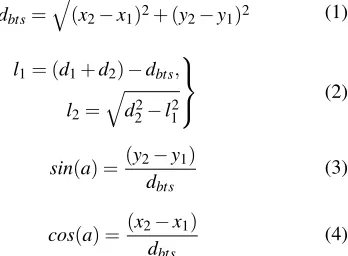
(x,y)of the mobile phone can be calculated based on the received signal strength, to be either one of the two val-ues represented by equations (6) or (7) as derived below. In Figure 4,(x1,y1)and(x2,y2)represents the
coordi-nates of two base stations. Their mean distances to the mobile phone ared1andd2respectively. The distance
between the two base stations,dbts, can be derived as,
dbts=
q
(x2−x1)2+ (y2−y1)2 (1)
l1= (d1+d2)−dbts,
l2=
q
d22−l12
(2)
sin(a) =(y2−y1) dbts
(3)
cos(a) =(x2−x1) dbts
(4)
The point wherel1andl2meets P,(xp,yp), can be
ob-tained as,
xp=x2−l1(cos(a)),
yp=y2−l1(sin(a))
)
(5)
Then we get,
x=x2−l1(cos(a))−l2(sin(a)),
y=y2−l1(sin(a)) +l2(cos(a))
)
(6)
x=x2−l1(cos(a)) +l2(sin(a)),
y=y2−l1(sin(a))−l2(cos(a))
)
(7)
relied upon. Therefore it may provide a strong separation indicator for long range relaying via GPRS and a weaker indicator for a shorter range relay bearer such as Blue-tooth. Similarly, a cell diameter can be quite large so if using only Cell-ID a relay attack mounted from within the same cell would be difficult to detect, and an efficient countermeasure would ideally need to obtain parameters from multiple neighbouring cells to improve the location resolution. When both parties are connected to different mobile network operators the Cell-IDs and LACs could also vary. Hence, care needs to be taken in design of the application that generates the location information in this way and its verification. There are also viable secu-rity threats to mobile location information integsecu-rity, such as false base station attacks [76].
Figure 5: GPS based location sensing and triangulation.
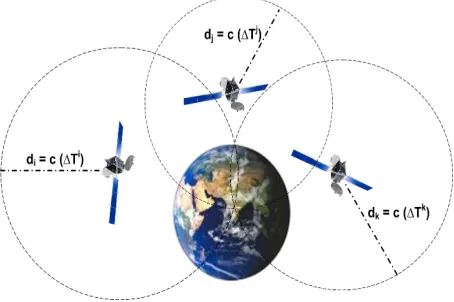
GPS Based Location Sensing The Global Position-ing System (GPS) is a navigational system based on earth-orbiting satellites and provides location informa-tion around the globe. GPS finds applicainforma-tions in many fields such as transportation, aviation and shipping. The GPS system is based on 24 satellites in six different orbital-paths. The satellites and the receivers are syn-chronised with high precision clocks which is used to es-timate the distance between them and the receiver. A GPS receiver requires an unobstructed line-of-sight to at least four or more satellites in order to calculate its three-dimensional position (latitude, longitude, altitude). However, with three satellites in view the receiver is able to compute its two-dimensional location (latitude, longi-tude) [74]. Figure 5 illustrates the GPS based location sensing and triangulation method. In the figure,di
rep-resents the distance ofith satellite from Earth. cis the
speed of light (299,792,458 m/s). ∆T is the time differ-ence of signal sent from the satellite and received on the Earth.
di2= (xi−x)
2
+ (yi−y)2+ (zi−z)2,
dj2= (xj−x)2+ (yj−y)2+ (zj−z)2,
dk2= (xk−x)2+ (yk−y)2+ (zk−z)2
(8)
By solving (8), and after error corrections we get,
[X,Y,Z]whereX= longitude,Y = latitude, andZ= alti-tude.
An increasing number of mobile phones contain Global Position System (GPS) receivers. GPS is a re-liable system for determining the location of the phone. Most mobile phone platforms allow access to GPS loca-tion informaloca-tion through public APIs. The GPS receivers can be categorised broadly as follows:
• Integrated/Autonomous GPS: Here the GPS
re-ceiver is embedded within the mobile device. The most accurate location sensing, is achieved when the receiver can receive the satellite transmissions clearly without any obstruction.
• Assisted GPS: In Assisted GPS (A-GPS), direct
satellite observation and a network “server” is used to generate accurate position information. A-GPS that is network assisted could faster compared to integrated GPS, and perform better in poor signal conditions. A-GPS devices cannot work outside the mobile network coverage region as it needs to be connected to the servers.
• External GPS: An external GPS is a physically
sep-arate device that can be linked to a mobile device over interfaces such as Bluetooth or USB.
Deriving location information from GPS also has some disadvantages. A mobile phone would need to be equipped with a GPS receiver and the accuracy of in-tegrated receivers is greatly diminished when operating indoors, where you would expect most transactions to take place.
(a) Prover - Phone A (b) Verifier - Phone B
Figure 6: “Prover” and “Verifier” mobile phones computing proximity based on location information.
are several proposals for how two devices can verify that they are in the same location. For example, in multi-channel protocols [77] the device associates additional media that is difficult to relay with the transaction, e.g. both devices can hear the same audio or are observing a picture known to be in the area (one of the device could generate the audio or picture). An area could also be as-sociated with a location ‘dongle’ or beacon [78], and if both devices can observe this dongle during the transac-tion they are likely to be in a specific locatransac-tion. Although these proposals are interesting we are of the opinion that a countermeasure should ideally use the location infor-mation already available on the devices in question. We therefore implemented a proof-of-concept proximity lo-cation applilo-cation using GPS and mobile network Cell-ID information.
Practical Proof-of-Concept Implementation When a transaction uses location information as an additional se-curity metric, it could potentially detect relay attacks. For example, a device would simply incorporate a loca-tion signature into the transacloca-tion data, which could be checked by the recipient and compared to its own loca-tion in order to verify device proximity. The localoca-tion in-formation may be generated by using any of the methods discussed previously. Based on this information a loca-tion signature record could be constructed as follows:
<location proof>
<issuer>Issuer’s Public Key</issuer> <recipient>Recipient’s Public Key </recipient>
<location information> <gps><lat>51.42869568</lat> <lng>-0.56286722</lng></gps> <mcc>234</mcc><mnc>15</mnc>
<lac>30056</lac><cellid>4404719</cellid> </location information>
</signature>D09A3B57D49CA179</signature> </location proof>
A simple proof-of-concept countermeasure applica-tion was implemented in order to demonstrate the fea-sibility of retrieving location and verifying proximity be-tween two transacting parties. The mobile applications were developed and installed on two Nokia N96 mobile phones (“Prover” and “Verifier”) that are based on Sym-bian S60 3rd Edition FP1 platform [79]. For each
the two phones do not match, but the GPS information is sufficient to determine that the phones are actually in close proximity (approximately 6 m). If the phones were far apart, and the communication was relayed, the ver-ifier would observe, from the location information inte-grated into the transaction data, that the legitimate prover is not within proximity, and the attack would be detected. The disadvantage to using such location-based secu-rity in contactless systems, apart from the potential in-consistency of the radio environment and lack of pre-cision, is that both parties need to be location aware. NFC-enabled handsets would be able to derive and ver-ify location information but conventional contactless to-kens would not benefit from this countermeasure. Fixed-location POS devices could potentially be programmed with its known location during installation.
4.2.2 Relay resistance at the communication layer
There are some aspects of the underlying communication processes that could be used to detect a relay attack. The NFC controller is responsible for all physical communi-cation operations, such as anti-collision, token selection, communication parameter setup and data formatting for transmission. During anti-collision and token selection the hardware UID of the token is normally used. The legitimate device and the proxy-token should in theory therefore have different UIDs. If the transaction data is linked to a UID, the verifying recipient should observe that the UID in the data does not correspond to the UID of the device it is communicating with, thus detecting the relay. In some systems this countermeasure is possible but increasingly contactless tokens are transmitting ran-dom identifiers during anti-collision as a privacy preserv-ing/untraceability measure [82]. Furthermore, the Black-berry emulation API allows the UID to be set by the ap-plication, and although our attempt to get this to work within the token emulation profile we used was not suc-cessful, we assume that this functionality will be avail-able. Binding the transaction data to a UID would there-fore be of little use, in cases of random identifiers, or provide no advantage in terms of security if the attacker can set the UID of the proxy-token.
The emulation application passes any data to be trans-mitted to the controller, which is responsible for fram-ing and error correction as needed. For example, in ISO 14443 each data byte is transmitted along with an odd parity bit and a 16-bit CRC is appended to the message. When using ISO 14443-4 formatted APDUs these parity bits and CRC bits are sent in plaintext and removed from the message by the recipient. Some contactless tokens only partially adhere to standards. One such proprietary product, Mifare Classic [83] also encrypts the parity and CRC bits. It is not thought possible to relay this
commu-nication with our relay implementation as it is not pos-sible to retrieve the encrypted parity and CRC bits from the controller (it is mostly likely that the controller will discard the message since what it considers to be plain-text parity and CRC bits will not match to the rest of the data). As a result, the message from the legitimate token cannot be captured or transmitted to the reader in its true form and the relay will fail. The Blackberry emulation API does allow for emulating and reading Mifare Classic tokens but in this case the attacker would need the right key to interact with the legitimate card and reader. How-ever, proprietary tokens, especially Mifare Classic, have often been shown to contain significant security vulnera-bilities [84, 85] so using such a product purely as a relay attack countermeasure is not at all recommended.
Figure 7: State diagrams: (1) emulation API routine showing relay, and (2) relay protection.
4.2.3 Application Restrictions
net.rim.device.api.io.nfc.emulation VirtualISO14443Part4TargetCallback byte[] processCommand(byte[] command) {...}
The parameter ‘command’ contains the ISO 14443-4 command sent by the external contactless reader. The function returns a byte array containing the response to be sent to the external reader. In order to implement the relay attack, the command was initially captured and sent over the relay bearer. The application then enters a delay state until the response is available to be returned to the reader. As shown in Figure 7.(2) any application that has entered state P (received command from a reader) should not be allowed to execute arbitrary delays (state D), or in fact be allowed to invoke other communication calls to transmit the command or facilitate the reception of the relay response (state R). Alternatively, there could also be additional restrictions on the use of the API, such as not allowing the application identifier (AID) to be set to a value reserved for security sensitive applications, unless additional developer verification has taken place. This could potentially be incorporated into existing applica-tion signing processes. We have considered the possibil-ity that such a system could be implemented using ap-plication permissions. Apap-plications executing on mobile platforms need to be granted, normally by the user, per-missions for performing certain functions or for having access to certain data. Permissions in their current form, unfortunately, does not seem to be a suitable vehicle for this countermeasure. None of the permissions on NFC platforms we worked with, Android 2.3 and Blackberry 7, contain the type of restriction we need to implement this scheme. Also, as permissions are largely controlled by the user an attacker could simply grant his attack ap-plication, running on his mobile device, the required per-mission.
5
Conclusion
In this paper we described the first generic practical im-plementation of a contactless relay attack using only NFC-enabled mobile phones and software applications. We were able to build a passive token, a proxy-reader and a suitable communication channel between the proxies by using only publicly available platform APIs. Our relay attack demonstrates the a reduced com-plexity of attack as it did not require special hardware. The attack implementation required no unlocking of de-vices or secure elements, no hardware or software modi-fication to the phone platform, and minimal knowledge of the data that was to be relayed. Neither was there any need to access the mobile network or any related ser-vices, and we utilised devices of a form factor accepted
by merchants. The attack implementation was applica-tion independent so would work against a number of con-ventional contactless systems. For example, we experi-mentally verified that the implementation work against both test payment and e-passport systems. The attack therefore holds implications for all contactless systems and can be implemented against any system using NFC or compatible technology, with a few exceptions as dis-cussed in Section 4.2.2. Research work on relay attacks, preceding this paper, have often been dismissed by sys-tem implementers as a complicated attack that is unlikely to be used in the real world. The ‘software-only’ nature of this relay attack implementation increases the likeli-hood of it being used in practice (e.g. an attacker simply downloads the applications), and so represents a poten-tial threat to real-world systems. This paper effectively disproves the opinion that relay attacks are complex at-tacks that do not translate to an effective real-world threat as argued in [31, 32].
The effectiveness and ease of the attack means that ticketing, payment (credit card and mobile wallets) and access control application need to be hardened against relay attacks. Currently, virtually no deployed products implement relay resistant mechanisms, with the excep-tion of NXP’s new Mifare Plus smart card and that has up to now only seen limited deployment and it is un-known how many systems that do use Mifare Plus ac-tually take advantage of this security service. There are a number of countermeasures in literature that are con-sidered effective against relay attacks, and mobile plat-forms have much possibilities when compared to con-ventional smart cards. We discussed several of these po-tential countermeasures capable of mitigating such a re-lay attack in a mobile environment. The early results of this work and suggested countermeasures were shared with relevant industry parties so that appropriate reme-dial measures could be considered such as changes to standardisation and implementation choices. The use of SEs that may be misused as development attack plat-forms also raises interesting questions regarding SE ar-chitecture and application management. Our future work will investigate whether a security framework for “soft-SEs” could be implemented that promotes the open de-velopment platform philosophy while at the same time protecting against ‘malicious’ applications misusing the platform.
Acknowledgment
References
[1] EMV. EMV Contactless Specifications for Payment Systems. EMV Communication Protocol Specification. Version 2.0, Au-gust 2007. Online:http://www.emvco.com/.
[2] VisaR payWaveTM. Online:http://www.visaeurope.com/ en/cardholders/visa_paywave.aspx.
[3] MasterCardR PayPassTM. Online: http://www.paypass. com/.
[4] International Civil Aviation Organization (ICAO). Document 9303 Machine Readable Travel Documents (MRTD). Part 1: Ma-chine Readable Passports, 2005.
[5] ISO/IEC 7501. Identification Cards - Machine Readable Travel Documents, October, 2005.
[6] Transport for London Oyster Card. TFL, UK. Online: https: //oyster.tfl.gov.uk.
[7] Octopus. Octopus Cards Limited, Hong Kong. Online: http: //www.octopus.com.hk/.
[8] ISO/IEC 15693. Identification cards – Contactless integrated cir-cuit cards – Vicinity cards. Online:http://www.iso.org/. [9] HID Global. Access Control Solutions. Online:
http://www.hidglobal.com/main/id-cards/ iclass-standard-credentials/.
[10] G. P. Hancke. Practical eavesdropping and skimming attacks on high-frequency RFID tokens. Journal of Computer Security -2010 Workshop on RFID Security (RFIDSec’10 Asia), Volume 19, Issue 2 (April 2011), 259-288, 2011.
[11] I. Kirschenbaum and A. Wool. How to Build a Low-Cost, Extended-Range RFID Skimmer.In Proceedings of 15th USENIX Security Symposium, pp 43–57, August 2006.
[12] D. Oswald, T. Kasper and C. Paar. Side-Channel Analysis of Cryptographic RFIDs with Analog Demodulation. Springer LNCS.In Proceedings of RFIDSec 2011, Northampton, USA. [13] A. Juels, D. Molnar and D. Wagner. 2005. Security and Privacy
Issues in E-passports.In Proceedings of the First International Conference on Security and Privacy for Emerging Areas in Com-munications Networks (SECURECOMM ’05). IEEE Computer Society, Washington, DC, USA, 74-88.
[14] S.C. Bono, M. Green, A. Stubblefield, A. Juels, A.D. Rubin and M. Szydlo. Security Analysis of a Cryptographically-Enabled RFID Device. Proceedings of Usenix Security Symposium, 2005. [15] T.S. Heydt-Benjamin, D.V. Bailey, K. Fu, A. Juels and T. OHare. 2007. Vulnerabilities in first-generation RFID-enabled credit cards.In Proceedings of Financial Cryptography and Data Security, pp. 1–22, February, 2007.
[16] G.P. Hancke, K.E. Mayes, K. Markantonakis. Confidence in Smart Token Proximity: Relay Attacks Revisited. Elsevier Com-puters & Security, Vol. 28, Issue 7, pp 615–627, October, 2009. [17] Near Field Communication (NFC) Forum. Online: http://
www.nfc-forum.org.
[18] Nokia C7. Nokia. Online:http://www.nokia.co.uk/gb-en/ products/phone/c7-00/.
[19] BlackBerry Bold 9900/9930. RIM. Online: http://uk. blackberry.com/devices/blackberrybold9900.jsp. [20] Samsung GT-I9020 (Google Nexus S). Samsung. Online:http:
//www.samsung.com/.
[21] Google Wallet, Google Inc. Online: http://www.google. com/wallet/.
[22] Orange Quick Tap, Orange France Telecom Group. On-line: http://shop.orange.co.uk/mobile-phones/ contactless/.
[23] G. Madlmayr, J. Langer, C. Schaffer and J. Scharinger. NFC Devices: Security and Privacy. In Proceedings of the 3rd In-ternational Conference on Availability, Reliability and Security, Barcelona 2008.
[24] L. Francis, G.P. Hancke, K.E. Mayes and K. Markantonakis. Po-tential Misuse of NFC Enabled Mobile Handsets with Embedded Security Elements as Contactless Attack Platforms.In Proceed-ings of the 1st Workshop on RFID Security and Cryptography (RISC’09), in conjunction with the International Conference for Internet Technology and Secured Transactions (ICITST 2009), pp 1-8, November 2009.
[25] R. Anderson. RFID and the Middleman.Conference on Financial Cryptography and Data Security, pp 46–49, December 2007. [26] Z. Kfir and A. Wool. Picking Virtual Pockets using Relay
At-tacks on Contactless Smartcard Systems. In Proceedings of IEEE/CreateNet SecureComm, pp 47–58, 2005.
[27] G.P. Hancke. Practical Attacks on Proximity Identification Sys-tems (short paper).In Proceedings of IEEE Symposium on Secu-rity and Privacy, pp 328–333, May, 2006.
[28] Libnfc. Public Platform Independent Near Field Communi-cation (NFC) Library. Online: http://www.libnfc.org/ documentation/examples/nfc-relay.
[29] M. Weiss. Performing Relay Attacks on ISO 14443 Contactless Smart Cards using NFC Mobile Equipment.Master Thesis, Tech-nischen Universitat Munchen, Munich, Germany, 2010. [30] L. Francis, G.P. Hancke, K.E. Mayes and K. Markantonakis.
Practical NFC Peer-to-Peer Relay Attack using Mobile Phones.
In Proceedings of the 6th Workshop on RFID Security (RFID-Sec’10), LNCS, Springer-Verlag, June 2010.
[31] W. Knight, The price of love, Elsevier Infosecurity, pp 30–33, Vol. 5, Iss. 1, January 2008.
[32] M. Roberti. Are RFID-Enabled Credit Cards Safer Than Magstripe Cards? RFID Journal, September 2010.http://www. rfidjournal.com/blog/entry/7870
[33] ISO/IEC 18092 (ECMA-340). Information technology – Telecommunications and information exchange between systems – Near Field Communication Interface and Protocol (NFCIP-1). 2004. Online:http://www.iso.org/.
[34] ISO/IEC 21481 (ECMA-352). Information technology – Telecommunications and information exchange between sys-tems – Near Field Communication Interface and Protocol-2 (NFCIP-2). 2005. Online:http://www.iso.org/.
[35] ISO/IEC 14443. Identification cards – Contactless integrated cir-cuit cards – Proximity cards. Online:http://www.iso.org/
[36] FeliCa, Sony. Online: http://www.sony.net/Products/ felica/.
[37] Bluetooth Core Specification Version 2.1.+ EDR. Volume 2, July 2007.
[38] Essentials for Successful NFC Mobile Ecosystems. NFC Forum White Paper. October 2008.
[39] Oracle/Sun Microsystems. Java Card Platform Specifica-tion v2.2.1. Online: http://java.sun.com/products/ javacard/specs.html.
[40] NXP. Java Card Open Platform. Online: http://www.nxp. com/.
[41] Global Platform. Card Specification v2.1.1. Online: http:// www.globalplatform.org.
[43] Third Generation Partnership Project. Characteristics of the Uni-versal Subscriber Identity Module (USIM) application (Release 7), TS 31.102 V7.10.0 (2007-09). Online: http://www.3gpp. org/.
[44] SD Card Association. Online:http://www.sdcard.org/. [45] Candidate Technical Specification: Signature Record Type
Defi-nition. NFC Forum. October 2009.
[46] NFC Data Exchange Format (NDEF). NFC Forum Technical Specification, Rev. 1.0, Jul. 2006.
[47] M. Roland, J. Langer and J. Scharinger. Security Vulnerabilities of the NDEF Signature Record Type. In Proceedings of Third International Workshop on Near Field Communication, pp. 65-70, 2011.
[48] C. Mulliner. Vulnerability Analysis and Attacks on NFC-Enabled Mobile Phones.In Proceedings of International Conference on Availability, Reliability and Security, ARES 2009, pp 695–700, March, 2009.
[49] R. Verdult and F. Kooman. Practical Attacks on NFC Enabled Cell Phones. In Proceedings of Third International Workshop on Near Field Communication, pp. 77-82, 2011.
[50] J.H. Conway. On Numbers and Games. Academic Press, 1976. [51] Y. Desmedt, C. Goutier and S. Bengio. Special Uses and Abuses
of the Fiat-Shamir Passport Protocol.Advances in Cryptology (CRYPTO), Springer-Verlag LNCS 293, pp 21, 1987.
[52] Y.C. Hu, A. Perrig and D.B. Johnson. Wormhole Attacks in Wire-less Networks.IEEE Journal on Selected Areas in Communica-tions (JSAC), pp 370–380, 2006.
[53] G.P. Hancke and M.G. Kuhn. An RFID Distance Bounding Proto-col.In Proceedings of IEEE/CreateNet SecureComm, pp 67–73, September 2005.
[54] A. Francillon, B. Danev and S. Capkun. Relay Attacks on Passive Keyless Entry and Start Systems in Modern Cars, In Proceed-ings of the Network and Distributed System Security Symposium (NDSS), 2011.
[55] RFID IO Tools. Online:http://www.rfidiot.org/. [56] S. Drimer and S.J. Murdoch. Keep your enemies close: distance
bounding against smartcard relay attacks.In Proceedings of 16th USENIX Security Symposium on USENIX Security Symposium (SS’07), USENIX Association, Berkeley, CA, USA, 2007. [57] Oracle/Sun Microsystems. JSR-000082 Java API for
Bluetooth 2.1, Online: http://jcp.org/aboutJava/ communityprocess/final/jsr082/index.html.
[58] Oracle/Sun Microsystems. JSR-000118 Mobile Information Device Profile 2.0, Online: http://jcp.org/aboutJava/ communityprocess/final/jsr118/index.html.
[59] Oracle/Sun Microsystems. JSR-000257 Contactless Commu-nication API 1.0, Online: http://jcp.org/aboutJava/ communityprocess/final/jsr257/index.html.
[60] Nokia 6131 NFC SDK, Online: http://www.forum.nokia. com/.
[61] Oracle/Sun Microsystems. Java Code Signing for J2ME, Online:
http://www.oracle.com/technetwork/java/javase/ tech/getcodesigningcertificate-361306.html. [62] Uncovered: The hidden NFC potential of the Google Nexus S
and the Nokia C7, Near Field Communications World, 13 Febru-ary 2011. Online:http://www.nfcworld.com/2011/02/13/ 35913/.
[63] Research In Motion Limited. BlackBerry v7.0.0 NFC API, On-line: http://www.blackberry.com/developers/docs/7. 0.0api/.
[64] Research In Motion Limited. Java Code Signing Keys, Online:
http://us.blackberry.com/developers/javaappdev/ codekeys.jsp.
[65] S. Brands and D. Chaum. Distance Bounding Protocols.In Pro-ceedings of Advances in Cryptology, EUROCYPT ’93, Springer-Verlag LNCS 765, pp 344–359, May 1993.
[66] J. Clulow, G.P. Hancke, M.G. Kuhn and T. Moore. So Near and Yet So Far: Distance-Bounding Attacks in Wireless Networks.
In Proceedings of European Workshop on Security and Privacy in Ad-Hoc and Sensor Networks (ESAS), Springer-Verlag LNCS 4357, pp 83–97, September 2006.
[67] G.P. Hancke and M.G. Kuhn. Attacks on Time-of-Flight Distance Bounding Channels.In Proceedings of the First ACM Conference on Wireless Network Security (WISEC’08), pp194–202, March 2008.
[68] G.P. Hancke. Design of a Secure Distance-Bounding Channel for RFID. Elsevier Journal of Network and Computer Applications, Volume 34, Issue 3, pp. 877-887, May 2011.
[69] Virginia Tech Cybersecurity Breakthrough Keeps Sensitive Data Confined in Physical Space. Online:
http://www.vtnews.vt.edu/articles/2011/10/ 101711-outreach-cybersecurephones.html. October 17, 2011.
[70] L. Francis, K. Mayes, G. Hancke and K. Markantonakis. A loca-tion based security framework for authenticating mobile phones.
In Proceedings of the 2nd International Workshop on Middleware for Pervasive Mobile and Embedded Computing (M-MPAC ’10). ACM, 2010.
[71] A. Narayanan, N. Thiagarajan, M. Lakhani, M. Hamburg and D. Boneh. Location Privacy via Private Proximity Testing. Proceed-ings of the Network and Distributed System Security Symposium (NDSS), 2011.
[72] F. Park, C. Gangakhedkar and P. Traynor. Leveraging Cellular In-frastructure to Improve Fraud Prevention. Proceedings of Annual Computer Security Applications Conference (ACSAC), 2009. [73] S. Y. Willassen. Positioning a Mobile Station, 1998, Online:
http://www.willassen.no/msl/node6.html.
[74] B. W. Parkinson and J. S. James. Global Positioning System: Theory and Practice. Volumes I and II., Washington DC, Ameri-can Institute of Aeronautics and Astronautics Inc, 1996. [75] A. Papliatseyeu, N. Kotilainen, O. Mayora and V. Osmani.
FINDR: Low-Cost Indoor Positioning Using FM Radio,In Pro-ceedings of MOBILWARE 2009, 2009, 15-26, Online: http: //dx.doi.org/10.1007/978-3-642-01802-2_2. [76] K.E. Mayes and K. Markantonakis (Eds.). Smart Cards, Tokens,
Security and Applications, Springer Verlag, 2008. ISBN: 978-0-387-72197-2.
[77] F. Stajano, F-L. Wong and B. Christianson. Multichannel proto-cols to prevent relay attacks. Proceedings of Financial Cryptog-raphy, 2010.
[78] A. Studer and A. Perrig. Mobile user location-specific encryption (MULE): using your office as your password. Proceedings of Pro-ceeding WiSec ’10 ProPro-ceedings of ACM Conference on Wireless Network Security (WiSec), 2010.
[79] S60 3rd Edition Feature Pack 1. S60 Platform SDKs for Symbian OS, for C++, Nokia, 2006, Online: http://forum.nokia. com/.
[80] Symbian Foundation Ltd. Symbian Signed, Online: https:// www.symbiansigned.com/
[82] MIFARE DESFire EV1 contactless multi-application IC, Product short data sheet, Rev. 02, 6 March, 2009, Online:
http://www.nxp.com/acrobat_download/datasheets/ MF3ICD21_41_81_SDS_2.pdf.
[83] K. Nohl, D. Evans, Starbug and H. Pl¨otz. Reverse-engineering a cryptographic RFID tag.In Proceedings of USENIX Security 2008, 185193, 2008
[84] F.D. Garcia, G. Gans, R. Muijrers, P. Rossum, R. Verdult, R.W. Schreur and B. Jacobs. Dismantling MIFARE Classic.In Pro-ceedings of European Symposium on Research in Computer Se-curity (ESORICS08), volume 5283, Lecture Notes in Computer Science, pages 97114. Springer, 2008.