The World is Not Enough:
Another Look on Second-Order DPA
Fran¸cois-Xavier Standaert1
, Nicolas Veyrat-Charvillon1
, Elisabeth Oswald2 , Benedikt Gierlichs3
, Marcel Medwed4
, Markus Kasper5
, Stefan Mangard6 .
1
Universit´e catholique de Louvain, Crypto Group, Belgium. 2
University of Bristol, Department of Computer Science, UK. 3
K.U. Leuven, ESAT/SCD-COSIC and IBBT, Belgium. 4
Graz University of Technology, IAIK, Austria. 5
Ruhr University Bochum, Horst G¨ortz Institute for IT Security, Germany.
6
Infineon Technologies AG, Security Innovation, Germany.
Abstract. In a recent work, Mangardet al.showed that under certain
assumptions, the (so-called) standard univariate side-channel attacks us-ing a distance-of-means test, correlation analysis and Gaussian templates are essentially equivalent. In this paper, we show that in the context of multivariate attacks against masked implementations, this conclusion does not hold anymore. While a single distinguisher can be used to com-pare the susceptibility of different unprotected devices to first-order DPA, understanding second-order attacks requires to carefully investigate the information leakages and the adversaries exploiting these leakages,
sepa-rately. Using a framework put forward by Standaertet al.at Eurocrypt
2009, we provide the first analysis that explores these two topics in the case of a masked implementation exhibiting a Hamming weight leakage model. Our results lead to refined intuitions regarding the efficiency of various practically-relevant distinguishers. Further, we also investigate
the case of second- and third-order masking (i.e.using three and four
shares to represent one value). This evaluation confirms that higher-order masking only leads to significant security improvements if the secret shar-ing is combined with a sufficient amount of noise. Eventually, we show that an information theoretic analysis allows determining this necessary noise level, for different masking schemes and target security levels, with high accuracy and smaller data complexity than previous methods.
1
Introduction
a performance point of view, masking a block cipher implies significant perfor-mance overheads, because it requires to compute the encryption of the different shares separately. As a result, an important problem is to determine the exact security level that it provides in function of the order of the schemed−1.
In order to solve this problem, Prouffet al.proposed a comprehensive study of first-order masking (i.e. second-order power analysis) in [17]. In their paper, the two leakage samples corresponding to the different shares are first mingled with a combination function. Next, a (key-dependent) leakage model is used to predict the output of this function. Eventually, the combined physical leakages are compared with the key-dependent predictions, thanks to Pearson’s correla-tion coefficient [1]. Different combinacorrela-tion funccorrela-tions are analyzed regarding the efficiency of the resulting attacks, leading to the following conclusions:
1. For every device and combination function, an optimal prediction function (or model) can be exhibited, that leads to the best attack efficiency. 2. Following an analysis based on Pearson’s coefficient and assuming a
“Ham-ming weight leakage model”, the “normalized product combining function” (both to be detailed in this paper) is the best available in the literature.
The first observation is in fact quite natural. Since every device is character-ized by its leakage function, there is one optimal model to predict these leakages that perfectly captures their probability density function (pdf for short). And for every optimal model, there is one way to combine the leakage samples that leads to the best possible correlation. But the idea ofoptimal combination func-tion also leads to a number of issues. On the one hand, as acknowledged by the authors of [17], their analysis is carried out for a fixed (Hamming weight) leakage function. Therefore, how the observations made in this context would be affected by a different leakage function is an open question. On the other hand, their analysis is also performed for a given statistical tool,i.e. Pearson’s correlation coefficient. Hence, one can wonder about the extent to which this statistical tool is generic enough for evaluating second-order DPA.
This second question is particularly interesting in view of the recent results of [12]. This reference shows that in the context of (so-called) standard first-order DPA and when provided with the same leakage model, the most popular distinguishers such as using distance-of-means tests [8], correlation analysis and Gaussian templates [3] require approximately the same number of traces to ex-tract keys. Differences observed in practice are only due to statistical artifacts. In addition, it is shown that the correlation coefficient can be related to the concept of conditional entropy which has been established as a measure for side-channel leakage in [20]. Therefore, a natural question is to ask if these observations still hold in the second-order case. For example, can the correlation coefficient be used to evaluate the information leakage of a masked implementation?
provided by the masked implementation. It quantifies its security limits and re-lates to the success rate of an adversary who can perfectly profile the leakage pdf. Second, a security analysis measures the efficiency of one particular dis-tinguisher. By applying this framework, we exhibit refined intuitions regarding the behavior of different second-order DPA attacks and combination functions. We then discuss the impact of these observations in profiled and non-profiled attack scenarios and confirm our theoretical investigations with practical exper-iments. We note that our results do not contradict [17] but rather emphasize that a single distinguisher cannot capture all the specificities of a leakage function. Eventually, we extend our analysis towards higher-order masking. This allows us to confirm that, from an information theoretic point of view, increasing the number of shares in a masking scheme only leads to an improved physical se-curity if a sufficient amount of noise is limiting the quality of the adversary’s measurements [2]. Higher-order masking also provides a case for the information theoretic metric introduced in [20]. We show that this metric can be used to determine the exact amount of shares and noise required to reach a certain se-curity level (against worst-case template attacks, exploiting intensively profiled leakage models), with smaller data complexity than previous methods.
Summarizing, first-order side-channel attacks are a quite simple context in which (under certain conditions) most popular distinguishers behave similarly, if they are fed with the same leakage models. As a consequence, it can be sound to use “one distinguisher for all” in this context. By contrast, second-order (or higher-order) DPA can be confronted with leakage probability distributions that can take very different forms (mixtures, typically). Hence, given a certain amount of information leaked by a masked implementation, and even if fed with the same leakage models (and combination functions), different statistical tools will take advantage of the key-dependencies in very different manners. In other words, de-pending on the devices and countermeasures, one or another attack may perform better, hence suggesting our title “the world is not enough”.
2
Boolean masking and second-order attacks
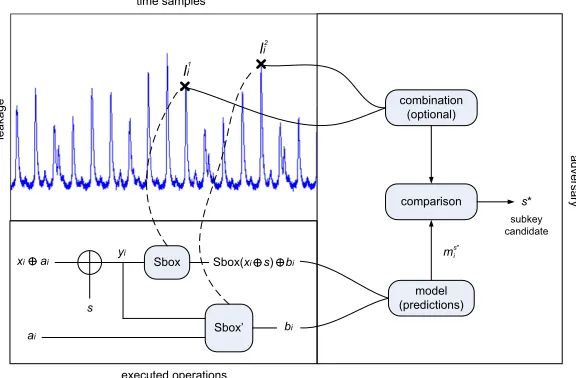
Many different masking schemes have been proposed in the literature. Although they can result in significantly different performances, the application of second-order attacks generally relies on the same principles, independent of the type of masking. In the following, we decided to focus on the Generalized Look Up Table (GLUT for short) that is described, e.g. in [16]. Such a scheme is represented in the lower left part of Figure 1, using the key addition and S-box layer of a block cipher as a concrete example. It can be explained as follows. For an input plaintextxi, a random maskai is first generated within the device. The
valuexi⊕ai is generally denoted as the masked variable. Then, the encryption
corresponding mask produces the original variable. In the case of the GLUT proposal, a precomputed functionSbox’is used for this purpose. For example in Figure 1, the masked S-box outputSbox(xi⊕ai⊕s) can be written asSbox(xi⊕
s)⊕bi, wherebi denotes an output mask produced by Sbox’.
xi
s
Sbox(xi s)
yi
time samples
le
a
k
a
g
e
executed operations li
ai
ai
Sbox
Sbox’
bi
bi li
model (predictions) combination (optional)
comparison
m
s*
subkey candidate
a
d
v
e
rs
a
ry
1
2
s* i
Fig. 1.Illustrative second-order DPA.
In practice, the GLUT countermeasure can be implemented in different man-ners. Mainly, the two S-box computations can be performed sequentially (as typical for software implementations) or in parallel (as typical for hardware im-plementations). In order to describe the second-order DPA that we investigate in this paper, we first use the sequential approach (the parallel one will be discussed in the next section). Also, we rely on the terminology introduced in [20]. Essen-tially, the idea of second-order DPA is to take advantage of the joint leakage of two intermediate computations during the encryption process (i.e. the masked value and its mask). In the software approach, the computation of these interme-diate variables will typically be performed in two different clock cycles. Hence, two leakage samplesl1
i andl
2
i corresponding to these computations can be found
in the leakage traces, as in the top of Figure 1. Following the standard DPA described in [12], the adversary will then work in three (plus one optional) steps:
1. For different plaintextsxiand subkey candidatess∗, the adversary predicts
some intermediate values in the target implementation. For example, one could predict the S-box outputsSbox(xi⊕s) in Figure 1.
3. Optionally, the adversary combines the leakage samples into a single variable. 4. For each subkey candidate s∗, the adversary finally compares the modeled
leakages with actual measurements, produced with the same plaintextsxi
and a secret subkey s. In a second-order DPA, each model is compared with two samples in the traces. This comparison is independent of all other points. Consequently, these attacks are referred to asbivariate. In practice, this comparison is applied to many pairs of points in the leakage traces and the subkey candidate that performs best is selected by the adversary.
As for the analysis of first-order attacks, comparing different distinguishers re-quires to provide them with the same leakage samples. However, contrary to the first-order case and as will be discussed in the following sections, the best pair of leakage samples is not necessarily the same for all distinguishers. This is because different distinguishers can take advantage of different leakage pdf with different efficiencies in this case. In practice, this requires to test all pairs of samples in the traces (but this meansN(N−1)/2 statistical tests to perform if the traces haveN samples). In this paper, we will generally assume that this best pair of samples is provided to the attacks we perform (which can be done easily when simulating experiments and requires significant - but tractable - computational power when performing attacks based on real measurements).
Finally, we will use the following notations:
– xq= [x1, x2, . . . , xq]: a vector of plaintext bytes.
– aq = [a1, a2, . . . , aq]: a vector of random input mask bytes. – bq = [b1, b2, . . . , bq]: a vector of random output mask bytes.
– v1
i =Sbox(xi⊕s)⊕bi: an intermediate value in the encryption ofxi.
– v2
i =bi: another intermediate value in the encryption ofxi.
– l1q = [l
1 1, l
1 2, . . . , l
1
q]: a vector of leakage samples corresponding to the first
intermediate valuesv1
i during the encryption process. – l2q = [l
2 1, l
2 2, . . . , l
2
q]: a vector of leakage samples corresponding to the second
intermediate valuesv2
i during the encryption process.
– ms∗
q = [ms
∗
1 , ms
∗
2 , . . . , ms
∗
q ]: a vector containing leakage models (i.e.
predic-tions) corresponding to a subkey candidates∗ and the plaintextsxq.
In the rest of the paper, these notations (in small caps) will represent sampled values, while their counterpart in capital letters will represent random variables.
3
Second-order attacks with Pearson’s coefficient
In theory, second-order DPA is possible if the joint probability distributions Pr[L1
q,L
2
q|Xq, s] are different for different subkey valuess. This can be illustrated,
e.g. for a Hamming weight leakage function which is frequently considered in the practice of side-channel attacks [11] and has been the running example in [17]. It means assuming that the leakage samplesl1
i andl
2
l1
i = WH(v
1
i) +n
1
i, (1)
l2
i = WH(v
2
i) +n
2
i, (2)
where WH is the Hamming weight function andn 1
i,n
2
i are normally distributed
noise values with mean 0 and standard deviationσn. In the context of an 8-bit
S-box (e.g. the AES one), it leads to 9 possible leakage distributions, corresponding to the 9 Hamming weight values of a secret stateΣi=Sbox(xi⊕s), as observed in
[21]. The left parts of Figures 11, 12 and 13 in Appendix A show the joint leakage distributions in this setting and clearly illustrate that they are key-dependent. As detailed in the previous section, taking advantage of these dependencies requires a comparison tool. In their statistical evaluation of second-order DPA, Prouff et al. use Pearson’s correlation coefficient. In the context of first-order attacks exploiting a single leakage sampleli, it implies computing:
ˆ
ρ(Msq∗,Lq) =
ˆ
E li−Eˆ(Lq)· ms
∗
i −Eˆ(Ms
∗
q )
ˆ
σ(Lq)·σˆ(Ms ∗
q )
,
where ˆEand ˆσdenote the sample means and standard deviations of a random variable, respectively. In order to extend this tool towards the second-order case, the classical approach is to first combine the two leakage samplesl1
i andl
2
i with a
combination function C. For example, Chariet al. proposed to take the product of two centered samples [2]:C(l1
i, l
2
i) = (l
1
i−Eˆ(L
1
q))·(l
2
i−Eˆ(L
2
q)) and Messerges
used the absolute difference between them [13]:C(l1
i, l
2
i) =|l
1
i−l
2
i|. As illustrated
in the right parts of Figures 11, 12 and 13, those combining functions also lead to key-dependencies. In addition to these standard examples, we finally plotted the distribution of the sum combining functionC(l1
i, l
2
i) =l
1
i +l
2
i because it can
be used to emulate the behavior of the GLUT masking in a hardware setting, where the two S-boxes of Figure 1 are computed in parallel.
3.1 Choice of a model and leakage-dependency of C
Given the above descriptions and assuming that the adversary knows a good leakage model for the samples l1
i and l
2
i, it remains to determine which model
to use when computing ˆρ(Msq∗,C(L
1
q,L
2
q)). That is, we do not need to predict
the leakage samples separately, but their combination. In addition and contrary to the first-order case, there is an additional variable (i.e. the mask) that is unknown to the adversary. But given a model for the separate samples, it is possible to derive one for their combination. For example, assuming a Hamming weight model that perfectly corresponds to the leakages of Equations (1) and (2), we can use the mean of the combination function, taken over the masks. For each subkey candidates∗, the model is is then given by:
msi∗ =E
bi
C WH(Σi∗⊕bi),WH(bi)
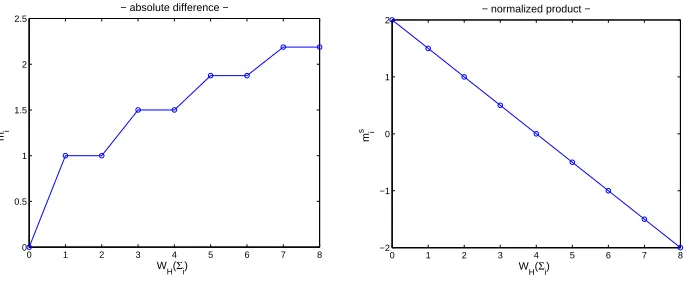
This is in fact similar to what is proposed in [17], where the mean is addition-ally taken over the leakage noise (which is more general, but implies additional profiling, i.e. a sufficiently precise knowledge of the noise distribution). As an illustration, Figure 2 shows the leakage models corresponding to the absolute difference and normalized product combination functions. They again only de-pend on the 9 Hamming weight values of the secret state, as opposed to the ones of a sum combining function for which the mean value (over the masks) is con-stant for all secret states. Hence, as already observed in [11], this sum combining function will not lead to successful second-order correlation attacks.
0 1 2 3 4 5 6 7 8
0 0.5 1 1.5 2 2.5
W H(Σi) mi
s
− absolute difference −
0 1 2 3 4 5 6 7 8
−2 −1 0 1 2
W H(Σi) mi
s
− normalized product −
Fig. 2.Leakage models for second-order DPA using the correlation coefficient.
The figure intuitively confirms the previous theoretical analysis of Prouffet al. where it is demonstrated that the normalized product combining function leads to the most efficient second-order side-channel attacks when using Pear-son’s coefficient and assuming a Hamming weight leakage model for the separate samples. Indeed, this particular setting gives rise to nicely linear dependencies of the models msi in the Hamming weight of the secret states WH(Σi). Also,
and contrary to the absolute difference combining function, all the 9 possible Hamming weights correspond to a different modelms
i in this particular case.
Interestingly, the efficiency of the normalized product combining function can be simply explained when looking at the equations since it computes:
ˆ
ρ(Msq∗,C(L
1
q,L
2
q)) =
ˆ
E C(l1
i, l
2
i)−Eˆ(C(L
1
q,L
2
q))
· ms∗
i −Eˆ(M
s∗
q )
ˆ
σ(C(L1
q,L
2
q))·ˆσ(Ms
∗
q )
.
As the product is normalized, we have that ˆE(C(L1q,L2q)) = 0, which leads to:
ˆ
ρ(Msq∗,C(L
1
q,L
2
q)) =
ˆ
E l1
i −Eˆ(L
1
q)
· l2
i −Eˆ(L
2
q)
· ms∗
i −Eˆ(Ms
∗
q )
ˆ
σ(C(L1
q,L
2
q))·σˆ(Ms
∗
q )
And this formula is in fact very close to the straightforward generalization of Pearson’s correlation coefficient to the case of three random variables:
ˆ
ρ(Msq∗,L
1
q,L
2
q) =
ˆ
E l1
i −Eˆ(L
1
q)
· l2
i −Eˆ(L
2
q)
· ms∗
i −Eˆ(Ms
∗
q )
ˆ
σ(L1
q)·σˆ(L
2
q)·σˆ(Ms
∗
q )
. (4)
The only difference between Equations (3) and (4) is in the leakage samples’ standard deviation terms, which are key-independent. Hence, when applied to the same pair of samples, attacks using Equations (3) or (4) are equivalent. Intu-itively, these equations provide a simple explanation of the normalized product combining function. That is, such a combining function will efficiently take ad-vantage of pairs of leakage samples that are linearly correlated conditioned on the key. As illustrated in Figures 11, 12 and 13, this is nicely achieved in the case of a Hamming weight leakage function for the two samplesl1
i andl
2
i.
4
Evaluating second-order leakage: IT analysis
In general, the evaluation of second-order side-channel attacks is not straight-forward to capture. More precisely, it is easy to see that an analysis based only on the correlation coefficient may suffer from certain limitations. For example:
– Given Pearson’s correlation coefficient as a distinguisher and a Hamming weight leakage function, there exist (trivial) combination functions for the samples (e.g. the sum) that do not lead to successful key recoveries.
– Given Pearson’s coefficient as a distinguisher and the normalized product combination function, there exist leakage functions (e.g. with no linear de-pendencies between the samples) that don’t lead to successful key recoveries.
These observations suggest that the simple situation in the first-order context, where the correlation coefficient could (under certain physical assumptions de-tailed in [12]) be used both as a distinguisher and as a measure of side-channel leakage, does not hold here. In second-order side-channel attacks, this correla-tion is only a distinguisher. Hence, it is a typical context in which the evaluacorrela-tion framework of Eurocrypt 2009 is interesting to put into practice:
In this section, we tackle the first part of the analysis. For this purpose, and in order to compare our conclusions with previous works, we use exactly the same assumptions as [17],i.e. a Hamming weight leakage function for the two samples, just as described in Section 3. Following the definitions in [20], we compute:
H[S|L1 1,L
2
1,X1]
=
−
P
s
Pr[s]
P
x1
Pr[x1]
R
l1
1
R
l2
1
Pr[l1 1, l
2
1|s, x1] log2Pr[s|l 1 1, l
2 1, x1]dl
1 1dl
2 1.
Since the leakage samples are assumed to be normally distributed, this can be quite easily done in function of the noise standard deviation σn. Some
simpli-fications allow to speed up the computations, e.g. by observing that only nine distributions are possible, corresponding to the nine Hamming weights of the secret states Σi. Also, in order to evaluate the information loss caused by the
different combination functions, we similarly evaluated H[S|C(L11,L21),X1]. This implies slightly more complex integrals since, e.g. the product combining gives rise to mixtures of normal product distributions. Figure 9 in Appendix A il-lustrates these distributions for two secret states and two σn’s. The mutual
information values corresponding to these different information leakages (i.e. I(S; (L1
1,L 2
1,X1)) = H[S]−H[S|L 1 1,L
2
1,X1]) are then plotted in Figure 3, in function of the noise varianceσ2
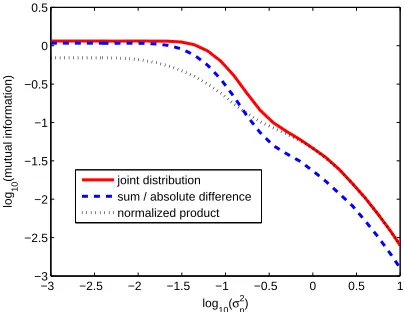
n(in log scale). From this figure, we can observe:
−3 −2.5 −2 −1.5 −1 −0.5 0 0.5 1
−3 −2.5 −2 −1.5 −1 −0.5 0 0.5
log
10(σ 2 n)
log
10
(mutual information) joint distribution sum / absolute difference normalized product
Fig. 3.Information leakage for different combination functions.
1. All combination functions imply a loss of information that can be avoided by dealing directly with the 2-dimensional joint leakage distribution. 2. The sum and absolute difference combining functions give rise to exactly the
same information leakage. This can be understood from the shape of their distributions: the distribution of the absolute difference combining can be seen as the one of the sum combining that has been folded up.
3. For smallσ2
n, the normalized product is the least informative combining
4. The respective efficiency of different combining functions varies with the amount of noise. In particular, after a certain noise threshold, the product combining carries more information onS than the sum/absolute difference.
Note that the leakage of the sum combining’s output clearly relates to the pre-vious evaluation of [21] in which masking is analyzed in the hardware setting.
5
Implications for profiled attacks: security analysis (I)
The previous information theoretic analysis provides a new perspective to un-derstand the relation between a masking scheme, its physical leakages and the exploitation of this information by a side-channel attack. For example, it ex-hibits that the sum combining function leads to significant information leakages (as can also be seen from the different pdf in appendix), although they cannot be directly exploited with Pearson’s correlation coefficient. Previous works such as the one of Waddle and Wagner [23] showed how to overcome this limitation of the correlation coefficient, by squaring the combined samples. But our analysis raises the question whether these information leakages can be directly exploited (i.e. without squaring) by other distinguishers. In order to tackle this question, we apply the second part of the framework in [20], i.e. security analysis. This section starts with the evaluation of profiled (template) attacks, for which a strong relation with the previous information theoretic analysis should hold.
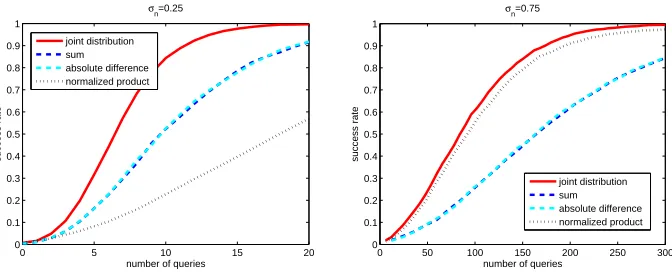
The results of various template attacks performed against the same masked AES S-box as in the previous sections are given in Figure 4, for two different noise standard deviations. We mention that these attacks donot use Gaussian templates as in [3] but the exact leakage distributions as in the previous in-formation theoretic analysis (e.g. attacks using the joint distributions exploit Gaussian mixtures; attacks using the normalized product combining function exploit normal product distribution mixtures, etc. as plotted in appendix A). The different success rates are computed over 1000 independent experiments and nicely confirm the theoretical predictions of Theorem 2 in [20].
0 5 10 15 20
0 0.1 0.2 0.3 0.4 0.5 0.6 0.7 0.8 0.9 1
number of queries
success rate
σn=0.25
joint distribution sum absolute difference normalized product
0 50 100 150 200 250 300
0 0.1 0.2 0.3 0.4 0.5 0.6 0.7 0.8 0.9 1
number of queries
success rate
σn=0.75
joint distribution sum absolute difference normalized product
First, we see that the sum and absolute difference combining functions lead to the same attack efficiency in this profiled case (since their outputs lead to the same information leakages). Second, we see that the point in Figure 3 where the sum / absolute difference and the normalized product curves intersect is mean-ingful. Left of the intersection (e.g.forσn = 0.25), the sum / absolute difference
combining functions allow more efficient attacks than the normalized product one. Right of the intersection (e.g. forσn= 0.75), the opposite conclusion holds.
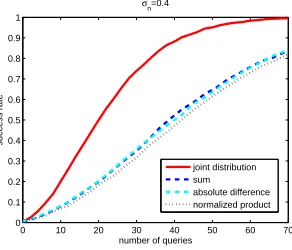
And as shown in Appendix A, Figure 10, these attacks have a similar efficiency at the intersection that falls aroundσn = 0.4 (that is, log10(σn2)≈ −0.8).
Of course, these experiments are partially artificial since in practice, an ad-versary who can profile the leakages will generally use the templates based on the joint distribution only. At least, this is the best strategy if the adversary has enough data and time to profile the multivariate leakage pdf. However, our results confirm that an information theoretic analysis provides an objective eval-uation of the quality of a countermeasure against the “best-available” template adversaries in the DPA setting. Hence, they emphasize that such an analysis is an important part in the evaluation of side-channel countermeasures. Also, these results lead to the same conclusions as [14], and show that resistance against suf-ficiently profiled template attacks cannot be achieved by masking only.
6
Implications for non-profiled attacks: security analysis (II)
The previous section showed that for carefully profiled template attacks, there is a strong connection between the information leakage of a device and the success rate of the adversary. By contrast, we know that in the non-profiled context of correlation attacks, this observation does not hold in general. For example, Pear-son’s coefficient cannot be used to exploit the leakages corresponding to the sum combining of Section 3.1. Hence, it is natural to check whether there exist other non-profiled distinguishers that can be successful in this case. We answer this question positively, using the Mutual Information Analysis (MIA) introduced in [5]. It can be seen as the counterpart of template attacks, in which the leakage distributions are estimated “on-the-fly” rather than prior to the attacks.
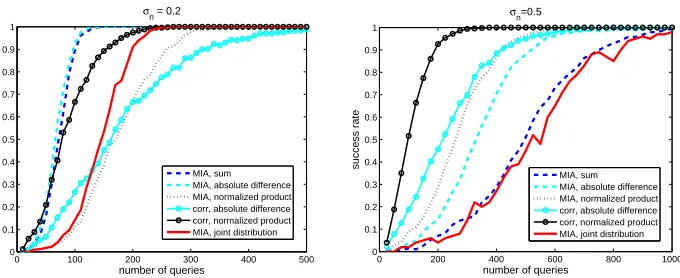
The success rates of correlation and MIA attacks (here, and in the rest of the paper, computed over 500 independent experiments), using different combining functions, are given in Figure 5, again using the (simulated) setting described in the previous section. In our experiments, MIA estimates the pdf using histograms with Nb linearly-spaced bins, and Nb corresponding to the number of possible
values for the models, as proposed in [5]. That is, we use 9 bins per leakage sample and we partition the leakage samples according to the 9 Hamming weights of the secret stateΣi. The following observations can be emphasized:
1. In the low noise scenario, MIA with the sum and absolute difference com-bining functions works best, as similarly observed for template attacks. 2. By contrast, and contrary to template attacks, MIA without combining
0 100 200 300 400 500 0
0.1 0.2 0.3 0.4 0.5 0.6 0.7 0.8 0.9 1
number of queries
success rate
σ n = 0.2
MIA, sum MIA, absolute difference MIA, normalized product corr, absolute difference corr, normalized product MIA, joint distribution
0 200 400 600 800 1000
0 0.1 0.2 0.3 0.4 0.5 0.6 0.7 0.8 0.9 1
number of queries
success rate
σn=0.5
MIA, sum MIA, absolute difference MIA, normalized product corr, absolute difference corr, normalized product MIA, joint distribution
Fig. 5.Success rate of (simulated) non-profiled attacks - masked AES S-box.
efficient solution in our simulations. This is caused by the need to estimate two-dimensional distributions, which turns out to require more data. 3. For similar reasons (i.e. also related to the different efficiency of the
“on-the-fly” pdf estimation), when increasing the noise, MIA with the sum and absolute difference combining functions are not equivalent anymore. 4. Finally, attacks using Pearson’s correlation coefficient perform well, specially
when combined with the normalized product (which is natural since our simulated leakages perfectly fulfill the requirements of Section 3.1).
Importantly, we note that all these non-profiled distinguishers lead to signifi-cantly lower efficiencies than the profiled ones in the previous section.
7
Experimental results
0 50 100 150 200 0
0.1 0.2 0.3 0.4 0.5 0.6 0.7 0.8 0.9 1
number of queries
success rate
low noise scenario
corr, sum corr, absolute difference corr, normalized product MIA, sum MIA, absolute difference MIA, normalized product MIA, joint distribution templates, joint distribution
0 100 200 300 400 500
0 0.1 0.2 0.3 0.4 0.5 0.6 0.7 0.8 0.9 1
number of queries
success rate
algorithmic noise scenario
corr, sum corr, absolute difference corr, normalized product MIA, sum MIA, absolute difference MIA, normalized product MIA, joint distribution templates, joint distribution
Fig. 6.Success rate of various experimental attacks against a masked DES.
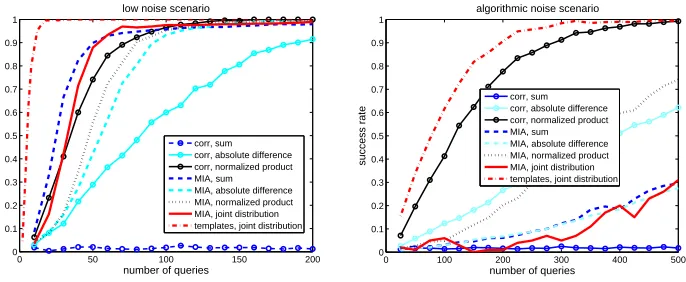
1. The excellent efficiency of template attacks1
and the good behavior of cor-relation attacks using the normalized product combining function are again exhibited. Interestingly, their respective efficiency gets closer when increas-ing the amount of algorithmic noise in the measurements, as it is suggested by the information theoretic analysis of Section 4.
2. MIA using the joint distribution is much more efficient than in the AES case. This is in fact related to the reduced number of bins that the 4-bit DES S-box allows in the pdf estimations (i.e. 25 rather than 81).
3. The presence of algorithmic noise (in the right part of Figure 6), affects the different distinguishers in a very different manner. To give a single example, MIA with the absolute difference combining function is strongly affected by this noise addition, compared to its counterpart using Pearson’s coefficient.
Summarizing, these experiments confirm the “world is not enough” nature of second-order DPA that was already underlined in the previous simulations. The only strong statement that can be made in this context is that an information theoretic metric estimated with perfect templates captures the security against the best possible profiled adversary. As for all the other distinguishers, their effi-ciency highly depends on the actual shape of the leakage pdf and the engineering knowledge that can be exploited when mounting an attack. And contrary to the first-order case discussed in [12], the Gaussian assumption for the leakage sam-ples does not hold anymore from the adversary’s point of view (e.g. masking typically imply mixtures of Gaussians - or other - distributions).
8
Generalization to higher-orders
In order to improve the security of masking schemes further, one approach is to increase their order. For this purpose, this final section analyzes the costvs. security tradeoff that can be obtained by generalizing the GLUT countermeasure in such a way, and details the second- and third-order cases for illustration. That
1
is, rather than using one input mask per S-box, we now use two or three masks per S-box. In terms of cost, this implies using one or two additional tablesSbox′′
andSbox′′′, as described,e.g.in [15]. Conveniently, all the tools used in
second-order DPA can be easily generalized to these third- and fourth-second-order attack cases. In particular, the information theoretic analysis of Section 4 just requires to integrate over three or four leakage samplesl1
i,l
2
i,l
3
i andl
4
i.
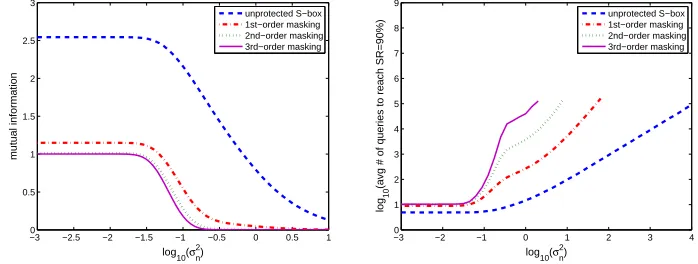
The information leakage of these different masking schemes is represented in Figure 7, in function of the noise variance. On the same plot, we represented the average number of queries to the target device required for a perfectly pro-filed attack (similar to the ones in Section 5) to reach a success rate of 90%. These figures provide a quantitative insight to the observations in [2], where it is demonstrated that, given a large enough noise variance, the data complexity of a side-channel attack increases exponentially with the amount of shares in the masking scheme. That is, given a noise varianceσ2
n in the leakage samples and
kshares, the data complexity required to attack a masking scheme successfully is proportional to (σ2
n)k/
2
. The linear regions of the (log scale) curves that are observed in the right part of the figure suggest that this expectation is fulfilled in our experiments. Importantly, it also shows that the impact of (higher-order) masking can be extremely small in terms of security increases, for smallσ2
n’s.
−30 −2.5 −2 −1.5 −1 −0.5 0 0.5 1
0.5 1 1.5 2 2.5 3
log 10(σn
2)
mutual information
unprotected S−box 1st−order masking 2nd−order masking 3rd−order masking
−3 −2 −1 0 1 2 3 4
0 1 2 3 4 5 6 7 8 9
log 10(σn
2)
log
10
(avg # of queries to reach SR=90%)
unprotected S−box 1st−order masking 2nd−order masking 3rd−order masking
Fig. 7.Information leakage and success rates for 1st
, 2nd
and 3rd
-order masking.
Note finally that these results give a practical counterpart to the recent the-oretical analysis of [4], where it is shown that masking schemes based on secret sharing techniques lead to secure implementations if the number of shares is adjusted to be large enough with respect to the noise in the measurements.
8.1 A case for the information theoretic metric
implementation. Unfortunately, for high security levels, the proper estimation of the number of traces required to reach a certain success rate becomes intensive (because of statistical sampling issues). Already in simulations, running 1000 attacks, each of them using 105
queries, is time consuming. And when moving to the analysis of real traces (taking much more time to be generated and space to be stored), this limitation becomes even more critical. Interestingly, this is ex-actly the context where an information theoretic analysis becomes useful. Given a leakage model, the mutual information I(S;L11,L
2
1, . . .) can be estimated with less data than the success rate of the corresponding template attack. And follow-ing [20], Theorem 2, it should hold that this mutual information is reasonably correlated with the number of traces required to reach a certain success rate. In order to confirm this expectation, we plotted an estimation of this number, based on the inverse of the mutual information multiplied with a constant factorc. As illustrated in Figure 8, this approximation holds nearly perfectly, with the same constantcfor all attacks, essentially depending on the success rate to reach (here 90%). Summarizing, these simulations confirm the relevance of an information theoretic analysis when designing countermeasures against side-channel attacks.
−3 −2 −1 0 1 2 3 4
0 1 2 3 4 5 6 7 8 9
log10(σn2)
log
10
(avg # of queries to reach SR=90%)
unprotected S−box 1st−order masking 2nd−order masking 3rd−order masking
estimations using (c⋅ I(S;L))−1
Fig. 8.Information leakage and success rates for 1st
, 2nd
and 3rd
-order masking.
Before to conclude, we note again that such an information theoretic analysis only captures the most powerful adversaries for which the profiling of the leakage distributions is perfect. But in practice, the reduction of the information leakage is not the only effect that increases the security in masked implementations. Namely, the pdf estimation of multidimensional distributions may become too complex for allowing the exploitation of all the information in the traces. And the number of pairs, triples,etc.of samples to test in the attacks also increases their time complexity considerably (up to N2
, N3
9
Conclusions
The results in this paper provide a first complete and unifying treatment of higher-order power analysis. They allow putting forward the strengths and weak-nesses of various approaches to second-order DPA and provide a sound expla-nation for them. Our analysis illustrates that in the context of cryptographic devices protected with masking, it is not sufficient to run a single arbitrary dis-tinguisher to quantify the security of an implementation. Evaluations should hold in two steps. First, an information theoretic analysis determines the actual information leakage (i.e. the impact of the countermeasure, independently of the adversary). Second, a security analysis determines the efficiency of various distinguishers in exploiting this leakage. By applying such a methodology to simulations and practical experiments, we consequently obtain a fair and com-prehensive evaluation of the security level that a masking scheme can ensure.
While not in contradiction with previous results in the field, these inves-tigations reshape the understanding of certain assumptions and allow refined intuitions. First, theoretical analysis and empirical attacks sometimes show a large gap between the efficiency of profiled attacks that best exploit the infor-mation from two or more leakage samples and the one of non-profiled attacks that are most frequently used in practice. This relates to the observation that the statistics in side-channel attacks are only used to discriminate secret data (while their natural objective is to allow a good estimation). Hence, the study of advanced pdf estimation techniques in the context of side-channel attacks is an interesting direction for further research, as initiated with MIA in [5].
Second, the security improvement obtained when increasing the order of a masking scheme beyond one is negligible if it is not combined with a sufficient amount of noise in the leakages. This observation relates to the generally ac-cepted intuition that side-channel resistance requires the combination of several countermeasures in order to be effective. We additionally show in this paper that an information theoretic analysis has very convenient features for evaluat-ing this noise threshold precisely. As a result, the best combination of maskevaluat-ing with other countermeasures (e.g.dual rail logic styles, time randomization,etc.) is a second interesting scope for further research. Finally, the relationship be-tween the mutual information and the success rate of a profiled attack, that is experimentally exhibited in this paper in the context of second- (and higher-) order DPA, could be analyzed in order to obtain a more formal justification of it,e.g. under the assumption of Gaussian noise in the leakages.
Acknowledgements.This work has been funded in part by the European
References
1. E. Brier, C. Clavier, F. Olivier,Correlation Power Analysis with a Leakage Model,
CHES 2004, LNCS, vol 3156, pp 16-29, Boston, MA, USA, August 2004.
2. S. Chari, C.S. Jutla, J.R. Rao, P. Rohatgi, Towards Sound Approaches to
Coun-teract Power Analysis Attacks, CRYPTO 1999, LNCS, vol 1666, pp 398-412, Santa
Barbara, California, USA, August 1999.
3. S. Chari, J. Rao, P. Rohatgi, Template Attacks, CHES 2002, LNCS, vol 2523, pp
13-28, Redwood Shores, California, USA, August 2002.
4. S. Faust, T. Rabin, L. Reyzin, E. Tromer, V. Vaikuntanathan, Protecting
Cir-cuits from Leakage: the Computationally-Bounded and Noisy Cases, Eurocrypt 2010,
LNCS, vol 6110, pp 135-156, Nice, France, May 2010.
5. B. Gierlichs, L. Batina, P. Tuyls, B. Preneel, Mutual Information Analysis - A
Generic Side-Channel Distinguisher, in the proceedings of CHES 2008, LNCS, vol
5154, pp 426-442, Washington DC,USA, August 2008.
6. B. Gierlichs, L. Batina, B. Preneel, I. Verbauwhede,Revisiting Higher-Order DPA
Attacks: Multivariate Mutual Information Analysis, in the proceedings of CT-RSA
2010, LNCS, vol 5985, pp 221-234, San Francisco, USA, February 2010.
7. L. Goubin, J. Patarin, DES and Differential Power Analysis, CHES 1999, LNCS,
vol 1717, pp 158-172, Worcester, MA, USA, August 1999.
8. P.C. Kocher, J. Jaffe, B. Jun,Differential Power Analysis, CRYPTO 1999, LNCS,
vol 1999, pp 388-397, Santa Barbara, CA, USA, August 1999.
9. S. Mangard, T. Popp, B.M. Gammel,Side-Channel Leakage of Masked CMOS Gates,
CT-RSA 2005, LNCS, vol 3376, pp 351-365, San Francisco, USA, February 2005.
10. M. Joye, P. Paillier, B. Schoenmakers,On Second-Order Differential Power
Anal-ysis, CHES 2005, LNCS, vol 3659, pp 293-308, Edinburgh, UK, September 2005.
11. S. Mangard, E. Oswald, T. Popp,Power Analysis Attacks, Springer, 2007.
12. S. Mangard, E. Oswald, F.-X. Standaert,One for All, All for One: Unifying
Stan-dard DPA Attacks, Cryptology ePrint Archive, Report 2009/449.
13. T.S. Messerges,Using Second-Order Power Analysis to Attack DPA Resistant
Soft-ware, CHES 2000, LNCS, vol 1965, pp 238-251, Worcester, MA, August 2001.
14. E. Oswald, S. Mangard,Template Attacks on Masking - Resistance Is Futile,
CT-RSA 2007, LNCS, vol 4377, pp 243-256, San Francisco, CA, USA, February 2007.
15. G. Piret, F.-X. Standaert, Security Analysis of Higher-Order Boolean Masking
Schemes for Block Ciphers (with Conditions of Perfect Masking), in IET
Infor-mation Security, vol 2, num 1, pp 1-11, March 2008.
16. E. Prouff, M. Rivain,A Generic Method for Secure S-box Implementation, WISA
2007, LNCS, vol 4867, pp 227-244, Jeju Island, Korea, August 2007.
17. E. Prouff, M. Rivain, R. B´evan,Statistical Analysis of Second Order DPA, in IEEE
Transactions on Computers, vol 58, num 6, pp 799-811, June 2009.
18. E. Prouff, M. Rivain, Theoretical and Practical Aspects of Mutual Information
Based Side-Channel Analysis, in the proccedings of ACNS 2009, LNCS, vol 5536,
pp 499-518, Paris, France June 2009.
19. K. Schramm, C. Paar,Higher Order Masking of the AES, CT-RSA 2006, LNCS,
vol 3860, pp 208-225, San Jose, California, USA, February 2006.
20. F.-X. Standaert, T.G. Malkin, M. Yung,A Unified Framework for the Analysis of
Side-Channel Key Recovery Attacks, in the proccedings of Eurocrypt 2009, LNCS,
21. F.-X. Standaert, E. Peeters, C. Archambeau, J.-J. Quisquater, Towards Security
Limits in Side-Channel Attacks, in the proceedings of CHES 2006, LNCS, vol 4249,
pp. 30–45, Yokohama, Japan, October 2006, latest version available on the Cryp-tology ePrint Archive, Report 2007/222, http://eprint.iacr.org/2007/222.
22. N. Veyrat-Charvillon, F.-X. Standaert,Mutual Information Analysis: How, When
and Why?, in the proceedings of CHES 2009, Lecture Notes in Computer Science,
vol 5747, pp 429-443, Lausanne, Switzerland, September 2009.
23. J. Waddle, D. Wagner,Towards Efficient Second-Order DPA, CHES 2004, LNCS,
vol 3156, pp 1-15, Cambridge, MA, August 2004.
A
Additional figures
−5 0 5
σn = 0.2
WH
(
Σi
) = 0
probability density
−5 0 5
σ n = 0.2
C(l 1,l2) WH
(Σi
) = 8
probability density
−5 0 5
σn = 0.5
probability density
−5 0 5
σ n = 0.5
C(l 1,l2)
probability density
Fig. 9.Leakage probability distributions for the product combining function.
0 10 20 30 40 50 60 70
0 0.1 0.2 0.3 0.4 0.5 0.6 0.7 0.8 0.9 1
number of queries
success rate
σn=0.4
joint distribution sum absolute difference normalized product
0 5 10 15
− sum −
C(l
1,l2)
probability density
0 5 10 15
− sum −
C(l
1,l2)
probability density
0 5 10 15
− sum −
C(l
1,l2)
probability density
−5 0 5
− normalized product −
C(l
1,l2)
probability density
−5 0 5
− normalized product −
C(l
1,l2)
probability density
−5 0 5
− normalized product −
C(l
1,l2)
probability density
0 2 4 6 8
0 2 4 6 8
− joint distribution −
l 1 W H ( Σi
) = 0
l2
0 2 4 6 8
0 2 4 6 8
− joint distribution −
l 1 W H ( Σi
) = 1
l2
0 2 4 6 8
0 2 4 6 8
− joint distribution −
l 1 W H ( Σi
) = 2
l2
0 2 4 6 8 10
− absolute difference −
C(l
1,l2)
probability density
0 2 4 6 8 10
− absolute difference −
C(l
1,l2)
probability density
0 2 4 6 8 10
− absolute difference −
C(l
1,l2)
0 5 10 15
− sum −
C(l
1,l2)
probability density
0 5 10 15
− sum −
C(l
1,l2)
probability density
0 5 10 15
− sum −
C(l
1,l2)
probability density
0 2 4 6 8 10
− absolute difference −
C(l
1,l2)
probability density
0 2 4 6 8 10
− absolute difference −
C(l
1,l2)
probability density
0 2 4 6 8 10
− absolute difference −
C(l
1,l2)
probability density
−5 0 5
− normalized product −
C(l
1,l2)
probability density
−5 0 5
− normalized product −
C(l
1,l2)
probability density
−5 0 5
− normalized product −
C(l
1,l2)
probability density
0 2 4 6 8
0 2 4 6 8
− joint distribution −
l 1 W H ( Σi
) = 3
l2
0 2 4 6 8
0 2 4 6 8
− joint distribution −
l 1 W H ( Σi
) = 4
l2
0 2 4 6 8
0 2 4 6 8
− joint distribution −
l 1 W H ( Σi
) = 5
0 5 10 15
− sum −
C(l
1,l2)
probability density
0 5 10 15
− sum −
C(l1,l2)
probability density
0 5 10 15
− sum −
C(l
1,l2)
probability density
0 2 4 6 8 10
− absolute difference −
C(l
1,l2)
probability density
0 2 4 6 8 10
− absolute difference −
C(l1,l2)
probability density
0 2 4 6 8 10
− absolute difference −
C(l
1,l2)
probability density
−5 0 5
− normalized product −
C(l
1,l2)
probability density
−5 0 5
− normalized product −
C(l1,l2)
probability density
−5 0 5
− normalized product −
C(l
1,l2)
probability density
0 2 4 6 8
0 2 4 6 8
− joint distribution −
l 1 W H ( Σi
) = 6
l2
0 2 4 6 8
0 2 4 6 8
− joint distribution −
l1
W
H
(
Σi
) = 7
l2
0 2 4 6 8
0 2 4 6 8
− joint distribution −
l 1 W H ( Σi
) = 8