Some Observations on TWIS Block Cipher
Bozhan Su, Wenling Wu, Lei Zhang, Yanjun Li State Key Laboratory of Information Security,
Institute of Software, Chinese Academy of Sciences, Beijing 100190, P. R. China
{subozhan, wwl, zhanglei1015, liyanjun}@is.iscas.ac.cn
Abstract. The 128-bit block cipher TWIS was proposed by Ojha et al
in 2009. It is a lightweight block cipher and its design is inspired from CLEFIA. In this paper, we first study the properties of TWIS structure, and as an extension we also considered the generalized TWIS-type struc-ture which can be called G-TWIS cipher, where the block size and round number can be arbitrary values. Then we present a series of 10-round dif-ferential distinguishers for TWIS and a n-round differential distinguisher for G-TWIS whose probabilities are all equal to 1. Therefore, by utilizing these kinds of differential distinguishers, we can break the full 10-round TWIS cipher and n-round G-TWIS cipher.
Key words:Block Cipher, TWIS, G-TWIS, Differential Distinguisher,
Differential Cryptanalysis.
1 Introduction
Recently, researches on the design of lightweight cryptography have received lots of attention. Lightweight cryptography mainly deals with designing ciphers for extremely resource constrained environments, such as applications of RFID tags and sensor networks. Considering that conventional algorithms such as AES although quite secure, are not suitable for such environments, hence a number of new symmetric lightweight block ciphers have been proposed in the open literature, such as DESL [6], PRESENT [2], HIGHT [5], LCASE [10], Cobra [9] and TWIS [7] et al.
TWIS is a lightweight block cipher designed by Ojha et al in 2009. Both of its block size and key size are 128-bit and the total number of rounds is 10. The overall structure of TWIS is a 2-branch generalized Feistel structure which employs key whitening at the beginning and at the end of the cipher.
In this paper, we first study the properties of TWIS structure, and as an extension we also considered the generalized TWIS-type structure which can be called G-TWIS cipher, whose block size is 4m-bits and consists of n rounds encryption in all, where n and m are arbitrary positive integers. Then we evaluate the security of TWIS and G-TWIS against differential cryptanalysis respectively. Our main results include: we present (23−1) differential distinguishers for
our analysis does not depend on any weak-key or weak-subkey assumptions, these attacks can both be independent of the key schedule algorithm.
The rest of this paper is organized as follows. Section 2 gives a brief de-scription of TWIS first and then gives the specification of the proposed cipher G-TWIS. Section 3 and Section 4 present the differential attack on the full TWIS cipher and on the full G-TWIS cipher respectively. Finally, Section 5 summarizes the paper.
2 Descriptions of TWIS and G-TWIS
TWIS is a 128-bit block cipher which uses key of size 128-bit. It employs a 2-branch Generalized Feistel structure and consists of 10 rounds. Each round of TWIS uses two rounds of Feistel network which involves a 64-bit round function called 𝐺-function. Furthermore, key whitening layers are employed both at the beginning and at the end of the encryption procedure. Since the key scheduling is not involved in out attack, we will omit the description of key schedule algorithm here and interested readers can refer to [7] for more details.
As an extension of TWIS, we construct a generalized TWIS-type cipher called G-TWIS. Its block size can be 4m-bit and consists of n rounds, where m and n are arbitrary positive integers. Similar to the round function of TWIS, in each round of G-TWIS we also use two rounds of Feistel network which involves a 2m-bit round function called𝐺′-function. In the following, we will give detailed descriptions of the encryption procedures of TWIS and G-TWIS.
2.1 Notation
In this subsection, we first introduce the following notations which are used throughout this paper.
−𝑍𝑚
2 : the set of 𝑚-bit words.
−𝑎⊕𝑏: bitwise XOR of a and b. −𝑎∧𝑏: bitwise AND of a and b. −𝑎∣𝑏: concatenation of a and b. −⋘𝑖: left rotation by i bits. −⋙𝑖: right rotation by i bits.
2.2 Encryption Procedure of TWIS
For the encryption procedure of TWIS, let𝑃 = (𝑃0, 𝑃1, 𝑃2, 𝑃3)∈(𝑍232)4 denote
a 128-bit plaintext, and𝐶= (𝐶0, 𝐶1, 𝐶2, 𝐶3)∈(𝑍232)4denote the corresponding
ciphertext. Let𝑅𝐾𝑖 ∈𝑍232(𝑖= 0,1, . . . ,10) denote the round subkeys provided
by the key scheduling part. First of all, two 32-bit whitening subkeys𝑅𝐾0 and
𝑅𝐾1 are XORed to𝑃0and𝑃3respectively, and the resulted intermediate value
is denoted as (𝑇0, 𝑇1, 𝑇2, 𝑇3). Then the same round transformation is iterated for
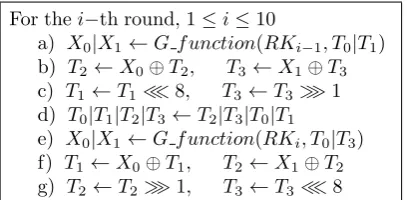
For the𝑖−th round,1≤𝑖≤10
a) 𝑋0∣𝑋1←𝐺 𝑓𝑢𝑛𝑐𝑡𝑖𝑜𝑛(𝑅𝐾𝑖−1, 𝑇0∣𝑇1)
b) 𝑇2←𝑋0⊕𝑇2, 𝑇3←𝑋1⊕𝑇3
c) 𝑇1←𝑇1⋘8, 𝑇3←𝑇3⋙1
d) 𝑇0∣𝑇1∣𝑇2∣𝑇3←𝑇2∣𝑇3∣𝑇0∣𝑇1
e) 𝑋0∣𝑋1←𝐺 𝑓𝑢𝑛𝑐𝑡𝑖𝑜𝑛(𝑅𝐾𝑖, 𝑇0∣𝑇3)
f) 𝑇1←𝑋0⊕𝑇1, 𝑇2←𝑋1⊕𝑇2
g) 𝑇2←𝑇2⋙1, 𝑇3←𝑇3⋘8
In the end, two whitening subkeys𝑅𝐾2and𝑅𝐾3are XORed to𝑇0 and𝑇3
respectively, and the result is just the ciphertext𝐶= (𝐶0, 𝐶1, 𝐶2, 𝐶3). The
detailed encryption procedure of TWIS is also illustrated in Fig. 1.
P0 P1 P2 P3
RK0 RK1
T0 T1 T2 T3
Initial Key Whitening
RKi-1
G-func
>>>1 <<<8
T0 T1 T2 T3
G-func RKi
>>>1 <<<8
Repeat for 10 rounds
T0 T1 T2 T3
RK2 RK3
C0 C1 C2 C3
Final Key
Whitening 128-Bit Plaintext
128-Bit Ciphertext
Fig. 1.The Encryption Process of TWIS
For the𝐺-function used in each round, it is defined as follows. It takes 64-bit data and 32-bit round subkey as inputs and produces 64-bit output, and this transformation can be written as the following expressions.
1. 𝑇0∣𝑇1←𝑋0∣𝑋1
3. 𝑌0∣𝑌1←𝑇1∣𝑇0
Here it calls another transformation named 𝐹 𝑓𝑢𝑛𝑐𝑡𝑖𝑜𝑛which takes 32-bit in-termediate state𝑋 and 32-bit round subkey𝑅𝐾 as inputs, and produces 32-bit output𝑌. The transformation of𝐹 𝑓𝑢𝑛𝑐𝑡𝑖𝑜𝑛is defined as follows:
1. 𝑇0∣𝑇1∣𝑇2∣𝑇3←𝑅𝐾⊕𝑋
2. 𝑇0←𝑆𝑏𝑜𝑥(𝑇0∧0𝑥3𝑓)
𝑇1←𝑆𝑏𝑜𝑥(𝑇1∧0𝑥3𝑓)
𝑇2←𝑆𝑏𝑜𝑥(𝑇2∧0𝑥3𝑓)
𝑇3←𝑆𝑏𝑜𝑥(𝑇3∧0𝑥3𝑓)
3. 𝑌0∣𝑌1∣𝑌2∣𝑌3←𝑇2∣𝑇3∣𝑇0∣𝑇1
Note that the Sbox used in𝐹 𝑓𝑢𝑛𝑐𝑡𝑖𝑜𝑛takes 6-bit input and yields 8-bit output, and the specific Sbox table can be obtained in [7].
2.3 Encryption Procedure of G-TWIS
As an extension of TWIS, we construct a generalized TWIS-type cipher called G-TWIS. Its block size can be 4m-bit and consists of n rounds, where m and n are arbitrary values. Let 𝑃 = (𝑃0, 𝑃1, 𝑃2, 𝑃3)∈(𝑍2𝑚)4 and 𝐶 = (𝐶0, 𝐶1, 𝐶2, 𝐶3)∈
(𝑍𝑚
2 )4 denote the plaintext and its corresponding ciphertext respectively. Let
𝑅𝐾𝑖 ∈ 𝑍2𝑚 (𝑖 = 0, . . . , 𝑛−1) denote the round subkeys provided by the key
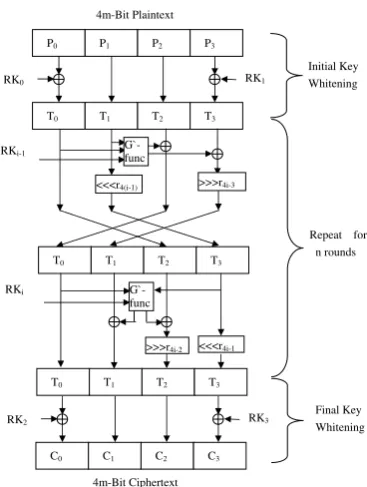
scheduling part. The key whitening layers at the beginning and at the end of G-TWIS are exactly the same with TWIS, and the round transformation used in each round is defined as follows. The encryption procedure of G-TWIS is also illustrated in Fig. 2.
For the𝑖−th round,1≤𝑖≤𝑛
a) 𝑋0∣𝑋1←𝐺′ 𝑓𝑢𝑛𝑐𝑡𝑖𝑜𝑛(𝑅𝐾𝑖−1, 𝑇0∣𝑇1)
b) 𝑇2←𝑋0⊕𝑇2, 𝑇3←𝑋1⊕𝑇3
c) 𝑇1←𝑇1⋘𝑟0, 𝑇3←𝑇3⋙𝑟1
d) 𝑇0∣𝑇1∣𝑇2∣𝑇3←𝑇2∣𝑇3∣𝑇0∣𝑇1
e) 𝑋0∣𝑋1←𝐺′ 𝑓𝑢𝑛𝑐𝑡𝑖𝑜𝑛(𝑅𝐾𝑖, 𝑇0∣𝑇3)
f) 𝑇1←𝑋0⊕𝑇1, 𝑇2←𝑋1⊕𝑇2
g) 𝑇2←𝑇2⋙𝑟2, 𝑇3←𝑇3⋘𝑟3
For the 𝐺′-function used in each round, it takes 2m-bit data and m-bit round subkey as inputs and produces 2m-bit output. Similar to the 𝐺-function in TWIS, 𝐺′-function can be written as the following expressions.
1. 𝑇0∣𝑇1←𝑋0∣𝑋1
2. 𝑇0←𝑇1⊕𝐹′ 𝑓𝑢𝑛𝑐𝑡𝑖𝑜𝑛(𝑅𝐾, 𝑇0)
3. 𝑌0∣𝑌1←𝑇1∣𝑇0
Here it calls 𝐹′ 𝑓𝑢𝑛𝑐𝑡𝑖𝑜𝑛 which takes m-bit intermediate state 𝑋 and m-bit round subkey𝑅𝐾 as inputs, and produces m-bit output𝑌.
𝐹′ 𝑓𝑢𝑛𝑐𝑡𝑖𝑜𝑛={{0,1}𝑚× {0,1}𝑚→ {0,1}𝑚,
RKi-1
RKi
Repeat for n rounds
Final Key Whitening
P0 P1 P2 P3
RK0 RK1
T0 T1 T2 T3
Initial Key Whitening
G`-func
>>>r4i-3
<<<r4(i-1)
T0 T1 T2 T3
G`-func
>>>r4i-2 <<<r4i-1
T0 T1 T2 T3
RK2 RK3
C0 C1 C2 C3
4m-Bit Plaintext
4m-Bit Ciphertext
Fig. 2.The Encryption Process of G-TWIS
3 10-Round Differential Distinguishers for TWIS
In this section, we present (23−1) 10-round differential distinguishers for TWIS
whose probabilities are all equal to 1. These differential distinguishers are mainly based on the following one-round iterative differential characteristic with prob-ability 1.
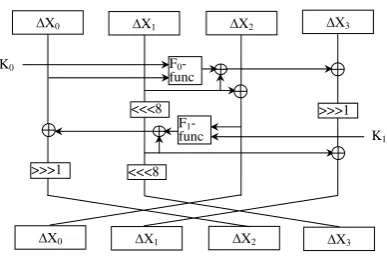
Fig. 3 illustrates this kind of one-round iterative differential characteristic in detail. Note here we choose both the input and output differences of the
𝑖-th round as 𝛥𝑋 = (𝛥𝑋0, 𝛥𝑋1, 𝛥𝑋2, 𝛥𝑋3) ∈ (𝑍232)4 which denotes a
128-bit nonzero difference. Then the input and output differences of 𝐹0 𝑓𝑢𝑛𝑐𝑡𝑖𝑜𝑛
are equal to 𝛥𝑋0 and 𝛥𝑋1⊕(𝛥𝑋1⊕(𝛥𝑋1 ⋘8)) ⋘1⊕𝛥𝑋3 respectively.
Similarly, the input and output differences of𝐹1 𝑓𝑢𝑛𝑐𝑡𝑖𝑜𝑛are equal to𝛥𝑋0and
𝛥𝑋0⊕(𝛥𝑋2⋘1)⊕(𝛥𝑋1⋘8) respectively. Furthermore, we can obtain the
following equations.
𝛥𝑋1⋘16 =𝛥𝑋3 (1)
If we set the input and output differences of 𝐹0 𝑓𝑢𝑛𝑐𝑡𝑖𝑜𝑛 and 𝐹1 𝑓𝑢𝑛𝑐𝑡𝑖𝑜𝑛 be
zero, then we can obtain the following three equations.
𝛥𝑋0∧0𝑥3𝑓3𝑓3𝑓3𝑓 = 0 (3)
𝛥𝑋1⊕(𝛥𝑋1⊕(𝛥𝑋1⋘8))⋘1⊕𝛥𝑋3= 0 (4)
𝛥𝑋0⊕(𝛥𝑋2⋘1)⊕(𝛥𝑋1⋘8) = 0 (5)
F0
-func
<<<8 >>>1
<<<8 >>>1
'X0 'X1 'X2 'X3
'X0 'X1 'X2 'X3
F1
-func K0
K1
Fig. 3.one-round iterative differential characteristic of TWIS
By solving the above system of equations (1)-(5), we find that there are (23−1) non-zero solutions in all. Since all these solutions satisfy that the input
and output differences of 𝐹0 𝑓𝑢𝑛𝑐𝑡𝑖𝑜𝑛and 𝐹1 𝑓𝑢𝑛𝑐𝑡𝑖𝑜𝑛 equal to zero, we can
construct (23−1) one-round iterative differential characteristics which all hold
with probability 1. Then by iterating this kind of one-round differential charac-teristic 10 times, we can obtain (23−1) 10-round differential distinguishers for
TWIS whose probabilities are all equal to 1. Table 1 contains all the (23−1) = 7
one-round iterative differential characteristics.
Table 1.one-round iterative differential characteristics for TWIS
No. 𝛥𝑋=𝛥𝑋0, 𝛥𝑋1, 𝛥𝑋2, 𝛥𝑋3 Pr(𝛥𝑋→𝛥𝑋)
4 n-Round Differential Distinguisher for G-TWIS
In this section, we present an 𝑛-round differential distinguisher for G-TWIS whose probability is also equal to 1. This 𝑛-round differential distinguisher is based on the following one-round iterative differential characteristic with prob-ability 1.
Similar to the analysis in Sect. 3, we also choose the input and output dif-ferences of the 𝑖-th round as 𝛥𝑋 = (𝛥𝑋0, 𝛥𝑋1, 𝛥𝑋2, 𝛥𝑋3) ∈ (𝑍2𝑚)4, which
denotes a 4m-bit nonzero difference. Then the input and output differences of
𝐹′
0 𝑓𝑢𝑛𝑐𝑡𝑖𝑜𝑛are equal to (𝛥𝑋0,𝛥𝑋1⊕(𝛥𝑋1⊕(𝛥𝑋1⋘𝑟0))⋘𝑟1⊕𝛥𝑋3),
and the input and output differences of𝐹′
1 𝑓𝑢𝑛𝑐𝑡𝑖𝑜𝑛are equal to (𝛥𝑋0,𝛥𝑋0⊕
(𝛥𝑋2⋘𝑟2)⊕(𝛥𝑋1⋘𝑟0)) respectively. Similarly, we can obtain the following
equations.
𝛥𝑋1⋘(𝑟0+𝑟3) =𝛥𝑋3 (6)
𝛥𝑋1⊕𝛥𝑋2=𝛥𝑋0 (7)
Then by setting the input and output differences of𝐹′
0 𝑓𝑢𝑛𝑐𝑡𝑖𝑜𝑛and𝐹1′ 𝑓𝑢𝑛𝑐𝑡𝑖𝑜𝑛
as zero, we can obtain the following equations.
𝛥𝑋0= 0 (8)
𝛥𝑋1⊕(𝛥𝑋1⊕(𝛥𝑋1⋘𝑟0))⋘𝑟1⊕𝛥𝑋3= 0 (9)
𝛥𝑋0⊕(𝛥𝑋2⋘𝑟2)⊕(𝛥𝑋1⋘𝑟0) = 0 (10)
Considering the above system of equations (6)-(10), it is easy to see that
(0, 𝛼, 𝛼, 𝛼) is a solution of the system, where𝛼= 2𝑚−1. Hence we can construct
an iterative differential characteristic (0, 𝛼, 𝛼, 𝛼)→(0, 𝛼, 𝛼, 𝛼) where𝛼= 2𝑚−1, and it holds with probability 1. Then by iterating this differential characteristic𝑛
times, we can obtain the following𝑛-round differential distinguisher for G-TWIS whose probability is equal to 1.
(0, 𝛼, 𝛼, 𝛼)−→𝑛 𝑅 (0, 𝛼, 𝛼, 𝛼). 𝛼= 2𝑚−1
The following Fig. 4 illustrates this one-round iterative differential characteristic of G-TWIS in detail.
5 Summary
In this paper, we first study the properties of TWIS structure, and as an ex-tension we also considered the generalized TWIS-type structure which can be called G-TWIS cipher, where the block size and round number can be arbitrary values. Then we present (23−1) 10-round differential distinguishers for TWIS
F0 `-func
<<<r0 >>> r1
<<< r3 >>> r2
'X0 'X1 'X2 'X3
'X0 'X1 'X2 'X3
F1 `-func K0
K1
Fig. 4.one-round iterative differential characteristic of G-TWIS
hence we can break the full 10-round TWIS cipher and n-round G-TWIS cipher very efficiently.
Our results demonstrate that the design of TWIS-type structure has fatal weakness, and no matter how security the internal building blocks such as Sbox and diffusion matrix are used and even how many rounds are used, the overall ci-pher is still vulnerable to differential attack. Furthermore, the reuse of whitening subkeys as round subkeys may endanger the cipher, too. Therefore, we suggest that this kind of TWIS-type cipher should be carefully used in a cryptographic system.
References
1. Biham, E., Shamir, A.: Differential Cryptanalysis of DES-like Cryptosystems. Jour-nal of Cryptology, Vol.4, No.1, pp. 3-72, 1991.
2. Bogdanov, A., Knudsen, L.R., Leander, G., Paar, C., Poschmann, A., Robshaw, M.J.B., Seurin, Y., Vikkelsoe, C.: PRESENT: An Ultra-Lightweight Block Cipher. In: Paillier, P., Verbauwhede, I. (eds.) CHES 2007. LNCS, vol. 4727, pp. 450-466. Springer, Heidelberg (2007).
3. Daemen, J.: Cipher and Hash Function Design Strategies Based on Linear and Differential Cryptanalysis. Doctoral Dissertation, March 1995, K.U.Leuven. 4. Daemen, J., Rijmen, V.: The Design of Rijndael- AES, the Advanced Encryption
Standard. Springer, 2002.
5. Hong, D., Sung, J., Hong, S., Lim, J., Lee, S., Koo, B., Lee, C., Chang, D., Lee, J., Jeong, K., Kim, H., Kim, J., Chee, S.: HIGHT: A New Block Cipher Suitable for Low-Resource Device. In: Goubin, L., Matsui, M. (eds.) CHES 2006. LNCS, vol. 4249, pp. 46-59. Springer, Heidelberg (2006).
6. Leander, G., Paar, C., Poschmann, A., Schramm, K.: New Lightweight DES Vari-ants. FSE 2007. LNCS, vol. 4539, pp. 196-210. Springer, Heidelberg (2007). 7. Ojha, S., Kumar, N., Jain, K., Lal, S.: TWIS - A Lightweight Block Cipher. ICISS
2009. LNCS, vol. 5905, pp. 280-291. Springer, 2009.
9. Sklavos, N., Moldovyan, N.A., Koufopavlou, O.: High Speed Networking Security: Design and Implementation of Two New DDP-Based Ciphers. Mobile Networks and Applications 10, pp. 219-231. Springer, Heidelberg (2005).