A Web-Based Crawler Using Bee Swarm Intelligent
Algorithm
Ojoma S1 ,Onuodu F. E2 ,Nlerum P. A3
1,2 Department Of Computer Science University Of Port Harcourt, Nigeria
3 Department Of Computer Science Federal University Otuoke, Nigeria
ABSTRACT
One of the major challenges with most swarm intelligence algorithms in multimodal optimization is premature convergence. Search engines are using web spiders to crawl the web in order to collect copies of the web sites for their databases. These spiders usually use the technique of breadth first search which is non- guided or blind that depends on visiting all links of any web site one- by-one. We have studied various swarm intelligence algorithm with the search engine to enrich the literature. In this work, we develop a Web-based Crawler Using Bee Swarm Intelligent Algorithm. The methodology used is Structured System Analysis and Design Methodology(SSADM) in this approach. We implemented with PHP programming language and MySQL as database. The expected results show links into different module in a closed system, which appear to be more productive, fast and more flexible when compared with existing web crawlers. This work could be beneficial to the government, research communities and any other organisations that deals with information retrieval.
Keywords: Web Crawler, Information
retrieval, Bee algorithm.
1.0 Introduction
Swarm Intelligence (SI) is a moderately new
interdisciplinary field, which has increased
gigantic prevalence nowadays. It is
investigation of computational frameworks,
which draw motivation from the aggregate
knowledge straightforward specialists (like
honey bees, ants and flying creatures). The
most surely understood ideal models of
swarm insight are Insect State Advancement
which used ACO (Liao et al, 2012),
Molecule Swarm Enhancement used PSO
(Kirchmaier et al, 2012), Manufactured
Honey bee Province used ABC (Karaboga et
al, 2015), Stochastic Dissemination Hunt
used SDS and bacterial rummaging
calculation. Other nature-roused
meta-heuristic calculations that proposed as
augmentations of SI, for example, firefly
calculation (Xin-She Yang, 2010),
firecrackers calculation, wasp swarm
calculation, Glowworm Swarm
Enhancement (GSO), Gravitational Pursuit
An occupations of any web search tool is
gathering pages likewise called creeping;
web crawler is a product or program that
uses the graphical structure of the web to
move from page to page and add them to a
neighborhood database. Web crawlers used
to make a duplicate of all sent information
by pages for later handling via web crawler,
another definition for the web crawler
(otherwise called robot) is a framework for
downloading of the site pages, web crawlers
utilized for assortment of purposes
(Stoddard et al, 2012).
Numerous sorts of enhancement calculations
are proposed to enhance the decent variety
of the populace for counteracting untimely
merging. Some of them are of swarms and
groups in nature. Additionally, chasing and
seeking conduct of predators are actualized
by an ever increasing number of analysts
and turned out to be a powerful technique.
For example, the fundamental thought of
Counterfeit Fish-Swarm Calculation that
made used of AFSA (Xiaolei Li, 2013) is to
mirror angle conduct, for example, preying,
swarming, and following with neighborhood
scan of individual fish for achieving the
worldwide ideal. The Dim Wolf
Streamlining agent that made use of GWO
(Seyedali et al, 2014) calculation, mirrors
the administration order and chasing system
of dim frauds.
Numerous examinations about the swarm
worldview (Christopher et al, 2010) have
discovered that the gbest write focalizes
rapidly on issue arrangements, however, has
a soft spot for getting to be caught in the
neighborhood optima, while lbest populaces
can escape from nearby optima, as
subpopulations investigate distinctive
locales. In 2010 Kennedy hypothesized that
heterogeneous populace structures, with a
few subsets of the populace are firmly
associated and others generally
disconnected, could give the advantages of
both lbest and gbest sociometries. Propelled
by the heterogeneous populace structure, an
adjusted dynamic virtual group is introduced
in this paper with the point of quickening the
early meeting rate and enhancing the
worldwide hunting ability down FPO. Web
crawler construct advancement in light of
honey bee swarm knowledge calculation
Dynamic virtual group, which was first
displayed by the Dolphin Accomplice
Enhancement (DPO) (Yang Shiqin et al,
2014) copies the chasing system of dolphins
virtual group demonstrated the assessment
of a few benchmark capacities.
Examinations demonstrate that it could
exhibit the alluring execution.
In any case, the first structure of the
dynamic group is not gainful for the FPO
framework. Besides, the usage of dynamic
virtual group in FPO caused a slight
execution debasement. All things
considered, the individual autonomous
cognizance is debilitated by the group
pioneer. Our work proposes a proper wheel
topology rather than the first topology
structure in DPO. In this paper, the adjusted
structure of the dynamic virtual group as a
suitable wheel topology is connected to
FPO, which is a Dynamic Wellness Predator
Enhancer (DFPO).
2.0 Related works
Tereshko et al, (2014): introduced an
application for organic recreation using
hereditary qualities calculations which
nourishment source, a forager honey bee
assesses a few properties related with the
sustenance source, for example, its closeness
to the hive, wealth of vitality, taste of its
nectar, and the simplicity or trouble of
separating this vitality. For the
effortlessness, the nature of a sustenance
source can be spoken to by just a single
amount in spite of the fact that it relies upon
different parameters specified before.
Additionally, She conveys data about this
particular source and offers it with different
honey bees holding up in the hive.
Notwithstanding their discovers, they
likewise took a shot at Jobless foragers
searches for a nourishment source to abuse.
It can be either a scout who looks through
the earth arbitrarily or a spectator who tries
to discover a sustenance source by methods
for the data given by the utilized honey bee
yet they could not improve Counterfeit
Honey bee Province (ABC) calculation.
Kuldeep et al, (2015): Presented, the
Manufactured Honey bee Province (ABC)
advancement calculation has connected by
its counterfeit honey bee settlement was
presented by Karabora in 2005. It was
produced to tackle genuine parameter
streamlining issue. BCO's (Honey bee
Province Improvement) searching conduct is
reproduced in manufactured honey bee state.
This framework is depicting sorted out
collaboration all around facilitated
cooperation, work division, synchronous
correspondence. In any case, they could not
utilize fastidious honey bee framework.
Yonezawa and Kikuchi (1996), Seeley and
Buhrman (1999), Schmickl et al. (2005)
Lemmens (2006) all dealt with Natural
reenactment utilizing fractional swarm smart
yet the outcome were sufficiently bad in the
earth of the honey bee.
Schmickl et al. (2005) assessed the
heartiness of honey bees' rummaging
conduct by utilizing a multiagent
reenactment stage. They looked at the
time-example of ecological changes influences
the rummaging system and the productivity
of the scavenging. They presumed that the
aggregate searching technique of a bumble
bee province is vigorous and versatile, and
that its development enabled the settlement
to discover ideal arrangements yet they
couldn't utilize nonstop streamlining
calculation to tackled the issue of bumble
bee in its condition.
Lemmens (2006) investigated whether
pheromone-based navigational calculations
(enlivened by organic subterranean insect
settlement conduct) are beated by
non-pheromone-based navigational calculations
(motivated by natural honey bee state
conduct) in the undertaking of scavenging.
The consequences of the investigations
demonstrated that pheromone-based
navigational calculations utilize less time
per emphasis venture in little estimated
universes,non-pheromone-based calculations
are altogether quicker when finding and
gathering sustenance and utilize less time
ventures to finish the undertaking, and with
developing world sizes, the
non-pheromone-based calculation in the long run beats
pheromone-construct calculations in light of
a period for every time step measure.
Regardless of every one of these benefits, it
is said that non-pheromone-based
calculations are less versatile than
pheromone-based calculations.
3.0 Materials and methods
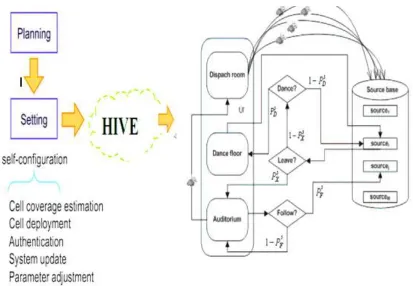
The Existing system
The current framework really influences
utilization of Honey bee to swarm
calculation to represent the Hive
demonstrate. The calculation utilized by
(Navrat et al, 2014) just inquiry through the
web utilizing Meta-watchwords as it were.
after with likelihood equivalent to the
quantity of honey bees moving for the
source partitioned by the quantity of all
moving honey bees (PSjf). With the contrary
likelihood the honey bee remains in the
assembly hall. On the off chance that the
honey bee does not pick any source inside
the predefined time (maximal time in
assembly room, past which starvation would
be fast approaching) she leaves the theater
and goes to the dispatch space to pick the
source from that point.
Figure 1.0: Architecture of Existing system (Navrat et al, 2014)
Drawbacks of Existing Framework includes
a. The model utilized as a part of the
current framework can not
characterize the conduct of the honey
bee outside the hive. This all
inclusive statement conveys a chance
to adjust the conduct of the
the issue area without the need to
alter the essential conduct of the
hive.
b. Non-ideal: Since swarm frameworks
are very excess and have no focal
control, they have a tendency to be
wasteful. The designation of assets is
not productive, and duplication of
exertion is constantly wild.
c. Uncontrollable: It is exceptionally
hard to practice control over a
swarm.
d. Unpredictable: The multifaceted
nature of a swarm framework
prompts unforeseeable outcomes.
The Hybrid Algorithm
The hybrid algorithm used in the proposed system comprises of Bee swarm and Breadth first algorithm, which tend to solve the crawling for information faster than the existing system. This hybrid algorithms crawl through the web using Normal search
directory, meta-keywords and search
keyword. The following algorithm illustrates the Hybrid algorithm in the proposed system functions and how it works:
a. Start
b. Initialize a crawling function by
entering a seed URL to it.
c. Fetch the URL and save its URL
keywords and page text in the database table called “Web data”.
d. Find the URL’s (links) to another
pages.
e. Calculate the link relevancy using
the following equation (page rank equation)
i.
PR(A)=(I-D)+D(PR(T1)/C(T1)+ …+PR (Tn)/C(Tn))
f. For each link in the queue
g. If the link rank>0.7 then initialize a new function (bee) to crawl this link Parameter Initialization
n = Number of employed bees m = Number of onlooker bees (m>n)
Iteration: Maximum iteration number αj: initial value of penalty parameter for jth agent
EC-Length: Length of ejection chain neighbourhood
Step: 1. Initialize employed bees with GRAH algorithm
σ i : ith employed bee in the population
Step: 2. Evaluate employed bees
Fitness Function (for minimization) Step: 3. Repeat Cycle = 1
Number of Scout bees = 0,1*n
For each Employed Bee
Apply SHIFT
Neighbourhood
If fit (Shift
Neighbour)<fit(Employed Bee) then
Employed Bee = Shift Neighbour
Apply DOUBLESHIFT
Neighbourhood
If fit (Double Shift
Neighbour)<fit(Employed Bee) then
Employed Bee = Double Shift Neighbour
Determine probabilities by using fitness function
P1 = ∑(1/ft)-1 ft
(for minimization)
Calculate the number of onlooker bees which will be sent to food sources of employed bees, according to previously determined probabilities
Ni= Number of onlooker bees sent to ith sites = pi*m
Oij: jth onlooker bee of ith solution (j=1,…,Ni)
{Oi1,
Oi2,…,OiNi}=EjectionChain(σ i )
Calculate fitness values for each onlooker bee
If the best fitness value of onlooker bees is better than the fitness value of employed bee, employed bee solution is replaced with this onlooker solution.
If (min (fit(Oij))<fit(σ i ) then σ i = Oij
If fit (BestCycle-1)> Min(Fit(σ i ))i=1..n then BestCycle=σ i
Else BestCycle= BestCycle-1 Until (i=n)
Step: 4. Scout bees
Initialize scout bees with GRAH algorithm
Step: 5. Cycle = Cycle+1 Until (cycle =Iteration) Go to H
h. Successful search through Breadth
first,
i. End for
j. End
Advantages of the Proposed System
The proposed system also uses Adaptive A* which is part of algorithm is the Best First Search algorithm.
1) It is use to search for the
shortest paths repeatedly.
2) It uses its experience with
earlier searches in the
sequence to speed up the current A* algorithm.
3) Search and run faster than
Repeated Forward A*
algorithm.
Figure 3.0: UML diagram for the Proposed system
4.0 Results and Discussion
Figure 4.1(b): Search Result of Proposed System
Figure 4.1(a) is showing the interface of the software model while the figure 4.1(b) illustrated the
used of the software to search and crawl for information.
Performance Evaluation
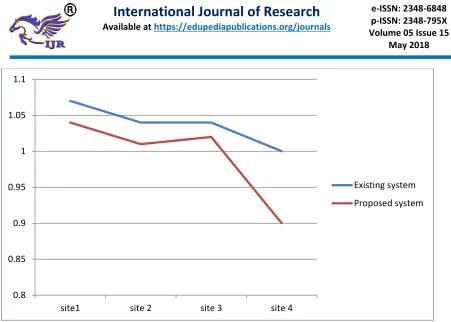
The result for selected tasks in comparing the Bee swarm algorithm and our Hybrid algorithm
are based on software quality assurance measurement called METRICS. These sites have been
crawled using the proposed bee algorithm and breadth first search and the result for crawling
speed for each sit was as follows
Table 1.0: Results of the Proposed System
Website (keywords) Time of bee algorithm
Crawling (Hive)
Time of Hybrid search
crawling
Pencover 1.07sec 1.04sec
Ojoma 1.04 1.01sec
Nairaland 1.04sec 1.02sec
Figure 4.2: Graph illustrating and comparing Existing and Proposed system
In the obvious chart the reader can recognize
that Hybrid algorithm crawling give a good
result in time than the Hive crawling. Now,
the second test is the test of crawled pages
relevancy by crawling the web for specific
subjects, so the user can input to the system
terms like ( Keywords: free, computer,
books, and download) with spaces between
each term, then press on “crawl the web
from Google directory”, this system will
crawl a sample of 5 sites , now repeat the
operation by using the last button “crawl
using Hybrid (breadth first search and hive).
5.0 Conclusion
This research reach to a good result when
using the hybridized swarm algorithm for
crawling a single web site in speed, and also
we have good results in crawling the web
0.8 0.85 0.9 0.95 1 1.05 1.1
site1 site 2 site 3 site 4
using keywords for a group of sites in sped
and relevancy of the crawled sites to the
desired topics, so the a swarm intelligence
can be viewed as a good improvement in
web crawling area.
Contribution to knowledge
1. We developed a Web-based Crawler
Using Bee Swarm Intelligent
Algorithm
2. We have designed a proposed model
using hybrid algorithm that gives
room for relatively fast search of
information within a short period of
time.
3. It can also be used to test the genuity
of a real website.
6.0 Recommendations
The work carried out in this research is
recommended to organizations both private
and public (e.g. surveillance, Universities,
E-government system etc.) that are looking
for a better and faster way to search for
information for proper used.
7.0 References
Akay, B (2013): A study on particle swarm
optimization and artificial bee colony
algorithms for multilevel thresholding,
Appl. Soft Computing. 13) 3066–3091.
Amir R. and Amir S ,(2012): Biology of
Spiders, 198 Madison Ave. NY, New York,
10016: Oxford University Press,
Bank K. M. and Passino H, (2013):
Biomimicry of bacterial foraging for
distributed optimization and control,
IEEE Control Syst. Mag. 22 (3), 52–67.
Bonabeau, M. Dorigo, G. and Theraulaz,
E(2014): “Swarm Intelligence: From
Natural to Artificial Systems”, New York,
Christopher O and Mark N, (2010): “web
crawling”, yahoo research, "An Idea Based
on Honey Bee Swarm For Numerical
Optimization" (PDF).
Christopher oilstone and Mark najork,(
2010): “web crawling”, yahoo research.
Chu W, X. Gao X, and Sorooshian S
(2011): Handling boundary con- straints
for particle swarm optimization in
high-dimensional search space, Inform. Sci. 181
(20) 4569–4581.
Das, P. N. Suganthan S, (2011):
Differential evolution: A survey of the
sate-of-the-art, IEEE Trans. Evol. Comput. 15
(1) 4–31
De Castro L.N. and F.J. Von Zuben, (2014):
“Artificial Immune Systems. Part I. Basic
Theory And Applications”, Technical
Report No. Rt Dca 01/99, Feec/Unicamp,
Brazil,.
Dorigo M and Birattori K. M. (2014):Ant
colony optimization for continuous
domains, European Journal of Operational
Research 185 (3), 1155–1173.
Drias H., Sadeg S., Yahi S.,(2005):
Cooperative Bees Swarm for Solving the
Maximum Weighted Satisfiability Problem,
IWAAN International Work Conference on
Artificial and Natural Neural Networks,
Barcelona, Spain, 318-325.
Farhoodnea, A. Mohamed, H. Shareef, H.
and Zayandehroodi M.(2014): Optimum
placement of active power conditioner in
distribu- tion systems using improved
discrete firefly algorithm for power quality
enhancement, Appl. Soft Comput. (23)249–
258.
Gianni, di carro,(2015) “introduction to
swarm intelligence”,
James, . R. L. and shareef H (2015) :"The
Evolution of the Organization of Work in
Social Insects" Monit. Zool. Ital. 20,
267-287.
Navrat, P. Drias H., Sadeg S., Yahi S
(2008): Web Search Engine Working as a
Bee Hive. Web Intelligence and Agent
Systems, 6:441 – 452,
James K, (2010): Particle swarm
optimization, In Encyclopedia of Machine
Learning,760–766.
karabog D (2005):A., “a comparative study
of artificial bee colony algorithm”,
ELSEVIER, www.elsevier.com/locate/amc,
2009.
Karaboga H. and Dervis G. (2015): "An Idea
Based on Honey Bee Swarm For Numerical
Optimization" (PDF).
Kennedy, R. C. Eberhart J (2013): “Particle
swarm optimization”, In Proceedings of the
IEEE International Conference on Neural
Networks” (4) 1942–1948.
Kirchmaier, S. Hawe, K. Diepold S (2013),
A swarm intelligence in- spired algorithm
for contour detection in images, Appl.
Soft Comput. 13(4) 3118–3129.
Lam, V. O. K. Li, J. J. Q. Yu A. Y. S.
(2013) Real-coded chemical reaction
optimization, IEEE Trans. Evol. Comput. 16
(3)339–353.
Liao T., Molina D., Stutzle T., Oca M. and
Dorigo M., (2012): An ACO algorithm
benchmarked on the bbob noiseless function
testbed, in: Proc. 14th Int. Conf. GECCO,
Philadelphia, U.S., 221-228.
Mallipeddi, R S. Mallipeddi, P. N.
Suganthan, M. Tasge- tiren, F.(2011):
Differential evolution algorithm with
ensemble of param- eters and mutation
strategies, Appl. Soft Comput. (11) 1679–
Mark Fleischer, (2012) “foundation of
swarm intelligence”, Institute of system
research, university of Maryland.
Mrco dorigo and Mauro birattari, (2014)
“swarm
intelligence”,http://www.scholarpedia.org/ar
ticle/swarm_intelligence,2007
Omkar, J. Senthilnath, R. Khandelwal,
G. N. Naik, S. Gopalakrishnan,(2011):
Artificial bee colony (abc) for multi-
objective design optimization of
composite structures, Appl. Soft Comput.
(11), 489–499.
Oster G, and Wilson E. O.(2015): "Castes
and Ecology in the Social Insects",
Princeton, NJ: Princeton University Press.
Parpinelli R.S, Lopes H.S, (2011): New
inspirations in swarm intelligence: a survey,
Int. J. Bio-Inspired Computation 3 (1), 1-16.
Pham D.T., Kog E., Ghanbarzadeh A., Otri
S., Rahim S., Zaidi M., (2006a) The Bees
Algorithm – A Novel Tool for Complex
Optimisation Problems, IPROMS 2006
Proceeding 2nd International Virtual
Conference on Intelligent Production
Machines and Systems, Oxford, Elsevier.
Pham D.T., Otri S., Ghanbarzadeh A., Kog
E.,(2006b) Application of the Bees
Algorithm to the Training of Learning
Vector Quantisation Networks for Control
Chart Pattern Recognition, ICTTA'06
Information and Communication
Technologies, 1624-1629.
Qin A. K. X. Li, (2013): Differential
evolution on the CEC-2013 single-
objective continuous optimization testbed,
in: Proc. IEEE Congress on Evolutionary
Computation (CEC), Cancun, Mexico,
Sandeep S. (2014):”web-crawling
approaches in search ”,Thapar university,
Patiala, India.
Schaber, S. N. Gorb, F. G. and Barth C. F.
(2012): Force transformation in spider
strain sensors: White light interferometry.,
J. Royal Society Interface 9 (71), 1254–126
Seeley T. D. and Visscher P.K.(2015):
“Assessing the benefits of cooperation in
honeybee foraging: search costs, forage
quality, and competitive ability”, Behav.
Ecol. Sociobiol., 22: 229-237.
Seyedali M., Seyed, M. M., and Andrew L.,
(2014): Grey wolf optimizer, Adv. Eng.
Software. 69, 46–61
Shiqin Y. and Yuji S. (2014): Fitness
predator optimizer to avoid premature
convergence for multimodal problems, In
Systems, Man and Cybernetics, IEEE
International Conference IEEE 258–263
Stoddard P. K., Salazar V. L., (2012):
Energetic cost of communication, The
Journal of Experimental Biology 2(14),
200-205.
Swagatam D., Arijit, B., Sambarta D., and
Ajith A. (2016): Bacterial foraging
optimization algorithm: theoretical
foundations, analysis, and applications, In
Foundations of Computational Intelligence
(3),23–55
Tereshko,V (2011): “Reaction-diffusion
model of a honeybee colony’s foraging
behaviour, M. Schoenauer, et al, Eds.,
Parallel Problem Solving from Nature VI”,
Lecture Notes in Computer Science,
Springer-Verlag: Berlin. 19(17), 807-816.
Vesterstrøm, J. Riget J. (2012): Particle
Swarms Extensions for improved local,
multi-modal, and dynamic search in
Wenping Z., Younlong Z., Hanning C. and
Zhu Z. (2010): “cooperative approaches to
artificial bee colony algorithm” ,
international conference on computer
application and system modeling, 23-45.
Xiaolei Li,(2013): A new intelligent
optimization-artificial fish swarm algorithm,
Doctor thesis,34-78.
Xin-She Y., (2010): A new metaheuristic
bat-inspired algorithm, In Nature inspired
cooperative strategies for optimization. 65–
74
Yang S., Jiang J., and Yan G., (2014): A
dolphin partner optimization, In Proceedings
of the 2009 WRI Global Congress on
Intelligent Systems 1(9), 124–128
Yim M., Zhang Y., and Duff .D. (2012):
Modular robots, IEEE Spectrum 39 (2),
30-34.
Yuhui S. (2011): Brain storm optimization
algorithm, In Advances in Swarm