An extended abstract of this paper appears in Moni Naor, editor, Advances in Cryptology – EURO-CRYPT 2007, volume 4515 of Lecture Notes in Computer Science, pages 573–590, Springer-Verlag, 2007. This is the full version.
Simulatable Adaptive Oblivious Transfer
Jan Camenisch1 Gregory Neven2,3 abhi shelat4
1IBM Research, Zurich Research Laboratory, CH-8803 R¨uschlikon
2 Katholieke Universiteit Leuven, Dept. of Electrical Engineering, B-3001 Heverlee 3 Ecole Normale Sup´erieure, D´epartement d’Informatique, 75230 Paris Cedex 05
4University of Virginia, Charlottesville, Virginia
Abstract
We study anadaptive variant of oblivious transfer in which a sender hasN messages, of which a receiver can adaptively choose to receivekone-after-the-other, in such a way that (a) the sender learns nothing about the receiver’s selections, and (b) the receiver only learns about thekrequested messages. We propose two practical protocols for this primitive that achieve a stronger security notion than previous schemes with comparable efficiency. In particular, by requiring full simulata-bility for both sender and receiver security, our notion prohibits a subtle selective-failure attack not addressed by the security notions achieved by previous practical schemes.
Our first protocol is a very efficient generic construction from unique blind signatures in the random oracle model. The second construction does not assume random oracles, but achieves remarkable efficiency with only a constant number of group elements sent during each transfer. This second construction uses novel techniques for building efficient simulatable protocols.
1
Introduction
Theoblivious transfer(OT) primitive, introduced by Rabin [Rab81], and extended by Even, Goldreich, and Lempel [EGL85] and Brassard, Cr´epeau and Robert [BCR87] is deceptively simple: there is a sender S with messages M1, . . . ,MN and a receiver R with a selection value σ ∈ {1, . . . , N}. The
receiver wishes to retrieve Mσ from S in such a way that (1) the sender does not “learn” anything
about the receiver’s choice σ and (2) the receiver “learns” only Mσ and nothing about any other message Mi for i 6= σ. Part of the allure of OT is that it is complete, i.e., if OT can be realized,
virtually any secure multiparty computation can be [GMW87, CK90].
In this paper, we consider anadaptiveversion of oblivious transfer in which the sender and receiver first run an initialization phase during which the sender commits to a “database” containing her messages. Later on, the sender and receiver interact up to k times allowing the receiver to retrieve up to k messages of its choice from the sender’s database. Notice here that we specifically model the situation in which the receiver’s selection in the ith phase can depend on the messages retrieved in the prior i−1 phases. This type of adaptive OT problem is central to a variety of practical problems such as patent searches, treasure hunting, location-based services, oblivious search, and medical databases [NP99b].
initialization phase (so that the sender commits to theN messages), and an amount of communication ofO(max(κ,logN)) during each transfer phase (so that the receiver can use cryptography and encode the index of his choice).1 In the race to achieve these efficiency parameters, however, we must also not overlook—or worse, settlefor less-than-ideal security properties.
1.1 Security Definitions of Oblivious Transfer
An important contribution of this work is that it achieves a stronger simulation-based security notion at very little cost with respect to existing schemes that achieve weaker notions. We briefly summarize the various security notions for OT presented in the literature, and how our notion extends them.
Honest-but-curious model. In this model, all parties are assumed to follow the protocol honestly.
Security guarantees that after the protocol completes, a curious participant cannot analyze the tran-script of the protocol to learn anything else. Any protocol in the honest-but-curious model can be transformed into fully-simulatable protocols, albeit at the cost of adding complexity assumptions and requiring costly general zero-knowledge proofs for each protocol step.
Half-simulation. This notion, introduced by Naor and Pinkas [NP05], considers malicious senders
and receivers, but handles their security separately. Receiver security is defined by requiring that the sender’s view of the protocol when the receiver chooses index σ is indistinguishable from a view of the protocol when the receiver chooses σ′. Sender security, on the other hand, involves a stronger notion. The requirement follows the real-world/ideal-world paradigm and guarantees that any mali-cious receiver in the real world can be mapped to a receiver in an idealized game in which the OT is implemented by a trusted party. Usually, this requires that receivers are efficiently “simulatable,” thus we refer to this notion as half-simulation.
The Problem of Selective Failure. We argue that the definition of half-simulation described
above does not imply all properties that one may expect from an adaptive k-out-ot-of-n OT. Notice that a cheating sender can always make the current transfer fail by sending bogus messages. However, we would not expect him to be able to cause failure based on some property of the receiver’s selection. Of course, the sender can also prevent the receiver from retrieving Mσ by replacing it with a random
value during the initialization phase. But again, the sender should not be able to make this decision anew at each transfer phase. For example, the sender should not be able to make the first transfer fail for σ = 1 but succeed for σ ∈ {2, . . . , N}, and to make the second transfer fail for σ = 2 but succeed for σ ∈ {1,3, . . . , N}. The receiver could publicly complain whenever a transfer fails, but by doing so it gives up the privacy of its query. Causing transfers to fail may on the long term harm the sender’s business, but relying on such arguments to dismiss the problem is terribly naive. A desperate patent search database may choose to make faster money by selling a company’s recent queries to competitors than by continuing to run its service.
We refer to this issue as the selective-failure problem. To see why it is not covered by the half-simulation notion described above, it suffices to observe that the notion of receiver security onlyhides the message received by the receiver from the cheating sender’s view. A scheme that is vulnerable to selective-failure attacks does not give the cheating sender any additional advantage in breaking the receiver’s privacy, and may therefore be secure under such a notion. (This illustrates the classic argument from work in secure multiparty computation that achieving just privacy is not enough; both privacy and correctness must be achieved simultaneously.) In fact, the schemes of [NP05] are secure under half-simulation, yet vulnerable to selective-failure attacks. In an earlier version [NP99b], the 1In practice, we assume that κ >log(N)—so that the protocol can encode the receiver’s selection—but otherwise
that κis chosen purely for the sake of security. In this sense,O(κ) is both conceptually and practically different than
same authors recognize this problem and remark that it can be fixed, but do not give formal support of their claim. A main contribution of this work is to show that it can be done without major sacrifices in efficiency.
Simulatable OT.The security notion that we consider employs the real-world/ideal-world paradigm
for both receiver and sender security. We extend the functionality of the trusted party such that at each transfer, the sender inputs a bit b indicating whether it wants the transfer to succeed or fail. This models the capability of a sender in the real world to make the transfer fail by sending bogus messages, but does not enable it to do so based on the receiver’s input σ. Moreover, for security we require indistinguishability of the combined outputs of the sender and the receiver, rather than only of the output of the dishonest party. The output of the honest receiver is assumed to consist of all the messages Mσ1, . . . ,Mσk that it received. This security notion excludes selective-failure attacks in
the real world, because the ideal-world sender is unable to perform such attacks, which will lead to noticeable differences in the receiver’s output in the real and ideal world.
Finally, we observe that simulatable oblivious transfer is used as a primitive to build many other cryptographic protocols [Gol04]. By building an efficient OT protocol with such simulation, we take the first steps at realizing many other interesting cryptographic protocols.
1.2 Construction Overview
Our random-oracle protocol. Our first construction is a black-box construction using any
unique blind signature scheme. Byunique, we mean that for all public keys and messages there exists at most one valid signature. First, the sender generates a key pair (pk,sk) for the blind signature scheme, and “commits” to each message in its database by xor-ing the message Mi with H(i,si),
where si is the unique signature of the message i under pk. Intuitively, we’re using si as a key to
unlock the message Mi. To retrieve the “key” to a message Mi, the sender and receiver engage in
the blind signature protocol for messagei. By the unforgeability of the signature scheme, a malicious receiver will be unable to unlock more than k such messages. By the blindness of the scheme, the sender learns nothing about which messages have been requested.
The random oracle serves four purposes. First, it serves as a one-time pad to perfectly hide the messages. Second, it allows a simulator to extract the sender’s original messages from the commitments so that we can prove receiver-security. Third, in the proof of sender-security, it allows the simulator to both extract the receiver’s choice and, via programming the random oracle, to make the receiver open the commitment to an arbitrary message. Finally, it allows us to extract forgeries of the blind signature scheme from a malicious receiver who is able to break sender-security.
Our standard-model protocol. There are three main ideas behind the standard protocol in§4.
At a very high level, just as in the random oracle protocol, the sender uses a unique signature of i
as a key to encrypt Mi in the initialization phase. However, unlike the random-oracle protocol, we
observe here that we only need a blind signature scheme which allows signatures on a small, a-priori fixedmessage space {1, . . . , N}.
The second idea concerns the fact that after engaging in the blind-signing protocol, a receiver can easily check whether the sender has sent the correct response during the transfer phase by verifying the signature it received. While seemingly a feature, this property becomes a problem during the simulation of a malicious receiver. Namely, the simulator must commit to N random values during the initialize phase, and later during the transfer phase, open any one of these values to an arbitrary value (the correct message Mi received from the trusted party during simulation). In the random
when it opens the commitment. This is not possible in our OT setting since the sender does not know which commitment is being opened.
Our solution is to modify the “blind-signing” protocol so that, instead of returning a signature to the user, a one-way function (a bilinear pairing in our case) of the signature is returned. To protect against a malicious sender, the sender then proves in zero-knowledge that the value returned is computed correctly. In the security proof, we will return a random value to the receiver and fake the zero-knowledge proof.
The final idea behind our construction concerns a malicious receiver who may use an invalid input to the “blind-signature protocol” in order to, say, retrieve a signature on a value outside of{1, . . . , N}. This is a real concern, since such an attack potentially allows a malicious receiver to learn the product
Mi·Mj which violates the security notion. In order to prevent such cheating, we require the receiver
to prove in zero-knowledge that (a) it knows the input it is requesting a signature for, and (b) that the input is valid for the protocol. While this is conceptually simple, the problem is that the size of such a theorem statement, and therefore the time and communication complexity of such a zero-knowledge proof, could potentially be linear inN. For our stated efficiency goals, we need a proof of constant size. To solve this final problem, we observe that the input to the blind signature process is a small set—i.e., only hasN possible values. Thus, the sender can sign allN possible input messages (using a different signing key x) to the blind signature protocol and publish them in the initialization phase. During the transfer phase, the receiver blinds one of these inputs and then gives a zero-knowledge proof of knowledge that it knows a signature of this blinded input value. Following the work of Camenisch and Lysyanskaya [CL04], there are very efficient proofs for such statements which are constant size.
Finally, in order to support receiver security, the sender provides a proof of knowledge of the “commitment key” used to commit to its input message. This key can thus be extracted from the proof of knowledge and use it to compute messages to send to the trusted party.
1.3 Related Work
The concept of oblivious transfer was proposed by Rabin [Rab81] (but considered earlier by Wies-ner [Wie83]) and further geWies-neralized to one-out-of-two OT (
OT
21) by Even, Goldreich and Lem-pel [EGL85] and one-out-of-N OT (OT
N1 ) by Brassard, Cr´epeau and Robert [BCR87]. A complete history of the work on OT is beyond our scope. In particular, here we do not mention constructions of OT which are based on generic zero-knowlege techniques or setup assumptions. See Goldreich [Gol04] for more details.Bellare and Micali [BM90] presented practical implementations of
OT
21 under the honest-but-curious notion and later Naor and Pinkas [NP01] did the same under the half-simulation definition. Brassard et al. [BCR87] showed how to implementOT
N1 using N applications of aOT
21 protocol. Under half-simulation, Naor and Pinkas [NP99a] gave a more efficient construction requiring only logNOT
21 executions. Several direct 2-messageOT
N1 protocols (also under half-simulation) have been proposed in various works [NP01, AIR01, Kal05].The first adaptive k-out-of-N oblivious transfer (
OT
Nk×1) protocol was proposed by Naor and Pinkas [NP99b]. Their scheme is secure under half-simulation and involves O(logN) invocations of aIn the random oracle model, Ogata and Kurosawa [OK04] and Chu and Tzeng [CT05] propose two efficient
OT
Nk×1schemes satisfying half-simulation which requireO(k) computation and communication during the transfer stage. Our first genericOT
Nk×1construction based on unique blind signatures covers both schemes as special cases, offers full simulation-security, and fixes minor technical problems to prevent certain attacks. Prior to our work, Malkhi and Sella [MS03] observed a relation between OT and blind signatures, but did not give a generic transformation between the two. They present a directOT
N1 protocol (also in the random oracle model) based on Chaum’s blind signatures [Cha88]. Their scheme could be seen as aOT
Nk×1 protocol as well, but it has communication complexity O(κN) in the transfer phase. Their scheme is not an instantiation of our generic construction.
OT
Nk×1 can always be achieved by publishing commitments to theN data items, and executing k
OT
N1 protocols on the N pieces of opening information. This solution incurs costs of O(κN) in each transfer phase.Naor and Pinkas [NP05] demonstrate a way to transform a singe-server private-information re-trieval scheme (PIR) into an oblivious transfer scheme with sublinear-in-N communication complexity. This transformation is in the half-simulation model and the dozen or so constructions of OT from PIR seem to also be in this model. Moreover, there are no adaptive PIR schemes known.
2
Definitions
If k ∈ N, then 1k is the string consisting of k ones. The empty string is denoted ε. If A is a randomized algorithm, theny←$ A(x) denotes the assignment toy of the output ofAon inputxwhen run with fresh random coins. Unless noted, all algorithms are probabilistic polynomial-time (PPT) and we implicitly assume they take an extra parameter 1κ in their input. A function ν:N→[0,1] is
negligible if for all c∈Nthere exists a κc ∈Nsuch thatν(κ)< κ−c for allκ > κc.
2.1 Blind Signatures
A blind signature scheme
BS
is a tuple of PPT algorithms (Kg,Sign,User,Vf). The signer generates a key pair via the key generation algorithm (pk,sk)←$ Kg(1κ). To obtain a signature on a message m, the user and signer engage in an interactive signing protocol dictated by the User(pk,m) andSign(sk) algorithms. At the end of the protocol, the User algorithm returns a signature s or ⊥ to indicate rejection. The verification algorithm Vf(pk,m,s) returns 1 if the signature is deemed valid and 0 otherwise. Correctness requires that Vf(pk,m,s) = 1 for all (pk,sk) output by the Kgalgorithm, for all m ∈ {0,1}∗ and for all signatures output by User(pk,m) after interacting withSign(sk). We say thatBS
isunique [GO92] if for each public keypk ∈ {0,1}∗ and each messagem ∈ {0,1}∗ there exists at most one signatures ∈ {0,1}∗ such thatVf(pk,m,s) = 1.The security of blind signatures is twofold. On the one hand, one-more unforgeability [PS96] requires that no adversary can outputn+ 1 valid message-signature pairs after being given the public key as input and after at most ninteractions with a signing oracle. We say that
BS
is unforgeable if no PPT adversary has non-negligible probability of winning this game.the protocol fail for votes for John Kerry, but let it proceed normally for votes for George W. Bush. Affected Kerry voters could complain, but by doing so they give up the privacy of their vote.
Selective-failure blindness is defined through the following game. The adversary first outputs a public key pk and two messages m0,m1. It is then given black-box access to two instances of the user algorithm, the first implementing User(pk,mb) and the second implementing User(pk,m1−b) for
a random bitb← {0$ ,1}. Eventually, these algorithms produce local outputsb and s1−b, respectively.
Ifsb6=⊥and s1−b6=⊥, then the adversary is given the pair (s0,s1); ifsb =⊥ands1−b 6=⊥, then it is
given (⊥, ε); ifsb6=⊥ands1−b =⊥, then it is given (ε,⊥); and ifsb=s1−b=⊥it is given (⊥,⊥). (It is here that our definition is stronger than the existing ones: in the existing definition, the adversary is simply given ⊥if either algorithm fails.) The adversary then guesses the bit b. The scheme
BS
is said to be selective-failure blind if no PPT adversary has a non-negligible advantage in winning the above game.2.2 Simulatable Adaptive Oblivious Transfer
An adaptive k-out-of-N oblivious transfer scheme
OT
Nk×1 is a tuple of four PPT algorithms (SI,RI,
ST,RT). During the initialization phase, the sender and receiver perform an interactive protocol where the sender runs theSIalgorithm on input messages M1, . . . ,MN, while the receiver runs theRI algorithm without input. At the end of the initialization protocol, theSIand RIalgorithm produce as local outputs state informationS0 andR0, respectively. During thei-th transfer, 1≤i≤k, the sender and receiver engage in a selection protocol dictated by the ST and RT algorithms. The sender runs
ST(Si−1) to obtain updated state information Si, while the receiver runs the RT(Ri−1, σi) algorithm on input state information Ri−1 and the index σi of the message it wishes to receive, to obtain
updated state information Ri and the retrieved message Mσ′i. Correctness requires that M
′
σi = Mσi
for all messages M1, . . . ,MN, for all selections σ1, . . . , σk ∈ {1, . . . , N} and for all coin tosses of the
algorithms.
To capture security of an
OT
Nk×1 scheme, we employ the real-world/ideal-world paradigm. Below, we describe a real experiment in which the parties run the protocol, while in the ideal experiment the functionality is implemented through a trusted third party. For the sake of simplicity, we do not explicitly include auxiliary inputs to the parties. This can be done, and indeed must be done for sequential composition of the primitive, and our protocols achieve this notion as well.Real experiment. We first explain the experiment for arbitrary sender and receiver algorithms bS
andRb. The experimentRealbS,bR(N, k,M1, . . . ,MN, σ1, . . . , σk) proceeds as follows. bSis given messages
(M1, . . . ,MN) as input and interacts with Rb without input. In their first run, bS and bR produce
initial states S0 and R0 respectively. Next, the sender and receiver engage in k interactions. In the i-th interaction for 1 ≤ i ≤ k, the sender and receiver interact by running Si
$
← bS(Si−1) and (Ri,Mσ′i)
$
← Rb(Ri−1, σi), where σi ∈ {1, . . . , N} is a message index. Both algorithms update their
states to Si and Ri, respectively. Note that Mσ′i may be different from Mσi when either participant
cheats. At the end of thek-th interaction, sender and receiver output strings Sk and Rk respectively. The output of theRealbS,Rb experiment is the tuple (Sk,Rk).
For an
OT
Nk×1 scheme (SI,ST,RI,RT), define the honest sender S algorithm as the algorithm that runs SI(M1, . . . ,MN) in the initialization phase, runs ST in all following interactions, and always outputs Sk = ε as its final output. Define the honest receiver R as the algorithm which runs RI in the initialization phase, runs RT(Ri−1, σi) and in the i-th interaction, and returns the list of received
messagesRk = (Mσ′1, . . . ,Mσ′
k) as its final output.
Ideal experiment. In experiment IdealbS′,R′b(N, k,M1, . . . ,MN, σ1, . . . , σk), the (possibly cheating)
T. In each of the k transfer phases, T receives a bitbi from the sender bS′ and an index σ′
i from the
(possibly cheating) receiver Rb′(σi). If bi = 1 and σ′i ∈ {1, . . . , N}, then T hands Mσ′′
i to the receiver;
otherwise, it hands ⊥ to the receiver. At the end of the k-th transfer, bS′ and Rb′ output a string Sk
and Rk; the output of the experiment is the pair (Sk,Rk).
As above, define the ideal senderS′(M1, . . . ,MN) as the algorithm that sends messagesM1, . . . ,MN
to the trusted party in the initialization phase, sendsbi = 1 in all transfer phases, and outputsSk=ε
as its final state. Define the honest ideal receiver R′ as the algorithm that at each transfer submits the real selection index σi to the trusted party, and that outputs the list of all received messages
Rk= (Mσ′1, . . . ,Mσ′k) as its final state.
Note that the sender’s bit bi models its ability to make the current transfer fail. However, the
sender’s decision to do so is independent of the index σ′i that is being queried by the receiver. This captures the strongest notion of “coherence” as envisaged by [LL06], and excludes schemes like [NP99b] that allow the sender to cause selective failure.
Sender security. We say that
OT
Nk×1 is sender-secure if for any PPT real-world cheating receiverb
R there exists a PPT ideal-world receiver Rb′ such that for any polynomial Nm(κ), any N ∈
{1, . . . , Nm(κ)}, any k ∈ {1, . . . , N}, any messages M1, . . . ,MN, and any indices σ1, . . . , σk ∈
{1, . . . , N}, the advantage of any PPT distinguisher in distinguishing the distributions
RealS,Rb(N, k,M1, . . . ,MN, σ1, . . . , σk) and IdealS′,bR′(N, k,M1, . . . ,MN, σ1, . . . , σk)
is negligible inκ.
Receiver security. We say that
OT
Nk×1 is receiver-secure if for any PPT real-world cheating senderb
S there exists a PPT ideal-world sender bS′ such that for any polynomial Nm(κ), any N ∈
{1, . . . , Nm(κ)}, any k ∈ {1, . . . , N}, any messages M1, . . . ,MN, and any indices σ1, . . . , σk ∈
{1, . . . , N}, the advantage of any PPT distinguisher in distinguishing the distributions
RealbS,R(N, k,M1, . . . ,MN, σ1, . . . , σk) and IdealbS′,R′(N, k,M1, . . . ,MN, σ1, . . . , σk) is negligible inκ.
3
A Generic Construction in the Random Oracle Model
In this section, we describe a generic yet very efficient way of constructing adaptive k-out-of-N OT schemes from unique blind signature schemes, and prove its security in the random oracle model.
3.1 The Construction
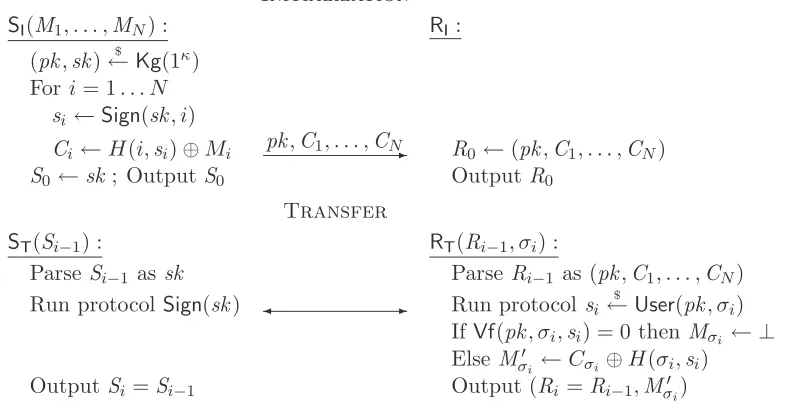
To any unique blind signature scheme
BS
= (Kg,Sign,User,Vf), we associate theOT
Nk×1 scheme as depicted in Figure 1. The security of the oblivious transfer scheme follows from that of the blind signature scheme. In particular, Theorem 3.1 states that sender security is implied by the one-more unforgeability ofBS
, while Theorem 3.2 states that receiver security follows from the selective-failure blindness ofBS
. Note that correctness follows from the uniqueness ofBS
.Theorem 3.1 If the blind signature scheme
BS
is unforgeable, then theOT
Nk×1 depicted in Figure 1 is sender-secure in the random oracle model.Initialization
SI(M1, . . . ,MN) : RI: (pk,sk)←$ Kg(1κ)
For i= 1. . . N
si ←Sign(sk, i)
Ci ←H(i,si)⊕Mi pk,C1, . . . ,C-N R0 ←(pk,C1, . . . ,CN)
S0 ←sk ; OutputS0 Output R0
Transfer
ST(Si−1) : RT(Ri−1, σi) :
Parse Si−1 assk Parse Ri−1 as (pk,C1, . . . ,CN)
Run protocol Sign(sk) - Run protocol si $
←User(pk, σi)
If Vf(pk, σi,si) = 0 thenMσi ← ⊥
Else Mσ′i ←Cσi⊕H(σi,si)
Output Si=Si−1 Output (Ri =Ri−1,Mσ′i)
Figure 1: A construction of
OT
Nk×1 using a random oracleH and any unique blind signature schemeBS
= (Kg,Sign,User,Vf).random stringsC1, . . . ,CN
$
← {0,1}ℓ. It then feeds the string (pk,C1, . . . ,CN) as input toRbto obtain
initial stateR0.
During the transfer phase, when bRengages in a transfer protocol, bR′ simulates the honest sender by executing the blind signature protocol as prescribed bySign(sk). To answer random oracle queries,Rb′
maintains an initially empty associative array HT[·] and a counter ctr. When Rb performs a random oracle query H(x),Rb′ responds with HT[x], or proceeds as follows if this entry is undefined:
Ifx= (i, s) and Vf(pk, i, s) = 1 andi∈[1, N] then ctr ←ctr + 1 ; Ifctr > k then abort
Obtain Mi from the ideal functionality HT[x]←Mi⊕Ci
else HT[x]← {0$ ,1}ℓ .
When eventually Rb outputs its final state Rk, Rb′ halts with the same outputRk. The running time
t′ of Rb′ is that of bRplus the time of a key generation, k signing interactions and up to qH signature verifications. It is clear that if Rb′ does not abort, then Rb′ provides Rb with a perfect simulation of the RealS,bR(N, k,M1, . . . ,Mk, σ1, . . . , σk) experiment, so no distinguisher D has advantage greater than
zero in distinguishing RealS,Rb fromIdealS′,bR′.
Theorem 3.2 If the blind signature scheme
BS
is selective-failure blind, then theOT
Nk×1 scheme depicted in Figure 1 is receiver-secure in the random oracle model.Proof: We have to show that for any real-world cheating senderbS, there exists an ideal-world sender
b
S′ whose output is indistinguishable from that of bS. Consider the ideal-world senderbS′ that on input (M1, . . . ,MN) runs bS(M1, . . . ,MN), simulating its random oracle queries by returning random values.
Let (pk, C1, . . . , CN) be the outgoing message produced by bS during the initialization phase. For all
random oracle queries H(i,s) with 1 ≤ i≤ N made by bS, bS′ checks whether Vf(pk, i,s) = 1. If so, then it setsMi′ ←Ci⊕H(i,s). For all 1≤j≤N such thatMj′ has not been defined by this procedure,
it assigns a random valueMj′← {0$ ,1}ℓ. Algorithm bS′ submits (M′
1, . . . ,MN′ ) to the trusted party.
To subsequently handle thektransfers,bS′setsR0 ←(pk,C1, . . . ,CN) and at thei-th transfer simulates
the environment of bS by running Ri ← RT(Ri−1,1), i.e., by always running the honest receiver that queries for the message with index one. Remember thatbS′is not given the selection indices (σ1, . . . , σk)
as input, so it cannot run RT on the real index σi. If the output of RT is ⊥, then bS′ sends bi = 0 to
the trusted party, indicating that this query should be aborted; otherwise, it sends bi = 1. Random
oracle queries of the formH(i,s) with 1≤i≤N andVf(pk, i,s) = 1 in this phase are answered with
Ci⊕Mi′; all other random oracle queries are answered with random values. At the end of the k-th
query, bSoutputs its final state Sk; the ideal sender bS′ outputs the same stringSk.
We use a hybrid proof to analyze the advantage of an algorithm Din distinguishing betweenRealbS,R and IdealbS′,R′. For 0≤i≤k, letbS′i be an algorithm that simulates the environment ofbSin a similar
way asbS′, but that usesRi ←$ RT(Ri−1,1) for the firstitransfers, and that usesRi $
←RT(Ri−1, σi) for the remainingk−itransfers. Let the output of experimentGame-icontain the final states ofbS′iand of the honest ideal-world receiverR′(σ1, . . . , σk) after interacting with each other through a trusted party
Tas in the ideal experiment. It is easy to see thatGame-0=Realb
S,Rand thatGame-k=IdealbS′,R′. If there exists an algorithm D that distinguishes betweenRealbS,R and IdealbS′,R′ with non-negligible advantageǫ, then there must exist an index 0≤i≤ksuch thatDdistinguishes betweenGame-iand Game-(i+1) with probability at leastǫ/k.
Given this distinguisher D, we show how to construct an adversary A against the selective-failure blindness of
BS
. Algorithm A runs bS, answering random oracle queries and extracting messages M1, . . . ,MN in the same way as described for bS′. It simulates the j-th transfer for 1 ≤ j ≤ i using RT(·,1), setting Mj′ = Mσj if the transfer succeeds, and setting Mj′ = ⊥ if it doesn’t. For the(i+ 1)-st transfer A uses its first user oracle to simulate the receiver. More particularly, it outputs pk,m0 =σi,m1 = 1 as the public key and messages on which it wishes to be challenged, and relays messages betweenbSand its first oracle that implementsUser(pk,mb) for some hidden valueb∈ {0,1}. With the second oracle, that implementsUser(pk,m1−b), it interacts in an arbitrary way (most likely causing it to fail) until it receives signatures (s0,s1). Ifs0 =⊥then it setsMi′+1=⊥, otherwise it sets Mi′+1 =Mσi+1. For the remaining transfersi+ 2≤ j ≤ k, it uses RT(·, σj) to simulate the receiver, settingMj′=Mσj if the transfer succeeds andMj′ =⊥if it doesn’t. WhenbSoutputs its final state Sk, A feeds the tuple (Sk,(M1′, . . . ,Mk′)) to D. One can check that if b= 0 then this tuple is distributed
according to Game-i, while if b = 1 then it is distributed according to Game-(i+1). Algorithm A
therefore can therefore use D’s output to win the blindness game with advantage at least ǫ/k.
3.2 Instantiations
two-round schemes, yielding round-optimal adaptive oblivious transfer protocols.
The instantiation of our generic construction with Chaum’s blind signature scheme coincides with the direct OT scheme of Ogata-Kurosawa [OK04]. However, special precautions must be taken to ensure that Chaum’s scheme is selective-failure blind. For example, the sender must use a prime exponent e greater than the modulus n [ANN06], or must provide a non-interactive proof that gcd(e, n) = 1 [CPP06].2 The authors of [OK04] overlooked this need, leading to easy attacks on the receiver security of their protocol. For example, a cheating sender could choose e= 2 and distin-guish between transfers forσi and σi′ for which H(σi) is a square modulonand H(σ′i) is not.
When instantiated with Boldyreva’s blind signature scheme [Bol03] based on pairings, our generic construction coincides with the direct OT scheme of Chu-Tzeng [CT05]. A similar issue concerning the dishonest-key blindness of the scheme arises here, but was also overlooked. The sender could for example choose the group to be of non-prime order and break the receiver’s security in a similar way as demonstrated above for the scheme of [OK04]. One can strengthen Boldyreva’s blind signature scheme to provide selective-failure blindness by letting the user algorithm check that the group is of prime order and that the generator is of full order.
3.3 Oblivious Keyword Search
Oblivious keyword search [CGN98, OK04] is a generalization of oblivious transfer where messages are indexed by keywords rather than by consecutive numbers. The sender owns a database of message-keyword pairs (M1, w1), . . . ,(MN, wN). (We can assume without loss of generality that every keyword
appears at most once.) At each transfer, the receiver chooses a keyword w, and receives Mi ifw=wi
for some 1≤i≤N, or receives⊥otherwise. The receiver does not learn any other information about the database, and the sender does not learn anything about the receiver’s selection w.
The oblivious transfer protocol of Figure 1 can be easily modified into an oblivious keyword search protocol by signing keywords instead of index numbers, i.e., by takingsi←Sign(sk, wi). Messages are
encrypted as Ci ←H(wi,si) ⊕ 02κkMi. In the transfer phase, the receiver obtains a blind signature
s on keyword w, and for all 1≤i≤N computes Ci⊕H(w,s) until the first 2κ bits of the obtained
bitstring are all zeroes. Instantiating our generic construction with Chaum’s blind signatures yields the oblivious keyword search scheme due to Ogata-Kurosawa [OK04], instantiating with Boldyreva’s blind signature scheme yields a new oblivious keyword search scheme based on the one-more CDH assumption.
The reason for padding messages with 2κzeroes instead ofκis the following. Suppose messages are padded with ℓzeroes to detect correct decryption. If a cheating sender can come up with w, s, w′, s′
so that the firstℓbits ofH(w, s) andH(w′, s′) are the same, then the same ciphertextC will decrypt correctly under both w and w′. In the proof of receiver security, the ideal-world sender can then no longer extract a unique decryption ofC, because there are now two different possibilities. We therefore need finding collisions on the first ℓ bits of the hash output to be hard, so by the birthday paradox we needℓ= 2κ to obtain O(2κ) security.
4
Simulatable Adaptive OT in the Standard Model
4.1 Preliminaries
Computational assumptions. Our protocol presented in this section requires bilinear groups and
2Anna Lysyanskaya suggested to let the receiver sendeto the sender. This solution is much more efficient than the
previous two, but would require re-proving the security of theOTNk×1 scheme since it is no longer an instance of our
associated hardness assumptions. Let Pg be a pairing group generator that on input 1κ outputs descriptions of multiplicative groupsG1,GT of prime orderpwhere|p|=κ. LetG∗
1 =G1\ {1}and let
g∈G∗
1. The generated groups are such that there exists an admissible bilinear mape:G1×G1 →GT, meaning that (1) for alla, b∈Zp it holds thate(ga, gb) =e(g, g)ab; (2)e(g, g)6= 1; and (3) the bilinear
map is efficiently computable.
Definition 4.1 [Strong Diffie-Hellman Assumption [BB04]] We say that theℓ-SDH assumption asso-ciated to a pairing generatorPgholds if for all PPT adversariesA, the probability thatA(g, gx, . . . , gxℓ) where (G1,GT)←$ Pg(1κ),g←$ G∗
1 and x $
←Zp, outputs a pair (c, g1/(x+c)) wherec∈Zp is negligible
inκ.
Definition 4.2 [Power Decisional Diffie-Hellman Assumption] We say that the ℓ-PDDH assumption associated toPgholds if for all PPT adversaries A, the probability thatAon input (g, gx, gx2, . . . , gxℓ, H) where (G1,GT)←$ Pg(1κ),g←$ G∗
1,x $
←Zp,H←$ GT, distinguishes the vectorT = (Hx, Hx2, . . . ,
Hxℓ) from a random vector T ←$ Gℓ
T is negligible inκ.
Evidence of the hardness of this new problem is presented in Appendix C.
Boneh-Boyen signatures. We use the following slight modification of the weakly-secure signature
scheme by Boneh and Boyen [BB04]. The scheme uses a pairing generator Pg as defined above. The signer’s secret key is x ←$ Zp, the corresponding public key is (g, y = gx) where g is a random
generator of G1. The signature on a message m is s ← g1/(x+m)
; verification is done by checking that e(s, y ·gm
) = e(g, g). This scheme is similar to the Dodis and Yampolskiy verifiable random function [DY05].
Security underweak chosen-message attack is defined through the following game. The adversary begins by outputting ℓ messagesm1, . . . ,mℓ. The challenger generates a fresh key pair and gives the
public key to the adversary, together with signaturess1, . . . ,sℓonm1, . . . ,mℓ. The adversary wins if it
succeeds in outputting a valid signature s on a messagem 6∈ {m1, . . . ,mℓ}. The scheme is said to be
unforgeable under weak chosen-message attack if no PPT adversary A has non-negligible probability of winning this game. An easy adaptation of the proof of [BB04] can be used to show that this scheme is unforgeable under weak chosen-message attack if the (ℓ+ 1)-SDH assumption holds. The proof is provided in Appendix A for completeness.
Zero-knowledge proofs and Σ-protocols. We use definitions from [BG92, CDM00]. A pair of
interacting algorithms (P,V) is a proof of knowledge (PoK) for a relation R ={(α, β)} ⊆ {0,1}∗× {0,1}∗ with knowledge errorκ∈[0,1] if (1) for all (α, β)∈R,V(α) accepts a conversation with P(β) with probability 1; and (2) there exists an expected polynomial-time algorithmE, called theknowledge extractor, such that if a cheating proverPb has probabilityǫof convincing Vto acceptα, thenE, when given rewindable black-box access toPb, outputs a witnessβ forα with probability ǫ−κ.
A proof system (P,V) is perfect zero-knowledge if there exists a PPT algorithm Sim, called the simulator, such that for any polynomial-time cheating verifier Vb and for any (α, β) ∈ R, the output of Vb(α) after interacting withP(β) and the output ofSimVb(α)(α) are identically distributed.
A Σ-protocol is a proof system (P,V) where the conversation is of the form (a, c, z), where a
and z are are computed by P, and c is a challenge chosen at random by V. The verifier accepts if
φ(α, a, c, z) = 1 for some efficiently computable predicateφ. Given two accepting conversations (a, c, z) and (a, c′, z′) forc6=c′, one can efficiently compute a witness β. Moreover, there exists a polynomial-time simulator Simthat on inputα and a random string coutputs an accepting conversation (a, c, z) forα that is perfectly indistinguishable from a real conversation between P(β) and V(α).
Initialization
SI(1κ,M1, . . . ,M
N) : RI(1κ) :
(G1,GT)←$ Pg(1κ)
g, h←$ G∗
1; H ←e(g, h)
x←$ Zp; y←gx; pk ←(g, H, y)
Fori= 1, . . . , N do Ai ←g1/(x+i) Bi←e(h, Ai)·Mi
Ci←(Ai, Bi) pk, C1, . . . , CN
-S0←(h,pk) PoK{(h) : H =e(g, h)-} R0←(pk,C1, . . . ,CN)
Transfer
ST(Si−1) : RT(Ri−1, σi) :
v←$ Zp; V ←(Aσ
i)
v
V
PoK{(σi, v) :e(V, y) =e(V, g)−σie(g, g)v}
W ←e(h, V) W
-PoM{(h) :H =e(g, h)∧W =e(h, V)}
-Si=Si−1 M ←Bσi/(W
1/v) Ri=Ri−1
Figure 2: Our
OT
Nk×1 protocol in the standard model associated to pairing generatorPg. We use notation by Camenisch and Stadler [CS97] for the zero-knowledge protocols. They can all be done efficiently (in four rounds andO(κ) communication) by using the transformation of [CDM00]. The protocols are given in detail in Appendix B.
to construct a four-move perfect zero-knowledge PoK forR with knowledge errorκ= 1/|C|, whereC
is the space from which the challenge cis drawn.
4.2 The Protocol
Our protocol in the standard model is depicted in Figure 2. All zero-knowledge proofs can be performed efficiently in four rounds and with O(κ) communication using the transformation of [CDM00]. The detailed protocols are provided in Appendix B. We assume that the messages Mi are elements of the
target group GT.3 The protocol is easily seen to be correct by observing that W = e(h, Aσ
i)
v, so
therefore Bσi/W
1/v =M σi.
We now provide some intuition into the protocol. Each pair (Ai, Bi) can be seen as an ElGamal
encryption [ElG85] inGT of Mi under public keyH. But instead of using random elements fromGT
as the first component, our protocol uses verifiably random [DY05] values Ai = g1/(x+i). It is this
verifiability that during the transfer phase allows the sender to check that the receiver is indeed asking for the decryption key for one particular ciphertext, and not for some combination of ciphertexts.
The relation of this protocol to blind signatures is not as explicit as in our random-oracle con-struction, but it could still be seen as being underlain by a somewhat “limited” blind signature
3
This is a standard assumption we borrow from the literature on Identity-Based Encryption. The target group is usually a subgroup of a larger prime field. Thus, depending on implementation, it may be necessary to “hash” the data messages into this subgroup. Alternatively, one can extract a random pad from the element in the target group and use
scheme. Namely, consider the scheme with public key (g, H, y, A1, . . . , AN) and corresponding secret
keyα= loggh= loge(g,g)H, where the signature of a message M ∈ {1, . . . , N}is given bys= (AM)α.
The signing protocol would be a variation on the transfer phase of our OT scheme where the user is given W =Vα rather than W =e(h, V). Verification is done by checking that e(s, ygM
) = H. The scheme has the obvious disadvantage that the public key is linear in the size of the message space; we therefore do not further study its properties here.
4.3 Security
Receiver security. We demonstrate the receiver security of our scheme by proving the stronger
property of unconditional statistical indistinguishability. Briefly, the ideal-world sender can extract h
from the proof of knowledge in the initialization phase, allowing it to decrypt the messages to send to the trusted party. During the transfer phase, it plays the role of an honest receiver and asks for a randomly selected index. If the real-world sender succeeds in the final proof of membership (PoM) of the well-formedness ofW, then the ideal sender sendsb= 1 to its trusted-partyT to indicate continue. Notice how the sender’s response W is simultaneously determined by the initialization phase, unpredictable by the receiver during the transfer phase, but yet verifiable once it has been received (albeit, via a zero-knowledge proof). Intuitively, these three properties prevent the selective-failure attack.
Theorem 4.3 The
OT
Nk×1 protocol in Figure 2 is statistically receiver-secure.
Proof: We show that for every real-world cheating sender bS there exists an ideal-world cheating senderbS′such that no distinguisherD, regardless of its running time, has non-negligible probability to distinguish the distributions RealbS,R(N, k,M1, . . . ,MN, σ1, . . . , σk) and IdealbS′,R′(N, k,M1, . . . ,MN,
σ1, . . . , σk). We do so by considering a sequence of distributionsGame-0, . . . ,Game-3 such that for
some bS′ that we construct, Game-0 = RealbS,R and Game-3 = IdealbS′,R′, and by demonstrating the statistical difference in the distribution for each game transition. Below, we use the shorthand notation
Pr [Game-i] = PrhD(X) = 1 : X ←$ Game-ii .
Game-0: This is the distribution corresponding toRealbS,R, i.e., the game where the cheating sender
b
S is run against an honest receiverRthat queries for index σi in thei-th transfer. Obviously,
Pr [Game-0] = PrhD(X) = 1 : X←$ RealbS,Ri .
Game-1: In this game the extractor E1 for the first proof of knowledge is used to extract from bS the element h such that e(g, h) = H. If the extractor fails, then the output of Game-1 is ⊥; otherwise, the execution ofbScontinues as in the previous game, interacting withR(σ1), . . . ,R(σk).
The difference between the two output distributions is given by the knowledge error of the PoK, i.e.,
Pr [Game-1]−Pr [Game-0] ≤ 1
p .
Game-2: This game is identical to the previous one, except that during the transfer phase the value
V sent by the receiver is replaced by picking a random v′ and sending V′ ← Av
and by the perfect witness-indistinguishability of the PoK (implied by the perfect zero-knowledge property), we have that
Pr [Game-2] = Pr [Game-1].
Game-3: In this game, we introduce an ideal-world sender bS′ which incorporates the steps from the previous game. Algorithm bS′ uses E1 to extract h from bS, decrypts Mi∗ as Bi/e(h, Ai) for
i = 1, . . . , N and submits M1∗, . . . ,MN∗ to the trusted party T. As in Game-2, during the
transfer phase, bS′ feeds V′ $ ← Av′
1 to bS and uses (v′,1) as a witness in the PoK. It plays the role of the verifier in the final PoM of W. IfbS convinces bS′ that W is correctly formed, then bS′
sends 1 to the trusted party, otherwise it sends 0. When bSoutputs its final state Sk,bS′ outputs Sk as well.
One can syntactically see that
Pr [Game-3] = Pr [Game-2] = PrhD(X) = 1 : X ←$ IdealbS′,R′
i
.
Summing up, we have that the advantage of the distinguisherD is given by PrhD(X) = 1 : X ←$ IdealbS′,R′
i
−PrhD(X) = 1 : X←$ RealbS,Ri ≤ 1
p .
Sender security. The following theorem states the sender-security of our second construction.
Theorem 4.4 If the (N+ 1)-SDH assumption and the (N+ 1)-PDDH assumptions associated toPg
hold, then the
OT
Nk×1 protocol depicted in Figure 2 is sender-secure.Proof: Given a real cheating receiver Rb, we construct an ideal-world cheating receiver Rb′ such that no algorithm D can distinguish between the distributions RealS,Rb(N, k,M1, . . . ,MN, σ1, . . . , σk) and
IdealS′,R′b(N, k,M1, . . . ,MN, σ1, . . . , σk). We again do so by considering a sequence of hybrid distribu-tions and investigate the differences between successive ones.
Game-0: This is the distribution corresponding toRbbeing run in interaction with the honest sender
S(M1, . . . ,MN). Obviously, we have that
Pr [Game-0] = PrhD(X) = 1 : X←$ RealS,Rbi .
Game-1: This game differs from the previous one in that at each transfer the extractor E2 of the second PoK is used to extract from Rb the witness (σ′i, v). If the extraction fails, Game-1 outputs ⊥. Because the PoK is perfect zero-knowledge, the difference on the distribution with the previous game is statistical (i.e., independent of the distinguisher’s running time) and given by ktimes the knowledge error, or
Pr [Game-1]−Pr [Game-0] ≤ k
p .
Game-2: This game is identical to the previous one, except thatGame-2 returns⊥if the extracted value σi′ 6∈ {1, . . . , N} during any of the transfers. One can see that in this cases =V1/v is a forged Boneh-Boyen signature on message σ′
i. The difference between Game-1 and Game-2 is
bounded by the following claim, which we prove below:
Claim 4.5 If the (N + 1)-SDH assumption associated toPgholds, then Pr [Game-2]−Pr [Game-1]
is negligible.
Game-3: In this game the PoK of h in the initialization phase is replaced with a simulated proof usingSim1, the value W returned in each transfer phase is computed asW ←(Bσi/Mσi)v, and
the final PoM in the transfer phase is replaced by a simulated proof using Sim3. Note that now the simulation of the transfer phase no longer requires knowledge ofh. However, all of the simulated proofs are proofs of true statements and the change in the computation ofW is purely conceptional. Thus by the perfect zero-knowledge property, we have that
Pr [Game-3] = Pr [Game-2].
Game-4: Now the valuesB1, . . . , BN sent toRb in the initialization phase are replaced with random
elements from GT. Now at this point, the second proof in the previous game is a simulated
proof of a false statement. Intuitively, if these changes enable a distinguisher Dto separate the experiments, then one can solve an instance of the PDDH problem. This is captured in the following claim:
Claim 4.6 If the (N + 1)-PDDH assumption associated to Pgholds, then Pr [Game-4]−Pr [Game-3]
is negligible.
The ideal-world receiverRb′ can be defined as follows. It performs all of the changes to the experiments described in Game-4 except that at the time of transfer, after having extracted the value of σi′ from
b
R, it queries the trusted party T on index σ′
i to obtain message Mσ′
i. It then uses this message to
compute W. Syntactically, we have that
PrhD(X) = 1 : X ←$ IdealS′,bR′
i
= Pr [Game-4].
Summing up the above equations and inequalities yields that PrhD(X) = 1 : X ←$ IdealS′,R′b
i
−PrhD(X) = 1 : X ←$ RealS,Rbi
is negligible. The running time of Rb′ is that of Rb plus that of O(N2) exponentiations, k extractions and kproof simulations, so is polynomial in the security parameter.
It remains to prove the claims used in the proof above.
security proof given in Appendix A, this directly gives rise to an expected polynomial-time adversary with non-negligible advantage in solving the (N + 1)-SDH problem.
Given a cheating receiverRb for that distinguishes betweenGame-1 andGame-2, consider the forger
Athat outputs messagesm1= 1, . . . ,mN =N, and on input a public keyyand signaturesA1, . . . , AN
runs the honest sender algorithm using these values forhand A1, . . . , AN. At each transfer it usesE2 to extract from bRvalues (σi, v) such that e(V, y) =e(V, g)−σie(g, g)v. (This extraction is guaranteed
to succeed since we already eliminated failed extractions in the transition fromGame-0toGame-1.) When σ′
i 6∈ {1, . . . , N}thenAoutputss←V1/v as its forgery on message M =σi′. The forger Awins
whenever it extracts a value σ′i 6∈ {1, . . . , N} from bS. Its running time is that of bRplus k times the running time of a single extraction, so polynomial in the security parameter.
Proof of Claim 4.6: Given an algorithmDwith non-negligible probability in distinguishingGame-2 and Game-3, consider the following algorithm A for the PDDH problem for ℓ = N + 1. On input (u, ux, . . . , uxN+1
, V) and a vector (T1, . . . , TN+1), A proceeds as follows. For ease of notation, let
T0 = V. Let f be the polynomial defined as f(X) = QNi=1(X +i) = PNi=0ciXi. Then A sets
g ← uf(x) = QNi=0(uxi)ci and y ← gx = QN
i=0(ux
i+1
)ci. If f
i is the polynomial defined by fi(X) =
f(X)/(X+i) =PNj=0−1ci,jXj, thenAcan also compute the valuesAi =g1/(x+i)asAi ←QNj=0−1(ux
j
)ci,j.
It then sets H ←Vf(x) =QNi=0Tci
i , and computesBi =H1/(x+i) asBi ←QNj=0−1T
ci,j
i , and continues
the simulation ofRb’s environment as inGame-3 andGame-4, i.e., at each transfer extracting (σi, v),
computingW ←(Bσi/Mσi) and simulating the PoM. WhenRb outputs its final state Rk, algorithmA
runs b←$ D(ε,Rk) and outputs b.
In the case that Ti = Vx
i
one can see that the environment that A created for bS is exactly that of Game-3. In the case that T1, . . . , TN are random elements of GT, then one can easily see that this environment is exactly that ofGame-4. Therefore, ifDhas non-negligible advantage in distinguishing the outputs of Game-3 and Game-4, then A has non-negligible advantage in solving the (N + 1)-PDDH problem. The running time of A is at most that of the distinguisher D plus that of O(N2) exponentiations, ofk+ 1 simulated proofs, and ofk extractions.
Acknowledgements
The authors would like to thank Xavier Boyen, Christian Cachin, Markulf Kohlweiss, Anna Lysyan-skaya, Benny Pinkas, Alon Rosen and the anonymous referees for their useful comments and dis-cussions. Gregory Neven is a Postdoctoral Fellow of the Research Foundation Flanders (FWO-Vlaanderen). This work was supported in part by the European Commission through the IST Program under Contract IST-2002-507932 ECRYPT and Contract IST-2002-507591 PRIME.
References
[AIR01] William Aiello, Yuval Ishai, and Omer Reingold. Priced oblivious transfer: How to sell digital goods. In Birgit Pfitzmann, editor, Advances in Cryptology – EUROCRYPT 2001, volume 2045 of Lecture Notes in Computer Science, pages 119–135, Innsbruck, Austria, May 6–10, 2001. Springer-Verlag, Berlin, Germany. (Cited on page 4.)
[BB04] Dan Boneh and Xavier Boyen. Short signatures without random oracles. In Christian Cachin and Jan Camenisch, editors,Advances in Cryptology – EUROCRYPT 2004, volume 3027 ofLecture Notes in Computer Science, pages 56–73, Interlaken, Switzerland, May 2–6, 2004. Springer-Verlag, Berlin, Germany. (Cited on page 11.)
[BBG05] Dan Boneh, Xavier Boyen, and Eu-Jin Goh. Hierarchical identity based encryption with constant size ciphertext. In Ronald Cramer, editor, Advances in Cryptology – EURO-CRYPT 2005, volume 3494 ofLecture Notes in Computer Science, pages 440–456, Aarhus, Denmark, May 22–26, 2005. Springer-Verlag, Berlin, Germany. (Cited on pages 22 and 23.)
[BCR87] Gilles Brassard, Claude Cr´epeau, and Jean-Marc Robert. All-or-nothing disclosure of se-crets. In Andrew M. Odlyzko, editor, Advances in Cryptology – CRYPTO’86, volume 263 of Lecture Notes in Computer Science, pages 234–238, Santa Barbara, CA, USA, August 1987. Springer-Verlag, Berlin, Germany. (Cited on pages 1 and 4.)
[BG92] Mihir Bellare and Oded Goldreich. On defining proofs of knowledge. In Ernest F. Brickell, editor, Advances in Cryptology – CRYPTO’92, volume 740 of Lecture Notes in Computer Science, pages 390–420, Santa Barbara, CA, USA, August 16–20, 1992. Springer-Verlag, Berlin, Germany. (Cited on page 11.)
[BM90] Mihir Bellare and Silvio Micali. Non-interactive oblivious transfer and applications. In Gilles Brassard, editor, Advances in Cryptology – CRYPTO’89, volume 435 of Lecture Notes in Computer Science, pages 547–557, Santa Barbara, CA, USA, August 20–24, 1990. Springer-Verlag, Berlin, Germany. (Cited on page 4.)
[BNPS03] Mihir Bellare, Chanathip Namprempre, David Pointcheval, and Michael Semanko. The one-more-RSA-inversion problems and the security of Chaum’s blind signature scheme. Journal of Cryptology, 16(3):185–215, 2003. (Cited on page 9.)
[Bol03] Alexandra Boldyreva. Threshold signatures, multisignatures and blind signatures based on the gap-Diffie-Hellman-group signature scheme. In Yvo Desmedt, editor, PKC 2003: 6th International Workshop on Theory and Practice in Public Key Cryptography, volume 2567 ofLecture Notes in Computer Science, pages 31–46, Miami, USA, January 6–8, 2003. Springer-Verlag, Berlin, Germany. (Cited on pages 9 and 10.)
[CDM00] Ronald Cramer, Ivan Damg˚ard, and Philip D. MacKenzie. Efficient zero-knowledge proofs of knowledge without intractability assumptions. In Hideki Imai and Yuliang Zheng, edi-tors, PKC 2000: 3rd International Workshop on Theory and Practice in Public Key Cryp-tography, volume 1751 of Lecture Notes in Computer Science, pages 354–372, Melbourne, Victoria, Australia, January 18–20, 2000. Springer-Verlag, Berlin, Germany. (Cited on pages 11, 12 and 20.)
[CGN98] Benny Chor, Niv Gilboa, and Moni Naor. Private information retrieval by keywords. Cryptology ePrint Archive, Report 1998/003, 1998. http://eprint.iacr.org/. (Cited on page 10.)
[Cha88] David Chaum. Blind signature systems. U.S. Patent #4,759,063, July 1988. (Cited on pages 5 and 9.)
[CK90] Claude Cr´epeau and Joe Kilian. Weakening security assumptions and oblivious transfer. In Shafi Goldwasser, editor, Advances in Cryptology – CRYPTO’88, volume 403 of Lecture Notes in Computer Science, pages 2–7, Santa Barbara, CA, USA, August 21–25, 1990. Springer-Verlag, Berlin, Germany. (Cited on page 1.)
[CL04] Jan Camenisch and Anna Lysyanskaya. Signature schemes and anonymous credentials from bilinear maps. In Matthew Franklin, editor,Advances in Cryptology – CRYPTO 2004, volume 3152 ofLecture Notes in Computer Science, pages 56–72, Santa Barbara, CA, USA, August 15–19, 2004. Springer-Verlag, Berlin, Germany. (Cited on page 4.)
isomorphisms and their application to password-based authentication. Journal of Cryp-tology, 2006. To appear, available from http://www.di.ens.fr/~pointche/. (Cited on page 10.)
[CS97] Jan Camenisch and Markus Stadler. Efficient group signature schemes for large groups. In Burton S. Kaliski Jr., editor, Advances in Cryptology – CRYPTO’97, volume 1294 of Lecture Notes in Computer Science, pages 410–424, Santa Barbara, CA, USA, August 17– 21, 1997. Springer-Verlag, Berlin, Germany. (Cited on page 12.)
[CT05] Cheng-Kang Chu and Wen-Guey Tzeng. Efficient k-out-of-n oblivious transfer schemes with adaptive and non-adaptive queries. In Serge Vaudenay, editor,PKC 2005: 8th International Workshop on Theory and Practice in Public Key Cryptography, volume 3386 of Lecture Notes in Computer Science, pages 172–183, Les Diablerets, Switzerland, January 23–26, 2005. Springer-Verlag, Berlin, Germany. (Cited on pages 5 and 10.)
[DNS04] Cynthia Dwork, Moni Naor, and Amit Sahai. Concurrent zero-knowledge. Journal of the ACM, 51(6):851–898, 2004. (Cited on page 14.)
[DY05] Yevgeniy Dodis and Aleksandr Yampolskiy. A verifiable random function with short proofs and keys. In Serge Vaudenay, editor,PKC 2005: 8th International Workshop on Theory and Practice in Public Key Cryptography, volume 3386 ofLecture Notes in Computer Science, pages 416–431, Les Diablerets, Switzerland, January 23–26, 2005. Springer-Verlag, Berlin, Germany. (Cited on pages 11 and 12.)
[EGL85] Shimon Even, Oded Goldreich, and Abraham Lempel. A randomized protocol for signing contracts. Communications of the Association for Computing Machinery, 28(6):637–647, 1985. (Cited on pages 1 and 4.)
[ElG85] Taher ElGamal. A public key cryptosystem and signature scheme based on discrete loga-rithms. IEEE Transactions on Information Theory, 31:469–472, 1985. (Cited on page 12.)
[FOO93] Atsushi Fujioka, Tatsuaki Okamoto, and Kazuo Ohta. A practical secret voting scheme for large scale elections. In Jennifer Seberry and Josef Pieprzyk, editors, Advances in Cryptology – AUSCRYPT ’ 92, volume 718 of Lecture Notes in Computer Science, pages 244–251. Springer-Verlag, Berlin, Germany, 1993. (Cited on page 5.)
[GMW87] Oded Goldreich, Silvio Micali, and Avi Wigderson. How to play any mental game, or a completeness theorem for protocols with honest majority. In19th Annual ACM Symposium on Theory of Computing, pages 218–229, New York City, New York, USA, May 25–27, 1987. ACM Press. (Cited on page 1.)
[GO92] Shafi Goldwasser and Rafail Ostrovsky. Invariant signatures and non-interactive zero-knowledge proofs are equivalent. In Ernest F. Brickell, editor, Advances in Cryptology – CRYPTO’92, volume 740 of Lecture Notes in Computer Science, pages 228–245, Santa Barbara, CA, USA, August 16–20, 1992. Springer-Verlag, Berlin, Germany. (Cited on page 5.)
[Gol04] Oded Goldreich. Foundations of Cryptography, Volume 2. Cambridge University Press, 2004. (Cited on pages 3 and 4.)
[JLO97] Ari Juels, Michael Luby, and Rafail Ostrovsky. Security of blind digital signatures (Ex-tended abstract). In Burton S. Kaliski Jr., editor, Advances in Cryptology – CRYPTO’97, volume 1294 of Lecture Notes in Computer Science, pages 150–164, Santa Barbara, CA, USA, August 17–21, 1997. Springer-Verlag, Berlin, Germany. (Cited on page 5.)
[Kal05] Yael Tauman Kalai. Smooth projective hashing and two-message oblivious transfer. In Ronald Cramer, editor, Advances in Cryptology – EUROCRYPT 2005, volume 3494 of Lecture Notes in Computer Science, pages 78–95, Aarhus, Denmark, May 22–26, 2005. Springer-Verlag, Berlin, Germany. (Cited on page 4.)
[MS03] Dahlia Malkhi and Yaron Sella. Oblivious transfer based on blind signa-tures. Technical Report 2003-31, Leibniz Center, Hebrew University, 2003.
http://leibniz.cs.huji.ac.il/tr/591.ps. (Cited on page 5.)
[NP99a] Moni Naor and Benny Pinkas. Oblivious transfer and polynomial evaluation. In31st Annual ACM Symposium on Theory of Computing, pages 245–254, Atlanta, Georgia, USA, May 1– 4, 1999. ACM Press. (Cited on page 4.)
[NP99b] Moni Naor and Benny Pinkas. Oblivious transfer with adaptive queries. In Michael J. Wiener, editor, Advances in Cryptology – CRYPTO’99, volume 1666 of Lecture Notes in Computer Science, pages 573–590, Santa Barbara, CA, USA, August 15–19, 1999. Springer-Verlag, Berlin, Germany. (Cited on pages 1, 2, 4 and 7.)
[NP01] Moni Naor and Benny Pinkas. Efficient oblivious transfer protocols. In12th Annual ACM-SIAM Symposium on Discrete Algorithms, pages 448–457, Washington, DC, USA, Jan-uary 7–9, 2001. ACM-SIAM. (Cited on page 4.)
[NP05] Moni Naor and Benny Pinkas. Computationally secure oblivious transfer. Journal of Cryptology, 18, 2005. (Cited on pages 2 and 5.)
[OK04] Wakaha Ogata and Kaoru Kurosawa. Oblivious keyword search. Journal of Complexity , 20(2-3):356–371, 2004. (Cited on pages 5 and 10.)
[Oka06] Tatsuaki Okamoto. Efficient blind and partially blind signatures without random oracles. In Shai Halevi and Tal Rabin, editors, TCC 2006: 3rd Theory of Cryptography Conference, volume 3876 ofLecture Notes in Computer Science, page ?, New York, NY, USA, March 4– 7, 2006. Springer-Verlag, Berlin, Germany. (Cited on page 5.)
[PS96] David Pointcheval and Jacques Stern. Security proofs for signature schemes. In Ueli M. Maurer, editor, Advances in Cryptology – EUROCRYPT’96, volume 1070 ofLecture Notes in Computer Science, pages 387–398, Saragossa, Spain, May 12–16, 1996. Springer-Verlag, Berlin, Germany. (Cited on page 5.)
[Rab81] Michael O. Rabin. How to exchange secrets by oblivious transfer. Technical Report TR-81, Harvard Aiken Computation Laboratory, 1981. (Cited on pages 1 and 4.)
[Sch80] Jacob T. Schwartz. Fast probabilistic algorithms for verification of polynomial identities. Journal of the ACM, 27(4):701–717, 1980. (Cited on page 24.)
[Sho97] Victor Shoup. Lower bounds for discrete logarithms and related problems. In Walter Fumy, editor, Advances in Cryptology – EUROCRYPT’97, volume 1233 ofLecture Notes in Computer Science, pages 256–266, Konstanz, Germany, May 11–15, 1997. Springer-Verlag, Berlin, Germany. (Cited on page 22.)
[Wie83] Stephen Wiesner. Conjugate coding. SIGACT News, 15(1):78–88, 1983. (Cited on page 4.)
A
Proof of Modified Boneh-Boyen Signatures
Given a forger F breaking the weak chosen-message security of the signature scheme described in Section 4.1, consider the following algorithmAsolving the (ℓ+ 1)-SDH problem. When given as input values g, gx, gx2, . . . , gxℓ+1, algorithm A runs F until it outputs messages m1, . . . ,mℓ. If x = mi for some 1≤i≤ℓthenA can trivially solve the (ℓ+ 1)-SDH problem. Consider the polynomialf(X) =
Qℓ
i=1(X +mi) = Pℓi=0αiXi. Algorithm A computes g′ ← gf(x) = Qℓi=0(gx
i
)αi and y ← gxf(x) =
Qℓ i=0(gx
i+1
)αi. It feeds (g′, y) as the public key to F. To compute the signatures for m1, . . . ,mℓ,
consider for each 1≤i≤ℓthe polynomial fi(X) =f(X)/(X+mi) =Qj6=i(X+mj) =Pℓj−=01βjXj.
Then Acan compute the signature as si←gfi(x) =Qℓj−=01(gx
j
)βj.
Eventually,Foutputs a message-signature pair (m,s) so thatm 6∈ {m1, . . . ,mℓ}ande(s, y·(g′) m
) =
and y=gxf(x) we have that
s = (g′)1/(x+m) =gf(x)/(x+m) .
Let γ(X) = Pℓi=0−1γiXi be the polynomial such that f(X) = (X+m)·γ(X) +γ∗ for some γ∗ ∈Zp.
We have that s=gγ(x)·gγ∗/(x+m)
, so that whenA computes
w←s /Qℓi=0−1(gxi)γi1/γ ∗
we have that w=g1/(x+m)
. Algorithm A outputs (m, w) as its solution to the (ℓ+ 1)-SDH problem. The advantage of A in solving the (ℓ+ 1)-SDH problem is equal to that of F in breaking the weak security of the signature scheme.
B
Proof of Knowledge Protocols
Cramer, Damg˚ard, and MacKenzie [CDM00] present a framework for constructing four-round perfect zero-knowledge proofs of knowledge for a special class of languages that have efficient Σ-protocols— which in particular, includes the three discrete-log-based languages used in our protocol. Two remark-able properties of their construction are that it is unconditional, i.e., the protocol does not require any additional computational assumptions, and that the extraction error is exponentially small.
The CDM construction for a relationshipR={(α, β)} uses both a sigma protocol forRas well as a sigma protocol for thecommitment relationship R′={((α, a),(c, z))}. Informally, this commitment relationship includes all pairs (α, a) for which there exists a witness (c, z) such that (a, c, z) is an accepting sigma-protocol transcript on the instanceα. (It is called the commitment relationship since (α, a) can be viewed as a commitment to c when the committer does not know β.) Given a proof system (P,V) (and a corresponding simulator Sim) forR and a protocol (P′,V′) (and a corresponding simulatorSim′) forR′, the CDM construction works as follows: in the first phase, the verifier commits to a challengeeby running the simulatorSim(α, e) to generate a pair (a, e, z) and sending (α, a) to the prover. The verifier then runs the sigma protocol P′((α, a),(e, z)) with the prover who runs V′(α, a) in order to prove knowledge of a witness of instance (α, a) for the R′ relation. Then the prover uses the standard “OR-Σ-protocol” POR to prove that it either knows a witnessβ forα inR, or a witness (e, z) for (α, a) in R′. The special relationship between R and R′ enables them to prove all of the incredible properties of this protocol. By merging rounds, this construction can be shortened to four rounds.
For the special case of knowledge of a discrete logarithm, Cramer, Damg˚ard, and MacKenzie offer a specially optimized proof which we include below for completeness. We then give the Σ-protocols forR and R′ for the two other languages for which we need proofs of knowledge.
B.1 Proof of Knowledge of a Pairing Preimage
Rather than giving the full zero-knowledge protocol, we give the Σ-protocols for the relation R and its commitment relation R′. The CDM construction can be applied to turn these components into a perfectly zero-knowledge proof system.
Σ-protocol for PoK{(h) :H=e(g, h)}
Common Input: Group parameters for G1=hgi and GT, instance H ∈GT.
Prover’s Input: h∈G1 s.t. H=e(g, h).