Proofs of Retrievability:
Theory and Implementation
Kevin D. Bowers, Ari Juels, and Alina Oprea RSA Laboratories, Bedford, MA {kbowers, ajuels, aoprea}@rsa.com
Abstract
Aproof of retrievability(POR) is a compact proof by a file system (prover) to a client (verifier) that a target fileFis intact, in the sense that the client can fully recover it. As PORs incur lower communication complexity than transmission ofFitself, they are an attractive building block for high-assurance remote storage systems.
In this paper, we propose a theoretical framework for the design of PORs. Our framework improves the previously proposed POR constructions of Juels-Kaliski and Shacham-Waters, and also sheds light on the conceptual limitations of previous theoretical models for PORs. It supports a fully Byzantine adversarial model, carrying only the restriction—fundamental to all PORs—that the adversary’s error rate²be bounded when the client seeks to extractF. Our techniques support efficient protocols across the full possible range of², up to²non-negligibly close to 1.
We propose a new variant on the Juels-Kaliski protocol and describe a prototype implementation. We demonstrate practical encoding even for filesFwhose size exceeds that of client main memory.
1 Introduction
Cloud computing, the trend toward loosely coupled networking of computing resources, is unmooring data from local storage platforms. Users today regularly access files without knowing—or needing to know—on what machines or in what geographical locations their files reside. They may even store files on platforms with unknown owners and operators, particularly in peer-to-peer computing environments.
While cloud computing encompasses the full spectrum of computing resources, in this paper we focus onarchivalorbackupdata, large files subject to infrequent updates. While users may access such files only sporadically, a demonstrable level of availability may be required contractually or by regulation. Financial records, for instance, have to be retained for several years to comply with recently enacted regulations.
Juels and Kaliski (JK) recently proposed a notion for archived files that they call aproof of retrievability
(POR). A POR is a protocol in which a server/archive proves to a client that a target fileF is intact, in the sense that the client can retrieve all ofF from the server with high probability. In a na¨ıve POR, a client might simply downloadF itself and check an accompanying digital signature. JK and related constructions adopt a challenge-response format that achieves much lower (nearly constant) communication complexity—as little as tens of bytes per round in practice.
In this paper, we introduce a general conceptual framework for PORs. The resulting design space encompasses both JK and SW, and leads naturally to variants—and improvements—on both proposals. We examine in particular a variant of JK that simultaneously achieves lower storage requirements and a higher level of assurance than JK, with minimal computational overhead. We describe a prototype implementation of this improved scheme. While SW has strong theoretical advantages over JK, e.g, it can tolerate any adversarial error rate² <1, and can support arbitrarily many POR interactions, we focus on JK in this paper because of its advantages in a practical setting. Although our framework supports efficient protocols up to ² <1and is applicable to SW, we focus our implementation on a variant of the JK protocol requiring² < 12 and supporting only a bounded number of queries. As we explain, JK’s theoretical restrictions are of limited impact in practical deployment scenarios. (For example, an adversary with² > 1
2 would be swiftly detected
by a client’s POR challenges.) As we show in Section 5, JK carries lower resource costs than SW in many settings of real-world interest.
1.1 Intuition for our framework
In a POR protocol, a file is encoded by a client before being transmitted to a storage provider for archiving. A POR enables bandwidth-efficient challenge-response protocols to guarantee probabilistically that a file is available at a remote storage provider. Most PORs proposed to date, and the ones we consider in this paper, use the technique of “spot-checking” in the challenge-response protocol to detect adversarial behavior. In each challenge, a subset of file blocks is sampled, and the results of a computation over these blocks is returned to the client. The returned results are checked using some additional information embedded into the file at encoding time.
Our POR framework operates in the strongest possible adversarial model: it assumes that the adversary replies correctly to a fraction of challenges 1−² > 0 chosen uniformly at random from the challenge space (we call such an adversary an²-adversary). The technique of spot-checking can only detect a large adversarial corruption rate. For POR protocols to be resilient to small adversarial corruption, an error-correcting code (calledouter code) is used to encode the full file.
By analogy with zero-knowledge proofs, the same interface used for challenge-response interactions between the client and server is also available forextraction. The client first tries to downloadF as normal (checking the integrity of the file against a MAC or digital signature of the file). If this usual process fails, then the client resorts to a POR-based extraction. The client in this case submits challenges to the server and reconstructsF from the (partially corrupted) values yielded by the server viarespond.
In most previously proposed POR constructions, the function respondreturns a single file block or an XOR of file blocks. Our key insight in this paper is a technique that basesresponditself on anarbitrary error correcting code. In particular, we consider schemes in whichrespondcomputes a codeword on the blocks insand returns theuthsymbol. We refer to this as theinner codeECC
inand to the codeECCoutas
theouter code.1
The concatenation or interleaving of two or more error-correcting codes is a classical technique for creating error-correcting codes with certain properties, e.g., resilience to burst errors. The way we compose the inner and outer codes in our construction is similar in spirit, but quite different in its application, which is aimed specially at PORs. The two codes play complementary roles, but operate in distinct ways and at different protocol layers. Most notably, while the inner code may vary dynamically based according to the challenge format, the outer code serves in the initial file encoding, and is thus static over the lifetime of a file.
The inner code ECCin, being computed on the fly by the server over the encoded file F˜, creates no
storage overhead. On the other hand, it imposes a computational burden on the server when it responds to
client challenges: The server must retrieve the blocks insand apply the codeECCin to them. The outer
code imposes little computational burden for the server, but results in an expansion of the stored file: The greater the error tolerance ofECCout, the larger|F˜|/|F|. In designing a practical POR, we seek to strike a
good balance in our selection ofECCoutandECCin.
POR protocols designed in our framework need to specify a maximum bound on the adversarial corrup-tion rate²they tolerate. Our POR framework proceeds in two phases. In Phase I, the client performs a series of challenge-response interactions with the server with the aim of detecting if the adversary is respecting the ²bound on corruption rate. (Phase I is in principle optional if we assume an adversary with error rate below ², but helps guarantee file-retrieval efficiency.) In Phase II, the client extracts the file, assuming that it deals with an²-adversary.
Based on the number of verifications they support over the lifetime of the system, we can classify PORs into two main types:
1. PORs that enableunlimitednumber of verifications, such as the SW scheme, are usually constructed by storing additional integrity values for file blocks. SW employs homomorphic integrity values (essentially MACs) that can be aggregated over multiple blocks, resulting in a bandwidth-efficient POR. In this case, thanks to the underlying system of MACs, the inner code can simply be an erasure code and the scheme can tolerate error rates²non-negligibly close to 1 (albeit at the cost of extraction polynomial in 1−1²). We describe in Section 4 a generalization of SW that fits into our framework and show how we can improve and simplify the SW construction. Theoretically, such protocols do not need to employ Phase I to limit²(since they can extract for²close to 1). In practice, it is still essential to bound the adversarial corruption rate using a Phase-I protocol, since this ensures that a file can be extractedefficiently.
2. PORs that can verify alimited number of queries, such as the JK scheme, usually pre-compute the responses to a set of challenges and embed them (encrypted) into the file encoding. The verification capability of these PORs is limited by the number of pre-computed challenges embedded into the file encoding. These types of POR cannot feasibly check all the responses received during Phase II, and thus need to employ error-correcting inner codes. In such protocols, we require an upper bound on the adversarial rate²less than12; the actually tolerable²depends on the inner and outer code parameters. For such protocols to fit our framework, we need to assume that the adversary’s corruption rate in Phase I is also limited by the same²determined by the extraction capability in Phase II. (The same assumption is required for SW if we are to guarantee efficient extraction.) Under this assumption, either an adversary has corruption rate greater than², in which case it will be detected in Phase I, or² is low enough so that it is possible to extract the file in Phase II.
In Section 4 we present a more efficient version of JK that employs a limited number of verifications assuming an upper bound on²given by the error correction rates of the inner and outer codes. Despite such restrictions, in Section 5 we show its practical advantages over SW, in terms of storage overhead and proof costs, for particular ranges of².
Besides providing a theoretical framework for designing POR protocols and showing improvements to existing protocols, in this paper we also consider the challenges encountered when designingpracticalPOR protocols. First, we show how to construct outer codes that can encode large files efficiently, while still preserving a high minimum distance. We define and construct practicaladversarial error-correcting codes
1.2 Organization
In Section 2, we review existing research related to PORs. We describe our proposed conceptual framework in Section 3. After presenting the full details of a new variant POR scheme and its security proof in Section 4, we compare it with the original JK protocol and with the SW scheme in Section 5. Finally, we describe several challenges we encountered in implementing the new variant and present performance evaluation in Section 6. The security analysis of the JK construction is in Appendix A, while a discussion on adversarial error-correcting codes can be found in Appendix B.
2 Related Work
The first proposed POR-like construction of which we are aware is that of Lillibridge et al. [13]. Theirs is a distributed scheme in which blocks of a fileF are dispersed in shares acrossnservers using an(m, n )-erasure code. Servers perform spot checks on the integrity of one another’s fragments using message au-thentication codes (MACs). These MACs also have the effect of allowing reconstruction ofFin the face of data corruption, i.e., turning the erasure code into an error-correcting code. Corrupted blocks are discarded, and thus treated as erasures. Lillibridge et al. do not offer formal definitions or analysis of their scheme.
Naor and Rothblum [19], extending the memory-checking schemes of Blum et al. [5], describe a the-oretical model that may be viewed as a generalization of PORs. Their model supposes the publication of a (potentially corrupted) encoded fileF˜, meaning that the client can directly sample segments of F˜. In the NR construction,F˜ includes message authentication codes (MACs) on file blocks: A client can check the intactness of a file by verifying the correctness of randomly sampled file blocks. As in Lillibridge, an error-correcting code ensures file recovery in the face of some degree of file corruption. NR, however, do not naturally model PORs with non-trivial challenge-response protocols, as required for our purposes in this paper.2 Additionally, NR propose a construction in which the client applies a high minimum-distance error correcting code across all ofF. As we explain below, one of the important challenges in practical schemes is the negotiation of complicated error-coding strategies; a code across all ofF is not necessarily practical.
Juels and Kaliski [12] propose a formal POR protocol definition and accompanying security definitions which we describe below. As in NR, they propose a scheme in which the client applies an error-correcting code to fileF to obtain the (expanded) fileF˜ stored on the server. JK do not store MACs for individual file blocks. Instead, the client challenges the server by specifying a subset of file blockssifrom a predetermined
setS = {si}qi=1. JK propose two mechanisms for checking the correctness of si. One is to generate the
values and locations of blockssiduring file encoding using a pseudorandom function (PRF), so that they are
independent ofF. The other appends a collection ofq MACs toF˜ to allow checking of subsets of blocks ofF. The JK protocol involves relatively small file expansion, as dictated by the error-correcting code, but supports only a limited numberqof queries.
Ateniese et al. [1] propose a closely related construction called aproof of data possession(PDP). A PDP demonstrates to a client that a server possesses a fileF (in an informal sense), but is weaker than a POR in that it does not guarantee that the client can retrieve the file. (In the nomenclature of proofs of knowledge, a PDP does not specify anextractor.) Curtmola et al. [6] describe how to integrate error-correcting codes with PDPs, and independently propose an adversarial error-correcting code construction similar to ours.
Shacham and Waters [22] propose protocols based on the idea of using homomorphic authenticators
for file blocks, essentially block integrity values that can be efficiently aggregated to reduce bandwidth in a POR protocol. Due to the use of integrity values for file blocks, their scheme can use a more efficient
2NR may be viewed as implicitly assuming thatrespondreturns raw file blocks. It is possible, if awkward, to model non-trivial
choices ofrespondin NR via an extended file encodingF˜∗={respond( ˜F , c)}
erasure code to encode the file; the block authenticators transform the erasure code into an error-correcting code. Their scheme supports an unlimited number of verifications.
While the basic POR model supports checking of file retrievability by a single client in possession of a secret key, apublicPOR allowsany clientto verify the retrievability ofF without secret keying material. Ateniese et al. [1] introduce the notion of public verifiability for PDPs. JK describe a straightforward Merkle-tree construction for public PORs, while SW describe a more efficient, public-key based version that relies on bilinear maps.
In other related work, Golle, Jarecki, and Miranov [10] propose techniques that enforce a minimum storage complexity on the server responsible for storing fileF. They describe protocols that ensure dedicated use by a server of storage at least|F|but do not enforce requirements on what data the server actually stores. Filho and Barreto [7] describe a POR scheme that relies on the knowledge-of-exponent assumption, first set forth in [3]. While communication efficient, this scheme is impractical, asrespondrequires computation of a modular exponentiation with respect to a bit-representation of all of F. Shah et al. [23] consider a symmetric-key variant of full-file processing to enable external audits of file possession. The scheme only works for encrypted files, and auditors are required to maintain long-term state.
Dynamic updates File updates in POR/PDP protocols are a particular challenge. There is a strong ten-sion between the security and efficiency of POR/PDP challenge-response protocols and the communication efficiency of file updates. Briefly, if an update changes a setAof blocks in the stored presentation of file F, then the server must “touch”A in computing a response to a challenge to ensure against irretrievable corruption of F. If A is a small, then “touching”Awith high probability imposes high overhead on the server. In a basic POR, any change to the contents of fileF, no matter how small, must propagate through the (generally substantial) error-correcting and challenge-response data encoded inF˜.
The lack of error correction and extraction algorithms in basic PDP constructions—and consequent lack of strong security against arbitrary adversaries—-permit file updates to be performed efficiently, i.e., with minimal communication overhead. In follow-up work to [1], Ateniese et al. [2] describe efficient tools for file updates in PDPs. Naor and Rothblum also support updates in their theoretical model.
We concern ourselves in this paper with archival and backup files. Such files are subject to infrequent change, so we treat them as static. Many systems modify backup or archival files periodically through incremental updates—often by appending a compendium of file changes. It is possible to treat such a compendium itself as an independent, static file in a POR system. That is, POR techniques may be applied to a full backup file by means of challenges against individual pieces: There is no need to reencode the full backup or archival repository.
That said, PORs do not gracefully handle files undergoing frequent, small updates. The specification of good batching schemes or other update techniques for PORs in such settings remains an open problem.
3 Our Conceptual Framework
3.1 Preliminaries
Following JK, a fileF = F1, F2, . . . , Fm consists of a set ofm blocks, each anl-bit symbol. We let L
denote the symbol alphabet{0,1}l. (As a point of reference, in our implementation we work with 32-byte
blocks, i.e.,l = 256.) For brevity, we letP denote the prover (server or archive) andV denote the verifier (client). To draw on the formalization of JK,πdenotes the set of system parameters, whileωdenotes local, persistent client state.ηis a file handle, which we drop from our notation where convenient. A POR includes six functions:
encode(F;κ, ω)[π]→( ˜Fη, η): Generates a file handleηand encodesF as a fileF˜η. challenge(η;κ, ω)[π]→c: Generates a challenge valuecfor the fileη.
respond(c, η)→r: Generates a responserto a challengec(the only function run by the prover).
verify((c, r, η);κ, ω)→b∈ {0,1}: Checks whetherris a valid response to challengec. It outputs a ‘1’ bit if verification succeeds, and ‘0’ otherwise.
extract(η;κ, ω)[π]→ F: Determines a sequence of challenges thatV sends toP sufficient to recover the file and decodes the resulting responses. If successful, it outputsF.
3.2 Adversarial model
For our purposes in this paper, a challenge for a file F of size |F| consists of a pairc = (s, u), where s∈[1,|F|]v =S specifies a subset ofvblocks inF, andu∈[1, w] =W is an accompanying nonce. Here
vandware system parameters that specify the number of blocks included into a challenge, and the nonce domain size, respectively. We letCdenote the full challenge spaceS×W.
An adversary A in our model receives an encoding of the file, and needs to answer at most Nmax
challenges over the lifetime of the file. The adversary is determined by a set of partitions(Ci+, Ci−)i=1,Nmax
ofC. Ci+is the set of all challenge values(s, u)to which the adversary responds correctly when queried for the i-th time, while Ci− is the set to which it responds incorrectly at thei-th challenge. The partition (Ci+, Ci−)is adaptively determined for everyi= 1, Nmax.
We let²i
s,u = 1if(s, u) ∈ Ci−, and²is,u = 0otherwise. We let²is = P
u∈W²is,u/wbe the probability
that the adversary responds incorrectly thei-th time to challenges on a subsetsof blocks for a random choice ofu. We let²i = Ps∈S,u∈W²is,u
|C| be the probability that the adversary responds incorrectly thei-th time to a
challenge selected uniformly at random fromC, i.e.,²i =|C−
i |/|C|. We denote²A = maxi=1,Nmax²i the
maximum fraction of corrupted challenges at each query.
An²-adversary is one for which²A ≤². Intuitively, an²-adversary replies correctly to a fraction of at
least1−²Achallenges over the lifetime of the file.
3.3 Our POR framework: Key ideas
It is useful to think of a POR in our framework as a two-phase process:
3.3.1 Phase I: Ensuring an²-adversary
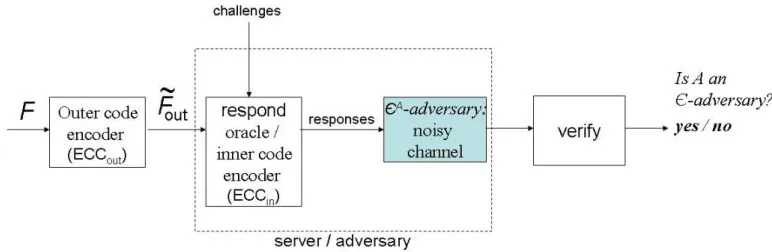
In the first phase of a POR (depicted in Figure 1), the client performs a series of challenge-response inter-actions with the serverAover fileF˜out(i.e., the encoding ofF under the outer codeECCout), with the aim of detecting the condition²A > ². To challenge the server, the client computesc =challenge(η;κ, ω)[π],
sendscto the server, receives a responser, and then computesverify((c, r, η);κ, ω)to check the response of the adversary. The client repeats this processqctimes, and rejects if any response is incorrect. Otherwise the client accepts.
Assuming that challenge selectsc∈U C, the probability that an adversaryAis accepted but isnotan²
-adversary, i.e.,²A> ², is< λ= (1−²)qc. The valueλcan be made arbitrarily small, with an appropriately
largeqc.
The JK protocol checks adversarial responses by precomputing a challenge set {ci}qi=1 ∈U C and
storing verifying data—sentinels or MACs—in the encoded file for download by the client. The Lillibridge et al. and NR constructions check adversarial responses by verifying MACs on file blocks. Thus, both of these constructions also select c ∈U C. The SW scheme omits Phase I, i.e., implicitly assumes an
Figure 1: Schematic of Phase I in our POR framework: Testing whether²A≤², i.e., ifAis an²-adversary.
Remark In practice, as envisioned in our implementation, the server may initially be honest, but turn bad at some point and be replaced by an adversaryA. To deal with such a dynamic adversary, the client may spread out its challenges over time. For example, the client might initiate a challenge every day. If Phase I is tuned to achieve a particularλforqc= 50, then, the condition²A > ²will be detected with probability at
least1−λwithin the first 50 days after the server has turned adversarial.
3.3.2 Phase II: ExtractingF from an²-adversary
Assuming an honest server, a client can simply downloadF—and verify its correctness via an appended MAC or digital signature. If this fails, the client can download the encoded fileF˜ηand try to correct it using
the outer error-correcting layer. Failing that, given an²-adversary, it is possible for the client to retrieveF viaextract, executing a series of challenges and decodingF from the responses. Note that in this phase, the client may not be able to verify the correctness of the responses it receives (in particular, for protocols with a bounded number of verifications): In this case, it relies on the²-bound onAfor successful decoding.
In our general framework, there aretwo levels of error-correction:
• Theouter code: This is a(n, k, d2)-error-correcting codeECCout applied toF to computeF˜out, the
error-corrected portion ofF output byencode. Usually, for large files,n < m, and to encode a file of sizemwe need to resort to a well-known technique, calledstriping: the file is divided into stripes of sizekblocks each, and each stripe is encoded underECCout. In the rest of the paper, when we encode
the file with the outer code, we implicitly mean that striping is performed if necessary.
• The inner code: This (w, v, d1)-error-correcting code ECCin represents a second layer of
error-correction in the challenge-response interface for a POR. The functionrespond(s, u)applies ECCin
to the setsof message blocks specified in a challenge; the valueu ∈ W specifies which symbol of the corresponding codeword should be returned to the client.
In this view, the adversary is a noisy channel with error probability at most ². We may think of the adversary as intercepting transmissions from a (correct) oracle forrespondto the client. When the client submits thei-th challengec= (s, u), therespondoracle computes the correct responser. If²i
s,u = 1, then Acorrupts the response in the channel; otherwise, the adversary leavesrunchanged.
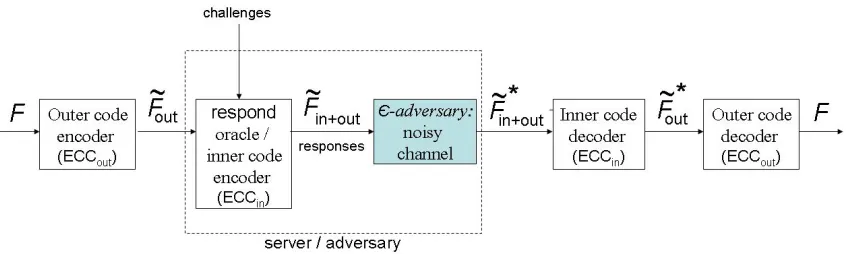
Figure 2: Schematic of Phase II in our POR framework: ExtractingF from an²-adversary.
outer code we need to employ. The outer code needs to be anadversarial error-correcting code, as defined in Appendix B. Intuitively, an adversarial code transforms an²0 computationally bounded adversary to a
random one, i.e., one in which the adversary has no better chance of corrupting codeword symbols than choosing at random.
Our PORs are designed to be effective against a maximum adversarial error². In the next section, we will show examples of protocols that tolerate²values non-negligibly close to 1, as well as protocols that require an upper bound on²less than 12. There are two main types of POR protocols that we can construct in our framework:
1. In protocols that enable an unbounded number of server verifications (e.g., SW), the responses to challenges in Phase II can be verified. In this case, the inner code can simply be an erasure code and can therefore tolerate error rates²non-negligibly close to 1. We describe in Section 4 a generalization of SW that fits into our framework. Even if, theoretically, such protocols do not need to employ Phase I to limit²(since they can extract for²close to 1), in practical settings obtaining a Phase-I bound on the adversarial corruption rate is still valuable to ensure efficient extraction.
2. In protocols in which a limited number of responses can be verified, we need to employ an error-correcting inner code in order to correct arbitrary server responses. In such protocols, we need to set an upper bound on the adversarial rate less than 1
2 and dependent on both the inner and outer
code parameters. For such protocols to fit our framework, we need to assume that the adversary’s corruption rate during extraction is also limited by the same² < 12. Under this assumption, either the adversary corruption rate is greater than², and will be detected with high probability in Phase I, or² is low enough so that we can extractF successfully in Phase II.
In Section 4 we present a more efficient version of JK that employs a limited number of verifications assuming an upper bound on² given by the error correction rate of the inner code. Despite such restrictions, we show its practical advantages in storage overhead and proof costs compared to SW for values of²within the error-correction capabilities of the inner and outer codes.
Now the full storage and successful extraction process for the client is as follows. We let the superscript
∗denote a corrupted file:
1. Outer encoding and storage: The client encodes fileF underECCoutasF˜out, and storesF˜outwith
the server. (ThusF˜outis a component of the full file encodingF˜η, which may include supplementary data
2. Extraction: If both ordinary downloading ofF and error-correction ofF˜η fails, the client invokes extract. In this case, the client submits a series of challenges to the respond oracle, which outputs sym-bols under the encodingECCin. Together, these responses make up a fileF˜in+out that is encoded under a
composition ofECCoutandECCin.
3. Corruption / noise:The adversary corrupts up to an²-fraction on average ofF˜in+out. The resulting
file isF˜∗
in+out.
4. Inner decoding:The client decodes the inner code inF˜in∗+outunderECCin, obtaining fileF˜out∗ . The
fileF˜∗
outis a representation ofF˜outwith²0-fraction corruption, where²0 < ².
5. Outer decoding:The client decodesF˜∗
outunderECCout, obtaining the original fileF.
3.4 Security definition
By viewing a POR as a two-phase process, we are able to offer a simpler security definition than JK that is akin to that of SW. We abstract away Phase I, and assume an²-adversary. Referring then to JK for details of the experimental setup:
Definition 1 A poly-time POR systemPORSYS[π]is a(², γ)-valid proof of retrievability (POR)if for every poly-time²-adversaryA, the probability thatextractoutputsF isγ. More formally,
γ =pr£F =Fη∗ ¯
¯F ←extractA(δ,·)(“respond”)(η∗;κ, ω)[π]¤.
Remark Observe that the inner code imposes no storage overhead in our protocol, as it is computed on the fly byrespond. We could in principle use an inner code only, with no outer code. The drawback to this approach is that the message size ofECCinwould have to be very large to guarantee extraction. In the limit,
we could letv=m. In this case,respondwould treat the whole fileFas a message, and return one symbol of a codeword over the whole file. In this case, ifd1 ≥2²m, i.e., the codeECCinis resilient to an²-fraction of file corruption, we could dispense with the outer code. But in practice, constructing an error-correcting code with large message size and large distance would be impractical. So in constructing a POR, we seek to strike a balance between the resource requirements of the inner code (computation and file-block retrieval) with the outer code (file expansion).
4 New Variant POR Protocols
4.1 The SW scheme
SW propose two constructions based on the idea of storing homomorphic authenticators for file blocks together with the file. These are essentially block integrity values that can be efficiently aggregated to reduce bandwidth in a POR protocol. Since each block can be independently verified with the stored authenticators, SW could encode the file with a more efficient erasure code. The block authenticators (or MAC values) effectively turn the erasure code into an error-correcting code.
More specifically, to encode a fileFof length|F|in the SW scheme, an erasure code of rateρis applied first. Then the encoded file is divided intonblocks, each consisting ofssectors. A sector is an element of a prime groupZp, where the size ofpis a security parameterλ. Thus,|F|=nsλρ.
For each block 1 ≤ i ≤ n, an authenticatorσi is computed and stored with the file. In addition, the
client stores a file tag of sizesλ. In a challenge, the client in the SW scheme sendslblock indices andl values inZp. The server response is one aggregated authenticator of size(s+ 1)λ.
include a Phase I stage to bound²below any desired value. While SW can tolerate essentially any² < 1, the ability to bound²at lower values in a Phase I stage can be quite important in practice. The error value ²determines the efficiency of file extraction for the client, so ensuring²bounded well away from 1 can be vital in practice.
We can generalize the SW construction by replacing their ad-hoc inner erasure code with an erasure code with linear encoding and decoding time, e.g., Tornado codes [16], on-line codes [17], LT codes [15] or Raptor codes [24]. In addition to obtaining a more efficient extraction algorithm (reducing the decoding cost fromO(|F|p|F|)toO(|F|), for the natural choice ofn=s=p|F|), this approach can simplify the security proofs of SW. For instance, the proofs from Section 4.2 in [22] could be easily inferred from the decoding properties of the above mentioned erasure codes.
4.2 Improvement to JK protocol
We now describe improvements that our new framework brings to the JK protocol, the main focus of the paper.
As explained above, SW has strong theoretical benefits, e.g., an ability to extract files for essentially any ² < 1. In practice, though, an adversary with² > 12 would be quickly detected in phase one of our framework. Consequently, in practice, the higher²tolerated by SW is of limited benefit. SW also permits an unbounded number of phase-one queries by the client. JK, however, can support a large number of phase-one queries in practice. As we explain in Section 5, JK has notable efficiency benefits over SW for parameter ranges we consider of most practical interest. This is the reason for our focus on JK.
Our main goals in designing the new variant on JK are to tolerate a larger level of errors than in the original JK scheme, reduce the storage overhead on the server, and employ a more lightweight verification mechanism in the first phase to ensure that the client is dealing with an²-adversary. After describing the details of the new variant, we provide its security analysis in a stronger adversarial model than employed in the JK protocol. We conclude the section by showing a range of parameters our new variant supports and their relative tradeoffs.
Building blocks
To specify the algorithms in our protocol, we need several cryptographic primitives, in particular a symmetric-key authenticated encryption scheme(KGenEnc,Enc,Dec), a family of pseudorandom permutationsPRP[n] :
KPRP × {0,1}n → {0,1}nand a message-authentication algorithm(KGenMAC,MAC,Ver). We assume
the primitives are secure according to standard security definitions, i.e., the encryption scheme is IND-CPA secure, the permutation family is pseudorandom and the MAC scheme is unforgeable [8, 9].
Outer layer of error correction
The outer layer of error correction needs to be adversarial in the sense that it transforms a noisy channel into a random one (see a discussion on adversarial codes in Appendix B). To implement an adversarial code, the JK’sencode algorithm uses a striped “scrambled” code. The file is divided into stripes and each stripe is encoded with a standard(n, k, d)Reed-Solomon code. The resulting symbols are permuted with a PRP and encrypted with secret keys known only to the client.
However, this does not ensure by itself a random adversarial channel, since the adversary has information about stripe boundaries. To hide stripe boundaries from the server, we first implicitly apply a pseudorandom permutation to the file blocks and then divide the permuted file into stripes. Our outer code outputs the file in order, followed by the “scrambled” parity blocks.
The encodealgorithm of our adversarial codeSA-ECCtakes as input secret keysk1,k2 andk3, and a
messageMof sizemblocks, and performs the following operations:
- PermuteMusingPRP[m]with keyk1, divide the permuted message intodmkestripes of consecutive
kblocks each, and compute error-correcting information for each stripe using codeECCout.
- The output codeword is M followed by permuted and encrypted error-correcting information (the permutation of parity blocks is done usingPRP[mk(n−k)]with secret keyk2 and their encryption
with keyk3, respectively).
Remark We emphasize that thanks to our use of systematic encoding ofF, we can achieve strong security in the encoded file byencrypting only the parity blocks. Such limited encryption fully conceals the error-coding stripes, as the blocks ofF itself remain untouched and therefore carry no permutation information.
Thedecodealgorithm ofSA-ECCsimply reverses the operations ofencode.
Precomputing challenge-response pairs
As described in Phase II of our framework, a challenge is a pair(s, u)∈S×W. The response is theu-th symbol in a codeword over an inner coding instance consisting of file blocks with indices in sets. The client precomputes a set of randomly generated challenges derived from a seed and appends to the file encrypted (and authenticated) corresponding responses.
4.2.1 Complete POR protocol
We present here the complete POR protocol. In thekeygenalgorithm, a master secret keyMSis generated, from which additional keys are derived: a master challenge keykchal, a keykind used to sample codeword
indices ofECCin, a file MAC keykfile
MAC, a master encryption keykenc, a file permutation keykfileperm, an ECC
permutation keykECC
perm and an ECC encryption keykECCenc . Let us denote the generator matrix ofECCin by
G={gij}1≤i≤v,1≤j≤w.
Theencodealgorithm for our POR protocol is the following:
1. Divide fileF intomblocks, each anl-bit symbol, i.e.,F =F1. . . Fm.
2. Apply outer error-correcting layer: Encode F underSA-ECCwith secret keys (kfile
perm,kECCperm,kECCenc ),
resulting inF0 =F
1. . . FmFm+1. . . Ft(witht=dmnk e).
3. Precompute challenge-response pairs: For each challengejwith1≤j ≤q: (a) The client first derives a challenge keykc
j fromkchal from which she computesvpseudorandom
block indicesi1, . . . , iv ∈ [1, t]. The client derives a random indexu ∈ [1, w]from seedkind
and an encryption keykjefromkenc.
(b) The client computesMj = Pv
s=1Fisgsuand appendsQj =Enckej(Mj)to the encoded file.
4. Append a MAC of the whole fileMACkfile
MAC(F)and return the encoded file.
In thechallengealgorithm, the client sends to the serverj, kc
j and the random indexuderived fromkind. In
therespondalgorithm, the server derivesi1, . . . , iv fromkc
j, computesMj = Pv
s=1Fisgsu, and returns to
In the extractalgorithm, executed when normal file download and error-correction of the encoded file fail, the client executes two phases, one for each layer of error correction. To decode from the inner layer, the client submits a sufficient number of challenges and then uses majority decoding. The client obtains on averageα decodings for each file block (forα a parameter in the system chosen so that each file block is covered with sufficiently large probability), and she decodes to the block that appears in at least a fraction of 12 +δ of decodings (forδ > 0a parameter of our system). If no such block exist, the client outputs an erasure for that block, denoted⊥. For each file blocki, the client maintains during the first extraction phase a set of all decodings obtained with repetitions, denotedDi. After decoding all blocks in the first phase, the
client uses the decoding procedure of the outer error-correcting code in order to correct the possible errors and erasures introduced in the first phase. Theextractalgorithm is given below:
1. Recover from the inner error-correction layer (a) Di= Φ, for all blocksi∈[1, t].
(b) Pick a set of challengesCof sizeNC=αvt as follows:
(b1) For eachj∈[1, αvt]do: • Generate a seedkc
j(used to generate a sequence ofvblock indices).
• Add(j, kcj)toC. (c) For each challenge(j, kc
j)∈ Cdo:
(c1) Executechallengewtimes with parametersj, kc
jandu, whereutakes all the values between
1andwand all the other parameters remain constant.
(c2) Apply the decoding procedure ofECCinto recoverFi1, . . . , Fiv (wherei1, . . . , iv are
gen-erated from seedkc
j) and add eachFis to the setDis, fors∈[1, v].
(d) For each blocki∈[1, t]do:
(d1) If there existsb∈ Disuch that |j:D|Di[ji]=| b| ≥ 12 +δ, outputFi =b.
(d2) Otherwise, outputFi =⊥.
2. Recover from the outer error-correcting layer: Decode F1. . . Ft under SA-ECC using secret keys (kfile
perm,kECCperm,kECCenc )and obtainF.
3. Compute the MAC over the whole file and check it against the MAC stored at the end of the file. If the MAC verifies, output the file, and otherwise output error.
The full security analysis of this construction is given in Appendix A.
4.2.2 Parameterization
In this section, we show different tradeoffs our construction achieves for different parameter choices. We consider different types of inner codes, in particular a first class of theoretical codes whose existence is guaranteed by the Varsharmov-Gilbert lower bound, and a second class of practical codes that can be easily built from concatenation of standard Reed-Solomon codes.
Theoretical codes The following lower bound for the minimum distance of a code(n, k)holds.
Theorem 1 (Varsharmov-Gilbert [21]) It is possible to construct an(n, k)code over an alphabetΣof size
σwith minimum distance at leastd, provided that: Pdi=0−2¡ni¢(σ−1)i≥σn−k.
0.0001 0.001 0.1 1
10 15 20 25 30
Error rates
Outer code distance Error rates for theoretical codes with rate 2/3
JK scheme Codeword size 500 Codeword size 1000 Codeword size 2000 Codeword size 3000 Codeword size 4000
0.0001 0.001 0.1 1
10 15 20 25 30
Error rates
Outer code distance Error rates for practical codes
JK scheme Inner code 1 Inner code 2 Inner code 3 Inner code 4 Inner code 5
Figure 3: Maximum error rate²tolerated as a function of outer code distances for both theoretical inner codes with rate 2/3 and for different practical codes.
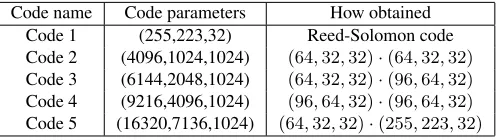
Practical codes obtained from concatenation A standard code used in practical applications is the sys-tematic (255,223,32) Reed-Solomon code. From this code we build several codes(k+ 32, k,32), with 32 ≤ k ≤ 223, by padding kwith zeros to obtain a message of size 223, encoding the padded message, and truncating the codeword of size 255 to sizek+ 32. It is easy to see that the distance given by this code remains 32. We obtain by this procedure codes(64,32,32)and(96,64,32).
For our construction, we need inner codes that operate on larger message sizes, on the order of several thousand bytes. A standard procedure to enlarge the message and codeword sizes is to build concatenated codes. The concatenation of two codes with parameters(n1, k1, d1)and(n2, k2, d2)is denoted(n1, k1, d1)·
(n2, k2, d2)and has parameters(n1n2, k1k2, d1d2). A description of the concatenation procedure is outside
the scope of this paper, but we refer the reader for more details to [21]. Several codes obtained through concatenation are given in Table 1.
Code name Code parameters How obtained
Code 1 (255,223,32) Reed-Solomon code
Code 2 (4096,1024,1024) (64,32,32)·(64,32,32)
Code 3 (6144,2048,1024) (64,32,32)·(96,64,32)
Code 4 (9216,4096,1024) (96,64,32)·(96,64,32)
Code 5 (16320,7136,1024) (64,32,32)·(255,223,32)
Table 1: Several practical codes.
Error rates tolerated In our new variant, we can tolerate a higher error rate than in the JK scheme, due to the addition of a new dimension in the design space of POR protocols, namely the inner code. As explained in our theoretical framework, the inner code reduces the adversarial error ²to a residual ²0 < ², and the
outer code then corrects the residual error²0. Since in the new variant²0 is reduced by at least an order of
magnitude compared to ², we need a more lightweight outer code than the JK scheme, and, as such, the outer code storage overhead decreases.
We show in Figure 3 the maximum error rate ² tolerated by different inner codes that follow the Varsharmov-Gilbert lower bound, as well as by several practical codes. For theoretical codes, we fix the code rate to a constant (2/3, corresponding to an expansion of 50%), and only vary the codeword size (and, implicitly, the message size)3. The graphs from Figure 3 plot the tolerated error rates as a function of the
10 100 1000 10000
10 15 20 25 30
Number of challenges
Outer code distance
Number of challenges for theoretical codes with rate 2/3
JK scheme Codeword size 500 Codeword size 1000 Codeword size 2000 Codeword size 3000 Codeword size 4000
10 100 1000 10000
10 15 20 25 30
Number of challenges
Outer code distance Number of challenges for practical codes
JK scheme Inner code 1 Inner code 2 Inner code 3 Inner code 4 Inner code 5
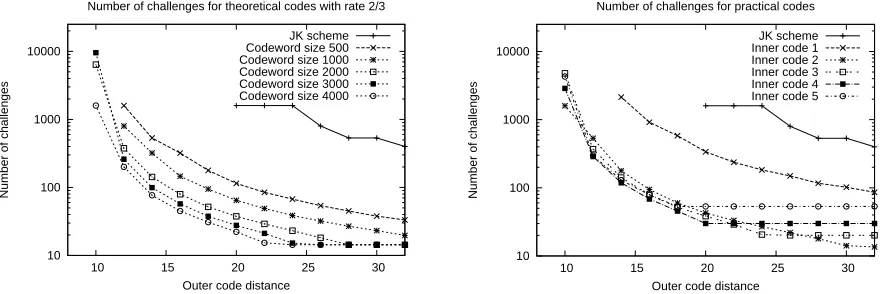
Figure 4: Number of challenges required in Phase I as a function of outer code distance.
outer code distance, for a file size of 4GB,α= 10,δ = 14 and security bound γ = 10−6. Our outer code
is built from the standard (255,223,32)Reed-Solomon code, by truncating codewords to size223 +dto obtain distance0< d≤32.
When the outer code distance drops below a certain threshold (i.e., 20 for the JK scheme, and between 10 and 14 for the new variant), we can no longer obtain a security bound ofγ = 1−10−6. This shows that our new variant spans a larger parameter domain, allowing different tradeoffs between the outer code storage overhead, the error rates tolerated and the number of verifications in Phase I.
The results for theoretical codes show that for a fixed outer code distance (and, implicitly, outer code storage overhead), higher error rates are tolerated by codes with larger codeword sizes. For practical codes, the results demonstrate that error rates do not depend only on inner codeword size, but also on inner code rate and minimum distance. For instance, for an outer code distance greater than 26, inner code 2 tolerates a higher fraction of errors than inner codes 3-5, even though its codeword size is smaller. For outer code distances smaller than 22, the amount of errors tolerated by codes 2-5 is close, with a difference of at most 0.003 between any consecutive codes. Code 1 performs much worse than codes 2-5 due to its small codeword size of 255 bytes.
Number of challenges required in Phase I Intuitively, as the protocol tolerates a larger amount of error rates, the number of verifications needed in Phase I of our framework decreases. Figure 4 shows the number of challenges for both theoretical codes with rate 2/3 and practical codes. For an outer code distance of 32 (and, thus, a file storage overhead of 14.34%), inner code 3 requires only 20 challenge verifications in Phase I. In contrast, JK needs 400 verifications for the same security level. The number of verifications in Phase I becomes prohibitive very fast for JK: for an outer code distance of 24, 1596 verifications are necessary. In contrast, as the outer code storage overhead decreases from 32 to 16 in the new variant, the number of challenges increases at an almost linear rate. For instance, for an outer code distance of 16, we need to check 94 challenges with inner code 2, 79 with inner code 3, and 68 with inner code 4. When the outer code distance drops below 16 in the new variant, the number of challenges exhibits an exponential increase. In conclusion, using one of the inner codes 2, 3 or 4 in the new variant, we can obtain a 50% reduction in the outer code storage overhead, at the expense of checking less than 100 challenges in the first phase.
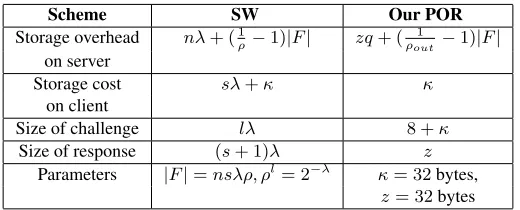
Scheme SW Our POR
Storage overhead nλ+ (1
ρ−1)|F| zq+ (
1
ρout −1)|F| on server
Storage cost sλ+κ κ
on client
Size of challenge lλ 8 +κ
Size of response (s+ 1)λ z
Parameters |F|=nsλρ, ρl= 2−λ κ= 32bytes,
z= 32bytes
Table 2: Storage overhead on server and client, and communication cost for SW and our scheme.
5 Practical Comparison With Previous Schemes
5.1 New Variant JK Protocol vs. Original JK Scheme
The original JK scheme employs only one layer of error-correction. In the challenge phase, the client downloads a number of sentinel values from the server and verifies their correctness. Thus, thechallenge
phase in JK is only used to ensure an²-adversary, but is not effectively useful to extract file blocks. For this reason, their scheme is resilient to a smaller fraction of block corruptions than the new variant. Our extraction success is amplified by using two layers of error correction.
We performed a detailed comparison of the two schemes by using the results from Figures 3 and 4. The new variant tolerates an error rate²at least an order of magnitude higher than the original JK scheme for the same outer code overhead and security bound. This imposes in the JK scheme the verification of a larger number of challenges in the first phase (e.g., by a factor between 20 and 80 for inner code 3) to achieve an equivalent error rate. The cost we pay for our efficiency in storage overhead and first phase verification is a more expensiveextractalgorithm. However, our hope is that in the normal case, i.e., most of the time, the user downloads the original file with a valid MAC or can correct the encoded file usingECCout, and does
not need to resort toextractfor file recovery.
Moreover, our security analysis for the new variant is performed in a much stronger adversarial model, since we do not make simplifying assumptions about the adversary’s behavior, except for the bound on²as described above. JK includes a strongblock isolation assumption, stating that the probabilities file blocks are returned correctly in a challenge are independent of one another.
5.2 Comparison to Shacham-Waters Scheme
5.2.1 Parameters in Shacham-Waters
In Table 2, we quantify the server storage overhead cost, storage cost on the client, and communication cost of challenge and response protocols in both SW and our new POR scheme. SW is parameterized by security parameter λ, the rate of the erasure code ρ, the number of blocks and authenticatorsn, and the size of a blocks, such thatρlis negligible inλ, e.g.,ρl= 2−λ. The JK variant is parameterized byρ
out= knthe rate
of the outer codeECCout, zthe size of a symbol in the outer code (e.g., 32 bytes in our implementation),
andκthe size of symmetric keys (e.g., 32 bytes).
5.2.2 Discussion
communication complexity in challenge and response protocols are traded off by the choice of parameters n,sand the erasure code expansion rateρ.
Let us consider a particular parameterization of our scheme in which we set a security level of10−6, an
outer code with rate 0.9 (and thus an expansion of 10%), and the total number of pre-computed challenges storedq = 10000. The storage overhead on the server for our scheme is 320KB +0.1· |F|. The maximum adversarial corruption rate ² < 12 is a value bounded by our inner and outer error correcting codes (for instance, for the(4096,1024,1024)inner code and the(255,223,32)outer code,²could be as large as 0.1 as shown in Figure 3). We show how we can design SW to match some of the parameters, assuming the same bound on². For SW, a security level of10−6translates toλ= 22.
To illustrate the relative costs between SW and our scheme, we consider two points of comparison, one in which the server storage overhead is set to be identical in both schemes, and another in which communication complexity is set to be identical. We derive the parameters for a 4GB file.
• For the same storage overhead on the server for the two schemes, we need to setρto 0.1 in SW, and thusl = 169. Additionally,nλneeds to equal 320KB, and we can derives = 13,107. In this case, the size of a challenge in SW is 464 bytes, and the response size is 36KB, as opposed to both these values being on the order of 40 bytes in our construction. The communication complexity in SW is increasing with the file size.
• For the same communication complexity in the two schemes,lλneeds to be 40 bytes, and(s+ 1)λ needs to be 32 bytes, which impliesl = 14ands = 10. We can then derive 1ρ = 2.96, and thus the storage overhead on the server in SW is about twice the size of the file.
These examples show that for small values of²SW is more expensive than our scheme with respect to both storage overhead on server and client and communication complexity. But, of course, it still retains the advantage that it allows for an unlimited number of verifications, and can provide file extraction for any ² <1(albeit at polynomial cost in1−1²).
6 Implementation
There are several challenges that we have encountered in the process of implementing the new variant.
6.1 Small PRPs
To build adversarial codeSA-ECC, we need to construct two pseudorandom permutations: one that permutes file blocks to generate stripes, and the second that permutes parity blocks. Both are “small” pseudrandom permutations, i.e., smaller than the size of a typical block cipher. For instance, for a 4GB file divided into 32-byte blocks, we need a permutation with domain size of227to permute file blocks.
Black and Rogaway [4] have considered the problem of designing small block ciphers, and proposed several solutions. For small domains, a practical solution (method 1 in [4]) is to build and store into main memory a table with random values. Another method applicable to larger domains (method 3 of [4]) is to use a 3-round Feistel cipher, with the random functions in each round based on a standard block cipher, such as DES or AES. However, their security bound is quite weak, i.e., the PRP-advantage to generate a permutation of length2n is on the order 2q2n, whereq is the number of permutation queries asked by the
adversary.
of size2nis 25q2n3. This bound is ideal for our limited adversarial model, in whichq = 1(our adversary does
not have access to a PRP oracle). The method we adopted in our implementation is to use a 6-round Feistel construction, with the random functions in each round implemented as random tables stored into memory. We have briefly experimented with the random functions implemented with AES, but this alternative is several orders of magnitude slower than having the tables stored into main memory.
6.2 Incremental encoding
A naive implementation of ourencodeprotocol based on random access to file blocks for encoding would be prohibitively expensive (for a seek time of 10ms, it takes 66000s to randomly access a 1GB file, using 32-byte blocks). As solid-state disks become more popular, random access might become comparable to sequential access. In the meanwhile, for today’s drives, our objective is to implement the encoding algorithm in onlyone passthrough the file, in an incremental fashion.
If Reed-Solomon codes are used for implementing ECCout, computation of parity blocks involves
as-sociative operations in a Galois field. For an incremental encoding of the file, we could store the parity blocks into main memory, and update them when we process a file chunk in memory. However, we pay some performance cost for incremental encoding, since existing Reed-Solomon implementations are highly optimized if the whole message is available at encoding time. The parity block size depends on both the file size and the outer code distance, but for a fixed outer code distance, it grows linearly with the file size.
With this method, we could encode incrementally files for which the parity blocks (whose size is a percentage of the file size) fit into memory. For large files for which parity blocks do not fit into main memory, there are several encoding alternatives. First, we could still perform a single pass over the file, but store only a smaller set of parity blocks into memory. As a file block is processed in memory, the parity blocks that depend on it are swapped in, updated, and then swaped out of memory. Another alternative is to break a very large file into more manageable sized files, and encode each separately.
Another problem we encountered was how to prepare the challenges in an incremental fashion. To compute each challenge,v blocks need to be picked at random from the range of all file blocks. A simple solution, which we have implemented, is to generate in advance all thesev block indices for each of theq challenges, and store them into main memory. We have experimented with an alternative technique in which we select the number of samples for each chunk from a Binomial distribution, and then sample uniformly the blocks in each chunk. This technique proved very expensive because of the high cost of sampling from a Binomial distribution, i.e., it takes about 3s in Java and 9s in Mathematica to generate 1,000 binomials.
As future work, we plan to investigate more efficient techniques for generating a fixed set of random numbers from a large interval incrementally.
6.3 Performance
We have implemented our new variant with incremental encoding of files in Java 1.6. The Java Virtual Machine has 1GB of memory available for processing. We report our performance numbers from an Intel Core 2 processor running at 2.16 GHz. Files were stored on a Hitachi 100 GB Parallel-ATA drive with a buffer of 8MB and rotational speed of 7200 RPMs. The average latency time for the hard drive is 4.2ms and the average seek time is 10ms. We use the BSAFE library in Java for implementing the cryptographic operations.
0 500 1000 1500 2000 2500 3000
1GB 2GB 4GB 6GB 8GB
Time (in s)
File Size Encoding micro-benchmarks
Read PRP ECC encode MAC Challenges Encrypt-Write
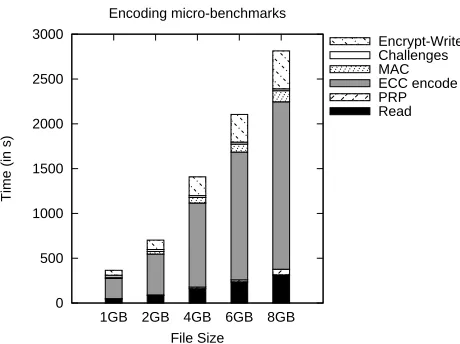
Figure 5: Encoding micro-benchmarks for inner code(4096,1024,1024)and outer code(241,223,18).
are reported for the (4096,1024,1024) inner code and the(241,223,18)outer code. We show averages over 10 runs.
The encoding algorithm achieves a throughput of around 3MB/s, and we observe that encoding time grows linearly with file size. The outer error-correcting layer is responsible for most of the encoding over-head (i.e., between 61% and 67% in our tests). The outer code encoding time can be reduced by reducing the outer code distance, at the expense of checking more challenges in Phase I of our framework. We expect that an optimized C implementation of Reed-Solomon encoding would reduce this overhead several times. Among the other components, noticeable overheads are seen in the time to compute a file MAC (around 4.2%), the time to access files from disk (around 11-12%), and the time to encrypt and write to disk the parity blocks (around 15%). Encryption of party blocks is slow because our decoding algorithm demands that each parity block is encrypted separately (if CBC encryption is used, for instance, then a corruption in one parity block will propagate to multiple blocks).
7 Conclusions
We have proposed in this paper a new framework for theoretical design of POR protocols that incorporates existing POR constructions, and enables design of new protocols with a wide range of parameter tradeoffs. We showed how the protocols of Juels-Kaliski and Shacham-Waters can be simplified and improved using the new framework. We designed a new variant of the Juels-Kaliski scheme that achieves lower storage overhead, tolerates higher error rates, and can be proven secure in a stronger adversarial setting. Finally, we provided a Java implementation of the encoding algorithm of the new variant, in which files are processed and encoded incrementally, i.e., as they are read into main memory.
References
[1] G. Ateniese, R. Burns, R. Curtmola, J. Herring, L. Kissner, Z. Peterson, and D. Song. Provable data possession at untrusted stores. InProc. ACM CCS, pages 598–609, 2007.
[2] G. Ateniese, R. Di Pietro, L. V. Mancini, and G. Tsudik. Scalable and efficient provable data possession, 2008. IACR ePrint manuscript 2008/114.
[3] M. Bellare and A. Palacio. The knowledge-of-exponent assumptions and 3-round zero-knowledge protocols. In
Proc. CRYPTO ‘04, pages 273–289. Springer, 2004. LNCS vol. 3152.
[4] J. Black and P. Rogaway. Ciphers with arbitrary finite domains. InProc. CT-RSA ‘02, pages 114–130. Springer, 2002. LNCS vol. 2271.
[5] M. Blum, W. S. Evans, P. Gemmell, S. Kannan, and M. Naor. Checking the correctness of memories. Algorith-mica, 12(2/3):225–244, 1994.
[6] R. Curtmola, O. Khan, and R. Burns. Robust remote data checking. InProc. 4th ACM Workshop on Storage Security and Survivability (StorageSS), 2008.
[7] D.L.G. Filho and P.S.L.M. Barreto. Demonstrating data possession and uncheatable data transfer, 2006. IACR eArchive 2006/150. Referenced 2008 at http://eprint.iacr.org/2006/150.pdf.
[8] O. Goldreich. Foundations of cryptography, Volume I: Basic tools. Cambridge University Press, 2001. First Edition.
[9] O. Goldreich. Foundations of cryptography, Volume II: Basic applications. Cambridge University Press, 2004. First Edition.
[10] P. Golle, S. Jarecki, and I. Mironov. Cryptographic primitives enforcing communication and storage complexity. In M. Blaze, editor,Proc. Financial Cryptography ‘02, pages 120–135. Springer, 2002. LNCS vol. 2357. [11] P. Gopalan, R.J. Lipton, and Y.Z. Ding. Error correction against computationally bounded adversaries, April
2004. Manuscript.
[12] A. Juels and B. Kaliski. PORs: Proofs of retrievability for large files. InProc. ACM CCS, pages 584–597, 2007. [13] M. Lillibridge, S. Elnikety, A. Birrell, M. Burrows, and M. Isard. A cooperative Internet backup scheme. In
Proc. USENIX Annual Technical Conference, General Track 2003, pages 29—41, 2003.
[14] R. J. Lipton. A new approach to information theory. InProc. 11th Annual Symposium on Theoretical Aspects of Computer Science, pages 699–708, 2004.
[15] M. Luby. LT codes. InProc. Symposium on Foundations of Computer Science (FOCS), pages 271–282. IEEE, 2002.
[16] M. Luby, M. Mitzenmacher, A. Shokrollahi, D. Spielman, and V. Stemann. Practical loss-resilient codes. In
Proc. Symposium on Theory of Computation (STOC), page 150159. ACM, 1997.
[17] P. Maymounkov. On-line codes. Technical Report TR2002-833, Computer Science Department at New York University, November 2002.
[18] S. Micali, C. Peikert, M. Sudan, and D. Wilson. Optimal error correction against computationally bounded noise. InProc. TCC, pages 1–16. Springer, 2005. LNCS vol. 3378.
[19] M. Naor and G. N. Rothblum. The complexity of online memory checking. InProc. 46th Annual IEEE Sympo-sium on Foundations of Computer Science (FOCS), pages 573–584, 2005.
[20] J. Patarin. Improved security bounds for pseudorandom permutations. InProc. ACM CCS, pages 142–150, 1997. [21] W. W. Peterson and E. J. Weldon, Jr. Error-Correcting Codes. MIT Press, 1972. Second Edition.
[22] H. Shacham and B. Waters. Compact proofs of retrievability. Proc. Asiacrypt 2008.
[23] M.A. Shah, M. Baker, J.C. Mogul, and R. Swaminathan. Auditing to keep online storage services honest, 2007. Presented at HotOS XI, May 2007.
A Security Analysis
Theorem 2 characterizes the security properties of the new protocol. We give first a brief overview of the security analysis, and then present the full proof.
We assume that our adversary is an²-adversary, i.e., it corrupts a fraction²of the challenge space, and ²is smaller than the error correction capability of the inner code. Our goal is to prove that we are able to extract the file correctly by interacting with such an adversary. LetC be the set of challenges selected in the extraction algorithm. By our majority decoding procedure in the extraction algorithm, a block is not correctly recovered when a large majority of the challenges inCcontaining that block is corrupted. We can thus build a mapping between corrupted challenges and corrupted blocks and we can use a simple counting argument to upper bound the fraction of corrupted blocks as a function of². We also need to ensure that the maximum fraction of block corruptions is within the error correction capability of the outer code.
Once we set the maximum block error rate²0, we bound the probability that the file can not be correctly
extracted (i.e.,1−γ) as the probability that at least one of thedt
nestripes ofF has more thand22 corruptions
(and, thus, exceeds the error correction capability of the outer code). In our decoding algorithm, we pick a set of challengesCof sizeαvt. Thus, we have to account in our bound on the (small) probability depending on αthat some blocks are not covered inC(they are treated as erasures in the outer code decoding procedure).
Theorem 2 Assume that the encryption scheme is IND-CPA secure, the family PRP is pseudorandom and the MAC algorithm is unforgeable. For any 0 < ² ≤ d1
2w, if there exists an ²0 for which 0 <
²0 < d2
4n − e
−α
4 and [1− (1− ²0)v](21 + δ) = 2d²w1 , our scheme is a (², γ)-secure POR scheme for γ = 1− dnteed22−2n²0−n2e−α
³ d2
4n²0+ne−α ´−d2
2
.
Proof:
We assume in the proof that the cryptographic primitives are ideal, i.e., ciphertexts reveal no information about plaintexts, the output of a pseudorandom permutation from familyPRPis random, and an adversary is unable to forge a MAC for a new message. Let0 < ²≤ d1
2w and assume that the client is dealing with
an²-adversary. We bound the probability that the file is not correctly extracted, after the client performs the
extractalgorithm using a set of challengesCof sizeNC. We proceed in two steps, following the two phases
of theextractalgorithm.
A.1 Decoding using the inner error-correcting code
After the first phase of theextractalgorithm, the probability thatDi = Φfor a given blockiis bounded by ¡
1−v t
¢NC
=¡1−v t
¢αt
v≈e−α. We call such a block anerasure. We bound below the probability that the
client outputs an incorrect decoding for a given block, assuming that the decoding set for that block is not empty.
First, we define a corrupted challenge(i1, . . . , iv) in space C to be such that at least d1
2 out of the w
challenges(i1, . . . , iv, u), u ∈ [1, w]are corrupted. A corrupted challenge adds an incorrect decoding to
each setDis, fors∈[1, v]in theextractalgorithm. Let us bound the numberTcorrof corrupted challenges.
If we denote by ²c = Pwu=1²cu the number of corrupted challenges in spaceC ×[1, w]containingc, then a challengecis corrupted in spaceCif²c> d21. IfTcorr challenges are corrupted in spaceC, it follows
that at leastd1
2Tcorrchallenges are corrupted in spaceC ×[1, w]. Thend21Tcorr≤
P
c∈C²c=²wNC, and we
can boundTcorrasTcorr ≤min(NC,2²wNC
d1 ) =
2²wNC
d1 , since²≤
d1
2w.
Since we are using majority decoding for extraction, in order to corrupt a block in the first step of