An extended abstract version of this work appears inAustralasian Information Security Conference 2010, CPRIT volume 105, pp. 56–66. © Australian Computer Society, 2010.http://crpit.com/Vol105.html
This is the full version.EPRINThttp://eprint.iacr.org/2008/214.
Multi-Factor Password-Authenticated Key Exchange
(full version)
Douglas Stebila
Information Security Institute, Queensland University of Technology, Brisbane, Australia
Poornaprajna Udupi
Sun Microsystems Laboratories, Santa Clara, California, United States
Sheueling Chang
[email protected]December 2, 2009
Abstract
We consider a new form of authenticated key exchange which we callmulti-factor password-authenticated key exchange, where session establishment depends on successful authentication of multiple short secrets that are complementary in nature, such as a long-term password and a one-time response, allowing the client and server to be mutually assured of each other’s identity without directly disclosing private information to the other party.
Multi-factor authentication can provide an enhanced level of assurance in higher-security scenarios such as online banking, virtual private network access, and physical access because a multi-factor protocol is designed to remain secure even if all but one of the factors has been compromised.
We introduce a security model for multi-factor password-authenticated key exchange protocols, propose an efficient and secure protocol calledMFPAK, and provide a security argument to show that our protocol is secure in this model. Our security model is an extension of the Bellare-Pointcheval-Rogaway security model for password-authenticated key exchange and accommodates an arbitrary number of symmetric and asymmetric authentication factors.
Keywords:multi-factor authentication, passwords, key exchange, cryptographic protocols
1
Introduction
Phishing and spyware are two of the major security problems on the Internet today.Phishing, or server impersonation, occurs when a malicious server convinces a user to reveal sensitive personal information, such as a username and password, to a malicious server instead of the real server. Additionally, many users’ computers are compromised withspyware, which can record users’ keystrokes (and thus passwords) and transmit this information to a malicious party. These attacks are possible not because of the break of any cryptographic protocol but because of externalities such as social engineering and software bugs.
Phishing can be combated by protocols that provide strong, easy-to-use server-to-client authentication. Password-authenticated key exchange (PAKE) can make server-to-client authentication easier and resistant to offline dictionary attacks, and additionally provides a secure key for encryption.
Spyware is more difficult to defend against. If a user’s computer is compromised by passive spyware that records keystrokes and occasionally transmits this information to an attacker’s server, then the use ofone-time passwordsmay be effective, since a previously used one-time password can not be used again. Active spyware – that frequently communicates with the attacker’s server and actively alters the user’s computer – is nearly impossible to defend against without additional trusted hardware.
To reduce the damage caused by compromising an authentication factor, many organizations with high security requirements – such as financial institutions, governments, and corporate virtual private networks (VPNs) – are deployingmulti-factor authentication, which depends on a variety of attributes, orfactors. The factors could include: a long-term password, a set of one-time passwords, a private key, or a biometric. To be effective in practice, factors should have different, complementary natures of compromise. For example, one-time passwords cannot all be compromised unless one obtains the sheet of paper listing all the one-time passwords or the device generating the one-time passwords, whereas a biometric read by a trusted device (such as a secure fingerprint reader) should not be able to be reproduced without the presence of the person in question (or at least their finger).
Contributions.Our goal is to design a framework for multi-factor authentication protocols that provides flexibility in the number and nature of factors. Protocols secure in this framework should provide strong mutual authentication, convey the authentication secrets in a secure manner, and remain secure even if all but one of the authentication factors is compromised. The authentication secrets can be low-entropy secrets, such as passwords. Using multiple low-entropy secrets can allow for passwords that may have different modes of compromise, such as a memorized long-term password and a one-time password generated from a hardware device or transmitted over a mobile phone text message.
First, we define a security model which is an extension of the Bellare-Pointcheval-Rogaway model
[BPR00] for PAKE. Our model allows for an arbitrary number of authentication factors, which can be either symmetric or asymmetric. Our security definition formalizes the notion that a multi-factor protocol should remain secure even if all but one of the factors has been compromised.
Next, we present an efficient multi-factor protocol that is secure in this model under standard cryptographic assumptions in the random oracle model. Our protocol combines facets of the
PAK
protocol[Mac02]for symmetric factors and thePAK
-Z
+protocol[GMR05]for asymmetric factors. We discuss how many different types of factors – long-term passwords, one-time passwords, biometrics, and even private keys – can be used in our protocol.Our work differs from previous work in PAKE because it uses multiple authentication factors and maintains security even if some are compromised. Others have considered some aspects of multi-factor authentication, but these have either used at least one multi-factor that is a long cryptographic secret
[YWWD06b,PP04,YY06,PZ08], or have not provided strong server-to-client authentication resistant to man-in-the-middle attacks.
1.1
Related work
Password-authenticated key exchange was first introduced by Bellovin and Merritt in 1992[BM92]as the encrypted key exchange (
EKE
) protocol, in which the client and server shared the plaintext password and exchanged encrypted information to allow them to derive a shared session key. A later variant by Bellovin and Merritt, AugmentedEKE
(A-EKE
)[BM93], removed the requirement that the server have the plaintext password, instead having a (non-trivial) one-way transformation of the password, which alone is not sufficient to impersonate the user. The former is called asymmetricpassword-based protocol, because both client and server share the same plaintext password (or a trivial transformation of it), whereas the latter is calledasymmetric. The dominant model for the security of PAKE protocols was proposed by Bellare, Pointcheval, and Rogaway[BPR00]and extended by Gentry, MacKenzie, and Ramzan[GMR05]to accommodate asymmetric protocols.Many PAKE protocols have been developed, including
PAK
[BMP00a,Mac02]andPAK
-Z
+[GMR05] which are relevant to our construction. Although universally composable constructions are attractive to consider when combining primitives, the existing work on universally composable PAKE[CHK+05]is only symmetric, not asymmetric, and thus unsuitable for our approach.A number of two-factor authentication schemes have been proposed that rely on a short password and a long cryptographic secret[PP04,YWWD06b,YY06]. Pointcheval and Zimmer[PZ08]presented a multi-factor authentication scheme using a password, a long cryptographic secret, and biometric data; their scheme has a formal security argument in a variant of the BPR model that shares some features with ours.
There are also non-cryptographic approaches to multi-factor authentication, but these do not provide as strong protection for the authentication factors. In amulti-channel system, the second factor is delivered over a separate channel (for example, via an SMS text message on a mobile phone), which the user then inputs into their web browser along side their password. In amulti-layersystem, software installed on the server evaluates additional attributes such as an HTTP cookie, IP address, and browser identification string to heuristically analyze whether the user is likely to be authentic. Some multi-layer systems try to offer additional reassurance to the user of the server’s identity by presenting the user with a customized image or string. While these multi-channel and multi-layer approaches can offer some increased assurance, they can be defeated by non-cryptographic means such as sophisticated man-in-the-middle attacks and spyware, and have been shown to be easily ignored by users[SDOF07].
2
Security for multi-factor protocols
In a multi-factor PAKE protocol, multiple authentication secrets of complementary natures, such as a long-term password and a one-time password, are used. We support two general types of authentication factors: symmetric and asymmetric.
The authentication secrets must be used in a way that the client can convince the server that it knows all the authentication secrets, and that the server can convince the client that it knows all the authentication secrets: this provides mutual authentication. However, the protocol must be carefully designed to not reveal any information about the authentication secrets to a passive or even active adversary.
Secure communications often involve both authentication and encryption so, in addition to providing authentication, we want protocols that establish an ephemeral shared secret key between client and server that can be used, for example, for bulk encryption.
1. Strong multi-factor server-to-client authentication: without knowledge of all of the authentication factors, a server cannot successfully convince a client of its identity.
2. Strong multi-factor client-to-server authentication: without knowledge of all of the authentication factors, a client cannot successfully convince a server of its identity.
3. Authentication secrets protected: no useful information about the authentication secrets is revealed during the authentication process.
4. Secure session key establishment: at the end of the protocol, an honest client and an honest server end up with a secure shared session key suitable for bulk encryption if and only if the mutual authentication is successful; otherwise no session is established.
2.1
Security model
We define a model for the security of multi-factor PAKE that allows one to argue that a protocol is secure by giving upper bounds on the probability that an adversary can break server-to-client or client-to-server authentication, or determine the session key established; the authentication secrets are protected from offline dictionary attacks as well.
This model is an extension of the model for PAKE proposed by Bellare, Pointcheval, and Rogaway
[BPR00]and modified by Gentry, MacKenzie, and Ramzan[GMR05]. The model allows for an arbitrary number of authentication factors, and each factor can be either symmetric or asymmetric.
Participants. In this model, each interacting party is either aclientor aserver, is identified by a unique fixed length string, and the identifier is a member of either the set
Clients
orServers
, respectively, withParties
=Clients
∪˙Servers
.Each authentication factor can be one of two types: symmetricorasymmetric. Suppose there aren
factors; letIsdenote the indices of symmetric factors andIadenote the indices of asymmetric factors. For each client-server pair(C,S)∈
Clients
×Servers
,nauthentication factors exist. The`th authentication factorpw
`C,S is chosen uniformly at random from the setPasswords
` and is stored by the client. Forsymmetric factors, the server also stores
pw
`C,S; for asymmetric factors, the server stores averifierpw
`C,S, which is some non-trivial transformation ofpw
`C,S. (The notion of “non-trivial transformation” will be clear in the freshness definition below, but intuitively the transformation should be such that compromise of the verifier alone should not be sufficient to impersonate the user without performing a dictionary attack.)Execution of the protocol. During execution, a party may have multiple instances of the protocol running. Each instanceiof a partyU∈
Parties
is treated as anoracledenoted byΠUi .
In a protocol, there is a sequence of messages, called flows, starting with a flow from the client instance, responded to by a server instance, and so on. After some number of flows, an instance may
accept, at which point it hold a session key
sk
,partner idpid
, andsession idsid
. Subsequently, it mayterminate. Two instances ΠCi and ΠSj are said to be partnered if they both accept, hold(
pid
,sid
,sk
) and(pid
0,sid
0,sk
0), respectively, withpid
=S,pid
0=C,sid
=sid
0, andsk
=sk
0, and no other instance accepts with session id equal tosid
. Alternatively, an instance mayrejectat any point in time, meaning it is no longer accepted or terminated.Queries allowed. The protocol is determined by how participants respond to inputs from the envi-ronment, and the environment is considered to be controlled by the adversary, which is formally a probabilistic algorithm that issues queries to achallengerwhich simulates parties’ oracle instances. For a protocol P, the queries that the adversary can issue are defined as follows (where clear by the setting, we may omit the subscriptP):
•
Execute
P(C,i,S,j): Causes client instanceΠCi and server instanceΠSj to faithfully execute protocol•
Send
P(U,i,M): Sends messageM to user instanceΠUi , which faithfully performs the appropriate portion of protocolPbased on its current state and the messageM, updates its state as appropriate, and returns any resulting messages.•
Test
P(U,i): If user instanceΠUi has accepted, then the following happens: the challenger choosesb∈R{0, 1}; if b=1, then return the session key ofΠUi , otherwise return a random string of the same length as the session key. This query may only be asked once.
•
RevealSK
P(U,i): If user instanceΠUi has accepted, then returns session keysk
held byΠUi . •RevealFactor
P(C,S,`): Returns the`th factorpw
`C,S held by clientC with serverS.•
RevealFactorV
P(S,C,`): If`is an asymmetric factor: returns the`th factor’s verifierpw
`C,S held by serverS with clientC.The
RevealFactor
andRevealFactorV
queries model the adversary learning the authentication secrets, which corresponds to weak corruption in the Bellare-Pointcheval-Rogaway model. We do not allow the adversary to modify stored authentication secrets (also called strong corruption).Definition 2.1 (Freshness) An instanceΠUi with partner id U0isfresh in the`th factor(with forward-secrecy) if and only if none of the following events occur:
1. a
RevealSK
(U,i)query occurs;2. a
RevealSK
(U0,j)query occurs, whereΠUj0 is the partner instance ofΠUi , if it exists;3. if U ∈
Clients
:RevealFactor
(U,U0,`)(and/orRevealFactorV
(U0,U,`) if the`th factor is asym-metric) occurs before theTest
query, andSend
(U,i,M)occurs for some string M ;4. if U ∈
Servers
:RevealFactor
(U0,U,`)occurs before theTest
query, andSend
(U,i,M)occurs for some string M .This notion of freshness accommodates the idea that an instance should remain fresh even if all but one of the authentication factors has been fully compromised. If an instance is fresh in all of its factors, then it is also fresh in the original notion of freshness for PAKE.
Adversary’s goals.For session key security, the goal of an adversary is to guess the bit b used in the
Test
query of an instance that is fresh in at least one of its factors; this corresponds to the ability of an adversary to distinguish the session key from a random string of the same length. LetSucc
akeP -f`(A)be the event that the adversaryAmakes a singleTest
query to some fresh in the`th factor instanceΠUi that has
accepted andAeventually outputs a bitb0, whereb0=band bis the randomly selected bit in the
Test
query. Theake-f`advantageofAattackingPis defined to beAdv
akeP -f`(A) =2 PrSucc
akeP -f`(A)−1.We can define similar notions for client-to-server, server-to-client, andmutualauthentication. For the security experiments involving authentication, the
Test
query is prohibited. We defineAdv
c2sP -f`(A) to be the probability that a server instanceΠSj with partner idC terminates without having a partner oracle before theRevealFactor
query in point 4 of the definition of freshness in the`th factor. We defineAdv
s2cP -f`(A)to be the probability that a client instanceΠCi with partner idSterminates without having a partner oracle before theReveal
∗queries in point 3 of the definition of freshness in the`th factor. Finally, we defineAdv
maP -f`(A) =max{Adv
c2sP -f`(A),Adv
s2cP -f`(A)}.We overload the
Adv
(and corresponding Pr(Succ
)) notation:Adv
NP(t,qse,qex,qro) =maxA{Adv
NP(A)},where the maximum is taken over all adversaries running in time at most t, making at mostqseandqex
queries of type
Send
P andExecute
P, respectively, and at mostqrorandom oracle queries.constantsδ`,`∈ {1, . . . ,n}, such that, for all polynomially-bounded adversariesA,
Adv
ake-fP `(A)≤
δ`qse
|Passwords`|+ε , if the`th factor is symmetric,
δ`((1−b`co)qse+b`coqro)
|Passwords`| +ε , if the`th factor is asymmetric,
and the corresponding bound applies for
Adv
maP -f`(A), where, for asymmetric factors`, b`co=1ifAmakes aRevealFactorV
(·,·,`)query and 0 otherwise.Intuitively, this notion of security says that any polynomially-bounded adversary can only do negligibly better than doing an online dictionary attack at any unknown factors and can gain no advantage by doing an offline dictionary attack. Ideally,δ`would be 1, indicating the adversary can only rule out one password with each online guess; however, a protocol can still be secure as long asδ`is small compared to|
Passwords
`|.Since an instance that is fresh in all of its factors is also fresh in the original ake notion of PAKE, we have that
Adv
akeP (A)≤ min`∈{1,...,n}
¦
Adv
akeP -f`(A)© .By providing bounds for each factor, we can provide greater granularity in relating the security of factors to their risks of compromise. For example, lower entropy factors (represented by smaller values of|
Passwords
`|) may be physically distributed and secured in different ways than higher entropy factors, or may be used for a shorter period of time. This contrasts with the approach of[PZ08], in which there is a single notion of freshness and a single bound over all factors.2.2
Using one-time passwords
The model presented in Section2.1uses long-term authentication secrets that do not change over time. However, multi-factor authentication may include a factor that varies, such as a one-time password. Such a factor may be the response to a challenge, or may vary with time. The benefit of a one-time password is that the compromise of a single one-time password should not affect the security for a different one-time password. One-time passwords offer some protection against passive spyware, as previously compromised one-time passwords are useless.
Although at first glance it may seem impractical for a user to store a large number of passwords, this is actually quite practical and is already being done in the real world: for example, some European banks issue paper lists of one-time passwords to users[Nor09], and corporations issue hardware devices for pseudorandomly generating one-time passwords for virtual private network (VPN) access[RSA09]or electronic commerce[Bli09]. Even though a user may be carrying as much data as in a cryptographic key, one-time passwords offer usability benefits: carrying a cryptographic key requires a hardware interface or carefully managed private key files, whereas one-time passwords can be easily entered in only a few keystrokes.
Abdallaet al.[ACP05a]present a protocol for the use of one-time passwords in an authenticated key exchange protocol but do not alter the security model from the standard BPR setting. Paterson and Stebila[PS09]do present an alteration to the BPR security model that accommodates the compromise of previous (and future) one-time passwords and we apply their ideas to allow for symmetric factors using one-time passwords as follows.
Adjusting the model. We can alter the security definition of a multi-factor protocol to allow a symmetric factor that corresponds to a one-time password by applying the ideas of Paterson and Stebila[PS09]. Let
set of indices of one-time passwords, and let
ch
∈Indices
`. When a party is activated, they are activated with the index of the one-time password to use for that instance; a party can only be activated once for eachch
∈Indices
`. Let{pw
`C,S,ch}be the set of one-time passwords betweenC andS, indexed bych
; each such password is chosen uniformly at random fromPasswords
`. We add an additional parameterch
to theRevealFactor
query:•
RevealFactor
P(C,S,ch
,`): Returns the `th factorpw
`C,Sch held by client C with server S for one-time password indexed bych
.The definition of freshness in the `th factor of ΠUi is adjusted as well, replacing points 3 and 4 in Definition2.1with:
3. ifU ∈
Clients
:RevealFactor
(U,U0,ch
,`)occurs before theTest
query, andSend
(U,i,M)occurs for some stringM, wherech
is the index of the one-time password with whichΠUi was activated; 4. ifU ∈Servers
:RevealFactor
(U0,U,ch
,`)occurs before theTest
query, andSend
(U,i,M)occurs for some stringM, wherech
is the index of the one-time password with whichΠUi was activated. The definitions of authentication are adjusted analogously as well.Paterson and Stebila go on to show that any secure PAKE protocol can be used in the natural way to build to a secure one-time PAKE protocol, by using the one-time password in place of the password. This holds even when the one-time passwords are pseudorandomly generated or time-dependent. This means that our
MFPAK
protocol in the next section can easily accommodate one-time passwords as authentication factors.3
MFPAK
: a multi-factor password-authenticated key exchange protocol
MFPAK
is the first PAKE protocol that uses multiple low-entropy authentication factors. It allows for an arbitrary number of factors which can be asymmetric or symmetric, and these factors can be independently changed as users need to change their passwords. Our approach is much more efficient, in terms of number of expensive operations, than the naïve approach of combining existing PAKE protocols as black boxes: we add no expensive operations for each additional symmetric factor, and only one additional expensive operation (signature generation/verification) for each party for each asymmetric factor.3.1
Design ideas
We designed
MFPAK
by considering two existing one-factor protocols as our building blocks: the asymmetric password protocolPAK
-Z
+for asymmetric factors, and the symmetric password protocolPAK
for symmetric factors. These two protocols are similar in structure which allows us to gain some efficiency improvements. All factors are tightly integrated into the authentication and key exchange processes. The underlying session key agreement comes from a hashed Diffie-Hellman construction. Authentication for asymmetric factors is done using a digital signature scheme, while for symmetric factors it is done using hash functions.Shielded ephemeral key. One of the main efficiency and security gains in the
MFPAK
protocol comes in the first flow from the client to the server. In this flow, the client shields its ephemeral public key by multiplying it by (the hash of) each factor. The client is made to commit to those values, thereby preventing a malicious client from making an offline dictionary attack later on. Moreover, the server must use the same values to unshield the client’s ephemeral public key or Diffie-Hellman key agreement will fail, thereby committing the server to its choice of values. By doing this multiple shielding operation, the client and server achieve mutual authentication, the client saves expensive operations compared to running multiple protocols separately, and the authentication secrets are protected.private key which is stored on the server. During the login stage of the protocol, the server returns the shielded private key, which the client can unwrap only if she knows the correct password. The client uses the private key to perform a signing operation which the server verifies using the public key. This allows for asymmetry: the compromise of the server’s database is not enough to impersonate the client to the server without a dictionary attack. This technique, as used in
PAK
-Z
+[GMR05], is an instantiation of the generic technique proposed by Gentryet al.[GMR06]for asymmetric password-based authentication. It is important to note that the digital signature scheme is not used in its normal sense with published or certified public keys, but simply as a convenient asymmetric construction.Hash function for symmetric factors. The hash of a symmetric factor is stored on the server. The server proves its knowledge of a symmetric factor by hashing it with the session key; the client does the same.
3.2
Protocol specification
The
MFPAK
protocol, like many other protocols, contains two stages: a user registration stage, com-pleted once per client-server pair, and a login stage, comcom-pleted each time a user attempts to login. For convenience in presentation of the login stage, we assume there is at least one symmetric factor and one asymmetric factor; however, the protocol can be altered in the natural way to deal with exclusively symmetric or exclusively asymmetric factors. The number and type of factors are fixed and publicly known.Ingredients and notation. Letκbe a cryptographic security parameter. The notationz∈RZ denotes
an elementzselected uniformly at random from a setZ. Angle brackets〈·〉denote a list, and·||·denotes concatenation. The protocol operates over a finite cycle groupGof orderq, generated by g, for which the Computational Diffie-Hellman (CDH) assumption holds. The function
Acceptable
(·)tests whether an element is inG (or, for efficiency reasons, a group containing G; see[Mac02, §4]). It makes use of a number of random hash functions based on random oracles[BR93]: H1 maps{0, 1}∗ to groupelements (such as [CI09]for hashing into elliptic curve groups), while all other hash functions Hi
map{0, 1}∗to{0, 1}κ. We also employ a signature schemeS= (
Gen
,Sign
,Verify
)that is existentially unforgeable under chosen message attacks[GMR88]. Let(v,V)←Gen
(1κ), wherev is a private key andV is the corresponding public key. Recall thatpw
`C,Sdenotes clientC’s password for serverS for the`th factor, and
pw
`C,Sdenotes the corresponding value held by the server, which may be equal topw
`C,S for symmetric factors and is some non-trivial transformation ofpw
`C,S for asymmetric factors.The user registration stageof
MFPAK
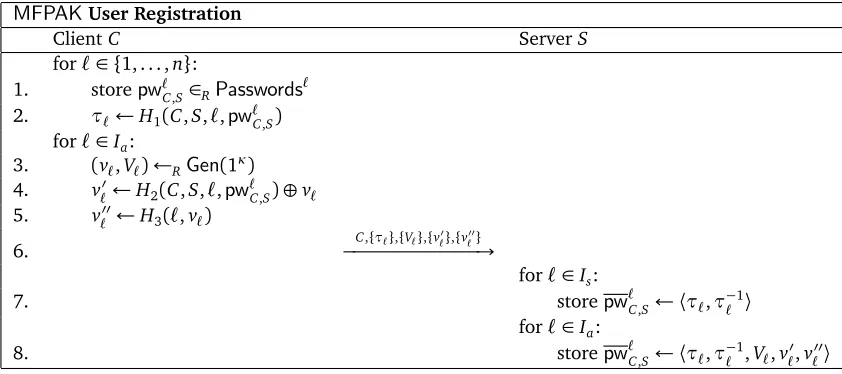
is given in Figure 1. This stage should be completed over a private, authentic channel. The user registration stage can be altered in the obvious way to have authentication secrets chosen by the server and supplied to the client, if necessary.Thelogin stageof
MFPAK
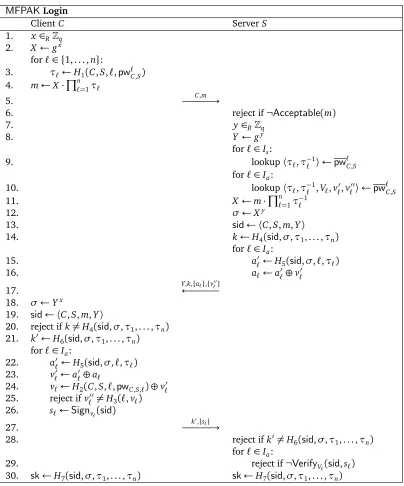
is given in Figure2. This stage can be completed over a public, untrusted channel. A clientC initiates the login stage with a serverS.3.3
Nature of the factors
The
MFPAK
protocol can accommodate a wide variety of authentication secrets using either symmetric or asymmetric factors, as we note below. Our approach offers improved functionality compared with the na¸Tve way of combining multiple authentication secrets by simply concatenating them into one long string: with concatenation, one cannot easily combine passwords that change over time (symmetric factors) with long-term passwords (asymmetric factors) because the server does not store the plaintext password.MFPAKUser Registration
ClientC ServerS
for`∈ {1, . . . ,n}:
1. storepw`C,S∈RPasswords`
2. τ`←H1(C,S,`,pw`C,S) for`∈Ia:
3. (v`,V`)←RGen(1κ)
4. v`0←H2(C,S,`,pw`C,S)⊕v`
5. v`00←H3(`,v`)
6. C,{τ`},{V`},{v 0
`},{v`00} −−−−−−−−−−−−→
for`∈Is:
7. storepw`C,S← 〈τ`,τ−`1〉
for`∈Ia:
8. storepw`C,S← 〈τ`,τ`−1,V`,v`0,v`00〉
Figure 1: The user registration stage of the
MFPAK
protocol.raise the amount of work an attacker needs to do by using asymmetric factors.
One-time passwords. One-time passwords are usually best accommodated as symmetric factors. Asymmetric factors could be used, but the costs for asymmetric factors may not be worth it for one-time passwords. It may be more efficient to generate one-time passwords from a seed using a challenge-response mechanism or a time-dependent generator. For factors that employ a challenge-challenge-response mechanism, an initial message from the server to the client conveying the challenge can be added to the beginning of the login stage of the protocol.
Cryptographic keys. Although our primary motivation has been the use of short strings as authentica-tion secrets so users can easily carry their authenticaauthentica-tion secrets between computers, there is nothing preventing a password-based protocol from using high-entropy secrets (that is, cryptographically large keys) as opposed to low-entropy secrets. We can directly use a cryptographic key as
pw
`C,S in either the symmetric or asymmetric case. In the asymmetric case, it would be possible to further streamline the protocol by having the user store the private keyv`from the digital signature scheme, and adjust the remainder of the protocol as follows: setpw
`C,S ← v`; in the registration stage, the server storespw
`C,S ← 〈τ`,τ−`1,V`〉; in the login stage, the server omits steps 15 and 16 for this factor and the client omits steps 22–25 for this factor. We recommend, however, that situations using exclusively cryptographically large keys should consider traditional authenticated key exchange protocols as the security models[CK01a,LLM07]are stronger and offer resistance to ephemeral key leakage in addition to static key leakage.Biometrics. Pointcheval and Zimmer[PZ08]describe in detail the use of biometric templates in an authenticated key exchange protocol. They use secure sketches and fuzzy extractors to safely see if two biometric templates match.
An alternative approach is to usefuzzy vaults, which were introduced by Juels and Sudan[JS02a]. They allow a secret to be embedded in avaultwhich is locked by a set of fuzzy values, such as the minutiae of a fingerprint. Fuzzy vaults could for example be used in a multi-factor protocol as follows: the user receives the fuzzy vault, uses her biometric to unlock the vault, and then uses the embedded secret value as another factor in the multi-factor protocol.
MFPAKLogin
ClientC ServerS
1. x∈RZq
2. X←gx
for`∈ {1, . . . ,n}:
3. τ`←H1(C,S,`,pw`C,S) 4. m←X·Qn
`=1τ`
5. −−−−−→C,m
6. reject if¬Acceptable(m)
7. y∈RZq
8. Y ←gy
for`∈Is:
9. lookup〈τ`,τ−`1〉 ←pw`C,S
for`∈Ia:
10. lookup〈τ`,τ−`1,V`,v`0,v`00〉 ←pw`C,S
11. X ←m·Qn`=1τ−`1
12. σ←Xy
13. sid← 〈C,S,m,Y〉
14. k←H4(sid,σ,τ1, . . . ,τn)
for`∈Ia:
15. a0`←H5(sid,σ,`,τ`)
16. a`←a`0⊕v`0
17. Y,k,{a`},{v
00
`} ←−−−−−
18. σ←Yx
19. sid← 〈C,S,m,Y〉
20. reject ifk6=H4(sid,σ,τ1, . . . ,τn)
21. k0←H6(sid,σ,τ1, . . . ,τn)
for`∈Ia:
22. a0`←H5(sid,σ,`,τ`) 23. v`0←a0`⊕a`
24. v`←H2(C,S,`,pwC,S,`)⊕v`0 25. reject ifv`006=H3(`,v`)
26. s`←Signv`(sid)
27. k
0,{s
`} −−−−−→
28. reject ifk06=H6(sid,σ,τ1, . . . ,τn)
for`∈Ia:
29. reject if¬VerifyV`(sid,s`)
30. sk←H7(sid,σ,τ1, . . . ,τn) sk←H7(sid,σ,τ1, . . . ,τn)
Figure 2: The login stage of the
MFPAK
protocol.factors? Should the secret embedded in the vault contain error correcting information, as suggested in
3.4
Efficiency
In many e-commerce and online banking situations, the performance-limiting factor is the number of connections a server can handle, and this is in turn limited by the number of expensive operations required by the cryptographic protocol.
MFPAK
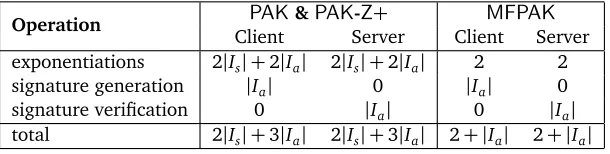
can increase security without a substantial additional computational burden on the server.Figure 3 compares the number of expensive operations (group exponentiations and signature generation/verification) performed by a naïve combination of
PAK
andPAK
-Z
+versus theMFPAK
protocol.MFPAK
has a fixed overhead of two group exponentiations each on client and server side. For each symmetric factor, there are no additional expensive operations (only multiplications and hashes, not exponentiations); for each asymmetric factor, there is one additional expensive operation on each side (signature generation by the client, signature verification by the server). This makesMFPAK
much more efficient, in terms of number of expensive operations, than if one were to make a multi-factor scheme simply by runningPAK
andPAK
-Z
+in parallel independently.Operation PAK&PAK-Z+ MFPAK
Client Server Client Server exponentiations 2|Is|+2|Ia| 2|Is|+2|Ia| 2 2 signature generation |Ia| 0 |Ia| 0
signature verification 0 |Ia| 0 |Ia|
total 2|Is|+3|Ia| 2|Is|+3|Ia| 2+|Ia| 2+|Ia|
Figure 3: Comparison of expensive operations for combined
PAK
&PAK
-Z
+andMFPAK
.3.5
Security analysis
The main idea of the security argument is that, if one factor, say the`∗th factor, remains uncompromised, then the difficulty of breaking
MFPAK
is related to the difficulty of breaking the corresponding one of eitherPAK
(for a symmetric factor) orPAK
-Z
+(for an asymmetric factor), each which is in turn related to solving the Computational Diffie-Hellman problem.For both symmetric and asymmetric factors, we describe a procedure (specified by a modifierM) to transform an adversaryAagainst
MFPAK
with the`∗th factor uncompromised into an adversaryA∗ against the corresponding one of the two underlying protocols (PAK
andPAK
-Z
+, respectively). The transformations are such that, if the oracle instance inMFPAK
against which theTest
query is directed is fresh in the`∗th factor, then the corresponding oracle instance is also fresh in the corresponding attack onPAK
(resp.,PAK
-Z
+). This is possible because of the design of theMFPAK
protocol: it essentially runs bothPAK
andPAK
-Z
+together while still capturing the security of each independently. This design characteristic allows the relatively straightforward (although lengthy) security argument.Our formal argument proceeds by considering four cases, two corresponding to an asymmetric factor being uncompromised and two corresponding a symmetric factor being uncompromised. The cases are:
1. Asymmetric factor uncompromised,U∗∈
Clients
: noRevealFactor
MFPAK(U∗,U0∗,`∗)orRevealFactorV
MFPAK(U0∗,U∗,`∗)query.Theorem 3.1 Letκbe a security parameter. Let G be a finite cyclic group generated by g and let S be a signature scheme. LetAbe an adversary that runs in time polynomial inκ, and makes at most qseand qexqueries of type
Send
andExecute
, respectively, and at most qro queries to the random oracle. If`is an asymmetric factor, then let bco=1ifAmakes aRevealFactorV
(·,·,`)query to a server, and 0 otherwise. ThenMFPAK
is a secure multi-factor PAKE protocol, withAdv
ake-fMFPAK` (A)≤
16δ((1−bco)qse+bcoqro)
|Passwords`| +ε , if the`th factor is symmetric, 4δqse
|Passwords`|+ε , if the`th factor is asymmetric,
whereεis a negligible function ofκ, andδ=|
Clients
| · |Servers
|; a similar bound exists forAdv
ma-fMFPAK` (A).As with any formal security argument, a proof of security does not imply security against all forms of attack. A protocol may be vulnerable to attack methods not described by the security model. Nonetheless, a security proof is valuable as a heuristic that the protocol is resistant to at least some types of attacks.
4
Conclusion and future work
We have presented a security model for multi-factor password-authenticated key exchange protocols that can accommodate an arbitrary number of factors. We have provided a security argument showing that our new protocol,
MFPAK
, is secure in this model. Our multi-factor authentication protocol offers enhanced authentication protection through the use of complementary factors, such as a long-term password and a one-time challenge/response. The construction is quite efficient in terms of the number of operations per factor; for example, a two-factor version of our protocol using a long-term password and one-time challenge/response has the same efficiency as the one-factor protocolPAK
-Z
+. The protocol remains secure even if all but one of the authentication factors is fully known to an adversary. Our multi-factor protocol is resistant to man-in-the-middle and impersonation attacks, providing enhanced authentication in the face of more complex threats like phishing.Other recent work in the field of PAKE protocols has focused on protocols where the sequence of flows fits existing network protocols such as SSL/TLS. An open question is to design a provably secure multi-factor PAKE protocol with support for asymmetric factors that fits within the message flow of SSL/TLS.
Additionally, multi-factor protocols supporting an arbitrary number of factors could be designed where some factors are optional and the number of factors used corresponds to differing levels of access depending on the application situation: one factor could be used for read-only access, two factors for small-value transactions, and three factors for large-value transactions.
An interesting future direction would be to further investigate the use of biometric information in a multi-factor authenticated key exchange protocol. We have outlined some ideas involving fuzzy vaults, but consideration of the privacy and security requirements requires further research.
Acknowledgements
References
[ACP05a] Michel Abdalla, Olivier Chevassut, and David Pointcheval. One-time verifier-based encrypted key exchange. In Serge Vaudenay, editor,Public Key Cryptography (PKC) 2005,LNCS, volume 3386, pp. 47–64. Springer, 2005. DOI:10.1007/b105124. Full version available as[ACP05b].
[ACP05b] Michel Abdalla, Olivier Chevassut, and David Pointcheval. One-time verifier-based encrypted key exchange, 2005.URLhttp://www.di.ens.fr/~mabdalla/papers/ACP05-letter.pdf. Extended abstract published as[ACP05a].
[Bli09] Blizzard Entertainment. Blizzard authenticator, 2009. URL http://eu.blizzard.com/ support/article.xml?locale=en_GB&articleId=28152.
[BM92] Steven M. Bellovin and Michael Merritt. Encrypted key exchange: Password-based protocols secure against dictionary attacks. InProceedings of the 1992 IEEE Computer Society Conference on Research in Security and Privacy. IEEE, May 1992. DOI:10.1109/RISP.1992.213269.
[BM93] Steven M. Bellovin and Michael Merritt. Augmented encrypted key exchange: a password-based pro-tocol secure against dictionary attacks and password file compromise. InProc. 1st ACM Conference on Computer and Communications Security (CCS)[CCS93], pp. 244–250.DOI:10.1145/168588.168618.
[BMP00a] Victor Boyko, Philip MacKenzie, and Sarvar Patel. Provably secure Password-Authenticated Key exchange using Diffie-Hellman. In Preneel[Pre00], pp. 156–171. DOI:10.1007/3-540-45539-6_12. Full version available as[BMP00b].
[BMP00b] Victor Boyko, Philip MacKenzie, and Sarvar Patel. Provably secure Password-Authenticated Key exchange using Diffie-Hellman, 2000. EPRINT http://eprint.iacr.org/2000/044. Short version published as[BMP00a].
[BPR00] Mihir Bellare, David Pointcheval, and Phillip Rogaway. Authenticated key exchange secure against dictionary attacks. In Preneel[Pre00], pp. 139–155.DOI:10.1007/3-540-45539-6_11.
[BR93] Mihir Bellare and Phillip Rogaway. Random oracles are practical: a paradigm for designing efficient protocols. InProc. 1st ACM Conference on Computer and Communications Security (CCS)[CCS93], pp. 62–73.DOI:10.1145/168588.168596.
[CCS93] Proc. 1st ACM Conference on Computer and Communications Security (CCS). ACM, 1993.
[CHK+05] Ron Canetti, Shai Halevi, Jonathan Katz, Yehuda Lindell, and Philip MacKenzie. Universally composable password-based key exchange. In Ronald Cramer, editor,Advances in Cryptology – Proc. EUROCRYPT 2005,LNCS, volume 3494, pp. 404–421. Springer, 2005. DOI:10.1007/11426639_24.
[CI09] Jean-Sébastien Coron and Thomas Icart. A random oracle into elliptic curves, 2009. EPRINT http://eprint.iacr.org/2009/340.
[CK01a] Ran Canetti and Hugo Krawczyk. Analysis of key-exchange protocols and their use for building secure channels. In Birgit Pfitzmann, editor,Advances in Cryptology – Proc. EUROCRYPT 2001,LNCS, volume 2045, pp. 453–474. Springer, 2001. DOI:10.1007/3-540-44987-6_28. Full version available as[CK01b].
[CK01b] Ran Canetti and Hugo Krawczyk. Analysis of key-exchange protocols and their use for building secure channels, 2001. EPRINThttp://eprint.iacr.org/2001/040. Extended abstract published as
[CK01a].
[GMR88] Shafi Goldwasser, Silvio Micali, and Ronald L. Rivest. A digital signature scheme secure against adaptive chosen-message attacks. SIAM Journal on Computing, 17(2):281–308, April 1988. DOI:10.1137/0217017.
[GMR06] Craig Gentry, Philip MacKenzie, and Zulfikar Ramzan. A method for making password-based key exchange resilient to server compromise. In Cynthia Dwork, editor,Advances in Cryptology – Proc. CRYPTO 2006,LNCS, volume 4117, pp. 142–159. Springer, 2006. DOI:10.1007/11818175_9.
[JS02a] Ari Juels and M. Sudan. A fuzzy vault scheme. InProc. IEEE International Symposium on Information Theory (ISIT) 2002, p. 408. IEEE Press, 2002. DOI:10.1109/ISIT.2002.1023680. Full version available as[JS02b].
[JS02b] Ari Juels and M. Sudan. A fuzzy vault scheme, 2002.URLhttp://www.rsa.com:80/rsalabs/ node.asp?id=2061.
[LLM07] Brian LaMacchia, Kristin Lauter, and Anton Mityagin. Stronger security of authenticated key exchange. In Willy Susilo, Joseph K. Liu, and Yi Mu, editors,First International Conference on Provable Security (ProvSec) 2007,LNCS, volume 4784, pp. 1–16. Springer, 2007. DOI:10.1007/
978-3-540-75670-5_1.
[Mac02] Philip MacKenzie. The PAK suite: Protocols for password-authenticated key exchange. Technical Report 2002-46, DIMACS Center, Rutgers University, 2002.URLhttp://dimacs.rutgers.edu/ TechnicalReports/abstracts/2002/2002-46.html.
[Nor09] Nordea Bank. Netbank security, 2009. URLhttp://www.nordea.ee/Private+customers/ E-channels++Netbank/Netbank/Netbank+Security/936612.html.
[PP04] Young Man Park and Sang Gyu Park. Two factor authenticated key exchange (TAKE) protocol in public wireless LANs.IEICE Transactions on Communications,E87-B(5):1382–1385, May 2004.
[Pre00] Bart Preneel, editor.Advances in Cryptology – Proc. EUROCRYPT 2000,LNCS, volume 1807. Springer, 2000. DOI:10.1007/3-540-45539-6.
[PS09] Kenneth G. Paterson and Douglas Stebila. One-time-password-authenticated key exchange, Septem-ber 2009. EPRINThttp://eprint.iacr.org/2009/430.
[PZ08] David Pointcheval and Sébastien Zimmer. Multi-factor authenticated key exchange. In Steven M. Bellovin and Rosario Gennaro, editors,Applied Cryptography and Network Security (ACNS) 2008,
LNCS, volume 5037, pp. 277–295. Springer, 2008. DOI:10.1007/978-3-540-68914-0_17.
[RSA09] RSA Security Inc. RSA SecurID, 2009. URLhttp://www.rsa.com/node.aspx?id=1156.
[SDOF07] Stuart Schecter, Rachna Dhamija, Andy Ozment, and Ian Fischer. The emperor’s new security indicators: An evaluation of website authentication and the effect of role playing on usability studies. InProc. IEEE Symposium on Security and Privacy (S&P) 2007, pp. 51–65. IEEE Press, 2007. DOI:10.1109/SP.2007.35. EPRINThttp://usablesecurity.org/emperor/.
[YWWD06a] Guomin Yang, Duncan S. Wong, Huaxiong Wang, and Xiaotie Deng. Formal analysis and systematic construction of two-factor authentication scheme, 2006. EPRINThttp://eprint.iacr.org/ 2006/270. Short version published as[YWWD06b].
[YWWD06b] Guomin Yang, Duncan S. Wong, Huaxiong Wang, and Xiaotie Deng. Formal analysis and systematic construction of two-factor authentication scheme (short paper). In Peng Ning, Sihan Qing, and Ninghui Li, editors,Proc. 8th International Conference on Information and Communications Security (ICICS) 2006,LNCS, volume 4307, pp. 82–91. Springer, 2006. DOI:10.1007/11935308_7. Full version available as[YWWD06a].
A
Other protocols
This section gives the specifications of the
PAK
[Mac02] andPAK
-Z
+ [GMR05] protocols and the security statements for these protocols. The notation has been adapted from the original papers to match the notation in this paper.A.1
PAK
The user registration stage of the
PAK
protocol is given in Figure4. This stage should be completed over a private, authentic channel. The number of hash functions is irregular so as to match the numbering inMFPAK
.PAKUser Registration
ClientC ServerS
1. pwC,S∈RPasswords
2. τ−1←(H
1(C,S,pwC,S))−1
3. C,τ
−1 −→
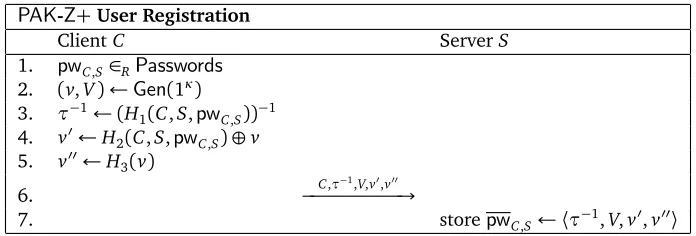
4. storepwC,S←τ−1
Figure 4: The user registration stage of the
PAK
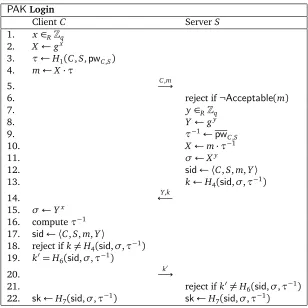
protocol.The login stage of the
PAK
protocol is given in Figure5. This stage can be completed over a public, untrusted channel.PAKLogin
ClientC ServerS
1. x∈RZq
2. X←gx
3. τ←H1(C,S,pwC,S)
4. m←X·τ
5. −→C,m
6. reject if¬Acceptable(m)
7. y∈RZq
8. Y ←gy
9. τ−1←pwC,S
10. X ←m·τ−1
11. σ←Xy
12. sid← 〈C,S,m,Y〉
13. k←H4(sid,σ,τ−1)
14. ←−Y,k
15. σ←Yx
16. computeτ−1 17. sid← 〈C,S,m,Y〉
18. reject ifk6=H4(sid,σ,τ−1) 19. k0=H6(sid,σ,τ−1)
20. −→k0
21. reject ifk06=H6(sid,σ,τ−1) 22. sk←H7(sid,σ,τ−1) sk←H
7(sid,σ,τ−1)
We note that the client-side efficiency of
PAK
could be improved by having the server store bothτ andτ−1 in the user registration stage, and having both the client and server useτinstead ofτ−1 in the hash function computations on lines 13, 18, 19, 21, and 22. This would eliminate the need for the client-side inversion on line 16 but remains equally secure.The formal security statement for
PAK
is as follows, modified from the version in[Mac02]to include constants:Theorem A.1 [Mac02, Thm. 6.9]Let G be a finite cyclic group generated by g. LetAbe an adversary that runs in time t and makes at most qseand qexqueries of type
Send
andExecute
, and at most qroqueries to the random oracles. Then, for t0=t+ (4q2ro+qse+2qex)texp,Adv
akePAK(A)≤ qse|
Passwords
|+2
qse
Adv
cdhG,g t0,q2ro+(qse+qex)(qro+qse+qex)
|G|
.
Moreover, the same bound applies for
Adv
maPAK(A).A.2
PAK
-
Z+
The user registration stage of the
PAK
-Z
+protocol is given in Figure6. This stage should be completed over a private, authentic channel.PAK-Z+User Registration
ClientC ServerS
1. pwC,S∈RPasswords
2. (v,V)←Gen(1κ) 3. τ−1←(H
1(C,S,pwC,S))−1
4. v0←H2(C,S,pwC,S)⊕v
5. v00←H3(v)
6. C,τ
−1,V,v0,v00
−−−−−−−−−→
7. storepwC,S← 〈τ−1,V,v0,v00〉
Figure 6: The user registration stage of the
PAK
-Z
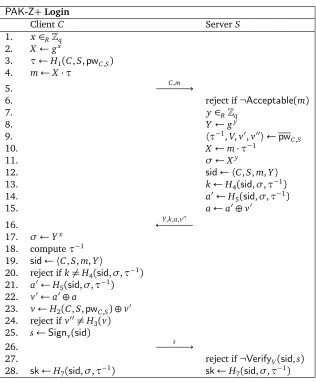
+protocol.The login stage of the
PAK
-Z
+protocol is given in Figure7. This stage can be completed over a public, untrusted channel.We note that the client-side efficiency of
PAK
-Z
+could be improved by having the server store bothτandτ−1in the user registration stage, and having both the client and server useτinstead ofτ−1 in the hash function computations on lines 13, 14, 20, 21, and 28. This would eliminate the need for the client-side inversion on line 18 but remains equally secure.
The formal security statement for
PAK
-Z
+is as follows, modified from the version in[GMR05]to include constants:Theorem A.2 [GMR05, Thm. 5.1]Let G be a finite cyclic group generated by g and let S be a signature scheme with security parameterκ. LetAbe an adversary that runs in time t and makes at most qseand qex queries of type
Send
andExecute
, and at most qroqueries to the random oracles. Let bco=1ifAmakes aRevealFactorV
query to a server, and 0 otherwise. Then, for t0=t+ (8qro2 +qse+qex)texp,PAK-Z+Login
ClientC ServerS
1. x∈RZq
2. X ←gx
3. τ←H1(C,S,pwC,S)
4. m←X·τ
5. −−−−−→C,m
6. reject if¬Acceptable(m)
7. y∈RZq
8. Y ←gy
9. 〈τ−1,V,v0,v00〉 ←pw
C,S
10. X ←m·τ−1
11. σ←Xy
12. sid← 〈C,S,m,Y〉
13. k←H4(sid,σ,τ−1)
14. a0←H5(sid,σ,τ−1)
15. a←a0⊕v0
16. ←−−−−−Y,k,a,v00
17. σ←Yx
18. computeτ−1 19. sid← 〈C,S,m,Y〉
20. reject ifk6=H4(sid,σ,τ−1) 21. a0←H5(sid,σ,τ−1) 22. v0←a0⊕a
23. v←H2(C,S,pwC,S)⊕v0
24. reject ifv006=H3(v)
25. s←Signv(sid)
26. −−−−−→s
27. reject if¬VerifyV(sid,s)
28. sk←H7(sid,σ,τ−1) sk←H
7(sid,σ,τ−1)
Figure 7: The login stage of the
PAK
-Z
+protocol.where
ε=2qse
Adv
cdhG,g t0,qro2+2
qse
Succ
eu-cmaκ (t0,qse) +(qse+qex)(qro+qse+qex)
|G|
.
Moreover,
Adv
s2cPAK-Z+(A)≤ qse|
Passwords
|+ε andAdv
c2sPAK-Z+(A)≤
qse(1−bco) +qrobco
|
Passwords
| +ε .B
Security analysis
This section contains the details of the security analysis supporting Theorem3.1.
It is helpful to be able to refer to the action of a party upon receipt of a message. We use the notation CLIENTACTIONiP and SERVERACTIONiP to refer to the portion of the protocol Pperformed by
B.1
Ingredients
Computational Diffie-Hellman assumption.
MFPAK
operates over a finite cycle groupG for which the Computational Diffie-Hellman (CDH) assumption holds. Let G be a finite cyclic group of orderq, let g be a generator of G, and let texp be the time it takes to perform an exponentiation in G. Let
Acceptable
: G → {true
,false
}such thatAcceptable
(z) =true
if and only if z∈G, whereG is a specified abelian group which hasG as a subgroup. For two valuesX andY, defineDH
(X,Y) =Xy, ifAcceptable
(X)andY =gy, orDH
(X,Y) =Yx, ifAcceptable
(Y)andX =gx. LetAbe a probabilistic algorithm with input(G,g,X,Y)that outputs a subset ofG, and defineAdv
cdhG,g(A) =PrDH
(X,Y)∈A(G,g,X,Y):(x,y)∈RZq,X =gx,Y =gy
.
Let
Adv
cdhG,g(t,n) =maxA{Adv
cdhG,g(A)}where the maximum is taken over all algorithms running in timetand outputting a subset of size at mostn. The CDH assumption is that, for any probabilistic polynomial time algorithmA,
Adv
cdhG,g(A)is negligible.Random hash functions.
MFPAK
makes use of a number of random hash functions based on random oracles[BR93]. Arandom hash function H:{0, 1}∗→ {0, 1}kis constructed by selecting each bit ofH(x)uniformly at random and independently for everyx ∈ {0, 1}∗. We make use of a number of independent random hash functionsH1,H2, . . . , which can be constructed from a single random hash function H
by settingH`(x) =H(`||x). Constructing a hash function that outputs elements of a group instead of
{0, 1}∗is also possible and efficient, and in fact all of the hash functions used in
MFPAK
are into the groupG.Signature scheme.
MFPAK
makes use of a signature schemeS = (Gen
,Sign
,Verify
)that is existentially unforgeable under chosen message attacks[GMR88]. Let(v,V)←Gen
(1κ), wherev is a private key andV is the corresponding public key. LettGenbe the runtime ofGen
(1κ), and tsigbe the runtime ofSign
andVerify
. A forgerF is given a public keyV and must forge signatures; it can query an oracle that returnsSign
v(m)for any messages mof its choice. It succeeds if it can output a forgery(m,σ) such thatVerify
V(m,σ) =true
, wheremwas not queried to the signing oracle. LetSucc
euS,κ-cma(F) =Pr(F succeeds), and
Succ
euS,κ-cma(t,qSign) =maxFn
Succ
euS,κ-cma(F)o
where the maximum is taken over all forgers running in timet and making at mostqSignqueries to the signing oracle. A signature scheme S isexistentially unforgeable under chosen message attacks (eu-cma)if, for any probabilistic polynomial time algorithmF,
Succ
euS,κ-cma(F)is negligible.B.2
Case 1: Attacking a client instance, asymmetric factor uncompromised
This case addresses impersonation of the server when the instance being attacked is a client instance and the uncompromised`∗th factor is asymmetric.
The modifier Mfirst uniformly at random guesses U∗ ∈R
Clients
andU0∗∈RServers
as its guessof who the adversaryAwill end up attacking. If the attacker ends up attacking the pair of users the modifier has guessed, then we will show how to transform the attack into an attack on
PAK
-Z
+.Let
GuessCS
be the event that the modifierMcorrectly guessesU∗andU0∗. ThenPr(
GuessCS
) =Pr((U∗correct)∧(U0∗correct)) (1)≥ 1
|
Clients
| · |Servers
| . (2)For this case, we assume that no
RevealFactor
MFPAK(U∗,U0∗,`∗)orRevealFactorV
MFPAK(U0∗,U∗,`∗)RevealFactorV
MFPAK(U0∗,U∗,`∗)query is allowed. Furthermore, noRevealFactor
MFPAK(U∗,U0∗,`∗)is allowed because an adversary can easily recover the verifierpw
`U∗∗,U0∗ from the secretpw
`∗
U∗,U0∗ and one
interaction withU0∗.
The modifierMdoes the following to convert an
MFPAK
adversaryAinto aPAK
-Z
+adversary A∗.Password preparation. For each (C,S,`) ∈
Clients
×Servers
× {1, . . . ,n} \ {(U∗,U0∗,`∗)}, M setspw
`C,S ∈RPasswords
`and constructs the correspondingpw
`C,S. Of all the authentication secrets, onlypw
`U∗∗,U0∗ andpw
`U∗∗,U0∗ remain unknown toMat this point. Compute the correspondingτ`, for`6=`∗,and setπ←Qn`=1,`6=`∗τ`.
Instantiation of
PAK
-Z
+simulator.We instantiate thePAK
-Z
+simulatorSPAK-Z+with the following random oracles: Hi∗(C,S,pw
C,S):=Hi(C,S,`∗,pw
C,S)fori=1, 2;H3∗(v):=H3(`∗,v);H4∗(〈C,S,m,Y〉,σ,τ−1)
:=H4(〈C,S,m·π,Y〉,σ,τ1, . . . ,τ, . . . ,τn)
k`∈Ia,`6=`∗H5(〈C,S,m·π,Y〉,σ,`,τ`) ;
H5∗(〈C,S,m,Y〉,σ,τ−1) := H5(〈C,S,m·π,Y〉,σ,`∗,τ); and H7∗(〈C,S,m,Y〉,σ,τ−1) := H7(〈C,S,m·
π,Y〉,σ,τ1, . . . ,τ, . . . ,τn).1 These ‘starred’ functions are independent random oracles if the correspond-ing unstarred functions are. The above construction is possible since{τ`}`6=`∗ andπare fixed and known
toMbecause of the guesses made at the beginning of this case. By using a concatenation of random oracles, the
PAK
system computes the values we need inM’s handling ofExecute
andSend
queries.Further,SPAK-Z+ is instantiated with the following signature scheme(
Gen
,Sign
∗,Verify
∗):Sign
∗v(〈C,S,m,Y〉):=Sign
v(〈C,S,m·π,Y〉)Verify
∗V(〈C,S,m,Y〉,s):=Verify
V(〈C,S,m·π,Y〉,s).Since the transformation that sends〈C,S,m,Y〉 7→ 〈C,S,m·π,Y〉is just a permutation, it follows that
(
Gen
,Sign
∗,Verify
∗)is an eu-cma signature scheme whenever(Gen
,Sign
,Verify
)is.M’s handling ofA’s queries. The modifierMperforms the following modifications to the queries of A. The main goal is forMto simulate all queries except for ones that are related to the U∗and U0∗
guessed at the beginning of the case: these queries are passed to the underlying
PAK
-Z
+simulator SPAK-Z+.RevealFactor
(C,S,`):1. If(C,S,`)6= (U∗,U0∗,`∗): Return
pw
`C,S.2. If(C,S,`) = (U∗,U0∗,`∗):
Reject; if this query occurs, thenM’s guess ofU∗ and U0∗at the beginning of this case was incorrect.
RevealFactorV
(S,C,`):1. If(C,S,`)6= (U∗,U0∗,`∗): Return
pw
`C,S.2. If(C,S,`) = (U∗,U0∗,`∗):
Reject; if this query occurs, thenM’s guess of U∗and U0∗ at the beginning of this case was incorrect.
Test
(U,i):1. IfU =U∗:
Send a
Test
PAK-Z+(U,i) query toPAK
-Z
+ simulator SPAK-Z+ and return the result to A.2. IfU 6=U∗:
Reject; if this query occurs, thenM’s guess ofU∗at the beginning of this case was
incor-1Note that we do not need to instantiate