Abstract
CAO, YINGFANG. Adaptability and Comparison of the Wavelet-based with Traditional
Equivalent Linearization Method and Potential Application for Damage Detection.
(Under the direction of Mohammad N. Noori.)
The main objective of this research work is to compare a wavelet transform based
Equivalent linearization technique, presented herein with the traditional Equivalent
linearization method. In addition, the application of this wavelet-base method to the
damage detection of a single Degree of Freedom system has also been presented.
In many practical applications the system of concern is nonlinear. In general, and
especially in random vibration analysis, it is difficult to obtain a closed form solution for
dynamic response of a nonlinear system. Therefore, it is necessary to replace the
nonlinear system with an equivalent linear system. Method of equivalent linearization has
been extensively used in these engineering applications. The wavelet analysis allows us
to capture temporal variations in the energy and frequency content. In combining the
wavelet analysis technique and the well-known Equivalent linearization method, a
nonlinear system can be approximated as a time dependent linear system. By comparing
the information of the time-varying natural frequency coefficient between the healthy
system and the damaged system, the introduced damage can be identified at a particular
time.
The first part of this document consists of a detailed description of some of the most
common types of time-frequency methods that have been developed or used for vibration
Equivalent Linearization Method have been introduced to demonstrate the general
procedure to linearize a system. An important linearization method, utilizing Wavelet
based transformation is then presented.
In this study, the benefits of this proposed method have been verified by its
application in a typical nonlinear system. Different wavelets and different excitations are
used in performing this analysis. To verify the accuracy of the wavelet based method, the
traditional Equivalent Linearization results of displacement have been compared with
those obtained by this method. In order to check the feasibility of the methodology, the
relationship of the restoring force vs. displacement has been compared between the
original nonlinear system and the equivalent linear system. For further application in the
structural health monitoring, this method has been applied to some simple cases to see the
effect of damage detection. To simplify the entire procedure of derivation, some
formulation work introduced by Basu, Gupta [1997] and Roberts and Spanos [1990] have
been followed.
ADAPTABILITY AND COMPARISON OF THE WAVELET-BASED WITH TRADITIONAL EQUIVALENT LINEARIZATION METHOD AND POTENTIAL
APPLICATION FOR DAMAGE DETECTION
by Yingfang Cao
A thesis submitted to the Graduate Faculty of North Carolina State University
in partial fulfillment of the requirements for the Degree of
Master of Science
MECHANICAL ENGINEERING
Raleigh
Biography
The author of this thesis was born in Shanxi Province, P.R. China on September
1975. Graduating from high school from the first high school in Xinzhou, P. R. China on
1993, she began her college education at the University of Science and Technology in
Beijing, and graduated in 1997 with a Bachelor in Science in Mechanical Engineering. In
2001, she began her graduate studies at North Carolina State University under the
Acknowledgements
Certainly, the completion of this work would have not been possible without having
God’s help all along the way. Also, this work would have not been possible without the
help and support of my parents. Special thanks to them for showing me, among all things,
the values of hard work and perseverance. Thanks also to my husband, Weijun Guo,
thanks for your constant support, and for providing me enthusiasm when it was most
needed. Also thanks to the rest of the members of my family for their endless support
throughout this time.
To Dr. Mohammad N. Noori my sincere thanks for allowing me to work with him for
this past years. Thanks for your trust, guidance and advices important for the completion
of this work. Special thanks to Dr. Hou and Dr. Arata Masuda for their continuous and
invaluable help and comments, and with whom it was a pleasure to work with. I will also
like to mention and thank the faculty at the Mechanical and Aerospace Engineering
Department and the Electrical Engineering Department at North Carolina State,
especially Dr. Yuan and Dr. Krim, for being part of my committees.
In addition thanks to all the friends, especially to those who have being around me
Table of Contents
LIST OF FIGURES... VI
CHAPTER 1 : INTRODUCTION ...1
1.1 TIME-FREQUENCY ANALYSIS...1
1.2 EQUIVALENT LINEARIZATION METHOD...4
1.3 STRUCTURAL HEALTH MONITORING...6
1.4 SCOPES...10
CHAPTER 2 : FOURIER ANALYSIS...13
2.1 FOURIER SERIES...13
2.2 FOURIER TRANSFORM...15
2.2.1 Definition...15
2.2.2 Properties of the Fourier Transform ...16
2.3 DISCRETE FOURIER TRANSFORM...18
2.4 FAST FOURIER TRANSFORM...19
2.5 APPLICATION OF THE FOURIER TRANSFORM...20
2.6 SUMMARY...21
CHAPTER 3 : INTRODUCTION OF TIME-FREQUENCY ANALYSIS...22
3.1 INTRODUCTION...22
3.2 UNCERTAINTY PRINCIPLES...22
3.3 SHORT TIME FOURIER TRANSFORM (STFT)...25
3.3.1 Definition...25
3.3.2 Remarks...27
3.3.3 Disadvantages ...27
3.4 WIGNER-VILLE DISTRIBUTION (WVD) ...28
3.4.1 Definition...28
3.4.2 Properties ...30
3.4.3 Disadvantages ...31
CHAPTER 4 : WAVELET TRANSFORM (WT) ...32
4.1 WHAT ARE WAVELETS...32
4.2 CONTINUOUS WAVELET TRANSFORM (CWT)...35
4.2.1 Definition...36
4.2.2 Properties of CWT ...40
4.2.3 Computation of CWT ...47
4.3 DISCRETE WAVELET TRANSFORM (DWT)...50
4.3.1 Definition...50
4.3.2 Multiresolution Analysis ...54
4.3.3 Wavelet Reconstruction...58
CHAPTER 5 : GENERAL EQUIVALENT LINEARIZATION METHOD...61
5.1 INTRODUCTION...61
5.1.2 Markov method ...62
5.1.3 Monte Carlo Simulation...62
5.1.4 Stochastic Equivalent Linearization ...63
5.2 STOCHASTIC EQUIVALENT LINEARIZATION METHOD...63
5.2.1 System model ...64
5.2.2 Implementation of the Stochastic Equivalent Linearization...65
CHAPTER 6 : WAVELET-BASED STOCHASTIC LINEARIZATION ...69
6.1 INTRODUCTION...69
6.2 INPUT-OUTPUT RELATIONSHIP FOR A LINEAR SYSTEM...70
6.2.1 Review of Wavelet Theory ...70
6.2.2 Input-output relation...71
6.3 WAVELET-BASED EQUIVALENT LINEARIZATION...73
6.4 IMPLEMENTATION TO DUFFING OSCILLATOR...74
CHAPTER 7 : NUMERICAL SOLUTIONS ...77
7.1 COMPARISON OF THE WAVELET-BASED AND TRADITIONAL EQL ...77
7.2 EFFECTS OF THE NONLINEARITY...81
7.3 DAMAGE DETECTION...85
CHAPTER 8 : CONCLUSIONS AND RECOMMENDATIONS ...89
8.1 CONCLUSIONS...89
8.1.1 Wavelet-based Equivalent Linearization Method...89
8.1.2 Nonlinearity effects ...90
8.1.3 Damage Detection ...91
8.2 RECOMMENDATIONS...91
List of Figures
FIGURE 4.1 COMPARISON OF THE SINE WAVE...33
FIGURE 4.2 DAUBECHIES WAVELETS...34
FIGURE 4.3 MORLET AND MEXICAN HAT WAVELET FORMS...35
FIGURE 4.4 SCALING AND SHIFTING OF A WAVELET...38
FIGURE 4.5 SCALE EFFECT ON FREQUENCY DOMAIN...39
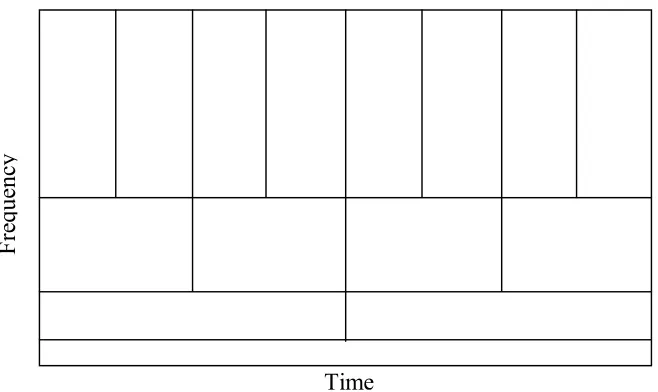
FIGURE 4.6 TIME AND FREQUENCY RESOLUTION OF THE WAVELET TRANSFORM...41
FIGURE 4.7 PROCESS OF THE WAVELET TRANSFORM...47
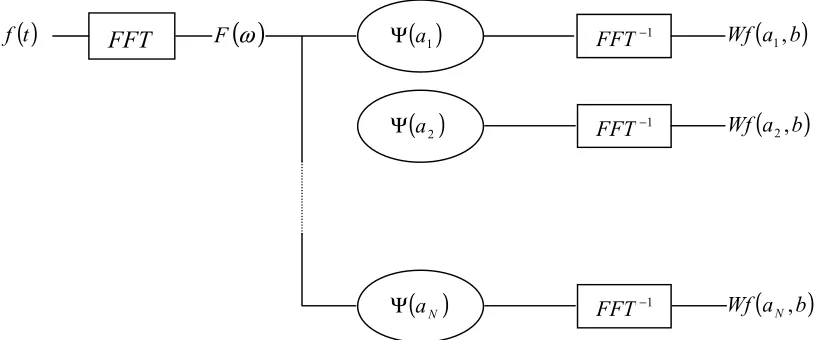
FIGURE 4.8 SCHEMATIC OF THE FREQUENCY-BASED ALGORITHM OF CWT ...49
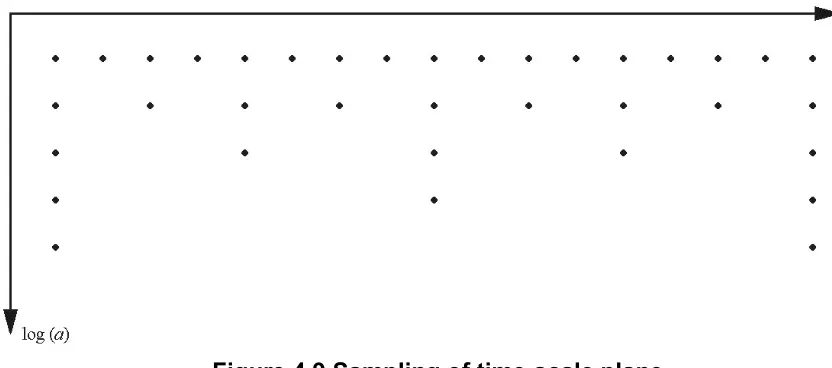
FIGURE 4.9 SAMPLING OF TIME-SCALE PLANE...52
FIGURE 4.10 TREE ALGORITHMS FOR WAVELET DECOMPOSITION AND RECONSTRUCTION...60
FIGURE 5.1 SDOF MASS-SPRING-DAMPER SYSTEM...64
FIGURE 7.1 EXCITATION 1- EL CENTRO EARTHQUAKE ACCELERATION...78
FIGURE 7.2USING MEXICAN HAT WAVELET...79
FIGURE 7.3USING MORLET WAVELET...79
FIGURE 7.4EXCITATION 2-WHITE NOISE...80
FIGURE 7.5 COMPARISON OF DIFFERENT METHOD UNDER WHITE NOISE EXCITATION...81
FIGURE 7.6 RESTORING FORCE VS. DISPLACEMENT WITH SMALL NONLINEARITY...82
FIGURE 7.7 RESPONSE RESULTS WITH NONLINEAR FACTOR λ=3 ...83
FIGURE 7.8RESTORING FORCE VS. DISPLACEMENT FOR CASE FOR λ=3 ...84
FIGURE 7.9 RESTORING FORCE VS. DISPLACEMENT FOR CASE FOR λ=5...84
FIGURE 7.10 RESTORING FORCE VS. DISPLACEMENT FOR CASE FOR λ=5...85
FIGURE 7.11 DISPLACEMENT RESPONSE OF THE DAMAGED SYSTEM...86
FIGURE 7.12 EQUIVALENT TIME-VARYING NATURAL FREQUENCY OF THE HEALTH SYSTEM...87
Chapter 1 : Introduction
1.1 Time-Frequency Analysis
Time-frequency analysis plays a central role in signal analysis. Time-frequency
methods are simply the extensions of the well-known Fourier Transform (FT) in which
most signals of practical interest can be decomposed into a sum of sinusoidal components
with different frequencies. As a tool for applications, Fourier Transform is used in
virtually all areas of science and engineering, especially in its discrete form since
computational power has increased dramatically. Fourier Transform demonstrates that
every signal has a spectrum, while the Fourier inversion theorem implies that a function
and its Fourier transform are really equivalent in the sense that one determines the other.
The invention of the computer algorithm known as the Fast Fourier Transform (FFT) in
the mid-1960s opened up the possibility of an even wider use of the FT in computational
physics and many other areas of Physics and Mathematics. Nowadays, computers being
used in computational physics are frequently evaluated principally on their capacity to
perform the FFT algorithm, and many special computers or add-on cards are available to
perform the FFT algorithm at ultra-high speed.
Even after the introduction of the FFT algorithm, the Fourier Transform still faces
some limitations. In many applications, the system being studied generates quickly
changing (impulsive) sounds or vibrations. The Fourier Transform cannot provide
temporal localization necessary for proper engineering analysis. This characteristic makes
it only suitable for the analysis of stationary signals where the frequency content of the
a new tool, which can be used to give information about signals simultaneously in the
time domain and the frequency domain.
One of the first time-frequency representations developed is the Wigner-Ville
transform. In 1932, Wigner derived a distribution over the phase space in quantum
mechanics [Wigner, 1932]. Some 15 years later, Ville, searching for an ``instantaneous
spectrum'' - influenced by the work of Gabor - introduced the same transform in signal
analysis [Ville, 1948]. Unfortunately the non-linearity of the Wigner distribution causes
many interference phenomena, which makes it less attractive for many practical purposes
[Cohen, 1995].
A different approach to obtain a local time-frequency analysis (suggested by various
scientists, among them Ville), is to cut the signal first into slices, followed by doing a
Fourier analysis on these slices. But the functions obtained by this crude segmentation are
not periodic, which will be reflected in large Fourier coefficients at high frequencies,
since the Fourier transform will interpret this jump at the boundaries as a discontinuity or
an abrupt variation of the signal. To avoid these artifacts, the concept of windowing has
been introduced. By segmenting the signal into small sections and analyzing each section
separately there is a better chance to procure meaningful analysis. If the signal has sharp
transitions, windowing the input data such that the sections converge to zero at the
endpoints helps to localize the signal in time. Adjacent sequences of windowed Fourier
analyses join together to produce a time ordered view of the frequency content of a
signal.
While the windowed Fourier Transform compromise between the time and frequency
window is chosen, that window is same for all frequencies. Many signals require a more
flexible approach—varying the window size to determine more accurately either time or
frequency.
A revolutionary change from the concept of time-frequency analysis came with the
introduction of Wavelet Transform (WT). Wavelet theory was initially proposed by J.
Morlet, a geophysicist, and A. Crossman, a theoretical physicist [1984], together with
their fellow Frenchman, Y. Meyer, their ‘French school’ developed the mathematical
foundations of wavelets. Due to its mathematical complexity, the wavelet analysis
remained purely theoretical and had very limited practical applications at that time. It was
the work of Daubechies [1988,1990,1992], and Mallat [1989], which established the
necessary links between the rigorous mathematical requirements and the wide
applications in signal processing.
Wavelet analysis allows the use of long time intervals where more precise
low-frequency information can be obtained and shorter regions where high-low-frequency
information can be gained. Instead of breaking down the signal into harmonics, the
Wavelet Transform break down the signal into a series of local basis functions called
wavelets. These basis functions are nothing but variable length window functions, where
the length depends on a variable scale parameter. This scale parameter then could be
related to a center frequency of the window and thus allowing for the construction of a
time-frequency map of the signal. Compared with sine waves, wavelets tend to be
irregular and asymmetric. Signals with sharp changes might be better analyzed with an
irregular wavelet than with a smooth sinusoid. With its capability of revealing the aspects
great acceptance in several fields, especially in the applications of image processing
which take great advantage of the variable window property of this new transform. This
same property will be the one, which will pose the Wavelet transform as a useful tool for
structural health monitoring applications.
1.2 Equivalent Linearization Method
In many practical applications, due to the high intensity nature and often complex
nature of environmental loads such as earthquakes, wind loads, and sea waves, the
systems subjected to these loadings may experience excessive stress or displacements
that results in elastic or even hysteretic behavior. This is particularly the case under high
intensity random excitation. Under these conditions, it is difficult to obtain the closed
form solution for dynamic response of a nonlinear system. Therefore, for higher
accuracy, one must resort to the analysis of nonlinear systems under non-stationary
forces.
Of the various possible approaches that are available, over last several decades, the
method of equivalent linearization has been proved to be the most useful approximation
technique and has been extensively used in engineering applications. Basically, the
method is the statistical extension of Krylov and Bogoliubov’s [1963] linearization
technique and is often referred to as the ‘describing function method’ in the electrical
engineering literature. An adaptation of the approach to deal with stochastic problems
was originally developed by Booton [1953] and used as a tool in control engineering.
Subsequent developments of this method in this field have been described by Sawaragi
[1962], Kazakov [1965], Gelb and Van Der Velde [1968], Atherton [1975] and Sinitsyn
Independently, the method, (now variously known as ‘statistical linearization’ or
‘equivalent linearization’) was proposed by Caughey [1963] as a means of solving
nonlinear stochastic problems in structural dynamics. With Caughey’s work, the linear
part of the nonlinear equation was uncoupled using the modal matrix, and then
linearization technique was applied to the resulting single-degree-of-freedom equations
separately. This is quite effective when applicable, but the conditions imposed on the
instantaneous correlation matrix of the excitation limited its application except for some
special cases. In Foster’s (1968) more general approach, numerical methods must be used
in order to obtain the equivalent linear stiffness and damping matrices. By this way, the
procedure of approximating closed form solutions would require an excessive amount of
algebraic computation. Later on, Iwan and Yang (1971 and 1972) were able to formulate
the approach such that the linear stiffness and damping matrices may be determined
analytically. Their approach is based on the concept of decomposing the nonlinear forces
of the actual system into the sum of simpler approximate nonlinear forces, each of which
depends solely on the relative displacement and velocity between discrete masses of the
system. In some cases, this method will yield closed form solutions. However, given a
system of nonlinear equations, accuracy of the solution depends heavily on the choice of
these approximate forces. Also, when the masses are distributed, the identification of the
forces might be quite complex.
This approach is well suited to mass-spring type systems. Numerous applications of
the technique for studying the response of non-linear oscillators to random excitation
have been described in the literatures [Roberts, 1981b, and Spanos, 1981a]. Although
has proved a useful analytical tool across a very wide spread of engineering applications
[Roberts and Spanos, 1990], generally, in this technique, the excitations are assumed to
be stationary and gaussian. Thus, in some cases, such as systems excited by ground
motion, it is necessary to approximate the nonlinear system to be a time-varying system.
Some theoretical developments in this area have been illustrated by Spanos [1978,1980
and 1981], Iwan and Mason [1980], Ahmadi [1980], and Noori et. al. [1986].
In recent years, it has been shown that Wavelet analysis provides a convenient way
for the response analysis of systems subjected to non-stationary ground motion (Basu,
Gupta, [1997]). Specifically, the wavelet transformation has been used to obtain both
frequency and temporal information of system response caused by non-stationary
excitation. Based on this capability, the wavelet analysis method can be combined with
traditional equivalent linearization method to obtain a time-varying equivalent system
[Basu and Gupta, 1999]. This recently developed wavelet-based equivalent linearization
method has proved to be more accurate when dealing with some nonlinear SDOF
structures [Cao and Noori, 2002].
1.3 Structural Health Monitoring
Nearly all in-service structures require some form of maintenance for monitoring
their integrity and health condition to prolong their lifespan or to prevent catastrophic
failure. The interest in the ability to monitor a structure and detect damage at the earliest
possible stage is pervasive throughout the civil, mechanical and aerospace engineering
communities. This is now commonly referred to as ‘Structural Health Monitoring and
Structural health monitoring can be defined as the diagnostic monitoring of the
integrity or condition of a structure. The intent is to detect and locate damage or
degradation in structural components and to provide this information quickly and in a
form easily understood by the operators or occupants of the structure. The damage may
result from fatigue, large earthquake, strong winds, and explosion or vehicle impact.
Early detection of damage or structural degradation prior to local failure can prevent
"runaway" catastrophic failure of the system. In engineering applications, damage is
understood intuitively as an imperfection or impairment of the function and working
condition of a structure or machine. Damage can be described in many ways depending
on the structure and its function. Hence damage detection has many definitions based on
what type of damage is being measured [Staszewski, 1998 and Sone, 1995]. Since the
health monitoring was defined as use of in-situ, nondestructive sensing and analysis of
system characteristic, including structural response, for the purpose of detecting changes,
the term, structural health monitoring and damage identification are usually
interchangeable.
Research over the past several decades within the structural engineering and other
related engineering fields have resulted in advancements and technologies that assist
structural engineers in their attempts to ensure the safety and reliability of structures over
their life spans. Two major reasons responsible for this growth of the health monitoring
of structural systems have been: the advances in sensors, data acquisition, data
communications, and real-time data analysis, allowing for the implementation of highly
reliable and accurate monitoring and diagnostics hardware with very advanced features
aerospace, and civil infrastructures, which see the application of health monitoring
systems as means of assuring the correct and safe performance of these engineered
systems, as well as protecting their investments [Chang, 1999].
The structural health monitoring can be performed on both global and local basis.
Global based health monitoring focuses on monitoring and verifying the performance of
the entire system. By monitoring the output, such as vibration displacement, velocity or
acceleration, of the system during its operation, the occurrence of the damage can be
detected. On the other hand, local based health monitoring is interested in monitoring
certain key elements of the total system. The applications of local based health
monitoring usually rely on the use of localized non-destructive evaluation techniques,
such as acoustic or ultrasonic methods, magnetic fields methods, radiography,
eddy-current methods, or thermal methods [Doherty, 1993]. All of these experimental
techniques require that the vicinity of the damage is known a priori and that the portion of
the structure being inspected is readily accessible [Doebling, 1998]. Subject to these
limitations, the need for additional global damage detection methods has led to the
development of the methods that examine changes in the vibration characteristics of the
structure.
Damage detection, as determined by changes in the dynamic properties or responses
of structures, is a subject that has received considerable attention in the literature. The
basic idea is that modal parameters (frequencies, mode shapes, etc.) are functions of the
physical properties will cause changes in the modal properties [Doebling et al. 1996].
Damage effects on a structure can be classified [Doebling et al. 1998] into linear or
structure is preserved after the occurrence of the damage. The changes of modal
properties are resulted from the changes in geometry or material properties of the
structure, but the behavior of the structure can still be modeled using linear equations of
motions. On the other hand non-linear effects are the ones in which the system does no
longer exhibit a linearly elastic behavior after the damage has been introduced. Loosing
of fastening elements, where the separation of mating parts induce non-linear responses
in the system, can be cited as these non-linear effects. Another example of nonlinear
damage is the formation of a fatigue crack that subsequently opens and closes under the
normal operating vibration environment.
As mentioned previously, the field of structural health monitoring is very broad.
Among those different issues, an important one is to use signal processing techniques,
which includes such method as Fourier analysis, time-frequency analysis and wavelet
analysis. There exist two major and complementary components that form the basis for
structural health monitoring: hardware or the experimental tools, and methodologies or
analytical/computational tools. Previous analytical and computational studies on damage
detection have been tailored toward identifying variations of modal parameters, such as
natural frequencies, modal shapes, and modal damping ratios obtained from the vibration
signals [Doebling, et al 1996, 1998]. Some of these methods allowed for assessing
changes in these parameters, which then were related to some structural damage, but they
could not provide information of the exact time of the occurrence of the damage neither
detecting the location of a fault, which may be an important part in the total picture of
the changes of the natural frequency to detect damage will be introduced in this thesis
work.
Methods such as the windowed Fourier Transforms and Wigner Distribution were
among the first time-frequency methods to be implemented. In recent years, the
application of the Wavelet Transform provided a new tool for time frequency analysis,
which has been effectively used in health monitoring and damage detection of various
structures.
1.4 Scopes
As introduced earlier, for some nonlinear problems, such as the dynamic behavior of
buildings to wind loading and earthquake, the vibration of vehicles traveling over rough
ground and the excitation of aircraft and missile by atmospheric and jet noise, the
classical linear theory is not applicable. With various possible nonlinear analysis
approaches, the method of equivalent linearization has been proved more effective.
However, most studies have assumed the response to be harmonic in nature leading to an
equivalent time invariant linear system. This may work well for steady-state response
with the frequency of response centered in a narrow band. Therefore, if the response
energy fluctuates temporally, a time-varying system may approximate the response better
[Mason, 1979]. Wavelet analysis provides a convenient way for the response analysis of
system subjected to non-stationary ground motion. Based on the capability to obtain both
temporal and frequency information of system response caused by non-stationary
excitation, wavelet analysis has been combined with the traditional equivalent
A pioneering work for developing the wavelet-based equivalent linearization method
was proposed by Basu and Gupta [1999]. In this work, based on a newly presented
technique of using wavelet analysis to solve the response of a single-degree-of-freedom
system subjected to transient excitation, a time-varying equivalent system can be
obtained. In this study, a SDOF system with nonlinear stiffness was considered.
To verify the effectiveness of this new method, it is necessary to compare the results
obtained using this way with other traditional methods. Therefore, the main goal of the
present work is to compare the system responses gained from different approaches. The
quantification of the error between nonlinear system and linearized system will
physically verify the applicability of this method.
The structural health monitoring and damage detection utilizing wavelet analysis have
been widely studied. By utilizing an orthogonal wavelet decomposition of the vibration
signal analysis, Masuda [1995] developed a way to determine the instant at which
damage occurred. Hou and Noori [1999] extended this orthogonal wavelet decomposition
method to evaluate damages in multi-degree of freedom systems. Alonso and Noori
[2001] built up a milestone of wavelet analysis application on structural health
monitoring. It also has been demonstrated [Alonso and Noori, 2001] that there is a
limitation of this wavelet decomposition for non-deterministic excitation such as
Gaussian white noise.
In using the newly developed wavelet-based equivalent linearization method, the
damage introduced to the nonlinear system under non-stationary excitation can be
system is subject to random loads and harmonic loads. The information provided by the
frequency changes contains instant message and the extent of the damage.
Chapter 2 : Fourier Analysis
Signal analysts already have an impressive arsenal of tools. Perhaps, the most well
known of these is Fourier analysis, which break down a signal into constitute sinusoids of
different frequencies. This chapter is devoted to an overview of this method. Instead of
presenting detailed information of Fourier analysis, this overview will only discuss some
basic concepts and important properties that might be useful in the understanding of
Wavelet analysis, a extension of the Fourier analysis, which will be widely used in this
research work. Fourier analysis basically involves the decomposition of the signals in
terms of sinusoidal components. With such decomposition, a signal is said to be
represented in the frequency domain. For the class of periodic signals, the decomposition
is called a Fourier series. For the class of finite energy signals, the decomposition is
called the Fourier transform.
2.1 Fourier series
To know Fourier analysis, the first element should be known is Fourier series. The
theory of Fourier series lies in the idea that most signals, and all engineering signals, can
be decomposed into a sum of sinusoid waves. J. Fourier, a French mathematician, used
such trigonometric series expansions in describing the phenomenon of heat conduction
and temperature distribution through bodies. Although his work was motivated by the
problem of heat conduction, the mathematical techniques that he developed during the
early part of the nineteenth century now find application in a variety of problems
encompassing many different fields, including vibrations in mechanical systems,
The Fourier series of an infinite signal f
( )
t with period Tpcan be represented as( )
∑
∞−∞ =
=
k
t jk ke
c t
f ω0 (2.1)
Where, j= −1, ω0 =2π Tp is the fundamental frequency of the sinusoids, and ck
are the Fourier coefficients, which can be obtain from
( )
∫
−=
p
T
t jk
p
k f t e
T
c 1 ω0
(2.2)
An important issue that arises in representing a periodical signal f
( )
t by the Fourierseries is whether or not the series converges to f
( )
t for every value of t. The so-calledDirichlet conditions will guarantee that the signal f
( )
t will be equal to a sum of harmonicseries. The Dirichlet conditions are:
1. The signal f
( )
t has a finite number of discontinuities in any period.2. The signal f
( )
t contains a finite number of maxima and minima during any period.3. The signal f
( )
t is absolutely integrable in any period, that is( )
<∞∫
f t dtp
T (2.3)
Generally, if a signal is periodical and satisfy the Dirichlet conditions, it can be
2.2 Fourier Transform
2.2.1 Definition
The Fourier Transform is a generalization of the Fourier series. Strictly speaking it
applies to continuous and aperiodic functions, but the use of the impulse function allows
the use of discrete signals. The Fourier transform can be defined as:
( )
∫
∞( )
∞ −
−
= f t e dt
F ω jωt (2.4)
It has been shown thatF
( )
ω is a function of the continuous variable ω. It does notdepend on Tp or ω0.
The inverse Fourier transform can be defined as:
( )
( )
ω ωπ F e ωd
t
f j t
∫
−∞∞=
2 1
(2.5)
The set of conditions that guarantee the existence of the Fourier transform is the
Dirichlet conditions, which may be expressed as:
1. The signal f
( )
t has a finite number of finite discontinuities.2. The signal f
( )
t contains a finite number of maxima and minima.3. The signal f
( )
t is absolutely integrable, that is( )
∫
−∞∞ f t dt <∞ (2.6)The Dirichlet conditions are sufficient but not necessary for the existence of the
Fourier transform. In any case, nearly all finite energy signals have a Fourier transform. It
transform is that the spectrum in the latter is continuous and hence the synthesis of an
aperiodic signal from its spectrum is accomplished by integration instead of summation.
2.2.2 Properties of the Fourier Transform
There are a variety of properties associated with the Fourier Transform and the
inverse Fourier transform. The following are some of the most relevant for
time-frequency analysis.
1. Linearity: The Fourier and the inverse Fourier transforms are linear operations.
( )
(
( )
( )
)
(
( )
)
(
( )
)
( )
ω( )
ω ω ω ω ω 2 1 2 1 2 1 bF aF dt e t f b dt e t f a dt e t bf t afF j t j t j t
+ = + = + =
∫
∫
∫
∞ ∞ − − ∞ ∞ − − − ∞ ∞ − (2.7)2. Shift: If a signal f
( )
t is shifted by τ, the Fourier transform can be:( )
ω(
(
τ)
ω)
( )
ω( τ) ωτ( )
ωτ f t e dt f ue du e F
F j t ∞ −j u− −j
∞ − ∞ ∞ − − = = −
=
∫
∫
(2.8)Following this property, for a time shifting signal f
( )
at , the Fourier transform will be( )
( )
( )
( ) = = = ∞ − ∞ − − ∞ ∞ −∫
∫
F aa du e t f a dt e at f
F j t j ua
a ω ω ω ω
1 1
(2.9)
Where a is a non-zero constant. If a is greater than 1, the spectrum will be expanded. If
a is less than 1, the spectrum will be contracted.
Based on the process used for time shifting, the frequency shift can be illustrated as:
( ) ( )
j to t f t e o
f = ω (2.10)
With the form of Fa
( )
ω =F( )
aω , the inverse Fourier transform will be:( )
=
a t f a t
fa 1 (2.11)
Where a is a non-zero constant.
3. Moments:
The nth order moment of a signal f
( )
t can be defined as:( )
∫
∞∞ −
= t f t dt
M n
n (2.12)
4. Convolution:
Convolution of function f and g is the new function f ⊗g such as
( ) (
τ g t τ)
dτf g
f ⊗ =
∫
−∞∞ − (2.13)
By taking the Fourier transform of the convolution, it can be proved that in the frequency
domain the convolution in time of two functions is equivalent to the multiplication of the
Fourier transform of the respective functions [Brigham, 1988], which can be expressed
as:
( )
ω Ff( ) ( )
ω Fg ωF = (2.14)
Where, Ff
( )
ω is the Fourier transform of f and Fg( )
ω is the Fourier transform of g.5. Parseval’s Theorem:
The energy, E, in a signal can be measured either in the spatial domain or the
frequency domain. For a signal with finite energy, the total energy calculated in the time
( )
∫
( )
∫
−∞∞∞ ∞
− f t dt= π F ω dω
2 2
2 1
(For continuous space) (2.15)
( )
( )
ω ωπ π
π F d
k f k 2 2 2 1
∫
∑
∞ − −∞ = =(For discrete space) (2.16)
This "signal energy" is not to be confused with the physical energy in the phenomenon
that produced the signal. If, for example, the value f
( )
k represents a photon count, thenthe physical energy is proportional to the amplitude of f
( )
k and not the square of theamplitude. This is generally the case in video imaging.
2.3 Discrete Fourier Transform
In practical applications, computers cannot handle a continuous signal. They have to
have discrete samples. Therefore, a discrete form of the Fourier Transform (DFT) has
been applied to approximate the spectrum of the signal. The Fourier Transform of a finite
energy discrete time signal f
( )
n is defined as:( )
( )
j nn
e n f
F ω ∞ −ω
−∞ =
∑
= (2.17)
Physically, F
( )
ω represents the frequency content of the signal f( )
n . In other words,( )
ωF is the decomposition of f
( )
n into its frequency components.The equation (2.17) can be written as:
( )
N( )
j n Nn
N f ne
F ω − ω
− =
∑
if for every ω, FN
( )
ω →F( )
ω as N →∞.Practically, by sampling the signal f
( )
t in N number of points equally spaced, the signalcan be represented as:
( )
t ⇒ f( )
kh , k =0,1,2, ,N −1f K (2.19)
Where h is the sampling period, and the frequency can be defined by it:
1 , , 2 , 1 , 0 ,
2 = −
= n N
Nh n
n K
π
ω (2.20)
From the equation (2.17), it is noticed that the integral has been replaced by a summation.
As N (the number of samples) increases the result goes to infinity, so to stop this
happening a factor of h has been multiplied. The Fourier transform in its discrete form
will be:
( )
∑
−( )
=
−
= 1
0
2 N
k
N kn j
n h f kh e
F ω π (2.21)
It should be noticed that for improperly sampled signal, the spectral estimate might be
distorted due to a so-called characteristic: leakage. To reduce it, the Nyquist criterion has
to be applied when sampling the signal. It requires the sampling rate to be at least twice
of the highest frequency component presented in the signal.
2.4 Fast Fourier Transform
The Fast Fourier Transform is simply a method of laying out the computation, which
The idea behind the FFT is the dividing and conquering approach, to break up the
original N point sample into two (N / 2) sequences. This is because a series of smaller
problems is easier to solve than one large one. The DFT requires (N-1)^2 complex
multiplications and N*(N-1) complex additions as opposed to the FFT's approach of
breaking it down into a series of 2 point samples which only require 1 multiplication and
2 additions and the recombination of the points which is minimal. In using this method, it
is possible to calculate the DFT more efficiently, which reduces the number of
multiplications from N2 to O
(
N N)
2log .
2.5 Application of the Fourier Transform
The use the Fourier transform has many applications, in fact any field of physical
science that utilizes sinusoidal signals in its theory, such as engineering, physics, applied
mathematics, and chemistry, will make use of Fourier theory and transforms. As you can
see it would be near impossible to give examples of all the areas where the FT is
involved, so the applications listed are related to engineering and signal processing.
1. Communications: The field of communications over a vast range of applications from
high level network management down to sending individual bits down a channel. The
Fourier transform is usually associated with low level aspects of communications.
2. Seismic: Seismic research has always been a common user for the Discrete Fourier
Transform (and the FFT). In fact if you look at the history of the FFT you will see
that the original use for the FFT was to distinguish between natural seismic events
and nuclear test explosions. The FFT is able to tell the difference between the two
because natural seismic events have a different frequency response (spectrum) to
3. Filtering: Most filters are designed to filter out some frequency components of a
signal be it low pass, high pass or band pass/stop. The Fourier Transform provides a
valuable tool in order to take signals across into the frequency domain to view their
characteristics before and after the filtering.
4. Acoustics: In Acoustics the signal is the fluctuations in pressure, which exist in the
path of a sound wave. The Fourier transform of this signal is effectively breaking
down the sound into pure tones as recognized by musicians as a note of definite pitch.
The Inverse Fourier transform is also used in acoustics by combining tones of
different frequencies to produce a desired resulting sound.
2.6 Summary
The Fourier transform is an important tool in practical applications. Especially the
DFT and the inverse DFT (IDFT), as computation tools, play a very important role in
many engineering and digital signal processing applications, such as frequency analysis
(spectrum analysis) of signals, power spectrum estimations, etc. The importance of the
DFT and IDFT in such practical applications is due to the large extent on the existence of
computationally efficient algorithm, which is known as the Fast Fourier Transform, for
Chapter 3 : Introduction of Time-Frequency Analysis
3.1 Introduction
Although essential to many fields of study, the Fourier Transform is faced with a
severe limitation since it is unable to provide information about how the spectral content
of the signal changes with time [Newland 1993b]. If the signal properties do not change
much over time, that is, if it is the stationary signal, this drawback isn’t very important.
However, most interesting signals contain numerous non-stationary or transitory
characteristics: drafts, trends, abrupt changes, and beginnings and ends of the events.
Theses characteristics are often the most important part of the signals, and Fourier
Transform is not suited to detect them. Therefore, the need to describe the changes in
frequencies of a particular signal and the limitation of the Fourier Transform of providing
this type of information induced the development of new signal analysis tools. These
new signal analysis tools and the field in which they were developed are known today as
time-frequency analysis, which sole purpose is to provide detail information on how the
spectral content of a signal varies with time. Every time-frequency signal analysis tool
provides a time-frequency representation in the form of a time-frequency map, which is a
two dimensional plot which illustrate the variation of the frequencies with time.
3.2 Uncertainty Principles
Although the verbal description of the goals of time-frequency analysis sounds
perfectly reasonable, the corresponding mathematical model does not always match the
intuition and presents some counterintuitive obstacles in the form of the uncertainty
One of the most common approaches to achieve time-frequency representation is by
the implementation of windowing functions. The window functions consist of functions
defined in certain interval, called the support, and whose value outside that interval is
zero. These window functions can be defined in both, time and frequency domains, so
their support could have units of time of frequency respectively. When this window is
centered around a particular value of time or frequency and then multiplied to the
function we are interested to analyze, the result is a new function with the characteristics
of the original function and the shape of the window. The result outside the support of the
window will be zero. This process introduces, the sense of locality, since the
characteristics of the resulting function from this multiplication will be unique only
around the value this window was placed.
For a window function ψ
( )
t defined on the space ψ ∈L2( )
ℜ , its Fourier transform isdefined as:
( )
∫
( )
t e i tdt ℜ−
= ψ ω
ω
ψˆ (3.1)
In mathematics, uncertainty principles in the narrow sense are inequalities that
involve both ψ and ψˆ . There are many uncertainty principles. Heisenberg's Uncertainty
Principle is the most classical one.
The center of the window can be defined as:
( )
( )
∫
∫
∞ ∞ − ∞
∞ −
=
dt t
dt t t t
2 2 *
ψ ψ
(3.2)
Now suppose the wave is confined to the region in space with a width whose value is
( )
( )
( )
∫
∫
∞ ∞ − ∞ ∞ − − = ∆ dt t dt t t t 2 2 * ψ ψ ψ (3.3)With Fourier transform ψˆ , the frequency center is defined as:
( )
( )
∫
∫
∞ ∞ − ∞ ∞ − = ω ω ψ ω ω ψ ω ω d d 2 2 * ˆ ˆ (3.4)Then its RMS radius will be
(
)
( )
( )
∫
∫
∞ ∞ − ∞ ∞ − − = ∆ ω ω ψ ω ω ψ ω ω ψ d d 2 2 * ˆ ˆ ˆ (3.5)It should be noticed that the window width is different from the actual support or duration
of the window. Here, the width of the frequency window can be obtained as 2∆ψˆ .
What Heisenberg discovered is that a window function confined to a very small
region must be made up of a lot of different frequency lengths. In other words, if the
uncertainty in the position of the particle is small, the uncertainty in the momentum is
large. And similarly, a particle whose window width is made up of only a few frequency
lengths will be spread out over a large region. It is a common practice to refer to the
width of a specific window as the resolution of that window in that particular domain.
Thus, the resolution of a time-frequency window will be the product of the time
resolution times the frequency resolution for that particular window.
The mathematical expression of this uncertainty principle will be:
2 1 ˆ ≥ ∆ ⋅
This inequality then specifies that the value for the product of the time and frequency
radius of the window cannot be smaller than 21 . It also shows that if the radius of the
window in the time domain is reduced in order to obtain more local information of the
signal, how the radius of the window in the frequency domain will increase in order to
satisfy uncertainty principle. Therefore, making it impossible to improve the time
localization by reducing the time window width, without affecting adversely the
frequency localization by instantly increasing the frequency width to satisfy Uncertainty
Principle.
3.3 Short Time Fourier Transform (STFT)
In order to obtain information about local frequency spectrum, Dennis Gabor [1946]
adapted Fourier transform to analyze only small section of the signal at a time-this is the
so-called Short Time Fourier Transform (STFT), maps a signal into a two-dimensional
function of time and frequency. The STFT represents a sort of compromise between a
time and frequency based views of a signal. It provides some information about both
when and at what frequencies a signal event occurs.
3.3.1 Definition
Given a signal f
( )
t , multiplying it by a finite time window function ψ(
t−τ)
, whichis translated by τ , the information of f
( )
t in the neighborhood of t=τ will be obtained.By applying Fourier transform, the spectral information of the signal in that instant will
length of the signal, a complete description of the spectral signal varying with time can be
obtained. The STFT of a signal f
( )
t with respect toψ can be expressed as:( )
∫
∞( ) (
)
∞ −
−
−
= f t t e dt
S j t
f ω,τ ψ τ ω (3.7)
Where ω is the frequency at which the window will be located in the frequency domain.
To illustrate the windowing effects more clearly in the frequency domain, in using
Parseval’s identity, the equation (3.7) can be written as:
( )
∫
∞( ) (
)
∞ − − = ωψ ω ξ ω π τξ F e ω d
S j t
f ˆ*
2 1
, (3.8)
Where ψˆ*
(
ω−ξ)
is the conjugate of the Fourier transformed window function. Thisexpression of the STFT allows illustrating the windowing effect that occurs in the
frequency domain. Notice that irrespective of how it is expressed, the result of the STFT
of a one-dimensional signal will be a complex value function of two real parameters: time
τ and frequency ω in the two-dimensional time-frequency space.
Similar with the Inverse Fourier transform, the signal f
( )
t can be reconstructed byapplying the inversion formula for the STFT:
( )
( )
∫ ∫
( ) (
)
∞ ∞ − ∞ ∞ − − = ω τ ψ τ ω ψ π ωdtd e t S t tf i t
f ,
2 1
2 (3.9)
Where ψ
( )
t 2 is the 2-norm of ψ defined as:( )
( )
=
∫
∞∞
− t dt t 2 ψ 2
3.3.2 Remarks
1. If ψ is compactly supported with its support centered at the origin, then Sf is the
Fourier transform a segment of f centered in a neighborhood of τ . As τ varies, the
window slides along the taxis to different positions. For this reason the STFT is often
called the “Sliding Window Fourier Transform”. With some reservations, Sf
( )
ω,τcan be thought of as a measure for the amplitude of the frequency band near ω at
time τ .
2. In signal analysis, at least in dimension d =1,ℜ2 is called the time-frequency plane,
and in physics, it is called phase space.
3. The STFT is linear in f and conjugate linear in ψ . Usually the window ψ is kept
fixed, and Sf is considered as a linear mapping from functions on ℜ to functions on
2
ℜ . Clearly the function Sf and the properties of the mapping f →Sf depend
crucially on the choice of the window function ψ .
3.3.3 Disadvantages
The problem with STFT can best be demonstrated due to Heisenberg Uncertainty
Principle demonstrated last section. This principle originally applied to the momentum
and location of moving particles, can be applied to time-frequency information of a
signal. According to the principle, one cannot know the exact time-frequency
representation of a signal, i.e., one cannot know what spectral components exist at what
instances of times. What one can know are the time intervals in which certain bands of
The problem with the STFT has something to do with the width of the window
function that is used. To be technically correct, this width of the window function is
known as the support of the window. If the window function is narrow, than it is known
as compactly supported. This terminology is more often used in the wavelet world.
If a window of infinite length is used, we will get the FT, which gives perfect
frequency resolution, but no time information. Furthermore, in order to obtain the time
domain information, in STFT, a short enough window will be used, in which the signal is
stationary. The narrower the window, the better the time resolution, and better the
assumption of stationarity, but poorer the frequency resolution:
Narrow window good time resolution, poor frequency resolution.
Wide window good frequency resolution, poor time resolution.
To use STFT, it is unavoidable to face the resolution problem. In order to obtain good
resolution in both time and frequency domain, a good choice of window function will be
crucial. The Wavelet transform (WT) can solves the dilemma of resolution to a certain
extent, as will be introduced in next chapter.
3.4 Wigner-Ville Distribution (WVD)
3.4.1 Definition
Wigner-Ville Distribution (WVD) is another popular tool for time-frequency analysis.
It can also be thought of as a short-time Fourier transform (STFT) where the windowing
transform of the signal's autocorrelation function with respect to the delay variable. It
generally has much better resolution than the STFT.
The Wigner-Ville distribution was introduced Wigner [1932]. A linear signal space χ
is a collection of signals f
( )
t such that any linear combination c1f1(t)+c2f2(t) of twoelements f1(t)∈χ and f2(t)∈χ is again an element of χ [franks, 1969, Naylor and
Sell, 1982]. The WVD of a signal f
( )
t is defined as:( )
∫
− − + = τ ωτ τ τ τω f t f t e d
t WVD i f 2 2 , * (3.11)
The WVD can also be represented in the frequency domain as
( )
ω ξ ω ξ ξπ
ω F F eξ d
t
WVD i t
f
∫
∞ ∞ − + + = 2 2 2 1 , * (3.12)Where 12π is a normalization factor, F
( )
ω is the Fourier Transform of f( )
t . As aresult of either Equation (3.1) or Equation (3.2), the WVD will be a time-frequency joint
representation of f
( )
t in the time-frequency space.The inverse WVD can be obtained from the inverse Fourier Transform of Eqn. (3.1).
Introducing the variables t1 =t+τ 2 and t2 =t−τ 2, the inverse Fourier Transform of
the Wigner-Ville distribution of Eqn. (3.1) yields
( ) ( )
ω ( ) ω π ωd e t t WVD t f tf it t
f , 1 2
2 2
1 1 2
2 * 1 − ∞ ∞ −
∫
+ = (3.13)Finally, the signal f
( )
t can be recovered from the inverse WVD by letting t1 =t and0
2 =
t , then Eqn. (3.3) can be written as:
( ) ( )
∫
∞ ∞ − = ω ω π ωd e t WVD f tf i t
Where f*
( )
0 is constant. In other words, the signal f( )
t is reconstructed from theinverse Fourier Transform of the Wigner-Ville distribution WVDf
(
t 2,ω)
, dilated in thetime domain.
Wigner-Ville distribution has many useful properties in the time and frequency
domains: time shift and frequency modulation properties, relation between Wigner-Ville
distribution and instantaneous frequency or group delay, and its uniqueness condition.
Another important property of Wigner-Ville distribution is related to the smoothing. It's
that general time-frequency analysis can be obtained by smoothing the Wigner-Ville
distribution with a two dimensional smoothing window. Smoothing the Wigner-Ville
distribution corresponds to multiplying a two-dimensional window to the ambiguity
function. The window is often called as the kernel. There can be many kernels, which
lead to the same number of distributions, depending on the targets or objectives to be
concerned.
3.4.2 Properties
In this section, some useful properties of the WVD are stated.
1. Real-valued: The WVD of a space is real-valued function which, however, is not
guaranteed to be everywhere nonnegative.
2. Time-frequency integral: The integral of WVD over the entire time-frequency plane
equals the dimension of χ,
( )
χωWVD f t ω dtdω N
t
∫
=3. Norm: The squared norm of WVDf
( )
t,ω equals the dimension of χ,( )
[
]
χω WVD t ω dtdω N
WVD f
t
f =
∫
∫
=2 2
, (3.16)
4. Finite support: If all signals f
( )
t ∈χ are time-limited to an interval[ ]
t1,t2 , then( )
t,ωWVDf is zero for all t outside
[ ]
t1,t2 .3.4.3 Disadvantages
The Wigner-Ville distribution has two problems: Cross-terms and Aliasing. These
problems have been largely dealt with, although people are still on the lookout for better
Chapter 4 : Wavelet Transform (WT)
Compared with other time-frequency analysis techniques, especially the Short Time
Fourier Transform, wavelet analysis represents the next logical space: a windowing
technique with variable sized regions. Wavelet analysis allows use of long time intervals
where more precise low frequency needed and shorter regions where high frequency
information needed. The original impetus for wavelets came from the analysis of
earthquake records [Goupillaud, 1984], but wavelet analysis has found important
applications in engineering and signal processing and is now a significant tool in signal
analysis generally.
4.1 What are Wavelets
A Wavelet is a waveform of effectively limited duration that has an average value of
zero. Wavelet analysis consists of breaking up a signal into shifted and scaled versions of
the original (mother) wavelets. Some of the wavelet forms will be introduced briefly in
this chapter. More detailed introduction can be found in the MATLAB wavelet toolbox.
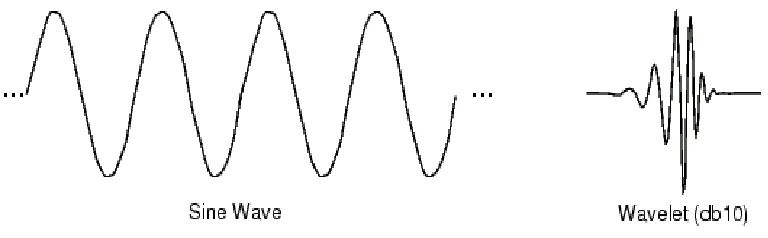
Here illustrated in Figure 4.1 is a comparison between sine wave and one of the
wavelet forms. As the basis function of Fourier analysis, sine wave does not have limited
duration and it is smooth and predictable. On the other hand, wavelets tend to be irregular
and asymmetric. Fourier analysis breaks up a signal into sine waves of various
frequencies. Similarly, Wavelet analysis breaks up a signal into mother wavelet with
different length and position. From this point of view, signals with sharp changes might
Figure 4.1 Comparison of the Sine Wave
As one of the major differences between the Wavelet Transform and Fourier
Transform, the wavelet basis function will be explicitly defined here. The idea behind the
wavelet theory is to define a set of general properties, which the basis function needs to
satisfy in order to be used. This allows for infinite possibilities of basis functions to be
used for the Wavelet Transform, which range from analytical to numerical, orthonormal
or non-orthonormal, etc. The discussion about the properties used to define the wavelet
basis will be presented later in this chapter.
Several families of wavelets that have proven to be especially useful are introduced
here. Notice how these wavelets functions are different in both time and frequency
domain. This fact makes it essential to properly specify, based on what wavelet basis
function the transform was performed, in order to make correct sense of the results. This
wavelet basis is called mother wavelet. The mother wavelet is chosen to serve as a
prototype for all windows in the process. All the windows that are used are the dilated (or
compressed) and shifted versions of the mother wavelet. There are a number of functions
that are used for this purpose. The Daubechies wavelet, the Morlet wavelet and the
1. Ingrid Daubechies, one of the brightest stars in the world of wavelet research,
invented what are called compactly supported orthonormal wavelets – thus making
discrete wavelet analysis practicable. The name of the Daubechies family wavelets is
written dbN, where N is the order, and db is the “surname” of the wavelet. The
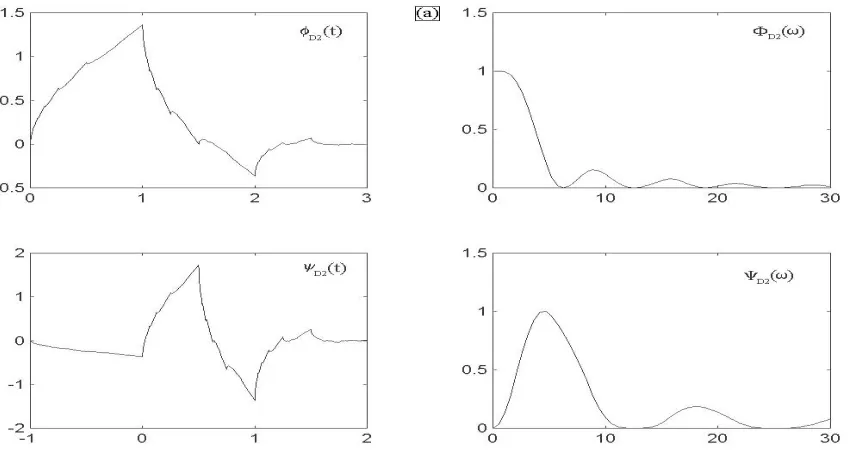
family includes the Haar wavelet, which is written as db1. Figure 4.2 illustrates some
of the scaling and wavelet functions along with their respective Fourier transform for
the Daubechies family.
Figure 4.2 Daubechies wavelets
2. Mexican hat wavelet:
The analytical expression of the Mexican hat wavelet is
( )
14(
2)
221 3
2 x e x
x − − −
= π
ψ (4.1)
This function is proportional to the second derivative function of the Gaussian probability
3. Morlet wavelet
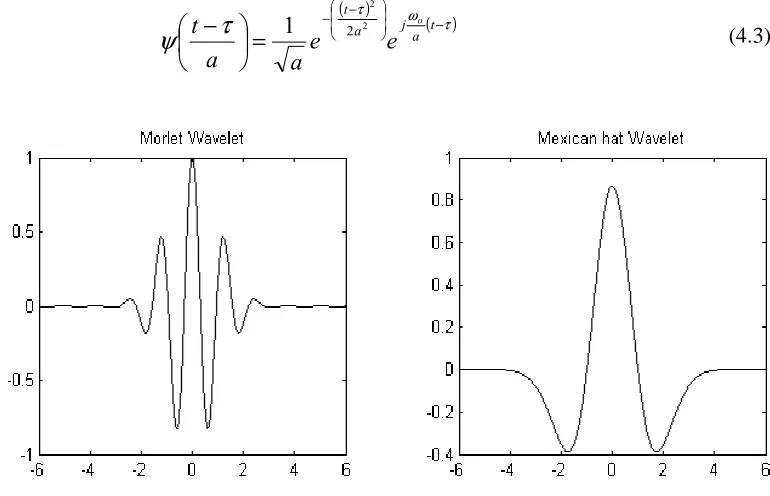
Morlet wavelet has [-4 4] as effective support. The analytical equation of it is defined
as:
( )
x e x22ejω0tψ = − (4.2)
Whereω0 =1.75π , is selected in order to satisfy one of the wavelet function conditions
[Grossmann, et al, 1989]. Figure 4.3 shows the basic form of the both Morlet and
Mexican hat wavelets. Introducing the scale and translation parameters of the Wavelet
Transform to equation3.2 yields
( )
( )τ ω τ τ
ψ −
−
−
=
− t
a j a t
o
e e
a a
t 2
2
2
1 (4.3)
Figure 4.3 Morlet and Mexican hat Wavelet forms
4.2 Continuous Wavelet Transform (CWT)
The Continuous Wavelet Transform was developed as an alternative approach to the
is done in a similar way to the STFT analysis, in the sense that the signal is multiplied
with a function, (or the wavelet), similar to the window function in the STFT, and the
transform is computed separately for different segments of the time-domain signal.
However, there are two main differences between the STFT and the CWT:
1. The Fourier transforms of the windowed signals are not taken, and therefore single
peak will be seen corresponding to a sinusoid, i.e., negative frequencies are not
computed.
2. The width of the window is changed as the transform is computed for every single
spectral component, which is probably the most significant characteristic of the
wavelet transform.
4.2.1 Definition
For a signal f
( )
t , the continuous Wavelet Transform is defined as the sum over alltime space of the signal multiplied by scaled, shifted version of the wavelet function ψ:
dt a
b t t f a b a
Wf
∫
+∞
∞ −
∗
−
= 1 ( )ψ
) ,
( (4.4)
Where ψ(t): Mother wavelet (* indicates the conjugate)
) (t
f : Signal being analyzed
a: Dilation parameters (a>0)
b: Translation parameters (b∈R)
Herein, the variable a scales the wavelet basis function such that the wavelet function
convolutes with f(t) in different temporal windows, and the variable bacts as a shift
operator by centering the window at several locations. Interpreting in frequency domain,
whether those frequencies are present at a particular stretch of the signal is analyzed by
centering the basis function with the help of variable b. The 1 a factor is used with the
purpose of energy normalization so that, all the scaled wavelets have the same energy
[Rao and Bopardikar, 1998]. The choice of the Mother wavelet is restricted by one of the
most important characteristics-admissibility condition:
∞ < Ψ
=+∞
∫
∞ −
ω ω
ω
ψ d
C
| |
| ) (
| 2
(4.5)
Where
ω ω ψ
ω) (t)exp( i t)d
( = −
Ψ +∞
∫
∞ −
(4.6)
is the Fourier transform of ψ(t).
The results of the CWT are Wavelet coefficients C, which are a function of scale and
position. Multiplying each coefficient by the appropriately scaled and shifted wavelet
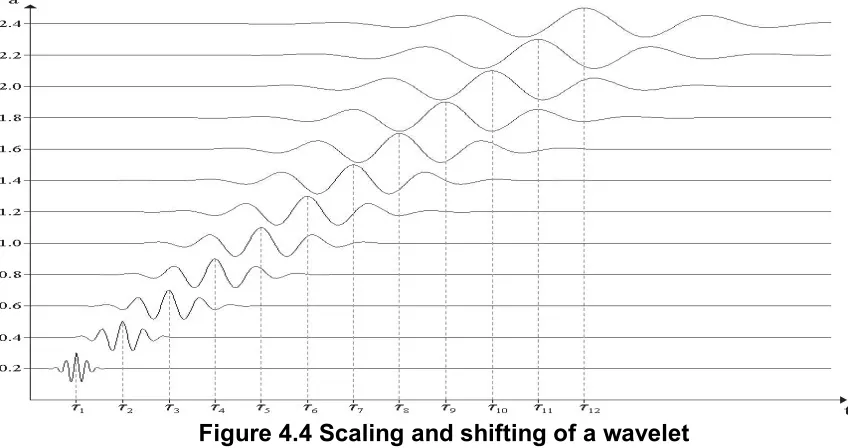
can yield the constituent wavelets of the original signals. Here the scale factor, which is
commonly denoted by the letter a, is introduced. Scaling a wavelet simply means to
stretch it. That means the smaller the scale factor, the more compressed the wavelet has
been. It is also clearly shown from the Figure 4.4 that the scale is related to the frequency
Figure 4.4 Scaling and shifting of a wavelet
The use of the scale parameter represents the first difference between the Wavelet
Transform and other types of transforms previously discussed. The result of the Wavelet
Transform of a function yields a two-dimensional time-scale representation by scaling
and translating the window function. Another way to view the Wavelet Transform is as a
decomposition of a function into a linear combination of the wavelets, where the
coefficients )Wf(a,b are the inner products between the function and the wavelet basis
used. By Parseval’s identity, the Wavelet transform can be represented in the frequency
domain, which can be written as:
( )
∫
∞( ) ( )
∞
− Ψ
= ω ω ω
π
ω d
e a F
a b a
Wf * j b
2
, (4.7)
Where, )F(ω is the Fourier transform of f
( )
t and Ψ*( )
aω is the complex conjugate ofFourier transform of the mother wavelet. Therefore, the Wavelet Transform can be seen
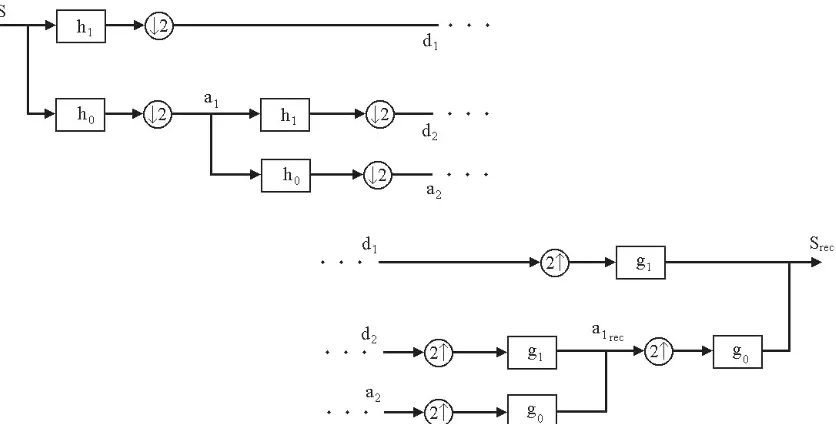
as a bank of filters with different scales. Here applying the