A COMPARATIVE STUDY OF THE PRE-SERVICE TEACHERS’ SELF-EFFICACY BASED ON FIELD EXPERIENCE
Santhanamary a/p R. Anthony, Institut Penguruan Temengong Ibrahim Dr. Hamdan Said, Faculty of Education, Universiti Teknologi Malaysia
Abstract
This study attempts to investigate the self–efficacy of the student teachers before and after their field experience as to predict their future teaching effectiveness. The study uses a causal-comparative research design. The targeted population consists of 155 pre–service teachers from the Institut Perguruan Temenggong Ibrahim. The instruments, ‘The Teachers Demographic Basic Data Questionnaire’ and ‘The Teachers’ Sense of Efficacy Scale (TSES)’, will be used for collecting data. The Teachers Demographic Basic Data Questionnaire will be field tested to ensure clarity of the questions. The TSES consists of a 24-item scale and the reliability was found to be 0.94. Reliabilities for the subscales of the TSES were found to be “.91 for instruction, .90 for management, and .87 for engagement”. The dependent variable in this research is the teachers’ self-efficacy beliefs whereas the independent variables are the teachers’ demographic factors. The Statistical Package for the Social Sciences (SPSS Windows 13.0) will be used to analyze the data gathered both descriptively and inferentially. In conclusion, understanding the self-efficacy scores of students in teacher preparation programs can be the first step in improving the pool of teacher candidates.
1.0 Introduction
In this era of rapid technological advancements and increase in knowledge, there is a growing interest in the fields of school effectiveness and quality of education. Our contemporary multicultural educational context calls teachers to assume a more demanding roles and responsibilities. Although teaching is a practical activity, it is not a static element that can be applied from observed classroom context to all other contexts and situations (Jack Lam & Mok Yan Fung, 2001). Teaching is a complex activity that needs teachers to develop capacity to make intelligent decision to handle ambiguous and challenging situations. Accordingly, teacher education has to foster such capabilities through theoretical understanding and practical experience. In the recent years, teacher preparation programs have put great emphasis on field experiences by having longer practicum experiences prior to student teaching and diversifying the locations of field placements between urban and suburban schools. The rationale behind these experiences is to have pre-service teachers become more confident in their teaching abilities in a variety of schools and thus be able to transfer the learning experiences during pre-service training into the first years of teaching. Hence, understanding teachers’ beliefs about their own effectiveness, known as teacher efficacy, which underlies many important instructional decisions which ultimately shape students educational experiences (Eslami, 2008) can shed some light on how teachers should prepare themselves to face the challenges of the 21st century.
2.0 Background of Study
are several ways for teachers to obtain a qualification to teach in the public schools. Preparation of future teachers through the university system is one way, other than through the Teacher Training Institution, which offers a wide range of courses to train teachers for the primary schools. These programs are aimed at achieving the objectives of the National Educational Philosophy and the Teacher Education Philosophy so as to produce competent, dynamic, morally uptight, highly intellectual, and technologically skilful teachers.
In the teacher training institutions, the attempt to mould pre-service teachers begin early in their college careers and culminate as they finish student teaching. Particular problems can arise for students in order to complete their requirements to become teachers. They must not only adapt to a new educational setting, but also into a teacher education program. In addition to adjusting to life at an institution, they will also experience an increased workload in the classroom - taking course content classes, doing research on instructional practices, and participating in early field experiences. The effect that this kind of transition might have on pre-service teachers’ self-efficacy as they attempt to master so many things at once is unknown.
One consistent measure of teachers’ future success in the classroom is their self-efficacy, or belief in their capability to do the job. This issue becomes of utmost importance in ensuring teacher quality since the link between a teacher’s perceived self-efficacy and his or her potential effectiveness in the classroom has been established by educational research (Gibson & Dembo, 1984).
In the quest of meeting the Vision 2020, the education system in Malaysia is being revamped and this has certainly increased the demand for teachers in the public schools. In an attempt to solve problems related to teachers, the government has taken necessary measures that help to enhance the quality of education and further upgrade the teaching profession. Stringent measures have been put in place to ensure that only the qualified gets into teacher training. Apart from other personal qualities appropriate for the role as teacher trainer, lecturers are also required to possess higher academic and professional qualification. The Ministry of Education therefore, had increased the intake of teachers with basic degrees in the relevant disciplines.
certified, quality teachers and quality education which is in accordance to the status of these teacher training institutions to confer degrees.
3.0 Statement of the Problem
Self-efficacy beliefs are believed to be able to predict future behavior ( Hoy,2004). In other words, if a teacher believes that he or she is capable of managing his or her classroom and conducting meaningful lessons, he or she will more likely to do just that. In light of this, schools of education in general and teacher preparation programs in particular need to be aware of the factors associated with increased levels of self-efficacy in order to produce the most capable, innovative, and dedicated teachers possible. The development of teachers’ efficacy beliefs among prospective teachers has generated a great deal of research interest (Eslami, 2008; Hoy, 2000; Rideout & Morton, 2007; Ritchie, 2006) and the time to effect change in a teacher’s self-efficacy should be early in the process of training and induction. This is because once efficacy beliefs are established; they appear to be somewhat resistant to change (Bandura, 1997). There is some evidence that coursework and practical have different impacts on personal and general teaching efficacy. General teaching efficacy appears to increase during college coursework, then decline during student teaching (Hoy & Woolfolk, 1990) suggesting that the optimism of young teachers may be somewhat tarnished when confronted with the realities and complexities of the teaching task. In Malaysia, research into teacher preparation programs and more specifically into pre–service teachers, is tentatively at an early stage. Studies specifically on field experience and self–efficacy is almost non– existent in Malaysia even though field experience is a compulsory task for pre-service teachers to undergo. With the increasing number of students enrolled in teacher training institutions to become teachers, research can help to determine if these institutions can potentially increase the self–efficacy of the pre-service teachers and the quality education on the whole. It is this concern of teacher quality that forms the basis for this particular study. Hence, the purpose of this study is (a) to determine the level of efficacy beliefs of the pre-service teachers in the Institut Perguruan Temenggong Ibrahim, Johor Bahru, before and after field experience (practicum) and (b) to predict their future effectiveness inclass.
4.0 Research Questions
Given the problems and importance of establishing self–efficacy in teachers in general and pre- service teachers in specific, this research will attempt to examine the following questions:
1. Are there differences in the pre–service teachers’ sense of efficacy beliefs between the two groups compared in terms of selected demographic characteristics (age, gender, ethnicity and education background) in relation to field experience?
2. Are there any differences in the pre–service teachers’ sense of efficacy beliefs between the two groups before and after their field experiences?
5.0 Theoretical Framework
The theoretical framework of this research is attributed to the work of theorist Albert Bandura. Through his Social Cognitive Theory he disagreed with behaviorist theories that implied that an individual is merely a product of his or her environment, but rather Bandura believed that there is more complexity that drives one’s choices and in his or her day-to-day life. He believed that an individual has dynamic interplay between his or her internal, external and his or her current and past behaviors (Bandura, 1986). He theorized that the behavior a person exhibits is influenced by his or her beliefs regarding an outcome expectation and an efficacy expectation. In an outcome expectation, a person estimates that “a given behavior will lead to a certain outcome” (p.193). Efficacy expectation refers to the belief that a person has regarding his ability to actually perform the “behavior required to produce the outcome” (p. 193). These two outcomes are distinct, particularly in the educational setting, because while a teacher may believe that specific teacher behaviors will lead to a better classroom environment, improved student learning, increased class participation, etc, that the same teacher may not have confidence in his or her ability to perform those behaviors. Educational researchers have labeled these two sets of expectations as “teaching efficacy and personal teaching efficacy” (Gibson & Dembo, 1984, p.573). In this regard, “efficacy is perceived as teachers’ belief or conviction that they can influence how well students learn, even those who may be considered difficult or unmotivated” (Guskey & Passaro, 1994, p. 628). Several studies point to the impact that teachers’ self-efficacy have on desirable behaviors exhibited by teachers and on the effects that those behaviors have on students. Some of those studies are described as follows:
A study by Gibson and Dembo (1984) to develop an instrument to measure teacher efficacy led to the development of the Teacher Efficacy Scale (TES). During the process to develop the scale, the researchers observed a small sub-sample of eight elementary school teachers in their classroom. The study showed that more teachers that are efficacious responded more positively to students who gave incorrect responses to verbal questions and higher efficacy teachers were also more effective in leading students to correct answers than teachers with lower self-efficacy. Although this was a small study based on classroom observations of a limited group of teachers, these results help support the importance, that efficacy plays in a teacher’s ability to effectively carry out his or her duties. In another study designed to examine teachers’ sense of self-efficacy, Woolfolk and Hoy (1990) found that pre-service teachers with high teaching efficacy scores who were also high in personal efficacy were more humanistic in their approach to pupil control.
are apt to believe that their personal abilities and attributes can outweigh any external pressures that might arise. The role of the colleges is then to foster the idealistic, optimistic outlook of teacher candidates while preparing them for the external factors that can so easily lead to burnout and attrition. The research in the field of self-efficacy continually points to a relationship between a teacher’s belief in his or her ability to teach and the actual ability to do so.
Although most of the current research in teachers’ self-efficacy has been based on results of the Teacher Efficacy Scale (Gibson & Dembo, 1984), many researchers have come to question its construct validity (Henson, 2001). For example, Guskey and Passaro (1994) noted concerns that prior research on the self-efficacy of teachers is really a locus of control issue and not a more complex distinction between personal teaching efficacy and general teaching efficacy. They expressed these concerns after their 1994 study that involved 342 participants. Two hundred and eighty-three of the subjects were experienced classroom teachers and 59 were pre-service teachers. Participants were given a modified version of the TES in which the wording of random items on the scale had been changed to reflect either internal or external orientation. “For example, one of the internal items, ‘When a student does better than usually, many times it is because I exert a little more effort’ was altered to read ‘When a student does better than usually, many times it is because the teacher exerts a little extra effort’” (p. 633). This changed the emphasis from a personal teaching efficacy question to a general teaching efficacy question. The researchers found that despite the modified wording, teachers, both pre-service and experienced, did not distinguish between a normative teacher’s ability to affect students and their own personal ability to do the same. However, they did make distinctions regarding the influence they and teachers in general have on the learning of students. Guskey and Passaro (1994) believe that part of the problem is that Bandura’s (1977) concepts of outcome and efficacy expectations cannot be directly applied to general teaching efficacy and personal teaching efficacy. In light of this and other criticism, new constructs of teacher efficacy have been proposed and new measurements have been developed to address the shortcomings of the TES. While some problems exist with the use and interpretation of the results obtained from the TES, the body of research still establishes a link between a teacher’s self-efficacy and the extent of his or her teaching abilities.
The results of these studies are important because as colleges and universities attempt to prepare the most qualified teaching candidates, their focus should be on helping to develop the self-efficacy of the future educators. It is found that once efficacy beliefs are established, it is difficult to change them (Hoy and Woolfolk, 2000). Therefore, the time to have the most impact on an educator’s sense of self-efficacy is during the formative years of teacher training. The role of the college and the university is to define ways to help foster the efficacy levels of the student teachers in their programs.
of adverse situations—the higher the sense of efficacy, the greater the effort, persistence, and resilience” (p. 544). This is a powerful statement. Understanding the self-efficacy scores of students in teacher preparation programs can be the first step in improving the pool of teacher candidates.
The review of the literature shows that there is a need to explore the concept of self – efficacy that is attributed to positive changes. In general, researchers have established that self-efficacy beliefs and behavior changes and outcomes are highly correlated and that self-efficacy is an excellent predictor of behavior. The review clearly showed that, it is not simply a matter of how capable one is, but of how capable one believes oneself to be.
6.0 Research Methodology
6.1 Design of the study
This study is a causal-comparative research design. The comparison groups will be formed based on the criterion of field experience. The TSES scores of the two groups will be compared. This is generally a descriptive study and specifically an explanatory study using questionnaire. This is in line with Patton’s (1990) statement, that the quantitative method is a convenient method of data collection. He further states that quantitative data are systematic, standard, easy to analyze in a short period of time. According to Fraenkel and Wallen (1990), descriptive study describes a given state of affairs as fully and carefully as possible. It is also said to be one of the most common forms of research engaged in by educational researcher. The research, they further illustrated will involve obtaining information from a group of people. The information is collected by obtaining answers from the sample group to a set of survey questions.
6.2 Population and samples of the Study
The targeted population of the study consists of pre–service teachers teaching in the Institut Perguruan Temenggong Ibrahim. The participants in this study are bachelor degree-seeking education students from the institute. These students are enrolled in the pioneer Bachelor of Education degree program of the institution. The total population involves 2 groups of the degree students (PISMP). The population for this study is 155-degree students.
The following Table 1 shows the population statistics of pre–service teachers from the institute, taken from the Institute Perguruan Temenggong Ibrahim’s Students’ Affairs Office. The samples in this study will be selected from these two groups. The exact number of samples and the pre-service teachers from these two groups are yet to be determined.
6.3 The research instruments
The instruments used to conduct this study are ‘The Teachers Demographic Basic Data Questionnaire’ and ‘The Teachers’ Sense of Efficacy Scale (TSES)’. Section A is the Teachers’ Basic Data Questionnaire designed to gather information about the teachers’ demographic data. It consisted of 4 items. A demographic survey is developed by the researcher and will be field tested to ensure clarity of the questions and to determine the length of time necessary to complete the survey. Comments from those individuals, as well as feedback will be used to improve the wording on the demographic questionnaire. This questionnaire will be used to collect information from the pre-service teachers.
The second instrument that will be used in this study is a measure of self-efficacy and also known as the Teachers’ Sense of Efficacy Scale (TSES) (Tschannen-Moran & Hoy, 2001). The TSES long form consists of a 24-item scale and is recommended for use with pre-service teachers. This scale asks for a self-report of teacher beliefs and is constructed using a nine-point, Likert-type response scale with the options of 1 (nothing), 3 (very little), 5 (some influence), 7 (quite a bit), and 9 (a great deal). The reliability for the 24-item scale was found to be 0.94. The results indicated that the TSES “could be considered reasonably valid and reliable” (Tschannen-Moran & Woolfolk, 2001, p.18).
6.4 Research variables
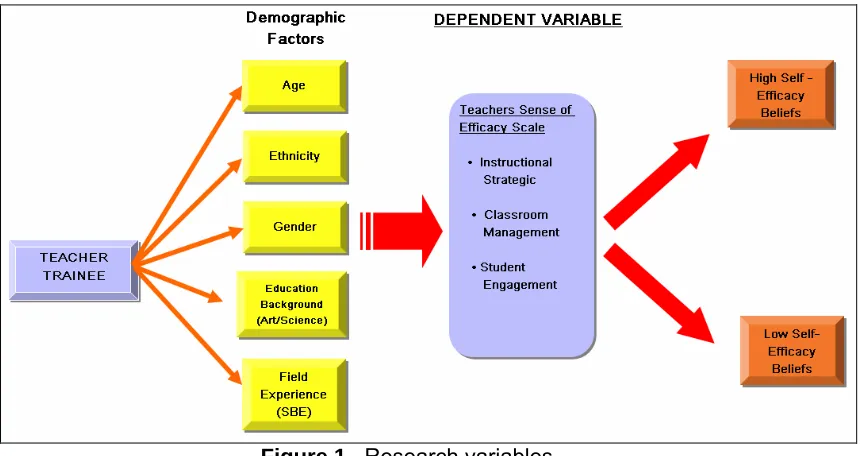
The research variables and the relationship between the variables in this study are shown in Figure 1 below.
Figure 1 Research variables
The dependent variables in this research are the teachers’ self efficacy which has three sub-scales (Instructional Strategies, Classroom Management and Student Engagement) that will be tested. The independent variables in this research are the teachers’ demographic factors such age, gender, ethnicity, education background and field experience.
6.5 Statistical analysis of data
The “Statistical Package for the Social Sciences, (SPSS Windows 9.01) will be used to analyze the data gathered both descriptively and inferentially. Descriptive statistics will be used in this research as they serve as a shorthand description of the entire data set (Sekaran, 1992). The descriptive statistics used in this research are number and percentage, frequency distribution, means and standard deviation.
Inferential statistics will be used in this study to allow the researcher to make inferences about a population based on findings obtained from a sample (Fraenkel & Wallen, 1990). This research will employ ANOVA and Regression. These statistical tests are appropriate to be used in this study.
7.0 Conclusion
that self-efficacy beliefs and behavior changes and outcomes are highly correlated and that self-efficacy is an excellent predictor of behavior. In order to respond to the continuously increased demands for quality in education, it is important to specifically investigate and develop the self–efficacy of the pre-service teachers to meet the ever- increasing change in the field. This paper is an effort to provide further reference in this area as there still remain a vacuum in the Malaysian educational system.
References
Bandura, A. (1982). Self-fficacy mechanism in human agency. American Psychological Review , 191-215.
Bandura, A. (1986). Social Foundations of Thought and Action: A Social Cognitive Theory. Englewood Cliffs, NJ: Prentice - Hall.
Bandura, A. (1997). Self-efficacy: The Exercise of Control. New York: W.H.Freeman and Company.
Fraenkel, J. R., & Wallen, N. E. (1990). How to Design and Evaluate Research Education. USA: Mc Graw - Hill, Inc.
Gibson, S. & Dembo, M.H. (1984). Teacher Efficacy: A Construct Validation. Journal of Educational Psychology , 569 - 582.
Guskey, T. R., & Passaro, P. D. (1994). Teacher Efficacy: A Study of Construct Dimension. American Educational Research Journal,(31), 62-643.
Henson, R. K. L., & Vancha Haase, T. (2001). A Reliability Generalization Study of the Teacher Efficacy Scale and Related Instrument. Educational and Psychological Measurement, 61(3), 404-420.
Hoy, A. W. (2000). Changes in Teacher Efficacy During the Early Years of Teaching. American Educational Research Association. New Orleans, LA.
Hoy, A. W. (2001). Teachers' Sense of Efficacy Scale. Retrieved September 18, 2008, from http://www.coe.ohio-state.edu/ahoy/researchinstruments.htm
Hoy, A. W. (2004). What Do Teachers Need to Know About Self-Efficacy? Paper Presented at the annual meeting of the American Educational Research Association. San Diego.
Hoy, W., &. (1990). Socialization of Students. American Educational Research Journal. American Educational Research Journal, 279-300.
Krejcie, R.V & Morgan,D.W. (1970). Determining sample size for research activities. Educational and Psychological Measurement , 30: 607 - 610.
Ministry of Education. (2004). The Development of Education: National Report of Malaysia.
Pajares, F. (n.d.). Overview of Social Cognitive Theory and of Self -Efficacy. Retrieved September 15, 2008, from http://www.des.emory.edu/mfp/eff.html
Pajares, F. (1996). Self-efficacy Beliefs in Academic Settings. Review of Educational Research, 66, 533-578.
Rideout, G.W & Morton, L.L. (2007). Pre - service teachers' beliefs and other predictors of pupil control. Journal of Educational Administration , (5), 587 - 604. Ritchie, K. R. (2006). A Comparison Of Self-Efficacy Scores of Preservice Teachers Based on Initial College Experience. United States: ProQuest Information and Learning Company.
Sekaran, U. (1992). Research Methods for Business: A Skill Building Approach. Singapore: John Wiley & Son, Inc.
Jack Lam & Mok Yan Fung. (2001). Strenghtening Teacher training Program :
Revamping the model of Teaching- Practice. Hong Kong Conference on Quality in teaching & Learning in Higher Education. Hong Kong.