IMPROVING THE PROCESS OF CAPTURING CLIENTS’ NEEDS
FAIZAH BINTI IBRAHIM
A capstone project report submitted in partial fulfilment of the
requirements for the award of the degree of
Master of Project management
Faculty of Civil Engineering
Universiti Teknologi Malaysia
Especially dedicated to:
ACKNOWLEDGEMENT
Praise to the Almighty Allah the God of the universe for guiding me
thru the process of preparing the report. First, I would like to express my
deepest gratitude and sincere appreciation to my project supervisor, Assoc.
Prof. Dr. Mohamad Ibrahim Mohamad for his generous advice, guidance,
encouragement and patience throughout the duration of project capstone.
Secondly, I am very grateful to all JKR officers and client officials
that were directly involves in the research. Their contribution are invaluable to the success of the research which I’m deeply appreciated. A special thank
for Datin Mariyam Ismail, Puan Rosila Mohammed and all of my friends and
colleagues for their big-hearted support, advice and encouragement.
Finally, I am thankful to my mother, sisters and brother for their
ABSTRACT
Understanding of customer’s need is very crucial for any organisation to
ensure that their need can be fully realised. Therefore, it is important for organisation
to have a systematic approach to capture their client requirements. For Jabatan Kerja
Raya (JKR) this system has been developed and implemented in 2000 with the
guidance of quality management system. However, based on the recent internal
survey conducted in 2009, it is found that Customer Satisfaction Index achieved by
JKR under the criteria of quality design is below the expectation. This has raised the
alarm for JKR to review back their back their business process related to the addressing their client’s need so that significance improvement can be made. This
study is embarked on in conjunction with such effort. The main focus of this study is
to propose improvement measure for JKR to reappraise their current process in
understanding and translating client requirements into design outputs. The
methodologies used for the study include thorough document search, interview with
expert panels and questionnaire survey. The data collection involved JKR personnel
as well as client form various government agencies in Malaysia. The findings from
the study clearly indicate that some limitations existed within the current processes
that need to be improved if JKR want to achieve the target of exceeding their client’s
satisfaction. Various improvement measures have been identified in this study and
proposed to JKR. Among the improvement measures are the need for JKR to conduct
benchmarking procedures, establish clear guidelines for the project team and
adequate client representation in design development process. Finally, the study
concluded that JKR must take a very serious action to realign their current process of
ABSTRAK
Memahami kehendak pelanggan adalah sangat penting untuk memastikan
bahawa keperluan mereka dapat dipenuhi. Oleh itu, adalah penting sesuatu organisasi
menpunyai kaedah yang sistematik untuk mengumpul, memahami, menganalisa dan
merealisasi keperluan pelanggan. Bagi Jabatan Kerja Raya, system pengurusan
kualiti telah di diaplikasi dan digunapakai sejak 2000. Walau bagaimanapun,
berdasarkan kepada kajiselidek dalaman yang dijalankan pada 2009, adalah didapati
Index Kepuasan Pelanggan yang dicapai oleh JKR bagi kriteria reka bentuk berkuali
berada di bawah paras jangkaan. Ini adalah sesuatu yang amat membimbangkan
kepada JKR supaya mengkaji semula proses dalaman berkaitan dengan keperluan
pelanggan supaya penambahbaikkan dapat dijalankan. Kajian ini dijalankan
berdasarkan kepada usaha tersebut. Fokus utama kajian ini adalah untuk
mencadangkan kepada JKR kaedah penambaikkan bagi menilai semula proses sedia
ada pengumpulan, pemahaman, penganalisaan dan merealisasi keperluan pelanggan
kepada output reka bentuk. Kaedah pengumpulan data yang dijalankan untuk kajian
ini adalah melalui kajian litertur, temuabual dengan pakar dan kajiselidek.
Pengumpulan data ini dijalankan ke atas pegawai JKR dan pelanggan JKR yang
terdiri daripada pelbagai agensi kerajaan. Hasil kajian menunjukkan terdapat
masaalah dan kekurangan semasa proses dijalankan yang perlu di perbaiki sekiranya
JKR hendak mencapai objektif melepasi kepuasan pelanggan. Pelbagai kaedah
penambahbaikkan telah dikenalpasti di dalam kajian ini dan dicadangkan kepada
JKR. Antaranya yang perlu dilaksanakan oleh JKR adalah prosedur penandaras, garis
panduan yang jelas untuk pasukan projek dan penglibatan pelanggan yang
mencukupi semasa proses membangunkan reka bentuk. Akhirnya, kajian in
merumuskan bahawa JKR hendaklah mengambil langkah yang tegas untuk
menastikan proses sedia ada dalam menangani keperluan pelanggan selari dengan
TABLE OF CONTENTS
CHAPTER TITLE PAGE
DECLARATION ii
DEDICATION ii
ACKNOWLEDGEMENT iii
ABSTRACT iv
ABSTRAK v
TABLE OF CONTENTS vi
LIST OF TABLES vii
LIST OF FIGURES vii
1 INTRODUCTION
1.1 Introduction 1
1.2 Problem Statement 2
1.3 Importance of Study 2
1.4 The Aim and Objectives 3
1.5 Scope of Study and Limitation 3
1.6 Brief Research Methodology 4
CHAPTER TITLE PAGE
2 CUSTOMER DRIVEN QUALITY PAGE
2.1 Introduction 5
2.2 Satisfying Client’s Needs 5
2.3 Quality Management System 6
2.4 Customer Focus Elements in Quality
Management System
6
2.4.1 ISO 9000 8
2.4.2 Total Quality Management 9
2.4.3 Six Sigma 10
2.4.4 Voice of Customer 11
2.4.5 Quality Functional Deployment 12
2.4.6 Balance Score Card 17
2.5 Capturing Client’s Needs in Construction
Industry
18
2.5.1 Project Brief 19
2.5.2 Client Responsibility 20
2.5.3 Project Team 21
2.6 Summary 22
3 SATISFYING CLIENT’S NEEDS IN JKR
3.1 Introduction 23
3.2 Implementation of QMS in Construction
Project in JKR
23
3.2.1 Background of JKR 25
3.2.2 Background of Architect Division 26
3.3 Current Approach in Capturing the Client’s
Needs by Architect/Designers in JKR
CHAPTER TITLE PAGE
3.3.1 Planning Phase 28
3.3.2 Design Phase 29
3.4 Reduce Change to Improve Quality Design 31
3.5 JKR’s initiatives in Customer Satisfaction 33
3.6 Effectiveness of Current Process 34
3.7 Summary 34
4 METHODOLOGY
4.1 Introduction 35
4.2 Preliminary Study 35
4.3 Data Collection 36
4.3.1 Literature Review 36
4.3.2 Interview with Expert Panel 36
4.3.3 Questionnaire Survey 37
4.4 Data Analysis 38
4.4.1 Content Analysis 38
4.4.2 Reliability Test of Questionnaire 39
4.4.3 Frequency Analysis 39
4.4.4 Relative Important Index 39
4.4.5 Mann-Whitney U Test 40
4.5 Writing the Report 41
4.6 Summary 41
5 DATA COLLECTION AND ANALYSIS
5.1 Introduction 5.1
5.2 Analysis of Interview 5.2
5.2.1 Profile of Interviewees 45
CHAPTER TITLE PAGE
5.3 Reliability of Questionnaire Survey Data 53
5.4 Analysis of Questionnaire Survey 54
5.4.1 Profiles of Respondent 55
5.4.2 Review of Current Process 55
5.4.3 Identify Improvement Measures on
Current Practice
57
5.4.4 Identify Improvement Measures on
Factors on Interconnected Network
People
59
5.4.5 Difference Opinion between Two
Groups of Respondents
61
5.5 Summary 62
6 DISCUSSION
6.1 Introduction 63
6.2 Current Process of Capturing Client’s Needs 63
6.2.1 Processes of Reviewing and
Analysing Client Project Brief
64
6.2.2 Processes of Preparation Conceptual
Design, Preliminary and Detail
Design Drawings
64
6.3 Problems and limitations of Current Process 65
6.3.1 Processes of Reviewing and
Analysing Client Project Brief
65
6.3.2 Process of Client Acceptance 66
6.3.3 Processes of Preparation Conceptual
Design, Preliminary and Detail
Design Drawings
CHAPTER TITLE PAGE
6.3.4 Project Team 67
6.4 Improvement Measures Current Process 68
6.4.1 Processes of Reviewing and
Analysing Client Project Brief
68
6.4.2 Processes of Preparation Conceptual
Design, Preliminary and Detail
Design Drawings
69
6.4.3 Process of Client Acceptance 69
6.4.4 Project Team 70
6.4.5 Client Representation 71
6.4.6 Stakeholders Involvement 72
6.5 Difference Opinion between Two Groups of
Respondents
72
6.6 Summary 73
7 CONCLUSION
7.1 Introduction 74
7.2 Ability of Current Process to Capture Client’s
Needs
75
7.3 Problems and limitations of Current Process 75
7.4 Improvement Measures Current Process
7.5 Summary 76
REFERENCES
LIST OF TABLES
TABLE NO. TITLE PAGE
5.1 Profile of Interviewee 44
5.2 Content Analysis of Interview 46
5.3 Reliability Test Results 54
5.4 Rate of Responses 54
5.5 Current Process of Capturing Client’s Needs and
Requirements
56
5.6 Results of Relative Index on the Variables to Improve
the Current process
58
5.7 Results of Relative Index on the Variables under
Interconnected Network of People
LIST OF FIGURES
FIGURE NO. TITLE PAGE
1.1 Schematic of Research Methodology 4
2.1 Four Components of Customer Relationship
Management
12
2.2 House of Quality 14
2.3 Four Perspectives of Balance Score Card 17
2.4 Total Quality Flowcharts for Project Lifecycle 22
3.1 Work Process Mapping for Technical Consultancy
Services and Project Management
24
3.2 Planning Work Process 28
CHAPTER 1
INTRODUCTION
1.1 Introduction
In the last few decades, the focus on client or customer satisfaction has
increased in all areas of industry, especially in increasing competitive and dynamic
environment; the customers determine the survival of all organisations. For private sectors, customer satisfaction is an effective way to differentiate them from the
competitors. Great expectation in accountability to stakeholders in public sector
requires customer satisfaction to be factored in together with quality service,
productivity, increase efficiency and effectiveness in government operations (Hood,
1995).
Organisation‟s policies, processes and procedures that reduce or eliminate
non-conformances to provide quality product or services, quality management
systems (QMSs) ensured by the organisation are customer driven. It is the customer
who is the source of standards for defining quality. With the intention of promoting
the application of QMSs to encourage competitiveness and economic growth,
customer satisfaction index is used an indicator to measure the performance of the
1.2 Problem Statement
Jabatan Kerja Raya (JKR) as one of public organization in Malaysia which
implement national infrastructure project became customer focus organisation when
it acquired MS ISO 9001 certification in 2000. Although the process of clients‟ needs
are usually defined and determined during planning and design phases which is
based on JKR MS ISO 9000: Manual Operating Procedure, JKR project teams still unable to satisfy client‟s need. Under quality attribute, JKR was ranked “less satisfaction” or moderate by it clients during planning and design phases; score of 62.2% of Client Satisfaction Index (CSI) for questionnaire survey on „conceptual design proposal submitted to client fulfil standard‟ and „JKR design meets the
function and performance as required by client obtain score of 64.3% (Laporan
Pengukuran Tahap kepuasan Pelanggan Bagi JKR 2009). Design changes during
construction become norms that affect both clients and JKR. Clients were unable to
move into their project as scheduled and at extra cost. To JKR, the changes incurred
additional resources and time required to perform the changes, and also they affected client‟ satisfaction and loyalty. One of the reasons is due to current process does not
have a guideline that helps the team members to capture the client‟s need. According
to Dikmen et. al. (2005) the organisation needs a most effective and structured tool to deal with clients‟ demands systematically while establishing what they want.
1.3 Importance of Study
It is very significant to carry out the study in identifying with JKR‟s clients‟ needs base on QMSs‟ client satisfaction focus. It will assist JKR in managing client‟s
needs systematically and accurately. Although satisfying client indicate how the
clients measure JKR throughout its operational quality process which consists of five phases; planning, design, procurement, construction and handing over, clients‟ needs
are usually briefed and defined during project planning and the needs are further
new development project for 10th Malaysian Plan announced by the Malaysian
government (Economic Planning Unit, 2009), JKR must improve its product and
service with the purpose of providing quality projects for public facilities.
1.4 The Aim and Objectives
The main aim of this study is to propose mitigation measures to improve the
current process of capturing clients‟ needs for the JKR project managers and designers with the purpose of achieving clients‟ satisfaction. The objectives of this
study are as follows:
a) To investigate the process of capturing client‟s requirements in JKR during
planning and design phases;
b) To identify the problems and limitation of the current process of capturing client‟s needs in JKR during planning and design phases; and
c) To identify best mitigation measures to improve the current process of capturing client‟s requirements in JKR during planning and design phases.
1.5 Scope of Study and Limitation
The study is confined to processes undertaken by the designer, namely the
architect and JKR project managers as the forerunners in building project. The
project phases are limited to planning and design stages where capturing and translating clients‟ need occur. Furthermore, the clients being examined are restricted
to ministries and government agencies/department that manage the development of
1.6 Brief Research Methodology
The methodology of this study started from identifying the problem statement;
literature review; collecting data from literature review, semi-structured interviews
and questionnaire survey; analysis of results; discussion result; conclusion and
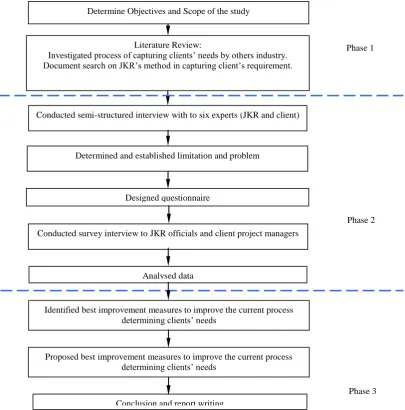
recommendations. A flowchart of the research methodology in order to achieve the
objectives of the study as shown in Figure 1:
Figure 1 Schematic of Research Methodology
Phase 1
Phase 2
Phase 3 Determine Objectives and Scope of the study
Designed questionnaire
Conducted semi-structured interview with to six experts (JKR and client)
Conducted survey interview to JKR officials and client project managers
Analysed data
Conclusion and report writing Literature Review:
Investigated process of capturing clients‟ needs by others industry. Document search on JKR‟s method in capturing client‟s requirement.
Identified best improvement measures to improve the current process determining clients‟ needs
Proposed best improvement measures to improve the current process determining clients‟ needs
REFERENCE
Abdul-Rahman, H. (2007). Some observations on the issue of quality cost in
construction. International Journal of Quality & Reliability Management.
14(5), 464-481. MCB University Press.
Al-Momani, A. H. (2000). Examining service quality within construction
processes.Technovation, 20, 643-651
Arditi, D and Gunaydin, H. (1997) Total quality management in the construction
process.International Journal of Project Management, 15(4), 235-243
Beatham, S. Anumba, C. and Thorpe, T. (2004). KPIs: A critical appraisal of their use
in construction, International Journal of Public Sector Management. 11(1),
93-117
Cheng, J. (2002). Discussion of importance index in technology foresight.National
Centre for Science and Technology for Development Ministry of Science and
Technology of the People Republic of China.
Chowdhury, S. (2001). The poweof Six Sigma: An inspiring tale of how Six Sigma is
transforming the way we work. Financial Times/Prentice Hall, London.
Dikmen, I., Birgonul, M. T, and Kiziltas, S. (2005).Strategic use of quality function
deployment (QFD) in the construction industry.Building and Environment. 40,
245-255
Economic Planning Unit(2009).GarispanduankeduaRancangan Malaysia Kesepuluh:
Ezekial, A. C., Olomolaiye, P. O., and Corbett, P. (1998). An Evaluation of Project
Needs of UK Building Clients. International Journal of Project
Management.16(6), 385-391,
Foster, S. T. (2010). Managing Quality: Integrating the supply change. Pearson
Education, Inc., New Jersey.
Fryer, K, Anthony, J and Ogden, S. (2009). Performance management in the public
sector. International Journal of Public Sector Management. 22(6), 478-498
Govers, C. P. M. (2000). QFD not just a tool but a way of quality
management.International Journal of Production Economics, 69, 151-159
Hannu, K. Pippo, P and Tuominen, M. (2001). Ten tools for customer-driven product
development in industrial companies. International Journal of Production
Economics, 69, 161-176
Harry, M., and Schroeder, R. (2000) Six Sigma: the breakthrough management
strategy revolutionizing the world’s top management, Doubleday, New York.
Harvey, J. (1998). Service quality: a tutorial. Journal of Operation Management. 16,
583-597
Hongen, L. andXiangwei, Z. (1996). A systematic approach to implementing total
quality management through quality function deployment.Computer Industry
Engineering, 31(3/4), 747-751
Hood, C. (1991). The new public management in the 1980s: variations on a theme.
Accounting, Organizations and Society, 20(2/3), 93-109
ISO 9000 (2005).Quality management system – Fundamental and Vocabulary (ISO
9001:2005). International Organisation for Standardisation, Geneva.
ISO 9000 (2000). Quality management system – Requirements (ISO 9001:2000).
Jusoh, R. and parnell, J. A. (2007). Competitive strategy and performance
measurement in the Malaysian Context. Management Decision. 46(1), 5-31.
Emereld Group Publishing Limited.
Kaplan, R. S. and Norton, D. P. (1996). Using Balanced Scorecard as a strategic
management system.Harvard Business Review, 1, 71-79
Kerzner, H. (2006). Project management: a system approach to planning, scheduling,
and controlling. John Wiley & Sons, Inc, Hoboken, New Jersey.
Mohamed, Z. (2000). Managing customer satisfaction: a best practice perspective.
The TQM Magazine, 12(6), 389-394
Odeh, A. M. and Bettaineh H. T. (2002). Causes of delay: traditional contracts.
International journal of Project Management. 20(1), 67-73.
Othman, A. A. E., Hassan, T. M. And Pasquire, C. L. (2005). Analysis of factors that
drive brief development in construction. Engineering, Construction and
Architectural Management, 12(1), 69-87. Emerald Group Publishing Limited
Othman, A. A. E., Hassan, T. M. And Pasquire, C. L. (2004). Drivers for dynamic
brief development in construction. Engineering, Construction and
Architectural Management, 11(4), 248-258. Emerald Group Publishing
Limited
Pande, P. S., and Holpp, L. (2002). What is Six Sigma? McGraw-Hill, New York.
Pheng, L. S., and Hui, M. S. (2004). Implementing and applying Six Sigma in
Construction. Journal of Construction Engineering and Management, ASCE,
July, August, 482-489
Pitman, G, Motwani, J, Kumr, A. and Ceng, C. H. (1996). QFD application in an
educational setting: A pilot project. International Journal of Quality
Rosli M. Z,Mohamad, I. M, Saiful, A. M and Tee, D.C.B (2008). Guidelines for the
preparation and submission of work schedule for construction
project.Malaysian Journal of Civil Engineering 20(2), 145-159
Ryd, N. (2004).The design brief as carrier of client information during construction
process.Design Studies. 25, 231-249
Tang, S.L., Ming, L., and Chan Y.L. (2003). Achieving clients satisfaction for
engineering consulting firms. Journal of Management in Engineering ASCE.
19(4), 166-172
Singles, J. Ruel, G. andWater, H. V. (2000).ISO 9000 series certification and
performance. International Journal of Quality & Reliability Management,
18(1), 62-75
Shehu, Z. and Akintoye,A. (2009). Theoretical success factor for effective programme
management: a pragmatic approach. The Built & Human Environment Review.
2
Snee, R. D. (2000). Impact of Six Sigma on quality engineering.Quality Engineering.
12(3), 9-24
Wong,W.H, Lam, T.L. and Chan, H. W. (2008). Optimising design objectives using
the Balanced Scorecard approach. Design Studies. 30, 39-392
Yu, A,T.W, Chan, H.W., Chan, W.M., Lam, T.I and Tang W.L. (2010).Management
of client requirements for design and build projects in the construction
industry of Hong Kong. Emerald Group Publishing Limited
.28(13/140,657-672
Yu, A,T.W, Shen, Q, Kelly, J and Hunter, K. (2007). An empirical study of the
variables affecting construction project briefing/architectural programming.
International Journal of Project Management. 25,198-212
Zeithmal, V. (1987). Defining and relating price, perceived quality and perceived