Abstract
HAIJIANG PENG. Classical E&M Model for Nonlinear Optics ⎯ Applications to the Generation of Harmonic and Terahertz Radiation (Under the direction of Professor
David E Aspnes).
Nonlinear optical techniques have become very useful diagnostic methods for
surface and interface properties of materials and for developing new materials. However,
it is still very difficulty to interpret nonlinear optical data. Here, I continued to develop
the simplified bond hyperpolarizability model (SBHM). I extended the theory to describe
the bulk-forbidden second harmonic generation (SHG), bulk third harmonic generation
(THG), and fourth harmonic generation (FHG). I clarified the relative importance of
bulk-forbidden contribution and surface dipole contribution to SHG. I showed the
transverse-bond-direction motion was necessary to correctly describe THG data. And I
presented a way to evaluate the surface roughness effects on FHG.
In addition, from the principle of SBHM, I developed a simple model to interpret the
origin of terahertz radiation from semiconductor surfaces trigged by ultrashort laser pulse.
I unified the mechanisms of terahertz generation ⎯ difference frequency mixing and
current surge mechanism at the field level.
Finally, I showed spectroscopic SHG could give us more information than single
Classical E&M Model for Nonlinear Optics —
Applications to the Generation of Harmonic and Terahertz
Radiation
By
Haijiang Peng
A dissertation submitted to the Graduate Faculty of North Carolina State University
in partial fulfillment of the requirements for the Degree of Doctor of Philosophy
PHYSICS
Raleigh
2005
APPROVED BY:
Dr. Christopher Roland Dr. Hans Hallen
Dedication
To my grandmother Juyun Liu, grandfather Dongsheng Peng, my parents Funan
Peng and Meixiu Chen, my stepmother Shengchun Liu, and my girl friend Shuwei Wu
for their love.
Biography
Haijiang Peng was born in a small village in XiangTan County, XiangTan, Hunan, P.
R. China to Funan Peng and Meixiu Chen. His mother, Meixiu Chen, died a few hours
after his birth. He grew up with his grandparents until he was 10 years old. He then
stayed with his father and stepmother, continuing in elementary school in Changsha.
After completing the 9th grade, he passed the entrance examination for a special class, in which the students are trained specifically for attending the competition of
Olympic-Physics competition for middle-school students. Unfortunately, his first try in physics
was unsuccessful. He did not do as well as expected in the contest. However, he did not
lose confidence. He continued his goal of physics in the Department of Physics, Jilin
University, after his graduation from high school. In Jilin Unversity he was really
attracted by the world of physics and felt the power of physics. He started his research
under Prof. Chengxiang Zhang in solid state physics. After he obtained his bachelor
degree, he went to the Department of Physics, National University of Singapore. There
he worked on the growth of cobalt silicide for 0.18µm CMOS technology, which is
supported by the largest chip manufacturing company, Chartered Semiconductor
Manufacture Ltd. In this project, he published his first scientific referred-journal paper on
solid-state electronics, “Effects of First Rapid Thermal Annealing Temperature on Co
Silicide Formation”. Two years later, he went to Department of Physics, North Carolina
State University, to pursue his PhD degree under the direction of Prof. David E. Aspnes.
He and Dr. Aspnes worked together very well, publishing 5 referred journal papers.
Acknowledgements
Here, I would like to thank many people for their help and encouragement. Without
them, it would have been impossible to finish this project. First of all, I appreciate very
much my advisor, David E. Aspnes. His attitude toward science, his keen insight into
problems, his solid background on all aspects of physics, and his kindness are always my
good example and my motivation to be a professor. I also thank Committee members
Prof. Hans Hallen, Prof. Christopher Roland, and Prof. Robert M. Kolbas for their time
and consideration.
I must say that our group is very nice. Jon–K. Hansen, a visiting scientist from
Norway, helped me significantly at the beginning. I have very happy memories of our
discussions during lunch time. I would also like to acknowledge other group members,
Ji-Fu Wang, Muharrem Asar, Klaus Flock, Sungjin Kim, Nicholas Stoute, Eric Adles, Inkyo
Kim, and Xiang Liu. I will remember them always.
TABLE OF CONTENTS
List of Tables……….. …...……….…………..……vii
List of Figures……...………...……….…………..…..viii
Chapter I. Introduction... 1
References:... 7
Chapter II Theory of Simplified Bond Hyperpolarizability Model ... 9
2.1 Basic equations. ... 9
2.2 Anharmonic restoring forces: elementary considerations... 12
2.3 Higher-order terms... 18
2.3.1 Phenomenological treatment... 18
2.3.2 First-principles treatment. ... 20
2.4 Conclusions... 22
References:... 23
Chapter III: Dipole-Forbidden Bulk SHG in Crystals with Inversion Symmetry ... 24
3.1 Introduction... 24
3.2 SHG including dipole-forbidden bulk contributions ... 25
3.2.1 Bond-sum evaluation: quadrupole contributions ... 26
3.2.2 Bond-sum evaluation: spatial dispersion contributions ... 29
3.2.3 Signals as a function of depth: field-penetration effects, phase considerations, and relative bulk and surface contributions ... 31
3.2.4 Determination of relative bulk/surface contributions from anisotropy data.... 35
3.3 Conclusions... 38
References:... 40
Chapter IV Bulk Third Harmonic Generation from Crystalline Si... 49
4.1 Introduction... 49
4.2 Derivation of expressions for THG... 51
4.3 General properties for tetrahedrally bonded semiconductors; connection to fourth-rank susceptibility tensor components ... 52
4.4 THG responses for specific geometries ... 55
4.4.1 General considerations... 55
4.4.2 Si (111)... 58
4.4.3 Si(001)... 62
4.4.4 Si (110)... 63
4.5 Estimation of relative bulk and surface contributions ... 65
4.6 Conclusions... 66
Chapter V. Surface Fourth-Harmonic Generation ... 74
5.1. Introduction... 74
5.2. Formulation... 74
5.3. (001)Si-SiO2 interface... 75
5.4. Comparison with experiment... 78
5.5 Conclusions... 83
References... 85
Chapter VI Dipole-Radiation Model for Terahertz Radiation from Semiconductors ... 89
6.1 Introduction... 89
6.2 Formulation... 89
6.3 Comparison to data for THz generation from InP ... 97
6.4 Conclusions... 99
References... 100
Chapter VII Spectroscopic Second Harmonic Generation ... 103
7.1 The spectroscopic properties of the SBHM ... 103
7.2 Spectroscopic SHG ... 104
Chapter VIII Conclusions and Proposals... 110
8.1 Conclusions... 110
8.2 Proposed work ... 111
List of Tables
List of Figures
Figure 3.1 Experimental configuration for harmonic-generation measurements………..43
Figure 3.2 Bond-vector diagram………...44
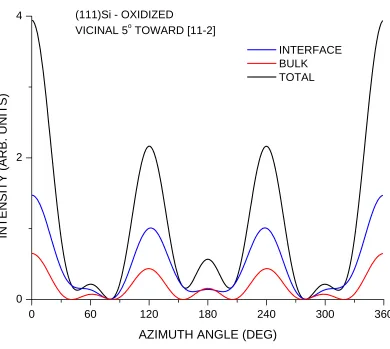
Figure 3.3 Anisotropy of SHG for vicinal Si 5° off (111) toward [11-2]………..45
Figure 3.4 Different contributions to the pp data of Fig. 3.2………46
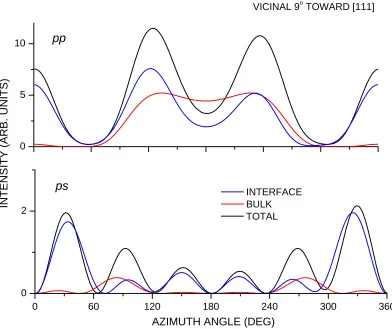
Figure 3.5 Anisotropy of SHG for vicinal Si 9° off (001) toward [111]………...…47
Figure 3.6 Different contributions to the data of Fig. 3.4……….48
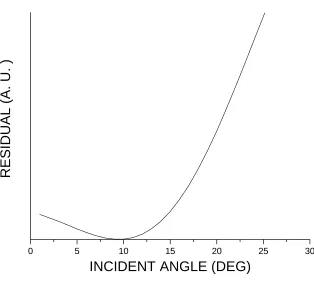
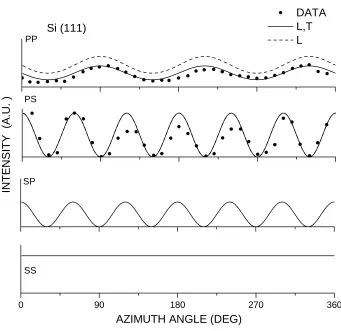
Figure 4.1 Azimuthal dependences of THG signals for vicinal Si (111) offcut 5° toward ] 2 11 [ . Points: data from Ref. 14. Lines: SHBM with longitudinal and transverse components both included (solid) and longitudinal component alone (dashed)…69 Figure 4.2 Best-fit residual as a function of angle of incidence qi………...70
Figure 4.3 As Fig. 4.1, but for on-axis Si(111). The data are from Ref. 20…………...71
Figure 4.4 As Fig. 4.1, but for Si (001). The data are from Ref. 20……..………72
Figure 4.5 As Fig. 4.1, but for Si (001). The data are from Ref. 14……..………73
Figure 5.1 Normalized FHG anisotropies for the (001)Si-SiO2 interface for the polarization combinations pp, ps, sp, and ss, as reported in Ref. 2. The solid curves are the results of the SBHM calculations………...86
Figure 5.2 Normalized FHG anisotropies of (001)Si immediately following exposure of the sample to a buffered oxide etch for durations of 0 (top), 10, 20, 30, and 60 min (bottom). The solid curves are the result of SBHM calculations taking into account interface roughening………..………..87
Figure 5.3 Normalized FHG anisotropies for the (001) Si-SiO2 interface for the polarization combinations pp and sp. The solid curves are the result of SBHM including interface roughness………88
Figure 6.1 pp- and ps- polarized FIR intensity for (001)InP. Data are from Ref.1…....101
Figure 6.2 Frequency dependence of the bond-charge contribution to the THz intensity. ……….102
Figure 7.1 SHG experimental configuration...……….106
Figure 7.2 Azimuthal-dependent data at difference wavelengths for samples with oxide-nitrided and oxide-oxidized layers with and without RTA on Si (111) surfaces tilted 5º towards (-1 -1 2)………..………...…………....107
Figure 7.3 Comparison of hyperpolarizabilities for samples with and without RTA: a, up bond; b, step bond; and c, back bonds……….………..108
Chapter I. Introduction
Optical probes have unique advantages that become more desirable when higher
spatial and temporal resolutions are required. Material damage and the buildup of
contamination layers associated with charged-particle exposure do not occur; no special
ambient conditions such as ultrahigh vacuum are needed; charging effects in insulators
are avoided; long penetration depths allow access to solid-solid and other buried
interfaces; and real-time, in-situ monitoring of film growth is possible [1-4]. These
advantages are important when exploring new materials, especially in the
nanotechnology era, and in applications to biology, where vacuum environments are not
relevant. However, optical techniques also have disadvantages when used for surface and
interface analysis. Signals are generally weak because of the weak interaction between
photons and matter [5], and data are often difficult to interpret [5]. For example, in
linear-optical measurements more than 90% of the reflection is due to the bulk, so the
signals from the interface/surface are relatively small and hence difficult to analyze.
We can classify optical techniques into two groups: linear and nonlinear. Linear
optical techniques involve the linear susceptibility, χ1, which is a second-rank tensor, and include laser light scattering (LLS), spectroscopic ellipsometry (SE), spectroscopic
polarimetry (SP), reflection-difference (-anisotropy) spectroscopy (RDS/RAS), surface
photoabsorption (SPA), photoluminescence (PL), etc. Nonlinear optical (NLO)
techniques such as second- (SHG), third- (THG), and fourth- (FHG) harmonic generation,
involve higher-order susceptibilities such as χ2, χ3, and χ4, which are third-, fourth-, and
fifth-rank tensors, respectively. Other NLO possibilities include optical sum-frequency
involved, NLO probes exhibit richer selection rules than linear-optic probes [6], so NLO
methods are potentially more powerful than linear-optic approaches as diagnostic tools.
Furthermore, because the symmetries of surfaces and interfaces are generally lower than
those of the bulk, some NLO approaches can be considered as only surface/interface
diagnostic techniques. For example, both SHG and FHG are dipole-forbidden in the bulk
of centrosymmetric crystals such as silicon [7-10], so if we ignore higher-order
contributions, either of these probes will return information only about Si surfaces and
interfaces.
Following the golden days of theoretical research in the 1960s and 1970s, interest in
NLO declined as a result of small signal strengths and the difficulties of interpreting data.
However, the development of the femtosecond (fs) laser changed the experimental
situation. By reducing pulse durations to the fs range, peak fields could be increased
substantially without violating the usual limit to signal strength, the average power
applied to a sample. The result for SHG was an increase in signal strength by 3 to 4
orders of magnitude. As a consequence, NLO has re-emerged as a viable experimental
approach for studying bulk material, thin films, interfaces, and surfaces.
However, until recently, the difficulties in interpreting NLO data remained. As we
noted, optical data are already difficult to interpret, and the situation for NLO is even
worse. One standard approach is the macroscopic tensor-coefficient representation. Its
basis is the relation between polarization and external field [11]. The approach takes
advantage of the known symmetry of a crystal. One first uses rotation to project the
applied field into the crystal frame, where the polarization is calculated. The polarization
expressions are used to obtain the observed harmonic fields. Another method is the
Green-function approach, where the NLO problem is solved using the classical E&M
Green-function formalism in terms of s- and p- polarized vector waves. This leads to
generated fields written as functions of the Fresnel coefficients of the interfaces [12].
The polarizable bond model calculates SHG in terms of the energy resonances associated
with the linear response [13], and in fact picks up only part of the total response, the
quadrupole contribution. Other methods such as quantum-mechanical evaluation of
polarizabilities from band structure, and simple listings of Fourier coefficients of
intensity anisotropies observed as the sample is rotated during exposure to a fixed
wavelength, are also used in some applications.
Unfortunately, none of the previous formalisms were simple enough to lead to
closed-form expressions or to provide useful or complete physical insight about the
origins of NLO signals on the atomic scale. These shortcomings were eliminated with
the development of the simplified bond-hyperpolarizability model (SBHM) of Powell et
al [14]. These workers introduced what they termed the SBHM to assist the analysis of
their SHG data obtained on Si-insulator interfaces [14, 15]. They showed that observed
SHG anisotropies could be described in terms of a hyperpolarizability associated with
each of 3 types of interface bonds as opposed to the 11 Fourier or 14 tensor characteristic
coefficients of previous work. Moreover, they showed that the 3 hyperpolarizabilities
determined from the observed intensity anisotropy of the pp polarization combination
could be used to predict the observed anisotropies for the ps, sp, and ss combinations.
Finally, they obtained analytic descriptions of these anisotropies in terms of these
SHG data, but also allowed them to be understood in terms of parameters that had direct
physical meaning on the atomic scale.
However, the question remains as to how general the SBHM really is. Powell et al.
did not address a number of NLO phenomena also of interest: FHG from Si-dielectric
interfaces, higher-order bulk contributions to SHG in centrosymmetric crystals, THG
from bulk Si, or the generation of terahertz (THz) radiation from semiconductor surfaces
and interfaces. Owing to the wide wavelength range involved and the relatively weak
signals associated with a high-order nonlinearity, FHG is not necessarily a universal
probe, but data exist so the model can be critically tested. Bulk contributions from
higher-order effects such as spatial-dispersion, magnetic-dipole, and electric-quadrupole
interactions have been postulated to be important for SHG from Si, so this needs to be
investigated as well. The first nonvanishing NLO contribution to the (001)Si interfaces
universally used in integrated-circuits technology is THG. However, THG is not
dipole-forbidden in the bulk of centrosymmetric semiconductors, so bulk THG needs to be
calculated also. Finally, the generation of THz radiation is important for a number of
emerging areas.
In this work we extend and modify the SBHM to fill these gaps by using it to
calculate FHG, bulk THG in centrosymmetric crystals, all dipole-forbidden contributions
relevant to bulk SHG in centrosymmetric materials, and the generation of THz radiation
from semiconductor surfaces and interfaces. With the exception of the THz application,
which falls in the sum-frequency category, we concentrate here on harmonic generation,
since sum-frequency calculations are a minor extension of the basic approach. We show
can be modeled in terms of randomly directed surface bonds. We find that the azimuth
dependence of THG on Si (111) can be described accurately in the SBHM provided that
the transverse contribution is taken into account, and establish the relationship between
the macroscopic susceptibility and the hyperpolarizabilties. To ensure that all
contributions are considered we formulate the electric-dipole-forbidden SHG contribution
in centrosymmetric crystals from first principles, obtaining results that are clear and
unambiguous from the perspective of both physics and mathematics. The capability of
obtaining analytic expressions allows us to assess the relative bulk and surface
contributions to SHG, and despite previous speculations to the contrary, we find that the
bulk contribution here is minor. Extending the SBHM to THz generation, we obtain a
very simple dipole-radiation expression to describe the two mechanisms giving rise to
THz generation in one analytical expression.
The outline of this work is as follows. In Ch. II, we review the basic theory of the
model. We start from Maxwell’s Equations, and with a few assumptions formulate the
SBHM. We also review the previous work of Powell et al. and Wang et al. In Ch. III, we
evaluate the bulk contribution to SHG, including not only electric-dipole-allowed terms
in both the bulk and at the interface, but also the electric-dipole-forbidden contributions:
spatial dispersion, magnetic-dipole, and electric-quadrupole effects. We evaluate these
for bulk Si, and show that their contribution is small compared to that of the interface. In
Ch. IV, we discuss bulk THG generation, showing that the transverse contribution is
important and describing how to we add it to the theory. In Ch. V, we treat FHG of
silicon, showing how interface-roughness contributions can be identified and described.
surfaces and interfaces. In Ch. VII, we provide a brief discussion of the possibilities fro
NLO spectroscopy. Finally, in Ch. VIII we draw some conclusions from our work and
References:
[1] G. Lüpke, Characterization of semiconductor interfaces by second-harmonic
generation, Surface Science Reports 35, 75 (1999).
[2] J. F. McGilp, A review of optical second-harmonic and sum-frequency generation at
surfaces and interfaces, Journal of Physics D29, 1812 (1996).
[3] J. F. McGilp, Optical characterization of semiconductor surfaces and interfaces,
Progress in Surface Science, 49, 1 (1995).
[4] D. E. Aspnes, Linear and nonlinear spectroscopy of surfaces and interfaces, Physica
Status Solid, a188, 1353 (2001).
[5] D. E. Aspnes, Real-time optical analysis and control of semiconductor epitaxy:
progress and opportunity, Solid State Communications, 101, 85 (1997).
[6] Y. R. Shen, The Principles of nonlinear optics (wiley, New York, 1984).
[7] T. F. Heinz, C. K. Chen, D. Ricard, and Y. R. Shen, Phys. Rev. Lett. 48, 478 (1982).
[8] T. F. Heinz, M. M. T. Loy, and W. A. Thompson, Phys. Rev. Lett. 54, 63 (1985).
[9] J. A. Litwin, J. E. Sipe, and H. M. van Driel, Phys. Rev. B 31, 5543 (1983).
[10] H. W. K. Tom, T. F. Heinz, and Y. R. Shen, Phys. Rev. Lett. 51, 1983 (1983).
[11] G. Lüpke, D. J. Bottomley, and H. M. van Driel, J. Opt. Soc. Am. B 11, 33 (1994).
[12] J. E. Sipe, New Green –function formalism for surface optics, J. Opt. Soc. Am. B4,
481 (1987).
[13] J. E. Mejia and B. S. Mendoza, Polarizable-bond model for surface second-harmonic
generation at Si(111): H (1 x 1), Physica Status Solid, a188, 1393 (2001).
[15] J.-F. T. Wang, G. D. Powell, R. S. Johnson, G. Lucovsky, and D. E. Aspnes, J. Vac.
Chapter II Theory of Simplified Bond Hyperpolarizability Model
2.1 Basic equations.
All electromagnetic phenomena can be derived from Maxwell’s Equations. In SI
units these are
∇⋅Dr =ρ, (2.1.a)
0
= ⋅
∇ Br , (2.1.b)
0
= ∂ ∂ + × ∇
t B E
r r
, (2.1.c)
J t D
H r
r r
= ∂ ∂ − ×
∇ . (2.1.d)
Here, ρ and J are the charge and current densities, respectively, and Dr, Br, Er, and Hr
are the displacement field, magnetic flux density, electric field, and magnetic field
intensity, respectively. For NLO calculations ρ and J are normally set equal to zero. Taking the time derivative of Eq. (2.1.d), using Eq. (2.1.c), setting the magnetic
permeability µ = 1, where Br =µHr , and using
P E
Dr = r+ r (2.1.e)
where Pr is polarization (dipole density in the dipole approximation), we have
) , ( )
, ( ] ) (
[ 2
2
2 2
t r P t t
r E t
r r r
r
∂ ∂ − = ∂
∂ + ∇× ×
∇ . (2.2.a)
We now separate Pr into linear and nonlinear parts:
NL L P P
which leads to NL P t t r E t r r r 2 2 2 2 ) , ( ] ) ( [ ∂ ∂ − = ∂ ∂ + ∇× ×
∇ ε . (2.3.a)
Here, ε is the dielectric function, which is defined as
L
P E E
Dr =εr = r+ r . (2.3.b)
If we ignore the nonlinear polarization, Eq. (2.2.a) reduces to the familiar form
0 ) , ( ] ) ( [ 2 2 = ∂ ∂ + ∇× ×
∇ E r t
t r r
ε . (2.3.c)
From Eq. (2.3.a), we can obtain the far-field limit of the radiation field within the dipole
approximation. This is
r e k P k ck Z E ikr NL
ff = (ˆ× )× ˆ⋅
4
2 r
r
π , (2.4)
where Z is the impedance of the medium. We emphasize that PrNL is a total effective nonlinear dipole density, which is a nonlocal function of the field and can be divided into
electric-dipole, quadupole, and magnetic-dipole (but not spatial-dispersion) contributions,
and so on.
The problem now is to calculate PrNL. In the linear case Pr is related to the external (driving) field by the linear susceptibility according to
∫
∞∞ −
⋅
= 1 ' ' ' ' ' ' r )d t , r ( E ) t -t , r -r ( ) ,
(r t dt
Pr r χ r r r r r . (2.5.a)
By Fourier-transforming the above expression we have
) , k ( E ) , k ( ) , k ( ) ,
(r r r ω χ1 r ω r r ω
r ⋅ = =P t r
P , (2.5.b)
∫
∞ ∞ − + ⋅ −= r t e drdt kr r ikrr i t r
r
ω
χ ω
χ1( , ) 1( , ) . (2.5.c)
Using this expression in Maxwell’s Equations in the linear-optics case leads to the
familiar reflection and refraction laws.
In the nonlinear case, if the applied field Er is sufficiently weak compared to internal
fields but still a strong laser field, then Pr can be expanded as a power series of Er to
obtain (2.6.a) L r r r r r r r r r M r r r r r r r r r r r r r r r r r r r r r r r + + + ⋅ =
∫
∫
∫
∞ ∞ − ∞ ∞ − ∞ ∞ − 3 3 2 2 1 1 3 3 2 2 1 1 3 3 2 2 1 1 ) 3 ( 2 2 1 1 2 2 1 1 2 2 1 1 ) 2 ( ' ' ' ' ' ' ) 1 ( r d r d r d ) t , ( ) t , ( ) t , ( ) t -t , r -r , t -t , r -r ; t -t , r -r ( r d r d ) t , ( ) t , ( : ) t -t , r -r ; t -t , r -r ( r )d t , r ( E ) t -t , r -r ( ) , ( dt dt dt r E r E r E dt dt r E r E dt t r P χ χ χwhere χ(n) is the nth order susceptibility. If we expand Er as a sum of monochromatic plane waves
, (2.6.b)
∑
= j j k E t rEv(r, ) r(r ,ω)
we can Fourier-transform Eq. (2.6.a) to obtain
L r r r r r r r r + + +
= (k, ) (k, ) (k, ) )
, k
( ω P(1) ω P(2) ω P(3) ω
P , (2.6.c)
), , ( ) , ( ) , ( ) , ( ) , k ( ), , ( ) , ( : ) , ( ) , k ( ), , ( ) , ( ) , k ( (3) ) 3 ( (2) ) 2 ( (1) ) 1 ( l l j j i i l j i l j i j j i i j i j i k E k E k E k k k k P k E k E k k k P k E k P ω ω ω ω ω ω ω χ ω ω ω ω ω ω χ ω ω ω χ ω r r r r r r M r r r r r r r r r r r r r r r r r r r r + + = + + = = + = + = = ⋅ = (2.6.d) and n n t t r r k t t r r k i n n n n n n dt r d dt r d e t t r r t t r r k k k k n n n
n r L r
r r L r r L r L r r r r r r L r r r 1 1 )] ( ) ( ) ( ) ( [ 1 1 2 1 2 1 ) ( 1 1 1 1 ) , ; ; , ( ) , ( − − − ⋅ + + − − − ⋅ − ∞ ∞ − × − − − − = + + + = + + + =
∫
ω ω χ ω ω ω ω χ (2.6.e)It follows that
L r r r r r r + +
= (k, ) (k, ) )
, k
( ω P(2) ω P(3) ω
PNL . (2.7)
Hence once we know the nonlinear susceptibilities, we can obtain the nonlinear
polarizations and therefore calculate in general the generated nonlinear fields. However,
only a very few nonlinear susceptibilities are known, and the method is still
mathematically very difficult. Furthermore this macroscopic description has no explicit
connection to the microscopic properties of materials on the atomic scale, such as bond
angles, strengths, and hyperpolarizabilities
2.2 Anharmonic restoring forces: elementary considerations.
To facilitate the interpretation of their SHG data Powell, Wang, and co-workers
developed the simplified bond-hyperpolarizability (SBHM) model [1-2]. Like the
tensor-coefficient description, the SBHM is phenomenological, but instead of simply listing
one-application of an external field. The second difference is that the far-field radiation Eff
r is
calculated using the expression for radiation from an accelerated charge in the dipole
approximation. As a result the SBHM is essentially the NLO version of the Ewald-Oseen
extinction theory of linear optics [3-4], with the exception of that the SBHM includes
bond directionality and the need to solve the radiation problem self-consistently is
eliminated, since the generated radiation is at a different frequency and also orders of
magnitude weaker than the driving field. The bond charges are treated separately and the
overall radiation obtained by summing the individual radiation fields over the unit cell,
then integrated from surface to bulk. It is also a semiclassical model, which assumes that
the charges are particles and the radiation field can be described as a wave.
The original assumptions of the SBHM are sufficient to treat the Powell-Wang
application to interface SHG of centrosymmetric materials with bulk contributions
ignored, and our application to interface FHG, which also involves centrosymmetric
crystals. These assumptions are: (1) for a given bond the only charge motion that is
relevant is that along the bond direction; (2) the bond directions themselves are those of
the bulk material; and (3) the observed intensity is a result of the coherent superposition
of radiation from the individual bonds calculated in dipole approximation. The first
assumption follows from the idea that bonds are essentially rotationally symmetric, which
eliminates transverse contributions for SHG and FHG. However, as in linear optics, the
assumption of rotational symmetry does not eliminate the transverse contributions in
THG, so for bulk THG we will need to extend the SBHM by considering the transverse
The third assumption is an adaptation of one of the concepts used in the derivation of
the Ewald-Oseen extinction theorem of linear optics [3-4]. As mentioned above, the
SBHM differs from the Ewald-Oseen treatment in two important ways: the SBHM
requires the added assumption of bond directionality at the microscopic level, and
self-consistency is not necessary since the generated radiation does not interact with driving
field. Calculation of higher-order NLO effects requires further elaboration: to evalute
bulk SHG in the centrosymmetric materials we need to consider magnetic-dipole,
electric-quadrupole, and spatial-dispersion contributions, and for THz generation,
free-carrier contributions as well.
We now consider the evaluation of the dipole density. The dipole moment is defined
as follows for the discrete and continuum cases:
' ) ' ( ) ' ( ) ' ( ) ( ) ( 1 3 0
∫
∑
∆ = − = r d r r r r n r r q vol P i i r r r r r r r r ρ (2.8)where in the upper line is the equilibrium position of the charge before the external
field is applied and in the lower line 0
rr
) (r
n r is the number density and is the local
displacement of
) ' (r r
∆r r
r') (r
ρ as a result of the laser field . We consider the discrete case of a
point bond charge q moving in the response of an applied field Er(rr,t)=Er0e−iωt. After the field is applied the position of q is assumed to be described by
b e r e r e r e r r e r e r r r t i t i t i t i t i t i ˆ )
( 1 2 2 3 3 4 4
where ∆rr=rr−rr0 is the displacement of q. In the second line we have written ∆rr as a power series of e-iωt and have made the basic SBHM assumption that we need consider only the motion of q in the direction b of the current bond of interest. With these
equations and assumptions,
ˆ
rr
∆ can be calculated with a one-dimensional force equation, which for the jth bond takes the form
, ˆ 4 4 3 3 2 2 1 2 2 dt r d r r r r e b E q dt r d m F t i j j r L r r r r v r r ∆ − − ∆ − ∆ − ∆ − ∆ − ⋅ = = − γ κ κ κ κ ω (2.10)
whereEr is the externally applied driving field; κ1 is the harmonic (linear or Hooke’s
Law) polarizability; κ2, κ3, and κ4 are the second-, third-, and fourth-order anharmonic
longitudinal hyperpolarizabilities; and g represents frictional loss. The terms that we
retain are determined by the order of harmonic generation that needs to be calculated.
From Eqs. (2.9) and (2.10) we obtain for the linear response of the jth bond:
j j j
j E b b
i m
q
r ( ˆ )ˆ
1 2 1 ⋅ − + − =
∆r r
γω κ
ω , (2.11.a)
which allows us to define the linear polarizability α1j of the jth bond as
γω κ ω α i m qj j − + − = 1 2
1 , (2.11.b)
in which case we can write
. (2.11.c)
j j j
j E b b
r1 = 1 ( ⋅ˆ )ˆ
∆r α r
2 1 2 2 1 2 2 2 1 2 2 1 2 2 ) ( 2 4 ˆ ) ˆ ( 2 4 γω κ ω ω γ κ ω κ ω γ κ ω κ i m q i m b b E i m r r j j j j j − + − ⋅ − + − ⋅ − = − + − ∆ − = ∆ r r (2.12.a)
This allows us to define a second-order nonlinear hyperpolarizability as
2 1 2 2 1 2 2 2 ) ( 2
4 ω κ γ ω ω κ γω
κ α i m q i m j
j − + − ⋅ − + −
−
= (2.12.b)
It follows that
j j j
j E b b
r2 = 2 ( ⋅ ˆ )2 ˆ
∆r α r . (2.12.c)
Similarly, for third- and fourth-order displacements we have
, (2.13.a)
j j j
j E b b
r3 = 3 ( ⋅ ˆ )3ˆ
∆r α r
. (2.13.b)
j j j
j E b b
r4 = 4 ( ⋅ ˆ )4 ˆ
∆r α r
Even though we have considered only longitudinal displacements here, we will see when
we treat THG in Ch. IV, the transverse displacements have the same form as above.
By substituting Eqs. (2.11.c), (2.12.c), (2.13.a), and (2.13.b) into (2.8), we can obtain
the linear, second-, third-, and fourth-order nonlinear dipole densities induced by the
external field. Up to fourth order these are
Linear:
∑
⋅ = i i i ibb Eq
Pr(1) α1 ˆ ˆ r (2.14.a)
Second-order:
∑
⋅⋅ = i i i iibbb EE
q
Pr 2 ˆ ˆ ˆ rr )
2
( α
(2.14.b)
∑
⋅⋅⋅ = i i i i iibbbb EEE
q
Pr 3 ˆ ˆ ˆ ˆ rrr ) 3 ( α (2.14.c) Fourth-order:
∑
⋅⋅ ⋅⋅ = i i i i i iibbbbb EEEE
q
Pr(4) α4 ˆ ˆ ˆ ˆ ˆ rrrr (2.14.d)
Hence according to the classical-E&M far-field radiation equation we have the radiation
fields Linear:
∑
⋅ ⋅ − ∝ − i i i iff I kk bb E
Er [ ˆˆ] { 1 ˆ ˆ} r )
1
( α
; (2.15.a)
SHG:
∑
⋅⋅ ⋅ − ∝ − i i i iibbb EE
k k I
Er [ ˆˆ] { 2 ˆˆ ˆ} rr
2 α
; (2.15.b)
THG:
∑
⋅⋅⋅ ⋅ − ∝ − i i i i iibbbb EEE
k k I
Er3 [ ˆˆ] { α3 ˆ ˆ ˆ ˆ} rrr; (2.15.c)
FHG:
∑
⋅⋅⋅ ⋅ − ∝ − i i i i i iibbbbb EEEE
k k I
Er4 [ ˆˆ] { α4 ˆ ˆ ˆ ˆ ˆ} rrrr. (2.15.d)
The expressions can be written as sums over the bond vectors of the unit cell because the
radiation fields are additive. These summations are generally straightforward to evaluate,
and in the simple case of tetrahedrally bonded semiconductors, closed-form expressions
can be obtained. The projection operator can also be written [ ], where
and are the unit vectors in the direction of the p- and s-polarized radiation,
respectively.
] ˆ ˆ [I−kk
− pˆpˆ +sˆsˆ
2.3 Higher-order terms
2.3.1 Phenomenological treatment
In the above, radiation is treated in the dipole approximation assuming anharmonic
restoring forces. However, the dipole contribution vanishes in the bulk of materials with
inversion symmetry. But we know from multipole expansions [5] that radiation can also
result from higher-order contributions. These include electric quadrupole, magnetic
dipole, and spatial dispersion. Using SHG as an example, the effective nonlinear
polarization can be written
L r t r r + × ∇ + ⋅ ∇ − = ) 2 ( 2 ) 2 ( ) 2 ( ) 2 ( ) 2 ( ) 2 ( ) 2 ( ) 2 ( ω ω ω ω ω M i c Q P Peff (2.16)
where Pr(2) , Qr(2), Mr (2) are the source terms giving rise to dipole,
electric-quadrupole, and magnetic-dipole contributions, respectively. Equation (2.16) is valid
when the dimensions of the volume element are small compared to the characteristic
length over which the field varies. These three terms can also be expressed in terms of the
applied external field through susceptibility tensors [6]:
) ( ) ( : ) ( ) ( : ) 2 ( ) 2 ( ω χ ω ω χ ω ω E E E E
Pr = tD r r + tP r ∇r ; (2.17.a)
) ( ) ( : ) 2 ( ) 2 ( ω χ ω ω E E
Qt = tQ r r ; (2.17.b)
) ( ) ( : ) 2 ( ) 2 ( ω χ ω ω E E
Mr = tM r r . (2.17.c)
) 2 ( ) 2 ( ω
Mr also vanishes for a material with inversion symmetry in both space and time.
As a result, when calculating the bulk contribution to SHG for materials with inversion
symmetry, such as Si, from a polarization-expansion perspective only the
spatial-dispersion and electric-quadrupole terms need be evaluated. In the next section we show
how to do this systematically from first principles.
We first consider the electric-quadrupole contribution. According to classical E&M
theory [5], the electric quadrupole is defined as
∑
∆ ∆ −∆= n
ij n j n i n n j
i q x x x
V
Q, (2ω) 1 (3 , , 2δ ), (2.18)
From these expression the 2wt electric-quadrupole contribution is clearly proportional to
the square of the linear displacement, and hence to the square of the linear susceptibility,
as obtained by Bloembergen et. al [7] and Mendoza et. al. [8] With Eq. (2.18) and
knowledge of the linear displacement, the quadrupole contribution to the far-field
radiation can be calculated. We will leave the details to the following chapter.
As stated above, the spatial variation (spatial dispersion) of the incident field in the
medium can also induce bulk SHG even in materials with inversion symmetry. The
physics is straightforward: if Er has a spatial dependence then in principle the field at
one end of a dipole is larger than the field at the other end, leading to an automatic
asymmetry. In our previous analyses of SHG from Si, we attributed the entire response
to the interface region and ignored the bulk. The assumption was justified on the grounds
that the bonding asymmetry at the interface is significant, even if the interface is only one
or two atomic layers thick. However, the spatial-dispersion term can easily be added to
E r E
Ej j j
r r r r ∇ • ∆ +
= 0 , (2.19)
where is from Eq. (2.9.2). Substituting Eqs. (2.19) and (2.9.2) into the force equation
introduces
j
rr
∆
Er
∇ , and therefore spatial dispersion.
2.3.2 First-principles treatment.
In principle the above provides a complete frame for performing SBHM calculations
for NLO, but we show here that it is also possible to take a more fundamental view,
allowing the far-field radiation to be evaluated from first principles. The advantages of a
first-principles method are 1) a better understanding of the principles behind, and the
physical meaning of, the various terms than what is provided by the purely
phenomenological treatment, and 2) the approach is more systematic. We will evaluate
dipole and first-forbidden bulk contributions to SHG in centrosymmetric materials as an
example of this method.
We begin with the Green-function expression for the 4-potential of a point charge q
propagating in free space:
|' | |) ' | 1 ' ( )) ' , ' ( ), ' , ' ( ( ' ' 1 )) , ( ), , ( ( 3 r r r r c t t t r J t r c dt r d c t r A t r r r r r r r r r r r − − − − =
∫
ρ δ φ , (2.20.a) where )) ' ( ' ( ) ' , '(rr t =qδ rr −rro −∆rr t
ρ ; (2.20.b)
) ' ( ' ) ' , ' ( ) ' , '
( r t
dt d t r t r
and where for each bond j with unit bond vectorbˆj, rj(t') r
∆ has the form of Eq. (2.9.b).
From the force equation we can obtain the vector potential Ar(rr,t) in the far–field region
as
∑
− •∆ − − • − •∆ • − − ∆ + ∆ × ⋅ − = j t r k i r k i t i ikr j j j t r k i r k i t i ikr j o j o e e e r r b e e e rc q i t r A ] 2 [ ˆ ) , ( ) ( 2 1 )( r r r r
r r r r r r ω ω ω (2.21)
In Eq. (2.21) we substitute the complex wave vector of the material for the
free-space value, which is acceptable because we are considering optically isotropic
materials at a discrete frequency ω. The magnetic-dipole and bulk-quadrupole terms
result from the expansion of the exponential, Dr
) ( ~ ~ ω k k =
j, next to the summation, although in this
application the magnetic-dipole contribution vanishes.
Evaluating the far-field radiation Erff explicitly we find
}, ] 2 ) )( ˆ ( 2 ) 4 ( ) ˆ ( [ ) 4 ( ) ( ) ˆ ( ˆ ) ˆ ( ˆ { ) ˆ ˆ ~ ( ) ( 2 2 2 2 2 1 2 1 2 1 2 2 1 2 2 ) ( 2 1 2 o o o o r k k i t i ikr o j j o j j r k k i t i ikr o j j ff e e m k b i m k b i m m E b q b e e m E b q b k k I r qk E r r r r r r r r r r r • − − • − − − − • + − • − − − • + − • • − =
∑
ω ω κ ω κ ω κ ω κ ω κ ω κ (2.22)where the projection operator (~I −kˆkˆ)can also be written (sˆsˆ+ pˆpˆ). The first term in braces is the linear-optic response, and the remaining three describe SHG. The physical
origin of the three SHG terms are clear from the development: the first term, which
involves the outgoing wave vector, is the electric-quadrupole contribution; the second
third term, which depends only on the anharmonic restoring force, reduces to the
contribution from asymmetric bonding at the interface for SHG from centrosymmetric
crystals. The intensity is proportional to the absolute square of the far field after all
contributions have been taken into account.
The above first-principles calculation can be applied to all other nonlinear optical
processes, including those such as sum- and difference-frequency mixing involving two
or more incident waves. A good example is the generation of THz radiation from
semiconductors that are illuminated by ultrafast laser pulses. THz generation involves
both bond charges and free carriers, and we will apply the one-dimensional force law to
both. We will discuss the generation of THz radiation in Ch.VI.
2.4 Conclusions
In this chapter we provide a detailed description of nonlinear harmonic generation
at the atomic scale using a one-dimensional force equation including anharmonic
restoring forces. Two ways are presented: the phenomenological approach of the original
SBHM, and the first-principles approach that we will use for effects of higher order than
References:
[1] G. D. Powell, J.-F. T. Wang, and D. E. Aspnes, Phys. Rev. B 65, 205320 (2002).
[2] J.-F. T. Wang, G. D. Powell, R. S. Johnson, G. Lucovsky, and D. E. Aspnes, J. Vac.
Sci. Technol. B 20, 1699 (2002).
[3] C. W. Oseen, Ann. Phys. (Leipzig) 48, 1 (1915).
[4] P. P. Ewald, Ann. Phys. (Leipzig) 49, 1 (1916).
[5] J. D. Jackson. Classical Electrodynamics. John Wiley & Sons, Inc., New York, Third
edition, 1998.
[6] P. Guyot-Sionnest and Y. R. Shen, Phys. Rev. B38, 7985 (1988).
[7] N. Bloembergen, R. K. Chang, S. S. Jha, and C. H. Lee, Physical Review 174, 813
(1968).
Chapter III: Dipole-Forbidden Bulk SHG in Crystals with Inversion
Symmetry
3.1 Introduction
Second-harmonic generation (SHG) was the first nonlinear-optical phenomena
studied [1], and has now been investigated intensively by both theory and experiment
[2-5]. Amplified femtosecond laser pulses have recently been used to study SHG from
semiconductor surfaces/interfaces [6-9]. As noted in the Ch. I, these investigations are of
interest because SHG are electric-dipole-forbidden in the bulk of materials with inversion
symmetry, which makes them particularly attractive for surface/interface studies provided
that higher-order bulk contributions can be ignored. As a result, SHG is already widely
used for studying semiconductor surfaces and interfaces [10-15].
However, since the capability of obtaining SHG data as a continuous function of
wavelength is limited, SHG results are usually in the form of anisotropy, i.e.,
dependences of intensity as a function of sample azimuth angle φ for the four possible
combinations of incident and observed polarizations, pp, ps, sp, and ss [16]. Here, p and
s refer to p- and s-polarization, with the first and second letters referring to the
polarization of the incident and observed beams, respectively. A large number of systems
have been investigated by SHG and include semiconductor, metal, and bio-systems.
In particular the Si (001), (110), and (111) interfaces have been studied thoroughly.
Lüpke [16] gave a complete description of SHG from Si in phenomenological terms.
SBHM, but being completely phenomenological also cannot address the problem of the
relative magnitude of the bulk and interface contributions to SHG.
In this chapter, we will give analytical expressions of dipole forbidden SHG for
silicon interfaces using the SBHM. We will also simulate the SHG data taking into
account the bulk contribution; which we evaluate, and then estimate the relative bulk and
surface contributions for SHG. Numerical calculations are given for the further proof of
relative bulk and surface contributions.
3.2 SHG including dipole-forbidden bulk contributions
Because Si has inversion symmetry and hence SHG signals from the bulk are
dipole-forbidden, Si SHG has received particular attention. Indeed, in previous work [20,
21] our group considered only the interface contribution, and obtained excellent
agreement between theory and experiment. However, the question remains: if we
consider higher-order contributions, can bulk SHG still be ignored? The issue arises
because the interface contribution originates essentially from one monolayer, whereas the
bulk contribution comes from many layers. Lüpke et al. [16] indicated that the bulk
contributions could not be neglected relative to that of the interface, and in fact argued
that the bulk contribution accounted for fully half of the observed SHG signal from
oxidized Si. Since this issue is still unresolved, we here use the SBHM developed in Ch.
2 to estimate the first-forbidden bulk contributions to SHG by obtaining and evaluating
analytic expressions, then directly comparing predicted anisotropies to experiment. We
find that bulk contributions are indeed minor, certainly less than half the interface
contributions. However, the coherent superposition of bulk and interface contributions is
3.2.1 Bond-sum evaluation: quadrupole contributions
Starting from the first-principles Eq. (2.22), if we assume that all bonds are identical,
as is the case in the bulk of the cubic semiconductors, we can obtain the total quadrupole
contribution by integrating over the penetration depth. We first obtain the analytical
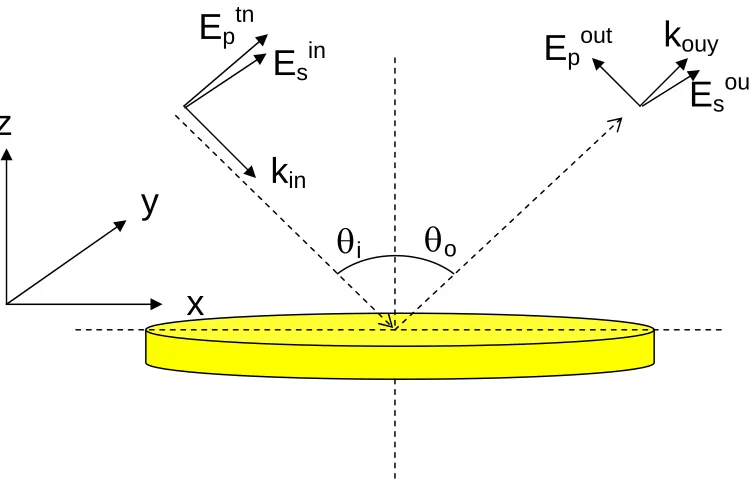
expression for the on-axis case. The configuration is shown in Fig. 3.1. The laboratory
axes are in the left of the figure. Light is incident on the sample surface at an angle of
incidence qi. The generated wave leaves at an angle qo, which we take to be equal to the
angle of incidence. For vicinal samples we tilt the crystal axes by the vicinal angle γ
using the rotation matrix
. (3.1)
⎟ ⎟ ⎟
⎠ ⎞
⎜ ⎜ ⎜
⎝ ⎛
− =
γ γ
γ γ
cos 0 sin
0 1 0
sin 0 cos
) (T M
We next rotate about the unit surface normal vector using the rotation matrix nˆ
. (3.2)
⎟ ⎟ ⎟
⎠ ⎞
⎜ ⎜ ⎜
⎝ ⎛ − =
1 0 0
0 cos sin
0 sin cos
)
( φ φ
φ φ
R M
In the following we obtain analytic expressions of quadrupole contributions only for
singular (on-axis) surfaces, but we use tilt angles when doing numerical calculations to
simulate data.
We consider first Si (111). Here, the bond vectors in the laboratory frame are
z
bˆ1 = ), (3.3.a)
z x
β β
β ˆsin ˆcos 2 3 sin ˆ 2 1 ˆ
3 x y z
b =− + + (3.3.c)
β β
β ˆsin ˆcos 2 3 sin ˆ 2 1 ˆ
4 x y z
b =− − + , (3.3.d)
where b = 109° is the bond angle. After some algebra we find the analytic expressions for
the bulk SHG fields for the four polarization combinations pp, ps, sp, and ss:
) 2 sin sin 6 )) sin 3 (sin sin 3 sin sin 24 sin 32 ( cos 3 cos cos sin cos 6 ( 64 2 3 4 3 2 3 2 3 2 0 0 3 θ β θ θ β θ β θ θ φ θ β β α π ⋅ − + + − + ⋅ ⋅ ⋅ − = r e V V Z iqck E ikr pp (3.4.a) φ β θ θ β α π 3 sin sin ) 3 cos cos 5 ( cos 128 3 3 2 0 0 3 ⋅ + − ⋅ = r e V V Z iqck E ikr ps (3.4.b) )] sin cos ) 2 cos 5 3 ( 3 cos 2 cos 2 sin 2 [ sin 128
3 0 0 2 2
3 θ θ β φ θ β β α π + − = r e V V Z iqck E ikr
sp (3.4.c)
φ β θ β α
π cos cos sin sin3
32
3 0 0 2 3
3 r e V V Z icqk E ikr
ss = (3.4.d)
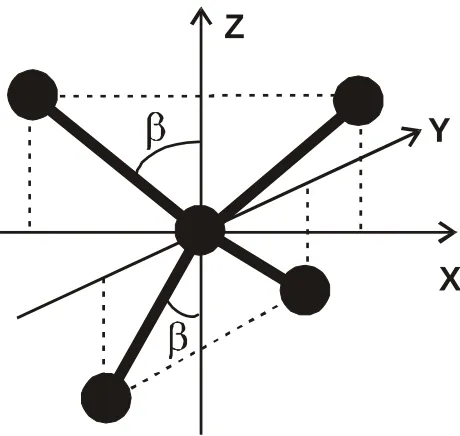
For Si (100), the situation is more complicated. If the bonds of the (001)Si-SiO2
interface are oriented in the same way as those of the bulk, the bonding configuration is
that shown schematically in Fig. 3.2. The bond vectors are specifically
However, on a macroscopic scale the (001)Si surface consists of two types of domains
differing by a 90° rotation of the bonds. This is a result of the fact that the two
sublattices of the diamond structure are chemically identical, so in contrast to e.g. the
III-V materials any interface generated by purely statistical means will contain nominally
equal areas of both, with each domain separated from the next by an atomic-height step.
Adding a second set of vectors rotated azimuthally by 90° from the original group yields
a set of 8 bonds. If the strengths of the four upper and four lower bonds were equal, then
the sum would vanish identically and no harmonic signal would result. However, if the
longitudinal hyperpolarizabilities of the upper and lower bonds are unequal, then we
obtain a finite result with the original hyperpolarizabilities replaced by their difference.
On a macroscopic scale we therefore consider the four basic bond vectors prior to
rotation to be
2 / cos 2 / sin 0 ˆ 2 / cos 0 2 / sin ˆ 4 , 3 2 , 1 β β β β ± = ± = b b , (3.5.b)
where all z-components are now taken to be positive. For singular samples the
quadrupole SHG contributions are
] 4 cos cos ) cos 2 2 cos 2 1 2 3 ( ) sin cos 10 cos 6 sin sin 3 sin 22 sin 6 [( sin cos 64 2 2 2 2 2 2 2 0 0 3 φ θ β β θ β β θ β θ β θ θ α π − + + − − + − + = r e V V Z icqk E ikr pp (3.6.a) φ β θ θ α
π 2 4
16 4 2 2 0 0 3 Sin Sin Sin Cos r e V V Z icqk E ikr
2 sin 2 sin ] 4 cos ) 1 (cos 2 cos 10 6 [ 64 2 2 0 0 3 β θ φ β β α π − + − − = r e V V Z icqk E ikr sp (3.6.c) φ β θ α
π sin sin 2 sin4
16 4 2 0 0 3 r e V V Z icqk E ikr
ss = (3.6.d)
3.2.2 Bond-sum evaluation: spatial dispersion contributions
Spatial dispersion is an effect due to the spatial variation of the incident field, which
can also induce second-order displacements and thus generate SHG. The spatial variation
of the incident field at the interface can be ignored since its SHG contribution is
dominated by first-order effects. As a result, the main contribution from spatial
dispersion comes from the bulk. In the following, we will begin with Eq. (2.19) instead of
Eq. (2.22), since the results are the same in either case. By expanding the field to first
order; we can write the force equation. (2.10) to second order as
, ) ( ) ( ) 1 ( ˆ 2 0 2 0 1 2 2 dt r d r r r r e r k i b E q dt r d m F j j j t i j j j j r r r r r r r v r r γ κ κ ω − − − − − ⋅ − ⋅ = = − (3.7)
where the ikr in Eq. (3.7) is from ∇Er, since Er is proportional to ikr, where k e r
r⋅ r
is the
wave vector of the incident wave. In Eq. (3.7) rr is the bond displacement, which is
equivalent to ∆rrj in Eq. (2.19). The vector r0
r can be taken to be , so the displacement
of the j
j bˆ
th
bond can be written
L r
r = + ∆ − +∆ − +
j t i j t i j j
j b r e r e b
Solving these equations and ignoring the terms of 2 )
(kr⋅br we obtain the part of SHG due to spatial dispersion:
2 1 2 2 1 2 2 2 1 2 2 1 2 2 2 ) ( 2 4 ˆ ) ˆ )( ( 2 ) ( 2 4 ˆ ) ˆ )( ( γω ω ω λ ω κ γω ω ω λ ω i k m q i k m b b E b k i i k m q i k m b b E b k r j j j j j j j j Dis j − + − ⋅ − + − ⋅ ⋅ − + − + − ⋅ − + − ⋅ ⋅ − = ∆ r r r r r r r (3.9)
From Eq. (3.9) we can see that the above spatial-displacement expression includes the
interface as well as the bulk contribution. The interface contribution is that involving k2,
which for centrosymmetric materials is zero in the bulk. In the following calculations we
ignore the k2 term.
Having for spatial dispersion, we can calculate the resulting field contribution
as done with Eqs. (3.4) and (3.6). For Si (111) these are
j rr ∆ φ β β
θcos sin sin3
cos 3 ∝ ss E (3.10.a) ) 2 cos 2 sin 6 2 sin 10 3 cos 2 sin 8 ( 3 sin sin2 β θ θ φ β θ β − − ∝ sp E (3.10.b) φ β θ θ
β(cos 3cos3 )sin sin3
cos + 3
∝ ps E (3.10.c) (3.10.d) ] sin cos 24 sin 8 sin cos cos 9 sin 2 sin 3 3 cos sin ) 3 cos (cos cos 3 [ cos 3 4 3 4 2 2 3 θ β β β θ θ θ β φ β θ θ β θ + + + − + ∝ pp E
We write these with the proportionality symbol because we are ignoring the prefactor.
φ β β
θ sin sin4
2 sin
sin 4 3
∝ ss E (3.11.a) ) 4 cos 4 cos cos cos 3 5 ( 2 sin 2
sin2 β θ + β+ β φ− φ
∝ sp E (3.11.b) φ β θ
θ sin4
2 sin sin
cos2 4
∝ ps E (3.11.c) )} cos 3 1 ( sin 2 cos 8 ) 4 cos 4 cos cos cos 7 1 ( 2 sin cos 2 [ 2 sin 2 2 2 2 β θ β φ φ β β β θ θ + − − + + ∝ pp E (3.11.d)
The final expression for the far field is
) 2 ( ) 2 ( ) 2 ( ) 2
( ω gDiph ω gQuadh ω gDish ω
h
g E E E
E − = − + − + − (3.12)
where g and h represent p or s. The dipole contributions can be found in [17]. The
intensity is the absolute square of the total field.
3.2.3 Signals as a function of depth: field-penetration effects, phase
considerations, and relative bulk and surface contributions
Since fields of bulk origin can emerge from an appreciable depth within the
material, the complete picture must take into account the fact that the phases of the
driving and radiation fields at different lattice planes in the bulk are different. In
addition, the contribution from the surface is expected to be different from that of the
bulk. However, all signals are phase-correlated since they arise from a common driving
Because interface and bulk contributions involve different orders of nonlinear effects for
SHG, we cannot simply compare thicknesses of the contributing bulk and surface regions
as is the case of THG discussed in the next chapter, where the two types of
hyperpolarizabilities appear to be comparable.
Since the interface is essentially only two monolayers thick, its contribution can be
evaluated directly without considering phase delays. For the bulk, we sum over the
individual monolayers with phase delays taken into account. Since the layer spacing is
much less than the wavelength of light we approximate the sum over layers with an
integral,
oz z
k i l
r k k i
k i e
dz
e o o z
Λ = Λ
≅
∫
∑
− • − ∗4
1 2 2
) ( 2 r r r
, (3.13)
where Λ is the interlayer spacing. This expression is derived assuming that the wave
vectors of the incident and radiating waves are normal to the surface and point in
opposite directions. The first assumption is valid to a high degree of accuracy for
semiconductors, where refractive indices are of the order of 3 to 4. Given this, the second
assumption is clearly correct for the backscattering configuration. The calculation does
not take absorption into account, but this can be added if necessary.
We also make the approximation
1 2 1
1 κ ω κ
α q
m q
≈ −
= (3.14)
where α1 is related to the linear susceptibility. We also ignore the mω2 contribution to
and , which is reasonable since for our application the frequency of
2 2
1 ω
interest is relatively far from any resonance. With phase considered in this way Eq. (2.22)
takes the form
}. ] 2 ) ˆ ( 2 ) ˆ ( [ ) ˆ ( ) ˆ ( { ˆ ) ˆ ˆ ~ ( ) ( 2 2 2 1 2 2 2 1 ) ( 1 2 o o o o r k k i t i ikr o j j o j r k k i t i ikr o j j ff e e k b i k b i E b e e E b b k k I r qk E r r r v v v r r r v r • − − • − − − • + • − • + • • − =
∑
ω ω κ κ α α (3.15)Performing a lateral integration over the surface leads to total linear and SHG
contributions of }, )) 2 ) ˆ ˆ ( 4 3 ( ) ˆ ( ) ˆ ( { ˆ ) ˆ ˆ ~ ( 2 2 1 2 2 0 2 1 1 t i kz i j j j t i ikz o j j tot ff e b k E b ik e E b b k k I V q E ω ω κ κ α α π − − Λ − • • + • • − =
∑
r r (3.16)where V = ΛA is the volume of the unit cell. For tetrahedral bonding the vector
projections and the sum over j reduce to 4/3 in the linear case, whence at normal
incidence the linear term reduces approximately to
n n V q E E o ff + − = ≈ 1 1 3
4π α1
. (3.17)
We can thus relate the SHG intensity originating from the bulk to the intensity of the
driving laser as
o I 4 2 2 2 2 2 1 1
128 ⎟⎟⎠
⎞ ⎜⎜ ⎝ ⎛ + − ≈ n n cq I V ISHG λ o
πγ
, (3.18)
2 ) ˆ ˆ ( ) ˆ ˆ ( ] ˆ ) ˆ ˆ
{[( j j j
j
j k b b E b
k k
I − • • •
=
∑
γv (3.19)
is the vector summarizing geometric factors and has a magnitude of order 0.2.
We can now estimate the relative bulk and surface contributions for
centrosymmetric materials. Using values appropriate to our SHG configuration (1 W
average incident power, λ = 800 nm, a duty cycle of 10-4, and an illuminated area of characteristic dimension 40 µm), we estimate that NSHG ~ 10
4γ2
/s ~ 0.04 µ 104/s, where
is the number of bulk SHG photons generated per second. For comparison we
typically observe total SHG generation rates of the order of 2.5 × 10
SHG N
4
/s, which indicates
that the bulk contribution, treated as if the intensities were additive, is very small,
certainly much less than the observed count rates.
A second way to estimate relative bulk and surface contributions is also possible.
We will consider the (111)Si surface as an example. From Eq. (3.4.a) we estimate that
, where V
∫
== SEdz V Ep
V0 01 01 is the focus area times the penetration depth and Ep is
the magnitude of the p-polarized incident field.. The other parameters can be obtained
from the literature. Taking the value [19] χ1 = 1.06µ10-10 for Si, assuming an incident
field of the order of 1×10⁸ N/C, and using λ = 800 nm, a unit cell volume = 4×10-23 cm3, a sample-collector separation of 0.5 m, a 2w absorption coefficient of 9.0×104 cm-1, and a volume exposed to the incident radiation of 1.4µ10-10 cm3, we find the emitted SHG energy to be about 0.24×10⁻¹⁴ J/s. This can be compared to values of about 1µ10-14 J/s that we measure experimentally. Hence from this perspective the bulk contribution is
above. We will include the quadrupole and spatial-dispersion contributions to SHG when
we simulate data later.
3.2.4 Determination of relative bulk/surface contributions from
anisotropy data.
We now consider the determination of relative bulk/surface contributions from data.
The results of Lüpke et al. [16] include all four polarization combinations pp, ps, sp, and
ss, and are shown in Fig. 3.3. These data were obtained at a wavelength of 765 nm on a
Si sample cut 5° off (111) toward the [11-2] direction. The angles of incidence and
observation in air were both 45°. Lüpke et al. used a phenomenological method to
analyze their data, where the dipole moment is connected to the far-field SHG or THG
through third- or fourth-rank susceptibility tensors, respectively. This macroscopic way
of connecting the total dipole density to the incident field is to formulate the macroscopic
second order (for bulk) and third order (for surface) susceptibility tensors in the crystal
frame, then rotate these tensors to the laboratory frame, and then obtain the dipole density.
The generated SHG far field radiation is then calculated in the dipole approximation.
To obtain the relative bulk contribution we perform a least-square analysis, fitting all
four data sets simultaneously with the SBHM model predictions. Since Lüpke et al.
normalized the individual polarization combinations to the 6th harmonic of the Fourier decompositions [16], the actual magnitudes are unknown. We take this into account by
using individual scaling factors for the ps, sp, and ss data. However, we use a common
scaling factor between the interface and bulk contributions for all four data sets, since this

![Figure 3.3 Azimuth dependence of SHG for vicinal Si 5° off (111) toward [11-2].](https://thumb-us.123doks.com/thumbv2/123dok_us/1277882.1160333/54.612.116.523.97.451/figure-azimuth-dependence-shg-vicinal-si.webp)
![Figure 3.5 Azimuthal dependence of SHG for vicinal Si 9° off (001) toward [111].](https://thumb-us.123doks.com/thumbv2/123dok_us/1277882.1160333/56.612.113.450.122.571/figure-azimuthal-dependence-shg-vicinal-si.webp)
![Figure 4.1 Azimuthal dependences of THG signals for vicinal Si (111) offcut 5° toward [112]](https://thumb-us.123doks.com/thumbv2/123dok_us/1277882.1160333/78.612.119.470.119.446/figure-azimuthal-dependences-thg-signals-vicinal-si-offcut.webp)