78:6 (2016) 101–109 | www.jurnalteknologi.utm.my | eISSN 2180–3722 |
Jurnal
Teknologi
Full Paper
COMPARISON
BETWEEN
CONTROLLED
AND
UNCONTROLLED
SPRAY-DIC
MODELING
FOR
DEHYDRATION
PROCESS
Nadia Nofri Yeni Suhari
a, Norma Alias
a*, Atheer Gazy
b, Che Rahim
Che Teh
ba
CSNano, Ibnu Sina Institute for Scientific and Industrial Research,
Universiti Teknologi Malaysia, 81310 UTM Johor Bahru, Johor,
Malaysia
b
Department of Mathematical Science, Faculty of Science,
Universiti Teknologi Malaysia, 81310 UTM Johor Bahru, Johor,
Malaysia
Article history
Received
15 September 2015
Received in revised form
15 November 2015
Accepted
15 May 2016
*Corresponding author
[email protected]
Graphical abstract
MATHEMATICAL MODELING OF SRAY-DIC TECHNIQUE
Abstract
The work reported here focuses on the controllability expressions in the mathematical modeling of dehydration process of food concentrates in producing powder using spray-DIC (spray-Détente Instantaneé Controlee or spray-instant controlled pressure drop). This paper presents the second-order partial differential equations for mathematical modeling of moisture and heat transfer in spray-DIC process. This paper proposes the enhancement in the simple model of DIC technique with controllability expression to be used in the spray-DIC. The controllability expression in the drying process models gives better results when compared to the models without the controllability expression. The results were computed and shown by MATLAB 2013 with Windows 8 operating systems. The controllability expression in dehydration process model using the spray-DIC drier manage to succesfully control the dehydration process.
Keywords: Mathematical modelling, DIC technique, Parabolic equation, Controllability expression, Dehydration process
Abstrak
Kerja-kerja yang dilaporkan di sini memberi tumpuan kepada ungkapan kawalan dalam pemodelan matematik untuk proses dehidrasi makanan yang menumpukan penghasilkan serbuk menggunakan kaedah penyemburan-DIC (kaedah penyemburan digabungkan dengan kaedah tekanan mengejut yang terkawal). Kertas kerja ini membentangkan dua persamaan pembezaan separa untuk pemodelan matematik iaitu model kelembapan dan pemindahan haba dalam proses semburan-DIC. Kertas kerja ini mencadangkan penambahbaikkan dalam model mudah teknik DIC dengan menambah ungkapan kawalan yang akan digunakan dalam semburan-DIC itu. Ungkapan kawalan dalam model proses pengeringan memberikan keputusan yang lebih baik jika dibandingkan dengan model tanpa ungkapan kawalan tersebut. Keputusan telah dikira dan ditunjukkan oleh MATLAB 2013 dengan system operasi Windows 8. Penggunaan ungkapan kawalan dalam model proses dehidrasi dalam semburan-DIC itu berjaya mengawal proses dehidrasi.
Keywords: Permodelan Matematik, teknik DIC, persamaan parabolic, ungkapan kawalan, proses dehidrasi
© 2016 Penerbit UTM Press. All rights reserved CONTROL EXPRESSION
102
1.0 INTRODUCTION
Nowadays, food preservation is more popular in our country in order to minimize food wastes. One of the food preservation method is food drying [1]. Food drying can inhibit the growth of bacteria by removing water vapour from the material surface into surrounding space [2]. The advancement in the food drying techniques nowadays depends on the development of mathematical models to give the best quality, stability and functional as well as economic conditions throughout the country [3].
Beside slice fruits, dried fish and so on, drying process also can produce the powder and natural dye by drying the fruit concentrates. The drying methods that apply to produce powder are spray dryer, freeze dryer, spray-freeze dryer and others [4]. Spray-DIC dryer is another technique that has been used in skim milk production [5]. The benefits of this technique are microbiological decontamination and low energy consumption [6].
1.1 DIC Technique
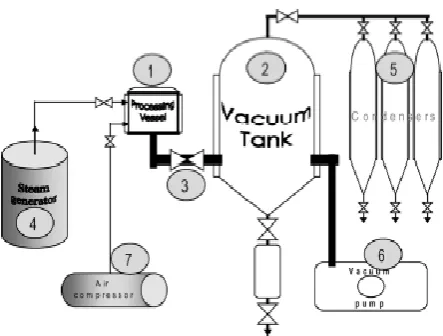
DIC technology has developed by Karim Allaf since 1988 in the University of La Rochelle, France. DIC technique is called as a high temperature high-pressure-short time process [7]. DIC technique has improved the texture, maintains the product colour, vitamins and flavour and has environmental friendly process [1, 8]. The improvement of kinetic energy for dehydration must emphasize to produce the best quality of food [8]. The immediate pressure drops (ΔP/Δt>0.5 MPa/s) modified the texture of food material by improving the material porosity and surface area. In addition, DIC technique can reduce the diffusion resistance of moisture, energy consumption and loss food nutrition and increase the water effective diffusively of food material [9]. The DIC machine can be illustrated in Figure 1 [6]:
Figure 1 Schematic presentation of DIC machine: 1. Processing chamber; 2. vacuum tank; 3. controlled instant pressure drop valve;
4. Steam generator; 5. condensers; 6. vacuum pump; 7. air compressor
During the process, there are four main transport types of moisture and heat transfer [9]:
i) Internal heat transfers the energy by heat conduction condition
ii) External heat transfers out energy based on contact, convection or radiation process iii) Internal mass transfers the water content in
liquid and vapour phase iv) External mass transfer process
1.2 Spray-DIC Technique
103
Figure 2 Schematic presentation of spray-DIC dryer
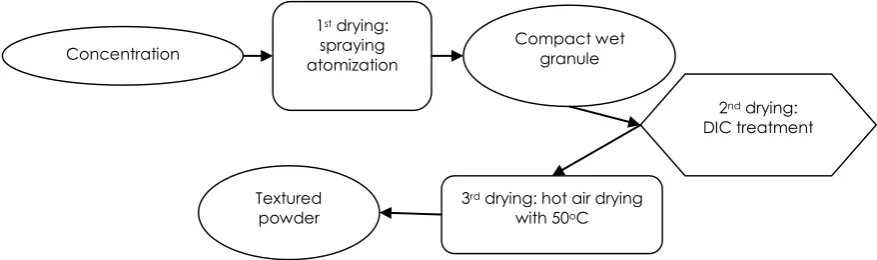
The spray-DIC dryer has a few operational stages. The first stage drying is nozzle spraying atomization of fruits concentrates to swell they and reformed their volume and hole content. The fixed surface area of concentrates granules will increase and produce the compact wet granules in this stage. In order to produce the highest quality of the powder, commonly the fixed area must be greater than 200m2/kg [6]. The
next process is a treatment of DIC dried operative
parameters. In this process, the molecule of water inside the fruit granule is broken with high pressure. The higher of DIC steam pressure gives the increase of expansion rate for drying process. The last drying process is carried out in an independent drier with a stream of dry air at 50oC. Then, the powder sample is
ready for characterization. The stages of spray-DIC can be summarized in Figure 3:
Figure 3 Stage of Spray-DIC Technique
Concentration
1st drying:
spraying atomization
Compact wet granule
2nd drying:
DIC treatment
3rd drying: hot air drying
with 50oC
104
2.0 MATHEMATICAL MODELING
In this paper, we focus on mathematical models in the DIC treatment of the spray-DIC drier. The contribution of this paper is the enhancement of the simple mathematical model from Haddad et al. [10] and present the comparison result of mathematical models of drying process between models involving controllability expression and uncontrollability expression. The presentation of controllability expression usually able to control the process of computation of mathematical [11].
Several mathematical models has been proposed to simulate and visualize the drying process. The pioneer research of DIC technique was investigated by Haddad et al. [10]. The effect of DIC treatment on phytate lupin experiments has been done by Haddad et al. [10] where the phytate content equation of
Lupinus albus using DIC technique with involving of
pressure treatment, time processing and water content are given by:
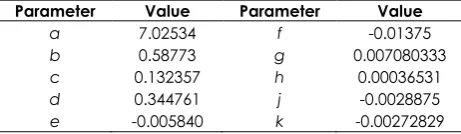
where the constants a to k values are as in Table 1:
Table 1 The values of constant a to k
Parameter Value Parameter Value
a 7.02534 f -0.01375
b 0.58773 g 0.007080333
c 0.132357 h 0.00036531
d 0.344761 j -0.0028875
e -0.005840 k -0.00272829
2.1 Uncontrollability Of Parabolic Mathematical Modeling
In this paper, we are focused on mathematical modeling of moisture and heat transfer in DIC treatment. Some assumptions are made based on Ramallo and Mascheroni [12] and Villa-Corrales et al. [13] for mathematical modeling, which are:
i) Solid temperature is constant and equal to air temperature
ii) Constant initial moisture and temperature distribution.
iii) Concentration is considered as a small granule exposed to constant airflow at constant temperature.
iv) External resistance to the mass transfer is negligible.
v) Moisture vaporisation only for the upper surface.
vi) Negligible radiation effects.
vii) Moisture transfer inside the concentration only by diffusion
Alias et al. [14] have studied the mathematical model of moisture content of drying process using DIC technique. Villa-Corrales et al. [13] have governed the transient heat and moisture transfers equation. The types of mathematical models in these both papers is parabolic partial differential equation without control expression. The following equations are mathematical models of moisture and heat transfer equation respectively: 𝜕𝑀 𝜕𝑡 = 𝜕 𝜕𝑥(𝐷𝑒𝑓𝑓 𝜕𝑀 𝜕𝑥) (2) 𝜕𝑇 𝜕𝑡 = 𝜕 𝜕𝑥( 𝑘 𝜌𝐶𝑝 𝜕𝑇 𝜕𝑥) (3)
The initial conditions given as:
𝑀(𝑥, 0) = 𝑀0 and 𝑇(𝑥, 0) = 𝑇0 for 0 ≤ 𝑥 ≤ 1
The boundary conditions given as:
𝜕𝑀 𝜕𝑥(0, 𝑡) =
𝜕𝑇 𝜕𝑥(0, 𝑡) =
𝜕𝑇 𝜕𝑥(𝐿, 𝑡) = 𝑓(𝑥, 𝑡) and 𝐷𝑒𝑓𝑓𝜌𝑑𝑝 𝜕𝑀 𝜕𝑥(𝐿, 𝑡) = −ℎ𝑚𝜌𝑎𝑖𝑟(𝑀𝑖− 𝑀𝑎𝑖𝑟),
3.0 CONTROLLABILITY EXPRESSION OF
DEHYDRATION PROCESS MODEL
According to Fattorini and Russell [15] theorem, the general form of multidimensional second-order parabolic partial differential operator of models given as: 𝐴𝑊 = − ∑ 𝜕 𝜕𝑥(𝑎𝑖,𝑗(𝑥) 𝜕𝑊 𝜕𝑥𝑗 ) + 𝐶(𝑥)𝑊 𝑑∈ℝ 𝑖,𝑗=1 ,
where 𝑎𝑖,𝑗(𝑥) is symmetric and positive finite matrix, 𝑊
is dependent variable and 𝐶(𝑥) ≥ 0. This theorem is
based on the Hilbert space.
Since that, in these cases, the moisture and heat transfer equations (2) and (3) become as follow respectively:
𝜕𝑀
𝜕𝑡 + 𝐴𝑀 = 0
(4)
𝜕𝑇
𝜕𝑡+ 𝐴𝑇 = 0
(5) where 𝐴𝑀 = ∑ 𝐷𝑒𝑓𝑓 𝜕𝑀 𝜕𝑥𝑖,𝑗 + 0(𝑥)𝑀 2 𝑖,𝑗=1 and
𝑧(𝑃, 𝑊, 𝑡) = 𝑎 + 𝑏𝑃 + 𝑐𝑡 + 𝑑𝑊 + 𝑒𝑃2+ 𝑓𝑃𝑡
+ 𝑔𝑃𝑊 + ℎ𝑡2+ 𝑗𝑡𝑊 + 𝑘𝑊2
105
𝐴𝑇 = ∑ 𝑘
𝜌𝐶𝑝
𝜕𝑇 𝜕𝑥𝑖,𝑗
+ 0(𝑥)𝑇
2
𝑖,𝑗=1
Fattorini & Russell (1971) has studied about the controllability of mass and heat transfer in fluid flows [15, 16]. The harmonic analysis method obtained the appropriate conditions for the exact controllability of systems governed by hyperbolic and parabolic partial differential equations [16]. The control expression 𝜇(𝑡)
to the moisture and heat transfer models in Equation (4) and (5) are:
𝜕𝑀
𝜕𝑡 + 𝐴𝑀 = 𝜇(𝑥) (6)
𝜕𝑇
𝜕𝑡+ 𝐴𝑇 = 𝜇(𝑥)
(7)
with the initial and boundary condition for moisture and heat transfer equations in subtopic 2.1.
The control expression can be changed according to any expression as well as can control the process. Usually, we can let the controllability expression as a simple expression. In this paper, there are three types of control expressions for controllability models (5) and (6) will be compared to uncontrollability model of moisture and heat transfer. The three types of control expressions are:
𝜇1(𝑥) = ∑
sin(− 𝑘𝑥) 𝑘
∞
𝑘=1
,
(8.1)
𝜇2(𝑥) = ∑
cos(− 𝑘𝑥)
𝑘 ,
∞
𝑘=1
(8.2)
𝜇3(𝑥) = ∑
exp(− 𝑘𝑥) 𝑘
∞
𝑘=1
(8.3)
4.0 RESULT AND DISCUSSION
The laboratory experiments results in Figures 4 and 5 for DIC technique has been done and supported by Field Emission Scanning Electron Microscope (FESEM) image of two types of fruits [17]. The experiments shows that the DIC technique succesfull to dehydrates the fruit slices.
Figure 4 Guava dehydrate Figure 5 Orange dehydrate
The computation of moisture and heat models was using MATLAB 2013. Table 2 shows the software specifications in computing the models:
Table 2 Software Specifications
Specification Item Name
Software MATLAB
Version 2013a
CPU type Intel Core i3
4.1 Comparison of Controllability and Uncontrollability Dehydration Process Model
The exact solution of drying process using DIC technique in Equation (1) is shown in Figure 6. Based on the figure, the pressure and water content of fruits are decreasing for every increasing time.
106
Figure 6 The visualization of Equation (1)at a) t=1s b) t=30s c) t=60s
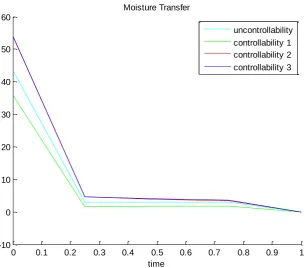
Figure 7 Comparison of uncontrollability Equation (2) and controllability Equations (6) of moisture content model
-5 0 5 -5 0 5 2 4 6 8 10 12 14 Pressure, P Liquid Content, W
p h y t a t e c o n t e n t , t h e t a -5 0 5 -5 0 5 5 10 15 20 Pressure, P Liquid Content, W
p h y t a t e c o n t e n t , t h e t a -5 0 5 -5 0 5 5 10 15 20 25 Pressure, P Liquid Content, W
p h y t a t e c o n t e n t , t h e t a
0 0.1 0.2 0.3 0.4 0.5 0.6 0.7 0.8 0.9 1
107
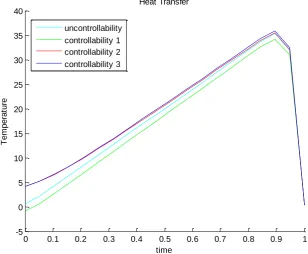
Figure 8 Comparison of uncontrollability Equation (3) and controllability Equations (7) of heat transfer model
By comparing the results in Figures 6 and 7, for moisture transfer for both equations has decrease decline with the time increase. It means that the drying process are occured in spray-DIC technique because the losing moisture content in the samples.
Based on Figure 7, the graphs look similar for the curves of uncontrollability and controllability models of moisture content. It can be concluded that the moisture content was decreased with respect to time. The presence of controllability causes the moisture transfer during the dehydration process controlled by control expression 𝜇(𝑡). Similar to the heat transfer
equation, based on Figure 8, the curve of the heat transfer looks similar. The heat transfer increase due to the time until it reaches the optimum temperature. After the process reached the optimum temperature, the heat transfer becomes decrease. However, for the graph that presents the controllability, the heat transfer gives the smooth process compared with the models without control expression.
Table 3 Comparison between maximum errors of control
expression for controlled models with uncontrolled models
Control expression Maximum error between
controllability and uncontrollability models
Moisture Content Equation
Heat Transfer Equation
Sinus Expression Equation (8.1)
7.581641 1.555378
Control expression Maximum error between
controllability and uncontrollability models
Moisture Content Equation
Heat Transfer Equation
Cosines Expression Equation (8.2)
10.45661 3.546428
Exponential Expression Equation (8.3)
10.76427 3.561738
Table 4 Maximum Errors with Exact Solution Equation (1)
Equations Maximum error with
Equation (1)
Equation (2) 5.1270
Equation (6) with Sinus Expression Equation (8.1)
3.8630
Equation (6) Cosines Expression Equation (8.2)
6.1597
Equation (6) Exponential Expression Equation (8.3)
6.3601
Based on Table 3, the sinus expression for control expression of the models gives the minimum error to the uncontrollability models rather than the cosines and exponential expressions. It gives the minimum error for both models. These results supported by the comparison of maximum error of moisture content equation with exact solution equation (1) in Table 4.
0 0.1 0.2 0.3 0.4 0.5 0.6 0.7 0.8 0.9 1
-5 0 5 10 15 20 25 30 35 40
Heat Transfer
time
Te
m
p
e
ra
tu
re
108
The results show that the sinus expression gives a minimum error compared to the others. Therefore, the sinus expression are the suitable controlled expression for drying process using spray-DIC technique. The results for moisture and heat transfer equation have improved and controlled by the control expression in the parabolic partial differential equation models.
5.0 CONCLUSION
Mathematical modeling based on partial differential equation with parabolic type is an alternative model to predict the visualization of moisture and heat transfer during the dehydration process of food. The enhancement of the dehydration process model using the controllability expression gives high impact to accurate prediction and produces a smooth visualization with low energy consumption. The MATLAB results show that the control expressions of moisture and heat transfer are the dynamic features for the specific parameter classification during the drying process. The suitable controlled expression for drying process is sinus expression. For future study is controllability for multidimensional of mathematical models and proving by laboratory experiments.
Acknowledgement
This research is supported in part by the Ministry of Higher Education (MOHE), Research Management Centre (RMC) and University Technology Malaysia (UTM) through Research University Grant (10J33 and 4F675) and the authors are grateful to Ibnu Sina Institute, University Technology Malaysia for the excellent support to this research.
Abbreviations
𝑘 Thermal conductivity (W/m k) 𝐿 Length of chamber (m)
𝑀 Moisture content of material (kg water/kg dry
specimen)
𝑇 Temperature of material (°𝐶) 𝐶𝑝 Specific heat (J/kg K)
𝐷𝑒𝑓𝑓 Effective diffusivity coefficient (m2/s)
ℎ𝑚 Mass transfer coefficient
𝑀0 Initial moisture content of material (kg
water/kg dry specimen)
𝑀𝑖 Interface moisture content (kg water
vapour/kg dry air)
𝑀𝑎𝑖𝑟 Air moisture content (kg water vapour/kg dry
air)
𝑇0 Initial temperature of material (°𝐶)
𝑡 Time (𝑠)
𝑥 Grid in 𝑥 direction (m)
Greek Letter
𝜌 Density (kg/m3)
𝜌𝑑𝑝 Density of drying process (kg/m3)
𝜌𝑎𝑖𝑟 Density in ambient air flow (kg/m3)
References
[1] Haddad, M. A., S. Mounir, V. Sobolik and K. Allaf. 2008. Fruits & Vegetables Drying Combining Hot Air, DIC Technology
And Microwaves. International Journal of Food
Engineering. 4(6).
[2] Chen, X. D. and A. S. Mujumdar. 2009. Drying Technologies In Food Processing. John Wiley & Sons.
[3] Jayaraman, K. and D. Das Gupta. 1992. Dehydration Of Fruits And Vegetables-Recent Developments In Principles And Techniques. Drying Technology. 10(1): 1-50.
[4] George, S., S. Cenkowski, and W. Muir. 2004. A Review Of Drying Technologies For The Preservation Of Nutritional Compounds In Waxy Skinned Fruit. North Central ASAE/CSAE Conf, Winnipeg, Manitoba, Canada. [5] Mounir, S., P. Schuck, and K. Allaf. 2010. Structure And
Attribute Modifications Of Spray-Dried Skim Milk Powder Treated By DIC (Instant Controlled Pressure Drop) Technology. Dairy Science & Technology. 90(2-3): 301-320. [6] Mounir, S. and K. Allaf. 2008. Three-Stage Spray Drying: New Process Involving Instant Controlled Pressure Drop. Drying Technology. 26(4): 452-463.
[7] Haddad, J. and K. Allaf. 2007. A Study Of The Impact Of Instantaneous Controlled Pressure Drop On The Trypsin Inhibitors Of Soybean. Journal of Food Engineering. 79(1): 353-357.
[8] Pilatowski, I., S. Mounir, J. Haddad, D.T. Chong, and K. Allaf. 2010. The Instant Controlled Pressure Drop Process As A New Post-Harvesting Treatment Of Paddy Rice: Impacts On Drying Kinetics And End Product Attributes. Food and Bioprocess Technology. 3(6): 901-907.
[9] Setyopratomo, P., A. Fatmawati, and K. Allaf. 2009. Texturing By Instant Controlled Pressure Drop DIC In The Production Of Cassava Flour: Impact On Dehydration Kinetics, Product Physical Properties And Microbial Decontamination. Proceedings of the World Congress on Engineering and Computer Science. San Francisco, USA2009.
[10] Haddad, J., R. Greiner, and K. Allaf. 2007. Effect Of Instantaneous Controlled Pressure Drop On The Phytate Content Of Lupin. LWT - Food Science and Technology. 40(3): 448-453.
[11] Imboden, A. G. 2013. Optimal Control for Partial Differential Equations.
[12] Ramallo, L. and R. Mascheroni. 2013. Effect Of Shrinkage On Prediction Accuracy Of The Water Diffusion Model For Pineapple Drying. Journal of Food Process Engineering. 36(1): 66-76.
[13] Villa-Corrales, L., J. J. Flores-Prieto,J. P. Xamán-Villaseñor and E. García-Hernández. 2010. Numerical And Experimental Analysis Of Heat And Moisture Transfer During Drying Of Ataulfo Mango. Journal of Food Engineering. 98(2): 198-206.
[14] Alias, N., H. F. S. Saipol, and A. C. A. Ghani. 2012. Some Numerical Methods Of Diffusion Equation For Dic Technique. The International Conference on Informatics and Applications (ICIA2012). The Society of Digital Information and Wireless Communication.
109
[16] Fursikov, A. V. and O. Y. Imanuvilov. 1995. On ControllabilityOf Certain Systems Simulating A Fluid Flow. Flow Control. Springer. 149-184.
[17] Alias, N., H. F. S. Saipol, and A. C. A. Ghani. 2014. Chronology of DIC Technique Based On The Fundamental