MANKAD, KARTIK. Analysis of Unified Memory Performance and Protection for Concurrent Kernel Execution. (Under the direction of Dr. Michela Becchi and Dr. Huiyang Zhou).
GPUs are increasingly gaining popularity as a mainstream computing platform due to
their excellent performance numbers for modern computing problems, especially for specific
application domains like deep learning and virtual reality. They are now commonplace in
compute infrastructure offerings from most major cloud computing vendors. It would serve these
cloud computing providers well to allow concurrent execution of applications on the same GPU
device and thus accommodate more users. However, this is currently not feasible because
runtime systems that allow this type of concurrent execution suffer from a lack of memory
protection and performance guarantee for kernels executing concurrently. In this work, we study
both these shortcomings in the context of the NVIDIA Pascal architecture and the Unified
Memory features it offers. We then demonstrate the how a runtime system could be
compromised by a Denial-Of-Service attack mounted based on the demand paging functionality
part of Unified Memory. As a partial fix, we propose an enhancement to the default memory
allocator which is able to prevent the Denial-Of-Service attack. We also discuss possible
© Copyright 2018 by Kartik Mankad
by Kartik Mankad
A thesis submitted to the Graduate Faculty of North Carolina State University
in partial fulfillment of the requirements for the degree of
Master of Science
Computer Engineering
Raleigh, North Carolina
2018
APPROVED BY:
_______________________________ _______________________________ Dr. Michela Becchi Dr. Huiyang Zhou
Committee Chair
DEDICATION
BIOGRAPHY
Kartik Mankad was born in Vadodara, Gujarat, India on August 8, 1991. He grew up
there and finished high school at Delhi Public School, Vadodara. After high school, he went on
to complete a dual degree – a Bachelors in Electrical & Electronics engineering along with an
MS in Chemistry at Birla Institute of Technology and Science, Pilani with honors. He joined
NVIDIA right out of college as a Verification engineer and worked at their Bangalore Design
Center for almost 3 years where he contributed to multiple successful chip tapeouts. He chose to
join North Carolina State University in the fall of 2016 to pursue an MS in Computer
Engineering. During his time at NC State, he focused his course work on computer architecture
and his research efforts on parallel computing systems. He plans to re-join NVIDIA in Santa
ACKNOWLEDGMENTS
First off, I would like to extend sincere thanks and express utmost gratitude towards my
advisor, Dr. Becchi. My research journey as detailed in these pages has been an intellectually
stimulating one throughout which I enjoyed great support, candid feedback and generosity from
her.
In addition, I would also like to thank Dr. Zhou, whose guidance and encouragement was
pivotal in bringing my work to its current state. I can confidently say that his unique insight and
in GPU architecture not only helped the end-result but also helped shape the approach leading up
to it.
I would also like to thank Dr. Tuck, for agreeing to be a part of my committee and for
reviewing this thesis. I am sure that my learnings from course on code optimization are going to
be with me for a long time and serve me well in my professional career – for which I am
extremely grateful.
Further, I would like to thank my fellow lab mates of the Networking and Parallel
Systems lab. I shall always cherish the technical as well as non-technical discussions with them.
Finally, I would like to thank my friends and family for helping me along this journey
TABLE OF CONTENTS
LIST OF TABLES...vi
LIST OF FIGURES...vii
CHAPTER 1 : Introduction ... 1
Contributions ... 3
Thesis organization ... 3
CHAPTER 2 : Background on Unified Memory in Kepler/Maxwell and Pascal Architecture ... 5
Pre-Pascal Unified Virtual Memory ... 9
Post-Pascal Unified Virtual Memory ... 11
CHAPTER 3: Background on Stream-based Concurrent Kernel Runtime Systems ... 16
The Many Core Runtime ... 21
The NVIDIA Multi Process Service Runtime ... 23
CHAPTER 4 : Memory Protection Experiments ... 25
Methodology ... 28
Hardware and Software setup ... 29
Results ... 30
Conclusion ... 33
CHAPTER 5: Memory Performance experiments ... 34
Methodology ... 37
Results ... 40
Motivation for an improved allocator ... 46
Pre-allocator Design ... 47
Conclusion ... 49
CHAPTER 6: Future Work ... 50
CHAPTER 7: Related Work ... 53
CHAPTER 8 : Conclusion ... 55
REFERENCES ... 56
APPENDIX ... 62
LIST OF TABLES
LIST OF FIGURES
Figure 2.1 Flow of execution for a typical CUDA Program... 5
Figure 2.2 cudaMallocManaged() in CUDA 6.0 ... 7
Figure 2.3 CUDA program with UVM ... 8
Figure 3.1 The NVIDIA Driver-Runtime stack ... 18
Figure 3.2 NVIDIA Driver-Runtime Stack with multiple contexts ... 20
Figure 3.3 NVIDIA Hyper-Q introduces multiple work queues. ... 21
Figure 3.4 Many Core Runtime from the NPS Lab ... 23
Figure 3.5 NVIDIA Multi Process Service ... 24
Figure 4.1 NVIDIA Driver-Runtime Stack ... 27
Figure 4.2 Memory Protection Microbenchmark (Serial execution) ... 28
Figure 4.3 Memory Protection Microbenchmark (Parallel mode) ... 29
Figure 5.1 Graph showing the slowdown of the victim kernel under the effect of the first version of the malicious kernel ... 42
Figure 5.2 Bar chart showing the severity of the victim slowdown as malicious kernel fragment size is varied ... 44
Figure 5.3 Bar chart showing the proportion of time spent servicing page faults across allocation sizes ... 45
Figure 5.4 Bar chart showing the relative execution speed when LoneStarGPU is run within the proof-of-concept system and MPS Runtime Systems ... 46
Figure 5.5 Bar chart showing the relative performance of the LoneStarGPU suite when co-run with an application (bfs) from the same suite in the POC system ... 47
CHAPTER 1 : Introduction
Since the introduction of NVIDIA’s Compute Unified Device Architecture (or CUDA as
it is popularly known) in 2007 [1], its popularity and adoption as a mainstream computing
paradigm in industry and academia has seen a sustained increase. Both the programming
experience as well as the performance of this system as a whole has improved significantly
moving from generation to generation. Apart from the improvements in the programming model
itself, this growth of the CUDA computing ecosystem has been supported by its robust and
well-designed toolchain that not only assists debugging, but also profiling and deploying code.
Popular IaaS (“Infrastructure as a Service”) providers noticed this trend of growing
popularity and demand for this platform among their clientele and invested heavily in an attempt
to get ahead of the demand curve for this computing platform. It was as early as 2010 [2] just 3
years after CUDA was first launched by NVIDIA, that Amazon Web Services (“AWS”)
introduced GPU-enabled cloud instances for their popular Elastic Compute service offering.
The mind-boggling amounts of data that need to be processed on a near real-time basis in
many commercial and enterprise applications (often dubbed “Big Data”) have only underlined
the relevance of a massively parallel computing platform like CUDA. Its recent adoption as the
de-facto computing platform for deep learning applications is a clear testament to its current and
future relevance in the modern computing landscape.
While GPUs represent a financially viable solution to the continuously growing
computing needs of tomorrow, it should be noted that the immense parallel processing potential
of this hardware platform is shrouded behind the software stack - specifically the runtime layer
In systems like Microsoft Azure, their GPU-enabled virtual machine instances are setup
such that only one user session is allowed to use the underlying GPU card at a given point in
time. This mode of managing devices in virtualized systems is referred to Discrete Device
Assignment [3]. While the CPU and other attached computing resources on the node(s) might be
virtualized across different user sessions, the GPU is attached to one user session only. While
this might be intuitive for their users - and convenient to manage from Microsoft’s perspective, it
is often the case that a lot of the massive computing power available on the node goes unused
because that single user might not be running enough compute applications to saturate the GPU’s
resources. Existing studies [4] have found that this indeed the case many times. They conclude
that typical applications (represented by benchmark suites in the referenced papers) often
underutilize the available hardware.
A natural next step based on such a conclusion is to try and accommodate enough work
on the GPU instances by allowing more than just one user access to the GPU. Not only does this
mean that the hardware is better utilized, it also means that commercial cloud computing
providers can sell many more times the service hours for the same investment in hardware and
computing infrastructure.
The underlying software infrastructure supporting users on such cloud computing
systems would need significant changes to accommodate this new use model. Many such
systems have been proposed [5] [6] [7] as valiant attempts to fill the void of a robust, multi-user
system that virtualizes GPUs at scale to achieve high device utilization. However, all of them
suffer from two main flaws that render them unfit commercial deployment - the lack of any
basic flaws that must be addressed for any such runtime to make it suitable for use in a
production environment.
Contributions
With this brief context of the issues in current runtime systems, the contributions of this
work are listed below:
• A study of the extent of the lack of memory protection and absence of any
performance guarantee in a concurrent execution scenario on a Kepler and Pascal
GPU, both with and without Unified Memory.
• Based on the observations from the above-mentioned study, we develop a malicious
CUDA kernel that can create a Denial-Of-Service (DoS) attack on a shared GPU
controlled by a stream-based concurrent kernel runtime system. This is benchmarked
on the LoneStarGPU [22] benchmark suite.
• We also propose and prototype a runtime system enhancement that represents a
moderately successful attempt at limiting the adverse effects of a malicious kernel
like the one we created. This too is benchmarked using the LoneStarGPU suite.
• Finally, we lay out the blueprint for what a comprehensive solution encompassing the
driver and runtime system to address these issues could look like.
Thesis organization
This thesis is organized as follows: Chapter 2 contains an in-depth description of the
Unified Memory feature available on NVIDIA GPUs. Chapter 3 serves to inform the reader
experiments conducted to evaluate the level of memory protection in the concurrent execution
case, with and without Unified Memory. Chapter 5 describes our experiments and
microbenchmarks to investigate the performance effects of demand paging. Chapter 6 discusses
the future work possible on the basis of the experiments we already describe in previous
chapters. Chapter 7 provides a succinct summary of the related publications in this area of GPU
CHAPTER 2 : Background on Unified Memory in Kepler/Maxwell and Pascal Architecture
This chapter serves to inform the reader about the workings and features of NVIDIA’s unified
virtual memory, a feature introduced in CUDA 6.0 [8].
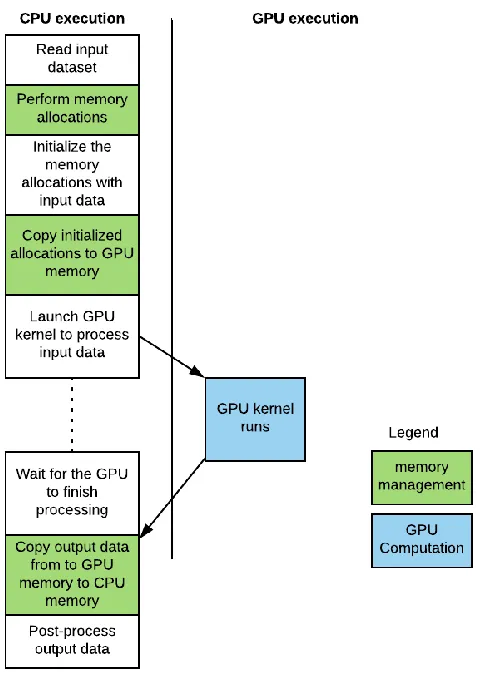
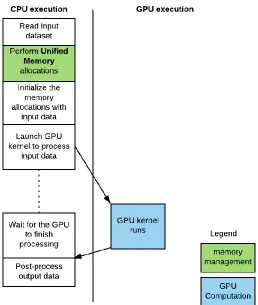
In CUDA platforms before CUDA 6.0, the typical flow of a program was as shown below:
Figure 2.1: Flow of execution for a typical CUDA Program.
The user is expected to setup the working memory for subsequent kernels to process and
once done, explicitly program API calls to copy the output data. This layout of most GPU
underlying hardware organization: the GPU and CPU are two, distinct processors and maintain
distinct memories. However, it is not the most ideal when it comes to ease-of-use and
performance because of the following reasons:
1. Need to setup the copy-in and copy-out operations just right: Mismatch in the number of
bytes or pointers often causes hard to track bugs. For simple, continuous buffers this is
not particularly hard to get right, but it can get tedious for nested C++ class objects and
structs.
2. Computational cores idle during copies: While it is possible to use the GPU’s copy
engines (DMA) to asynchronously copy data into and out of buffers such that it overlaps
with computation, setting that up has its own restrictions and is tedious to do in practice.
Thus, the scenario where computational cores are idle while data is being copied to/from
the GPU is not uncommon.
3. If a program’s data set exceeds the physical memory capacity of the GPU, it simply can’t
be run on the GPU ‘as-is’. This prevented a large class of problems across data analytics,
genomics and deep learning from being readily deployable on GPUs. The data flow
needed to be double or triple buffered for optimal performance. This was until Unified
Virtual Memory was introduced.
Considering these inconveniences associated with the traditional copy-compute-copy
model, NVIDIA added Unified Memory with CUDA 6. Unified Virtual Memory (“UVM”), as
the name suggests, aims to present a unified, virtual address space (and memory management
interface) to programmers. Irrespective of what memory (GPU or CPU) a pointer could be
referring to, the address space and functions to control the allocation it points to would be the
users now had the option to use NVIDIA’s Unified Memory API - cudaMallocManaged().
It could be used for both CPU and GPU allocations. In other words, GPU memory allocated via a
cudaMallocManaged() call can be seamlessly accessed via pointers even on the CPU. The
key is that the system automatically migrates data allocated in Unified Memory between host
(CPU) and device (GPU) so that the data is seamlessly resident on the CPU memory for code
running on the CPU, and on the GPU memory to code running on the GPU. Programmers would
never need to call cudaMemcpy() in their programs. Thus, the notion of disjoint address
spaces and independent memories between the CPU and the GPU no longer exists in the
programmer’s view with UVM.
With UVM, Figure 2.3 shows what a typical CUDA program would now look like. Note that
there is no longer explicit copy-to and copy-from operations in Figure 2.3 below. __host__ cudaError_t cudaMallocManaged ( void** devPtr, size_t size, unsigned int flags)
Further description of UVM is split into two sections based on GPU architecture generations -
pre-Pascal (Kepler/Maxwell architecture) and post-Pascal (Pascal/Volta architecture), as Pascal
and Volta generations carry significant changes in the mechanisms around UVM.
Pre-Pascal Unified Virtual Memory
In GPU generations before Pascal – Kepler and Maxwell architectures, the Unified
Virtual Memory served as little more than an automation layer to the explicit cudaMemcpy()
calls that the programmer had to make otherwise.
On calling cudaMallocManaged() in order to allocate a chunk of Unified Memory,
the memory would be allocated on the GPU first. The NVIDIA kernel driver would also setup
the page directory and page tables for the allocation on the CPU side, so that any access to this
memory would not trigger a segmentation fault, but instead trigger a page fault on the CPU.
Initializing these pages on the CPU before launching the GPU kernels (a typical programming
practice in many GPU programs) would have those Unified Memory pages resident on the CPU
due to CPU page faults that would be triggered when attempting to initialize that Unified
Memory allocation.
Further, all allocations made via cudaMallocManaged() would be copied over to the
GPU by the runtime before the it actually launched the user’s kernel on the GPU. Irrespective of
whether those allocations would actually be accessed or required by the user’s kernel running on
the GPU, the runtime system undertook a time-consuming copy operation in order to make all
the data available to any code that would run on the GPU. The kernel launch was thus delayed
until this copy operation was complete. This was a necessary step for ensuring correct
functionality of GPU kernels, but clearly inefficient.
All memory accesses to Unified Memory allocations on the GPU would proceed as
scenario when not using Unified Memory). During a kernel’s execution, any access to that
allocation by CPU code1 would return a segmentation fault. The data is accessible from the CPU
only after execution on the device is complete, or the device is idle and can handle servicing the
copy operation on required pages as requested by the NVIDIA UVM kernel driver operating
along with the CPU’s page fault handler. These generations of GPUs (before Pascal) could not
handle these page copies asynchronously and on-demand.
Assuming the execution on the device was complete and an access was made to a Unified
Memory allocation, those pages would be made available on the CPU’s memory. The access
would trigger a CPU page fault. The default page handler in the OS would then pass on control
to NVIDIA’s page fault handler (part of the UVM kernel driver) which would recognize this as
an access to an allocation of memory created via a previous cudaMallocManaged()call. It
would then proceed to copy the relevant pages of GPU memory back to the CPU’s memory and
update the CPU’s page table entries to point to this newly-copied-over data in the CPU’s
memory. [9]
This process is quite like a typical page fault on the CPU, where pages might be swapped
out to secondary storage (usually a disk). Instead of the disk, pages are compulsorily swapped
out to GPU memory before a kernel launch and are available for swapping back from GPU
memory once the device is idle.
1 CUDA Kernel launches are asynchronous with respect to CPU execution. Control returns immediately after the
Thus, to recap:
• On a cudaMallocManaged() memory allocation request : Setup Page Directory,
Page Table and mark the pages as not present on the CPU. Allocate that memory on the
GPU.
• Before a kernel launch: Copy all Unified Memory allocations from the CPU and to the
GPU and set them up on the GPU.
• During a kernel launch: No CPU access to the managed allocations is possible. GPU
access would proceed as in the non-Unified Memory allocation case.
• After a kernel launch: The CPU’s page fault handler and NVIDIA’s UVM driver would
work together to copy pages over and set them up on the CPU’s virtual memory system
on a need basis, per-page.
Post-Pascal Unified Virtual Memory
With the Pascal generation of GPUs, while the programmer visible interface has
remained largely the same (with a few additions), but the underlying mechanism has become
more efficient in several ways:
1. No immediate allocation: Behind a cudaMallocManaged() call, no CPU page
table entries are setup, neither is the memory carved out from the available memory
on the GPU. Unlike prior generations, these are setup only on an actual access. The
current policy is first touch [12]. The pages are setup (and initially resident) on the
processor (CPU or GPU) that first attempts to access them. Thus, only the required
(accessed) page entries occupy resources in the page management infrastructure of
2. No pre-launch copy: With Pascal and onwards, the pages allocated via
cudaMallocManaged() calls are no longer bulk copied to the GPU before the
kernel is launched. Instead, demand paging is implemented. This means that only on
an actual access of the page (and a subsequent GPU page fault) will the page be
copied from the CPU (if it was resident on the CPU, due to say, initialization) to the
GPU. The page could also be resident on a peer GPU and sourced from there. With
multi-GPU systems becoming commonplace [10], Unified Memory has been
designed with scalability across multiple GPUs in mind.
Not only does this ensure that there is no overhead before a kernel launch,
but also that the GPU’s memory is occupied by pages that are really required to reside
there. Previously, copying all managed pages was a conservative approach that had
the undesired effect of cluttering the GPU memory (and page tables) with pages that
might never be used on the GPU in addition to padding the kernel launch with an
extraneous overhead.
The key takeaway from #2 above is that GPUs can now raise page faults, just like CPUs
can. In the event of a GPU page fault, the respective SM (Streaming Multiprocessor) goes into
trap mode and stalls the execution of dependent warps in anticipation of the pages being
available once the fault is done being serviced. As part of this sequence of events the
corresponding TLB2 is also locked so that the hardware’s view of memory remains consistent
across the page fault [12].
2 Depending on which Pascal architecture GPU it is, TLBs may be shared between 2 SMs, or each SM might be tied
The NVIDIA UVM (Unified Virtual Memory) kernel driver then addresses this GPU
page fault and executes the below listed sequence of events:
1. Allocate new pages on the GPU;
2. Un-map the page table entries corresponding to the old pages on the CPU;
3. Trigger a blocking copy of those pages from the CPU to the GPU;
4. Setup the respective SM’s TLB entries for these newly copied pages on the GPU;
5. Free old CPU page table and TLB entries.
Considering this new GPU page fault mechanism, a number of new features are enabled:
1. Concurrent CPU-GPU access: Unlike the mechanism in Maxwell, Kepler (pre-Pascal),
the CPU can access memory pages that the GPU might be processing currently. There
will no longer be a segmentation fault, but instead a CPU page fault would be triggered.
That fault would cause the GPU execution on that page to stall, then trigger an eviction of
the page from the GPU’s memory system and finally a page-copy operation to have the
page now in the CPU’s virtual memory system (The sequence listed above). Thus, both
the CPU and the GPU can raise page faults over absentee pages and work on the data
simultaneously. Ofcourse, while this is functionally possible now, it comes with its own
overhead due to the operations involved in a page fault (as listed above). The data copy
over the PCIe link between the two processors is the most expensive operation in terms
of latency. However, with many page faults, the overhead to update and maintain the
paging infrastructure also adds up (Steps 1, 2, 4, 5). This scenario of concurrent access
also applies identically to a multi-GPU use case. Multiple GPUs can seamlessly work on
the same set of data without the functional need to batch, stream or locally buffer the
2. Over-subscription of GPU memory: This demand paging mechanism also allows
programs running on the GPUs to over-subscribe GPU memory. This is akin to how CPU
processes may use more than the physically present RAM, by using the secondary storage
(usually disk) as a swap buffer. In the case of a GPU, that swap buffer is the CPU’s
system memory. With this feature, programs whose datasets exceed the physical memory
of the GPU can be accommodated “as-is”, without the need to setup buffering schemes or
batch the processing to make the program fit in GPU memory. To accommodate pages
that would otherwise be beyond the capacity of the device, existing pages in the GPU’s
virtual memory system would be evicted to the CPU’s system memory. This eviction
would be carried out as part of the GPU page fault itself. This is not optimal from a
performance standpoint, but that is far better than not being able to run at all. It provides
a very low barrier of entry to being able to start to deploying applications with large
memory footprints.
3. System-wide Atomics: For multi-GPU systems such as DGX-2 [10] to be useful to
programmers, the support for multi-GPU, or system-wide atomics is a must. This
eviction/allocation mechanism of pages ensures that can be achieved. A page can be
made to reside on only one GPU’s physical memory at any given point in the program’s
execution. Thus, support for system wide atomics is easily enabled as by the GPU page
fault mechanism added in Unified Memory in the Pascal architecture.
From the programmer’s point of view, the demand paging mechanism is completely
transparent. The only knob that the programmer has been provided is in the form of the
cudaMemAdvise() call. This call allows the user to specify how they typically expect the
runtime would simply create a copy of the page on the processor (CPU or peer GPU) that raised
a page fault, rather than an eviction from the owner processor followed by a copy operation to
the destination processor. Further it also presents the programmer the ability to set a “preferred”
processor for a page. Presumably, the driver uses this to keep those pages resident on the
preferred processor as far as possible.
The internal heuristics and policies implemented in the NVIDIA UVM kernel driver
(nvidia-uvm.ko) are not publicly documented. However, the kernel driver itself is open
source and the source code can be accessed just like other linux kernel source code. Thus, there
exists a lot of opportunity to not only better understand the existing page handling policies
implemented, but also implement other policies by modifying this MIT-licensed open source
driver to improve the current setup. It must however be noted that the remainder of the NVIDIA
driver (nvidia.ko) - the part that interacts with the hardware via I/O commands is still closed
source. These I/O commands are not publicly documented either. It is only the page handling
part of the driver (dubbed the ‘UVM kernel driver’) that is open source. Chapter 4 proposes a
policy that could be implemented in the driver to help make the system more robust towards
CHAPTER 3: Background on Stream-based Concurrent Kernel Runtime Systems
As a preface to the concept of concurrent execution on NVIDIA GPUs, we shall first
explore the typical (non-concurrent) mode of execution for CUDA programs and the associated
software layers.
The user’s program basically consists of host code that runs on the CPU, and “device”
code that runs on the GPU. The device code is usually a set of one or more thread parallel
functions that are called CUDA kernels. The primary role of the host code is to control and setup
execution of the parallel code that will run on the GPU. Setting up its working data, configuring
the device and launching the parallel execution on the device is all to be done by the CPU
portion of the program’s code. In this sense, the CUDA programming model is CPU centric in
terms of the overall flow of execution.
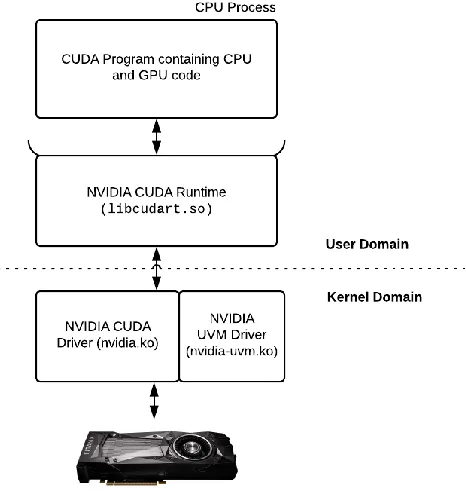
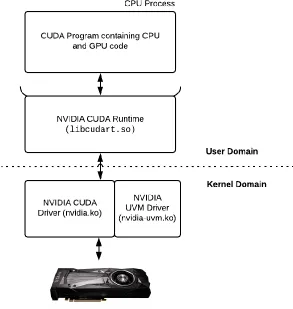
These calls in the host part of the program to manage execution on the GPU are CUDA
Runtime API calls. The CUDA Runtime is the layer of software that exists between the
closed-source kernel driver and the user program. The runtime interacts with this kernel device driver by
calling CUDA Driver APIs. Both the Runtime APIs and Driver APIs are well documented for
users - thus allowing them to use APIs at whatever level of abstraction might be suitable for their
application. The Runtime API presents a high-level, easy-to-use abstraction of the device, while
the Driver API allows users fine-grained control over the execution and configuration of the
This CUDA Driver API is implemented in the NVIDIA kernel driver itself. The driver is
the last software layer that interacts with the device via proprietary commands over the
respective interface (usually PCIe, but NVLink is also supported on some platforms [13])
between the CPU and the GPU.
Figure 3.1: The NVIDIA Driver-Runtime stack.
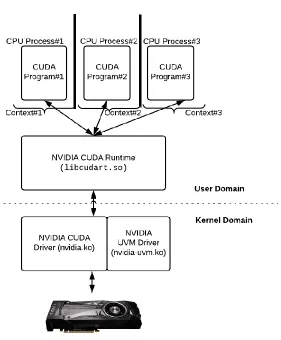
The CUDA Runtime maintains isolation between user processes accessing the GPU by
serving those processes within the confines of a software “context”. This context is a per-process
software abstraction maintained by the Runtime to allow multiple CPU processes to run device
knobs and configuration parameters, each context also presents a distinct virtual address space to
the user programs running within its confines.
Since each CPU process is associated with an independent context, there must be a
context-switch before the next CPU process can use the device. For devices older than Compute
Capability 3.5, the only opportunities the driver uses to Context switch are the end of a kernel’s
computation, or at the end of a memory copy to/from the GPU. A running kernel cannot be
pre-empted. This was a simplistic choice such that very little state information needed to be
maintained. For devices with Compute Capability of 3.5-5.*, a running grid may only be
preempted at a thread block (or more appropriately in hardware terms, Shared Multiprocessor)
granularity. For the device, this means resetting the respective SM pipelines, work queues and
associated software data structures in the driver and runtime. This involves some software
overhead to keep track of the thread blocks that are pending and running. With devices of
Compute Capability 6+ (Pascal, Volta) NVIDIA has introduced Instruction Level Compute
Pre-emption. This mechanism allows the execution on the device to be pre-empted at an instruction
granularity. This was introduced to help the response time for applications with both compute
and graphics requirements (most Virtual Reality applications fall in this category). It involves
storing (and restoring) the most amount of state information (register file contents, L1 contents at
the very least) owing to this fine granularity compared to previous generations. Irrespective of
the granularity, this overhead of “context switching” is prohibitively high to extract satisfactory
performance for the case of multiple CPU processes using the GPU running real world
compute-only workloads. Analysts have reported it to be over 100x higher the context switch latency on a
practices are concerned [14]. Thus, the naive idea of a multi-process CPU program is not a very
good way to introduce concurrent execution on the GPU.
Figure 3.2: NVIDIA Driver-Runtime Stack with multiple contexts.
Early CUDA GPUs supported only thread level parallelism - where users were to write
intuitive model for programmers, NVIDIA added another level of concurrency for programmers
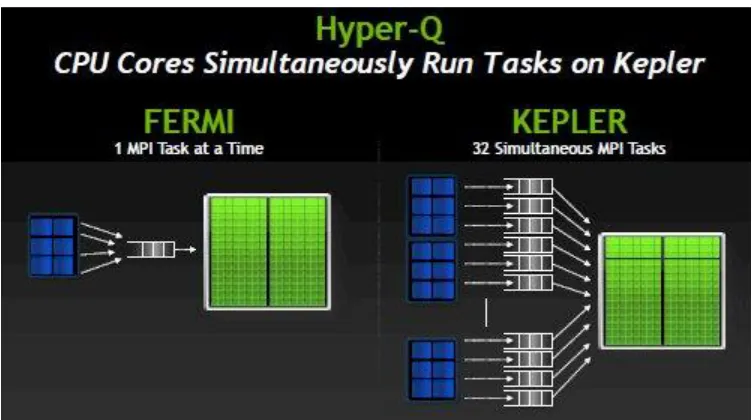
to exploit. The Kepler architecture introduced the concept of concurrent CUDA Streams3 [16].
These Streams represented independent execution sequences that the device consumed. Each
such “Stream” in the user’s program fed a separate work queue on the hardware. This technology
is termed “HyperQ” [16].
Figure 3.3: NVIDIA Hyper-Q introduces multiple work queues. Image Credits: www.nvidia.com.
This allowed programmers to express asynchronous data transfers and overlap execution
from multiple device kernels. One example of an efficient use-model of these Streams was to
manage multiple data buffers - one stream to run a copy operation of data from the CPU to the
GPU for processing, one stream to execute kernels that would process the data currently on the
3 While the concept of streams was also present in the Fermi architecture, they were mapped to a single hardware
GPU, and yet another stream to run another copy operation to siphon processed data back to the
CPU for post-processing. Such schemes are quite effective in achieving high levels of
performance and are only possible because of Streams.
The key takeaway here is that Streams allow for task level concurrency in GPUs. There
have been many proposals of runtime systems that leverage this feature to provide the ability to
run multiple kernels (presumably from different users/processes) on the GPU concurrently. In
the following pages, we shall briefly elaborate on two such systems - the Many Core Runtime
from the NPS Lab [17] and the Multi-Process Service developed by NVIDIA [18].
The Many Core Runtime
The Many Core Runtime (“MCR”) system proposed by Dr. Becchi et. al [17] is a robust
stream-based runtime system. Apart from virtualizing the GPU by allowing multiple processes to
share the GPU by leveraging CUDA Streams, the runtime supports the following novel features:
1. Dynamic binding between an application and device: This allows the runtime to
spread the execution of kernels from the same program across multiple GPUs - thus
achieving near-ideal device utilization.
2. A smart memory management system that allows kernels with memory footprints that
might exceed the device capacity to run seamlessly. The runtime performs the
necessary data swapping needed to achieve this in the background. This is noteworthy
because it was proposed and implemented successfully at a time when the CUDA
platform did not support Unified Virtual Memory with all its features as it currently
3. In addition to these, this runtime was also built to support load balancing in case of
GPU addition and removal as well as provide some level of resilience to GPU failures.
Since its initial version, this system has seen improvements [19] in terms of optimizing
programs’ inbuilt synchronizations and thus improving overall device utilization. However, this
system suffers from the lack of memory protection and does not carry any mechanism to regulate
the execution of multiple kernels such that each of them get a fair share of execution and
performance.
The NVIDIA Multi Process Service Runtime
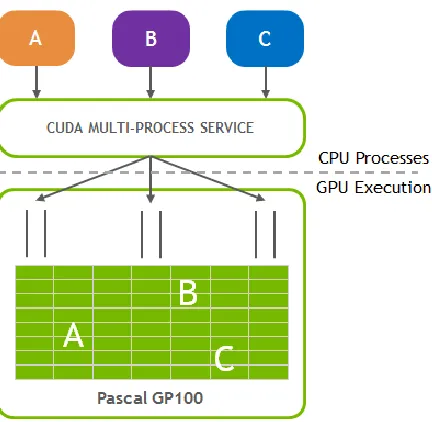
The Multi Process Service Runtime (“MPS”) developed and maintained by NVIDIA [18]
is also a stream-based node-level runtime. It is a Linux-only system that is available on Kepler
and newer GPUs. While this runtime system was developed to allow MPI processes to
seamlessly use the same GPU device - it serves the purpose of running concurrent kernels
irrespective of whether they are part of an MPI process or not.
Figure 3.5: NVIDIA Multi Process Service. Image Credits belong to NVIDIA Corporation
The current documentation for MPS states that it is only intended as a runtime for
cooperative processes effectively acting as a single application, such as multiple ranks of the
same MPI job. Considering this limited scope of deployment, it carries only basic mechanisms to
enforce some performance guarantee and memory protection.
For ensuring that one job does not dominate the rest in terms of performance, the MPS
runtime allows the user (administrator) to set the maximum number of threads that an MPS
threads, it would most certainly dominate execution and prevent other kernels from even
launching on the device due to insufficient resources being available to them. The system
however does not enforce any real-time checks, or execution-based mechanisms or policies to
ensure the relative performance of running jobs.
On the memory protection front, the MPS runtime for Volta and beyond claims to
maintain fully isolated virtual address spaces for concurrently running jobs. This claim has not
been investigated in this work since our experimental focus is on the Pascal architecture. For
pre-Volta architectures (Pascal, Maxwell, Kepler) the runtime has no mechanism to raise errors for
“out-of-bounds” memory accesses by potentially malicious kernels. Accesses made with an
intent to corrupt or read the working memory of other kernels running on the device can proceed
undetected. Though it is unable to restrict rogue pointer access, it does prevent explicit
corruptions attempts made via cudaMemcpy() calls to access/modify the working memory of
another job which was also setup via a set of one or more prior cudaMalloc() and/or
cudaMemcpy() calls. The experiments on memory performance detailed in Chapter 4 are also
carried out on the MPS runtime for completeness sake.
In this work, we create a ‘proof-of-concept’ runtime system (referred to as POC Runtime
in the following pages) setup which is inspired by these two systems for our experiments. It
consists of a simple multi-threaded single process application that runs benchmarks within it.
Those applications are mapped onto separate concurrent streams, as in the MCR system.
CHAPTER 4 : Memory Protection Experiments
This chapter describes various experiments and microbenchmarks created to better
understand the extent to which the lack of memory protection can be exploited on the Pascal
architecture for programs running concurrently on independent CUDA streams on the same
device. The general approach followed was to come up with a possible “malicious” kernel for
various scenarios and see how it could attack/compromise a potential victim kernel’s execution.
There are two types of exploits that we attempted for memory protection – ‘Serial’, and
‘Parallel’ as described below:
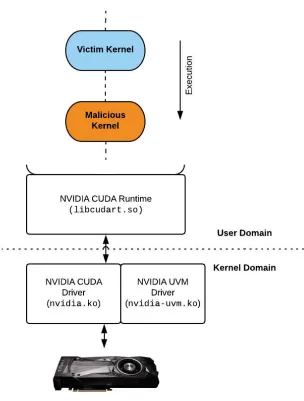
1. Serial : ‘Serial’ here implies that our malicious kernel was after the victim kernel
fully completed execution. The GPU was also reset between these two runs using the
nvidia-smi tool. The figure below shows the execution sequence:
The intent of the malicious kernel here is to attempt to read/recover the
data “left over” by the previous kernel by performing what is essentially a memory
dump of the GPU’s memory. This attack was also repeated with the victim and the
malicious kernel running in different contexts (as different CPU processes).
2. Parallel: In this case, our victim kernel ran concurrently with the malicious kernel.
The malicious kernel aims to corrupt the working set of the victim in real-time as it is
executing. Just like the “Serial” attempt, this too was repeated for the case of different
contexts.
The figure below shows the sequence of execution on the device:
For both these cases, we chose a simple vectorAdd (from the NVIDIA
CUDA SDK Sample suite) kernel as the victim kernel. While this might be too
simple a kernel compared to real world applications, it is adequate to demonstrate the
vulnerabilities we are interested in.
Also, the experiments were repeated for both cases – using Unified
Memory (using cudaMallocManaged()) and using traditional allocations
(cudaMalloc()) . Further, we attempted to accommodate the major classes of
GPU architecture based on developments in the Unified Memory feature-set –
pre-Pascal (Kepler in this case) and pre-Pascal. A Tesla K20c was used as a representative of
the pre-Pascal Kepler architecture and a TITAN Xp as a candidate from the Pascal
family.
Methodology
For the experiments involving in the same context, we simply compiled both the
malicious and victim kernels together into one application and minimally modified their launch
calls to run on separate streams. Neither used the default Stream, Stream 0. This was done to
maintain the experimental condition of a single context that would exist in a full-fledged runtime
system like the Many Core Runtime. Where needed, we introduced minimal modifications to
convert the vectorAdd program to use Unified Memory. Allocations were always free’d once
they were no longer needed using the cudaFree() call.
For the case involving running in separate contexts, we compiled these applications
separately and launched both depending on the type (serial/parallel) of exploit. The parallel case
concurrently, no additional synchronization conditions were imposed to keep the conditions as
realistic as possible.
There is no quantitative metric we tracked for these protection tests, but only whether the
malicious kernel was able to recover the data (even if partially) of the victim kernel, and whether
the malicious kernel was able to corrupt the execution of the victim.
Hardware and Software setup
The experiments described above were run on a node with two NVIDIA GeForce Titan
Xp GPUs for when the Pascal architecture was evaluated. Only one GPU was utilized for our
runs. Each Titan Xp GPU was equipped with 3840 CUDA cores clocked at 1.6GHz with a total
memory bandwidth of 547.7Gbps to 12GB of GDDR5X on-board memory. For experiments
involving pre-Pascal GPUs, we used a Tesla K20c. The K20c is equipped with 2496 CUDA
cores clocked at 706Mhz with a total memory bandwidth of 208Gbps. Frequency boost was
disabled for these experiments. ECC was also kept off for most of the runs. The compute node
also had two 6 core Intel® Xeon® E5-2630 CPUs with each core clocked at 2.2GHz. The CPU
memory capacity was 125GB. The CUDA SDK version used was v9.1.85 and the GPU kernel
Results
This sub-section is organized based on the type of exploit attempted (serial or parallel)
and the number of contexts involved (same or multiple):
1. Serial:
a. Same Context, Different Streams: Running a malicious program within the
same context after the victim kernel completed allowed us to completely read
the memory contents as they were left by the previous kernel when it exited if
the malicious kernel requested exactly the same sized memory allocations and
did not use Unified Memory. The use of unified memory irrespective of the
architecture generation (Kepler/Pascal) did not have the same outcome – we
were unable to recover the victim kernel’s data. This seems to indicate that
the traditional memory allocator does not employ any sort of address layout
randomization, but the Unified Memory allocator does. Digging into the
source code of the NVIDIA UVM driver, we observed that the CPU side page
allocations were made using the Linux kernel’s alloc_pages() API –
which does randomize address layout. We were unable to deduce from the
GPU side allocation functions’ code whether there was intentional
randomization, but the results certainly seem to indicate there is. We also
observed that the GPU reset via the nvidia-smi tool did not have any
effect on the memory contents, with all other GPU settings remaining
unchanged between the victim’s run and the subsequent malicious run. Also,
performing cudaFree() does not seem to affect the memory contents
b. Different contexts: Here also, we were able to exactly recover the memory
contents of the victim kernel as long as the malicious kernel requested exactly
the same memory sizes as the victim and did not use Unified Memory. The
same physical pages were assigned (owing to the lack of address layout
randomization) and simply reading those pages allowed us to recover the data.
c. Another accidental observation made was the initialization of the ECC (Error
Correcting Code) functionality for the GPU memory (either done when the
feature is turned on, or on what is presumably driver/runtime4 initialization if
the feature is already on.) effectively triggered a zero-ing out of the GPU
memory to bring the GPU’s memory error tracking logic to a known state.
Thus, if ECC is toggled between runs, the data is rendered unrecoverable
between runs. Support for memory ECC exists primarily on the datacenter
class Tesla product line only, so this was discovered when the same tests were
run on a Tesla K20c GPU via distinct CPU processes, serially. In most Tesla
GPUs, ECC protection is enabled by default. Thus, when the context was
re-created for the subsequent run, it triggered an ECC initialization that reset the
state of memory. It is worth pointing out that toggling ECC support requires
administrative privileges and access to the nvidia-smi tool.
4 We expect the ECC initialization to be in the driver’s domain rather than the runtime – and out of the program’s
2. Parallel:
a. Same context, different streams: In this case, the absence of dedicated address
space for each kernel allowed the malicious kernel to corrupt the working set
of the victim quite easily once the victim’s memory layout was known. The
malicious kernel could simply zero out the data structures maintained by the
victim. However, the knowledge of its layout before-hand is a weak
assumption (and a necessary pre-condition) and may not often occur in
practice. Knowing the memory pointers of the victim’s data structures is a
necessary pre-condition for such an exploit because arbitrary memory
accesses will be flagged as erroneous accesses by the device and will not
succeed – irrespective of the type of allocation made (Unified or traditional).
Such illegal memory accesses would abort execution of the malicious kernel
at the very least and sometimes abort all execution on the device in some
cases. That in itself could be viewed as a primitive denial of service attack, but
it orthogonal to the current scope of our current experiment - To corrupt the
running memory of a victim kernel.
b. Different contexts: In this case, the presence of separate virtual address spaces
completely isolated the victim kernel from the malicious kernel’s attempts to
influence its execution by memory corruption. In this case, memory protection
indeed exists and works as intended irrespective of the type of allocation used.
However, the presence of multiple contexts incurs the penalty of
context-switching as described earlier in Chapter 3. It should also be interesting to
non-Unified Memory allocation by one kernel could cause the other kernel’s
similar non-Unified allocation to fail due to inadequate free memory on the
device. Allocating these as Unified Memory allocations does however work
around this possible issue – another reason to use Unified Memory. This again
could be the premise of a simple Denial-Of-Service attack on a concurrent
runtime system for applications using the traditional cudaMalloc(), but it
is an exploit that the runtime system can be easily enhanced to prevent as
discussed in the section on the performance experiments in pages ahead.
Conclusion
Thus, our tests on memory protection reveal a drawback of the current traditional
memory allocator - specifically the lack of address space randomization. Further, we learn that
the runtime does not attempt to clean up the memory after execution is complete and this is
revealed by the lack of address randomization in the non-Unified Memory case. We also noted
that Unified Memory is superior to the traditional allocator since we were never able to recover
data at all when Unified memory was used, irrespective of the architecture involved. The only
time that memory is physically cleared is when ECC is first turned on.
Thus, we can conclude that though a potential vulnerability exists, exploiting it in
practice needs more work since a raw dump might not readily reveal clues about the organization
CHAPTER 5: Memory Performance experiments
Our approach to formulate possible exploits aimed at affecting a victim kernel’s
performance is divided into two sub-categories as listed below.
1. Compute/resource based
2. Memory based
Let us look at both these categories:
1. Compute/resource based: The negative side-effect that a malicious kernel could have
in terms of resources would be to occupy the lion’s share – simply with the intent of
keeping them unavailable for the victim kernels to use. If the resource requirements
for the victim kernel are not met simultaneously, it will not be launched at all. Till the
requirements are not met (which could be never – depending on how unrelenting the
malicious kernel might be), the victim kernel is kept shelved in the work queue thus
completely ruining its turnaround time. These resources that the malicious kernel
could claim-and-hold could be a large fraction of shared memory and/or registers,
and/or number of threads.
This form of influence on the victim kernel is easily understood. It may
also be controlled easily from a runtime point of view. Both the malicious kernel and
the victim kernel must go via the runtime to launch their kernels, setup their data
structures etc. The runtime system could then set and enforce limits on the resources
that could be allocated to any single kernel to prevent this exact scenario of a
malicious kernel grabbing all or enough available resources. The Driver API exposes
function calls to query the register and shared memory usage of a GPU kernel -
and enforce certain limits on kernels. This also includes limiting the launch grid
parameters (number of thread blocks and number of threads per block) which the
runtime could enforce per-kernel or per-stream limits on. The NVIDIA MPS runtime
does claim it implements such a configurable limit on the number of threads a kernel
could execute [18]. We have not implemented any such measure in the MCR runtime
in this work but recognize it as a future enhancement that can be implemented using
the function suggested above.
2. Memory based: Our scope of investigation for this category is quite specific. The
introduction of demand paging in the Pascal architecture, or more specifically the
ability of the GPU to raise page faults opens the door to a memory page fault based
exploit that might be able to severely degrade the performance of the victim kernel.
We ran experiments where we created conditions to generate increasing numbers of
page faults on the device, thus adversely affecting the victim kernel’s performance as
it executes concurrently with the malicious kernel.
The basic idea behind this malicious kernel is to force the victim kernel’s
execution to slow down by creating a situation in which it (victim) is forced to raise
page faults at almost every memory access it makes. Each time-consuming page fault
would have the SM’s execution pipeline stall till the fault is serviced, thus slowing
down the overall execution of the victim kernel.
The way our malicious kernel achieves the above described effect is by doing large,
oversubscribed allocation(s) and keeping all of the pages from those allocations alive. Once
launched, the malicious kernel would touch each page in this oversubscribed allocation(s) over
alive in the GPU’s TLB, page tables and physical memory. Since the allocation is larger than the
physical memory capacity of the devices, the virtual memory system would be completely
saturated because of these accesses by the malicious kernel. A simple for-loop with page access
(read/write) achieves this. For our hardware setup, the memory capacity of the GPU was 12GB.
Thus, we are talking about an allocation that totals up to more than 12GB.
To bring in (and keep) the malicious kernel’s pages on the GPU in response to its
accesses, the UVM driver would be forced to evict pages from the victim kernel’s working set -
thus forcing the victim kernel to incur a page fault when the victim kernel accesses the
now-evicted pages later in the future. It could also be possible that the UVM driver chooses to evict
some pages from the malicious kernel’s working set. However, this does not affect the outcome
of this exploit due to the repetitive nature of the accesses that we plan to have the malicious
kernel do.
Another important key point to note here is that - The GPU page size is not fixed. It is not
always the case that the GPU chooses a page size identical to the CPU. So, it is also not the case
that the transfer of the contents of a page in response to a page fault is exactly the CPU page size.
The NVIDIA UVM kernel driver appears to employ some heuristics to choose an appropriate
page size. Existing literature for the Pascal architecture [24] states the page size is at least the OS
page size but could be larger too. It is possible that this sizing is architecture dependent, but we
Methodology
The hardware/software setup is like the memory protection experiments, with the main
distinction being that we ran all the memory performance experiments on the TITAN Xp only
since we are interested in the demand paging aspect of the Pascal architecture.
Unlike the memory protection experiments, we are interested in quantitative data in this
case, specifically the wall clock time to complete execution. An initial set of experiments was
run with vectorAdd as the victim kernel, whose footprint was kept at 3GB. Keeping the kernel
simple and well understood for the initial set of experiments was key, since it helped us fine tune
the scenario and eliminate secondary effects from contributing to the results. Further, profiling a
simple kernel like vectorAdd is much easier and allows us a clear picture of the execution flow –
unlike, say a benchmark application that might have multiple kernels, streams, overlapping
copies and code that might be creating secondary effects which might unnecessarily influence
the results of our initial experiments.
From these initial experiments, we deduced an ‘optimal’ configuration of the malicious
kernel. Here, the ‘optimal’ configuration was one that could slow the victim to a glacial pace by
creating a near Denial-Of-Service situation for our simple victim. Once this ‘optimal’ formula
for the malicious kernel was isolated, we repeated these experiments with real world benchmarks
from the LoneStarGPU suite [22] running them via our ‘proof-of-concept’ runtime (POC
Runtime) to see if we got similar results.
Before we could run the applications from the LoneStarGPU suite concurrently with our
malicious kernel, the applications needed updates to use Unified Memory instead of the
by A. Vastrad et. al under the guidance of Dr. Zhou was leveraged with some minor
modifications5 [23]
To carefully isolate the cause of any changes in the measured wall clock time for these
applications, we established multiple baselines. First, we obtained the wall clock times when the
benchmarks were run standalone – as regular applications with the default NVIDIA runtime.
Then, we measured the wall clock time for the applications when run inside the POC Runtime
system as well as the NVIDIA MPS runtime system (to get a comparative idea of the overhead
involved when running these applications within a non-default runtime system) without any
concurrent kernel co-executing with them. We then attempted to get an approximate measure of
the slowdown observed when an application is co-run with another, non malicious application.
We chose the bfs benchmark in the suite as the concurrent execution companion to the rest of the
suite. This way, we can be absolutely sure that the subsequent results are only because of the
malicious kernel and can verify that the execution scenarios playing out are exactly in line with
our experimental intent here. Finally, we obtained the baseline wall clock time for the
applications in the benchmark suite when they were co-run with two representative
configurations of the malicious kernel’s allocation pattern – one below device memory capacity
(in our case, less than 12GB so that no oversubscription occurs) and one above (oversubscription
occurs) to see the effects of our worst malicious kernel with real world applications in a
concurrent execution scenario.
5 The initial ported code carried some extraneous cudaDeviceSynchronize() calls in some benchmarks that were
Each benchmark in the LoneStarGPU suite has multiple flavors because of different input
datasets and options. The table below shows the input configurations and kernel dimensions
used:
Table 5.1: Description of the LoneStarGPU benchmark applications used
Name Description Inputs Largest Kernel
Dimensions
bh Barnes-Hut Force
calculation algorithm
Number of bodies 3000000,
TimeSteps 2
Grid:60x1x1
Block:1024x1x1
bfs Breadth first search using a
modified Bellman Ford
algorithm
USA Florida Road Network
Graph (~1M nodes, ~2.7M
edges)
Grid: 104x1x1
Block:1024x1x1
dmr Delunay Mesh Refinement Synthetic mesh with 5M
nodes
Grid: 420x1x1
Block:64x1x1
pta Points-To analysis of
memory pointers
represented as a graph
‘Pine’ benchmark graph
with 6M nodes and 4M
edges
Grid: 90x1x1
Block:32x16x1
mst Minimum spanning tree
using Boruvka’s algorithm
USA Florida Road Network
Graph (~1M nodes, ~2.7M
edges)
Grid: 1046x1x1
Results
The results from our initial experiments are as graphed below: The malicious kernel’s
continuous memory allocation pattern is varied from 3GB to 12GB. It is concurrently executed
with the vectorAdd kernel in a separate but independent stream as described earlier. The launch
parameters were kept such that both, the victim as well as the malicious kernels could be
accommodated concurrently on the GPU. Both kernels were granted an equal number of thread
blocks (15 each, out of the 30 total on the NVIDIA TITAN Xp card) to ensure that they ran
concurrently. Their concurrent execution was then confirmed using the NVIDIA Visual Profiler
as well.
Figure 5.1: Graph showing the slowdown of the victim kernel under the effect of the first version of the malicious kernel.
We see a clear correlation between the allocation size and the slowdown in the vectorAdd
kernel’s execution time. This is inline with our expectations since larger allocations by the
malicious kernel imply a proportionally larger share of the GPU’s virtual memory system would 0.0 50.0 100.0 150.0 200.0 250.0 300.0 350.0
3GB 6GB 9GB 12GB
Vc tim k e rn e l sl o wd o wn p ro p ro tion
Size of the malicious kernel footprint
be hogged by the malicious kernel. As allocation sizes increase and the malicious kernel nearly
saturates the virtual memory system, the victim kernel faces greater difficulty in executing
without experiencing numerous page faults – slowing it down significantly.
Tweaking the malicious kernel [Appendix A], we observed that increasing the trip count
of the for loop used to touch pages within the allocation helped prolong the effects of the
malicious kernel’s dominance on the GPU’s memory system. To improve the malicious kernel
further, we reasoned that we needed to create a scenario where even greater numbers of page
faults were seen. One way we could increase the number of page faults for the same number of
accesses (unchanged allocation size and access loop trip count) would be to decrease the page
size. Unfortunately, the page size is not something the user can control. The page size is decided
by internal heuristics in the NVIDIA UVM kernel driver. However, we did observe that smaller
allocations (of the order of KBs) hinted the internal heuristics in the driver to pick the smaller
options among its possible choices for the GPU page size. Similarly, larger allocations (of the
order of GBs) could nudge the UVM driver into picking larger sized pages to store these larger
allocations. Thus, to trick the UVM driver into using small pages, we fragmented the malicious
kernel’s allocation while keeping the overall footprint large enough to achieve oversubscription.
Rather than one large allocation, we decided to allocate multiple smaller arrays, the combined
memory footprint of which would be larger than the device’s memory capacity – thus
maintaining oversubscription. The malicious kernel with these updates slowed down execution
of the victim kernel to the extent it gave the user the illusion6 that the victim was hung – a
6 We use the word ‘illusion’ to be conservative. No visible error (dmesg, strace, STDOUT) is seen, and execution
Denial-Of-Service situation. The results of the malicious kernel with fragmented allocations but
a shorter trip count are shown below:
Figure 5.2: Bar chart showing the severity of the victim slowdown as malicious kernel fragment size is varied.
the NVIDIA MPS Runtime system’s and can’t seem to recover. Apart from the fact that no execution seems to proceed after his error, not much else is known. No such error is seen when the malicious kernel or any of the victims are run standalone with MPS or POC runtimes.
0.0
20.0
40.0
60.0
80.0
100.0
120.0
140.0
256KB 512KB
1MB
2MB
4MB
16MB
64MB
Vic
tim
K
ern
el
Sl
owd
ow
n
Size of memory allocations performed by malicious kernel
The chart below shows the proportion of time spent servicing page faults during the
execution relative to the case when the victim ran alone, without a malicious kernel.
Figure 5.3: Bar chart showing the proportion of time spent servicing page faults across allocation sizes.
Thus, a greatly oversubscribed allocation (18GB) with a high trip count loop (50) keeping
all pages in that oversubscribed allocation consistently brought the victim’s execution to a
standstill. We chose this configuration as our ‘optimal’ malicious kernel configuration for the
remainder of our experiments.
1 2 4 8 16 32 64 128 256 512 1024
256KB 512KB 1MB 2MB 4MB 16MB 64MB
Incr
e
as
e
in
ti
me
sp
e
n
t
in
pa
ge
f
au
lts
Size of memory allocations performed by malicious kernel
malicious mem. footprint = 3GBmalicious mem. footprint = 6GB
malicious mem. footprint = 9GB
The results from the first 3 runs (standalone, running alone in our proof-of-concept
runtime, running alone in MPS) with the LoneStarGPU suite running solo (without any
concurrent kernel companions) are shown below in Figure 5.4.
Figure 5.4: Bar chart showing the relative execution speed when LoneStarGPU is run within the proof-of-concept system and MPS Runtime Systems.
The vertical axis in Figure 5.4 above is the proportion of wall clock time consumed while
running within the runtime systems relative to running standalone (no runtime used). From the
bar chart above, we observe that the runtime systems we are using here are efficient enough for
these applications since they do not contribute significantly to the overall wall clock time in
relation to the magnitude of slowdown our malicious kernel does. 0
0.5 1 1.5 2
bh bfs dmr pta mst
Vic tim kern el w allclock time p ro p o rtio n
Victim kernel name
LoneStar solo execution witin proof-of-concept
runtime, MPS
The chart below shows the relative slowdown of the benchmarks when co-run with a
non-malicious kernel, bfs on the proof-of-concept runtime system.
Figure 5.5: Bar chart showing the relative performance of the LoneStarGPU suite when co-run with an application (bfs) from the same suite in the POC system.
These results demonstrate that these kernels are good candidates for concurrent execution
and our experiment, since none of them sees a major slowdown. This implies that their resource
requirements can be accommodated easily even in the presence of a similar kernel. Thus, we can
safely conclude that any additional slowdown we observe will be because of our malicious
kernel, and not because of any secondary effects simply because we are concurrently executing
them with another kernel.
As mentioned in the preceding section, we chose two representative configurations of the
malicious kernel, a 6GB footprint spread across multiple arrays of 256KB each, and an 18GB
footprint spread across multiple 1 MB arrays. With the latter configuration, we were able to
achieve a complete DoS scenario. The smaller, non-oversubscribed configuration of the 0 0.5 1 1.5 2 2.5
bh bfs dmr pta mst
Vic tim kern el w allclock time p ro p o rtio n
Victim kernel name
malicious kernel was not able significantlyslowdown the benchmarks. This is expected since
there was no oversubscription and hence very little possibility of the malicious kernel forcing
evictions of the victim’s pages. Further, the slowdown is not as acute as with our simple
vectorAdd kernel, because these programs involve much more computation than a simple
addition that is in vectorAdd – making them less sensitive to memory performance. Each
application of the LoneStarGPU suite has multiple kernels in each of these benchmarks and a
CPU portion of the program also consumes time. That CPU portion is not directly affected by the
slowdown on the GPU.
Figure 5.6: Chart showing the effects of a milder version of the malicious kernel on the LoneStarGPU suite as run in the POC system.
Motivation for an improved allocator
Armed with this data and our understanding of the Unified Memory System we set
ourselves to the task of enhancing the existing Many Core Runtime to limit or prevent such a
malicious kernel from affecting performance in this way. We noticed the most drastic result in 0 1 2 3 4 5 6 7
bh bfs dmr pta mst
Vic tim kern el slowdo w n p ro p o rtio n
Victim kernel name
![Figure 3.4: Many Core Runtime from the NPS Lab. Image Credits to the original authors of [17]](https://thumb-us.123doks.com/thumbv2/123dok_us/1221391.1153848/32.612.112.504.291.539/figure-core-runtime-nps-image-credits-original-authors.webp)