PLEASE SCROLL DOWN FOR ARTICLE
On: 30 March 2010
Access details: Access Details: [subscription number 919616456]
Publisher Taylor & Francis
Informa Ltd Registered in England and Wales Registered Number: 1072954 Registered office: Mortimer House,
37-41 Mortimer Street, London W1T 3JH, UK
Molecular Physics
Publication details, including instructions for authors and subscription information: http://www.informaworld.com/smpp/title~content=t713395160
Charged hard spheres in a uniform neutralizing background using 'mixed'
integral equations
F. Lado a
a Department of Physics, North Carolina State University, Raleigh, N.C.
To cite this Article Lado, F.(1976) 'Charged hard spheres in a uniform neutralizing background using 'mixed' integral
equations', Molecular Physics, 31: 4, 1117 — 1127
To link to this Article: DOI: 10.1080/00268977600100851
URL: http://dx.doi.org/10.1080/00268977600100851
Full terms and conditions of use: http://www.informaworld.com/terms-and-conditions-of-access.pdf
This article may be used for research, teaching and private study purposes. Any substantial or systematic reproduction, re-distribution, re-selling, loan or sub-licensing, systematic supply or distribution in any form to anyone is expressly forbidden.
MOLECULAR
PHYSICS,
1976, VOL. 31, No. 4, 1117-1127C h a r g e d h a r d s p h e r e s i n a u n i f o r m n e u t r a l i z i n g
b a c k g r o u n d u s i n g ' m i x e d ' i n t e g r a l e q u a t i o n s
by F. LADO
Department of Physics, North Carolina State University, Raleigh, N.C. 27607
(Received 29 September 1975)
The structure and thermodynamic properties of a collection of charged hard spheres immersed in a uniform neutralizing background are studied using ' mixed ' integral equations, wherein the Percus-Yevick approximation is used with the hard-sphere part of the potential and the hypernetted-chain approximation for the correction due to the Coulomb tail. Numerical solu- tions are presented along a particular isotherm and a comparison is made with the results of the Mean Spherical Model for the same system.
1. INTRODUCTION
The non-linear integral equation approach to fluid state theory has become, with the help of the computer, a practical and often highly successful one. While there is no known integral equation for the pair distribution function
g(r) which is suitable under all circumstances, there are today a number of
approximate equations, each of which may be well matched with a particular type of intermolecular potential and conditions of temperature and density. Thus, for example, the extreme cases of a hard-core potential and a Coulomb potential can be reasonably well studied using respectively the Percus-Yevick [1] (PY) and hypernetted-chain [2] (HNC) integral equations [3, 4]. Neither of these equations, however, would be entirely suitable for these two potentials in combination, i.e. for charged hard spheres. For such a case, one might seek to construct another approximate equation better adapted to this potential [5]. But, as shown in recent publications [6, 7], the inverse procedure is also possible. One may instead adapt rather the potential itself to suit the strong points of known equations. Thus, for the case mentioned, the PY approximation could be used to study the effect of the hard core and the H N C approximation for the influence of the Coulomb potential. The results of such a ' mixed ' approach are presented in this paper.
We consider a system of N hard spheres of diameter d, each carrying a charge Q, embedded in a uniform neutralizing background which for simplicity is allowed to permeate the spheres [8]. For a given configuration of the ions in the volume V the potential energy of the system is
9
1 N
Q2
U(rX) = X r I d r - - , (1)
~ < j I"
where p - N~ V and
r r < d , }
=Q2/r, r > d . (2)
4n M.P,
T h e pair distribution function ( P D F ) for the potential (2) is then obtained in two stages. First we find the P D F
go(r)
for just the hard-core potential~bo(r)=~
r>dr<d}
(3)using the PY equation (or actually any other suitable method). T h e complete P D F is then written
g(r) = go(r) + AG(r),
(4)where AG, the correction due to the long-range Coulomb potential, is the solution of the equations [6]
AC(r) = AG(r)-
In [g(r) exp[fld?l(r)]/go(r)],
(5 a)A~(k) = 1 [1 +
pGo(k)]ZAC(k)
(5 b) - p[l +pOo(k)]A~(k)'
which constitute the analogue of the H N C approximation when applied to just the correction AG rather than to the complete pair distribution function. (Were the ideal gas, with go = 1, used as the reference system in these equations, they would reduce to the usual H N C equations.) In equation (5 a), ~bl(r ) is the C o u l o m b potential for separations greater than the hard-sphere diameter and is undefined for smaller separations. Furthermore, we have put
Go(r ) =go(r)-1
in these expressions and have used a tilde to denote a Fourier t r a n s f o r m ; as usual, /3 = (k BT) -1.
Equations (5) are to be solved iteratively. As with the H N C equation itself, it is preferable to obtain the unknown
AG(r)
in the formH(r)
= flq~l(r) + In[g(r)/go(r)],
(6)for which equations (5) become
AC(r)
= go(r){exp [H(r) - fl4h(")] - 1 } -H(r),
(7 a)[1 +
pOo(k)]2AC(k)
A~(k).
(7 b) /t(k) = 1 - p[1 +pOo(k)]A~(k) -
T h e P D F is then finally obtained as
g(r) = go(r)
exp [H(r) - fi~x(r)]. (8)It is worth noting here that equations (7), when viewed as a perturbation scheme to incorporate the effects of a
weak
potential q~l(r) on the pair distribution function, may be approximately solved in a simple fashion. If ~l(r) possesses a Fourier transform, we may begin the iterations by assumingg(~
)
or equivalentlyH(~
; here the superscript labels the iteration. T h e n equations (7) giveAC(~
= -- ~(DI(Y ) (9 a)[--l + PO~
+ ~q~,(k),
(9 b)/~(1)(r) = - 1 + p[1 +
p~o(k)]~q~x(k)
Charged hard-sphere liquids
1119so that from (8) the corrected P D F after one iteration is
where:
g(1)(r) =
go(r)
exp [ - h ( r ) ] ,(10)
[1 +
pOo(k)]2fiq~l(k)
(11) /~(k) = 1 + p[1 +pGo(k)]fi~l(k)"
Equations (10) and (11) constitute a simple, non-iterative approximation proposed earlier [9], as well as by Anderson and Chandler [10], who called it the exponential approximation.
In general, if the perturbing potential ~l(r) is not in some sense ' weak ', as will be the case here, equations (7) may be readily solved numerically by con- tinuing the iterations until self-consistency is reached. This is further discussed in w 2. For the specific potential at hand, once a solution
g(r)
is found we may compute the values of the internal energy E, the pressure p, and the Helmholtz free energy A from [6]E :~ _ 1 - - , (12)
NhT .e-~P l dr[g(r)-
1]fiQ"
I"
pv
N k T - 1 = ~rrpdag(d) + ~,p I dr[g(r) -
1] fiQ2, (13)r
A
A o
{
NhT NhT ~pI dr 1AC;(r)2+AG(r)
In Lg0(r)JF
g(r)
]
fl
O 2}_
g(r)
- [ g ( r ) - l ] r1 pAG(k) _ l n 1 + . (14) +2p(Z~r)--- ~ j d k 1
+pGo(k)
1 +pGo(k)_J3
Here, A 0 is the excess free energy due to the hard-sphere potential alone, for which we will take the PY result [11]. T h e appearance of
g(r)-
1 rather thang(r)
alone when multiplyingfiQ2/r
in these expressions is a consequence of the uniform background which neutralizes the system.Before terminating this section, we note that, in addition to equations (5), other approximate methods for incorporating the effects of a perturbing potential ~,(r) on a reference system with potential ~0(r) are easily obtained. Actually, equation (5 b) is exact and follows from the Ornstein-Zernike equations for the reference and perturbed systems [6]. T h e approximation is in equation (5 a), the exact version of which reads [6]
A t ( r ) = AGO" ) - g o ( " ) exp [/3r ) exp
[fiq~,(r)]/go(r)-
1]+ a P ( r ) + AB(r), (15)
where
AP(r) = go(r) exp
[fiq~o(r)][g(r)
exp[fiOl(r)]/go(r)-
1]--In [g(r) exp [ ~ l ( r ) ] / g o ( r ) ] . (16)
4D2
Neglect of
AB,
analogous to the H N C approximation, leads to equation (5 a). Alternatively, one could obtain a PY-type approximation [9] by assumingAB(r) ~ - AP(r). (17)
Both of these approximations are included in the more general expression
AB(r) ~
mAP(r),
(18)where furthermore the parameter m could now be chosen to satisfy some imposed constraint, such as consistency between the pressures obtained from the virial and compressibility equations [12]. Other approximations are of course possible; the appropriateness of any particular one will evidently depend on the nature of the perturbing potential el(r). In the remainder of this paper we shall study only the H N C - t y p e approximation, equations (5), which seems well suited for the Coulomb potential [4]. It has in addition the advantage of permitting the direct evaluation of the free energy, equation (14).
2. NUMERICAL SOLUTIONS
For very large separations the functions
H(r)
and AC(r) have the asymptotic formsH(r)"~fl~l(r)'
I
(19)AC(r) ~ - f l r
Since here r is the slowly vanishing Coulomb potential, serious truncation errors can arise when these functions are numerically integrated over a finite range. This troublesome feature of the Coulomb potential has motivated alternative versions of the PY and H N C equations based on infinite re-summa- tions of their diagram expansions, which have the final effect of replacing the Coulomb potential with a shielded Coulomb potential [13, 14]. However, since the difficulty is merely numerical, rather than one of principle, it can be circumvented by appropriate numerical techniques. Here we follow the method of Springer
et al.
[4] in subtracting out the known long-range behaviour of H and AC, working instead with the short-range functionsHs(r )
= H(r) -
HL(r ), }(20) (
ACs(r ) = A C ( r ) +
HL(r), j
where
HL(r ) = [1 -- exp ( --
~r)]flQ2/r
(21)and ~ is a disposable parameter chosen so as to make the function es(r), defined below, negligibly small at the termination of the finite range of r. The version of equations (7) that is actually solved numerically, namely
ACs(r ) = g0(r){exp [ns(r ) - es(r)] - 1} - Hs(r ), (22 a)
f i tk~-
[1 +pGo(k)]2[A~s(k)-/~L(k)] _ ACs(k) ' (22 b)s~ , - 1 - p[1 +
pOo(k)][AOs(k) -/~L(k)]
Charged hard-sphere fiquids
1121w h e r e
~bs(r ) - exp ( -
oLr)~Q2/r,
(23)/qL(k) = 4~r/3Q 2~2
k2(k 2 + ~2), (24)
n o w involves only s h o r t - r a n g e functions t h a t can be n u m e r i c a l l y h a n d l e d in the usual way.
T h e external p a r a m e t e r s of this calculation are the ion density p and the t e m p e r a t u r e T. I t is c o n v e n i e n t to use the ion s p h e r e radius a, where
~aZp = 1,
(25)as the unit of distance and the electrostatic energy at separation a as the unit of energy, with the usual p a r a m e t e r
r = ~p2/a
(26)2 . 0
g ( r )
1 . 0
I I I I I I
~ C h a r g e d H a r d S p h e r e s
- ~ - N e u t r a l H a r d S p h e r e s - - I t
C h a r g e d P o i n t s
-
/
-
- -
/ / (3 ,,.
1 . 0
I I I I I I
2 . 0 3 . 0 4 . 0
r i o
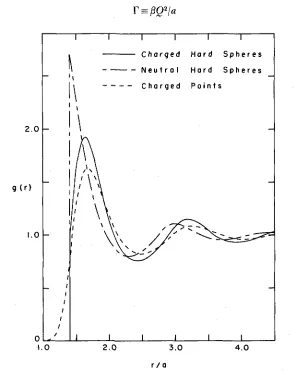
Figure 1. Pair distribution function for charged hard spheres at I ' = 7 0 with 1"0=50 (corresponding to a reduced hard sphere density of
pda=0"6551).
Also shown for comparison are the g's for neutral hard spheres at the same density and charged points at the same 1".incorporating both t e m p e r a t u r e and density specification. T h e other p a r a m e t e r which must be specified is now the reduced ion diameter
a - d / a . (27)
M o r e conveniently, solutions along a particular isotherm can be obtained by fixing
I ' , , - 5 Q 2 / d , (28)
so that a = 1'/I" 0 and 1" is the only input p a r a m e t e r remaining to be specified. Chihara [5] has applied a new integral equation to a similar model system, obtaining solutions for g(r) corresponding to the choices Q = e , the electronic charge, d = 3 . 4 •, and T = 5 0 0 ~ which lead to the value F o = 6 3 . 5 7 . In his solutions, however, a modified form of the C o u l o m b potential is used, so that direct comparisons cannot be made with the results below. For reasons of numerical convenience, we have chosen F o = 50, which, with the same values of Q and d as above, corresponds to a t e m p e r a t u r e of 709"8~
Equations (22) have been solved for the cases F = 2 . 5 , 5-0, 10(10)80 and, as
- 2 0
- 4 0
C ( r )
- 6 0
- 8 0
I I I 1 I J I
J
C h a r g e d
- ~ - N e u t r a l
C h a r g e d
9 _ # Q 2
r
H a r d S p h e r e s
H a r d S p h e r e s
P o i n t s
/ / / / 0
I I I I I I
o 0 . 5 I , O 1,5
r i o
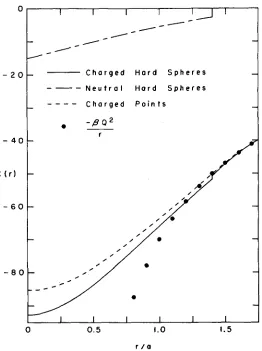
Figure 2. Direct correlation function for the same cases shown in figure 1.
Charged hard-sphere liquids
11232 . 0 I I
1 . 5
S ( k )
1.0
\
F i g u r c 3.
0 . 5 !
x/
I
I ~ C h a r g e d H a r d S p h e r e s
! I I
I - ~ - N e u t r a l H a r d S p h e r e s
C h a r g e d P o i n t s
k - - - " ,.,/
o ~ - . . ~
i i i i iO 4 8 1 2
k a
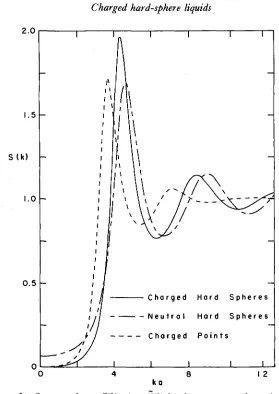
S t r u c t u r e f a c t o r S ( k ) = 1 + p G ( k ) f o r t h e s a m e cases s h o w n in f i g u r e 1.
E p V A - Aideal
F p d a - - - ~ - - - 1
N k T N k T N k T
2"5 0"00003 - 1"706 - 0 ' 5 6 8 5 - 1'391 5.0 0"0002 - 3 " 7 3 2 - 1-244 - 3 . 1 9 0 10 0 ' 0 0 1 9 - 7 ' 9 3 6 - 2'645 - 7 ' 0 6 0 20 0'0153 - 16'54 - 5.513 - 15'19 30 0 ' 0 5 1 6 - 25"24 - 8'415 - 2 3 ' 5 4 40 0 ' 1 2 2 2 - 34"00 - 11"33 - 3 2 ' 0 0 50 0 ' 2 3 8 7 - 4 2 " 7 9 - 14'26 - 4 0 ' 5 4 60 0 ' 4 1 2 5 - 5 1 " 6 8 - 17.11 - 4 9 ' 2 0 70 0'6551 - 6 0 ' 9 2 - 18'90 - 57"90 80 0 ' 9 7 7 8 - 7 0 ' 7 0 - 14"96 - 6 5 " 6 7
T a b l e 1. C o m p u t e d t h e r m o d y n a m i c p a r a m e t e r s of c h a r g e d h a r d s p h e r e s in a n e u t r a l i z i n g b a c k g r o u n d , u s i n g ' m i x e d ' P Y a n d H N C i n t e g r a l e q u a t i o n s , a l o n g a n i s o t h e r m d e f i n e d b y f l Q 2 / d = 5 0 . T h e s e c o n d c o l u m n s h o w s t h e c o r r e s p o n d i n g r e d u c e d h a r d - s p h e r e d e n s i t y .
n o t e d , P0 = 5 0 . T h e c h o i c e of i n t e r v a l for t h e d i s c r e t e n u m e r i c a l t r a n s f o r m s
[15] w a s in all cases Ar/a--0"025 a n d t h e r a n g e of i n t e g r a t i o n w e n t f r o m r/a = 7.5
f o r P - 2.5 to r / a - 2 2 . 5 for P = 80 ; i t e r a t i o n s w e r e s t a r t e d w i t h t h e i n i t i a l g u e s s
H s ( ~ = 0 a n d w e r e c o n t i n u e d u n t i l t h e l a r g e s t d i f f e r e n c e b e t w e e n s u c c e s s i v e
i t e r a t e s of rHs(r ) was s m a l l e r t h a n 10 4. I n all cases t h e P Y s o l u t i o n [11] was
u s e d f o r t h e h a r d s p h e r e go(r).
T h e c o m p u t e d v a l u e s of i n t e r n a l e n e r g y , p r e s s u r e , a n d free e n e r g y are s h o w n
in t a b l e 1]'. F o r t h e m o s t p a r t , t h e s e r e s u l t s are s c a r c e l y d i s t i n g u i s h a b l e f r o m
t h o s e of a p u r e C o u l o m b p o t e n t i a l [4, 16], a fact l a r g e l y e x p l a i n e d b y t h e l o w d e n s i t i e s of t h e h a r d s p h e r e s t h a t f o l l o w f r o m m o s t of t h e 12 v a l u e s , as s h o w n in
t a b l e 1. A t h i g h e r d e n s i t i e s , t h e q u a n t i t y m o s t s e n s i t i v e to t h e f i n i t e size of t h e
i o n s is t h e p r e s s u r e .
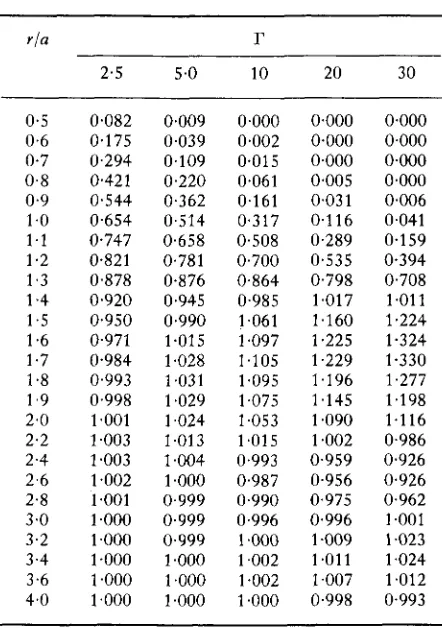
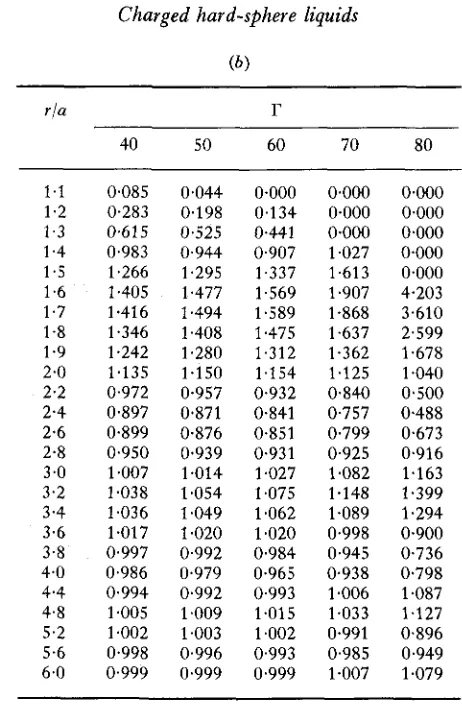
T h e p a i r d i s t r i b u t i o n f u n c t i o n s , t a b u l a t e d in t a b l e 2, s h o w m o r e v a r i a b i l i t y .
A t l o w 12 v a l u e s , t h e c o m p u t e d g(r) are, as e x p e c t e d , p r a c t i c a l l y t h e s a m e as
(a)
r/a I ~
2'5 5-0 10 20 30
0'5 0'082 0.009 0"000 0'000 0'000
0.6 0"175 0.039 0'002 0"000 0'000
0.7 0"294 0.109 0"015 0"000 0-000
0.8 0'421 0.220 0 " 0 6 1 0'005 0'000
0"9 0'544 0.362 0 " 1 6 1 0.031 0"006
1.0 0"654 0.514 0'317 0"116 0"041
1 "1 0"747 0.658 0-508 0.289 0"159
1 '2 0"821 0.781 0'700 0'535 0"394
1'3 0"878 0"876 0'864 0-798 0"708
1-4 0'920 0.945 0-985 1.017 1"011
1.5 0"950 0.990 !"061 1"160 1"224
1'6 0"971 1 " 0 1 5 1'097 1 " 2 2 5 1"324
1.7 0"984 1'028 1 " 1 0 5 1.229 1"330
1'8 0"993 1.031 1'095 1-196 1.277
1.9 0.998 1'029 1 " 0 7 5 1.145 1'198
2'0 1 '001 1.024 1 "053 1 '090 1"116
2'2 1"003 1-013 1'015 1'002 0-986
2'4 1'003 1'004 0.993 0.959 0'926
2.6 1"002 1"000 0.987 0-956 0'926
2.8 I '001 0.999 0.990 0.975 0'962
3'0 1"000 0.999 0.996 0'996 1-001
3 "2 1.000 0.999 1 "000 1-009 1.023
3.4 1"000 1.000 1.002 1 '011 1"024
3"6 1"000 1"000 1"002 l'007 1"012
4'0 1 "000 1.000 1 "000 0.998 0-993
t As noted by Springer et al. [4] computed thermodynamic values involving the Coulomb
potential are more stable with respect to variation in the range of the computed g(r) when
evaluated using Fourier transforms rather than direct space functions. Thus, the direct
space integrals in equations (12)-(14) were first converted to equivalent transform space integrals ; these were then numerically evaluated to obtain the values tabulated in table 1. Also, the excess free energy of hard spheres alone, which enters the total free energy in
table I, was calculated using the PY virial equation of state.
Charged hard-sphere liquids
1125(b)
r/a
F
40 50 60 70 80
1"1 0'085 0'044 0.000 0'000 0"000 1'2 0-283 0 " 1 9 8 0'134 0 " 0 0 0 0'000 1"3
0"615
0'525 0 . 4 4 1 0 " 0 0 0 0"000 1 '4 0'983 0.944 0"907 1 '027 0"000 1'5 1'266 1'295 1.337 1 " 6 1 3 0"000 1'6 1'405 1'477 1'569 1'907 4"203 1'7 1.416 1'494 1'589 1 " 8 6 8 3"610 1-8 1"346 1 " 4 0 8 1 " 4 7 5 1 - 6 3 7 2'599 1"9 1"242 1'280 1.312 1 " 3 6 2 1'678 2"0 1"135 1 " 1 5 0 1'154 1 " 1 2 5 1"040 2'2 0-972 0 " 9 5 7 0 " 9 3 2 0 " 8 4 0 0'500 2"4 0'897 0 " 8 7 1 0 " 8 4 1 0 " 7 5 7 0"488 2"6 0"899 0 " 8 7 6 0 " 8 5 1 0 " 7 9 9 0"673 2"8 0'950 0.939 0.931 0 " 9 2 5 0.916 3'0 1'007 1 " 0 1 4 1'027 1 " 0 8 2 1"163 3'2 1"038 1'054 1'075 1 " 1 4 8 1"399 3"4 1"036 1'049 1'062 1 " 0 8 9 1.294 3"6 1"017 1 " 0 2 0 1'020 0 " 9 9 8 0.900 3"8 0'997 0-992 0.984 0'945 0"736 4"0 0'986 0 " 9 7 9 0 " 9 6 5 0'938 0.798 4"4 0'994 0 " 9 9 2 0 " 9 9 3 1 " 0 0 6 1.087 4'8 1"005 1'009 1 " 0 1 5 1 " 0 3 3 1"127 5'2 1'002 1'003 1'002 0.991 0'896 5-6 0"998 0'996 0'993 0 " 9 8 5 0'949 6'0 0"999 0'999 0'999 1 " 0 0 7 1.079Table 2. Computed values of the pair distribution function of charged hard spheres in a neutralizing background, using ' mixed ' PY and H N C integral equations, along an isotherm defined by
fiO2/d
= 50.those of the p u r e C o u l o m b potential [4]. F o r F = 8 0 , however,
g(r)
for the c o m b i n e d potentials is close to the h a r d s p h e r e P D F , except in the vicinity of the m a i n peak where it is by c o m p a r i s o n d e p r e s s e d as a c o n s e q u e n c e of the additional repulsion.T h e case P = 7 0 , which results in a = 1.4 and p d 3 = 0 . 6 5 5 1 , leads to the
g(r)
which is m o s t distinct, a m o n g the solutions presented, f r o m b o t h the p u r e h a r d s p h e r e a n d p u r e C o u l o m b limits. T h i s function is s h o w n in figure 1, along with the c o r r e s p o n d i n g hard sphere and C o u l o m b solutions o b t a i n e d f r o m the PY and H N C equations, respectively. T h e r e is an evident overall increase in s t r u c t u r e in c o m p a r i s o n with the C o u l o m b c a s e ; c o m p a r e d to neutral h a r d spheres, the extra repulsion of the charged h a r d spheres results in a depression of the m a i n peak and a shift of the overall curve away f r o m the origin.T h e c o r r e s p o n d i n g shapes of the direct correlation f u n c t i o n
C(r)
for the s a m e solutions are s h o w n in figure 2. One sees that the difference b e t w e e nC(r)
for charged points and charged h a r d spheres is significant only within theh a r d - s p h e r e d i a m e t e r a = 1.4 and slightly b e y o n d , b o t h curves soon m e r g i n g into the limiting shape of
-flQ2/r.
T h e direct correlation f u n c t i o n for the c h a r g e d spheres is in addition d i s c o n t i n u o u s at the h a r d - s p h e r e diameter.1.2
g ( r )
0 . 8
0 . 4
0
5 0 . 0
I l l / / / / / / /
I I I I I I I I I
I f I
i I
\
\\ \
\ \
%
" M i x e d " I n t e g r a l E q u a t i o n s
M e a n S p h e r i c o M o d e l
I I I I I [
1,0 1.4 1.8 2 . 2
r l o
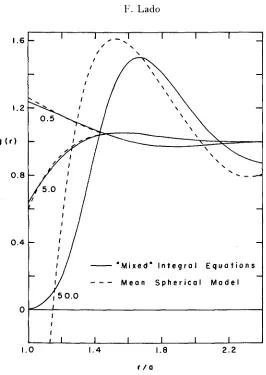
Figure 4. Pair distribution functions obtained trom t h e ' m i x e d ' integral equations approach and the Mean Spherical ~Iodel for the common parameter o = l
(pd3=
0.2387) and three values of I', as shown.Contrary to the behaviour of the direct correlation function, the scattering factor
S(k)= 1 + pG(k),
shown in figure 3, displays a shape that roughly inter- polates between those of charged points and neutral hard spheres, but is closer to the latter. T h e relative expansion of g(r), compared to g(r) for uncharged hard spheres, is here reflected in a corresponding compression ofS(k).
A comparison with the Mean Spherical Model [8] ( M S M ) is shown in figure 4 for the pair distribution function. In these results the hard-sphere diameter
= d/a
was held fixed a t ~ = 1.0, resulting in a reference hard spherego(r)
whichwas the same in all three cases and which corresponded to a reduced hard-sphere density pd3=0.2387. T h e correction AG(r) to this
go(r)
is quite small at F = 0.5, so that the close agreement shown between the two results in this case masks a larger relative difference in just the correction,kG(r).
Agreement is still relatively good for I ' = 5 . 0 , but for the final curve shown at F = 5 0 the M S M gives qualitatively incorrect results, g(r) here taking on negative values in the vicinity of the hard core. This breakdown tor large I" is analogous to that of the linearized Debye H/ickel approximation, to which the M S M reduces in theCharged hard-sphere liquids 1127
absence of a h a r d core. T h e c o m p u t e d internal energies for the cases s h o w n in figure 4 are E / N k T - ~ = - 0 . 3 4 1 , - 3 . 8 6 9 , and - 4 7 " 5 0 for the M S M , in o r d e r of increasing P, and - 0 . 3 4 1 , - 3 . 8 7 0 , and - 4 2 . 7 9 for the ' m i x e d ' integral equations.
Finally, we h o p e to have s h o w n t h a t a ' m i x e d ' integral equations a p p r o a c h , w h e r e i n the characteristic a p p r o x i m a t i o n s used in familiar integral equations are applied only with that part of the potential for which each is k n o w n to w o r k c o m p a r a t i v e l y well, is a practical one entailing little m o r e c o m p l i c a t i o n t h a n a single integral equation.
REFERENCES
[1] PERCUS, J. K., and YEVICK, G. J., 1958, Phys. Rev., II0, I.
[2] VAN LEEUWEN, J. M. J., GROENEVELD, J., and DE BOtR, J., 1959, Physica, 25, 792. MEERON, E., 1960, J. math. Phys., 1, 192. RVSHBROOKE, G. S., 1960, Physica, 26, 259. VERLET, L., 1960, Nuovo Cim., 18, 77.
[3] ROWLINSON, J. S., 1968, Physics of Simple Liquids, edited by H. N. V. Temperley, J. S. Rowlinson and G. S. Rushbrooke (North-Holland).
[4] SPRINGER, J. F., POKRANT, M. A., and STEVENS, Jr., F. A., 1973, J. chem. Phys., 58, 4863.
[5] CHmARA, J., 1973, Prog. theor. Phys., Osaka, 50, 409. [6] LADO, F., 1973, Phys. Rev. A, 8, 2548.
[7] LADO, F., 1973, J. chem. Phys., 89, 4830 ; 1974, Ibid., 60, 1686.
[8] PALMER, R. G., and WEEKS, J. D., 1973, J. chem. Phys., 58, 4171. The Mean Spherical Model for such a system has been solved analytically by these authors.
[9] LADO, F., 1964, Phys. Rev., 135, A1013.
[10] ANDERSON, H. C., and CHANDLER, D., 1972, J. chem. Phys., 57, 1918.
[11] WESTHEIM, M. S., 1963, Phys. Rev. Lett., 10, 321 ; 1964, J. math. Phys., 5, 643. TmELE, E., 1963, J. chem. Phys., 39, 474.
[12] ROWLINSON, J. S., 1965, Molec. Phys., 9, 217. CARLEY, D. D., and LADO, F., 1965,
Phys. Rev., 137, A42.
[13] ALLNATT, A. R., 1964, Molec. Phys., 8, 533. COOPER, M. S., 1973, Phys. Rev. A, 7, 1.
[14] Mo, K. C., and HOOP~R, Jr., C. F., 1974, Phys. Rev. A, 9, 908. A different re- summation technique leading to a non-iterative expression /or the pure Coulomb
g(r) has recently been developed by these authors.
[15] LADO, F., 1971, J. comp. Phys., 8, 417. The numerical Fourier transforms were performed using the trapezoidal rule.
[16] HANSEN, J. P., 1973, Phys. Rev. A, 8, 3096.