A NEW ROBUST IMAGE WATERMARKING APPROACH USING TWO-LEVEL INTERMEDIATE SIGNIFICANT BITS
COUPLED WITH HISTOGRAM INTERSECTION TECHNIQUE
Mir Shahriar Emami
A thesis submitted in fulfilment of the requirements for the award of the degree of
Doctor of Philosophy (Computer Science)
Faculty of Computer Science and Information System Universiti Teknologi Malaysia
ACKNOWLEDGEMENT
I would like to express my sincere gratitude to my supervisor, Professor Dr. Ghazali Bin Sulong, for his supports and valuable guidance during my research.
I would like thank Universiti Technologi Malaysia (UTM), for awarding me the International Doctoral Fellowship (IDF) an also for supporting me with the Research University Grant Scheme (RUGS) during my study.
I also gratefully acknowledge the suggestions made by anonymous journal reviewers that have enhanced the quality of my PhD thesis.
I would like to thank my parents for offering their support and love through my life.
ABSTRACT
ABSTRAK
TABLE OF CONTENTS
CHAPTER TITLE PAGE
DECLARATION ii
DEDICATION iii
ACKNOWLEDGEMENT iv
ABSTRACT v
ABSTRAK vi
TABLE OF CONTENTS vii
LIST OF TABLES xi
LIST OF FIGURES xiv
LIST OF ABBREVIATIONS xvii
1 INTRODUCTION 1
1.1. Background of the Study 1
1.2. Problem Statement 4
1.3. Purpose of the Study 6
1.4. Objectives 7
1.5. Scope of the Study 7
1.6. Contributions of the Study 8
1.7. Significance of the Study 9
1.8. Research Framework 9
1.9. Thesis Organization 13
2 LITERATURE REVIEW 14
2.1. Introduction 14
2.2.1. Watermarking Embedding 15
2.2.2. Watermark Extracting 16
2.2.3. Attacks on Watermarked Property 19 2.2.3.1. Geometric Attacks 20 2.2.3.2. Non-Geometric Attacks 20
2.2.4. Performance Evaluation 21
2.2.4.1. Imperceptibility Metric 21 2.2.4.2. Robustness Metrics 22 2.2.4.3. Trade-off among Performance
Measures
23
2.3. Watermarking Techniques 24
2.3.1. Transform Domain Watermarking 25 2.3.1.1. Discrete Fourier Transform 25 2.3.1.2. Discrete Cosine Transform 26 2.3.1.3. Discrete Wavelet Transform 28 2.3.2. Spatial Domain Watermarking 30 2.3.2.1. Bit Value Replacement Approach 31 2.3.2.2. Pixel Value Substitution Approach 33 2.3.3. Hybrid Domain Watermarking 56
2.4. Summary 62
3 PROPOSED WATERMARKING ATTACKS 64
3.1. Introduction 64
3.2. Research Methodology 65
3.3. Proposed Watermarking Attacks 66
3.3.1. Reset Removal Attack (RR Attack) 66 3.3.2. Set Removal Attack (SR Attack) 67
3.4. Results of Experiments 68
3.5. Analysis and Discussions 74
4 TRADE-OFF MEASUREMENT AMONG
IMPERCEPTIBILITY, ROBUSTNESS AND CAPACITY
77
4.1. Introduction 77
4.2. Research Methodology 78
4.3. Performance Testing Prerequisites 79 4.4. Proposed Techniques to Measure the Trade-off 79 4.4.1. A Threshold-based Technique 80 4.4.1.1.Results of Proposed Threshold
Technique
82
4.4.1.2. Analysis and Discussions 89 4.4.2. Proposed Fuzzy Performance Approach 90 4.4.2.1.Proposed Fuzzy Performance Model 91 4.4.2.2.Fuzzification of the Input Variables 92 4.4.2.3.Application of the Fuzzy Operators 93 4.4.2.4.Implication and Aggregation 94 4.4.2.5.Defuzzification 94 4.4.2.6.Membership Functions 95 4.4.2.7.Results of the Proposed Fuzzy
Performance Modelling
98 4.4.3. Analysis and Discussions 100
4.4 Summary 107
5 A STATISTICAL METHOD FOR OWNERSHIP IDENTIFICATION
108
5.1. Introduction 108
5.2. Research Methodology 108
5.3. Proposed Techniques based on L2Norm Histogram Matching Technique
109 5.4. Experimental Results and Discussions 112
5.5. Summary 119
6 PROPOSED WATERMARKING TECHNIQUE 120
6.1. Introduction 120
6.3. Proposed Embedding Technique 122
6.4. Proposed Extracting Technique 129
6.5. Proposed Approximation Approach for Ownership Identification
132 6.5.1.Histogram Intersection Technique 133
6.5.2. Conjecture 133
6.5.3. Mathematical Modelling 135
6.6. Results of Experiments 138
6.7. A Technique for the Robustness Improvement of the BiISB Technique
147
6.7.1. Description 147
6.7.2. Results of Experiments 148
6.8. Analysis and Discussions 154
6.9. Summary 159
7 CONCLUSION 161
7.1. Introduction 161
7.2. Summary and Contributions 164
7.3. Recommendations and Future Works 167
REFERENCES 168
LIST OF TABLES
TABLE NO. PAGE
2.1. Watermark Algorithms Verities 19
2.2. EISB Sub-Ranges Table 52
2.3 Ranges of the Bias values 52
2.4 Chronology of Watermarking Techniques 59 3.1 Comparison among the proposed attack and
JPEG, JPEG2000, and Skewing using BCR
69
3.2. Robustness and Imperceptivity Evaluation after RR Attack (100%) when the 2nd Bit-plane was used
70
3.3. Robustness and Imperceptivity Evaluation after RR Attack (100%) when the 3rd Bit-plane was used
70
3.4. Robustness and Imperceptivity Evaluation after RR Attack (100%) when the 4th Bit-plane was used
71
3.5. Robustness and Imperceptivity Evaluation after RR Attack (100%) when the 5th Bit-plane was used
71
3.6. Robustness and Imperceptivity Evaluation after SR Attack (100%) when the 2nd Bit-plane was used
72
3.7. Robustness and Imperceptivity Evaluation after SR Attack (100%) when the 3rd Bit-plane was used
3.8. Robustness and Imperceptivity Evaluation after SR Attack (100%) when the 4th Bit-plane was used
73
3.9. Robustness and Imperceptivity Evaluation after SR Attack (100%) when the 5th Bit-plane was used
73
4.1. Conditions of Watermarking Performance Trade-off
81
4.2 Testing points of the Threshold-based Technique Experiment
83 4.3. The Characteristics of the Proposed FIS 92 4.4. The Number of 1s and 0s in the Capital Letters
and the Ten Digits ASCII Binary Codes
99
4.5. The PBT Interpretations of Five bit-plane Watermarking Algorithms
106
5.1. Four different Embedded Watermarks in Separate Experiments
112 5.2. Matching Rate for Watermark No. 1 using
proposed Technique after the Rotating attack ( )
113
5.3. Matching Rate for Watermark No. 2 using proposed Technique after the Rotating attack ( )
114
5.4. Matching Rate for Watermark No. 3 using proposed Technique after the Rotating attack ( )
114
5.5. Matching Rate for Watermark No. 4 using proposed Technique after the Rotating attack ( )
115
5.6. Matching Rate for Watermark No. 1 using proposed Technique after JPEG 2000 attack
116 5.7. Matching Rate for Watermark No. 2 using
proposed Technique after JPEG 2000 attack
116 5.8 Matching Rate for Watermark No. 3 using
proposed Technique after JPEG 2000 attack
117 5.9 Matching Rate for Watermark No. 4 using
proposed Technique after JPEG 2000 attack
6.2. Needed Memory Space for the Main Watermark and their respective Sub-watermarks in five Different Watermarks
125
6.3. Watermark Embedding Structure of the Proposed Scheme in a Host Image ofN×M
Size
128
6.4. Various BiISB Bit-plane Combinations in the Proposed Approach
139
6.5 Results of the Ownership Identification by the Exact Methods after JPEG2000 Lossy
Compression Attack using the Extracted Main Watermarks.
140
6.6. Results of Experiments under JPEG2000 Lossy Compression Attack with Different β Values
141
6.7. Results of Improved BiISB Technique (β=2 and bias value=10) against JPEG2000 Lossy Compression Attack
149
6.8. Results of Improved BiISB Technique (β=2 and bias value=20) against JPEG2000 Lossy Compression Attack
150
6.9. Results of Improved BiISB Technique (β=2 and bias value=30) against JPEG2000 Lossy Compression Attack
151
6.10. Fuzzy performance Assessment of the
improved BiISB Technique against RR attack
153
6.11. Robustness Comparison between the Proposed Technique with other Watermarking
Approaches after Attacks
155
6.12. Quality Comparison between the Proposed Technique and other Watermarking
Approaches
156
6.13 Effective Embedding Capacity Comparison between the Proposed Technique and other Watermarking Approaches.
LIST OF FIGURES
FIGURE NO. PAGE
1.1. Diagram of the Approach of the Study 10 2.1. Embedding Stage in a Watermarking System 16 2.2. Extracting Stage in a Watermarking System 17 2.3. 1-Level (Single Level) Signal Frequency Splitting
using Discrete Wavelet Transform
28
2.4. 2-Level Signal Frequency Splitting using Discrete Wavelet Transform
30 2.5. 8 bit-planes of an 8-bit grayscale image 31
2.6. LSB Replacement Approach 32
2.7 Image Differencing Method 34
2.8. Non-overlapping Pixel Pair Method 36
2.9. Four-sided Method 40
2.10. Trade-off between Imperceptibility and Embedding Capacity in k-sided Method
42 2.11. Estimation-based Adjacent-area Approach 43 2.12. Additive Watermark Embedding Method (α=50) 46 2.13. Spatial Domain Watermark Embedding using Bocks
of Pixels
47
2.14. Atawneh Watermark Embedding Technique 49
2.15. IP LSB Substitution Approach 51
2.17. TIVB-DW Watermark Embedding Scheme 58 3.1. Main Stages in a Watermarking Scheme 65 3.2. Bit-planes of an 8-bit Grayscale Image. 67 3.3. Trade-off between Imperceptibility and Robustness
in four EISB bit-plane methods
75 4.1. Attacking Scenarios for each Bit-plane
Watermarking Schemes
85
4.2 Degree of Balanced Trade-off using eight Bit-planes 89 4.3. Proposed Fuzzy-based Measurement Model 92
4.4. Subject Host Image Histogram 100
4.5. Degree of Performance Balanced Trade-off 101 5.1 Proposed Scheme using L2Norm Technique 110 5.2. Comparison Results after Rotating attack ( ) 118 5.3. Comparison Results after JPEG2000 attack 119 6.1. Block Diagram of the Proposed Embedding Scheme 123 6.2 Different Watermarks and their Bit-pattern
Histograms
124
6.3. Proposed Embedding Flow Chart 127
6.4. Block Diagram of the Proposed Embedding Technique
129
6.5. Proposed Extracting Flow Chart 131
6.6. Histogram Relationship Triangle (HRT) 132 6.7. PSNRw of the watermarked image using different
WP-HP values
139 6.8. Proposed Technique Performance against
JPEG2000 Attack
143
6.9. Ownership Probability Results using Different β values after JPEG2000 Attack
144
6.10. Proposed Technique Performance against of Vertical Skewing Attack
6.11. Proposed Technique Performance against of Rotating Attack
146
6.12 Proposed Improved BiISB Technique Performance against JPEG2000 Attack (β=2 and bias value=10)
149
6.13 Proposed Improved BiISB Technique Performance against JPEG2000 Attack (β=2 and bias value=20)
150
6.14. Proposed Improved BiISB Technique Performance against JPEG2000 Attack (β=2 and bias value=30)
151 6.15. Results of Improved BiISB Technique from the
Quality Perspective.
152
6.16. Comparison of Robustness against JPEG2000 attack between Improved BiISB and BiISB
153 6.17. Watermarking Quality Comparison between
Different Techniques
157 6.18. Visual Observation of the Quality of the Improved
BiISB Technique and the Block-Based Biased-EISB Approach .
LIST OF ABBREVIATIONS
BCR - Bit Correct Rate
dB - Decibel
DCT - Discrete Cosine Transform
DFT - Discrete Fourier Transform
DWT - Discrete Wavelet Transform
EISB - Enhanced Intermediate Significant Bit
FFT - Fast Fourier Transform
FIS - Fuzzy Inference System
HH - High-High frequency band
HL - High-Low frequency band
HRT - Histogram Relationship Triangle
IDCT - Invert Discrete Cosine Transform IDFT - Invert Discrete Fourier Transform IDWT - Invert Discrete Wavelet Transform
IP - Inverted Pattern
ISB - Intermediate Significant Bit
JPEG - Joint Photographic Expert Groups
LH - Low-High frequency band
LPAP - Local Pixel Adjustment Process
LSB - Least Significant Bit
MFRB - Mamdani Fuzzy Rule Based
MSB - Most Significant Bit
MSE - Mean Square Error
NCC - Normalized Cross Correlation
OPAP - Optimal Pixel Adjustment Process
OSR - Optimal Similarity Rate
PSNR - Peak Signal to Noise Ratio
PVD - Pixel Value Differencing
SR - Set Removal
RR - Reset Removal
TIBV - Thresholds based on Intermediate Bit Values
VBA - Visual Basic for Applications
CHAPTER 1
INTRODUCTION
1.1. Background of the Study
In the past few years, digital multimedia has proliferated with the rapid advancements of multimedia and communication technologies. In spite of the several advantages of these advancements, multimedia assets are largely vulnerable to replication and redistribution via simply popular accessible networks particularly the Internet. According to recent statistics, billions of dollars have been lost to multimedia piracy. These may bring about hindering the offer of digital distributions of intellectual properties by their owners as they worry about the copyright protection of their digital assets.
Moreover, several varieties of attacks against watermarking approaches have been recognized and of course, many new kinds of them may emerge in the near future. Experimental investigations have shown that the proposed watermarking approaches are prone to be impacted severely by several attacks. This makes them unable to extract the embedded watermark to identify the ownership of the digital media. Therefore, a universal watermarking algorithm which can withstand all kinds of attacks and simultaneously satisfy the imperceptibility requirement does not seem to exist. Thus, new solutions must be devised to tackle this problem (Licks and Jordan, 2005).
Furthermore, digital watermarking process requires a rapid and low computational power particularly for real-time applications. Currently, there is a time lap between image creation and watermarking embedding. This gap as a security hole will provide good opportunities to the attackers to exploit the delay of original image transformation to watermarked version of the image. In such a situation, there is a need of low complexity watermarking mechanism for many of todays’ applications. For example, digital photographs need to be watermarked as soon as they are taken by the digital phone cameras (Sohn, et al., 2006). This brings about the identification of those photographs to a particular digital phone camera or to its owner immediately after they are taken.
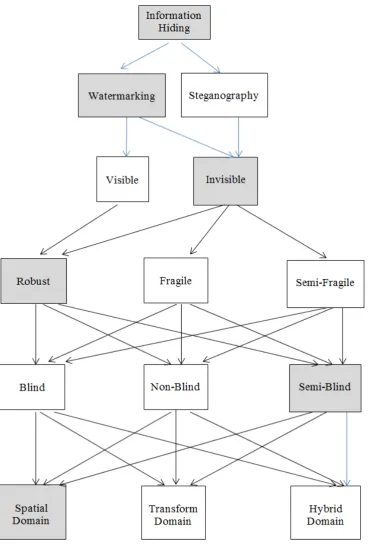
In addition, digital watermarking schemes with respect to the information taken into account through extracting can be categorized as blind and non-blind approaches. In non-blind watermarking approaches, both data for actual host image and data statistics about watermarked image are known in the time of watermark detection and extraction (Tao and Eskicioglu, 2004). In contrast, in blind approach retrieving the watermark without referring to the original image is preferred (Al-Otum and Samara, 2010). There are several difficulties concerning the blind watermarking approaches. On the one hand, high effectiveness of blind watermarking is also proven. Therefore, a new technique called semi-blind watermarking was introduced. In this kind of watermarking approach, only the original watermark or the watermarked multimedia statistics are known (Tao and Eskicioglu, 2004; Shieh, 2006; Eugene, 2007). Paunwala, and Patnaik, (2011), applied semi-blind strategy in their approach in which principal direction of the subject watermarked image as statistical information is available at the time of watermark extraction to avoid the use of the original host image. Consequently, in the non-blind approaches in the original host data is needed after the extraction time to identify the rightful owner. On the other hand, in blind approaches detecting and extracting the watermark information will become very difficult if the watermarked image is highly attacked either intentionally or unintentionally. Therefore, the semi-blind approach as a key solution is more robust than the blind approach and more effective than the non-blind approach.
1.2 Problem Statement
Instantaneous digital image watermarking is an urgent need for many of today’s applications such as digital cameras and digital phone cameras. Comparing two of the watermarking techniques, transform domain watermarking approaches requires higher computational complexity than spatial domain techniques (Wolfgang et al., 1999; Wu and Hwang, 2007; Burdescu et al., 2007; Larijani and Rad; 2008, Mehemed et al.; 2009, and Kougianos et al., 2009). This is due to the forward and inverse transformations of the transform-domain watermarking approaches. Nonetheless, there are problems with spatial-domain techniques. For example, high embedding errors in ISB bit-planes results in many researchers employing low-order bit-planes such as LSB for data hiding, for example in Maity and Kundu (2002) Chan and Cheng (2004), and Yang (2008). However, the low-order bit-planes techniques does not contain visually significant information so, the embedded watermark may be simply corrupted or replaced by unauthorized users without influencing visual effects. For example, Abolghasemi et al. (2010) proposed a technique using co-occurrence matrix and bit-plane clipping which can detect the hidden data in LSB.
On the other hand, a watermarking attack may bring about much degradation effects for the watermarked image quality and make the watermarked image useless and unproductive for piracy. This can be interpreted as a higher robustness. Therefore, selecting lower bit-planes results in lower visual degradation effects and lower robustness because the embedded watermark can be simply corrupted or replaced by malicious users without any visual effects. To overcome this drawback, Zeki and Manaf (2009) proposed an enhanced technique based on ISB approach, which can be called as EISB for simplicity. This approach allows the use of higher ISB bit-planes with low perceptible visual effects. Although EISB improved ISB scheme in terms of watermarking visual degradation effects, there is still robustness weaknesses in this approach. For example, JPEG2000 attack can simply corrupt the embedded watermark(s) in the EISB approach. Zeki and Manaf (2011) introduced the Block-based Biased-EISB approach in order to overcome this drawback. However, there are still three main weaknesses in this approach. Firstly, the biased-based strategy degrades the watermarked image quality drastically. Secondly, some common image processing attacks such as rotating, skewing, etc. can simply influence on the continuity of the structure of the blocks so the embedded watermark can be corrupted easily. Thirdly, as each bit of the watermark information is embedded in a block of pixels instead of one single pixel, so this approach suffers from low embedding capacity.
but bias strategy decrease the quality and the blocking strategy decrease the capacity. Fazli and Khodaverdi (2009) in their latest research on the LSB watermarking concluded similar results. Similarly, in real-time applications such as digital cameras and digital phone cameras, the mentioned requirements are also in trade-off but the simplicity of the watermarking technique is another requirement in such applications. Hence, new approaches are required to obtain a balanced trade-off among quality, robustness and capacity in order to enable the EISB-based watermarking approaches to be applied for real-time applications. Now the question is: Is it possible to obtain a technique to balance a trade-off among visual imperceptibility, robustness and embedding capacity in EISB-based watermarking approaches?
Finally, numerous diversities of attacks against watermarking approaches have been documented, for example in Song et al. (2010), and of course a number of new varieties may emerge in the near future. Experimental investigations have shown that the previous watermarking approaches are prone to be impacted severely by several kinds of such attacks. This makes them unavailable to extract the embedded watermark(s) in order to identify the ownership of the digital media. In addition, many of the attacks against watermarking schemes may be too complex to model, so an effective analysis of their behaviour is not simple (Cox et al., 1997). Consequently, a universal watermarking approach that can withstand against several varieties of attacks and, at the same time, satisfies the quality and the embedding capacity requirements with a low complexity has not been discovered yet. In this situation, approximation approaches can be employed in order to identify the ownership of the attacked watermarked image with low computational complexity. Now the question is: How to come up with a solution that can withstand against many varieties of attacks without knowing their exact behaviours?
1.3. Purpose of the Study
restrictions. Therefore, several techniques must be employed simultaneously to attain the acceptable degree of trade-off among robustness, imperceptibility and capacity. The main aim of this study is to introduce an approximation approach based on the statistical information in terms of both the embedding watermark and the extracting watermark which provides a balanced trade-off among robustness, visual imperceptibility and embedding capacity.
This can be realized by proposing a new robust image watermarking technique based on two-level ISB using the remnant information of the embedded watermarks in order to identify the ownership of the watermarked image even after severe attacks. The proposed approach should achieve a balanced trade-off among the visual imperceptibility, robustness and embedding capacity.
1.4. Objectives
In order to achieve the goal, the following objectives are to be performed:
I. To propose new severe attacks.
II. To propose measurement schemes in order to evaluate the trade-off among imperceptibility, robustness and capacity requirements.
III. To propose a new technique for owner identification.
IV. To propose a new watermarking technique in order to obtain a balanced trade-off among robustness, imperceptibility, and capacity.
1.5. Scope of the Study
The focus of this study is as in the followings:
III. 8-bit gray-scale still image
IV. JPEG, JPEG2000, Rotating, Vertical Skewing, Horizontal Skewing , Pepper & Salt, and Cropping Attacks
1.6. Contributions of the Study
The contributions of this study can be categorized as: (I) new attacks, (II) new measurement techniques to evaluate balanced trade-off, (III) new owner identification technique, (IV) new watermarking technique. For each category the contributions are as follows:
I. Two new attacks which are severer than most popular attacks such as JPEG, JPEG2000, and Skewing. Unlike the popular attacks, the attacks introduced impacts directly on the embedded watermarks and remove the embedded watermarks partially or totally.
II. Two new measurement techniques namely, Threshold-based and Fuzzy-based approaches. Unlike the popular measures such as BCR, NCC, and PSNR which merely evaluate one of the main watermarking requirements, the techniques introduced measure the balanced trade-off among robustness, imperceptibility, and capacity.
III. New ownership identification method utilizing L2Norm technique for the ownership identification. The technique introduced identifies the ownership of the property using the remnant information after the attack totally destroys the embedded watermarks.
totally destroyed by the attacks. The technique introduced is better than other techniques as it obtains a balanced trade-off among robustness, imperceptibility, and capacity.
1.7. Significance of the Study
The proposed watermarking scheme can be applied for real-time applications such as digital camera, digital phone camera, human interacting-robots, etc. in order to protect the ownership of the attacked watermarked images regardless the behaviour of the attacks. Moreover, the proposed scheme highly preserves the quality of the watermarked image such that it can be used in clinical studies, medical applications, photography, etc.
1.8. Research Framework
There are four key concepts in digital robust watermarking viz: watermark attacking, performance measurement, watermark embedding, and watermark extracting.
First of all, in the case of watermark attacks, the behaviours of some kinds of previous attacks and future unknown attacks against watermarking techniques may be either complex or unknown. Meanwhile, most watermarking attacks originated from either signal or image processing common operations. However, there are also other watermarking attacks that originated from an attacker’s mind. Such attacks can be severe enough that the attacked watermarked image can no longer be identified (Chapter 3 introduces the two of such attacks.). Thus, a universal watermarking technique which is compatible with all forms of known and unknown attacks has not appeared yet. Meanwhile, several robust digital watermarking techniques have been proposed by researchers which are able to withstand certain attacks. However, in order to obtain a precise assessment, all of the above attacks should be considered.
Secondly, in the case of performance measurement, there are at least three main requirements viz: quality (visual imperceptibility), robustness, and embedding capacity that should be fulfilled in a robust watermarking technique. Unfortunately, these requirements conflict with each other which means there is a trade-off among them. In order to assess the effectiveness of a watermarking technique, it is important to measure this trade-off by means of an effective mechanism. In order to fulfill this need, two different approaches are proposed in Chapter 4 viz: an effective technique based on three Threshold conditions, and a Fuzzy based model.
extracted watermark is not similar to the original embedded watermark. To overcome this problem, a statistical approach utilizing the L2Norm technique is introduced in Chapter 5 for ownership identification of the watermarked image. However, there is still no guarantee for this approach as certain attacks may be so severe that the ownership of the attacked watermarked image cannot be recognized. To overcome this drawback, a new strategy is required in the embedding process.
Fourthly, in the embedding stage, both the main watermark and statistical information regarding the main watermark in the form of bit-pattern histogram (called sub-watermark) can be embedded in the host image concurrently. A new watermarking technique, namely BiISB, is introduced in Chapter 6 in which both the high-order and the low-order bit-planes are used for embedding the sub-watermark and main watermark, respectively. This approach couples a two-level ISB approach with the Histogram Intersection technique in order to produce a high imperceptibility and, at the same time, withstand several kinds of attacks. Thus, the proposed technique can provide strong and probabilistic guarantees on the proof of ownership of the host image.
1.9. Thesis Organization
REFERENCES
Abolghasemi, A., Aghaeinia, H., Faez, K., Mehrabi, M. A. (2010), “Detection of Steganography based on Co-occurrence Matrix and Bit-plane Clipping”, Journal of Electronic Imaging, Vol.19, No.1
Adelson, E. H. (1990), “Digital signal encoding and decoding apparatus,” U.S. Patent 4939515
Ahire, V. K. and Kshirsagar, V. (2011), “Robust Watermarking Scheme Based on Discrete WaveletTransform (DWT) and Discrete Cosine Transform (DCT) for Copyright Protection of Digital Images”, International Journal of Computer Science and Network Security, Vol..11, No.8
Al-Haj A. (2007), “Combined DWT-DCT digital image Watermarking”, Journal of Computer Science, Vol 3, PP. 740-746
Aliwa, M. B., El-Tobely, T. E. and Fahmy, M. M., (2010), “A New Novel Fidelity Digital Watermarking Based on Adaptively Pixel- Most-Significant-Bit-6 in Spatial Domain Gray Scale Images and Robust”, American Journal of Applied Sciences vol.7, no.7, pp.987-1022
Al-Otum , H. M. and Samara, N. A. (2010), “A robust blind color image watermarking based on wavelet-tree bit host difference selection”, Signal Processing, Elsevier, Vol :90, PP 2498-2512
Amirgholipour, S. K. and Naghsh-Nilchi, A. R., (2009),” Robust Digital Image Watermarking Based on Joint DWT-DCT”, International Journal of Digital Content Technology and its Applications, Volume 3, No.2
Atawneh, S. (2006), “A New Algorithm for Hiding Gray Images Using Blocks”, Proc of IEEE Computer Society
Baba, S., Krikor, L. Z., Arif, T. and Shaaban, Z. (2010),” Watermarking of digital images in Frequency Domain”, International Journal of Automation and Computing, 7(1), PP. 17-22
Bennour, J., Dugelay, J,., and Matta, F (2007)., “Watermarking Attack (BOWS contest)”, Security, Steganography, and Watermarking of Multimedia Contents, Proceedings of SPIE-IS&T Electronic Imaging, Vol. 6505, pp. 650518-1 - 650518-6, SPIE-IS&T
Burdescu, D. D., Stanescu, L., Ion, A., and Mihaescu, C. M. (2007), “A Spatial Watermarking Algorithm for Video Images”, Computer Network Security- Communications in Computer and Information Science, Vol 1, Part 7, Part 12, Springer-Verlag, PP. 402-407
Chan, C. and Cheng, L. M., (2001), Improved Hiding Data in Images by Optimal Moderate Significant Bit Replacement, IEE Electronics Letters, vol.37, no.16, pp.1017-1018
Chan, C., and Cheng, L.M., (2004), “Hiding data in images by simple LSB substitution”, Pattern Recognition 37, Elsevier, PP 469 – 474
Chang, C., and Tseng, H. (2004), “A Stenganographic Method for Digital Images using Side Match”, Pattern Recognition Letters, vol.25, pp.1431–1437
Chang, C., Lin, C. and Hu, Y. (2007), “An SVD Oriented Watermark Embedding Scheme with High Qualities for the Restored Images”, International Journal of Innovative Computing, Information and Control, Vol. 3, No. 3
Chang, K., Huang, P. Tu, S., T., and Chang, C. (2007), “Adaptive image steganographic scheme based on Tri-way Pixel-Value Differencing “, IEEE International Conference on Systems, Man and Cybernetics, pp. 1165 - 1170, IEEE Computer Society
Chang, C., Lin, C., and Hu, Y. (2007), “An SVD Oriented Watermark Embedding Scheme with High Qualities for the Restored Images”, International Journal of Innovative Computing, Information and Control, Vol. 3, No. 3
Cheung, W. N. (2000), ”Digital Image Watermarking in Spatial and Transform Domains”, Proceedings TENCON 2000, pp. III-374 – III-378, IEEE Computer Society
Cooley, J. and Tukey, J. (1965), “An Algorithm for the Machine Calculation of Complex Fourier Series”, Math. Comp., 19, PP. 297-301
Cox, J., Miller, M. L., and Bloom, J. A. (2002), “Digital Watermarking”, Morgan Kaufmann, San Francisco
Chu, S., Jain, L. C., Huang, H. and Pan, J. (2010), “Error-Resilient Triple-Watermarking with Multiple Description Coding”, Journal of Networks, Vol. 5, No. 3, pp. 267-274, IEEE Computer Society
Daubechies, I. (1992), Ten lectures on wavelets, SIAM Press, Philadelphia, PA., USA
Dejun, Y., Rijing, Y., Yuhai, Y. and Huijie, X. (2009), “Blind Digital Image Watermarking Technique Based On Intermediate Significant Bit and Discrete Wavelet Transform”, Proc, International Conference on Computational Intelligence and Software Engineering, CISE 2009. IEEE Computer Soceity Devapriya, M. and Ramar, K. (2010), ” Statistical Image Watermarking In DWT
with Capacity Improvement”, Global Journal of Computer Science and Technology, Vol. 10, Issue 2, Ver 1.0
Eggers, J. J., Su, J. K. and Girod, B. (2000), ”Robustness of a Blind Image Watermarking Scheme’, International Conference on Image Processing, pp. 17-20, IEEE Computer Society
El-Ghoneimy, M. M. (2008), “Coparison Between Two WatermarkingAlgorithms Using DCT Coefficient, And LSB Replacement ”, Journal of Theoretical and Applied Information Technology, JATIT
Elbasi, E. and Eskicioglu, A. M. (2006), “A Semi-Blind Watermarking Scheme for Images using a Tree Structure ”, Proc, 2006 IEEE Sarnoff Symposium, PP. 1-4, IEEE Computer Society
Eugene, P.G. (2007), “Digital watermarking of bitmap images”, Proc, International Conference on Computer Systems and Technologies, June 14-15, ACM Press, Rousse, Bulgaria, pp: 1-6
Fazli, S. and Khodaverdi, G. (2009), “Trade-off between Imperceptibility and Robustness of LSB Watermarking using SSIM Quality Metrics”, Proc, Second International Conference on Machine Vision, IEEE Computer Society Fourati, W. and Bouhlel, M. S. (2006), “Amelioration of the JPEG2000 by a
Ganesanl, K. and Guptha (2010), T. K., “Multiple Binary Images Watermarking in Spatial and Frequency Domain”, Signal & Image Processing : An International Journal(SIPIJ), Vol.1, No.2, PP 148-159
Ghannam, S. and Abou-Chadi, F., (2008), F., “Enhancing Performance of Image Watermarks Using Wavelet Packet”, International Conference on Computer Engineering & Systems, ICCES 2008, IEEE Computer Society
Ghannam, S. and Abou-Chadi, F. E. Z., (2009), “WPT versus WT for a Robust Watermarking Technique”,International Journal of Computer Science and Network Security, Vol.9 No.1, pp. 236-241
Habes, A. (2006), “Information Hiding in BMP image Implementation, Analysis and Evaluation”, Information Trnsmissions In Computer Networks, Tom. 6, No. 1 Hameed, K., Mumtaz, A. and Gilani, S. A. M. (2006), “Digital image watermarking in the wavelet transform domain”, Proc. World Academy of Science, Engineering and Technology, Vol . 13: PP. 86-89
Honsinger, C. (2000), “Data Embedding using Phase Dispersion”, IEE Seminar on Secure Images and Image Authentication , pp. 5/1 - 5/7, IEEE Computer Society
Hore, A. and Ziou, D. (2010), “ Image Quality Metrics_PSNR vs SSIM”, International Conference on Pattern Recognition, IEEE Computer Society, pp.2366-2369
Hsu, C. and Wu, J. (1996), “Hidden Signatures in Images”, Proc, International Conference on Image Processing, Vol.3, PP. 223 - 226 , IEEE Computer Society
Huang, H., Chu, C., and Pan, J. (2009), ”Genetic Watermarking for Copyright Protection”, Information Hiding and Applications, SCI 227, pp. 1–19, Springer-Verlag
Istepanian, R. S. H., Philip, N., Martini, M. G., Amso, N. and Shorvon, P. (2008), ”Subjective and Objective Quality Assessment in Wireless TeleUltrasonography”, proc, International IEEE EMBS Conference, Vancouver, Canada, pp.20-24
Jin, C., Zhang, Z., Jiang, Y., Qu, Z. and Ma, C., (2007), “A Blind Watermarking Algorithm Based on Modular Arithmetic in the Frequency Domain”, Advances and Innovations in Systems, Computing Sciences and Software Engineering, pp. 543–547, Springer
Jou, F., Fan, K., Chang, Y. (2004), “Efficient Matching Large Size Histograms”, Pattern Recognition Letters, Vol. 25, pp. 277–286
Kailasanathan, C., (2003), “Fragile Watermark based Polarity of Pixel Points”, proc, 3rd International Symposium on Image and Signal Processing and Analysis, pp. 860-865, USA
Kamran, H., Mumtaz, A. and Gilani, S. A. M. (2006), “Digital image watermarking in the wavelet transform domain”, Proc. World Academy of Science, Engineering and Technology, Vol . 13: pp..86-89
Kao, C. H. and Hwang, R. J. (2005), Information Hiding in Lossy Compression Gray Scale Image”, Tamkang Journal of Science and Engineering, Vol. 8, No 2, pp. 99_108
Kluska, J. (2009) Analytical Methods in Fuzzy Modeling and Control, Studies in Fuzziness and Soft Computing, Springer-Verlag
Kothari, A.M., Suthar, A. C. and Gajre, R. S. (2010), “Performance Analysis of Digital Image Watermarking Technique–Combined DWT–DCT over individual DWT”, International Journal of Advanced Engineering & Applications
Kougianos, E., Mohanty, S. P. and Mahapatra, R. N. (2009), “Hardware Assisted Watermarking for Multimedia”, Computers and Electrical Engineering 35, PP. 339–358, Elsevier
Kumar, S. P., Anusha, K., Ramana, R. V. (2011), “A Novel Approach to Enhance Robustness in Steganography Using Multiple Watermark Embedding Algorithm”, International Journal of Soft Computing and Engineering, Vol.1, Issue 1, pp.50-56
Larijani, H. H. and Rad, G. R. (2008), “A New Spatial Domain Algorithm for Gray Scale Images Watermarking”, Proc, International Conference on Computer and Communication Engineering, PP. 157-161, Kuala Lumpur, Malaysia Li, M., Narayanan, S. and Poovendran, R. (2004), “Tracing Medical Images Using
Engineering in Medicine and Biology Society, pp. 3233 – 3236, IEEE Computer Society
Li, S. , Leung K., Cheng, L.M. and Chan C. (2006),” Data Hiding in Images by Adaptive LSB Substitution based on the Pixel-value Differencing”, First International Conference on Innovative Computing, Information and Control, China, Beijing, pp. 58 - 61
Licks, V. and Jordan, R. (2005), “Geometric Attackes on Image Watermarking Systems”, IEEE Multimedia, PP. 68-78, IEEE Computer Society
Lie, W. and Chang, L. C., (1999), “Data hiding in images with adaptive numbers of least significant bits based on the human visual system”, International Conference on Image Processing, vol.1, pp.286 – 290
Liujuang, Q., and Ding, Z. (2008), “Spread Spectrum Watermark for color Image ”, Based on Wavelet Tree Structure”, Proc, International Conference on Computer Scienece and Software Engineering, PP 692-695
Maity S. P. and Kundu, M. K. (2002),” Robust and blind spatial watermarking in digital image”, proc, 3rd Indian Conf. on Computer Vision, Graphics and Image Processing (ICVGIP '2002), pp. 388 -393
MaruthuPerumal, S. and VijayaKumar, V., (2011), “A Wavelet based Digital Watermarking Method using Thresholds on Intermediate Bit Values”, International Journal of Computer Applications,Vol. 15, No.3, pp.29-36 Meerwald, P. and Pereira, S. (2002), “Attacks, applications, and evaluation of known
watermarking algorithms with Checkmark”, Proc, Security and Watermarking of Multimedia Contents IV, Vol. 4675, PP. 293-304, SPIE Mehemed, B.A., El-Tobely, T.E.A., Fahmy, M.M., Naser, M.E.L.S. and El-Aziz,
M.H.A. (2009), "Robust digital watermarking based falling-off boundary in corners board-MSB-6 gray scale images", International Journal of Computer Science and Network Security,Vol.9, No.8, PP.227-240
Mohan, B. C., Kumar, S. S. and Chatterjee, B. N. (2006), “Digital Image Watermarking in Dual Domains ”, Proc, IET International Conference on Visual Information Engineering, PP. 410 – 415, IEEE Computer Society
Mohanty, S.P. (1999), “Digital Watermarking: A Tutorial Review”., www.cs.unt.edu/~smohanty/research/Reports/MohantyWatermarkingSurvey1
Nishchal, N. K. (2009), “Optical image watermarking using fractional Fourier transform”, Journal of Optics 38 (1), Springer
Ozturk, M., Akan, A. and Cekic, Y. (2010), “A Robust Image Processing in the Joint Time-Frequency Domain”, EURASIP Journal on Advances in Signal Processing, Hindawi Publishing Corporation, Vol.2010
Pan, G., Wu, Z. and Pan Y. (2002), “A Data Hiding Method for Few-color Images”, proc, IEEE International Conference on Acoustics, Speech and Signal Processing, IEEE Computer Society, pp. 3469-3472, USA
Paunwala, M. C. and Patnaik, S (2011), Biometric Template Protection With Robust Semi–Blind Watermarking Using Image Intrinsic Local Property, International Journal of Biometrics and Bioinformatics (IJBB), Vol.5, Issue 2 Perumal S. M. and Kumar V. V. (2011), A Wavelet based Digital Watermarking
Method using Thresholds on Intermediate Bit Values, International Journal of Computer Applications, vol.15, no.3, pp.29-36
Potdar, V. M., Han, S. and Chang, E. (2005),“ A Survey of Digital Image Watermarking Techniques”, 3rd International Conference on Industrial Informatics(INDIN), PP. 709 – 716, IEEE Computer Society
Qi, H., Zheng, D., and Zhao, J. (2008),” Human visual system based adaptive digital image watermarking”, Signal Processing , vol.88, pp.174–188
Rabah K. (2004), “Steganography -- The Art of Hiding Data”, Information Technology Journal, Vol.3, No. 3, PP. 245-269
Rabie, T. and Guerchi, D. (2007), “Magnitude Spectrum Speech Hiding ”, Proc, IEEE International Conference on Signal Processing and Communications , PP. 1147 – 1150, IEEE Computer Society
Rafigh, M. and Moghaddam, M. E. (2010),” A Robust Evolutionary Based Digital Image Watermarking Technique in DCT Domain”, PP 105-109. , Seventh International Conference on Computer Graphics, Imaging and Visualization, IEEE Computer Society
Ramkumar, M., Akansu, A. and Alatan , A. (1999), “A Robust data hiding scheme for images using DFT”, Proc, IEEE International Conferenece on Image Processing, IEEE Computer Society, PP. 211-215
Sakawa, M. (1983), Interactive computer programs for fuzzy linear programming with multiple objectives. Intern.J. Man-Machine Stud., 18, PP. 489–503 Schyndel, R. G. V., Trike, A. Z. and Osborne, C. F. (1994), “A Digital Watermark”,
proc, 1st International IEEE Image Processing Conference, RMIT, Houston, USA
Seshadrinathan, K. and Bovik, (2008), A. C.,“ Unifying Analysis of Full Reference Image Quality Assessment”, 15th IEEE International Conference on Image Processing, pp.1200 - 1203
Shapiro, J. M. (1993), “Embedded Image Coding Using Zerotrees of Wavelet Coefficients”, IEEE Transactions on Signal Processing, Vol. 41 No. 12, IEEE Computer Society
Shieh, J., Lou, D., and Chang, M. (2006), “A Semi-blind digital watermarking scheme based on singular value decomposition”, Elsevier, Computer Standards & Interfaces 28, PP 428– 440
Senthil, V. and Bhaskaran, R. (2008),“ Robustness Analysis of Blind and Non-Blind Multiple Watermarking using Edge Detection and Wavelet Transforms ”, 16th International Conference on Advanced Computing and Communications, ADCOM, PP. 106 – 111, IEEE Computer Society
Shih, F. Y., Wu, S. Y. T. (2003), “Combinational Image Watermarking in the Spatial and Frequency Domains”, Pattern Recognition 36, PP. 969 -975, Elsevier Sohn, J. S., Lee, S. I., Lee, S. H., Kwon, K. R. and Kim, D. G. (2006), “Blind Image
Watermarking Technique for Digital Phone Camera”, IEEE Sensors, IEEE Computer Society, Conf, Daegu, Korea
Song, C., Sudirman, S., Merabti, M. and Jones, D. L. (2010), “Analysis of Digital Image Watermark Attacks”, Proc, Consumer Communications and Networking Conference (CCNC), 2010 7th IEEE , IEEE Computer Society Sun Q. and Zhang, Z. (2006), “A Standardized JPEG2000 Image Authentication
Solution based on Digital Signature and Watermarking”, China Communications, pp. 71-80
Swain, M. J. and Ballard D. H. (1991). Color indexing. International Journal of Computer Vision, 7(1):11–32
Temi, C., Choomchuay, S., and Lasakul, A. (2005), “A Robust Image Watermarking using Multiresolution Analysis of Wavelet”, Proc, IEEE International Symposium on Communications and Information Technology, 2005. ISCIT 2005. Vol. 1, IEEE Computer Society
Voloshynovskiy, S., Pereira, S., Iquise V. and Pun, T. (2001),” Attack Modeling: towards a second generation watermarking benchmark”, Signal Processing Vol. 81, pp. 1177-1214, Elsevier
Wang, J. and Liu, R. (2009) , “Low Complexity DCT-Based Distributed Source Coding for Hyperspectral Image”, 4th International Conference on Communications and Networking, ChinaCOM, PP. 1-5, IEEE Computer Society
Wang, R., Lin, C. and Lin, J., (2000), “Hiding data in images by optimal moderately significant bit replacement”, IEE Electronics Letters, vol.36, no.25, pp.2069-2070
Wang, S. (2005), “Steganography of capacity required using modulo operator for embedding secret image, (2005)”, Applied Mathematical and Computation, Applied Mathematics and Computation, vol.164, pp. 99–116
Wang, S., Zheng, D., Zhao , J., Tam, W. J., and Speranza, F. (2005),” An accurate method for image quality evaluation using digital watermarking”, IEICE Electronics Express, vol.2, no.20, pp.523-529
Wang, Y., and Pearmain, A., (2004), “Blind Image Data Hiding based on Self Reference”, Pattern Recognition Letters, vol. 25, pp.1681–1689
Westfeld, A., and Pfitzmann, A. (1999), “Attacks on Stenganographic Systems Breaking the Stenganographic Utilities EzStego, Jsteg, Stegnos, and S-Tools and Some Lessons Learned ”, Proc, International Workshop Information Hiding, Dresden, Germany
Wolfgang, R. B., Podilchuk, C. I., and Delp, E. J. (1999), "Perceptual Watermarks for Digital Images and Video," Proceedings of the IEEE, Vol. 87, No. 7, PP. 1108-1126
Wu, D.C. and Tsai, W.H. (2000) “Spatial-domain image hiding using image differencing”, IEE Proc.-Vcs. hncige Signal Process 147, No.1, pp.29-37 Wu, H.-C., Wu, N., Tsai, (2003), “A Stegnographic Method for Images by
Wu, H.-C., Wu, N.-I., Tsai, C.-S. and Hwang, M.-S. (2005), ‘Image steganographic scheme based on pixel-value differencing and LSB replacement methods”, Visual and Image Signal Processing, Vol. 152, No. 5, IEE
Wu, N., (2004), A Study on Data Hiding for Gray-Level and Binary Image, Master Thesis, Chaoyang University of Technology, Taiwan
Wu, N. I., and Hwang, M. (2007), “Data Hiding: Current Status and Key Issues”, International Journal of Network Security, Vol.4, No.1, PP.1–9
Wu, X., Guan, Z. (2007), “A Novel Digital Watermark Algorithm based on Chaotic Maps”, Physics Letters A, Vol.365, pp.403–406
Wu, X. , Guan, Z. and Wu, Z. (2007), ”A Chaos Based Robust Spatial Domain Watermarking Algorithm”, Lecture Notes in Computer Science, Vol.4492/2007, pp.113-119
Xuan, M., and Jiang, J. (2009), “A Novel Watermarking Algorithm in Entropy Coding Based on Image Complexity Analysis ”, proc, International Conference on Multimedia Information Networking and Security, MINES'09, PP 128-129
Yang, C. (2008), “Inverted pattern approach to improve image quality of information hiding by LSB.”, Pattern Recognition 41, Elsevier, PP. 2674 – 2683
Yin, C. Y., Wu, D. C. and Tsai W. H. (2002), “New Data Hiding Methods for Copyright Protection, Annotation and Authentication of BMP Archive Images in Digital Libraries and Museums”, proc, 1st Workshop on Digital Achieves Technologies, pp. 168-183, Taiwan
Yoo, J., Choi, B. and Choi, H. (2010), “1-D fast normalized cross-correlation using additions”, Digital Signal Processing 20, PP. 1482–1493, Elsevier
Yoshida, M., Fujita, T. and Fujiwara, T. (2006), “A New Optimum Detection Scheme for Additive Watermarks Embedded in Spatial Domain”, proc, International Conference on Intelligent Information Hiding and Multimedia Signal Processing, IEEE Computer Society
You, X., Du, L., Cheung, Y. and Chen Q., (2010), “A Blind Watermarking Scheme Using New Nontensor Product Wavelet Filter Banks”, IEEE TRANSACTIONS ON IMAGE PROCESSING, Vol. 19, No. 12
Zeki, A. M. and Manaf, A. A. (2009), “ A Novel Digital Watermarking Technique Based on ISB (Intermediate Significant Bit), International Journal of Information Technology, vol:5:3
Zeki, A. M. and Manaf, A. A. (2011), “ISB Watermarking Embedding: A Block Based Model”, Information Technology Journal, Vol.10, No.4, pp.841-848 Zhang, D., Xu, J., Li, H. and Li, H. (2009), “A Novel Image Watermarking
Algorithm with Fast Processing Speed”, International Conference on Information Engineering and Computer Science, IEEE Computer Society, pp.1-4
Zhang, X., and Wang, S., (2004), “Vulnerability of pixel-value differencing steganography to histogram analysis and modification for enhanced security”, Pattern Recognition Letters, vol.25, pp. 331–339
Zhao, X. and Ho, A. T. S. (2010), “An Introduction to Robust Transform Based Image Watermarking Techniques”, Studies in Computational Intelligence, Volume 282, Intelligent Multimedia Analysis for Security Applications, PP. 337-364