CONSTRUCTING AN E-COMMERCE TRUST MODEL
Ab. Razak Che Hussinl, Nur Zailan Othman2, Halina Mohamed DahianJ
Faculty of Computer Science and Information Systems Universiti Technologi Malaysia,
81310 Skudai, Johor, Malaysia
Email: .abrazak:@[email protected]@utm.my
Abstract: Trust issues is still considered as a main obstacle in the implementation of
e-Commerce. Due to the increasing numbers of cyber crimes committed today, consumers are
faced with doubt to engage in online shopping. As a safety precaution, consumers will take
certain measures to protect their information by evaluating and assessing these websites
trustworthiness before an actual purchase occurs. This paper describes a model that examines
the elements related to online consumer behavior and to investigate this behavior towards
building and increasing trust. The applicability of the model was tested in attempt to view
consumers' acceptance towards the model and its component. The fmdings indicate the
respondents are aware of the trust issue surrounding e-Commerce implementation as they
accept and agreed with the model and its components.
Keywords: Consumer behavior, e-Commerce, Online, Internet Shopping, Trust
1. INTRODUCTION
E-Commerce is a valuable asset that emerged as a result from the Internet evolution. It
ughout
allows corporate organization and business enthusiasts to carry out their business without the
.lpractiCal III barrier of time and distance. The Internet, which upon e-Commerce is based, is becoming an
,'This
paper important means for handling complex processes that governs day-to-day operations and f;cbaracteris among these operations is in the area of sales and marketing. The true potential of the Internet
is now being exploited at a higher rate as a medium of selling and purchasing goods [8].
Businesses are searching for various methods to promote and sell their product effectively and
encouragin a better way to do it is by using the Internet and e-Commerce websites. There are numerous
validate thl benefits that can be associated with e-Commerce in terms of increasing sale, reducing
Jilid 20, Bil. 2 (Disember 2008) Jurnal Teknologi Maklumat JUid20,Bii
CONSTRUCTING AN E-COMMERCE TRUST MODEL
Ab. Razak Che Hussinl, Nur Zailan Othman2,Halina Mohamed Dahlan]
Faculty of Computer Science and Information Systems Universiti Technologi Malaysia,
81310 Skudai, Johor, Malaysia
Email: [email protected]@hotmail.com.][email protected]
Abstract: Trust issues is still considered as a main obstacle in the implementation of
e-Commerce. Due to the increasing numbers of cyber crimes committed today, consumers are
faced with doubt to engage in online shopping. As a safety precaution, consumers will take
certain measures to protect their information by evaluating and assessing these websites
trustworthiness before an actual purchase occurs. This paper describes a model that examines
the elements related to online consumer behavior and to investigate this behavior towards
building and increasing trust. The applicability of the model was tested in attempt to view
consumers' acceptance towards the model and its component. The fmdings indicate the
respondents are aware of the trust issue surrounding e-Commerce implementation as they
accept and agreed with the model and its components.
Keywords: Consumer behavior, e-Commerce, Online, Internet Shopping, Trust
1. INTRODUCTION
E-Commerce is a valuable asset that emerged as a result from the Internet evolution. It
allows corporate organization and business enthusiasts to carry out their business without the
barrier of time and distance. The Internet, which upon e-Commerce is based, is becoming an
important means for handling complex processes that governs day-to-day operations and
among these operations is in the area of sales and marketing. The true potential of the Internet
is now being exploited at a higher rate as a medium of selling and purchasing goods [8].
Businesses are searching for various methods to promote and sell their product effectively and
a better way to do it is by using the Internet and e-Commerce websites. There are numerous
benefits that can be associated with e-Commerce in terms of increasing sale, reducing
Jilid 20, Bil. 2(Disember2008) Jurnal Teknologi Maklumat
CONSTRUCTING AN E-COMMERCE TRUST MODEL
Ab. Razak Che Hussinl, Nur Zailan Othman2,Halina Mohamed Dahlan]
Faculty of Computer Science and Information Systems Universiti Technologi Malaysia,
81310 Skudai, Johor, Malaysia
Email: [email protected]@hotmail.com.][email protected]
Abstract: Trust issues is still considered as a main obstacle in the implementation of
e-Commerce. Due to the increasing numbers of cyber crimes committed today, consumers are
faced with doubt to engage in online shopping. As a safety precaution, consumers will take
certain measures to protect their information by evaluating and assessing these websites
trustworthiness before an actual purchase occurs. This paper describes a model that examines
the elements related to online consumer behavior and to investigate this behavior towards
building and increasing trust. The applicability of the model was tested in attempt to view
consumers' acceptance towards the model and its component. The fmdings indicate the
respondents are aware of the trust issue surrounding e-Commerce implementation as they
accept and agreed with the model and its components.
Keywords: Consumer behavior, e-Commerce, Online, Internet Shopping, Trust
1. INTRODUCTION
E-Commerce is a valuable asset that emerged as a result from the Internet evolution. It
allows corporate organization and business enthusiasts to carry out their business without the
barrier of time and distance. The Internet, which upon e-Commerce is based, is becoming an
important means for handling complex processes that governs day-to-day operations and
among these operations is in the area of sales and marketing. The true potential of the Internet
is now being exploited at a higher rate as a medium of selling and purchasing goods [8].
Businesses are searching for various methods to promote and sell their product effectively and
a better way to do it is by using the Internet and e-Commerce websites. There are numerous
benefits that can be associated with e-Commerce in terms of increasing sale, reducing
operational cost and effectively manage marketing strategies but there are also daunting challenges that may jeopardize the growth and future direction of e-Commerce.
Consumer trust is a vital element to the success of e-Commerce implementation [13]. It is widely agreed that e-Commerce can only become a broad success if the general public trusts the virtual environment [21]. It is important to fIrst understand how consumer behave and react when engaging in e-Commerce that ends up with trusting the website. By revie;.ving several studies related to consumer behavior and issues associated with it, it will narrow down the way in fInding a clearer solution towards understanding the concept of online consumer behavior and trust. Consumers are the main players in the fIeld of e-Commerce and their involvement in it will determine which businesses are at the top of the competition and which are at the bottom.
The rapid growth of the Internet is not only brings countless opportunities for businesses but also critical issues associated mainly with security and privacy. E-Commerce relies on the information that is transmitted through the Internet and if weaknesses in software systems have been detected by hackers and use them to their advantage, catastrophe may follow [9]. Businesses or specifIcally, Internet vendor will have to face the loss of their loyal consumers due to the lack of consumer trust towards them. Recently, cyber crimes are reported as one of the most committed crimes and the victims are online shoppers. Due to this situation, it affects consumers' perception and decision-making processes. Concerns arise about their privacy and personal information being misused by other parties. Until today, security and privacy issues in any technological-based domain especially e-CommerCe are still undergoing research and development to identify the common issue that are haunting the security and privacy aspect in the development of e-Commerce sites. Furthermore, newly E-Commerce softwares are being developed based on the need to resolve this issue.
Various literatures have been published that provides understandable concept about consumer behavior [17,4,18,19], focused on the technological and economical aspect of a consumer profIle [10,1,24], and understanding the basic concept of consumer's intention to purchase [3,5]. Although the context of consumer behavior has been explained in details throughout several literatures but there has been very little research available that provide practical and tested guidelines for Internet vendor to adopt into their e-Commerce website. This paper presents and looks into the aspect of online consumer behavior involving the characteristics that influence their intention to purchase and trust. In addition, it presents a model that has been developed, drawing from the fIndings of e-Commerce research in the area of consumer behavior and trust in e-Commerce. At the end, this paper presents some encouraging results on the survey that was conducted by selecting several online shoppers to validate the
Jilid 20, Bil.2 (Disember 2008) Jumal Teknologi Maklumat operational cost and effectively manage marketing strategies but there are also daunting
challenges that may jeopardize the growth and future direction of e-Commerce.
Consumer trust is a vital element to the success of e-Commerce implementation [13].Itis
widely agreed that e-Commerce can only become a broad success if the general public trusts
the virtual environment [21]. Itis important to fIrst understand how consumer behave and
react when engaging in e-Commerce that ends up with trusting the website. By revie;.ving
several studies related to consumer behavior and issues associated with it, it will narrow down
the way in fInding a clearer solution towards understanding the concept of online consumer
behavior and trust. Consumers are the main players in the fIeld of e-Commerce and their
involvement in it will detennine which businesses are at the top of the competition and which
are at the bottom.
The rapid growth of the Internet is not only brings countless opportunities for businesses
but also critical issues associated mainly with security and privacy. E-Commerce relies on the
infonnation that is transmitted through the Internet and if weaknesses in software systems
have been detected by hackers and use them to their advantage, catastrophe may follow [9].
Businesses or specifIcally, Internet vendor will have to face the loss of their loyal consumers
due to the lack of consumer trust towards them. Recently, cyber crimes are reported as one of
the most committed crimes and the victims are online shoppers. Due to this situation, it
affects consumers' perception and decision-making processes. Concerns arise about their
privacy and personal infonnation being misused by other parties. Until today, security and
privacy issues in any technological-based domain especially e-CommerCe are still undergoing
research and development to identify the common issue that are haunting the security and
privacy aspect in the development of e-Commerce sites. Furthennore, newly E-Commerce
softwares are being developed based on the need to resolve this issue.
Various literatures have been published that provides understandable concept about
consumer behavior [17,4,18,19], focused on the technological and economical aspect of a
consumer profIle [10,1,24], and understanding the basic concept of consumer's intention to
purchase [3,5]. Although the context of consumer behavior has been explained in details
throughout several literatures but there has been very little research available that provide
practical and tested guidelines for Internet vendor to adopt into their e-Commerce website.
This paper presents and looks into the aspect of online consumer behavior involving the
characteristics that influence their intention to purchase and trust. In addition, it presents a
model that has been developed, drawing from the fIndings of e-Commerce research in the
area of consumer behavior and trust in e-Commerce. At the end, this paper presents some
encouraging results on the survey that was conducted by selecting several online shoppers to
validate the
Jilid 20, Bil.2 (Disember 2008) Jumal TeknologiMaklumat operational cost and effectively manage marketing strategies but there are also daunting
challenges that may jeopardize the growth and future direction of e-Commerce.
Consumer trust is a vital element to the success of e-Commerce implementation [13].Itis
widely agreed that e-Commerce can only become a broad success if the general public trusts
the virtual environment [21]. Itis important to fIrst understand how consumer behave and
react when engaging in e-Commerce that ends up with trusting the website. By revie;.ving
several studies related to consumer behavior and issues associated with it, it will narrow down
the way in fInding a clearer solution towards understanding the concept of online consumer
behavior and trust. Consumers are the main players in the fIeld of e-Commerce and their
involvement in it will detennine which businesses are at the top of the competition and which
are at the bottom.
The rapid growth of the Internet is not only brings countless opportunities for businesses
but also critical issues associated mainly with security and privacy. E-Commerce relies on the
infonnation that is transmitted through the Internet and if weaknesses in software systems
have been detected by hackers and use them to their advantage, catastrophe may follow [9].
Businesses or specifIcally, Internet vendor will have to face the loss of their loyal consumers
due to the lack of consumer trust towards them. Recently, cyber crimes are reported as one of
the most committed crimes and the victims are online shoppers. Due to this situation, it
affects consumers' perception and decision-making processes. Concerns arise about their
privacy and personal infonnation being misused by other parties. Until today, security and
privacy issues in any technological-based domain especially e-CommerCe are still undergoing
research and development to identify the common issue that are haunting the security and
privacy aspect in the development of e-Commerce sites. Furthennore, newly E-Commerce
softwares are being developed based on the need to resolve this issue.
Various literatures have been published that provides understandable concept about
consumer behavior [17,4,18,19], focused on the technological and economical aspect of a
consumer profIle [10,1,24], and understanding the basic concept of consumer's intention to
purchase [3,5]. Although the context of consumer behavior has been explained in details
throughout several literatures but there has been very little research available that provide
practical and tested guidelines for Internet vendor to adopt into their e-Commerce website.
This paper presents and looks into the aspect of online consumer behavior involving the
characteristics that influence their intention to purchase and trust. In addition, it presents a
model that has been developed, drawing from the fIndings of e-Commerce research in the
area of consumer behavior and trust in e-Commerce. At the end, this paper presents some
encouraging results on the survey that was conducted by selecting several online shoppers to
validate the
2. LITERATURE REVIEW
2.1 Basic Concept of Consumer Behavior
This paper describe about the development of a trust model that takes into account consumer behavior aspect. Understanding the basic concept of consumer behavior can lead to exploring criteria or element that might influence their trust formation and increase trust, and also the process of making a decision. They are several definitions coined by renowned scholars in the field of consumer behavior. Among those are [18], where they viewed customers as one entity that play it part in two context and define it as the mental and physical activities undertaken by household and business customers that result in decisions and actions to pay for, purchase, use products and services. A customer can play one or all three of the following roles: (I) a buyer (Le. selecting products), (2) a payer (i.e paying for a product), or (3) a user/consumer (i.e using or consumer a product). Their definition of consumer behavior includes both mental and physical activities. Examples of mental activities are assessing the suitability of a product or service brand, making inferences about a product or service's qualities from advertising information, and evaluating actual experience with the product. Physical activities include visiting stores, searching for information on the Net, talking to salespeople, and issuing a purchase order.
According to [17], consumer behavior refers to the behavior that consumers display in searching for, purchasing, using, evaluating, and disposing of products and services that they expect will satisfy their needs while [18] gave a definition that is more sensible in the context of consumer behavior as a process, where they define consumer behavior as the study of the process involved when individuals or groups select, purchase, use, or dispose of products, services, ideas and experiences to satisfy needs and desires. These definitions explain about the actions (purchase, use, etc) and process (from actions to satisfying needs) that a consumer involved in while engaging in business activities to achieve a common goal (satisfying needs).
From these definitions, it is found that satisfying needs are the main goal to be achieved and without any doubt, buying from a physical store would expect to achieve those goals. Trust might not be the problem in this kind of situation because in the real world environment, consumer can experience the item physically and if they are satisfied then they will purchase the item. Furthermore, an electronic transaction has numerous disadvantages and it involved a lot of risk rather than normal or traditional transaction.
Jilid 20, Bil. 2 (Disember 2008) Jumal Teknologi Maklumat
2.2 Online Con
Consumertr
A model prl Commerce env triggered by a c characteristics, logistics, and by and behaviors c control as attitul show that custc experience. For can prove suffil service.
However, f more important the number of conducted in thl
Jilid 20, Bil.2 (I 2. LITERATURE REVIEW
2.1 Basic Concept or Consumer Behavior
This paper describe about the development of a trust model that takes into account
consumer behavior aspect. Understanding the basic concept of consumer behavior can lead to
exploring criteria or element that might influence their trust formation and increase trust, and
also the process of making a decision. They are several definitions coined by renowned
scholars in the field of consumer behavior. Among those are [18], where they viewed
customers as one entity that play it part in two context and define it as the mental and physical
activities undertaken by household and business customers that result in decisions and actions
to pay for, purchase, use products and services. A customer can play one or all three of the
following roles: (I)a buyer (i.e. selecting products), (2) a payer (i.e paying for a product), or
(3) a user/consumer (i.e using or consumer a product). Their definition of consumer behavior
includes both mental and physical activities. Examples of mental activities are assessing the
suitability of a product or service brand, making inferences about a product or service's
qualities from advertising information, and evaluating actual experience with the product.
Physical activities include visiting stores, searching for information on the Net, talking to
salespeople, and issuing a purchase order.
According to [17], consumer behavior refers to the behavior that consumers display in
searching for, purchasing, using, evaluating, and disposing of products and services that they
expect wil1 satisfy their needs while [18] gave a definition that is more sensible in the context
of consumer behavior as a process, where they define consumer behavior as the study of the
process involved when individuals or groups select, purchase, use, or dispose of products,
services, ideas and experiences to satisfy needs and desires. These definitions explain about
the actions (purchase, use, etc) and process (from actions to satisfying needs) that a consumer
involved in while engaging in business activities to achieve a common goal (satisfying
needs).
From these definitions, it is found that satisfying needs are the main goal to be achieved
and without any doubt, buying from a physical store would expect to achieve those goals.
Trust might not be the problem in this kind of situation because in the real world
environment, consumer can experience the item physically and if they are satisfied then they
will purchase the item. Furthermore, an electronic transaction has numerous disadvantages
and it involved a lot of risk rather than normal or traditional transaction.
Jilid 20, Bil. 2 (Disember 2008) Jumal Teknologi Maklumat 2. LITERATURE REVIEW
2.1 Basic Concept or Consumer Behavior
This paper describe about the development of a trust model that takes into account
consumer behavior aspect. Understanding the basic concept of consumer behavior can lead to
exploring criteria or element that might influence their trust formation and increase trust, and
also the process of making a decision. They are several definitions coined by renowned
scholars in the field of consumer behavior. Among those are [18], where they viewed
customers as one entity that play it part in two context and define it as the mental and physical
activities undertaken by household and business customers that result in decisions and actions
to pay for, purchase, use products and services. A customer can play one or all three of the
following roles: (I)a buyer (i.e. selecting products), (2) a payer (i.e paying for a product), or
(3) a user/consumer (i.e using or consumer a product). Their definition of consumer behavior
includes both mental and physical activities. Examples of mental activities are assessing the
suitability of a product or service brand, making inferences about a product or service's
qualities from advertising information, and evaluating actual experience with the product.
Physical activities include visiting stores, searching for information on the Net, talking to
salespeople, and issuing a purchase order.
According to [17], consumer behavior refers to the behavior that consumers display in
searching for, purchasing, using, evaluating, and disposing of products and services that they
expect wil1 satisfy their needs while [18] gave a definition that is more sensible in the context
of consumer behavior as a process, where they define consumer behavior as the study of the
process involved when individuals or groups select, purchase, use, or dispose of products,
services, ideas and experiences to satisfy needs and desires. These definitions explain about
the actions (purchase, use, etc) and process (from actions to satisfying needs) that a consumer
involved in while engaging in business activities to achieve a common goal (satisfying
needs).
From these definitions, it is found that satisfying needs are the main goal to be achieved
and without any doubt, buying from a physical store would expect to achieve those goals.
Trust might not be the problem in this kind of situation because in the real world
environment, consumer can experience the item physically and if they are satisfied then they
will purchase the item. Furthermore, an electronic transaction has numerous disadvantages
and it involved a lot of risk rather than normal or traditional transaction.
2.2 Online Consumer Behavior and Trust
Consumer trust may be even more important in electronic, "cyber" transaction than it is in
traditional, "real world" transactions [5]. The authors dermed online consumer behavior as
''the process of performing actions (search, purchase, sell, etc) by a consumer while engaging
in online trading activities that satisfy their needs and intentions. There are few research
conducted that emphasizes on online consumer behavior that leads to building online trust.
Most of these researches have come out with a model that presents consumer behavior on the
web.
A model presented by [22], shows the basic consumer behaviors, adjusted to fit the
e-Commerce environment. According to this model, the purchasing decision process is
triggered by a customer's reaction to stimuli. The process is then influenced by the buyer's
characteristics, by the purchasing environment, by the relevant technology, by the EC
logistics, and by other seller-controlled factors. A theoretical framework for consumer attitude
and behaviors on the Web proposed by [6] shown that shopping enjoyment and perceived
control as attitudinal variables that directly affect online consumer behavior. The results also
show that customers' product involvement can have a significant impact on their on-line
experience. For new customers, involvement is less important, and the novelty of the Web site
can prove sufficiently interesting even if the customer is not as involved in the product or
service.
However, for repeat customers, novelty quickly wears off, and product involvement is
more important in increasing shopping enjoyment. This relationship seems to increase with
the number of past visits to the Web store. Table I summarizes some of the research
conducted in the context of consumer behaviors and several key to trust attributes found.
Jilid 20, Bil.2 (Disember 2008) Jumal Teknologi Maklumat 2.2 Online Consumer Behavior and Trust
Consumer trust may be even more important in electronic, "cyber" transaction than it is in
traditional, "real world" transactions [5]. The authors defmed online consumer behavior as
''the process of performing actions (search, purchase, sell, etc) by a consumer while engaging
in online trading activities that satisfy their needs and intentions. There are few research conducted that emphasizes on online consumer behavior that leads to building online trust.
Most of these researches have come out with a model that presents consumer behavior on the
web.
A model presented by [22], shows the basic consumer behaviors, adjusted to fit the
e-Commerce environment. According to this model, the purchasing decision process is
triggered by a customer's reaction to stimuli. The process is then influenced by the buyer's
characteristics, by the purchasing environment, by the relevant technology, by the EC
logistics, and by other seller-controlled factors. A theoretical framework for consumer attitude
and behaviors on the Web proposed by [6] shown that shopping enjoyment and perceived
control as attitudinal variables that directly affect online consumer behavior. The results also
show that customers' product involvement can have a significant impact on their on-line
experience. For new customers, involvement is less important, and the novelty of the Web site
can prove sufficiently interesting even if the customer is not as involved in the product or
service.
However, for repeat customers, novelty quickly wears off, and product involvement is
more important in increasing shopping enjoyment. This relationship seems to increase with
the number of past visits to the Web store. Table I summarizes some of the research
conducted in the context of consumer behaviors and several key to trust attributes found.
Jilid 20, Bil.2 (Disember 2008) Jumal Teknologi Maklumat 2.2 Online Consumer Behavior and Trust
Consumer trust may be even more important in electronic, "cyber" transaction than it is in
traditional, "real world" transactions [5]. The authors defmed online consumer behavior as
''the process of performing actions (search, purchase, sell, etc) by a consumer while engaging
in online trading activities that satisfy their needs and intentions. There are few research conducted that emphasizes on online consumer behavior that leads to building online trust.
Most of these researches have come out with a model that presents consumer behavior on the
web.
A model presented by [22], shows the basic consumer behaviors, adjusted to fit the
e-Commerce environment. According to this model, the purchasing decision process is
triggered by a customer's reaction to stimuli. The process is then influenced by the buyer's
characteristics, by the purchasing environment, by the relevant technology, by the EC
logistics, and by other seller-controlled factors. A theoretical framework for consumer attitude
and behaviors on the Web proposed by [6] shown that shopping enjoyment and perceived
control as attitudinal variables that directly affect online consumer behavior. The results also
show that customers' product involvement can have a significant impact on their on-line
experience. For new customers, involvement is less important, and the novelty of the Web site
can prove sufficiently interesting even if the customer is not as involved in the product or
service.
However, for repeat customers, novelty quickly wears off, and product involvement is
more important in increasing shopping enjoyment. This relationship seems to increase with
the number of past visits to the Web store. Table I summarizes some of the research
conducted in the context of consumer behaviors and several key to trust attributes found.
Table 1: Summarized research paper on consumer behavior and trust
Trust is based on disposition to
McKnight & Chervany Purchasing, cooperating, trust, institutional based, and
(2001) and information sharing.
trust in vendor.
Koufaris, Kambil and Trust is based on individual Unplanned purchase and Labarbera (2001) factors and website factors. intention to return.
Shows how consumer trust is Pennanen (2005) formed before a consumer
engaged in a relationship with
Consumer characteristics e-vendors
Privacy policy, 3' party seals, interacting with customers, reputation building, links to other sites and
uarantees.
Internal search engine, navigation, interface, layout, classification of product, product presentation, on-click shopping cart, music, color and customer review.
Chen and Barnes (2007)
Investigation on how online consumers develop their initial trust and urchase intention.
Initial trust, purchase intention
Interaction, company size, willingness to customize. Provide a basic theoretical
Kim, Ferrin & Rao (2007)
framework to study the importance and effects of trust and risk antecedences to
Intention to purchase,
actual purchase Third party seals. consumer urchasin decisions
2.3 Consumer Characteristics
When engaging in e-Commerce, consumer behavior and trust is influenced by their personal characteristics. These characteristics might change their process of making decision whether to purchase from the website or not. It can also reduce their intention to purchase and this usually occurs when they visit an unfamiliar website. When this situation occurs, they depend on their personal characteristics to evaluate the trustworthiness of the website. According to a model developed by [16], several consumer characteristics such as culture, personality, demographic, experience, personal value and psychographics influenced consumers' dispositional trust. Both [16] and [22] argue that personal characteristics have a significant influence on consumers' behavior and trust.
The authors identified that there are'four characteristics to be relevant to this study, which are personality, experience, educational background and computer literacy. Personality is an important element pointed out by several scholars in terms of having a high influence. Behavior and personality are inter-related where different personality shows different
Jilid 20, Bil. 2 (Disember 2008) Jumal Teknologi Maklumat
lififenmt personalities
Experience is one of ";';Qsing the Internet to se~
;a
strong relationship wi lrusted. For new online past customer. looking provided by web men::: experiences from othe According to [12], com Apart from experieJ increasing trust. Most' more educated, and 1shopping behavior ag Computer literacy als, confidence to shop on role in consumer beha technologically savvy know-how to gather transactions.
2.4 Intention to Purc
The process of m problem [19]. When a or affairs and some d been recognized, con consumer search for il instance, if a consum search for possible inf an intention to purcha key steps: informati, information retrieval however, product pur, A study conducted by
Jilid 20, Bil.2 (Disembe
Table 1: Summarized research paper on consumer behavior and trust
McKnight&Chervany (2001)
Koufaris, Kambil and Labarbera (2001)
Pennanen (2005)
Chen and Barnes (2007)
Kim, Ferrin& Rao (2007)
Trust is based on disposition to trust,institutional based, and trust in vendor.
Trust is based on individual factors and website factors.
Shows how consumer trust is formed before a consumer engaged in a relationship with e-vendors
Investigation on how online consumers develop their initial trust and urchase intention. Provide a basic theoretical framework to study the importance and effects of trust and risk antecedences to consumer urchasin decisions
Purchasing, cooperating, and information sharing.
Unplanned purchase and intention to return.
Consumer characteristics
Initial trust, purchase intention
Intention to purchase, actual purchase
Privacy policy, 3' party seals, interacting with customers, reputation building, links to other sites and
uarantees.
Internal search engine, navigation, interface, layout, classification of product, product presentation, on-click shopping cart, music, color and customer review.
Interaction, company size, willingness to customize.
Third party seals.
2.3 Consumer Characteristics
When engaging in e-Commerce, consumer behavior and trust is influenced by their
personal characteristics. These characteristics might change their process of making decision
whether to purchase from the website or not.Itcan also reduce their intention to purchase and this usually occurs when they visit an unfamiliar website. When this situation occurs, they
depend on their personal characteristics to evaluate the trustworthiness of the website.
According to a model developed by [16], several consumer characteristics such as culture,
personality, demographic, experience, personal value and psychographies influenced
consumers' dispositional trust. Both [16] and [22] argue that personal characteristics have a
significant influence on consumers' behavior and trust.
The authors identified that there are fouf characteristics to be relevant to this study, which
are personality, experience, educational background and computer literacy. Personality is an
important element pointed out by several scholars in terms of having a high influence.
Behavior and personality are inter-related where different personality shows different
Jilid 20, Bi!. 2 (Disember 2008) Jurnal Teknologi Maklumat
Table 1: Summarized research paper on consumer behavior and trust
McKnight&Chervany (2001)
Koufaris, Kambil and Labarbera (2001)
Pennanen (2005)
Chen and Barnes (2007)
Kim, Ferrin& Rao (2007)
Trust is based on disposition to trust,institutional based, and trust in vendor.
Trust is based on individual factors and website factors.
Shows how consumer trust is formed before a consumer engaged in a relationship with e-vendors
Investigation on how online consumers develop their initial trust and urchase intention. Provide a basic theoretical framework to study the importance and effects of trust and risk antecedences to consumer urchasin decisions
Purchasing, cooperating, and information sharing.
Unplanned purchase and intention to return.
Consumer characteristics
Initial trust, purchase intention
Intention to purchase, actual purchase
Privacy policy, 3' party seals, interacting with customers, reputation building, links to other sites and
uarantees.
Internal search engine, navigation, interface, layout, classification of product, product presentation, on-click shopping cart, music, color and customer review.
Interaction, company size, willingness to customize.
Third party seals.
2.3 Consumer Characteristics
When engaging in e-Commerce, consumer behavior and trust is influenced by their
personal characteristics. These characteristics might change their process of making decision
whether to purchase from the website or not.Itcan also reduce their intention to purchase and this usually occurs when they visit an unfamiliar website. When this situation occurs, they
depend on their personal characteristics to evaluate the trustworthiness of the website.
According to a model developed by [16], several consumer characteristics such as culture,
personality, demographic, experience, personal value and psychographies influenced
consumers' dispositional trust. Both [16] and [22] argue that personal characteristics have a
significant influence on consumers' behavior and trust.
The authors identified that there are fouf characteristics to be relevant to this study, which
are personality, experience, educational background and computer literacy. Personality is an
important element pointed out by several scholars in terms of having a high influence.
Behavior and personality are inter-related where different personality shows different
behavior and reaction. A study conducted by [23] on understanding personality that affects
consumer behavior and trust in e-Commerce indicates that there is some evidence that
different personalities attribute different importance levels to each of the trust features
presented.
Experience is one of the antecedents of building online trust. For consumers that have been
using the Intemet to search for information, engaged in many e-Commerce activities and have
a strong relationship with web merchant, it is easier for them to identify which website can be
trusted. For new online shoppers, experience and knowledge can be gain by interacting with
past customer. looking into customer feedback and testimonials and other method that are
provided by web merchant [13]. In terms of trust formation, consumers can ask opinions or
experiences from other consumers to evaluate the trustworthiness of e-Commerce [16].
According to [12], consumers' disposition to trust changes during the experiences of life.
Apart from experience, educational background has a huge impact in communicating and
increasing trust. Most Internet studies agree that the on-line population is relatively younger,
more educated, and wealthier than the general population and most studies of on-line
shopping behavior agree that on-line shoppers are better educated and wealthier. [10].
Computer literacy also affects the consumer behavior in term of gaining knowledge and
confidence to shop online [13]. According to [10], technological savvy plays an important
role in consumer behavior related to building the trust of on-line shoppers. People who are
technologically savvy have more experience with the Internet and consequently have the
know-how to gather information on e-Commerce they are considering for business
transactions.
2.4 Intention to Purchase and Initial Trust
The process of making decisions and end up with purchase is an act of response to a
problem [19]. When a consumer sees a significant difference between his or her current state
or affairs and some desired or ideal state, problem recognition occurs. Once a problem has
been recognized, consumers require adequate information to resolve it and this is when
consumer search for information through every resource available including the Internet. For
instance, if a consumer needs to buy a computer for his or her household, he or she' will
search for possible information and when those information or product meet the requirements,
an intention to purchase is initiated. Online transactions can be considered to consist of three
key steps: information retrieval, information transfer, and product purchase [15]. The
information retrieval and exchange steps are regarded as intentions to use a web site;
however, product purchase is more applicable to an intention to transact with a web site [15].
A study conducted by [5] suggests that a consumer's trust directly and indirectly affects his or
lilid 20, Bil.2 (Disember 2008) lurnal Teknologi Maklumat behavior and reaction. A study conducted by [23] on understanding personality that affects
consumer behavior and trust in e-Commerce indicates that there is some evidence that
different personalities attribute different importance levels to each of the trust features
presented.
Experience is one of the antecedents of building online trust. For conswners that have been
using the Internet to search for information, engaged in many e-Commerce activities and have
a strong relationship with web merchant, it is easier for them to identify which website can be
trusted. For new online shoppers, experience and knowledge can be gain by interacting with
past customer. looking into customer feedback and testimonials and other method that are
provided by web merchant [13]. In terms of trust formation, consumers can ask opinions or
experiences from other consumers to evaluate the trustworthiness of e-Commerce [16].
According to [12], consumers' disposition to trust changes during the experiences of life.
Apart from experience, educational background has a huge impact in communicating and
increasing trust. Most Internet studies agree that the on-line population is relatively younger,
more educated. and wealthier than the general population and most studies of o~-line
shopping behavior agree that on-line shoppers are better educated and wealthier. [10].
Computer literacy also affects the consumer behavior in term of gaining knowledge and
confidence to shop online [13]. According to [10], technological savvy plays an important
role in consumer behavior related to building the trust of on-line shoppers. People who are
technologically savvy have more experience with the Internet and consequently have the
know-how to gather information on e-Commerce they are considering for business
transactions.
2.4 Intention to Purchase and Initial Trust
The process of making decisions and end up with purchase is an act of response to a
problem [19]. When a consumer sees a significant difference between his or her current state
or affairs and some desired or ideal state, problem recognition occurs. Once a problem has
been recognized, consumers require adequate information to resolve it and this is when
consumer search for information through every resource available including the Internet. For
instance, if a consumer needs to buy a computer for his or her household, he or she' will
search for possible information and when those information or product meet the requirements,
an intention to purchase is initiated. Online transactions can be considered to consist of three
key steps: information retrieval, information transfer, and product purchase [15]. The
information retrieval and exchange steps are regarded as intentions to use a web site;
however, product purchase is more applicable to an intention to transact with a web site [15].
A study conducted by [5] suggests that a consumer's trust directly and indirectly affects his or
Jilid 20, Bil.2 (Disember 2008) Jurnal Teknologi Maklumat behavior and reaction. A study conducted by [23] on understanding personality that affects
consumer behavior and trust in e-Commerce indicates that there is some evidence that
different personalities attribute different importance levels to each of the trust features
presented.
Experience is one of the antecedents of building online trust. For conswners that have been
using the Internet to search for information, engaged in many e-Commerce activities and have
a strong relationship with web merchant, it is easier for them to identify which website can be
trusted. For new online shoppers, experience and knowledge can be gain by interacting with
past customer. looking into customer feedback and testimonials and other method that are
provided by web merchant [13]. In terms of trust formation, consumers can ask opinions or
experiences from other consumers to evaluate the trustworthiness of e-Commerce [16].
According to [12], consumers' disposition to trust changes during the experiences of life.
Apart from experience, educational background has a huge impact in communicating and
increasing trust. Most Internet studies agree that the on-line population is relatively younger,
more educated. and wealthier than the general population and most studies of o~-line
shopping behavior agree that on-line shoppers are better educated and wealthier. [10].
Computer literacy also affects the consumer behavior in term of gaining knowledge and
confidence to shop online [13]. According to [10], technological savvy plays an important
role in consumer behavior related to building the trust of on-line shoppers. People who are
technologically savvy have more experience with the Internet and consequently have the
know-how to gather information on e-Commerce they are considering for business
transactions.
2.4 Intention to Purchase and Initial Trust
The process of making decisions and end up with purchase is an act of response to a
problem [19]. When a consumer sees a significant difference between his or her current state
or affairs and some desired or ideal state, problem recognition occurs. Once a problem has
been recognized, consumers require adequate information to resolve it and this is when
consumer search for information through every resource available including the Internet. For
instance, if a consumer needs to buy a computer for his or her household, he or she' will
search for possible information and when those information or product meet the requirements,
an intention to purchase is initiated. Online transactions can be considered to consist of three
key steps: information retrieval, information transfer, and product purchase [15]. The
information retrieval and exchange steps are regarded as intentions to use a web site;
however, product purchase is more applicable to an intention to transact with a web site [15].
A study conducted by [5] suggests that a consumer's trust directly and indirectly affects his or
intention to purchase.
Initial trust in the context of this study refers to the development of fIrst impression of
trust towards an online site. This kind of trust developed due to the existence of uncertainty
risks and control mechanisms used by the site as preventive measures from the invasion of
privacy. Higher degrees of online initial trust and familiarity with online purchasing stimulate
higher degrees of consumers' purchase intentions; familiarity with online purchasing reduces
consumers' perceived risks, brings positive attitudes in purchase intentions, and eases
purchase decisions [3]. When consumers' initial trust exceeds the perceived risk and
perceived control of their personal threshold, consumer is willing to take part in a risky
relationship [16].
2.5 Web Merchant Characteristics
The Business-to-Consumer (B2C) concept in e-Commerce refers to the involvement of an
organization (web merchant) that market and sells its product or services to a buyer, which is
the consumer. Based on this concept, the business and consumer relationship must overcome
all the risks and trust, in order for a transaction to happen and ends up with the consumer
trusting the e-Commerce website which is the representative of the web vendor. In a normal
or brick and mortar store, consumer can directly evaluate the item that they are going to buy
but unlike this kind of business, an online business involves far greater risks.
Overcoming the perceived risks threshold is not an easy task and there are certain criteria
that consumer assess and among them is the web merchant's characteristics. There are three
dimensions of web merchant described by [11], which are ability, benevolence and integrity.
Many scholars have adopted this dimension into their research to provide a better
understanding about the concept of trustworthiness. The ability of a merchant is reflected in
its ability to handle sales transactions and the expertise to generally conduct business over the
Internet [2]. Benevolence means that one believes that the other party cares about one and is
motivated to act in one's interest. Consumer can be sure that the web merchant will act in
consumer's interest rather than their own [16]. Integrity refers to the consumer perception that
the web merchant acts in an honest way and take into account an accepted set of principles
and standards [12,20].
There is a stronl
whole transaction pI
activity, e-Commercc
consumer cannot mo:
mechanism to proteC1
invaded. There are N
policy solutions [7] ..
corporate and home u
to overcome and redt:
few years. There are
and provide a safety (
Several common t
which are TechnoloE
Stating a Clear Polic:
~ Information. Table 2
previous studies to in1
, • >
C~
Technology for Securi Channels
Interacting with Consu
Stating A Clear Policy
Utilizing Professional.
Acquiring Third Party
Accurate Vendor's ane
Jilid 20, BU. 2 (Disember 2008) Jumal Teknologi Maklumat Jilid 20, Bil.2 (Disembe
intention to purchase.
Initial trust in the context of this study refers to the development of fIrst impression of
trust towards an online site. This kind of trust developed due to the existence of uncertainty
risks and control mechanisms used by the site as preventive measures from the invasion of
privacy. Higher degrees of online initial trust and familiarity with online purchasing stimulate
higher degrees of consumers' purchase intentions; familiarity with online purchasing reduces
consumers' perceived risks, brings positive attitudes in purchase intentions, and eases
purchase decisions [3]. When consumers' initial trust exceeds the perceived risk and
perceived control of their personal threshold, consumer is willing to take part in a risky
relationship [16].
2.5 Web Merchant Characteristics
The Business-to-Consumer (B2C) concept in e-Commerce refers to the involvement of an
organization (web merchant) that market and sells its product or services to a buyer, which is
the consumer. Based on this concept, the business and consumer relationship must overcome
all the risks and trust, in order for a transaction to happen and ends up with the consumer
trusting the e-Commerce website which is the representative of the web vendor. In a normal
or brick and mortar store, consumer can directly evaluate the item that they are going to buy
but unlike this kind of business, an online business involves far greater risks.
Overcoming the perceived risks threshold is not an easy task and there are certain criteria
that consumer assess and among them is the web merchant's characteristics. There are three
dimensions of web merchant described by[II], which are ability, benevolence and integrity. Many scholars have adopted this dimension into their research to provide a better
understanding about the concept of trustworthiness. The ability of a merchant is reflected in
its ability to handle sales transactions and the expertise to generally conduct business over the
Internet [2]. Benevolence means that one believes that the other party cares about one and is
motivated to act in one's interest. Consumer can be sure that the web merchant will act in
consumer's interest rather than their own [16]. Integrity refers to the consumer perception that
the web merchant acts in an honest way and take into account an accepted set of principles
and standards [12,20].
Jilid 20, Bit. 2 (Disember 2008) Jurnal Teknologi Maldumat intention to purchase.
Initial trust in the context of this study refers to the development of fIrst impression of
trust towards an online site. This kind of trust developed due to the existence of uncertainty
risks and control mechanisms used by the site as preventive measures from the invasion of
privacy. Higher degrees of online initial trust and familiarity with online purchasing stimulate
higher degrees of consumers' purchase intentions; familiarity with online purchasing reduces
consumers' perceived risks, brings positive attitudes in purchase intentions, and eases
purchase decisions [3]. When consumers' initial trust exceeds the perceived risk and
perceived control of their personal threshold, consumer is willing to take part in a risky
relationship [16].
2.5 Web Merchant Characteristics
The Business-to-Consumer (B2C) concept in e-Commerce refers to the involvement of an
organization (web merchant) that market and sells its product or services to a buyer, which is
the consumer. Based on this concept, the business and consumer relationship must overcome
all the risks and trust, in order for a transaction to happen and ends up with the consumer
trusting the e-Commerce website which is the representative of the web vendor. In a normal
or brick and mortar store, consumer can directly evaluate the item that they are going to buy
but unlike this kind of business, an online business involves far greater risks.
Overcoming the perceived risks threshold is not an easy task and there are certain criteria
that consumer assess and among them is the web merchant's characteristics. There are three
dimensions of web merchant described by[II], which are ability, benevolence and integrity. Many scholars have adopted this dimension into their research to provide a better
understanding about the concept of trustworthiness. The ability of a merchant is reflected in
its ability to handle sales transactions and the expertise to generally conduct business over the
Internet [2]. Benevolence means that one believes that the other party cares about one and is
motivated to act in one's interest. Consumer can be sure that the web merchant will act in
consumer's interest rather than their own [16]. Integrity refers to the consumer perception that
the web merchant acts in an honest way and take into account an accepted set of principles
and standards [12,20].
3. TRUST MECHANISMS TO BUILD ONLINE TRUST
There is a strong relation between consumer trust and security aspects that govern the
whole transaction processes in an e-Commerce website. As a new form of commercial
activity, e-Commerce involves more uncertainty and risks that traditional commerce because
they are less weB known to consumers. Factors that are affecting trust in e-Commerce include
security risks, privacy issue and lack of reliability e-Commerce processes in general [14]. A
consumer cannot monitor the safety and security of sending sensitive personal and fmancial
information [8]. Online business organizations should search for high-tech security
mechanism to protect itself from intrusion and also protect it customer from being indirectly
invaded. There are two lines of defense for e-Commerce, which are technology solutions and
policy solutions [7]. A great deal of progress has been made by both private security fIrms,
corporate and home users, network administrators, technology fIrms and government agencies
to overcome and reduces the issue of security breaches and invasion of privacy since the past
few years. There are also several technologies and mechanisms that focus on building trust
and provide a safety online business transaction in the market today.
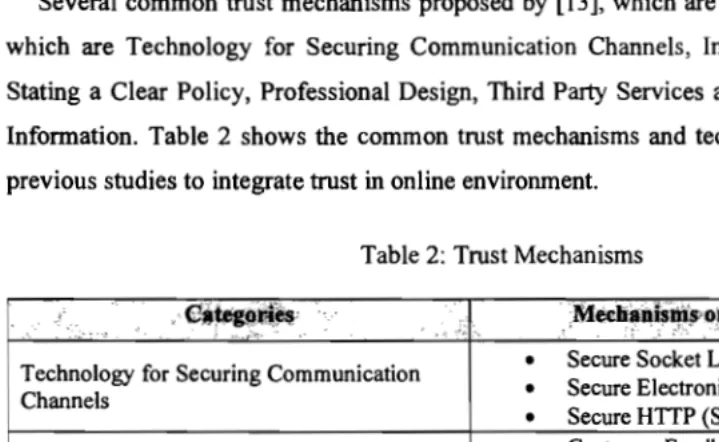
Several common trust mechanisms proposed by [13], which are divided into 6 categories,
which are Technology for Securing Communication Channels, Interacting with Customer,
Stating a Clear Policy, Professional Design, Third Party Services and Vendor's and Product
Information. Table 2 shows the common trust mechanisms and technologieC) pointed out by
previous studies to integrate trust in online environment.
Table 2: Trust Mechanisms
.
.,l , .··C,,~r~~s
,;; .. ,Mtcll~il~s~;"or'~~!I~ologj"
•
Secure Socket Layer (SSL) Technology for Securing Communication•
Secure Electronic Transfer (SET) Channels•
Secure HTTP (S-HTTP)•
Customer FeedbackInteracting with Consumer
•
User Testimonials•
Reference from Past Users•
Privacy Statement Stating A Clear Policy•
Security Policy•
Graphical, Color•
Symmetric Framework Utilizing Professional Design•
Personalization•
Easy to use Navigation•
Trust seal programs Acquiring Third Party Services•
Digital certificate•
SSL verification•
Physical Location of Company Accurate Vendor's and Product Information•
Company Contact Information•
Product Details, Pricing & QualityJilid 20, Bi\.2 (Disember 2008) Jurnal Teknologi Maklumat
3. TRUST MECHANISMS TO BUILD ONLINE TRUST
There is a strong relation between consumer trust and security aspects that govern the
whole transaction processes in an e-Commerce website. As a new form of commercial
activity, e-Commerce involves more uncertainty and risks that traditional commerce because
they are less well known to consumers. Factors that are affecting trust in e-Commerce include
security risks, privacy issue and lack of reliability e-Commerce processes in general [14]. A
consumer cannot monitor the safety and security of sending sensitive personal and fmancial
infonnation [8]. Online business organizations should search for high-tech security
mechanism to protect itself from intrusion and also protect it customer from being indirectly
invaded. There are two lines of defense for e-Commerce, which are technology solutions and
policy solutions [7]. A great deal of progress has been made by both private security fInns,
corporate and home users, network administrators, technology fInns and government agencies
to overcome and reduces the issue of security breaches and invasion of privacy since the past
few years. There are also several technologies and mechanisms that focus on building trust
and provide a safety online business transaction in the market today.
Several common trust mechanisms proposed by [13], which are divided into 6 categories,
which are Technology for Securing Communication Channels, Interacting with Customer,
Stating a Clear Policy, Professional Design, Third Party Services and Vendor's and Product
Information. Table 2 shows the common trust mechanisms and technologie':i pointed out by
previous studies to integrate trust in online environment.
Table 2: Trust Mechanisms
, ' "eJ*r~~!I' , ' , ',MecbJlil,slfi~'o.t::'~~!I~olog'~
Technology for Securing Communication
•
Secure Socket Layer (SSL)Channels
•
Secure Electronic Transfer (SET)•
Secure HTIP (S-HTTP)•
Customer Feedback Interacting with Consumer•
User Testimonials•
Reference from Past Users Stating A Clear Policy•
Privacy Statement•
Security Policv•
Graphical, Color Utilizing Professional Design•
Symmetric Framework•
Personalization•
Easy to use Navigation•
Trust seal programs Acquiring Third Party Services•
Digital certificate•
SSL verification•
Physical Location of Company Accurate Vendor's and Product Information•
Company Contact Information•
Product Details, Pricing&QualityJilid 20, Bil.2 (Disember 2008) Jurnal Teknologi Maklumat 3. TRUST MECHANISMS TO BUILD ONLINE TRUST
There is a strong relation between consumer trust and security aspects that govern the
whole transaction processes in an e-Commerce website. As a new form of commercial
activity, e-Commerce involves more uncertainty and risks that traditional commerce because
they are less well known to consumers. Factors that are affecting trust in e-Commerce include
security risks, privacy issue and lack of reliability e-Commerce processes in general [14]. A
consumer cannot monitor the safety and security of sending sensitive personal and fmancial
infonnation [8]. Online business organizations should search for high-tech security
mechanism to protect itself from intrusion and also protect it customer from being indirectly
invaded. There are two lines of defense for e-Commerce, which are technology solutions and
policy solutions [7]. A great deal of progress has been made by both private security fInns,
corporate and home users, network administrators, technology fInns and government agencies
to overcome and reduces the issue of security breaches and invasion of privacy since the past
few years. There are also several technologies and mechanisms that focus on building trust
and provide a safety online business transaction in the market today.
Several common trust mechanisms proposed by [13], which are divided into 6 categories,
which are Technology for Securing Communication Channels, Interacting with Customer,
Stating a Clear Policy, Professional Design, Third Party Services and Vendor's and Product
Information. Table 2 shows the common trust mechanisms and technologie':i pointed out by
previous studies to integrate trust in online environment.
Table 2: Trust Mechanisms
, ' "eJ*r~~!I' , ' , ',MecbJlil,slfi~'o.t::'~~!I~olog'~
Technology for Securing Communication
•
Secure Socket Layer (SSL)Channels
•
Secure Electronic Transfer (SET)•
Secure HTIP (S-HTTP)•
Customer Feedback Interacting with Consumer•
User Testimonials•
Reference from Past Users Stating A Clear Policy•
Privacy Statement•
Security Policv•
Graphical, Color Utilizing Professional Design•
Symmetric Framework•
Personalization•
Easy to use Navigation•
Trust seal programs Acquiring Third Party Services•
Digital certificate•
SSL verification•
Physical Location of Company Accurate Vendor's and Product Information•
Company Contact Information•
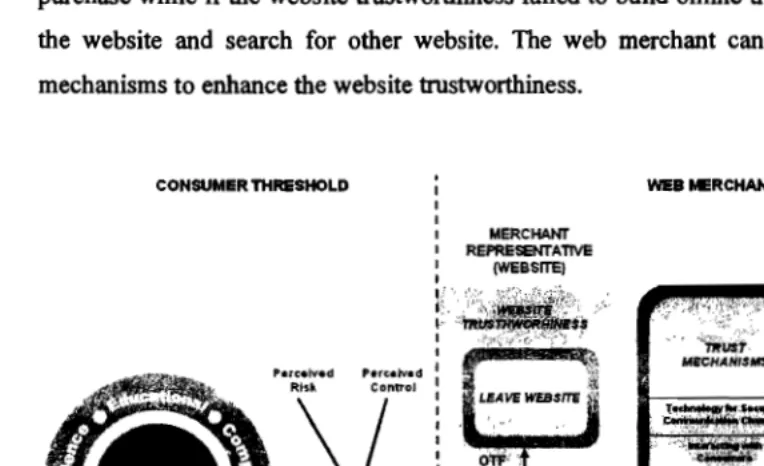
Product Details, Pricing&QualityThe model proposed in this study in shown in Figure I. The model is divided into 2
thresholds, the consumer threshold and the web merchant threshold. Base on the model,
consumer intention to purchase is influenced by 4 personal characteristics. When a consumer
visits an unfamiliar website, the initial trust existed due to the uncertainty of risks and control
and the perceived risk threshold is exceeded, consumer will then explore and evaluate the
website's trustworthiness. If online trust is built, it will result in actual product or service
purchase while if the website trustworthiness failed to build online trust, consumer will leave
the website and search for other website. The web merchant can use the proposed trust
mechanisms to enhance the website trustworthiness.
CONSUMER THRESHOLD
.
I WEB MERCHANr THRESHOLD II
I MERCHANT
I REPRESENTATIVE
I
I (WEBSITE)
" 1'.
I'
I I
,.rc_lv_d :
Control I
I I I I I
_--IIIIlIJ1Il:
II,
•
OTB = online trust built oTF = online trust tailed
Figure 1: An E-Commerce Trust Model
s.
TESTING THE MODEL APPLICABILITYAn online survey was conducted to view consumer's opinions and acceptance towards the
elements contain in the proposed model. This survey is conducted using a website that offers
free accounts for researchers and businesses. 19 statements were used ranging from
demographic questions to questions related to the elements in the model. Respondents were
chosen among those that have at least one year of online shopping experience. A number of
47 respondent participated and only 27 respondents have at least one year of buying
Jilid 20, Bi!. 2 (Disember 2008) Jumal Teknologi Maklumat
used in the survey an,
have been asked to a
strongly disagree and
have been asked to n
option I for very not i
Tab
Elements Trust Mechanisl
Initial Trust
Internet Mercht Characteristic
Consumer Charact,
Jilid 20, Bil.2 (Disembc The model proposed in this study in shown in Figure I. The model is divided into 2
thresholds, the consumer threshold and the web merchant threshold. Base on the model,
consumer intention to purchase is influenced by 4 personal characteristics. When a consumer
visits an unfamiliar website, the initial trust existed due to the uncertainty of risks and control
and the perceived risk threshold is exceeded, consumer will then explore and evaluate the
website's trustworthiness. If online trust is built, it will result in actual product or service
purchase while if the website trustworthiness failed to build online trust, consumer will leave
the website and search for other website. The web merchant can use the proposed trust
mechanisms to enhance the website trustworthiness.
CONSUMER THRESHOLD I I I
I MERCHANT
I REPRESENTATIVE
: (WEBSrrE)
,.
f.
WEBMERCHAHr~ESHOLD
OTe= online trust bui"
OiF=online trust tailed
Figure 1: An E-Commerce Trust Model
s.
TESTING THE MODEL APPLICABILITYAnonline survey was conducted to view consumer's opinions and acceptance towards the
elements contain in the proposed model. This survey is conducted using a website that offers
free accounts for researchers and businesses. 19 statements were used ranging from
demographic questions to questions related to the elements in the model. Respondents were
chosen among those that have at least one year of online shopping experience. A number of
47 respondent participated and only 27 respondents have at least one year of buying
Jilid 20, Bil. 2 (Disember 2008) Jurnal Teknologi Maklumat
The model proposed in this study in shown in Figure I. The model is divided into 2
thresholds, the consumer threshold and the web merchant threshold. Base on the model,
consumer intention to purchase is influenced by 4 personal characteristics. When a consumer
visits an unfamiliar website, the initial trust existed due to the uncertainty of risks and control
and the perceived risk threshold is exceeded, consumer will then explore and evaluate the
website's trustworthiness. If online trust is built, it will result in actual product or service
purchase while if the website trustworthiness failed to build online trust, consumer will leave
the website and search for other website. The web merchant can use the proposed trust
mechanisms to enhance the website trustworthiness.
CONSUMER THRESHOLD I I I
I MERCHANT
I REPRESENTATIVE
: (WEBSrrE)
,.
f.
WEBMERCHAHr~ESHOLD
OTe= online trust bui"
OiF=online trust tailed
Figure 1: An E-Commerce Trust Model
s.
TESTING THE MODEL APPLICABILITYAnonline survey was conducted to view consumer's opinions and acceptance towards the
elements contain in the proposed model. This survey is conducted using a website that offers
free accounts for researchers and businesses. 19 statements were used ranging from
demographic questions to questions related to the elements in the model. Respondents were
chosen among those that have at least one year of online shopping experience. A number of
47 respondent participated and only 27 respondents have at least one year of buying