Analysis of an Open Tandem
Queueing Network with
Population Constraint and
Constant Service Times
Y. Rhee
H. G. Perras
-Center for Communications and Signal Processing
Department of Computer Science
North Carolina State University
Analysis of an Open Tandem Queueing
Network with Population Constraint and
Constant Service Times
1Young Rhee
Graduate Program in Operations Research and Center for Communications and Signal Processing
North Carolina State University Raleigh, NC 27695-7913
Harry G. Perras
Computer Science Department and
Center for Communications and Signal Processing North Carolina State University
Raleigh, NC 27695-8206
ABSTRACT.
We consider an open tandem queueing network with population constraint and constant service times. The total number of customers that maybe presented in the network can not exceed a given value K. Customers arriving at the queueing network when there are more than K customers are forced to wait in an external queue. The arrival process to the queueing network is assumed to
be arbitrary.
We show that this queueing network can be transformed into a simple
net-work involving only two nodes. Using this simple netnet-work, we obtain an upper and
lower bound on the mean waiting time. These bounds can be easily calculated.
Validations against simulation data establish the tightness of these.
KEY WORDS: open queueing network, population constraint, constant service
1. Introduction
In this paper, we consider an open tandem queueing network with constant
service times and population constraint. The total number of customers
simul-taneously present in the network can not exceed a given value K. Customers arriving while the network has K or more customers are forced to wait in an ex-ternal queue which is assumed to have an infinite capacity. As soon as a customer
leaves the network, the first customer in the external queue is allowed to enter
the network. Queueing networks with population constraints do not have a closed
form solution. As a result, several approximate solutions have been proposed in
the literature.
In a population constrained queueing network, the number of customers in
the network can be controlled by a semaphore queue. A semaphore queue consists
of an external queue for customers waiting to enter the queueing network and a
token pool for unused tokens. A customer can not enter the queueing network
unless it has a token. A customer arriving at the queueing network to find the
token queue empty, is queued in the external queue. Upon departure of a
cus-tomer from the queueing network, the token is returned back to the pool. At
that moment, if there is at least one customer waiting in the external queue, the
first customer takes the token and enters the queueing network. The semaphore
queue mechanism was first used to model window flow control mechanisms in
solving an open queueing network with Poisson arrivals and exponential service
times which consists of several subnetworks where each subnetwork is controlled
by semaphore queue. They used this type of network to model the nested
slid-ing window flow control mechanisms. Dallery [3] analyzed a single class open
queueing network with population constraint assuming Coxian service times. He
first transformed the basic open model into an equivalent closed model by
ex-changing the roles of customers and tokens. The model obtained was a closed
queueing network whose population is equal to the maximum allowable number
of customers in the open queueing network. The closed queueing network was
then analyzed using Marie's approximation method
[14].
Shapiro and Perros[21]
presented a hierarchical method for analyzing nested sliding window flow control
mechanisms with packet fragmentation and reassembly. An approximation
algo-rithm was presented to hierarchically reduce the network to a single queue whose
performance characteristics represented the original network. Perros, Dallery and
Pujolle [18] extended the approach proposed in Dallery [3] in order to analyze open
multiclass queueing networks with class dependent population constraints. Other
semaphore controlled queueing models have been also considered in the literature.
For two node queueing networks with population constraint see Perros [17] and
references within. Lam [10] extended the class of multichain queueing networks
arrivals and exponential service times. They derived the stability condition and proposed an analytic approximation for the mean waiting time.
Several studies of open tandem queueing network with constant service time and without a population constraint have been reported in the literature. A vi-Itzhak [2] and Friedman [5] analyzed an open tandem configuration with blocking and constant service times, assuming that the first queue has an unlimited capac-ity. Altiok and Kao
[1]
presented a lower and upper bound on the throughput of the same queueing network assuming that the first queue is finite. Ziegler and Schilling [22] and Gall [6] studied the delay decomposition in a queueing network with Poisson arrivals and constant service times and assume to be infinite capac-ity queue. Shalmon and Kaplan [20] considered a tandem network with constant service times and multiple interfering sources. Assuming that all nodes have an infinite capacity, they derived the steady-state moment generating function for the waiting time. They also presented a complete delay analysis for an embeddedMIG/1
queue and a batch arrivalMIG/1
queue. Finally, Newell [16] analyzed a tandem network with constant service times, assuming that the first node is saturated.and lower bound of the mean waiting time in the queueing network. An improved
upper and lower bound is also described. In section 4, we establish the tightness of these bounds using simulation results. Finally, the conclusions are given in
section 5.
2. An open tandem queueing network with population constraint.
Let us consider an open tandem queueing network with a population
con-straint and constant service times. We assume that the queueing network consists
of
N
nodes. The arrival process to the queueing network is assumed to be agenerally independent with rate Aand the service time at each node is constant
equal to
s.,
i=
1,2 ...N. The population constraint of the queueing network is controlled by a semaphore as shown in Figure 1.External Queue
=8~=c0""=B
SkenpOOI
K
L
Tokens
Figure 1: An open queueing network with constant service times
The semaphore mechanism consists of a pool of K tokens and an external queue. An arriving customer takes a token and enters the queueing network. The
returned to the pool in zero time. Customers that arrive during the time when
the pool is empty are forced to wait in the external queue. The first customer in
the external queue enters the queueing network as soon as a token is returned to
the pool.
For this queueing network, the waiting time of a customer remains the same
even though the order of the service times is rearranged.
External Queue
Token Pool
K Tokens
s = SI =max {s~,i=1,2..N }
K 1 ~
Figure 2: Rearranged open queueing network with constant service times
Theorem 1. Let us rearrange the original open queueing network into an open queueing network where the node with the longest service time is placed at the
begining of the queueing network as shown in Figure2. A customer's waiting time in either queueing network is the same.
Proof. Let Wpj be customer p's waiting time at node
i,
j==
1,2, ...N. Also, let apj be the interarrival time between the pth and the (p - 1).t
customer to nodei,
j=
1,2 ...N,
and apO be customer p's interarrival time to the external queue. Finally, let S1c= max{Sj,j = 1,2, ...N},
that is thek
t h node is assumed to be theWe first consider the case that an arriving customerpin the original queueing
network finds the token pool non-empty, We assume that arriving customers are
numbered sequentially, and thatpis the sequential number of our tagged customer.
Let
wi
be the it h customer's waiting time in the external queue. Then customer p's interarrival time to the first node is apl=
apO - W;_l- Ifthe first node is idle,then customer p does not wait at the first node, and the interarrival time to the
second node is a p2
=
apl - W(p-l)l- However, if the first node is busy, then the interarrival time to the second node is ap 2 = 81 and customer p's waiting time atthe first node is Wpl
=
W(p-1)1+
81 - ap 1 . In general, for any node j (j ~k),
wehave
ifWpj
>
0if Wpj = 0
(1)
max{O,W(p-1);
+
8; - api} for j ~ k(2)
There is no waiting for customer p after node k, because the interarrival time is
always larger than the service time of the subsequent nodes. The total amount of
waiting for customer p, Wp , is
Ie
- L
max{O,W(p-l)i+
s; - api}i=l
which can be shown recursively to be equal to
max{O,W(p-l)
+
Sic - apO}(4)
We now observe that in the rearranged queueing network, customer p will only
wait in the first node for a period of time equal to max{O,W(p-l)
+
Sic - apa}.Let us now consider the other case where an arriving customer p in the
original queueing network finds the token pool empty. That is, there are K cus-tomers in the queueing network. Then, customer p has to wait in the external queue until the previous
(p -
K)th
customer leaves. Customer p's arrival timeto the external queue is
Ef=l
aiO and the(p -
K)th
customer's departure time isN p
w;
=
Wp-K+
L
s; -L
aiOi=l
i=p-K+lTherefore, customer p's interarrival time to the first node is
(5)
(6)
Once customer p enters node 1, its waiting time and interarrival times can be calculated using expressions
(1)
and(2).
Therefore, the same customer in therearranged queueing network will wait for the same amount of time as in the
original queueing network. 0
customerp are as follows;
N p
w;
max{O,Wp-K+
L
s; -L
aiO}i=l i=p-K+1
4pl apO
+
We - Wep p-1
if Wpj
>
0if Wpj
=
0 and j2:
1(7)
Let us consider the rearranged queueing network shown in Figure 2. Since
there is no queue after the first node, the time a customer spends in the remaining
nodes is the sum of the service times L~2Si. In view of this, we can represent the
queueing network in Figure 2 by a simpler two-node queueing network as shown
in Figure 3. For presentation purposes we shall refer to these two node as the first
node and the second node. s· represents the longest service time in the network
and8 is the sum of the remaining service times, i.e.,8 = L~l s, - s", The number
of parallel servers at the second node is infinite. A customer's waiting time in the
two-node queueing network is the same as in the rearranged queueing network,
and consequently it is the same as in the original queueing network under study.
Below, we shall concentrate on the two-node queueing network. Forall customers, the interdeparture times from the first node are greater than or equal to s", This
means that the customers at the second node have different residual service times
and the difference between any two consequtive residual service times is greater
second node
s
External queue
Token pool
first node
=0
KTokens
Figure 3: Two-node open queueing network with constant service times
Theorem 2. Let us consider the two-node queueing network as shown in Figure 3 and let K be the allowable number of tokens in the token pool and s" be the service time at the first node and "8 be the service time at the second node. If
Ks"
>
L,~1 Si, then a customer's waiting time in the queueing network is that ofa
GI/ D
/1 queue with a service time s",Proof. Let us consider the instance t{n) when a new busy period of the queueing network begins. Let ui; , ai and T be, the
i
t h customer's waiting time in the network, its interarrival time, i.e., the difference between the arrival times of the(i
-1).t andith customer and the sum of all service times, i.e., L,~l8,
respectively.begining of a busy period, WI
==
0, customer 1's departure time from the first nodeis ten)
+
s", and its departure time from the queueing network is ten)+
T. There is no external waiting time for the firstx»
customers, i.e.wi
== 0,i == 1,2 ...K.For the
ph
customer,(2
~ j ~K),
the waiting time in the first node,wf,j
=1, 2 ...
K,
and its departure time from the first node,df,
and its departure time from the queueing network, dj , are given by the following expressions;w~1
d·1
max{O,Wj-I
+
8- - ai};
ten)
+
L
a;+
Wj+
s·i=2
j
ten)
+
L
a;+
Wj+
Ti=2
(8)
(9)
(10)
The time when the first token returns to the pool is ten)
+
T,
which is equal to dl .The time when the first node is free for the
(K
+
l)·t
customer is ten)+
2:~2ai+
WK
+
8·,
i.e., d~, which is also equal to ten)+
2:~lus;+
K
8-.
Finally, the time when the(K
+
1)·t
customer arrives to the external queue is ten)+2:f::i1
ai. Since we assumeK
8·2:
2:~1 Si, thendk
2:
dl,
which means the waiting time dependson the time when the first node is free for the
(K
+
1)·t
customer only. In other words, once an arriving customer experiences the external queue waiting time, then the customer has to wait in the first node. For the(K
+
1).t
arrivmg customer, the external queue and the first node waiting times areK+l
max{O, T -
L
ail
(11)
For the
(K
+
2)nd
arriving customer, the arrival time is t{n)+
'E~t2 a; and the time of the second token's returning to the pool is t{n)+
a2+
W2+
T. Therefore,e
d
fwK+2 an wK+2 are
K+2
max{O,T
+
W2 -L
aili=3
(12)
In general, for the
lth
customer,wi =
max{O,T+
Wl-K - 'E~=l-K+l ail andw{
=
max{O,WI-l
+
8* -all -
wi.
The departure time from the first node isd{
=
'E~=2 a.;
+
ui;+ 8·
and the departure time from the network is d,=
'E~=2a;+
WI+
T.For the
(1
+
K)th
customer, the arrival time to the external queue is 'E~~fa,and
the token's arrival time to the pool is 'E~=2 ai
+
WI+
T. For the (1+
K)th
customer,we have;
(13)
Now, let us consider a
GI/ D
/1 queue with a service time equal to 8·. Thewaiting time and departure time of the
jth
customer is;W·J max{O,Wj-l
+
s" - aj}(14)
i
d·J
L
a;+
Wj+
s·(15)
We note that the expression for the waiting time of a customer in the network,
i.e.
wi
+
w{,
is identical to(14).
0For a queueing network with constant service times, the number of tokens
in the network, i.e. the size of the window, may influence where customers wait internally in the network. However, a customer's waiting time in the network
is independent of the number of tokens in the network, when
K
~K·
whereK·
==
r
;'1.
This can be easily shown using the above Theorem 2. IfK
8·2:
T,
then the waiting time of a customer is the same as that of a
GI/ D
/1 queue, whichis independent of K. Thus, we have the following corrolary.
Corrolary 1. The waiting time of a customer in the two-node queueing network is independent of the number of tokens K, when K ::; K·
=
r
;'1·
Finally, we observe that when K ~ N, then
Ks·
~Ns·
~ T, and hence Theorem 2 holds. Therefore, we have the following corrolary.Corrolary 2. If K ~ N, then Theorem 2 always holds.
3. Bounds on the mean waiting time
In this section, we present a lower and an upper bound of the mean waiting
time in the original queueing network assuming that Ks"
<
T. First, we consider the single token case and then the multiple token case.Inthe case where the token pool consists of one token, the original queueing network is reduced to a
GI/ D
/1
queue with a service time equal toT.
If the arrival process is Poisson, then we obtain an M / D/1
queue in general, and the mean waiting time is given by Khinchin-Pollaczek formula, i.e.,w
=2(:~
p) where p=
Ax
is traffic intensity(16)
However, for the
GI/G/l
queue, there is no exact expression available for the mean waiting time. Marshall [15] and Marchal [13] give the following bounds for theGI/G/l.
{O
A2u1+p(p-2)}
W '\(u~+u1)max
<
<
-, 2'\(1 -
p)
-
q - 2(1 -p)
(17)
where u~ and
u1
are the variances of interarrival distribution and service time distribution respectively. For the case of the constant service time, the variance<71
is zero. Therefore, the lower bound is always zero. Marchal [12] obtained the following approximation for the lower bound of the mean waiting time in aGljGjl
queue;,\2(u~
+
u~)__
1_+_P
2'\(1 -
p)
2,\(18)
Langenbach-Belz [9] is
(19)
where c; and
C;
are the squared coefficient of variation of the interarrival timeand service times respectively, and
{
exp(-2(1 -
p)P(21~))
if
~
<
12 2 p & •
g(Ca,c.,p)
=
exp(
-(1 -
p)
(~+:~»)
otherwise3.2 The multiple token case
Below, we obtain a lower and upper bound on the mean waiting time,
as-suming that
K
8*<
T.
3.2.1 A lower bound on the mean waiting time
Let us consider the equivalent queueing network shown in Figure 3. We note
that the tokens are used in the order in which they arrive at the token pool. For
the semaphore controlled queueing network. Obviously, this service time depends
on how many other tokens are being used at the same time. In other words, the
service time in a queue depends on the state of the remaining
(K -
1)
queues.A lower bound on the mean waiting time can be easily obtained by setting the service time of each of these
K
queues equal toT
(==
I:~18i),
i.e., independentof the state of the other queues. Ifthe arrival process to the original queueing
network is a general independent process with arrival rate
A,
then the arrival process to each of theK
queues is the convolution ofK
general. arrival process withan arrival rate
ic.
Thus, each queue can be analyzed as a GI~GI~...
~GI/D/lqueue, where GI~GI0
... 0GI
is the convolution of theK
arrival processes, andthe service time is equal to T. When the arrival process to the queueing network is Poisson with an arrival rate A, the arrival process to each queue becomes an Erlang distribution with
K
phases and an arrival rateA
for each phase.3.2.2 An upper bound on the mean waiting time
Let us consider the queueing network under study assuming that the external
queue is saturated. That is, there is always at least one customer waiting in the
external queue. In this case, all K tokens are continuously used. Let us consider the case where T
>
s": In this case, a token arriving to the first node always findsK
the node empty. Thus, the time it takes for a token to return to the token pool
external queue is saturated, the average throughput is ~. The conjecture from
this is that the average throughput of the two-node queueing network lies between
.: and ~. Therefore, An upper bound on the mean waiting time can be obtained
by representing a
GIIDI1
queue with a service time equal to max{s·,i}.
The mean waiting time in this queue can be obtained using (16) for the
arrival process is Poisson. For non-Poisson arrival process, we can obtain the
bounded mean waiting time by
(17)
or the approximation value by(19).
3.3 Stability conditions
Generally, it is known that the stability condition for the queueing network
IS
AT
K
(20)
We note that both analytic models for the lower and upper bound' satisfy this
3.4 An improved bound on the mean waiting time
Inthe previous section, we obtained an upper and lower bounds of the mean waiting time in the queueing network using single server queues. Below, we obtain tighter bounds by appropriately combining these single server queues.
3.4.1 An improved upper bound
During the time that the external queue is busy (i.e., the token pool is empty), we approximate the mean waiting time in the two-node queueing network by that of a GI/ D /1 queue with service time ~ ( i.e., the upper bound ). This is because,in this case, the average throughput is ~. However, during the time that the external queue is idle, we approximate the mean waiting time in the queueing network by that of a GI/ D
/1
queue with service time s", This is because, in this case, an arriving customer may go straight into the first node (if there is a token in the pool upon arrival) and the average throughput of the two-node queueing network lies between.1.
and ~. LetPh
andPi
be the probability that the external queue of the two-node queueing network is busy and idle respectively. We havePi
== 1 -Ph,
andPh
is approximately taken to be equal tof.
Thus, the mean waiting time in the queueing network is approximated by the quantity:(21)
where
WI,
the mean waiting time of aGI / D
/1
queue with service time~
andFor the Poisson arrival process, we first obtain probabilities
P
b andPi
thatan M / D
/1
queue with service time ~ is busy and idle respectively. We haveP
b = p andPi
= 1 - p, where p=
>J.
Let WI and W2 be the mean waitingtime in the M / D
/1
queue with service timei
and 8- respectively. The improvedupper bound on the mean waiting time can be obtained by combining WI and W2
as follows,
(22)
For non-Poisson arrival processes, we do not have an exact expression for
the mean waiting time in a GI/ D
/1
queue. In this case, we can use one of theapproximations mentioned in section 3.1.
3.4.2 An improved lower bound
This lower bound in section 3.2.1 was derived by decomposing the two-node
queueing network into K parallel and independent queues. Let p
=
>J
be the probability that one of the parallel queues is busy. Then, pK is the probabilitythat all K queues are busy. When all K tokens in the two-node queueing network
are used, this is approximately equivalent to all parallel queues being busy.
by that of a
GI / D
/1 queue with service timei:.
This event is assumed to occur approximately with probability pK. However, when not all tokens are used, the mean waiting time in the two-node queueing network is approximated by the lower bound given in section 3.2.1, referred to as W3 • Thus, the improved lower bound on the mean waiting time,W,
can be obtained by combining WI and W3as follows:
(23)
4. Numerical output
The lower and upper bounds given in section 3.4 were checked by compar-mg them against simulation estimates of the mean waiting time in the queue-ing network. The experiments were carried out assummqueue-ing Poisson arrivals and phase-type arrival process, i.e., Erlang and hyper-exponential distributions.
Example 1
A Poisson arrival process is assumed with an arrival rate A = ~, 8*
=
2.5and :9
=
28.~ number of tokens
~
51 8 10
~
Marchal's upper bound 23.72 9.28 5.77 4.18 3.28 2.70 K. and L.B. upper bound 18.10 5.17 2.49 1.56 1.13 0.90 simulated upper bound 18.10 5.17 2.49 1.56 1.13 0.90 sim. mean waiting time 17.45 4.25 1.80 1.06 0.80 0.70 simulated lower bound 17.11 3.99 1.30 0.48 0.20 0.10 K. and L.B. lower bound 16.60 2.78 0.52 0.09 0.01 0.01 Marchal's lower bound 11.92 1.36 0.21 0.03 0.01 0.00
10
Number of tokens 9
Marchal's Lower Bound
8
c••••••••••~
.. Marchal's Upper Buond ... K.&L.B. Upper Bound
• • Simulated Upper Bound
o 0 Sim. Mean Waiting Time
c a Simulated Lower Bound
D -c K.&L.B. Lower Bound
7 6 5
•
.
.
....
~ ~.
~...
.
.
.
..
.
\
~..
.
~..
.
~..
.
..
...
...
..
...
...
...
...•
Example 2
The arrival process is an Erlang 2 with a phase arrival arrival rate
=
3~510
~
~
5Marchal's upper bound 11.86 4.64 2.89 2.09 1.64 1.35 K. and L.B upper bound 9.91 3.12 1.67 1.11 0.83 0.68 simulated upper bound 8.53 2.13 0.97 0.55 0.36 0.28 sim. mean waiting time 7.24 1.30 0.40 0.25 0.20 0.20 simulated lower bound 7.88 1.33 0.30 0.10 0.001 0.0 K. and L.B lower bound 7.64 0.77 0.07 0.01 0.00 0.00 Marchal's lower bound 5.96 0.68 0.10 0.02 0.00 0.00
8*
=
2.5 and "3 == 28.~ number of tokens
9 10
Number of tokens Marchal's Lower Bound
8
D••••••••••~
... Marchal'sUpperBuond ... K.&L.B. UpperBound
• • Simulated Upper Bound
o 0 Sim. MeanWaitingTime
o D SimulatedLower Bound
0 ...·.···0[] K.&L.B. LowerBound
7 6 5 a
...
.
..
..
.
.
.
e e e e e•• e.•...
•
~.
~ ~ ~•••
,.
~ ,,.
.
.
.
,.
.
.
.
.
.
.
.
.
.
.
".\
",~
.
,,
.
.
,,.
.
,,.
.
,,.
.
,,.
.
,.
.
.
,,.
.
.
.
,,.
.
...
,..
,,..
..
-,..
<. •••• -',...
"-,.
--,
.
"-".
...
.
..
... 5Example
3The arrival process is a H2 with P1
==
~, P2==
~,Al
==
115 and
A2
==
~. Thesquared coefficient of the variation for the arrival process c;
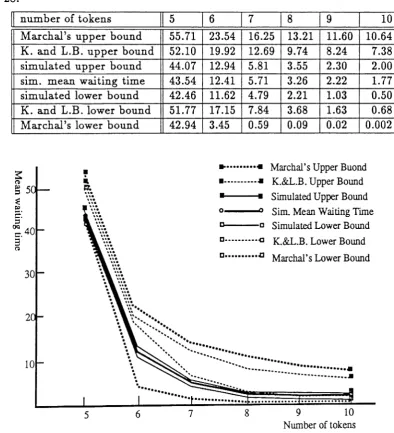
==
2.31, 8·==
2.5 and:3
==
28.~ number of tokens
~
5 1 8 10~
Marchal's upper bound 55.71 23.54 16.25 13.21 11.60 10.64 K. and L.B. upper bound 52.10 19.92 12.69 9.74 8.24 7.38 simulated upper bound 44.07 12.94 5.81 3.55 2.30 2.00 sim. mean waiting time 43.54 12.41 5.71 3.26 2.22 1.77 simulated lower bound 42.46 11.62 4.79 2.21 1.03 0.50 K. and L.B. lower bound 51.77 17.15 7.84 3.68 1.63 0.68 Marchal's lower bound 42.94 3.45 0.59 0.09 0.02 0.002
9 10
Number of tokens Marchal's LowerBOWld
8
c••••••••••.c
... Marchal's UpperBuond ... K.&L.B. UpperBound
• • Simulated UpperBOWld
o 0 Sim. Mean Waiting Tune
C C Simulated Lower Bound 0 -0 K.&L.B. Lower Bound
7 6 5 !I
•
~~~
"::~~
•• 'I.'I.
•• 'I.'I.
•
.
.
'I.,.,.
..
•
.
.
'I..
..
,
..
.
.
.
".
.,.
,..
•.
'I...
..
-:. "~'I •••
• n.. ••
~ .,
.
~ ",.
\ ''''I ..' .
~ ..
.
\ ''''I • •••••••••••
~ "'I • •••••••••••
\....
.
-
~~~~~~~~~~::::~
...
...
.2
30
10
5. Conclusions
We consider an open tandem queueing network with population constraint
and constant service times.
It is shown that this queueing network can be transformed into a simple
queueing network involving only two nodes. Using this simple queueing network,
we obtain an upper and lower bound on the mean waiting time. These bounds
can be easily calculated. Simulation experiments showed that the lower bound is
a very good approximation when the number of tokens is small. The upper bound
References
[1] T. Altiok and Z. Kao, "Bounds for throuput in production/inventory systems in series with deterministic processing times", Dept. of IE Rutgers Univ., May 1987.
[2] B.
Avi-Itzhak,"A
sequence of service stations with arbitrary input andreg-ular service times", Mangement Science, 11(1965) 565-571.
[3] Y.
Dallery, "Approximate analysis of general open queueing networks withrestricted capacity", Technical Report
LAG,
N87-08, 1987, revised Feb. 1989. [4]S.
Fdida, H. Perros, and A. Wilk, "Semaphore queues: Modeling multi-layered window flow control mechanisms", IEEE Trans. Camm., 38,pp.309-317, 1990.
[5] R.D.
Friedman, "Reduction methods for Tandem queueing system."Opera-tions Research, V-13, 1965.
[6] P. L.
Gall, "Packetized queueing networks and window flow control." CNET,Issy-Ies-Moulineaux, France.
[8] J.F.C.
Kingman, "Some inequalitiesfor the queueGI/G/l",
Biometrika,v-49. pp. 315-324, 1962.
[9] Kramer and Langenbach-Belz, "Approximate formulae for the delay in the queueing system
GI/G/1."
Eight Int. Tele. Con., Melbourne,235/1-8
[10]
5.5.
Lam, "Queueing networks with population size constraint,"IBM
J.RD,
v-197, pp. 370-378.
[11] Lindley, "Theory of queue with single server", Proc. Camb. Phil. Soc., 48
pp. 277-289, 1952.
[12]
W.G.
Marchal,"A
modified Erlang approach to approximatingGI/G/1
queues", J.Appl.Prob., 13, pp. 118-126, 1976.
[13]
W.G.
Marchal, "Some simpler bounds on the mean queueing time",Opera-tions Research, v-26, No 6, pp. 1083-1088, 1978.
[14] R. Marie, "An approximate analytical method for general queueing net-works", IEEE Trans. on Software Engineering, SE-5, n5, pp. 530-538, 1979.
[15] K. T. Marshall, "Some inequalities in queueing", Operations Research, v-16, pp. 651-665, 1968.
[16] G.F. Newell. "Approximate behavior of tandem queues", Lecture note m
[17] R.G. Perros, "Queueing Networks with Blocking", Performance
Evaluation
Review, 12, pp. 8-12, 1984.
[18]
B.G.
Perros, Y.Dallery andG.
Pujolle, "Analysis of a queueing network model with class dependent window flow control",IEEE
Infocom, pp. 968-977, 1992. [19] M. Reiser, "Admission delays on virtual ruotes with window flow control",in Proc. Per/arm. Data Commun. Syst. Appl., Pujolle,
Ed.,
North-Holland,pp. 67-76, 1981.
[20] M.
Shalmon andM.
Kaplan, "A tandem network of queues with deterministic service and intermediate arrivals", Operations Research, v-32, n4, pp. 753-773, 1984.[21]
G.W. Shapiro and R.G. Perros, "Nested sliding window protocols with packet fragmentation",CCSP TR-89/15,
North Carolina State University.[22]
C.
Ziegler andD.L.
Schilling, "Delay decomposition at a single server queue with constant service time and multiple inputs",IEEE Trans. on Commun.,