ABSTRACT
STANHOPE, DANIEL STERLING. Core Self-Evaluations in the Context of Training: The Impact of Self-Regard on Training Outcomes. (Under the direction of Samuel B. Pond III.)
Research supports the viability of the core self-evaluations construct in multiple work contexts, but the training domain is absent investigation. This study used hierarchical
Self-Regard on Training Outcomes
by
Daniel S. Stanhope
A thesis submitted to the Graduate Faculty of North Carolina State University
in partial fulfillment of the requirements for the Degree of
Master of Science Psychology Raleigh, North Carolina
2010
APPROVED BY:
_________________________ _________________________ S. Bartholomew Craig Mark A. Wilson
________________________________ Samuel B. Pond III
BIOGRAPHY
Daniel Sterling Stanhope is a native of the Midwest, born and raised in Topeka, KS. After graduating from a private high school, he attended the University of Kansas for his undergraduate education. He graduated Magna cum Laude with a Bachelor of Arts degree in Psychology. After graduation, he immediately transitioned to graduate school at North Carolina State University in the Industrial and Organizational Psychology doctoral program. His research interests include training (broadly), test development and validation,
performance measurement and management, individual differences, intraindividual temporal development, and leadership (broadly). Ask him again the next time you see him, and that list will undoubtedly have several additions. He has held multiple past and present
employment positions including his current roles as associate consultant at SWA Consulting Inc., graduate research assistant at the Friday Institute for Educational Innovation, and member of the editorial review board for the Meridian Journal. He is passionate about the application of psychological science to various workplace settings and has engaged in
ACKNOWLEDGEMENTS
I want to offer my sincere appreciation to my committee—Dr. Samuel B. Pond III, Dr. S. Bartholomew Craig, and Dr. Mark A. Wilson—whose insightful feedback and direction helped enable this research endeavor to come to fruition. To my committee chair, Dr. Samuel B. Pond III, thank you for artfully shaping my rococo writing style into a
science-oriented style appropriate for this manuscript—perhaps your tutelage will prevent me from having to redirect my career toward journalism at the New York Times.
Secondly, I want to thank SWA Consulting, Inc. for not only employing me and affording me many propitious opportunities, but also for allowing me to use data that I had a hand in collecting, processing, and analyzing. The guidance and support you have offered throughout my time of employment has not gone unappreciated.
Thirdly, I want to thank several sources who I continue to learn immensely from: Jason Dean Stanhope, William Sterling Stanhope, and Linnell Odoi Stanhope. The initial being his brother, best friend, and constant source of energy and motivation; the centermost being the father that made him the man he is proud to be; and the lattermost being his mother, sagacious teacher, and ultimate inspiration.
TABLE OF CONTENTS
LIST OF TABLES ... vi
CORE SELF-EVALUATIONS IN THE CONTEXT OF TRAINING: THE IMPACT OF SELF-REGARD ON TRAINING OUTCOMES ...1
Theoretical Background of Core Self-Evaluations ...2
Four Indicators of Core Self-Evaluations ...3
General Self-Efficacy...3
Emotional Stability ...4
Locus of Control ...5
Self-Esteem ...6
CSES: The Construct and the Measure ...7
Core Self-Evaluations and Training ...8
CSE and Training Effectiveness ...8
CSE, Training Criteria, and Hypotheses ...11
CSE and Level 1 (Reactions) ...11
CSE and Level 2 (Learning) ...13
CSE and Level 3 (Behavior) ...17
CSE and Level 4 (Results) ...18
Method ...18
Sample and Procedures ...18
Measures ...20
Core Self-Evaluations ...20
Reactions Criteria (Level 1) ...20
Cognitive Learning Criteria (Level 2) ...21
Skill-Based Learning Criteria (Level 2) ...22
Affective Learning Criteria (Level 2) ...22
Behavior Criteria (Level 3) ...23
Cognitive Ability ...24
Training Motivation ...24
Results ...25
Descriptive Statistics and Zero-Order Correlations ...25
CSE and Training Criteria ...26
Incremental Validity over Cognitive Ability and Training Motivation ...29
Discussion ...30
Limitations and Future Research ...38
Conclusion ...42
References ...44
APPENDICES ...64
Appendix A. Thesis Proposal ...65
Appendix B. Core Self-Evaluations ...124
Appendix C. Affective Reactions ...125
Appendix D. Utility Reactions (4-item) ...126
Appendix E. Utility Reactions (3-item) ...127
Appendix F. Metacognitive Activity ...128
Appendix G. Task-Specific Self-Efficacy ...129
Appendix H. Personal Goals ...130
Appendix I. Motivation to Transfer ...131
Appendix J. Intentions to Transfer ...132
LIST OF TABLES
Core Self-Evaluations in the Context of Training: The Impact of Self-Regard on Training Outcomes
In addition to other disciplines in the social and behavioral sciences, industrial and organizational psychology has historically acknowledged the impact of personal disposition on human behavior. Individual differences have myriad linkages with work outcomes, including various training criteria. These outcomes include training motivation (e.g., Colquitt, LePine, & Noe, 2000), training performance (Salas & Cannon-Bowers, 2001), and transfer of training (e.g., Colquitt et al., 2000). Research that supports dispositional influence exploits singular traits such as conscientiousness, as well as multi-dimensional frameworks such as the Five-Factor Model of personality (Costa & McCrae, 1992). Circa 1997, a new dispositional predictor with expected pragmatic value materialized: core self-evaluations.
Core self-evaluations (CSE)—one’s fundamental self-appraisal—is a dispositional construct predictive of various work outcomes (Judge, Locke, & Durham, 1997). Although job satisfaction was the original criterion of interest, empirical inquiries eventually surfaced from researchers interested in the potential of CSE predicting other work outcomes (Judge, Erez, & Bono, 1998). Heretofore, published research has yet to examine the influence of CSE within the training context. Accordingly, the main objective of the present study is to investigate CSE’s relation with training outcomes derived from Levels 1, 2, and 3 of
Kirkpatrick’s (1976) training criteria taxonomy. This study serves to add clarification to the
the quality of a given intervention and ensures benefit for both the trainee and trainer. This study examines a military training program designed to teach foreign language acquisition. Participants are military personnel from an authentic training setting, so this study capitalizes on results obtained with a real-world sample, in a real-world setting. Ultimately, advancing the literature on a nascent construct, within an unexplored context is a step toward the transcendent goal of understanding the influences and dynamics of the human disposition.
Theoretical Background of Core Self-Evaluations
Core self-evaluations (CSE) is a higher-order construct underlying a broad set of personality traits that encompass fundamental self-appraisals including general self-regard, self-assuredness, and self-sufficiency. Soon after introduction to the literature (Judge, Locke, & Durham, 1997), researchers spoke of its promising utility by claiming it ―may further explicate the psychological processes underlying the dispositional source of job satisfaction‖
(Judge, Locke, Durham, & Kluger, 1998, p. 18). A more recent portrayal connotes the shift from a satisfaction-specific conceptualization to a more robust one: ―[CSE is] the
fundamental appraisal of one’s worthiness, effectiveness, and capability as a person‖ (Judge
Four Indicators of Core Self-Evaluations
Judge and colleagues conceptualized CSE as a broad set of personality traits, and applied three stipulations to determine its trait manifestations: evaluative, fundamental, and broad in scope. Judge et al. (1997) used these criteria to identify four indicators: (a) general self-efficacy, (b) emotional stability, (c) locus of control, and (d) self-esteem. Judge and Bono (2001) noted that these traits share many conceptual similarities; and Judge et al. (2003) speculated that these traits share similarities because they are all indicators of a deeper, common core construct (i.e., CSE). These are among the most studied traits in the work outcome literature, and are well represented in the training literature. However, the training context is void any investigation into the latent construct underlying these trait indicators (i.e., CSE). Thus, understanding CSE’s impact on training is called for.
General self-efficacy. General self-efficacy (G-SE) is an indicator of CSE, because
adapted more effectively on tasks of differing complexities. Training often covers unfamiliar or novel knowledge and skills. G-SE accounts for variability across diverse and complex situations, as it reflects self-referent beliefs not confined to the parameters of a given context. So, the decision to engage, the manifestation of heightened motivation, and the persistence of individuals with high G-SE—and thus, high CSE—is accentuated in the training context.
Emotional stability. Emotional stability is a manifestation of CSE, as it reflects the
―tendency to be confident, secure, and steady‖ (Judge & Bono, 2001, p. 80). Low emotional
stability is indicative of negative cognitive and explanatory styles, resulting in a focus on the negative aspects of one’s self (Pinder, 2008, p. 192); and, the proclivity to perceive and recall
negative information and experiences (Johnson, Rosen, & Levy, 2008). These individuals tend to be insecure, apprehensive, and susceptible to feelings of helplessness and anxiety, all of which heighten in novel situations (Costa & McCrae, 1992). Therefore, it is feasible to expect a low CSE trainee to have trouble adjusting to a complex training environment, especially if other stressors are present such as negative feedback, frustration, or social pressure. Further, these trainees are at higher risk for performance anxiety and other handicappers. A trainee high in emotional stability—and thus, CSE—should be poised and able to avoid burning up limited cognitive resources on matters such as impression
Locus of control. Locus of control (LOC) is an indicator of CSE, as it refers to the fundamental beliefs individuals hold concerning who or what controls events in their lives (Rotter, 1966). Internals (internal LOC) believe they control outcomes of events and ascribe causality to internal factors such as effort and ability. Internals attribute successes or failures to factors within themselves, and believe in their own capacity. Externals (external LOC) believe the environment, powerful others, or fate determines events, and tend to attribute successes and failures to external sources. It is unlikely that they intensify effort amid tribulation because they lack belief in their capacity to influence outcomes. The confidence internals possess about outcome controllability influences performance and motivation. A study about military training effectiveness found LOC predicted training performance (Bradley & Nicol, 2006); and Colquitt et al. (2000) found LOC predicted skill acquisition and training transfer. Internal LOC is linked to achievement-orientation, low anxiety, and increased motivation (Spector, 1982). LOC’s affect on motivation and effort is due to belief that actions (e.g., exerting effort) influence attainment of positive outcomes. In fact,
Self-esteem. Self-esteem is the core self-appraisal and most fundamental evaluation of the self (Judge et al., 1998). Self-esteem is key to self-concept, and research shows it has long-term stability (Costa & McCrae, 1994). Those with high self-esteem have consistent and coherent self-concepts, whereas those with low self-esteem have unclear and malleable ones. This instability evinced in Brown and Dutton’s (1995) finding that when those with low self-esteem failed, they overgeneralized the negative implications, which proved deleterious to subsequent performance. However, individuals with high self-esteem construed this as a learning opportunity and did not endure diminished motivation and performance. The training environment is likely to present situations where a trainee encounters hindrances and adversity. The esteem-influenced reactions to these phenomena (e.g., changes in motivation and effort) depend on CSE and ultimately influence the quality of the training experience. As a case in point, Quick, Joplin, Nelson, Mangelsdorff, and Fiedler (1996) linked self-esteem to self-reliance in a military training context. They
CSES: The Construct and the Measure
Measuring singly or in combinations the traits of G-SE, emotional stability, LOC, and self-esteem provides valuable dispositional insight. However, directly measuring the
underlying cause of these manifest indicators (i.e., CSE) is ideal because (a) omitting indicators could result in predictor deficiency and variance unaccounted for, (b) avoiding aggregates and composites helps limit error and helps with reliability and validity, and (c) a direct measure is more precise, practical, and economical. Judge et al. (2003) developed such a measure for CSE called the Core Self-Evaluations Scale (CSES), and employed a series of studies to provide support for its structural and external validity.
Core Self-Evaluations and Training
CSE and Training Effectiveness
Training effectiveness is assessed from both the situation (e.g., training design) and the person (e.g., trainee characteristics). Whereas historically the former has received the most attention (Goldstein & Ford, 2002), the latter has become a focal area of research (e.g., Baldwin & Ford, 1988; Herold, Davis, Fedor, & Parsons, 2002). Not enough focus has been on the learner within the learning context, and Tannenbaum and Yukl (1992) posit that when trainee characteristics are linked to outcomes, investigators typically examine ability or trainability in lieu of disposition. Campbell (1989) quipped that trainees do not fall out of the sky; they bear idiosyncratic experiences, attitudes, and tendencies. Recognizing individual differences and the influence they exert on training effectiveness is advantageous. To date, training literature is void of investigations into whether CSE predicts variance in training outcomes, so any influence I hypothesize is inferential. As basis for these conjectures, I call upon motivational theories, as well as convergent findings from related contexts.
A first theory, Lazarus’s (1991) cognitive appraisal process, posits that the primary
approach and leave training with a positive outlook, opt to engage in training, exert adequate effort throughout training, and believe in their efficacy to influence training outcomes.
A second theory, social-cognitive theory, emphasizes the role of cognitive processing, which facilitates decision-making based on learned expectations and awareness of what leads to desirable outcomes. Bandura (1986) described human capabilities inherent to social-cognitive theory, including (a) anticipation and forethought, (b) regulation, (c) self-reflection, and (d) intentionality. High CSE trainees are likely to positively self-assess and anticipate valued outcomes, which thereby catalyzes intentions and initiates goal-driven behavior. Furthermore, they will adeptly self-regulate learning and performance throughout the experience, as they are ―likely to take on tasks, set goals, alter goals, and attempt to master their environments if they positively assess their own capabilities‖ (Pinder, 2008, p. 461). This culminates in those with high CSE demonstrating heightened training outcomes.
A third theory, valence-instrumentality-expectancy theory (VIE; Vroom, 1964), posits that individuals cognitively weigh the expectancy that a given behavior will lead to outcomes, that outcomes will be rewarded, and that rewards will be valued. The choice of engaging and exerting the requisite effort is based on the individual’s belief that he or she can influence the outcomes. High CSE trainees believe in their self-sufficiency and capacity (LOC), deem themselves capable (G-SE) and worthy (self-esteem), and value the outcomes because success is consistent with their high self-regard. Indeed, Noe (1986) reported that trainees were more motivated to perform well if they perceived that (a) effort led to
A fourth theory that provides rationale for CSE’s influence on training is goal setting
theory. Individuals who set specific, difficult goals and who are committed to those goals are likely to exert effort and perform at high levels (Locke, Latham, & Erez, 1988; Mento, Steel, & Karren, 1987; Tubbs, 1986). Mesmer-Magnus and Viswesvaran (2007) reported that goal setting yielded higher learning outcomes and improved not only training performance, but also the potential that trained knowledge and skills transfer to the job. These findings correspond to Erez and Judge’s (2001) finding of CSE’s relation to motivation, goal setting, and goal commitment. I propose that high CSE trainees set difficult goals, are predisposed to higher goal commitment, heightened motivation, and higher knowledge and skill acquisition and application. Self-concordance theory supplements goal setting, positing that individuals are happiest and most productive when goals match enduring interests and values (Judge, Bono, Erez, & Locke, 2005). If CSE is high, then regard is high and more goal self-concordance is experienced (Luthans & Youssef, 2007). Judge, Bono et al. (2005) found in two studies that CSE related to goal self-concordance, such that individuals with high CSE were more likely to pursue goals for intrinsic and value-congruent reasons. I propose that high CSE trainees will not only set goals that are lofty and consistent with their positive self-concept, but also have commitment and motivation to attain them to sustain their self-image.
self-efficacy faced this predicament, they opted for an intensification of effort. Emotional stability should also help because it allows for avoiding withdrawal-provoking anxiety, viewing the discrepancy as a learning experience, and using negative feedback
constructively. Additionally, a high self-esteem should remain unperturbed and prevent one from altering standards or acting incongruently with his or her positive self-regard. Training presents complex challenges, and I expect that a trainee with high CSE will perform at a level that matches the high standards derived from an esteemed self-worth. In the instance where performance does not meet expectation, rather than reducing standards or
withdrawing, the individual will intensify effort to reach the preconceived levels of learning and performance.
CSE, Training Criteria, and Hypotheses
Kirkpatrick (1976) facilitated training assessment via a training criteria taxonomy consisting of four levels: (a) reactions, (b) learning, (c) behavior, and (d) results. This taxonomy reduced the convolution of training evaluation by providing a simple, yet
systematic means of operationalizing training outcomes. Despite being the most influential and frequently used approach (Goldstein & Ford, 2002), researchers have offered two noteworthy amendments, both having discernible utility and backing (Alliger, Tannenbaum, Bennett, & Traver, 1997; Kraiger, Ford, & Salas, 1993). Next, I describe the levels,
including the hypothesis associated with each level and the specific rationale driving my conjectures.
CSE and Level 1 (Reactions). Trainee reactions are attitudinal measures that
judgments about features such as trainer characteristics and training content. Originally, this level included all reactions, regardless of the nature. In response to criticism that a
unidimensional conception of reactions was impractical, Alliger et al. (1997) offered a modification, which dichotomized the level into affective reactions and utility reactions.
Affective refers to satisfaction and enjoyment with the training experience, whereas utility
captures evaluative judgments about whether the trainee perceived the training as relevant, useful, and practical.
I expect CSE to relate positively to both satisfaction (affective reactions) and
perceived usefulness (utility reactions) of training. Firstly, extrapolating from CSE’s relation with other satisfaction indices (e.g., subjective well-being and job satisfaction), I expect these oft-evidenced positive relationships (e.g., Judge, Heller, & Klinger, 2008; Judge, Locke, Durham, & Kluger, 1998) to generalize to the training domain. Secondly, individuals with high CSE tend to carry positive outlooks, and engage in attitudes and behaviors that maintain that outlook. Conversely, those with low CSE tend to selectively attend to and recall
the negative aspects as valuable opportunities, and form overall positive perceptions of the training experience.
Hypothesis 1: Core self-evaluations is positively related to (a) affective reactions, and (b) utility reactions to training.
CSE and Level 2 (Learning). Level 2 refers to training-specific learning and
behavior that indicates the amount of knowledge and skills acquired during training,
regardless of whether they transfer to the work context. Whether trainees learned the training content is a fundamental issue of evaluation (Campbell, 1988); and, learning outcome data are critical because if learning has not taken place then it is unlikely that a change in behavior will ensue. Research backs this assertion, showing that high levels of learning correlate with high levels of transfer (Ford, Smith, Weissbein, Gully, & Salas, 1998).
Early explication of learning outcomes was absent a clearly contoured classification scheme. Due to the overly simplistic and vaguely defined nature of this level, Kraiger et al. (1993) further delineated it by trichotomizing the unidimensional conceptualization into (a) cognitive learning, (b) skill-based learning, and (c) affective learning. They drew from multiple disciplines (e.g., cognitive and social psychology), inspired by affluent streams of research (i.e., Bloom, 1956; Gagné, 1984), to arrive at an integrated classification that
The first set—cognitive learning outcomes—capture aspects of learning that include declarative knowledge and cognitive strategy. Declarative knowledge can be demonstrated via paper-and-pencil tests; includes facts, information, and understanding of training content; and is essential for higher-order learning. Cognitive strategy refers to such processes as metacognition, which includes self-regulation, monitoring, and self-assessment.
Metacognition aids learning and is the mechanism through which individuals monitor progress, identify successes and failures, and adjust strategies to benefit maximally from the experience (Ford et al., 1998). Ford et al. (1998) reported metacognition as significantly related to post-training learning, performance, and self-efficacy. In corroboration, Schmidt and Ford (2003) reported metacognition to be a significant predictor of cognitive, skill-based, and affective learning outcomes even after controlling for ability and experience.
The second learning criteria component offered by Kraiger et al. (1993) is skill-based learning outcomes. Researchers frequently refer to skill-based outcomes as post-training performance, and measure these outcomes several ways including behavior-based
assessments and skill-based proficiency tests. The more advanced trainee exhibits fluid, seemingly automatic performance that is relatively free from error. Conversely, the less advanced trainee is privy to err and likely to perform poorer on skill-based proficiency tests.
The third learning dimension is affective learning outcomes. According to Kraiger et al. (1993), affective learning is a training outcome because ―attitudes can determine behavior or performance. … [and] because motivation is also an internal state that affects behavior‖
restrictive and that attitudinal and motivational outcomes should be included. Two oft-studied attitudinal and motivational learning outcomes are self-efficacy and goal setting.
Self-efficacy influences choice of activity, effort, persistence, and task performance (Bandura, 1977). Research has shown that the learning outcome of self-efficacy is a viable predictor of training transfer and skill maintenance (e.g., Ford et al., 1998). Salas and Cannon-Bowers (2001) asserted that self-efficacy consistently leads to better learning and performance; and Schwoerer et al. (2005) emphasized its relevance before, during, and after training. Locke and Latham (1990) demonstrated the importance of specific and difficult goals, and asserted that these goals motivate behavior by influencing direction, arousal, and persistence of effort. Further, Mesmer-Magnus and Viswesvaran (2007) reported that goal setting cultivated transfer intentions, and concluded that goals led to high learning outcomes and thus improved not only performance but also the potential that knowledge and skills transferred to the job. Therefore, attitudinal and motivational outcomes are not only
likely to engage in metacognitive strategy (e.g., planning and self-monitoring) to ensure success. Low CSE trainees will tend to view training negatively, deem outcomes to be out of their control and unmanageable, and conclude their efforts are futile. These self-referenced appraisals are a function of low emotional stability (tendency to seek negativity), external LOC (not believing in one’s agency), and low G-SE (not believing the task is manageable). Fifthly, high-level learning and performance is consistent with the high self-regard seen in those with high CSE, and any discrepancies should serve as motivation to intensify effort to achieve a level of learning and performance that matches those high standards.
Hypothesis 2: Core self-evaluations is positively related to cognitive learning outcomes as measured by (a) metacognition, and (b) end-of-course grades.
Hypothesis 3: Core self-evaluations is positively related to skill-based learning outcomes as measured by (a) reading proficiency scores, and (b) listening proficiency scores.
this finding should generalize to the training setting. Not only are high CSE trainees more likely to engage in goal setting, but also more likely to set challenging goals reflective of the high standards that are consistent with their esteemed self-regard and concordant with their values and interests.
Hypothesis 4: Core self-evaluations is positively related to affective learning outcomes as measured by (a) self-efficacy, and (b) goal setting.
CSE and Level 3 (Behavior). Kirkpatrick’s (1976) third level refers to skill
maintenance, transfer of training, and behaviors exhibited in the actual work context. It is important to emphasize the distinction between behavior criteria (Level 3) and learning criteria (Level 2). Learning represents the acquisition of behaviors, whereas transfer represents the application of behaviors. Differentiating between behavioral-based learning outcomes and on-the-job behavior outcomes is critical in training evaluation.
noted in Smith, Jayasuriya, Caputi, and Hammer (2008), though transfer is an important outcome that requires measurement in the workplace, intentions to transfer is a useful proxy.
Erez and Judge (2001) found CSE predictive of goal setting and goal commitment. This commitment to self-set goals implies increased maintenance for trained knowledge and skills, and that goals will continue to motivate individuals past the confines of training. This is due to the trainee internalizing the training, finding utility in the training, and desiring to sustain standards and high self-regard. This should result in enhanced motivation to transfer and intentions to transfer. In addition to motivation and intention, the trainee should show higher levels of efficacy, which influences engagement in trained knowledge and skills when back in the work setting. Thus, CSE should not only influence acquisition of training
material, but should also influence the application of trained material (i.e., Level 3).
Hypothesis 5: Core self-evaluations is positively related to transfer behavior as measured by (a) intentions to transfer, and (b) motivation to transfer.
Level 4 (Results). Results in Kirkpatrick’s (1976) taxonomy refer to organizational
outcomes and objectives such as productivity, turnover, costs, and absenteeism. Despite the importance of these training criteria, it is beyond the scope of this study to address them.
Method
Sample and Procedures
avoid substantial loss in power and to avoid throwing out trainees as a result of a small amount of missing data. The military organization that provided the training required language acquisition training for every member and offered pay incentives for those that scored above a pre-established cutoff. Trainees comprised different cohorts based upon when they entered training. The present study examined two independent cohorts—Cohort A and Cohort B— that were comprised of 249 (56%) and 197 (44%) trainees, respectively. There were 10 different target languages, and the military organization placed a trainee in his or her respective language at random. There is nothing to suggest that individuals contained within the different cohorts or within the different languages should vary significantly from each other. Students in the training were predominately male, and ranged in age from 18 to 44 years (M = 27.1, SD = 4.4).
At the beginning of the training program, each trainee filled out a pre-training survey that assessed multiple constructs, which included CSE and training motivation. Trainees then entered standardized foreign language acquisition training, which lasted approximately 4–6 months and aimed at developing proficiency in the target language. Throughout the training, trainees were assessed with content-relevant quizzes and module tests that the instructor scored. Each trainee received an end-of-course grade calculated from these
post-training surveys, trainees completed aptitude tests to assess their foreign language listening and reading proficiency. These tests consisted of two components of the Defense Language Proficiency Test (DLPT-Reading and DLPT-Listening; skill-based learning outcomes).
Measures
Core self-evaluations. I measured CSE (see Appendix B) using the Core
Self-Evaluations Scale (CSES; Judge et al., 2003). This is a 12-item instrument, half being reverse-scored. CSES used a 5-point Likert-type agreement scale ranging from 1 (strongly disagree) to 5 (strongly agree), with a neutral point in the middle (neither disagree nor agree). Example items include, ―When I try, I generally succeed,‖ and ―I do not feel in control of my success in my career.‖ This measure is as an alternative to the indirect method
of assessing CSE, which involves aggregating responses on the four individual scales (i.e., G-SE, emotional stability, LOC, and self-esteem) to form a composite. Internal consistency reliability was sufficiently high (α = .89) for the CSES in this study.
Reactions criteria (Level 1). I assessed affective training reactions (see Appendix
C) with eight items that tap the trainees’ overall satisfaction and enjoyment with the training. The scale used a 5-point Likert-type format that ranged from 1 (dissatisfied) to 5 (satisfied), with a neutral point in the middle (neither dissatisfied nor satisfied). The scale consisted of an item stem (―How satisfied are you with each of the following?‖), followed by items such as, ―Overall effectiveness of the instructor,‖ and ―Classroom’s physical environment (e.g., temperature, lighting, etc.).‖ Affective reactions showed unidimensionality and sufficient
Utility reactions (see Appendix D and Appendix E) tap whether trainees perceived the training as useful and relevant. The utility items involved content such as whether the training was applicable to their jobs, and whether training was successful in distilling
relevant knowledge and skills. Participants responded to four items on a 7-point Likert-type agreement scale, ranging from 1 (strongly disagree) to 7 (strongly agree), including a neutral middle point (neither disagree nor agree). Participants responded to three additional items on a 5-point Likert-type satisfaction scale ranging from 1 (dissatisfied) to 5 (satisfied), with a neutral point in the middle (neither dissatisfied nor satisfied). Both utility reactions measures were unidimensional with sufficient internal consistency (α = .94 and α = .85, respectively).
Cognitive learning criteria (Level 2). Metacognitive activity (see Appendix E) was
measured with nine items derived from a scale used by Ford et al. (1998), and also by Schmidt and Ford (2003). This measure consisted of a Likert-type agreement scale with responses ranging from 1 (strongly disagree) to 7 (strongly agree), including a neutral middle point (neither disagree nor agree). The scale consisted of an item stem (―From the midpoint of training through the end of training…‖), followed by a series of statements about trainees’ engagement in metacognitive activities such as, ―I set goals for myself in order to direct my learning activities,‖ and ―I noticed where I made mistakes and focused on improving those areas.‖ The scale showed sufficient internal consistency (α = .92).
Skill-based learning criteria (Level 2). The knowledge and skills trained in this context concerned target language proficiency. I used a standard instrument designed by the Defense Language Institute (DLI) to assess this learning outcome. The Defense Language Proficiency Test (DLPT) consists of two sections: listening and reading. These tests tapped the language skill proficiencies that trainees acquired during training. The scoring rubric is identical for both sections of the DLPT; a trainee’s score fell into one of seven proficiencies (0, 0+, 1, 1+, 2, 2+, and 3), a higher score denoted greater proficiency. Specific
psychometric information is not available, but individuals with expertise in training-relevant linguistics and psychometrics developed the DLPTs according to well-defined assessment criteria; and they are used in high-stakes testing by the United States Department of Defense (DoD).
Affective learning criteria (Level 2). Post-training self-efficacy (see Appendix F)
was measured with a scale developed specifically for the purposes of this training. The scale taps one’s confidence in his or her ability to perform successfully on specific tasks identified as critical by subject matter experts (SMEs), evaluators, incumbents, and knowledgeable experts in the field. The scale consisted of eight items that range from 1 (strongly disagree) to 7 (strongly agree), including a neutral point (neither disagree nor agree). A stem
preceded the scale (―In the language being trained, I am confident in my current ability to…‖), and is followed by items that include, ―Discuss local weather,‖ and ―Discuss operational terminology.‖ The scale showed sufficient internal consistency reliability (α =
goal for listening proficiency at the end of training and (b) personal goal for speaking proficiency at the end of training. The proficiency scale corresponded with the systematic scoring of DLPT tests (0+, 1, 1+, 2, 2+, and 3).
Behavior criteria (Level 3). I measured behavior outcomes using both transfer
intentions and transfer motivation. Machin and Fogarty (2004) asserted that relevant transfer intentions likely consist of intentions to use transfer enhancement procedures such as goal setting, practicing skills learned in training, and seeking opportunities to demonstrate skills learned during training. Motivation to transfer (see Appendix H) consisted of seven items, and used a likelihood scale format. A stem was presented (―Please estimate the likelihood that you will…‖), followed by response options that ranged from 0% to 100%, with 10%
gradients (11 response options total). Example items include, ―Improve your language proficiency,‖ and ―Volunteer for mission tasks that require language skills.‖ The scale
demonstrated unidimensionality and sufficient reliability (α = .94).
Intentions to transfer measure (see Appendix I) consisted of four items, and used a Likert-type agreement scale ranging from 1 (strongly disagree) to 7 (strongly agree), with a neutral point (neither disagree nor agree). Example items include, ―I intend to volunteer for duties where I can practice and use my language skills,‖ and ―I intend to use the language skills that I learned during training on deployments in my AOR where this language is used.‖
This scale demonstrated unidimensionality and sufficient internal consistency (α = .90).
Language difficulty. Studies must account for content difficulty when measuring
learn the various languages. The present study used a 4-level scale used by military organizations and other government agencies to categorize language difficulty. The
operationalization is the difficulty of a native English speaker to learn the targeted language (Silva & White, 1993). Each language resides in one of four categories, with higher
categories denoting higher difficulties (e.g., Category IV represents the highest level of difficulty). Examples of the four categories reflected in this study include Spanish (Category I), Indonesian (Category II), Russian (Category III), and Modern Standard Arabic (Category IV). I controlled for language difficulty in order to ensure that the influence of CSE on training outcomes was attributable to its inherent variability rather than to variability in a confounding or alternative variable (i.e., language difficulty). The data included 151 Cat I trainees (34.0%), 47 Cat II trainees (10.4%), 128 Cat III trainees (28.7%), and 120 Cat IV trainees (26.9%).
Cognitive ability. Cognitive ability is a commonly used gauge for measuring
individuals and is one of the most well validated predictors of desired work outcomes, including training criteria (Alvarez, Salas, & Garofano, 2004). Cognitive ability measures for this study consisted of scores on the Armed Forces Qualification Test (AFQT). The AFQT is an overall score computed from four areas of the Armed Services Vocational Aptitude Battery (ASVAB): (a) Word Knowledge, (b) Paragraph Comprehension, (c) Arithmetic Reasoning, and (d) Mathematics Knowledge.
Training motivation. Training motivation is an oft-cited predictor of effective
training contexts‖ (Colquitt et al., 2000, p. 678). I assessed training motivation at the
beginning of training via self-report (see Appendix J). The scale consisted of seven items that ranged from 1 (strongly disagree) to 7 (strongly agree), with a neutral point (neither disagree nor agree). The content of the scale tapped the trainees’ motivation to participate in the training experience, acquire language skills, and master the training content. Example items include, ―I am motivated to learn the language I have been assigned,‖ and ―I am motivated to perform well in language training.‖ The scale showed unidimensionality and
sufficient internal consistency (α = .82).
Results
Descriptive Statistics and Zero-order Correlations
The first step in the analysis was to examine the descriptive statistics and
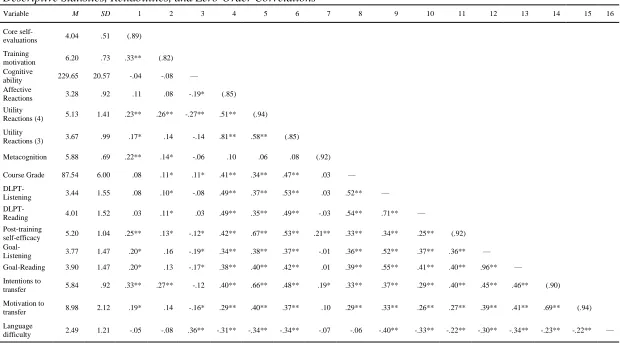
intercorrelations amongst study variables. In Table 1, I present means, standard deviations, and zero-order correlations, along with scale reliabilities (coefficient α) where appropriate. Even prior to statistically controlling for language difficulty, there is interesting information amid the intercorrelations. Firstly, the control variable (i.e., language difficulty) is negatively correlated with nearly all of the variables, as expected. Namely, as the level of language difficulty escalated, so too did the undesirable manifestation of the training criterion coupled with it. Thus, trainees that went through training that was more difficult reported it to be less satisfying, practical, and useful; reported lower self-efficacy and personal goals; reported lower transfer intentions and motivation; and, scored lower on the proficiency tests. Secondly, the affective reactions and two utility reactions measures demonstrated
positive and significant at p < .01. This, at least initially, supports the practicality of both forms of reactions. Thirdly, the positive intercorrelations among the three training levels are noteworthy. Past research provides mixed findings regarding the interrelatedness of
Kirkpatrick’s (1976) four levels. According to the initial findings, all levels appear to be
significantly and positively related (not including Level 4, which was not examined). Lastly, CSE initially seems to relate positively to self-regulatory mechanisms and motivational mechanisms, but does not seem to relate to the objective learning and performance criteria.
CSE and Training Criteria
To address the research hypotheses in a more refined manner, I used hierarchical regression analyses to examine the relationship between CSE and the various training
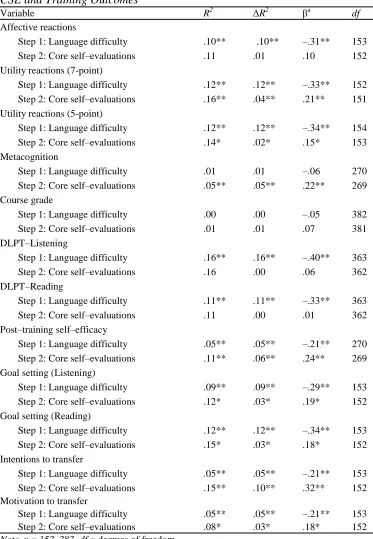
from β = –.21 (p = .007) to β = –.40 (p < .001); which is a magnitude indicative of statistical
and practical significance.
The next step was to investigate whether CSE accounted for variance beyond the statistically controlled language difficulty variable. A significant ΔR2 value indicates that CSE predicts variance in the training outcome above and beyond that accounted for by the variable entered in the first step (i.e., language difficulty). Hypothesis 1 concerned CSE’s prediction of training reactions (Level 1). CSE did not account for variance in affective training reactions beyond that of language difficulty. However, CSE did predict above and beyond language difficulty for both the 4-item measure of utility reactions (ΔR2 = .04; p = .005) and the 3-item measure of utility reactions (ΔR2 = .02; p = .049). CSE demonstrated disparate influence on the two reactions types; thus, results partially support Hypothesis 1.
The next three hypotheses addressed whether CSE predicted variance in Level 2 learning outcomes (cognitive, skill-based, and affective), while statistically controlling for language difficulty. The cognitive learning outcomes measured in this study (metacognition and end-of-course grade) were the only two learning outcomes that were uninfluenced by language difficulty. Metacognition was significantly predicted by CSE (ΔR2 = .05; p < .001), though. End-of-course grades, on the other hand, were predicted by neither language
difficulty nor CSE. Thus, results partially support Hypothesis 2 because CSE significantly predicted one of the two cognitive learning outcomes.
assessments was not surprising (expecting an individual with the target language of Chinese-Mandarin to acquire the same level of proficiency as an individual with the target language of Spanish is unrealistic). However, CSE did not account for additional variance beyond that of language difficulty for either proficiency measure. Thus, Hypothesis 3, which predicted CSE would influence skill-based listening and reading proficiency, was not supported.
Affective learning represents the third type of learning outcome, and was assessed with post-training self-efficacy and two measures of goal setting. Despite language difficulty accounting for a significant portion of the variance in each of these three outcomes, CSE still predicted above and beyond language difficulty for post-training self-efficacy (ΔR2 = .06; p < .001), listening proficiency goal setting (ΔR2 = .03; p = .016), and reading proficiency goal setting (ΔR2 = .03; p = .015). Thus, Hypothesis 4 was supported, as CSE demonstrated influence over each of the affective learning outcomes, controlling for language difficulty.
Incremental Validity over Cognitive Ability and Training Motivation
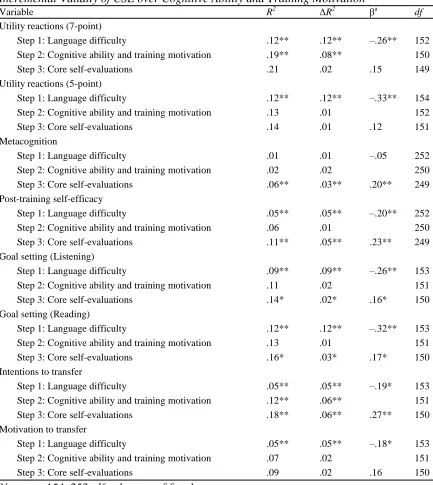
The next set of hierarchical multiple regressions examined the incremental validity of CSE over cognitive ability and training motivation (controlling for language difficulty). If CSE accounts for variance in training outcomes beyond that attributable to these two oft-cited predictors (e.g., Alvarez et al., 2004), then this further evinces the utility of the dispositional construct. I entered language difficulty into the first block of the regression, and then entered cognitive ability and training motivation into the second block, and entered CSE into the third block. Again, each training outcome served as the dependent variable in these analyses. I present the results in Table 3. I investigated the relationship between CSE and only eight of the training criteria because four were dropped from further analyses for not having variance explained by CSE in the initial regressions. The initial regressions addressed the study’s hypotheses and this subsequent analysis was exploratory, absent
expectations as to whether CSE would predict variance incremental to that of two established predictors of numerous training outcomes (Alvarez et al., 2004).
A significant ΔR2 value indicates that CSE predicts variance in the given training outcome that is unaccounted for by the variables entered in the first and second steps (i.e., language difficulty, cognitive ability, and training motivation). CSE failed to account for variance beyond that of the controls for three of the eight training outcomes: 4-item measure of utility reactions (ΔR2 = .02; p = .056), 3-item measure of utility reactions (ΔR2 = .01; p =
Metacognitive activity was the only (of two) cognitive learning outcomes that was tested in this set of analyses (end-of-course grade dropped because of nonsignificance in the initial analysis), and CSE predicted variance incremental to that of cognitive ability and training motivation (ΔR2 = .03; p = .003). CSE also demonstrated incremental validity over these three variables for each of the three affective learning outcomes. CSE accounted for variance in post-training self-efficacy (ΔR2 = .05; p < .001), listening proficiency goal setting (ΔR2 = .02; p = .05), and reading proficiency goal setting (ΔR2 = .03; p = .039) incremental to that explained cognitive ability and training motivation. Finally, the last pair of training outcomes—motivation to transfer and intentions to transfer—were shown by the regressions to be differentially predicted by CSE. CSE explained incremental validity over cognitive ability and training motivation for intentions to transfer (ΔR2 = .06; p < .001), but it did not explain variance beyond that of the controls for motivation to transfer (ΔR2 = .02; p = .058).
Discussion
The purpose of the present study was to investigate the general utility of the higher-order construct of core self-evaluations by examining its predictive validity with outcomes derived from Kirkpatrick’s (1976) training criteria taxonomy. Research supports the viability
Before discussing the relation between CSE and training outcomes, it is noteworthy to reiterate the predication that it would be necessary to statistically control for language difficulty. The only training characteristic unique to this setting was the placement of trainees into four different categories of language difficulty. Despite random assignment, controlling for language difficulty allows me to attribute more rigorously the findings of the study to the dispositional influence of CSE rather than to a potentially confounding language difficulty effect. As expected, the analyses showed that language difficulty adversely
influenced nearly all of the training outcome variables. The data indicated that as training difficulty increased, desired training outcomes decreased. This was not only manifested by lessened training learning and performance, but also by lower satisfaction and utility reactions, lower self-efficacy, lower goal setting, lower motivation to transfer, and lower intentions to transfer the material learned in training to the work setting.
tactics of ensuring that these trainees stay efficacious, motivated, and cognizant of the importance of the training material despite the challenging nature of the content.
Exemplifications of the aforementioned are incentivizing trainees and positively reinforcing successes (and ensuring that successes occur), setting aside time to facilitate a goal setting process, and making salutary outcomes salient—including instrumental means to outcomes.
Two noteworthy findings that were secondary to the main purpose of the study were (a) the patterns of zero-order correlations displayed by affective reactions and utility
reactions, and (b) the interrelations among the different training criteria levels. First, the initial findings support the utility of both affective and utility reactions, as both types
correlated positively with multiple training outcomes, and at similar magnitudes. This lends credence to Alliger et al.’s (1997) delineation and suggests that measuring one without the
The core query driving this study asked whether CSE was a viable dispositional predictor of various training outcomes. Support, or lack thereof, for Hypotheses 1–5 provided a compilation of specific evidences used to attempt to answer the aforementioned general query. Hypothesis 1 concerned the relationship between CSE and reactions to training. The affective reactions and utility reactions had differential relations with CSE, regardless of controlling for language difficulty. In both cases (with the control and without the control), affective reactions were not influenced by an individual’s level of CSE. This is contrary to my expectation that a trainee with high CSE would enter and leave training with a positive outlook, leading to a higher satisfaction with the experience. This indicates that affective reactions are not purely dispositional reflections of an individuals’ general
positivity, which corroborates findings from Sitzmann, Brown, Casper, Ely, and Zimmerman (2008) that demonstrated affective reactions were most influenced by characteristics of the training program (e.g., training difficulty and trainer likability) rather than personality. However, both utility reactions measures were significantly and positively influenced by CSE, controlling for language difficulty. Utility reactions seem to be influenced by both characteristics of the training and personal disposition (as evidenced by significant relations with both). These findings suggest that trainees with high CSE are more likely to value the training outcomes and the means to said outcomes. Further, they are more inclined to both perceive of and recall training that is useful and instrumental for attaining valued outcomes.
grades. The results provide partial support, as CSE accounted for significant variance in metacognitive activity, but not in end-of-course grades. People are ―likely to take on tasks, set goals, alter goals, and attempt to master their environments if they positively assess their own capabilities‖ (Pinder, 2008, p. 461). Individuals with high CSE have an elevated sense of competence and self-worth and therefore engage in the activities mentioned by Pinder (2008), each of which indicates self-regulation and metacognitive activity. Those with high CSE expect to do well, effectively monitor successes and failures, make adjustments in strategy, and strive to maintain their high standards and positive self-image. In terms of the objective measure of end-of-course grade, CSE did not predict this outcome. This was the first of a series of objective measures not predicted by the dispositional measure of CSE. I will recapitulate this set of findings as they surface in ensuing sections.
Hypothesis 3 was concerned with skill-based learning criteria, and predicted that CSE would account for variance in trainees’ post-training proficiency scores. Contrariwise, CSE
research, I am hesitant to make the inference that the null findings are indicative of CSE’s general influence on knowledge and skill-based training outcomes, so this relationship should be further explored in future studies.
Hypothesis 4 concerned the last of the learning criteria, affective learning outcomes. I measured two forms of affective learning outcomes: post-training self-efficacy and goal setting. I hypothesized that CSE would positively relate to each of the measures, and this supposition was fully supported. First, CSE explained variance in post-training self-efficacy while statistically controlling for language difficulty, which was not surprising partly because of the generalized trait version of self-efficacy (G-SE) being a direct indicator of CSE. This finding corroborates Schwoerer et al.’s (2005) finding that pre-training G-SE significantly influenced changes in specific self-efficacy from Time 1 to Time 2, and lends support to CSE being manifested in the general tendency to possess confidence in one’s capabilities across diverse domains. Higher levels of CSE lead to higher levels of post-training self-perceived competence. Perhaps these individuals are better able to internalize the content of instruction and transform that into usable knowledge and skills. This finding supports the utility of CSE because self-efficacy is important before, during, and after training (Salas & Cannon-Bowers, 2001), and is significantly related to other desirable training outcomes (Gist & Mitchell, 1992).
Also conferred was support for CSE’s relation to the other affective learning outcome: goal setting. The ability for CSE to predict variance in goal setting, while
statistically controlling for language difficulty further evinced CSE’s dispositional source of
setting in multiple contexts (e.g., Erez & Judge, 2001; Judge, Bono et al., 2005), but until this study had not been examined in the training setting. This adds evidence for the
generalizability of past research demonstrating CSE’s correlations with goal setting, goal self-concordance, and goal commitment. It appears that high CSE trainees are more apt to set goals that align with their values and interests, and goals that are challenging—in accord with their heightened standards and self-regard. Furthermore, they are more motivated to commit to these goals because they are intrinsically appealing and because attainment sustains their self-image. CSE’s impact on goal setting is important because goal setting has consistently related to motivation and performance (Locke & Latham, 1990; Locke et al., 1988).
It is noteworthy to reiterate that, for learning criteria overall, the general trend in this set of findings was that CSE demonstrated predictive validity for affective, self-regulatory, and motivational learning outcomes, but not for objective measures of learning from training and performance. CSE predicted metacognition, post-training self-efficacy, and goal setting controlling for language difficulty. In fact, CSE not only predicted the former three
clear, and future research should further investigate the impact of CSE on training performance, particularly objective measures of performance.
The final hypothesis (Hypothesis 5) focused on transfer of training. I used two proxies to assess this level: (a) intentions to transfer and (b) motivation to transfer. CSE accounted for significant variance in both measures, controlling for language difficulty. Furthermore, CSE significantly predicted variance in intentions to transfer incremental to that of cognitive ability and training motivation. This finding was not surprising because I expect individuals with high CSE to have the intention of, and motivation to, use and maintain post-training levels of proficiency. Further, those with high CSE set goals that are more difficult (consistent with their high self-regard), more aligned with enduring values and interests (goal self-concordance), and are thus more committed to the attainment of said goals. This leads to goal pursuit, which makes knowledge and skill transfer instrumental in goal attainment, thus increasing intentions and motivation to transfer. This finding is consistent with other
outcomes and greater training effectiveness (e.g., Cannon-Bowers, Salas, Tannenbaum, & Mathieu, 1995; Mathieu, Tannenbaum, & Salas, 1992). Thus, individual differences in CSE are important to assess when designing or implementing training due predictive validity with transfer motivation and intentions, and subsequent impact on overall training effectiveness.
Limitations and Future Research
No study is without limitations, and this was no exception. These first limitations are of a methodological nature. External validity inferences and the generalizability of the findings to the general population should be made with caution. The sample was a rather homogenous group of individuals that were training to become elite military personnel. It may be overly optimistic to assume that the characteristics of these individuals are fully representative of the general population. However, the mechanisms through which CSE work should not be specific to this sample, and the general implications that CSE has for training is important nonetheless. Furthermore, past research on the individual indicators of CSE and training outcomes using military samples have supported their generalizability (e.g., Noe, 1986). It would be fruitful, however, for future research to investigate CSE’s relation to training outcomes in additional training settings. Language acquisition training within the military is a specific training context and exploring similar research questions in different settings and with different samples would serve to increase cross-situational validity and transportability. Training is a multifarious endeavor that consists of very diverse contexts; thus, cross-validation in multiple settings would be informative.
CSE. Again, the sample was elite military personnel that possessed generally high levels of confidence about their capabilities. The mean scale score for CSE was 4.04 (maximum of 5), and the standard deviation was 0.51. This high average score and low variance may have led to ceiling effects, and may have confined the variance in the predictor to a smaller portion of the construct’s latent continuum. Less variability results in truncated correlations that are
likely to be underestimated, and the actual relationships between the predictor and criteria may be more pronounced than what was indicated by the data. Future research should attempt to replicate this study with a more normally distributed population. Further, future research should examine whether the CSES garners data throughout the general population that conforms to the normal distribution, and whether different response formats (e.g., seven response options instead of five) are better able to capture variance in CSE.
The next methodological limitation was the inability to avoid same-source data. Having the same individuals provide data for both the predictor and the criterion contributes to the plausibility of common-source bias, and this may have led to inflated correlations. Research demonstrates that self-ratings are generally confined to a smaller portion of the construct continuum than other-ratings and are therefore less variable (Scullen, Mount, & Judge, 2003). This is a potential problem with the reactions data (Level 1), cognitive
criteria was substantial enough to infer that responding on the former should have little to no impact on responding on the latter. Second, the constructs under investigation differ enough to assume small carry-over from one type of scale to the other. Lastly, there is reason to believe that the military personnel are sufficiently motivated to complete the measures with vigilance and objectivity. That said, the CSE and training literature would benefit from future research that replicates this study using multiple sources, and relying less on same-source data.
The previous call for research segues into the next limitation, because it has to do with the choice of measures. I used the proxies intentions to transfer and motivation to transfer instead of an actual Level 3 transfer outcome. This limits inferences made about CSE and Level 3 outcomes, and alters the interpretability of the findings. However, research does demonstrate the usefulness of these proxies (Machin & Fogarty, 2004), and supports the relation between them and actual transfer (Smith et al., 2008). So, although these measures are not perfect indicators of actual transfer, the results of CSE’s affects on transfer—as measured in the present study by intentions and motivation—are meaningful nonetheless. It is still important that readers interpret these results with this limitation in mind. A fruitful call for future research is to investigate the impact of CSE on actual training transferred to the job. CSE predicting transfer motivation and intentions are noteworthy, but evidence of its prediction of actual Level 3 behavior would add substantially to the utility of the
construct.
One appropriate area of future research is to test CSE’s relationship with
such as company profit margins and turnover were beyond the scope of this study and were not investigated. However, Level 4 results are of certain interest and future research should look into CSE’s relationship with this criteria. There are obvious benefits to knowing if, for
example, individuals with high CSE are less likely to turnover as a result of training, or if a given organization is likely to increase profit due to training high CSE individuals. Further, along these lines, one could do a utility analysis to estimate the impact that CSE’s relation to training outcomes has on an organization. There are many potential areas for research here, as CSE and Level 4 results criteria have yet to be examined together.
composite of the four indicator scales then it should merit further recognition as an instrument capable of rendering valid and reliable inferences.
Conclusion
References
References preceded by an asterisk were included only in the proposal (see Appendix A). *Ackerman, P. L. (1987). Individual differences in skill learning: An integration of
psychometric and information processing perspectives. Psychological Bulletin, 102(1), 3-27. doi:10.1037/0033-2909.102.1.3
*Ackerman, P. L., Kanfer, R., & Goff, M. (1995). Cognitive and noncognitive determinants and consequences of complex skill acquisition. Journal of Experimental Psychology: Applied, 1(4), 270-304. doi:10.1037/1076-898X.1.4.270
Alliger, G. M., Tannenbaum, S. I., Bennett, W. J., & Traver, H. (1997). A meta-analysis of the relations among training criteria. Personnel Psychology, 50(2), 341-358.
doi:10.1111/j.1744-6570.1997.tb00911.x
Alvarez, K., Salas, E., & Garofano, C. M. (2004). An integrated model of training evaluation and effectiveness. Human Resource Development Review, 3(4), 385-416.
doi:10.1177/1534484304270820
*Arthur, W. J., Bennett, W. J., Edens, P. S., & Bell, S. T. (2003). Effectiveness of training in organizations: A meta-analysis of design and evaluation features. Journal of Applied Psychology, 88(2), 234-245. doi:10.1037/0021-9010.88.2.234
Baldwin, T. T., & Ford, J. K. (1988). Transfer of training: A review and directions for future research. Personnel Psychology, 41(1), 63-105.
doi:10.1111/j.1744-6570.1988.tb00632.x
Bandura, A. (1977). Self-efficacy: Toward a unifying theory of behavioral change.
Bandura, A. (1986). Social foundations of thought and action: A social cognitive theory. Englewood Cliffs, NJ US: Prentice-Hall, Inc. Retrieved from PsycINFO database. *Bandura, A. (1997). Behavior theory and the models of man (1974). In J. M. Notterman, &
J. M. Notterman (Eds.), The evolution of psychology: Fifty years of the American psychologist. (pp. 154-172). Washington, DC US: American Psychological Association. doi:10.1037/10254-011
Bandura, A., & Cervone, D. (1983). Self-evaluative and self-efficacy mechanisms governing the motivational effects of goal systems. Journal of Personality and Social
Psychology, 45(5), 1017-1028. doi:10.1037/0022-3514.45.5.1017
*Barrick, M. R., & Mount, M. K. (1991). The big five personality dimensions and job performance: A meta-analysis. Personnel Psychology, 44(1), 1-26.
doi:10.1111/j.1744-6570.1991.tb00688.x
*Baumgardner, A. H. (1990). To know oneself is to like oneself: Self-certainty and self-affect. Journal of Personality and Social Psychology, 58(6), 1062-1072.
doi:10.1037/0022-3514.58.6.1062
*Berry, C. M., Ones, D. S., & Sackett, P. R. (2007). Interpersonal deviance, organizational deviance, and their common correlates: A review and meta-analysis. Journal of Applied Psychology, 92(2), 410-424. doi:10.1037/0021-9010.92.2.410
Bloom, B. (1956). Taxonomy of educational objectives: The cognitive domain. New York: Donald McKay.
Bono, J. E., & Judge, T. A. (2003). Core self-evaluations: A review of the trait and its role in job satisfaction and job performance. European Journal of Personality, 17(1), S5-SS18. doi:10.1002/per.481
*Bowling, N. A., Beehr, T. A., & Lepisto, L. R. (2006). Beyond job satisfaction: A five-year prospective analysis of the dispositional approach to work attitudes. Journal of Vocational Behavior, 69(2), 315-330. doi:10.1016/j.jvb.2006.04.004
Bradley, J. P., & Nicol, A. A. M. (2006). Predictors of military training performance for office cadets in the canadian forces. Military Psychology, 18(3), 219-226.
doi:10.1207/s15327876mp1803_3
Brown, J. D., & Dutton, K. A. (1995). The thrill of victory, the complexity of defeat: Self-esteem and people's emotional reactions to success and failure. Journal of Personality and Social Psychology, 68(4), 712-722. doi:10.1037/0022-3514.68.4.712
*Brown, K. G. (2005). A field study of employee e-learning activity and outcomes. Human Resource Development Quarterly, 16(4), 465-480. doi:10.1002/hrdq.1151
Campbell, J. P. (1988). Training design for performance improvement. In J. P. Campbell & R. J. Campbell (Eds.), Productivity in organizations. San Francisco: Jossey-Bass. Campbell, J. P. (1989). The agenda for theory and research. Training and development in
Cannon-Bowers, J., Salas, E., Tannenbaum, S. I., & Mathieu, J. E. (1995). Toward
theoretically based principles of training effectiveness: A model and initial empirical investigation. Military Psychology, 7(3), 141-164. doi:10.1207/s15327876mp0703_1
*Cantor, N. (1990). From thought to behavior: 'having' and 'doing' in the study of personality and cognition. American Psychologist, 45(6), 735-750.
doi:10.1037/0003-066X.45.6.735
*Caprara, G. V., Paciello, M., Gerbino, M., & Cugini, C. (2007). Individual differences conducive to aggression and violence: Trajectories and correlates of irritability and hostile rumination through adolescence. Aggressive Behavior, 33(4), 359-374.
doi:10.1002/ab.20192
Carver, C. S., & Scheier, M. F. (1981). The self-attention-induced feedback loop and social facilitation. Journal of Experimental Social Psychology, 17(6), 545-568.
doi:10.1016/0022-1031(81)90039-1
Cervone, D. (1997). Social-cognitive mechanisms and personality coherence: Self-knowledge, situational beliefs, and cross-situational coherence in perceived self-efficacy. Psychological Science, 8(1), 43-50.
doi:10.1111/j.1467-9280.1997.tb00542.x
*Connolly, J. J., & Viswesvaran, C. (2000). The role of affectivity in job satisfaction: A meta-analysis. Personality and Individual Differences, 29(2), 265-281.
doi:10.1016/S0191-8869(99)00192-0
*Costa, P. T., & McCrae, R. R. (1980). Influence of extraversion and neuroticism on
subjective well-being: Happy and unhappy people. Journal of Personality and Social Psychology, 38(4), 668-678. doi:10.1037/0022-3514.38.4.668
*Costa, P. T., McCrae, R. R., & Norris, A. H. (1981). Personal adjustment to aging:
Longitudinal prediction from neuroticism and extraversion. Journals of Gerontology, 36(1), 78-85.
Costa, P. T., & McCrae, R. R. (1992). Normal personality assessment in clinical practice: The NEO personality inventory. Psychological Assessment, 4(1), 5-13.
doi:10.1037/1040-3590.4.1.5
Costa, P. T. J., & McCrae, R. R. (1994). Set like plaster? evidence for the stability of adult personality. In T. F. Heatherton, J. L. Weinberger, T. F. Heatherton & J. L.
Weinberger (Eds.), Can personality change? (pp. 21-40). Washington, DC US: American Psychological Association. doi:10.1037/10143-002
*Costa, P. T. J., & McCrae, R. R. (1997). Stability and change in personality assessment: The revised NEO personality inventory in the year 2000. Journal of Personality
Assessment, 68(1), 86-94. doi:10.1207/s15327752jpa6801_7