Article
Application of Structural Equation Modeling (SEM)
to Solve Environmental Sustainability Problems:
A Comprehensive Review and Meta-Analysis
Abbas Mardani
1,
*
ID, Dalia Streimikiene
2,
*
ID, Edmundas Kazimieras Zavadskas
3
ID,
Fausto Cavallaro
4
ID, Mehrbakhsh Nilashi
5
ID, Ahmad Jusoh
1
and Habib Zare
6
1
Faculty of Management, Universiti Teknologi Malaysia (UTM), Skudai Johor 81310, Malaysia;
[email protected]
2
Lithuanian Energy Institute, Breslaujos 3, LT-44403 Kaunas, Lithuania
3
Department of Construction Technology and Management, Vilnius Gediminas Technical University,
Sauletekio al. 11, LT-10223 Vilnius, Lithuania; [email protected]
4
Department of Economics, Management, Society and Institutions (EGSI), University of Molise,
Via De Sanctis, 86100 Campobasso, Italy; [email protected]
5
Faculty of Computing, Universiti Teknologi Malaysia (UTM), Skudai Johor 81310, Malaysia;
6
Faculty of Economic, Management & Accounting, Yazd University, P.O. Box 89195-741, Yazd, Iran;
*
Correspondence: [email protected] (A.M.); [email protected] (D.S.);
Tel.: +60-112-734-7432 (A.M.); +370-614-03424 (D.S.)
Received: 6 September 2017; Accepted: 26 September 2017; Published: 10 October 2017
Abstract:
Most methodological areas assume common serious reflections to certify difficult study and
publication practices, and, therefore, approval in their area. Interestingly, relatively little attention
has been paid to reviewing the application of Structural Equation Modeling (SEM) in environmental
sustainability problems despite the growing number of publications in the past two decades.
Therefore, the main objective of this study is to fill this gap by conducting a wide search in two main
databases including Web of Science and Scopus to identify the studies which used SEM techniques
in the period from 2005 to 2016. A critical analysis of these articles addresses some important key
issues. On the basis of our results, we present comprehensive guidelines to help researchers avoid
general pitfalls in using SEM. The results of this review are important and will help researchers to
better develop research models based on SEM in the area of environmental sustainability.
Keywords:
environmental sustainability; structural equation modeling; comprehensive analysis;
meta-analysis
1. Introduction
Sustainability is the biggest challenge of the 21st century because civilization has reached a point
where natural resources are in rapid decline. Several previous studies have emphasized the vital
role of environmental sustainability in various applications areas such as waste management [1–4],
energy [5–8], sustainability performance [9–11], green product [12–15], low carbon and climate [16–18],
tourism [19–22], information and communication technology [23–26], health [27,28], behavioral
science [29,30], innovation [31–33], economic development [34–37], risk assessment [38–40], decision
making [41–44], tourist behaviour [45–48], business practices [49–52], industrial manufacturing [53–56],
agricultural [57–60], supply chain [61–64], and other applications. The environmental issues such as
global warming, ozone depletion, natural resource decline, ecosystem destruction, carbon emissions
have raised a concern for the causes of these problems. The conventional thoughts, principles and
methods are currently in question and the challenge we are facing today requires radical changes and
global leadership.
Sustainability can be seen as being linked to three main dimensions: the environmental, social,
and economic [65–67]. However, Njoh [68] and Luthra, Kumar [24] suggest that there are now
four interrelated but competing pillars that have emerged with regard to sustainability. Alongside
the biophysical (environmental), the economic, and the social systems, a fourth important dimension
is the political system through which power is exercised. This fourth sphere, the political or
institutional dimension, functions as the referee that arbitrates in relation to the different and often
incompatible claims made by the actors of the social and economic sphere [24]. How much emphasis
is placed on these different dimensions or pillars may be linked to different schools of thought,
discourses, rationalities or world views regarding the importance of the environment versus economic
growth [69–73].
The variety of environmental perspectives on sustainability demonstrates varying emphasis on
either altering the resource side or the demand side of the equation [74–83]. They reflect a spectrum
from a dark green ecological perspective [84] to a light green perspective (see [85]) which draws
on different epistemological assumptions and rationalities. The strong sustainability label is more
closely linked to the dark green spectrum, and the light green to the weak sustainability approach.
From a dark green perspective, an ecologically rational approach must have lexical priority [73],
and ecological values should drive environmental decisions. It is a holistic perspective recognising
the interdependence of environmental and social systems.
Collaboration between government, industry, and a strong science and technology sector with
requisite research and development funding is the key to solving environmental problems [79,86–88].
While accepting the contribution that science and technology have made in creating environmental
problems, they are seen as central to their resolution. Science, therefore, provides the means to
better detect environmental dangers, and technological innovation enables the development of
alternatives [89]. Talking about theories and models regarding environmental sustainability first
raises the question of how environmental sustainability is described in these circles. Scientists
doing research in the area of environmental sustainability often cite the definition of environmental
sustainability based on the conferences and publications presented in the United Nations program.
Kolk and Mauser [90], explore in their review a wide number of different models of environmental
sustainability. According to their research, some authors see this as a continuous process towards
a higher level of sustainable behavior of the company, therefore called stage models. When researchers
do not assume a development over time, models are described more as a continuum of possible
strategies or simply choices between equal opportunities. Probably the first publication describing
strategies for environmental sustainability is the work of [91] and describes a classification of models
for environmental management, based on the survey of 132 managers of US firms. Petulla [91], explores
a range of possible strategies. Scholars from a wide range of disciplines and perspectives have sought to
unravel the high complexities of sustainability. A mature understanding of sustainability management
requires studies to adopt a multidisciplinary systemic lens capable of appreciating the interconnectivity
of economic, political, social and ecological issues across temporal and spatial dimensions [92].
area, scope and sample, type of method (quantitative, qualitative or mix method), technique (partial
least squares (PLS), Analysis of Moment Structures (AMOS) or other techniques), unit of analysis
(individual, group and country), number of sample, respondents, related theory, measure validation
(Exploratory factor analysis (EFA) or Confirmatory Factor Analysis (CFA)), data collection method
(Online or offline survey), name of variables, number of hypotheses, study purpose, gap and research
problem, name of author, year of publication, country of authors, and finally results and outcome.
Additionally, in we provided the developed frameworks of all selected papers based on the name of
author(s). We also present several recommendations and directions for future research in the area of
environmental sustainability.
The remainder of this review paper is structured in the following sections. Section
2
presents
the research method and procedure of this review paper. Section
3
presents classification of papers
based on the application areas. Section
4
provides the breakdown of articles based on scope. Section
5
presents breakdown of articles based on type of method. Section
6
provides breakdown of articles
based on technique. Section
7
provides breakdown of articles based on unit of analysis. Section
8
classified the article based related theory. Section
9
categories the article based on measure validation.
Section
10
classifies of articles based on data collection method. Section
11
presents the distribution of
articles by name of journals. Section
12
provides the articles by year of publication. Section
13
provides
breakdowns of articles based on nationality of authors. Section
14
presents the study discussion,
and finally Section
15
presents the conclusion, limitations and recommendations for future studies.
2. Research Method
For the research methodology in this study, we used the Preferred Reporting Items for Systematic
Reviews and Meta-Analyses (PRISMA) provided by Moher, Liberati [93]. The purpose of the PRISMA
statement is an evidence-based minimum set of items to help scholars for enhancing the reporting
quality a wide array of systematic reviews and meta-analyses. PRISMA as a checklist is not only an
instrument for quality assessment for systematic reviews; it can be very valuable for critical assessment
objectives in all sections of articles such as title, abstract, introduction, method, results and discussion.
PRISMA emphasizes directions in which scholars could ensure a complete and transparent and
report of this type of research and presents the substantial transparency in the selection procedure of
articles in a systematic review. The flow diagram of PRISMA represents the flow of information in
the different stages of a systematic review. PRISMA has two main parts, including systematic reviews
and meta-analyses. Systematic reviews provide objective summaries of what has been conducted on
a specific research area. This is especially valuable in wide research areas, where many publications
exist, each focusing on a narrow aspect of the field [94]. Systematic reviews aim to provide a full
overview of research conducted in a specific area until the present date. All research procedures have to
be made explicit before the actual behaviour of the review to make the process objective and replicable.
Meta-analysis provides a means of mathematically integrating findings employing diverse statistical
approaches to study the diversity of the articles. In this kind of synthesis, original studies that are
compatible with their quality level are selected. This aspect may help and highlight different facts
which individual primary studies fail to do, e.g., it may prove that results are statistically significant
and relevant when small primary studies provide inconclusive and uncertain results with a large
confidence interval [95]. The main goal of PRISMA is to help researchers and practitioners to complete
a comprehensive and clear literature review [96].
using PRISMA in various fields to develop a comprehensive literature review [97–99]. In order to
implement the PRISMA method in this study, we performed three main steps including: literature
search, choosing the eligible published papers, and extraction of data and summarization [97–99].
2.1. Literature Search
In this step, we have chosen the Web of Science and Scopus databases to provide a comprehensive
application of SEM in the assessment of environmental sustainability. The literature search was
performed based on several keywords including environmental sustainability (1878 records), green and
environmental supply chain (35 records), sustainability (22,021 records), green human resource
management (14 records), green and environmental information technology and system (319 records),
renewable and sustainable energies (288 records), green and environmental marketing (37 records),
environmental operation and production (4963 records) and other related keywords such as partial
least squares (195 records) and structural equation modelling (3164 records). In the first step of our
search, we found 32,914 scholarly papers related to these mentioned keywords which were extracted
according to our strategy search. In the next step, we searched for papers which were published and
checked the duplicated papers with redundant information.
After this step, 542 papers were remaining. After removing 89 records due to duplication,
we screened papers based on the titles and abstracts, and irrelevant papers were removed. In total,
279 potentially related papers remained (see Figure
1).
2.2. Articles Eligibility
In this step of the review, for the purpose of eligibility, we reviewed the full text of each
manuscript independently (which extracted from the last step). In the last step, we carefully identified
the related articles to attain a consensus. Book chapters, unpublished working papers, editorial notes,
master dissertations and doctoral theses, textbooks, and non-English papers were excluded. In the end,
we selected 171 articles related to the environmental sustainability topics and SEM, from 69 peer review
scholarly journals, which met our inclusion criteria.
2.3. Data Extraction and Summarisation
In the final step of our methodology, after negotiation with other authors, some required
information was collected, and finally, 171 articles were reviewed and summarised.
approach for the evaluation of environmental sustainability problem. Although a considerable amount
of time was spent in the selection process, it helped us to choose the most suitable publications in
conducting the review.
Sustainability
2017
,
9
, 1814
5 of 63
problem. Although a considerable amount of time was spent in the selection process, it helped us to
choose the most suitable publications in conducting the review.
Table 1.
Classification of papers based on application area.
Application Areas
Frequency
Percentage of Frequency
Green and sustainable Supply Chain Management (SCM)
50
29.24%
Corporate Social Responsibility (CSR)
8
4.68%
Renewable and sustainable energies
7
4.09%
Green and ecological innovation
11
6.43%
Green and environmental Human Resource Management (HRM)
32
18.71%
Environmental information technology and systems
8
4.68%
Other Green and sustainable operation management
28
16.37%
Green and environmental marketing
27
15.79%
Total
171
100.00%
3. Application Areas Classification
Although categorising and combining the articles in this field is complex, for the classification task,
we used the opinions of experts in the fields of sustainability.
Consequently, based on the opinions of experts, we categorised articles into six different
applications areas (see Table
1). In the following section, all selected articles were summarised
and reviewed based on the various criteria.
3.1. Breakdown of Articles Based on Green and Sustainable SCM
between level of green collaboration and the degree of green supplier assessment. In addition,
the influence of commitment on green collaboration is mediated by the purchasing department
capabilities. Moreover, the results showed that there is a positive relationship between environmental
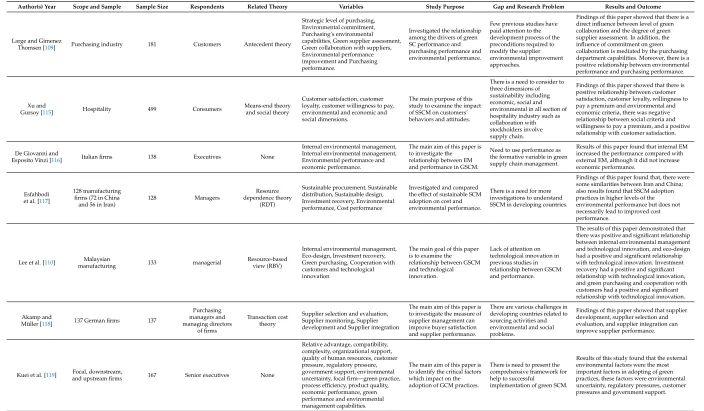
performance and purchasing performance. Lee, Ooi [110] examined the relationship between GSCM
and technological innovation in 133 Malaysian manufacturing companies. The results of this paper
demonstrated that there was a positive and significant relationship between the internal environmental
management and technological innovation, and eco-design had a positive and significant relationship
with technological innovation, investment recovery had a positive and significant relationship with
technological innovation, and green purchasing and cooperation with customers had a positive and
significant relationship with the technological innovation.
According to Table
A1
(see Appendix
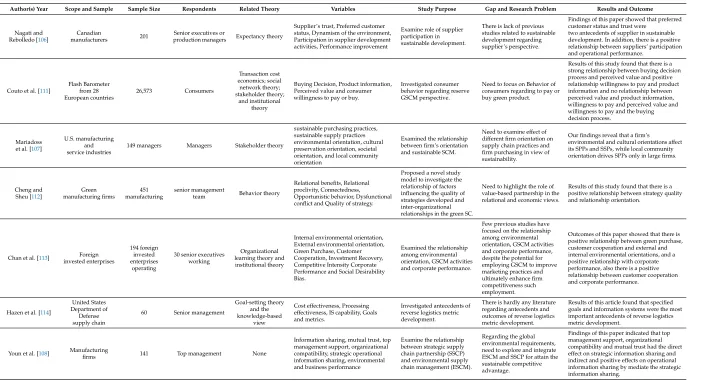
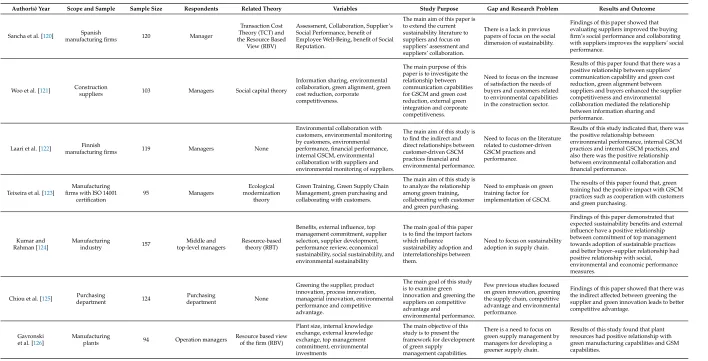
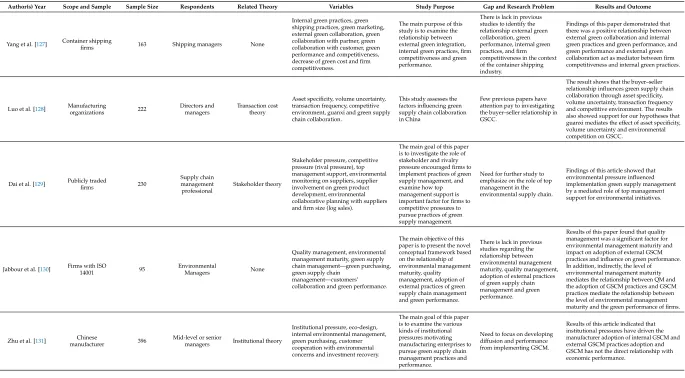
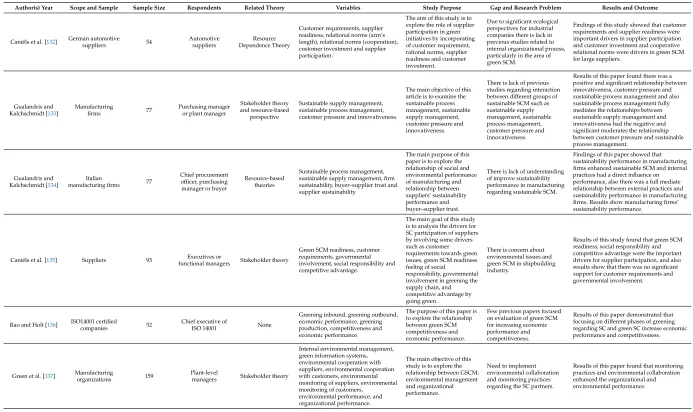
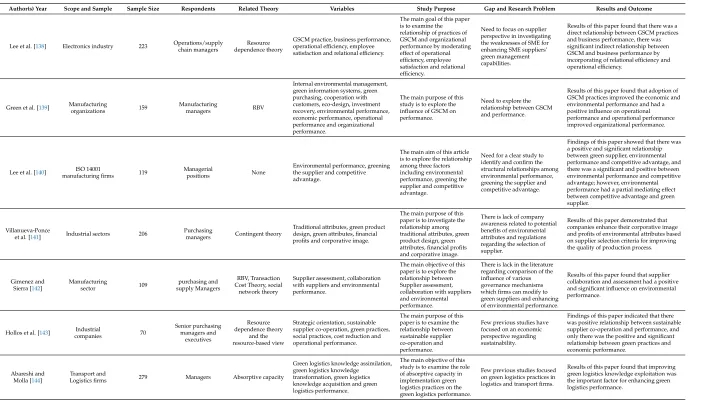
A), in total, 50 previous published papers [111–155] have
used SEM techniques for assessment of green and sustainable SCM. This table represents significant
distribution findings of green and sustainable SCM based on the author(s) names, year of publication
scope and sample of study, area of study, number of sample, respondents, related theory, variables,
study purpose, gap and research problem, and results and outcome.
3.2. Breakdown of Articles Based on CSR
development had the positive relationship between competitive advantage of the participating firms
and financial performance. Kang, Chiang [165] investigated the relationship between CSR and business
performance by using sustainability balanced scorecard in 200 hotels. To develop the framework,
this study used some variables such as corporate social responsibility, financial dimensions, customer
dimensions, business dimensions, learning and growth dimensions. The outcomes of this study
showed that there is a significant relationship between CSR and business performance in three groups
by using a balance score card. Table
A2
(see Appendix
A) [166–170] provided the important results of
CSR papers based on the author(s) names, year of publication scope and sample of study, area of study,
number of sample, respondents, related theory, variables, study purpose, gap and research problem
and results and outcome.
3.3. Breakdown of Articles Based on Renewable and Sustainable Energies
publication scope and sample of study, area of study, number of sample, respondents, related theory,
variables, study purpose, gap and research problem, and results and outcome.
3.4. Breakdown of Articles Based on Green and Ecological Innovation
3.5. Breakdown of Articles Based on Green and Environmental HRM
In recent years scholars have devoted considerable attention to the topic of sustainability,
intended as the balance between economic, social and environmental performances of the firm [199].
As a consequence, the concept of green and sustainable HRM takes the development of social,
environmental and human capital capitals into account, opposing to strategic HRM that is mostly
focused on achieving economic goals and maximize profitability [200,201]. Within the broad field
of sustainable HRM, a growing stream of studies explores the specific relation between HRM
and environmental sustainability. Indeed, developing employees’ commitment and involvement
towards environmental sustainability have been found to be a key factor to realize sustainable
organizations [202,203].
According to Renwick, Redman [203], the integration of corporate
environmental management into HRM is described as green HRM. They also stated that human
resources aspects of environmental management are green HRM. Several previous scholars used
the SEM methods to examine and test the relationship between hypotheses. For example, Kalamas,
Cleveland [204] believed that there is a need to study the understanding of consumers’ allocation
regarding environmental responsibility related to external forces; in this regard, this study examines
how external attributions affect pro-environmental behaviors of consumers among 263 consumers
of the Canadian urban area, for developed SEM model this study used TPB by involving several
variables such as corporate responsibility, government responsibility, god/higher power and natural
earth-cycle. The results of this paper showed analytical ways for government and corporations to
improve the pro-environmental efforts. Zhan, Tan [205] evaluated the relationship between lean and
green practices and organizational performance by moderation effect of guanxi in 172 respondents
from manufacturing industry, this study claimed there is a need to focus on the green and lean practice
to attain sustainable development to enhance organizational performance in China context. The results
of this study indicated that there was a positive relationship between green and lean practices and
improving organizational performance.
3.6. Breakdown of Articles Based on Environmental Information Technology and Systems
Environmental information systems including remote sensing, computer modeling, databases and
other technologies are developed around the world to address the various issues from climate change
to loss of biodiversity to economic underdevelopment [236,237]. The implications for the human
welfare, natural environment, and democratic governance are significant [238]. Environmental
information systems structure what people see in the environment, and how they collaborate to
deal with environmental problems [239]. They make a legal argument, scientific inquiry and consider
how citizens contribute in the different governance. They are technologies designed to produce new
social relationships, new truths, new forms of political decision-making and, ultimately, a renewed
environment. Information system and technology help communities to find problems related to
environmental issues and create informed management decisions [240]. The need for enhanced and
relevant information on the environment in turn is a prerequisite to managing natural resources
towards helping to achieve sustainable development [241]. Regarding these issues, a wide range
of literature related to information and technology place an emphasis on environmental problems
using SEM methods. For instance; Gholami, Sulaiman [242] believe that few previous papers place
an emphasis on the adoption of green IS in organization for reduce the environmental influence,
therefore this study examined the perception of 405 senior managers in relationship between green
IS and environmental performance in service and manufacturing organizations. Institutional theory
used as underpin theory for this study by focusing on some variables like attitude, coercive pressure,
environmental performance, future consequences, mimetic pressure, pollution prevention, product
stewardship and sustainable development. The findings of this paper show that a coercive pressure
impact of attitude toward green IS does not influence mimetic pressure. In addition, there is a positive
significant relationship between attitude, green IS adoption and future consequences consideration
and green IS adoption had a significant relationship with environmental performance in the long term.
Ryoo and Koo [243] develop a new model based on the following variables of green practices:
information system alignment, green practice-manufacturing coordination, green practices-marketing
coordination, environmental performance and economic performance in 77 manufacturing firms.
The findings of this paper show that there was positive relationship between green practices-IS,
green practices-marketing coordination and alignment green practices-manufacturing coordination.
Moreover, green practices-marketing coordination and green practices-manufacturing coordination
were significant predictors for environmental performance, while green practices-IS alignment had
an indirect relationship with environmental performance by incorporating green practices-marketing
coordination and green practices-manufacturing coordination. Akman and Mishra [244] examine
the role of green information technology in IT professionals in private and public sectors in 182 public
and private sectors. Technology Acceptance Model (TAM) was used for this study with the following
variables: perceived ease-of-use, subjective norms, perceived usefulness, attitude toward, and actual
system usage level of awareness. The findings of this paper showed that: there was diversity among
establishments from public- and private-sectors in the impact of the PEU on PU and on the ATU,
and TAM is important for private-sector establishments excluding the relations between the PEU and
ATU and PEU and PU. Table
A6
(see Appendix
A) [245–249] represented the results of eight published
articles regarding environmental information technology and systems based on the author(s) names,
year of publication scope and sample of study, area of study, number of sample, respondents, related
theory, variables, study purpose, gap and research problem and results and outcome.
3.7. Breakdown of Articles Based on Other Green and Sustainable Operation Management
businesses in their quest for selecting appropriate indicators [252–254]. Sustainability is an initiative
increasingly essential to the core business model of many companies [255]. There are many diverse
perspectives on sustainability in operation management such as green product development [256],
green procurement and green supplier development [257], green shipping management capability [258],
green and environmental issues [259] and corporate sustainability [260] and other perspectives.
Some companies consider it to be the burden of more government regulations, new compliance
requirements and higher manufacturing costs. However, industry leading companies recognize
that sustainability can actually be a business driver for next-generation products, more efficient
operations and increased profitability. Previous and current literature has used various techniques and
methods to examine and analyze sustainable and green operation management areas such as SEM.
SEM methods have been used in various previously published papers; for example, Camp
ó
n-Cerro,
Hern
á
ndez-Mogoll
ó
n [261] investigated the role of loyalty for sustainable advantage and identify
the loyalty factors for understanding destination loyalty in rural tourism destinations. Expectancy
disconfirmation theory was used as the underpinning theory with some additional factors such as
image, quality, value, attribute satisfaction, overall satisfaction and loyalty. The findings of this
paper showed that quality, destination attribute satisfaction and image were the direct antecedents
for loyalty in the rural tourism destination. Blohmke, Kemp [262] believed that there is a need to
analyze the interaction among environmental policy determinant; therefore, this study evaluated
the determinants of environmental policy on international environmental governance and national
environmental policy in private sectors data sets of 47 countries. For this paper, environmental policy
theory was used by incorporating some variables such as green advocacy, awareness, governance
capacity, international environmental governance and national environmental policy. Findings of this
study demonstrated that government capacity and green industry advocacy have a positive impact on
environmental policy.
Lai and Cheng [263] investigate the influence of undergraduate students regarding green
marketing practices and their attitude toward the environment, their environmental responsibility and
the seriousness of their perceived environmental problem. The results of this paper found that there is
a strong relationship between perceived environmental responsibility and green products purchase
willingness, there is no relationship between perceived seriousness of environmental problems and
undergraduate students’ green product purchase willingness and there are significant relationships
between students’ willingness to purchase green products and their green purchase behavior. Luzzini,
Brandon-Jones [264] found there is lack of focus in previous studies in relation of sustainability
commitments on development of collaborative capabilities for supply functions and purchasing on
sustainability performance; therefore, this study examined the relationship between sustainability
commitment, collaborative capabilities and performance. The finding of this paper showed that there
is a link between sustainability commitment and collaborative capabilities, cost performance and
social and environmental performance. Jabbour, Jugend [256] investigated the relationship between
GPD practices on firm performance such as market, environmental and operational aspects with some
factors such as environmental practices, operational performance, human/organizational aspects,
green performance, technological aspects and market performance. The results of this paper found that
GP practices affected firm performance and technical aspects. Table
A7
(see Appendix
A) mentioned
the analysis of 28 studies [265–283] regarding green and sustainable operation management based
on the author(s) names, year of publication scope and sample of study, area of study, number of
sample, respondents, related theory, variables, study purpose, gap and research problem and results
and outcome.
3.8. Breakdown of Articles Based on Green and Environmental Marketing
variables. It states that green marketing involves the marketing strategies used to achieve a firm’s
financial as well as strategic goals while reducing its negative impact on the environment [284].
Kumar and Anand [285] and Ottman [286] have characterized green marketing as an integration of
ecological concerns into marketing aspects including production, distribution and logistics, promotion
and packaging along with marketing communications. On the other hand, Prakash [287] defines
green marketing as an environmentally considered strategy that consists of disclosing information
to consumers at different levels like industry, firm and product level. Green marketing is associated
with identifying the consumer needs and satisfying those needs in a valuable and sustainable
manner [288]. It can be inferred from various literature that green marketing basically bridges
the communication between environmentally conscious firms and consumers, in turn strengthening
their relationship. Empirical researches have recognised that issues regarding sustainability, awareness
about environmental issues and green brands are becoming a focal point in developed and developing
nations, with added consciousness from the government and population in general. Various other
studies have been pursued on green marketing and the strategies used for communication in order to
influence the consumer purchase behaviour. It is observed that a correlation exists between consumers’
environmental beliefs and their confidence in the performance of green products [289]. Empirical
researches have used several methods and approaches like SEM. For example, De Giovanni and
Esposito Vinzi [290] analyzed the relationship between environmental training and environmental
management maturity in 178 manufacturing companies. This study found there is a lack of work in
previous studies regarding empirical study related to external and internal environmental management
and firms performance. The results of this paper showed that the European Union’s Emissions
Trading System (ETS) should focus on internal environmental management, internal environmental
practices to improve the economic performance, and supplier collaboration which can slightly affect
firms’ performance.
and environmental performance. The findings of this study showed that stakeholder pressures
had a positive and significant influence on internal green management and there was a significant
and positive relationship between internal green management and green product/process design.
Also, two green operations practices had a positive and significant relationship with environmental
performance. Table
A8
(see Appendix
A) represented the findings of 27 studies [296–316] regarding
green and environmental marketing based on the author(s) names, year of publication scope and
sample of the study, area of study, number of sample, respondents, related theory, variables, study
purpose, gap and research problem and results and outcome.
4. Breakdown of Articles Based on Scope
SEM has become prevalent within a variety of disciplines, particularly management research,
for analyzing the cause-and-effect relations between latent constructs [317]. The term SEM refers to
a family of covariance-based statistical methods. SEM is a very general statistical modeling technique,
which is widely used in the various fields such as sustainability. It can be viewed as a combination of
factor analysis and regression or path analysis. The interest in SEM is often on theoretical constructs,
which are represented by the latent factors [318]. The relationships between the theoretical constructs
are represented by regression or path coefficients between the factors. The structural equation
model implies a structure for the covariances between the observed variables, which provides the
alternative name covariance structure modeling [318]. SEM method has been used in various studies
around the world in several different industries like tourism and the hospitality industry service and
manufacturing industries, transportation industry, firms, universities and other industries and sectors.
In Figure
2
we provided the percentages of each industry which is incorporated in this study
and implemented the SEM method. According to the results of this paper, manufacturing firms or
industry had the highest percentage with 53 percent, the second rank was related to service firms with
17 percent, and tourism and hospitality had the third rank with 11 percent among other industries and
sectors. The information related to the percentage of all scopes is provided in Figure
2.
Sustainability
2017
,
9
, 1814
14 of 63
and significant relationship with environmental performance. Table A8 (see Appendix A)
represented the findings of 27 studies [296–316] regarding green and environmental marketing based
on the author(s) names, year of publication scope and sample of the study, area of study, number of
sample, respondents, related theory, variables, study purpose, gap and research problem and results
and outcome.
4. Breakdown of Articles Based on Scope
SEM has become prevalent within a variety of disciplines, particularly management research,
for analyzing the cause-and-effect relations between latent constructs [317]. The term SEM refers to a
family of covariance-based statistical methods. SEM is a very general statistical modeling technique,
which is widely used in the various fields such as sustainability. It can be viewed as a combination
of factor analysis and regression or path analysis. The interest in SEM is often on theoretical
constructs, which are represented by the latent factors [318]. The relationships between the theoretical
constructs are represented by regression or path coefficients between the factors. The structural
equation model implies a structure for the covariances between the observed variables, which
provides the alternative name covariance structure modeling [318]. SEM method has been used in
various studies around the world in several different industries like tourism and the hospitality
industry service and manufacturing industries, transportation industry, firms, universities and other
industries and sectors.
In Figure 2 we provided the percentages of each industry which is incorporated in this study
and implemented the SEM method. According to the results of this paper, manufacturing firms or
industry had the highest percentage with 53 percent, the second rank was related to service firms
with 17 percent, and tourism and hospitality had the third rank with 11 percent among other
industries and sectors. The information related to the percentage of all scopes is provided in Figure
2.
Figure 2.
Breakdown of articles based on scope.
5. Breakdown of Articles Based on Type of Method
Types of research methods can be classified into several categories according to the nature and
purpose of the study and other attributes. Types of research methods can be broadly divided into
two categories, quantitative and qualitative. Quantitative research describes, infers, and resolves
problems using numbers. Emphasis is placed on the collection of numerical data, the summary of
those data and the drawing of inferences from the data [319]. Qualitative research, on the other hand,
is based on words, feelings, emotions, sounds and other non-numerical and unquantifiable elements.
It has been noted that “information is considered qualitative in nature if it cannot be analysed by
means of mathematical techniques. This characteristic may also mean that an incident does not take
place often enough to allow reliable data to be collected” [320]. In this study, to show the type of
11%
53%
17%
7%
5%
2% 5%
Tourism and hospitality
industry
Manufacturing firms
Service firms
University
Energy industry
Transportation firms
Figure 2.
Breakdown of articles based on scope.
5. Breakdown of Articles Based on Type of Method
It has been noted that “information is considered qualitative in nature if it cannot be analysed by means
of mathematical techniques. This characteristic may also mean that an incident does not take place
often enough to allow reliable data to be collected” [320]. In this study, to show the type of method,
we divided the selected studies into three types of methods, including: quantitative, qualitative and
a mix of quantitative and qualitative methods.
The frequency of each method is provided in Figure
3. According to Figure
3, from 171 reviewed
papers, 168 papers use the quantitative method and no paper uses the qualitative method. However,
the mix method was used in three papers. In our review paper, we focused on the application of SEM
in previous studies; therefore, for this reason the number of studies which used the qualitative method
was zero. The breakdown of articles based on type of method is presented in Figure
4.
Sustainability
2017
,
9
, 1814
15 of 63
method, we divided the selected studies into three types of methods, including: quantitative,
qualitative and a mix of quantitative and qualitative methods.
The frequency of each method is provided in Figure 3. According to Figure 3, from 171 reviewed
papers, 168 papers use the quantitative method and no paper uses the qualitative method. However,
the mix method was used in three papers. In our review paper, we focused on the application of SEM
in previous studies; therefore, for this reason the number of studies which used the qualitative
method was zero. The breakdown of articles based on type of method is presented in Figure 4.
Figure 3.
Breakdown of articles based on type of method.
Figure 4.
Breakdown of articles based on technique.
6. Breakdown of Articles Based on Technique
The technique for the analysis of selected studies was another important category for this review
paper. In this section, we divided the reviewed papers based on SEM techniques such as AMOS,
SmartPLS, LISREL, STATA, EQS, integration of AMOS and SmartPLS and integration of SmartPLS
and LISREL.
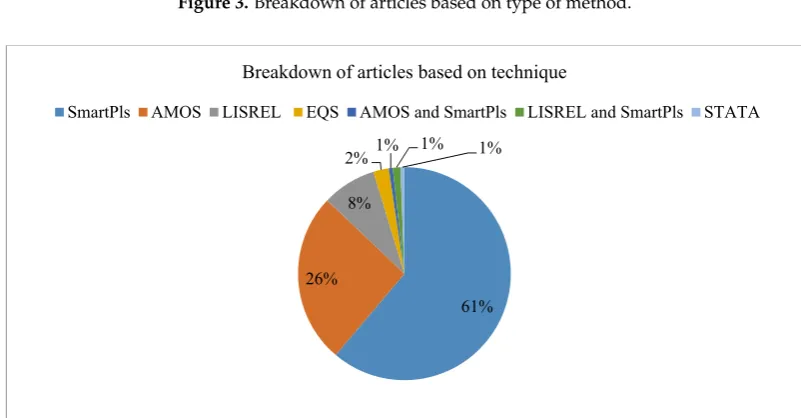
According to the findings, we found that most of the published papers have used SmartPLS with
105 papers. AMOS has the second rank among 171 selected papers with 26 percent. The information
regarding the percentages of techniques is provided in Figure 4.
0
20
40
60
80
100
120
140
160
180
Quantitative
Quantitative and
qualitative
Qualitative
No. articles
168
3
0
Number of
Publication
Breakdown of articles based on type of method
61%
26%
8%
2%
1%
1%
1%
Breakdown of articles based on technique
SmartPls
AMOS
LISREL
EQS
AMOS and SmartPls
LISREL and SmartPls
STATA
Figure 3.
Breakdown of articles based on type of method.
Sustainability
2017
,
9
, 1814
15 of 63
method, we divided the selected studies into three types of methods, including: quantitative,
qualitative and a mix of quantitative and qualitative methods.
The frequency of each method is provided in Figure 3. According to Figure 3, from 171 reviewed
papers, 168 papers use the quantitative method and no paper uses the qualitative method. However,
the mix method was used in three papers. In our review paper, we focused on the application of SEM
in previous studies; therefore, for this reason the number of studies which used the qualitative
method was zero. The breakdown of articles based on type of method is presented in Figure 4.
Figure 3.
Breakdown of articles based on type of method.
Figure 4.
Breakdown of articles based on technique.
6. Breakdown of Articles Based on Technique
The technique for the analysis of selected studies was another important category for this review
paper. In this section, we divided the reviewed papers based on SEM techniques such as AMOS,
SmartPLS, LISREL, STATA, EQS, integration of AMOS and SmartPLS and integration of SmartPLS
and LISREL.
According to the findings, we found that most of the published papers have used SmartPLS with
105 papers. AMOS has the second rank among 171 selected papers with 26 percent. The information
regarding the percentages of techniques is provided in Figure 4.
0
20
40
60
80
100
120
140
160
180
Quantitative
Quantitative and
qualitative
Qualitative
No. articles
168
3
0
Number of
Publication
Breakdown of articles based on type of method
61%
26%
8%
2%
1%
1%
1%
Breakdown of articles based on technique
SmartPls
AMOS
LISREL
EQS
AMOS and SmartPls
LISREL and SmartPls
STATA
Figure 4.
Breakdown of articles based on technique.
6. Breakdown of Articles Based on Technique
According to the findings, we found that most of the published papers have used SmartPLS with
105 papers. AMOS has the second rank among 171 selected papers with 26 percent. The information
regarding the percentages of techniques is provided in Figure
4.
7. Breakdown of Articles Based on Unit of Analysis
One of the most important ideas in this research review was the unit of analysis. The unit of
analysis is the major entity that researchers have analyzed in environmental sustainability fields.
Typical units of analysis include individuals, countries, groups, social organizations and social artifacts.
In our review paper, we divided the unit of analysis into three main levels including individual level,
organizational level and country level.
According to the findings of this study, we found that individual level had the first rank among
171 papers with 78 percent and organizational level was the second type of unit of analysis with
21 percent. Information regarding all parts is shown in Figure
5. The comparison of the results
presented by Figure
5
is interesting as we can see that organizations played an important role
in environmental sustainability developments as the majority of the research was conducted at
the organization level. Generally, this indicates that organization level has been more important
for environmental sustainability developments in relation to the individual and country levels.
Sustainability
2017
,
9
, 1814
16 of 63
7. Breakdown of Articles Based on Unit of Analysis
One of the most important ideas in this research review was the unit of analysis. The unit of
analysis is the major entity that researchers have analyzed in environmental sustainability fields.
Typical units of analysis include individuals, countries, groups, social organizations and social
artifacts. In our review paper, we divided the unit of analysis into three main levels including
individual level, organizational level and country level.
According to the findings of this study, we found that individual level had the first rank among
171 papers with 78 percent and organizational level was the second type of unit of analysis with 21
percent. Information regarding all parts is shown in Figure 5. The comparison of the results presented
by Figure 5 is interesting as we can see that organizations played an important role in environmental
sustainability developments as the majority of the research was conducted at the organization level.
Generally, this indicates that organization level has been more important for environmental
sustainability developments in relation to the individual and country levels.
Figure 5.
Breakdown of articles based on unit of analysis.
8. Breakdown of Articles Based on Related Theory
Categorizing the selected papers based on theory was another interesting issue for this review
paper. According to our findings, various theories have been implemented in environmental
sustainability fields. In total, 40 theories contributed to the field of environmental sustainability. Some
important theories were: Resource-Based View (RBV), stakeholder theory, institutional theory (INT),
Theory of Planned Behavior (TPB), transaction cost theory, Transaction Cost Theory (TCT), Resource
Theory (RDT), social capital theory, Theory of Reasoned Action (TRA), contingency theory, ecological
modernization theory, technology acceptance model, organizational theory, expectancy theory,
theory of dynamic capabilities, agency theory, motivation theory, Schwartz’s theory, absorptive
capacity theory and social network theory. However, based on our review, in some of selected
articles, we could not find related theories; therefore, we categorized these articles with a no or
none-theory label.
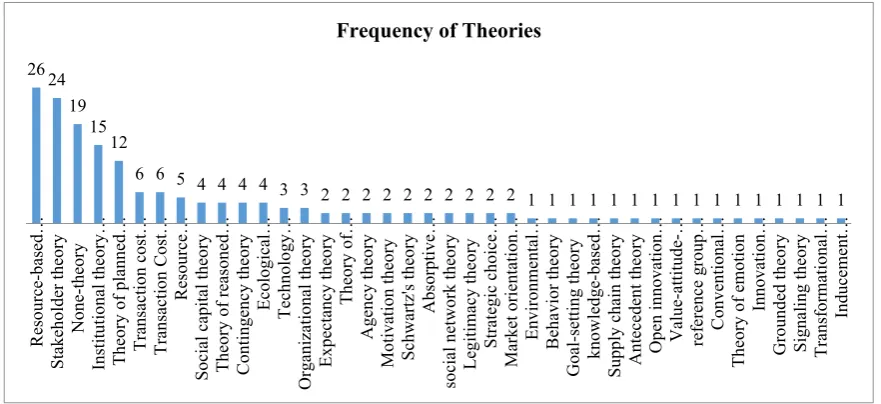
According to our findings, in fields of environmental sustainability, RBV theory and stakeholder
theory had the first and second rank with 26 and 24 records respectively. Figure 6 represented the
information of all theories. The comparison of the results presented by Figure 6 is interesting as we
can see that RBV, which has been found to be a management device used to assess the available
amount of a business’ strategic assets, is often used in conducting research on environmental
sustainability. This indicates that the resource-based method is seen as an effective and efficient
application for all useful resources that will help environmental sustainability developers in
determining their competitive advantage. In addition, although, as discussed earlier, several
empirical studies have been conducted for environmental sustainability development by
investigating the critical success factors incorporated to the research theories, the results presented
21%
78%
1%
Frequency based on unit of analysis
Individual level
Organization level
country level
Figure 5.
Breakdown of articles based on unit of analysis.
8. Breakdown of Articles Based on Related Theory
Categorizing the selected papers based on theory was another interesting issue for this review
paper. According to our findings, various theories have been implemented in environmental
sustainability fields. In total, 40 theories contributed to the field of environmental sustainability.
Some important theories were: Resource-Based View (RBV), stakeholder theory, institutional theory
(INT), Theory of Planned Behavior (TPB), transaction cost theory, Transaction Cost Theory (TCT),
Resource Theory (RDT), social capital theory, Theory of Reasoned Action (TRA), contingency theory,
ecological modernization theory, technology acceptance model, organizational theory, expectancy
theory, theory of dynamic capabilities, agency theory, motivation theory, Schwartz’s theory, absorptive
capacity theory and social network theory. However, based on our review, in some of selected
articles, we could not find related theories; therefore, we categorized these articles with a no or
none-theory label.
This indicates that the resource-based method is seen as an effective and efficient application for
all useful resources that will help environmental sustainability developers in determining their
competitive advantage. In addition, although, as discussed earlier, several empirical studies have
been conducted for environmental sustainability development by investigating the critical success
factors incorporated to the research theories, the results presented in this study can be seen as
comprehensive because most theories along with their factors are reported in this study for the first
time in the literature.
Sustainability
2017
,
9
, 1814
17 of 63
in this study can be seen as comprehensive because most theories along with their factors are reported
in this study for the first time in the literature.
Figure 6.
Breakdown of articles based on related theories.
9. Breakdown of Articles Based on Measure Validation
Figure 7 provided the frequency of papers based on the measurement validation. Measurement
instruments are widely used for research and policy decision making purposes in many professional
disciplines. The quality of the data and the quality of the decisions and inferences made based on the
scores from the measurement instruments are therefore not inconsequential. Validity and validation
are the most fundamental issues in the development, evaluation, and use of measurement
instruments. Validity refers to the quality of the inferences, claims, or decisions drawn from the scores
of an instrument and validation is the process in which we gather and evaluate the evidence to
support the appropriateness, meaningfulness, and usefulness of the decisions and inferences that can
be made from instrument scores [321]. In this paper, we divided the measurement validity based on
two important types: Exploratory Factor Analysis (EFA) and Confirmatory Factor Analysis (CFA).
Figure 7.
Breakdown of articles based on measure validation.
According to the findings of this section, EFA has been used in the selected papers with 105
records and CFA with 65 records. Figure 7 represents the frequency of measure validation use in the
selected articles.
26
24
19
15
12
6 6 5 4 4 4 4
3 3 2 2 2 2 2 2 2 2 2 2 1 1 1 1 1 1 1 1 1 1 1 1 1 1 1 1
Res
ource
-bas
ed…
Stakeholder
theory
None-theory
Instit
utiona
l theory…
Theory of
planned…
Transaction cost…
Transaction Cost…
Resource…
So
cia
l capi
tal
th
eory
Theory of
reasoned…
Contingency theory
Ecological…
Technology…
Organizational theory
Expe
cta
ncy the
ory
Theory of…
Agency the
ory
Motiva
tion the
ory
Schwartz
's the
ory
Absorptive…
social network theory
Le
giti
mac
y t
heory
Strategic choice…
Market orientation…
Environmental…
Behavior theory
Goal-se
tti
ng the
ory
knowledge-based…
Supply chain theory
Antecedent theory
Open innovation…
Value
-at
tit
ude-…
ref
erence group…
Conventional…
Theory of
emotion
Innovation…
Grounded theory
Signaling theory
Transf
ormational…
Inducement…
Frequency of Theories
61%
39%
Frequency based on measure validation
Exploratory Factor Analysis
Confirmatory factor analysis (CFA)
Figure 6.
Breakdown of articles based on related theories.
9. Breakdown of Articles Based on Measure Validation
Figure
7
provided the frequency of papers based on the measurement validation. Measurement
instruments are widely used for research and policy decision making purposes in many professional
disciplines. The quality of the data and the quality of the decisions and inferences made based
on the scores from the measurement instruments are therefore not inconsequential. Validity and
validation are the most fundamental issues in the development, evaluation, and use of measurement
instruments. Validity refers to the quality of the inferences, claims, or decisions drawn from the scores
of an instrument and validation is the process in which we gather and evaluate the evidence to
support the appropriateness, meaningfulness, and usefulness of the decisions and inferences that can
be made from instrument scores [321]. In this paper, we divided the measurement validity based on
two important types: Exploratory Factor Analysis (EFA) and Confirmatory Factor Analysis (CFA).
Sustainability
2017
,
9
, 1814
17 of 63
in this study can be seen as comprehensive because most theories along with their factors are reported
in this study for the first time in the literature.
Figure 6.
Breakdown of articles based on related theories.
9. Breakdown of Articles Based on Measure Validation
Figure 7 provided the frequency of papers based on the measurement validation. Measurement
instruments are widely used for research and policy decision making purposes in many professional
disciplines. The quality of the data and the quality of the decisions and inferences made based on the
scores from the measurement instruments are therefore not inconsequential. Validity and validation
are the most fundamental issues in the development, evaluation, and use of measurement
instruments. Validity refers to the quality of the inferences, claims, or decisions drawn from the scores
of an instrument and validation is the process in which we gather and evaluate the evidence to
support the appropriateness, meaningfulness, and usefulness of the decisions and inferences that can
be made from instrument scores [321]. In this paper, we divided the measurement validity based on
two important types: Exploratory Factor Analysis (EFA) and Confirmatory Factor Analysis (CFA).
Figure 7.
Breakdown of articles based on measure validation.
According to the findings of this section, EFA has been used in the selected papers with 105
records and CFA with 65 records. Figure 7 represents the frequency of measure validation use in the
selected articles.
26
24
19
15
12
6 6 5 4 4 4 4
3 3 2 2 2 2 2 2 2 2 2 2 1 1 1 1 1 1 1 1 1 1 1 1 1 1 1 1
Res
ource
-bas
ed…
Stakeholder
theory
None-theory
Instit
utiona
l theory…
Theory of
planned…
Transaction cost…
Transaction Cost…
Resource…
So
cia
l capi
tal
th
eory
Theory of
reasoned…
Contingency theory
Ecological…
Technology…
Organizational theory
Expe
cta
ncy the
ory
Theory of…
Agency the
ory
Motiva
tion the
ory
Schwartz
's the
ory
Absorptive…
social network theory
Le
giti
mac
y t
heory
Strategic choice…
Market orientation…
Environmental…
Behavior theory
Goal-se
tti
ng the
ory
knowledge-based…
Supply chain theory
Antecedent theory
Open innovation…
Value
-at
tit
ude-…
ref
erence group…
Conventional…
Theory of
emotion
Innovation…
Grounded theory
Signaling theory
Transf
ormational…
Inducement…
Frequency of Theories
61%
39%
Frequency based on measure validation
Exploratory Factor Analysis
Confirmatory factor analysis (CFA)
According to the findings of this section, EFA has been used in the selected papers with
105 records and CFA with 65 records. Figure
7
represents the frequency of measure validation
use in the selected articles.
10. Breakdown of Articles Based on Data Collection Method
Data Collection is an important aspect of any type of research study. Inaccurate data collection
can impact upon the results of a study and ultimately lead to invalid results. There are several ways
to undertake data collection. In this study, we classified the papers based on two types including
an online survey and offline survey.
According to the outcome of this section, we found that 60 percent of the reviewed papers used
an online survey to collect the data for their model evaluation. The frequency of articles based on
the data collection method is shown in Figure
8.
Sustainability
2017
,
9
, 1814
18 of 63
10. Breakdown of Articles Based on Data Collection Method
Data Collection is an important aspect of any type of research study. Inaccurate data collection
can impact upon the results of a study and ultimately lead to invalid results. There are several ways
to undertake data collection. In this study, we classified the papers based on two types including an
online survey and offline survey.
According to the outcome of this section, we found that 60 percent of the reviewed papers used
an online survey to collect the data for their model evaluation. The frequency of articles based on the
data collection method is shown in Figure 8.
Figure 8.
Breakdown of articles based on data collection method.
11. Breakdown of Articles by Journals
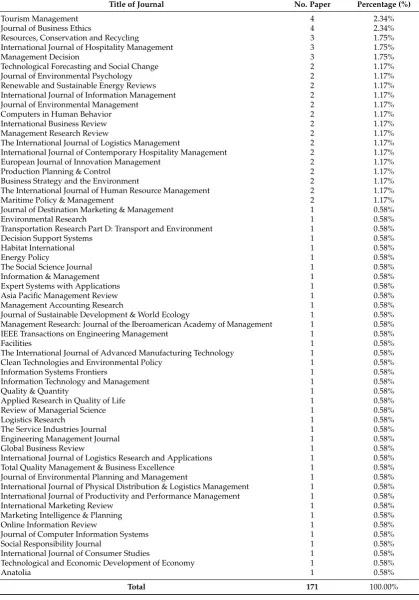
Table 2 presents the results of analyzing articles based on the title of the journals. The articles
related to environmental sustainability have been chosen from 69 different international scholarly
journals indexed in the Web of Science and Scopus databases. Selected published articles, along with
an extensive diversity of journals that focus on environmental sustainability, validate the willingness
of different scholarly journals to publish in this field. By far the highest ranking journal is the Journal
of Cleaner Production with 32 articles, followed by the International Journal of Production Research
with eight papers. Additionally, in other rankings, the Journal of Operations and Production
Management and Industrial Management and Data Systems had the third highest rank with seven
publications, followed by the journal of Transportation Research Part E: Logistics and Transportation
Review with six articles.
Table 2.
Breakdown of articles by journals.
Title of Journal
No. Paper
Percentage (%)
Journal of Cleaner Production
32
18.71%
International Journal of Production Research
8
4.68%
Journal of Operations & Production Management
7
4.09%
Industrial Management & Data Systems
7
4.09%
Transportation Research Part E: Logistics and Transportation Review
6
3.51%
Industrial Marketing Management
5
2.92%
Journal of Business Research
5
2.92%
International Journal of Production Economics
5
2.92%
Journal of Purchasing and Supply Management
5
2.92%
Supply Chain Management: An International Journal
5
2.92%
Tourism Management
4
2.34%
Journal of Business Ethics
4
2.34%
Resources, Conservation and Recycling
3
1.75%
International Journal of Hospitality Management
3
1.75%
Management Decision
3
1.75%
Technological Forecasting and Social Change
2
1.17%
Journal of Environmental Psychology
2
1.17%
Renewable and Sustainable Energy Reviews
2
1.17%
60%
40%
Frequency based on data collection method
Online survey
Offline survey
Figure 8.
Breakdown of articles based on data collection method.
11. Breakdown of Articles by Journals
Table
2
presents the results of analyzing articles based on the title of the journals. The articles
related to environmental sustainability have been chosen from 69 different international scholarly
journals indexed in the Web of Science and Scopus databases. Selected published articles, along with
an extensive diversity of journals that focus on environmental sustainability, validate the willingness of
different scholarly journals to publish in this field. By far the highest ranking journal is the Journal of
Cleaner Production with 32 articles, followed by the International Journal of Production Research with
eight papers. Additionally, in other rankings, the Journal of Operations and Production Management
and Industrial Management and Data Systems had the third highest rank with seven publications,
followed by the journal of Transportation Research Part E: Logistics and Transportation Review with
six articles.
Table 2.
Breakdown of articles by journals.
Title of Journal
No. Paper
Percentage (%)
Journal of Cleaner Production
32
18.71%
International Journal of Production Research
8
4.68%
Journal of Operations & Production Management
7
4.09%
Industrial Management & Data Systems
7
4.09%
Transportation Research Part E: Logistics and Transportation Review
6
3.51%
Industrial Marketing Management
5
2.92%
Journal of Business Research
5
2.92%
International Journal of Production Economics
5
2.92%
Journal of Purchasing and Supply Management
5
2.92%
Table 2.
Breakdown of articles by journals.
Title of Journal
No. Paper
Percentage (%)
Tourism Management
4
2.34%
Journal of Business Ethics
4
2.34%
Resources, Conservation and Recycling
3
1.75%
International Journal of Hospitality Management
3
1.75%
Management Decision
3
1.75%
Technological Forecasting and Social Change
2
1.17%
Journal of Environmental Psychology
2
1.17%
Renewable and Sustainable Energy Reviews
2
1.17%
International Journal of Information Management
2
1.17%
Journal of Environmental Management
2
1.17%
Computers in Human Behavior
2
1.17%
International Business Review
2
1.17%
Management Research Review
2
1.17%
The International Journal of Logistics Management
2
1.17%
International Journal of Contemporary Hospitality Management
2
1.17%
European Journal of Innovation Management
2
1.17%
Production Planning & Control
2
1.17%
Business Strategy and the Environment
2
1.17%
The International Journal of Human Resource Management
2
1.17%
Maritime Policy & Management
2
1.17%
Journal of Destination Marketing & Management
1
0.58%
Environmental Research
1
0.58%
Transportation Research Part D: Transport and Environment
1
0.58%
Decision Support Systems
1
0.58%
Habitat International
1
0.58%
Energy Policy
1
0.58%
The Social Science Journal
1
0.58%
Information & Management
1
0.58%
Expert Systems with Applications
1
0.58%
Asia Pacific Management Review
1
0.58%
Management Accounting Research
1
0.58%
Journal of Sustainable Development & World Ecology
1
0.58%
Management Research: Journal of the Iberoamerican Academy of Management
1
0.58%
IEEE Transactions on Engineering Management
1
0.58%
Facilities
1
0.58%
The International Journal of Advanced Manufacturing Technology
1
0.58%
Clean Technologies and Environmental Policy
1
0.58%
Information Systems Frontiers
1
0.58%
Information Technology and Management
1
0.58%
Quality & Quantity
1
0.58%
Applied Research in Quality of Life
1
0.58%
Review of Managerial Science
1
0.58%
Logistics Research
1
0.58%
The Service Industries Journal
1
0.58%
Engineering Management Journal
1
0.58%
Global Business Review
1
0.58%
International Journal of Logistics Research and Applications
1
0.58%
Total Quality Management & Business Excellence
1
0.58%
Journal of Environmental Planning and Management
1
0.58%
International Journal of Physical Distribution & Logistics Management
1
0.58%
International Journal of Productivity and Performance Management
1
0.58%
International Marketing Review
1
0.58%
Marketing Intelligence & Planning
1
0.58%
Online Information Review
1
0.58%
Journal of Computer Information Systems
1
0.58%
Social Responsibility Journal
1
0.58%
International Journal of Consumer Studies
1
0.58%
Technological and Economic Development of Economy
1
0.58%
Anatolia
1
0.58%
Total
171
100.00%
12. Breakdown of Articles by Year of Publication
In recent decades, application of SEM in environmental sustainability has increased dramatically
in the literature. A historical growth of environmental sustainability has existed for many years.
A frequency analysis of the 171 articles based on the articles published for different years is shown
in Figure
9. During 2010–2012, the articles published on the application of SEM in environmental
sustainability were at a steady rate with zero, three and 21 articles. An uptrend in output was observed
from the year 2012 until 2016. Figure
9
presents relevant information based on the frequency of
breakdown by the year of publication.
Sustainability
2017
,
9
, 1814
20 of 63
observed from the year 2012 until 2016. Figure 9presents relevant information based on the frequency
of breakdown by the year of publication.
Figure 9.
Breakdown of articles by year of publication.
Accordingly, it can be indicated that nowadays there are many researchers in the field of
environmental sustainability and it can be predicted that in coming years these numbers will increase.
13. Breakdown of Articles Based on Nationality of Authors
This review paper attempted to show the difference among countries related to environmental
sustainability. Two kinds of principles were used for identifying the characteristics in selected
articles, including the information gained directly from the papers or the nationality of the first
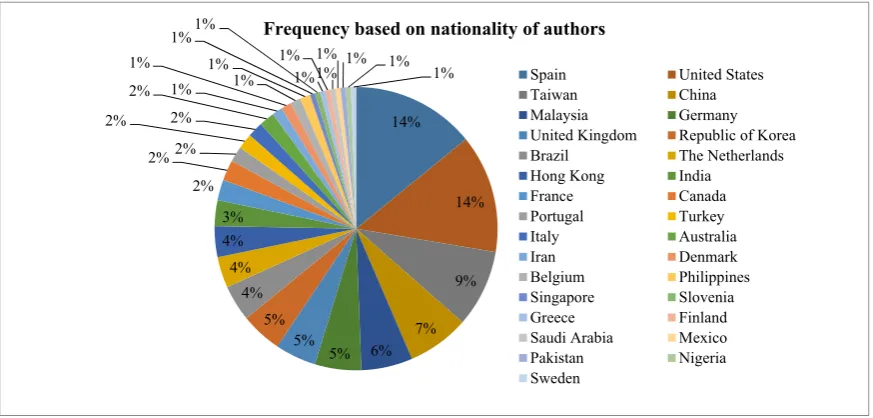
author. Figure 10 shows that authors from 31 nationalities and countries used SEM in environmental
sustainability.
Figure 10.
Breakdown of articles based on nationality of authors.
Most of the published papers were from Spain with 25 publications followed by United States,
Taiwan and China with 23, 15 and 12 publications, respectively. Figure 10 shows the breakdown of
articles based on the nationality of authors. The comparison of the results presented by Figure 10 is
interesting as we can see that some developing countries such as China and Malaysia are relatively
good at conducting research on environmental sustainability. However, we can find some research
in the literature that shows research into environmental sustainability being conducted separately for
0
20
40
60
80
100
120
140
160
180
2005
2006
2007
2008
2009
2010
2011
2012
2013
2014
2015
2016
Number of
Publications
Year of Publication
14%
14%
9%
7%
6%
5%
5%
5%
4%
4%
4%
3%
2%
2%
2%
2%
2%
2%
1%
1%
1%
1%
1%
1%
1%
1%
1%
1% 1% 1%
1%
Frequency based on nationality of authors
Spain
United States
Taiwan
China
Malaysia
Germany
United Kingdom
Republic of Korea
Brazil
The Netherlands
Hong Kong
India
France
Canada
Portugal
Turkey
Italy
Australia
Iran
Denmark
Belgium
Philippines
Singapore
Slovenia
Greece
Finland
Saudi Arabia
Mexico
Pakistan
Nigeria
Sweden
Figure 9.
Breakdown of articles by year of publication.
Accordingly, it can be indicated that nowadays there are many researchers in the field of
environmental sustainability and it can be predicted that in coming years these numbers will increase.
13. Breakdown of Articles Based on Nation